
AI in Steel Market Size, Share, Growth, Report 2026 to 2035
The AI in steel market report segmented By Component (Software, Hardware, Services), By Deployment Type (On-Premises, Cloud-Based, Hybrid), By Technology (Machine Learning (ML), Computer Vision, Natural Language Processing (NLP), Generative AI, Predictive Analytics, Robotics & Autonomous Systems, Others), By Application (Predictive Maintenance, Process Optimization & Production Control, Quality Inspection & Defect Detection, Energy Optimization & Sustainability Management, Supply Chain & Demand Forecasting, Safety Monitoring & Workforce Analytics, Autonomous Operations & Robotics, Others)-Global Industry Analysis, Size, Trends, Leading Companies, Regional Outlook, and Forecast 2026 to 2035
Content
What is the AI in Steel Market Size and Share?
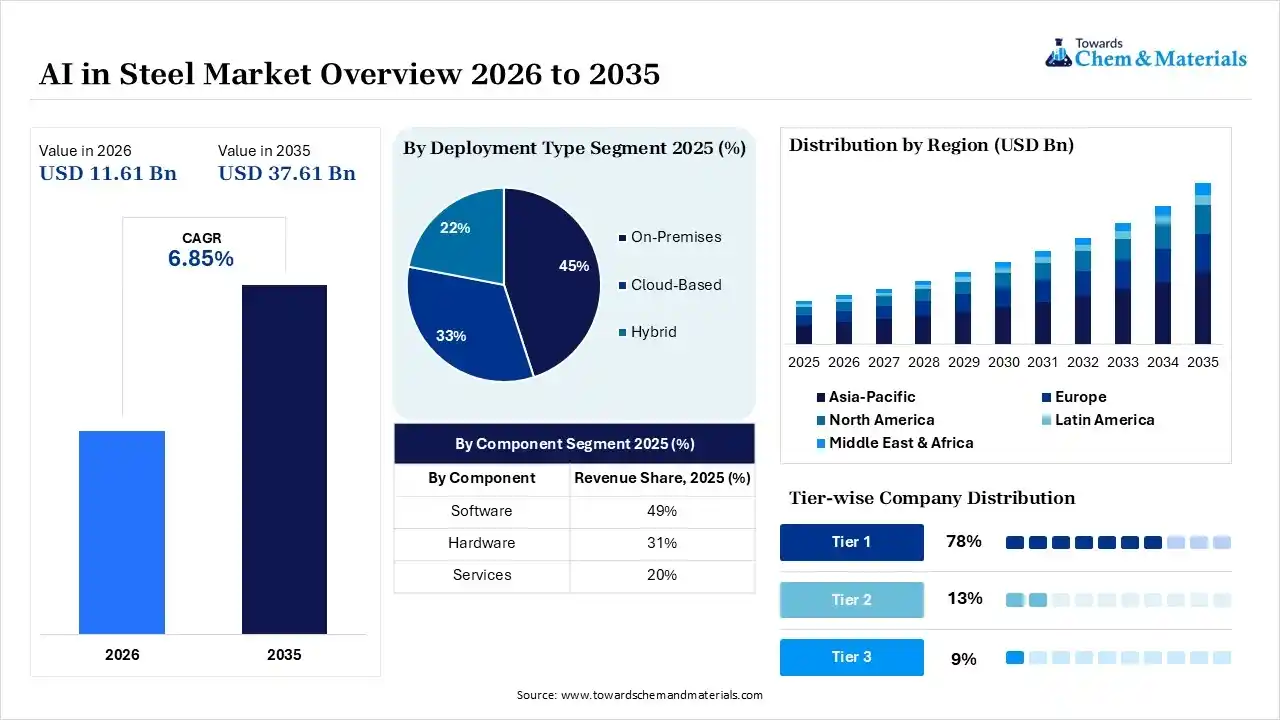
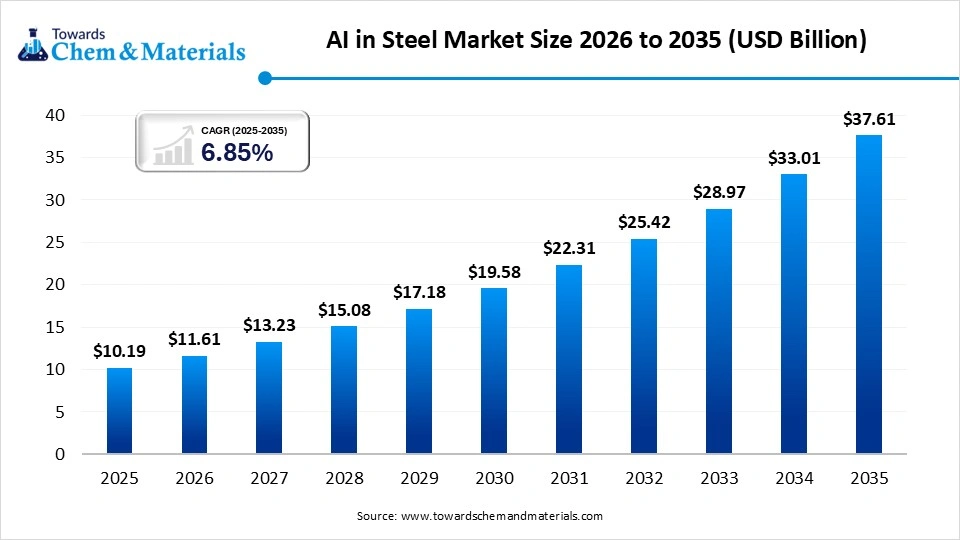
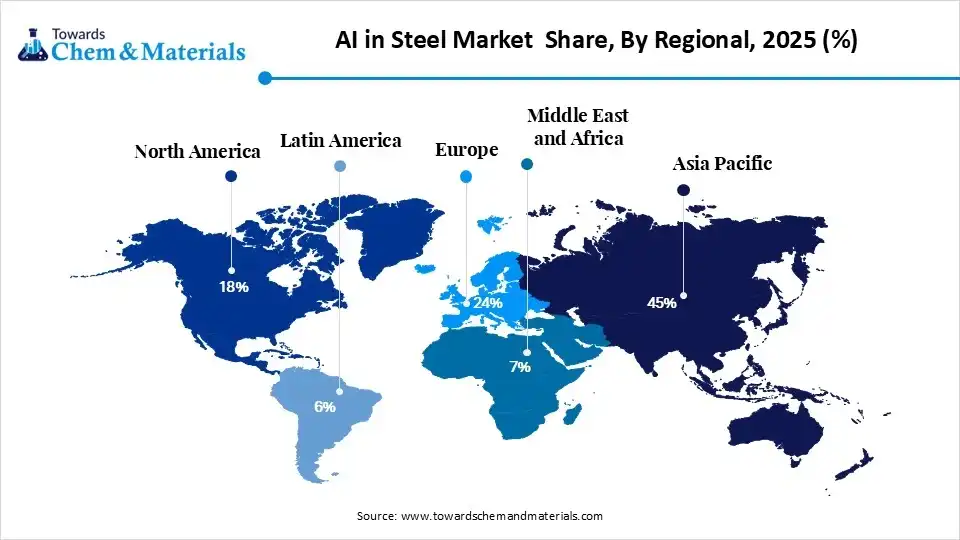
The AI in steel market size was valued at USD 10.19 billion in 2025, is estimated to reach USD 11.61 billion in 2026, and is projected to reach USD 37.61 billion by 2035, exhibiting a compound annual growth rate (CAGR) of 6.85% over the forecast period from 2026 to 2035.Asia Pacific dominated the AI in steel market with the largest revenue share of 45% in 2025 and is expected to grow at the fastest CAGR of 15.74% during the forecast period. The industry is changing its potential from manual to fully automated approaches while reducing load from humanized systems with greater precision. Also, the major manufacturers have been seen under the heavy investment and development of the collaboration with greater R&D research in the current period.
Market Highlights
- By region, Asia Pacific dominated the market with a share of 45% in 2025, due to the region having the world's largest steel production capacity and a strong manufacturing base.
- By region, the Middle East and Africa are notably growing with 7.0% market share in 2025 and are expected to be the fastest-growing region in the market, with a CAGR of 31.80% in the forecast period, owing to many countries investing in new industrial facilities and smart manufacturing projects.
- By component, the software segment dominated the market with 49% share in 2025, akin to software acting as the core system that collects, analyzes, and processes production data.
- By component, the services segment held the 20.0% market share in 2025 and is expected to be the fastest-growing in the market, with a CAGR of 31.20% in the forecast period, owing to more steel manufacturers seeking expert support for AI implementation and management.
- By deployment type, the on-premises segment dominated the market with 45% share in 2025, as these steel manufacturers often handle large amounts of sensitive operational and production data.
- By deployment type, the hybrid segment held the 22.0% market share in 2025 and is expected to be the fastest-growing in the market, with a CAGR of 33.10% in the forecast period, owing to its combination of the benefits of both on-premises and cloud-based systems.
- By technology, the machine learning (ML) segment dominated the market with 28% share in 2025, as it is highly used for analyzing production data & identifying patterns that increase operational performance.
- By technology, the generative AI segment held the 12% market share in 2025 and is expected to be the fastest-growing segment in the market, with a CAGR of 35.60% in the forecast period, due to it can help steel manufacturers create faster insights, automate reporting, and support production planning.
- By application, the predictive maintenance segment dominated the market with 24.0% share in 2025, owing to the preventing equipment failures is a major priority for steel manufacturers.
- By application, the energy optimization & sustainability management segment held the 12% market share in 2025 and is expected to be the fastest-growing segment in the market, with a CAGR of 34.20% in the forecast period, due to reducing energy costs and carbon emissions has become a major focus for steel manufacturers.
Quick Stats at a Glance
- Market in Size 2025: USD 10.19 Billion
- Market Estimated Size in 2026: USD 11.61 Billion
- Market Projected Size by 2035: USD 37.61 Billion
- Market CAGR (2026–2035): 6.85%
- Asia Pacific: largest Regional Market Revenue Share of 45% in 2025|USD 4.59 Billion
- Middle East and Africa: Fastest-growing Regional Market Revenue Share of 7% in 2025|USD 0.71 Billion
- By country: The China held the largest Market share of 51% in 2025
 Global shift towards automation and faster production needs has presented new business opportunities for the steel manufacturers these days. Moreover, the manufacturers are observed in heavy implementation of robotics, technologies which has data analytics, and compute visions while following the aim of minimum effort and cost with greater production as per the recent survey. Furthermore, by helping manufacturers to analyze large volumes of operational data and other heavy tasks, the AI is likely to become a major integral part of every production industry in the upcoming years.
- For instance, in February 2026, ArcelorMittal unveiled the greater platform, which represents the predictive maintenance technology deployed in some of their heavy steel production units, as per the published report. Also, the platform is called ArcelorMittal Sentinel Platform.(Source:oxmaint.com)
The growing focus on sustainability is also encouraging the adoption of AI in the steel industry. Steel producers are under pressure to reduce energy consumption, lower carbon emissions, and improve environmental performance. AI-powered systems help manufacturers optimize furnace operations, manage energy usage, and reduce material waste.
In recent years, advancements in industrial digitalization and smart factory development have further accelerated AI adoption across steel plants.
Global Investment Flow for AI in Steel 2026
- Investment is moving from traditional machinery toward intelligent production systems in recent years. Steel companies are increasingly funding AI platforms that can improve production decisions, monitor operations, and reduce manual intervention across manufacturing facilities.
- Energy-saving AI solutions are attracting significant investment in the current period. Also, the rising energy costs are encouraging steel producers to fund AI systems that optimize power consumption, improve furnace efficiency, and lower overall operating expenses.
- Emerging steel-producing countries are accelerating AI-related investments as per the recent survey. Also, the nations expanding their steel manufacturing capacity are incorporating AI technologies into new projects from the beginning, creating opportunities for faster and more efficient plant operations.
Market Trends
- The shift toward predictive maintenance has driven substantial financial gains in the manufacturing sector in recent years. Also, by actively monitoring machine performance and breakdowns, AI has been playing a major role in maintenance cycles, as per the recent survey taken by our industry experts.
- The growing demand for AI-based quality control and inspection increases the return on investment for manufacturers in the current period. Moreover, the manufacturers have been observed in heavy adoption of technologically advanced cameras, vision systems, and sensors, which support this trend nowadays.
- The energy optimization through artificial intelligence is likely to turn into a higher margin opportunity for manufacturers in the coming years. Furthermore, manufacturers are increasingly using AI with better data analytics, where energy conservation and its optimal usage are the major steps.
Report Scope
| Report Attributes | Details |
| Market Size in 2026 | USD 11.61 Billion |
| Revenue Forecast in 2035 | USD 37.61 Billion |
| Growth Rate | CAGR 6.85% |
| Base Year of Estimation | 2025 |
| Forecast Period | 2025 - 2035 |
| High Impact Region | Asia Pacific |
| Segment Covered | By Component, By Deployment Type, By Technology, By Application, By Region |
| Key Companies Profiled | ArcelorMittal, Tata Steel, Baosteel, JSW Steel, voestalpine, Nippon Steel, SSAB, Gerdau |
From Automation to Intelligent Manufacturing
In recent years, steel plants have relied mainly on fixed automation and manual monitoring processes. Moreover, today, AI combines machine learning, industrial sensors, cloud computing, and real-time data analytics to make production systems more intelligent and adaptive. In the current period, steel manufacturers are increasingly implementing digital twins, AI-driven process optimization, and automated decision-making platforms.
AI in Steel Market Regulatory Landscape: Regulations
| Country Region | Regulatory Body | Key Regulations | Focus Areas |
| United States | Occupational Safety and Health Administration (OSHA) | NIST AI Risk Management Framework (AI RMF 1.0): Governs industrial AI deployment. Section 3 outlines the Core Functions (Govern, Map, Measure, Manage) to mitigate operational failures in physical machinery | Lifecycle Workplace Safety & Hazard Monitoring: Tracking real-time safety via computer vision. For example, U.S. Steel leverages camera-based AI models to audit and enforce personal protective equipment (PPE) compliance in active environments. |
| Europe | European AI Office |
EU AI Act (Regulation (EU) 2024/1689):Article 6 & Annex III (High-Risk AI Systems): Classifies AI used as safety components in the operation and management of critical industrial infrastructure (such as automated blast furnaces and heavy casting lines) as High-Risk. | Quality Inspection: Minimizing product defects using high-precision AI vision. For instance, Austria's voestalpine deploys AI to spot micro-cracks in steel sheets, drastically improving structural compliance. |
| China | Ministry of Industry and Information Technology (MIIT) | MIIT Joint Industrial Digital Transformation Guidelines (September 2025 Directive) | AI+ Steel" Initiative (Phase I, 2025–2026) |
AI in Steel Market Dynamics
Driver
Real Time Intelligence for Steel Success
The growing need for efficient and cost-effective steel production is elevating earning potential for the producers in the current period. Also, steel manufacturers are facing pressure to increase output while controlling operational costs. AI helps companies improve production planning, reduce machine downtime, minimize material waste, and maintain product quality. In the current period, many steel plants are adopting AI solutions to make faster and smarter decisions using real-time data. Furthermore, rising competition in the steel industry is encouraging companies to modernize their operations.
Restraint
Cost Pressure Slow Digital Transformation
The high initial investment required for implementation is anticipated to hamper the industry's potential flow in the coming years. Also, installing AI systems often requires advanced software, digital infrastructure, sensors, and employee training programs. Many small and medium-sized steel manufacturers may find these costs difficult to manage. Furthermore, integrating AI into existing production systems can take time and require technical expertise.
Opportunity
Greener Steel Through Smart AI
The increasing focus on sustainable manufacturing is likely to support stronger cash flows for manufacturing enterprises during the forecast period. Also, the steel companies are actively looking for ways to reduce energy consumption, lower carbon emissions, and improve resource efficiency. AI is expected to help monitor production processes and identify areas where energy and raw materials can be used more effectively. In recent years, environmental regulations have become stricter, encouraging manufacturers to adopt smarter technologies. Moreover, the customers are increasingly demanding environmentally responsible products.
Segmental Insights
Component Insights
The software segment dominated the market with 49% share in 2025, akin to software acts as the core system that collects, analyzes, and processes production data. Steel manufacturers use AI software to monitor operations, improve quality control, optimize production schedules, and support decision-making. In the current period, companies are investing heavily in AI platforms because software can be integrated across multiple production processes. Furthermore, software solutions are easier to upgrade as technology advances. Since every AI application depends on software to function effectively, demand has remained strong.
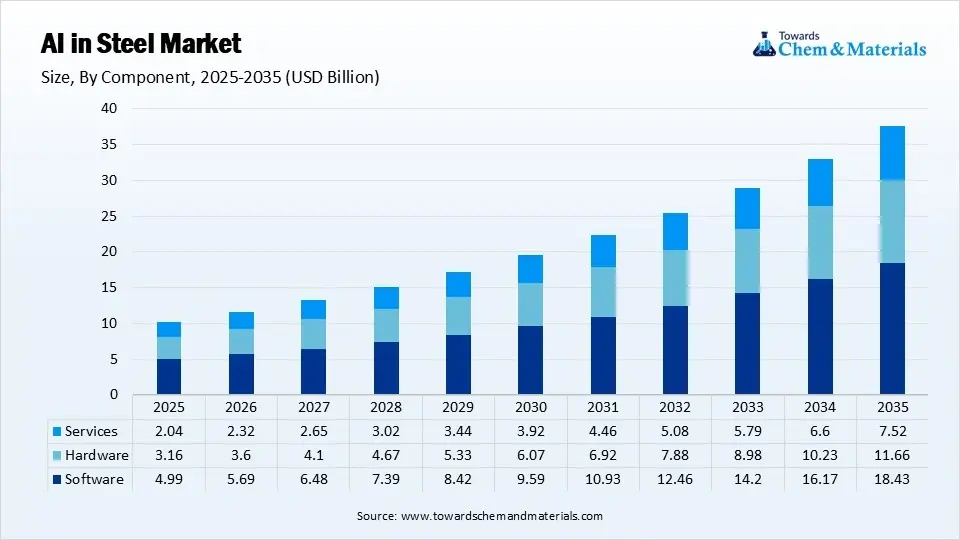 The services segment held the 20.0% market share in 2025 and is expected to be the fastest-growing in the market, with a CAGR of 31.20% in the forecast period, owing to more steel manufacturers seeking expert support for AI implementation and management. Many companies require assistance with installation, integration, maintenance, training, and system upgrades. As AI technologies become more advanced, businesses will increasingly depend on service providers to ensure smooth operations. Furthermore, continuous monitoring and optimization services help companies maximize the benefits of AI investments.
AI in Steel Market Share,By Component, 2025 (%)
| By Component | Revenue Share, 2025 (%) |
| Software | 49% |
| Hardware | 31% |
| Services | 20% |
Deployment Type Insights
The on-premises segment dominated the market with 45% share in 2025, as these steel manufacturers often handle large amounts of sensitive operational and production data. Keeping AI systems within company facilities provides greater control over data security and system performance. In the current period, many steel plants prefer on-premises deployment because it offers reliable operation even in locations with limited internet connectivity. The manufacturers can customize systems as per their specific production needs.
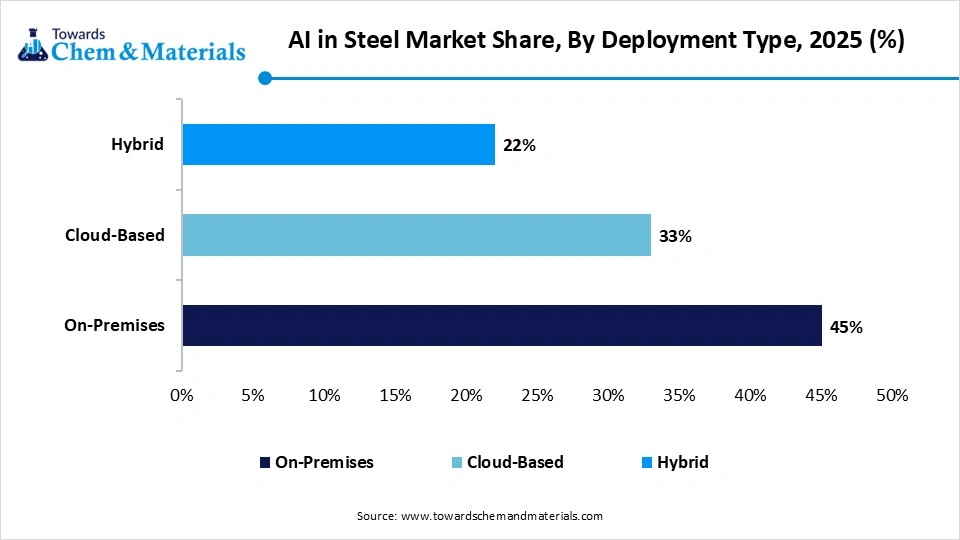
The hybrid segment held the 22.0% market share in 2025 and is expected to be the fastest-growing in the market, with a CAGR of 33.10% in the forecast period, owing to its combination of the benefits of both on-premises and cloud-based systems. Steel manufacturers can keep critical production data on-site while using cloud technologies for advanced analytics and remote monitoring. This approach offers superior scalability, flexibility, & cost efficiency. Furthermore, hybrid deployment allows companies to gradually adopt new AI technologies without completely replacing existing infrastructure. As digital transformation expands across the steel industry, businesses are increasingly looking for balanced solutions that offer security and operational flexibility.
AI in Steel Market Share,By Deployment Type, 2025 (%)
| By Deployment Type | Revenue Share, 2025 (%) |
| On-Premises | 45% |
| Cloud-Based | 33% |
| Hybrid | 22% |
Technology Insights
The machine learning (ML) segment dominated the market with 28% share in 2025, as it is widely used for analyzing production data and identifying patterns that improve operational performance. Moreover, the steel manufacturers use machine learning algorithms to predict equipment failures, optimize manufacturing processes, and improve product quality. In recent years, the availability of large industrial datasets has increased the effectiveness of machine learning applications. Furthermore, machine learning can continuously improve its performance as more data becomes available.
The generative AI segment held the 12% market share in 2025 and is expected to be the fastest-growing segment in the market, with a CAGR of 35.60% in the forecast period, due to it can help steel manufacturers create faster insights, automate reporting, and support production planning. Generative AI can analyze large amounts of information and provide recommendations in a simple and understandable format. Furthermore, it can assist engineers and plant managers by improving decision-making and reducing manual work. As companies seek higher productivity and smarter operations, demand for generative AI solutions is expected to rise significantly.
AI in Steel Market Share,By Technology, 2025 (%)
| By Technology | Revenue Share, 2025 (%) |
| Machine Learning (ML) | 28% |
| Computer Vision | 22% |
| Natural Language Processing (NLP) | 8% |
| Generative AI | 12% |
| Predictive Analytics | 18% |
| Robotics & Autonomous Systems | 9% |
| Others | 3% |
Application Insights
The predictive maintenance segment dominated the market with 24.0% share in 2025, owing to the preventing equipment failures is a major priority for steel manufacturers. AI-powered predictive maintenance systems monitor machine conditions and identify potential problems before breakdowns occur. This helps companies reduce costly downtime, improve equipment performance, and extend machine lifespan. In the current period, many steel plants are investing in predictive maintenance because it delivers clear financial and operational benefits.
The energy optimization & sustainability management segment held the 12% market share in 2025 and is expected to be the fastest-growing segment in the market, with a CAGR of 34.20% in the forecast period, due to reducing energy costs and carbon emissions has become a major focus for steel manufacturers. AI helps companies monitor energy consumption, identify inefficiencies, and optimize production processes. Furthermore, governments and environmental organizations are encouraging industries to adopt cleaner manufacturing practices. Steel producers are increasingly investing in technologies that support sustainability goals while maintaining profitability.
AI in Steel Market Share, By Application, 2025 (%)
| By Application | Revenue Share, 2025 (%) |
| Predictive Maintenance | 24% |
| Process Optimization & Production Control | 22% |
| Quality Inspection & Defect Detection | 18% |
| Energy Optimization & Sustainability Management | 12% |
| Supply Chain & Demand Forecasting | 9% |
| Safety Monitoring & Workforce Analytics | 7% |
| Autonomous Operations & Robotics | 5% |
| Others | 3% |
Regional Analysis
How will Asia Pacific Dominate AI in Steel Market in 2025?
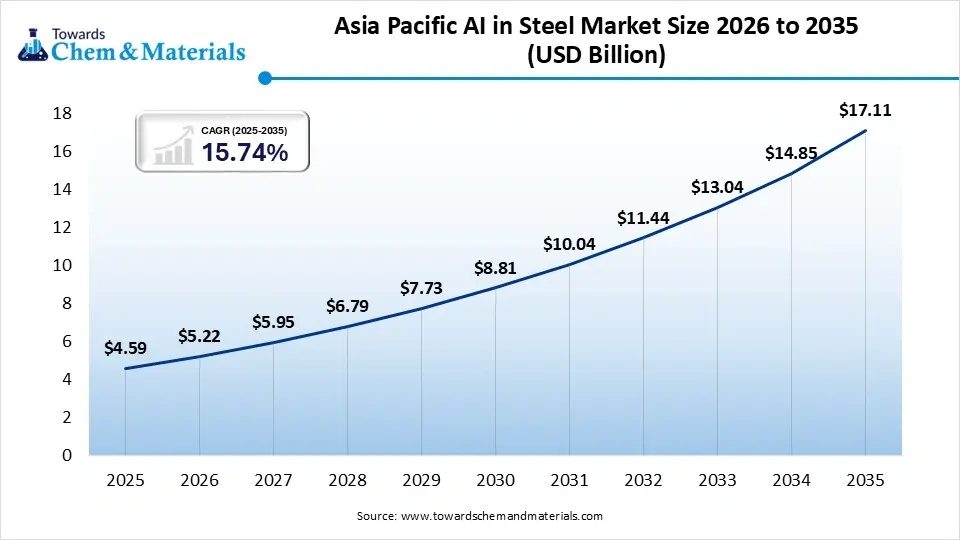
The Asia Pacific AI in steel market size was estimated at USD 4.59 billion in 2025 and is projected to reach USD 17.11 billion by 2035, growing at a CAGR of 15.74% from 2026 to 2035.Asia Pacific dominated the market with a share of 45% in 2025, due to the region having the world's largest steel production capacity and a strong manufacturing base. Countries across the region are investing in factory automation, digital technologies, and smart manufacturing systems to improve efficiency and product quality. In the current period, steel producers are increasingly adopting AI to reduce costs, optimize production, and strengthen global competitiveness. Furthermore, rising industrialization, infrastructure development, and government support for digital transformation are accelerating AI adoption.
 China
China
- The steel companies in China are implementing intelligent manufacturing systems that use AI for production monitoring, quality improvement, and operational optimization.
- The manufacturers in China have focused on improving efficiency while reducing environmental impact.
Japan
- The steel producers in Japan are utilizing AI for automated inspections, process control, and real-time production adjustments while they are supporting high-value steel products that require strict quality standards
- Labor shortages are encouraging manufacturers to increase automation and reduce dependence on manual processes in Japan.
AI in Steel Market Evaluation in the Middle East and Africa
The Middle East and Africa AI in steel market size was estimated at USD 0.71 billion in 2025 and is projected to reach USD 2.82 billion by 2035, growing at a CAGR of 7.57% from 2026 to 2035.The Middle East and Africa are notably growing with 7.0% market share in 2025 and are expected to be the fastest-growing region in the market, with a CAGR of 31.80% in the forecast period, owing to many countries investing in new industrial facilities and smart manufacturing projects. Governments are actively supporting economic diversification and industrial development beyond traditional sectors. Furthermore, new steel plants are being designed with advanced digital technologies from the beginning, creating favorable conditions for AI adoption. Rising infrastructure investments and industrial expansion are increasing the demand for efficient steel production.
Saudi Arabia
- The country is investing in modern industrial infrastructure and encouraging the adoption of digital technologies across manufacturing industries, while Steel producers are exploring AI solutions to improve operational efficiency.
- The developments are positioning Saudi Arabia as an important future market for AI applications in steel manufacturing.
UAE
- UAE is promoting smart industry development through strong investments in digital transformation and advanced technologies, as many industrial facilities are adopting data-driven systems to improve productivity.
- The manufacturers in the UAE have increasingly explored AI solutions that support automation, predictive analytics, and resource management in recent years.
Europe AI in Steel Industry Conditions
The Europe AI in steel market size was estimated at USD 2.45 billion in 2025 and is projected to reach USD 9.21 billion by 2035, growing at a CAGR of 14.16% from 2026 to 2035.Europe held the 24.00% market share in 2025, owing to manufacturers' focus on sustainability, energy efficiency, and advanced industrial technologies. Steel producers across the region are investing in AI solutions that improve production performance while helping achieve environmental goals. Furthermore, strict regulations regarding emissions and energy usage are encouraging the adoption of intelligent manufacturing systems. In the current period, companies are increasingly implementing AI to optimize operations, reduce waste, and improve resource utilization.
Germany
- The manufacturers are focusing on intelligent production systems that enhance product quality and reduce energy consumption, while strong engineering expertise supports the development and adoption of advanced industrial technologies.
- The advantage of advanced technology is helping steel producers remain competitive while accelerating the transition toward smarter and more sustainable production operations in the current period.
Italy
- The country is focusing on improving manufacturing efficiency and competitiveness through increased digitalization of industrial operations, and producers are adopting AI technologies to optimize production processes.
- The companies have shown growing interest in smart manufacturing solutions that help reduce operational costs and improve flexibility.
North America AI in the Steel Sector Observation
The North America AI in steel market size was estimated at USD 1.83 billion in 2025 and is projected to reach USD 6.96 billion by 2035, growing at a CAGR of 14.29% from 2026 to 2035.North America held the 18% market share in 2025, akin to the region has strong technology capabilities, advanced industrial infrastructure, and high investment in digital transformation. Steel manufacturers are increasingly adopting AI to improve efficiency, reduce costs, and strengthen competitiveness. Furthermore, the presence of leading AI developers and industrial technology providers supports rapid innovation. Companies are also focusing on sustainability, energy optimization, and smart factory development.
 United States
- The country is actively expanding the use of AI in steel manufacturing through investments in smart factories, industrial automation, and data-driven operations.
- The collaboration between technology providers and industrial companies is accelerating innovation across the sector.
Canada
- There has been growing interest in technologies that help reduce environmental impact while maintaining productivity, while the strong focus on innovation and clean industrial development is encouraging the use of advanced digital solutions.
- AI is supporting improved decision-making, better equipment management, and greater production visibility according to regional manufacturers.
AI in Steel Market Survey in Latin America
The Latin America AI in steel market size was estimated at USD 0.61 billion in 2025 and is projected to reach USD 2.44 billion by 2035, growing at a CAGR of 14.87% from 2026 to 2035.Latin America held the 6.00% market share in 2025 due to manufacturers are increasingly modernizing production facilities and investment in digital technologies. Steel companies are seeking solutions that improve efficiency, reduce operational costs, and enhance product quality. Furthermore, industrial development and infrastructure projects are creating higher demand for steel products across the region. In the current period, growing awareness of smart manufacturing benefits is encouraging companies to adopt AI-powered systems.
Brazil
- The increasing demand from construction, automotive, and industrial sectors is encouraging manufacturers to improve production capabilities, while AI is helping companies gain better visibility into manufacturing operations.
The manufacturers are exploring AI technologies that help improve productivity, equipment performance, and quality control.
Argentina
- The companies continue investing in operational improvements and technology upgrades, and AI adoption is expected to expand steadily across Argentina's steel manufacturing industry.
- The modernization efforts within industrial sectors are creating opportunities for advanced technologies in Argentina nowadays.
Competitive Analysis
The industry is fast changing its perspectives as steel manufacturers are adopting artificial intelligence to improve production efficiency, reduce energy consumption, enhance product quality, and support sustainability goals. AI is becoming an important part of modern steelmaking operations.
- Tata Steel is actively using AI across its steel plants to improve product quality, reduce energy usage, and predict equipment failures before they occur. The company is also expanding AI-driven automation to make manufacturing faster and more efficient.
- ArcelorMittal is using AI to optimize production processes, monitor plant performance, and improve predictive maintenance. These solutions help increase productivity, reduce downtime, and strengthen operational efficiency across its facilities.(Source:www.tatasteel.com),(Source:oxmaint.com)
Competitive Landscape Analysis
Tier 1 Companies
| Rank | Company Name | Headquarters | Country | Why Relevant to This Market | Key Products / Material Portfolio |
|---|---|---|---|---|---|
| 1 | ArcelorMittal | Luxembourg City | Luxembourg | World's largest steel producer with extensive AI deployment for digital twins, quality prediction, logistics optimization, and smart steelmaking initiatives | Flat steel, long steel, automotive steel, AI-enabled manufacturing systems |
| 2 | Tata Steel Limited | Mumbai, Maharashtra | India | Global leader in AI-driven steel manufacturing with hundreds of deployed AI models and autonomous operations programs | Carbon steel, specialty steel, AI-powered steel production platforms |
| 3 | POSCO Holdings Inc. | Pohang, North Gyeongsang | South Korea | Operates one of the world's most advanced smart steel mills utilizing AI-based furnace control and plant optimization | Hot rolled steel, electrical steel, automotive steel, smart mill solutions |
| 4 | Nippon Steel Corporation | Tokyo | Japan | Major adopter of AI for precision manufacturing, defect detection, process optimization, and energy efficiency improvements | High-grade steel, automotive steel, electrical steel, advanced steel products |
| 5 | ABB Ltd. | Zurich | Switzerland | Leading industrial AI, automation, and digitalization provider serving steel plants worldwide with AI-enabled process optimization software | Industrial AI platforms, automation systems, digital twins, process control solutions |
Tier 2 Companies
| Rank | Company Name | Headquarters | Country | Why Relevant to This Market | Key Products / Material Portfolio |
|---|---|---|---|---|---|
| 1 | JSW Steel Limited | Mumbai, Maharashtra | India | Actively investing in AI, digital transformation, predictive maintenance, and smart manufacturing initiatives | Flat steel, long steel, coated steel products |
| 2 | United States Steel Corporation | Pittsburgh, Pennsylvania | USA | Uses AI-driven analytics, procurement intelligence, production optimization, and operational automation | Flat-rolled steel, tubular products, electrical steel |
| 3 | voestalpine AG | Linz, Upper Austria | Austria | Strong adoption of AI-driven quality control and advanced manufacturing technologies | High-performance steel, rail systems, specialty steel |
| 4 | SMS Group GmbH | Düsseldorf, North Rhine-Westphalia | Germany | Major supplier of AI-enabled steel plant technologies, digital twins, and autonomous process optimization solutions | Smart mill technologies, digital metallurgy platforms, automation software |
| 5 | Google Cloud | Mountain View, California | USA | Significant AI technology provider to steel manufacturers including Tata Steel's large-scale AI agent deployment program | AI platforms, cloud AI infrastructure, industrial analytics |
Tier 3 Companies
| Rank | Company Name | Headquarters | Country | Why Relevant to This Market | Key Products / Material Portfolio |
|---|---|---|---|---|---|
| 1 | Ripik.AI | New Delhi | India | Specialized industrial AI company focused on steel process optimization, computer vision, and manufacturing intelligence | Vision AI, predictive analytics, production optimization software |
| 2 | Tata Elxsi Limited | Bengaluru, Karnataka | India | Provides AI-driven automation and Industry 4.0 solutions for steel manufacturing facilities | Industrial AI, digital factory solutions, smart manufacturing platforms |
| 3 | Huawei Technologies Co., Ltd. | Shenzhen, Guangdong | China | Active participant in AI-enabled steel industry modernization and smart manufacturing initiatives | Industrial AI platforms, cloud infrastructure, smart manufacturing systems |
| 4 | KAI Software Solutions LLC (Kaispe) | Atlanta, Georgia | USA | Focused on AI-powered steel supply chain optimization, inventory management, and logistics intelligence | Supply chain AI, forecasting software, logistics optimization tools |
| 5 | AI Steel Solution Inc. | Wilmington, Delaware | USA | Emerging AI specialist focused exclusively on steel-sector forecasting, analytics, and optimization technologies | Steel forecasting algorithms, AI analytics, decision-support software |
Recent Development
- In April 2026, Tata Steel created a strategic collaboration with Google Cloud. Also, the main purpose of the partnership is to deploy advanced AI agents in their global chain as per the published report. Furthermore, the company has already deployed 300 AI agents with their ongoing global operations as per the survey.(Source:tatasteel.com)
Top Vendors in the AI in Steel Market & Their Offerings
- ArcelorMittal: This global steel giant uses AI to improve safety, quality, and environmental impact. The company deploys smart computer vision systems to monitor hot steel mills and track defects in real time. They also use advanced machine learning algorithms to optimize energy consumption and speed up the development of low-carbon green steel.
- Tata Steel: A pioneer in digital manufacturing, Tata Steel integrates AI across its global plants. They use predictive maintenance models to stop machinery failures before they happen, saving massive repair costs. AI also automates complex furnace operations, ensuring high product consistency, reduced fuel emissions, and safer working conditions for shop-floor employees.
- Baosteel: As China's leading steelmaker, Baosteel actively builds highly automated, smart factories. The company utilizes specialized blast furnace AI models & heavy robotics to operate casting and rolling lines with minimum human interference. This advanced automation maximizes raw energy efficiency, minimizes carbon emissions, and ensures high-volume production accuracy.
Other Key Players
- JSW Steel
- voestalpine
- Nippon Steel
- SSAB
- Gerdau
Segments Covered in the Report
By Component
- Software
- AI Platforms
- Analytics Software
- Digital Twin Software
- Process Control Software
- Quality Management Software
- Hardware
- Industrial Sensors
- Edge AI Devices
- Smart Cameras
- Industrial Servers
- Robotics Hardware
- Services
- Consulting
- Integration & Deployment
- Training & Support
- Managed Services
By Deployment Type
- On-Premises
- Private Data Centers
- Plant-Level Deployments
- Cloud-Based
- Public Cloud
- Private Cloud
- Multi-Cloud
- Hybrid
- Edge-to-Cloud Integration
- Distributed AI Architecture
By Technology
- Machine Learning (ML)
- Supervised Learning
- Unsupervised Learning
- Reinforcement Learning
- Computer Vision
- Surface Inspection
- Defect Detection
- Video Analytics
- Natural Language Processing (NLP)
- Knowledge Management
- Document Intelligence
- Operational Assistance
- Generative AI
- Process Simulation
- Digital Assistants
- Engineering Design Support
- Predictive Analytics
- Equipment Health Prediction
- Demand Prediction
- Production Forecasting
- Robotics & Autonomous Systems
- Autonomous Material Handling
- Automated Inspection Robots
- Intelligent Process Robots
- Others
- Expert Systems
- Fuzzy Logic
- Cognitive Automation
By Application
- Predictive Maintenance
- Asset Monitoring
- Failure Prediction
- Maintenance Scheduling
- Process Optimization & Production Control
- Blast Furnace Optimization
- Rolling Mill Optimization
- Yield Improvement
- Quality Inspection & Defect Detection
- Surface Quality Inspection
- Product Consistency Monitoring
- Automated Defect Recognition
- Energy Optimization & Sustainability Management
- Energy Consumption Monitoring
- Carbon Emission Management
- Resource Optimization
- Supply Chain & Demand Forecasting
- Inventory Optimization
- Procurement Planning
- Demand Forecasting
- Safety Monitoring & Workforce Analytics
- Worker Safety Monitoring
- Compliance Analytics
- Workforce Productivity Analytics
- Autonomous Operations & Robotics
- Autonomous Vehicles
- Automated Material Movement
- Robotic Process Operations
- Others
- R&D Optimization
- Environmental Monitoring
By Region
- North America
- U.S.
- Canada
- Europe
- Germany
- UK
- France
- Italy
- Spain
- Sweden
- Denmark
- Norway
- Asia Pacific
- China
- Japan
- India
- South Korea
- Thailand
- Latin America
- Brazil
- Mexico
- Argentina
- Middle East and Africa (MEA)
- South Africa
- UAE
- Saudi Arabia
- Kuwait
FAQ'
Question 1 : What are the main uses and advantages of AI in the steel industry?
Answer : AI is primarily used for predictive maintenance, real-time quality defect detection through computer vision, blast furnace energy optimization, and automated supply chain tracking. The main advantages include a drastic reduction in unplanned machine downtime, lowered fuel emissions, eliminated material waste, and vastly improved workplace safety.
Question 2 : Who are the top key players in the AI in steel market?
Answer : The top key industrial players include ArcelorMittal, Tata Steel Limited, POSCO Holdings, Nippon Steel Corporation, and JSW Steel. Major technology and automation enablers driving the market include ABB Ltd., SMS Group, Google Cloud, and specialized firms like Ripik.AI.
Question 3 : What is the projected market value of AI in steel by 2035?
Answer : The global market value of AI in the steel industry is projected to reach USD 37.61 billion by 2035, climbing steadily from USD 11.61 billion in 2026.
Question 4 : Why are steel manufacturers turning to hybrid cloud deployments?
Answer : The hybrid deployment segment is growing the fastest at a 33.10% CAGR because it offers the perfect balance for industrial operations. Steelmakers can keep sensitive core production data locally on-site for immediate, zero-latency edge calculations while securely pushing non-sensitive data to the cloud for heavy analytics.
Question 5 : How does artificial intelligence help steel companies achieve sustainability goals?
Answer : AI acts as a core driver for green steel initiatives by continuously tracking and optimizing the combustion metrics inside multi-story blast furnaces. This micro-level energy management slashes excessive power consumption, reduces raw material waste, and minimizes the overall carbon footprint of the plant.
Meet the Team

Saurabh Bidwai
Principal Consultant
Saurabh Bidwai, a B.Tech Chemical Engineering graduate with 4+ years of experience, specializes in specialty chemicals, commodity chemicals, and engineered materials, offering valuable insights into market trends and emerging opportunities.

Aditi Shivarkar
Reviewed By
Aditi Shivarkar, with 14+ years in Chemical and Materials market research, specializes in Chemical and Materials. She ensures accurate, actionable insights, driving Towards Chemicals And Materials Analytics and Consulting excellence in industry trends and sustainability.