
Core Materials Market Size, Share, Growth, Report 2026 to 2035
The global core materials market report segmented By Material Type (Foam Core, Honeycomb Core, Balsa Core, Others), By End-Use Industry (Wind Energy, Aerospace & Defense, Marine, Transportation, Construction, Consumer Goods), By Manufacturing Process (Continuous Lamination, Vacuum Infusion, Compression Molding, Resin Transfer Molding (RTM), Prepreg Processing, Others), By Density (Low Density (<80 kg/m³), Medium Density (80–150 kg/m³), High Density (>150 kg/m³)), By Sales Channel (Direct Sales, OEM Contracts, Distributors & Traders, Online Procurement Platforms)- Global Industry Analysis, Size, Trends, Leading Companies, Regional Outlook, and Forecast 2026 to 2035
Content
What are the Core Materials Market Size and Share?
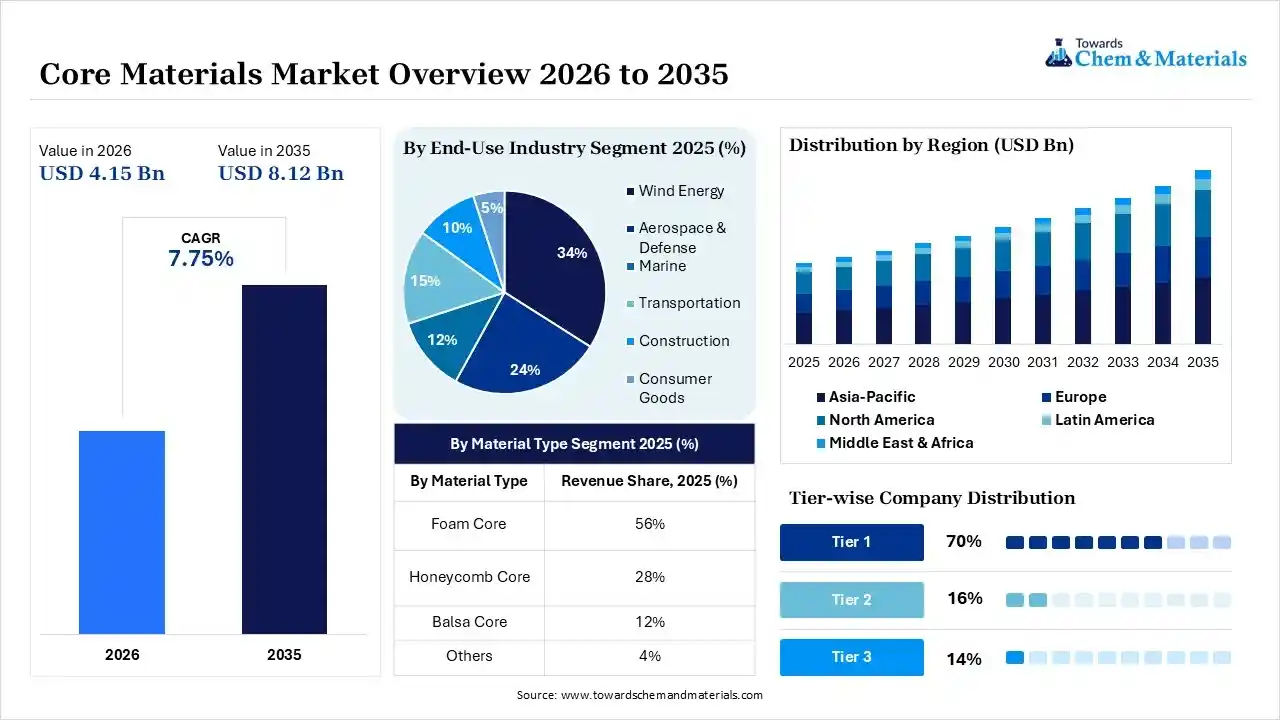
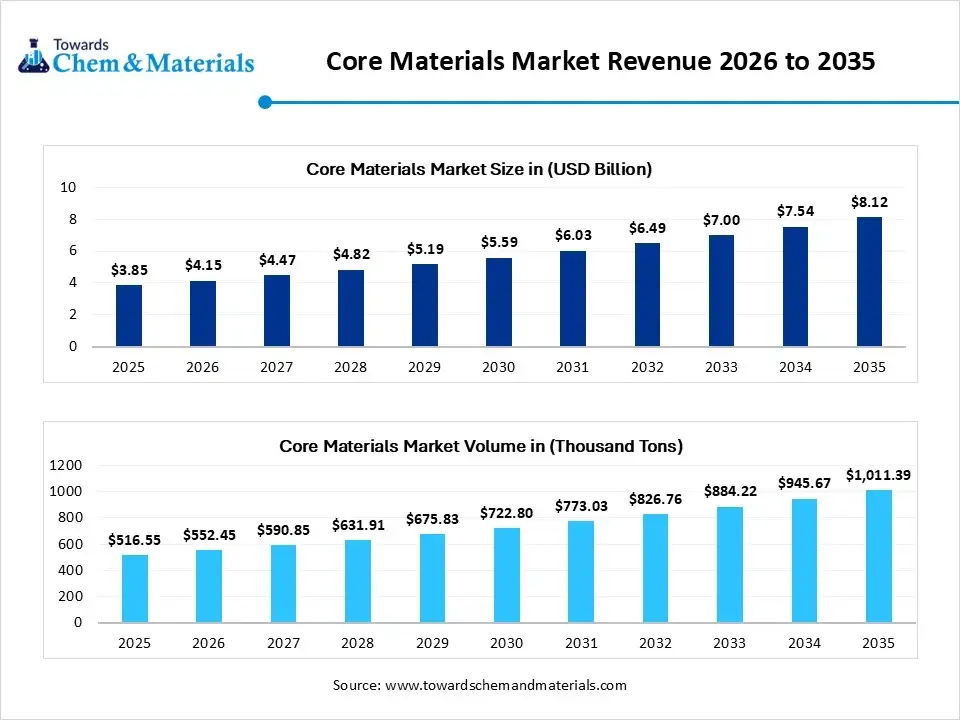
The global core materials market size was valued at USD 3.85 billion in 2025, is estimated to reach USD 4.15 billion in 2026, and is projected to reach USD 8.12 billion by 2035, exhibiting a compound annual growth rate (CAGR) of 7.75% over the forecast period from 2026 to 2035. Asia Pacific dominated the core materials market with the largest revenue share of 39% in 2025 and is expected to grow at the fastest CAGR of 7.90% during the forecast period. In terms of volume, the xxx market is projected to grow from 516.55 thousand tons in 2025 to 1,011.39 thousand tons by 2035. growing at a CAGR of 6.95% from 2026 to 2035. The market is growing quickly. The main driver is the need for lightweight, strong, and durable materials in wind energy, aerospace, and transportation. Companies like Evonik Industries, Hexcel Corporation, Gurit, and investments by the government for end-use industries and innovation by the manufacturers increase the growth of the market, according to the latest reports.
Market Highlights
- By region, Asia Pacific dominated the market with a share of 39% in 2025. Wind energy expansion remains strong.
- By region, North America held 27% market share in 2025 and is expected to experience the fastest growth with a CAGR of 8.90% in the forecast period. Advanced composite manufacturing supports demand.
- By material type, the foam core segment dominated the market with 56% share in 2025. Widely used in wind energy and transportation.
- By material type, the honeycomb core segment held 28% market share in 2025 and is expected to have the fastest growth with a CAGR of 8.80% in the forecast period. High stiffness and low weight improve performance.
- By end-use industry, the wind energy segment dominated the market with 34% share in 2025. Renewable energy investments continue globally.
- By end-use industry, the aerospace & defence segment held 24% market share in 2025 and is expected to have the fastest growth with a CAGR of 9.20% in the forecast period. Rising aircraft production boosts consumption.
- By manufacturing process, the continuous lamination segment dominated the market with 26% share in 2025. Reduces production costs significantly.
- By manufacturing process, the prepreg processing segment held 12% market share in 2025 and is expected to have the fastest growth with a CAGR of 8.90% in the forecast period. Aircraft manufacturers require precision composites.
- By density, the medium density (80–150 kg/m³) segment dominated the market with 46% share in 2025. Balances strength and weight effectively.
- By density, the low-density (<80 kg/m³) segment held 38% market share in 2025 and is expected to have the fastest growth with a CAGR of 8.4% in the forecast period. Lightweight designs dominate end-use markets.
- By sales channel, the direct sales segment dominated the market with 42% share in 2025. Large manufacturers prefer direct procurement.
- By sales channel, the OEM contracts segment held 31% market share in 2025 and is expected to have the fastest growth with a CAGR of 8.50% in the forecast period. Aerospace and wind OEMs secure dedicated supply.
Quick Stats at a Glance
- Market in Size 2025: USD 1.50 Billion | CAGR (2026–2035): 7.75%
- Market Estimated Size in 2026: USD 1.62 Billion
- Market Projected Size by 2035: USD 3.21 Billion
- Asia Pacific: largest Regional Market Revenue Share of 39% in 2025 | USD 1.50 Billion
- North America: Fastest-growing Regional Market Revenue Share of 27% in 2025 | USD 1.04 Billion
- By country: The China held the largest Market share of 48% in 2025
- Market Volume in 2025: 516.55 Thousand Tons | Volume CAGR (2026–2035): 6.95%
- Market Estimated Volume in 2026: 552.45 Thousand Tons
- Market Projected Volume by 2035: 1,011.39 Thousand Tons
- Market Pricing (2025):
- Average Manufacturing Price: USD 4,860/Ton
- Average Selling Price: USD 6,350/Ton
- Pricing CAGR (2026–2035): 2.85%
The core materials market is essential because it produces lightweight, strong, and durable materials like foams, honeycombs, and balsa wood used in sandwich composites. These materials significantly reduce the weight of end products, which improves fuel efficiency in transportation, lowers carbon emissions, and maximizes renewable energy production. Replacing solid, heavy materials with core materials lowers the total weight of structures. This allows cars, airplanes, and boats to use less energy to move.
Core materials are used to manufacture long, stiff, and lightweight wind turbine blades. This allows wind turbines to capture more wind and produce more electricity efficiently. Despite being very light, core materials maintain excellent strength and stiffness. This ensures safety and durability in demanding fields like aerospace and defense.
- For instance, Evonik ROHACELL offers specialized PMI and PET foams used to manufacture high-performance components for aircraft and wind turbines. Its structural foam provides the aerospace, automotive, medical technology, and other industries with extensive options for lightweight construction using high-performance composite materials.(Source: performance-foams.evonik.com)
The shift toward electric vehicles (EVs) relies heavily on core materials to lighten car bodies, which directly extends battery life and driving range. These factors and end-use industry demand fuel the growth and expansion of the market.
Global Investment Flow for Core Materials Market 2026
In 2026, major companies and governments are pouring hundreds of billions into core materials manufacturing. This includes huge investments in semiconductors, green energy metals, and battery recycling. Governments aim to stop relying on a single foreign country for vital supplies.Global tech giants and foundries like Intel, AMD, and Samsung are building massive, next-generation fabrication facilities to support AI and high-performance computing.
The US and India formalized an agreement by signing a bilateral Critical Minerals Framework, marking a milestone in the strategic partnership to secure and diversify global supply chains for essential rare earth elements and strategic materials. Washington has pledged over $30 billion in financial support alongside private sector investments to advance these shared strategic priorities.(Source: in.usembassy.gov)https://in.usembassy.gov/united-states-and-india-sign-strategic-critical-minerals-cooperation-framework/
- In India, a ₹ 7,280 crore scheme was approved to create specialized Rare Earth Corridors in coastal states like Odisha, Kerala, Andhra Pradesh, and Tamil Nadu to promote mining.(Source: www.pib.gov.in)
Growth Trends:
- Focus on Sustainability: Companies are shifting toward recyclable and eco-friendly core materials. PET foams and recycled cores are gaining market share because they are easier to recycle compared to traditional PVC foams.
- Wind Energy Expansion: Larger onshore and offshore wind turbines demand lighter, stiffer blades. Manufacturers use core materials like foam, honeycomb, and balsa to make these massive blades both strong and lightweight.
- Aerospace and Defense: Next-generation aircraft and defense programs rely on advanced honeycomb and high-heat cores to improve fuel efficiency and structural performance.
Report Scope
| Report Attributes | Details |
| Market Size and Volume in 2026 | USD 4.15 Billion / 552.45 Million Tons |
| Revenue Forecast in 2035 | USD 8.12 Billion / 1,011.39 Million Tons |
| Growth Rate | CAGR 7.75% |
| Base Year of Estimation | 2025 |
| Forecast Period | 2025 - 2035 |
| High Impact Region | Asia Pacific |
| Segment Covered | By Material Type, By End-Use Industry, By Manufacturing Process, By Density, By Sales Channel, By Regions |
| Key Companies Profiled | Evonik Industries AG (Germany), The Gill Corporation (United States), Euro-Composites S.A. (Luxembourg), Plascore, Inc. (United States), Changzhou Tiansheng New Materials Co., Ltd. (China), Toray Industries, Inc. (Japan), Owens Corning (United States), Solvay S.A. (Belgium), BASF SE (Germany), CoreLite Inc. (United States), SGL Carbon SE (Germany), Huntsman Corporation (United States), Showa Aircraft Industry Co., Ltd. (Japan), Carbon-Core Corp. (United States), Saertex GmbH & Co. KG (Germany) |
Core Materials Market: Technological Shifts Through the Integration of AI
AI integration is revolutionizing the core materials market. It accelerates the discovery of new materials from decades to days and drastically cuts R&D costs. Major shifts include accelerated property predictions, robotic lab automation, and a strong focus on building sustainable materials. Research is moving toward automated testing environments. AI systems predict material properties, direct robots to synthesize the materials, and automatically analyze the results to refine the next experiment.
Core Materials Regulatory Landscape
| Country / Region | Regulatory Body | Key Regulations | Focus Areas | Notable Notes |
| United States | Federal Aviation Administration; Environmental Protection Agency | FAA Material Certification Standards; Toxic Substances Control Act | Lightweight composites, aerospace materials | The U.S. promotes advanced core materials for aerospace, wind energy, marine, and construction applications. |
| European Union | European Chemicals Agency; European Commission | REACH Regulation; European Green Deal | Sustainable composites, lightweight structures | Europe emphasizes recyclable and high-performance core materials to support decarbonization and energy efficiency goals. |
| China | Ministry of Industry and Information Technology; Ministry of Ecology and Environment | Environmental Protection Law; Advanced Materials Development Policies | Composite manufacturing, renewable energy | China is expanding production of core materials for wind turbine blades, transportation, and industrial applications. |
| India | Ministry of Heavy Industries; Bureau of Indian Standards | National Composite Policy Initiatives; BIS Material Standards | Infrastructure, transportation, and renewable energy | India is increasing the adoption of core materials in wind energy, railways, and construction sectors. |
| Germany | Federal Ministry for Economic Affairs and Energy; German Institute for Standardization | REACH Compliance; Composite Material Standards | Wind energy, automotive lightweighting | Germany leads innovation in composite core materials for renewable energy and advanced manufacturing applications. |
Supply Chain Analysis of Core Materials Market
- Core Material Production & Processing:Core materials are produced from foam, balsa wood, and honeycomb structures through specialized manufacturing processes to provide lightweight, high-strength, and stiffness-enhancing properties in composite structures used across various industries.
- DIAB Group specializes in high-performance foam core materials used in wind energy, marine, aerospace, and transportation applications. The company is known for its PVC, PET, and SAN foam cores that improve strength, durability, and weight reduction in composite structures.
- Key players: 3A Composites, Gurit, DIAB Group, Hexcel Corporation
- Quality Testing and Certification:Core materials must comply with standards for compressive strength, shear strength, fire resistance, fatigue performance, and structural integrity before use in composite applications.
- Hexcel Corporation develops aerospace-grade honeycomb core materials that meet stringent aviation certification requirements. Its products are widely used in commercial aircraft interiors, structural panels, and defense applications.
- Key players: International Organization for Standardization, ASTM International, Federal Aviation Administration, European Union Aviation Safety Agency
- Distribution to Industrial Users:Core materials are supplied to wind energy manufacturers, aerospace companies, marine vessel producers, automotive manufacturers, and construction industries for lightweight composite structures.
Gurit supplies structural core materials, composite tooling solutions, and engineering services to the wind energy, marine, and industrial sectors. The company plays a key role in enabling lightweight and high-strength composite component manufacturing.
- Key players: 3A Composites, Gurit, DIAB Group.
Core Materials Market Dynamics
| Drivers | Restrains | Opportunities |
| Marine & Construction Needs:Lightweight, durable cores are in high demand to build faster boats and modern infrastructure that requires less maintenance. | High Production and Raw Material Costs:Advanced honeycomb cores and high-performance foams require expensive, highly precise manufacturing processes | Recyclable PET Foam Cores:Stricter rules on the environment and a push for green materials are boosting the demand for Polyethylene Terephthalate (PET) foams. Manufacturers are shifting to these because they are eco-friendly. |
| Focus on Sustainability:Manufacturers are adopting eco-friendly, recyclable PET foam cores to meet strict green manufacturing goals. | Difficulty in Recycling and Reusing:Separating the core from the outer skin for recycling is highly difficult and expensive. | Electric Vehicles (EVs) and Aerospace:Lighter vehicles and aircraft mean better fuel efficiency. Automakers and aerospace companies are using more structural foams and honeycomb cores to reduce weight. |
| Aerospace Modernization:Modern aircraft use advanced honeycomb and foam cores to reduce weight, boost passenger capacity, and save on fuel costs | Strict Environmental Regulations:Stricter sustainability rules and bans on toxic chemicals in various countries force manufacturers to find greener alternatives. | Wind Energy Expansion:Governments worldwide are pushing for clean energy. This requires manufacturing massive wind turbine blades that are both stiff and light. Balsa, honeycomb, and foam cores are essential for this. |
Segmental Insights
Material Type Insights
The foam core segment dominated the market with 56% share in 2025, because it provides a strong, lightweight base for advanced composite materials. Acting as a thick, low-weight center between stronger outside layers, it helps industries build durable parts without adding extra mass. This directly improves fuel efficiency and performance. Foam cores are heavily adopted in the building and construction sector because of their thermal and acoustic insulation properties.
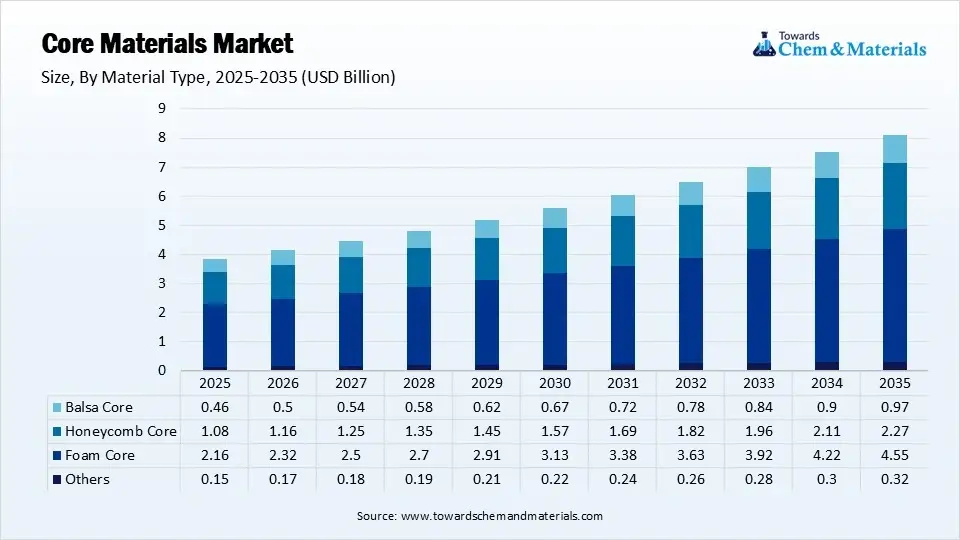 The honeycomb core segment held 28% market share in 2025 and is expected to have the fastest growth with a CAGR of 8.80% in the forecast period. This is driven by strong demand for lightweight, high-strength materials that improve fuel efficiency, lower carbon emissions, and enhance structural performance across industries like aerospace, automotive, and construction. More than 80% of honeycomb core revenue comes from composite sandwich panels. These are made by placing a honeycomb core between two thin, strong sheets of material.
Core Materials Market Share,By Material Type, 2025 (%)
| By Material Type | Revenue Share, 2025 (%) |
| Foam Core | 56% |
| Honeycomb Core | 28% |
| Balsa Core | 12% |
| Others | 4% |
Manufacturing Process Insights
The continuous lamination segment dominated the market with 26% share in 2025, because it lowers production costs and boosts manufacturing speeds. This automated process creates durable, lightweight materials that are replacing heavier traditional materials like steel, wood, and aluminum across major industries. Builders prefer continuous laminated panels used for roof panels and wall cladding because they are moisture-resistant, install easily, and insulate buildings well.
The prepreg processing segment held 12% market share in 2025 and is expected to have the fastest growth with a CAGR of 8.90% in the forecast period, due to soaring demand for lightweight, high-strength composites in the aerospace, wind energy, and automotive industries. Prepreg refers to reinforcing fibers that are already pre-impregnated with a resin system, offering unmatched mechanical strength and processing consistency. Automakers use prepreg composites to reduce the weight of electric and high-performance vehicles, which directly improves battery range and safety.
Core Materials Market Share,By Manufacturing Process, 2025 (%)
| By Manufacturing Process | Revenue Share, 2025 (%) |
| Continuous Lamination | 26% |
| Vacuum Infusion | 22% |
| Compression Molding | 18% |
| Resin Transfer Molding (RTM) | 16% |
| Prepreg Processing | 12% |
| Others | 6% |
Density Insights
The Medium Density (80–150 kg/m³) segment dominated the market with 46% share in 2025. This is driven by surging demand for affordable ready-to-assemble (RTA) furniture, sustainable building practices, and high-performance, moisture-resistant panels. The boom in modern modular kitchen design relies heavily on moisture-resistant medium-density boards to withstand humid environments. MDF is a top choice for ready-to-assemble (RTA) furniture, cabinets, and shelving. Its smooth surface makes it ideal for painting and flawless finishes.
The Low Density (<80 kg/m³) segment held 38% market share in 2025 and is expected to have the fastest growth with a CAGR of 8.4% in the forecast period, due to a global demand for lightweight, high-strength materials that improve fuel efficiency and reduce carbon emissions. Industries use these materials to build "sandwich" structures that are stiff and durable, yet incredibly light. The aerospace industry is focused on making aircraft lighter. Low-density foam and honeycomb cores are highly prized because they allow planes to reduce weight, save on fuel, and increase carrying capacity.
Core Materials Market Share,By Density, 2025 (%)
| By Density | Revenue Share, 2025 (%) |
| Low Density (<80 kg/m³) | 38% |
| Medium Density (80–150 kg/m³) | 46% |
| High Density (>150 kg/m³) | 16% |
Sales Channel Insights
The direct sales segment dominated the market with 42% share in 2025, by cutting out middlemen. This allows manufacturers to build direct relationships with buyers in the wind energy, aerospace, and automotive industries. It helps companies deliver custom technical solutions and faster, more specialized support. When manufacturers sell directly, they share new product lines and formulations with buyers instantly, which increases growth rapidly.
The OEM Contracts segment held 31% market share in 2025 and is expected to have the fastest growth with a CAGR of 8.50% in the forecast period. This is mainly because of a massive demand for lightweight composite parts in major industries, including aerospace, wind energy, and automotive. Contract manufacturers and material suppliers are securing multi-year contracts with major OEMs to supply ready-to-use "material kits". These long-term agreements guarantee a steady supply of materials. They protect companies from global price changes and ensure factories have exactly what they need.
Core Materials Market Share,By Sales Channel, 2025 (%)
| By Sales Channel | Revenue Share, 2025 (%) |
| Low Density (<80 kg/m³) | 38% |
| Medium Density (80–150 kg/m³) | 46% |
| High Density (>150 kg/m³) | 16% |
End-Use Industry Insights
The wind energy segment dominated the market with a 34% share in 2025 by pushing demand for larger, lighter, and stronger turbine blades. These vital components allow wind farms to generate more electricity at lower costs, directly fueling renewable energy growth. To capture more wind, turbines are scaling up. Blades now frequently exceed 50 to 80 meters in length. These giant blades need to be incredibly stiff and lightweight, increasing the use of core materials.
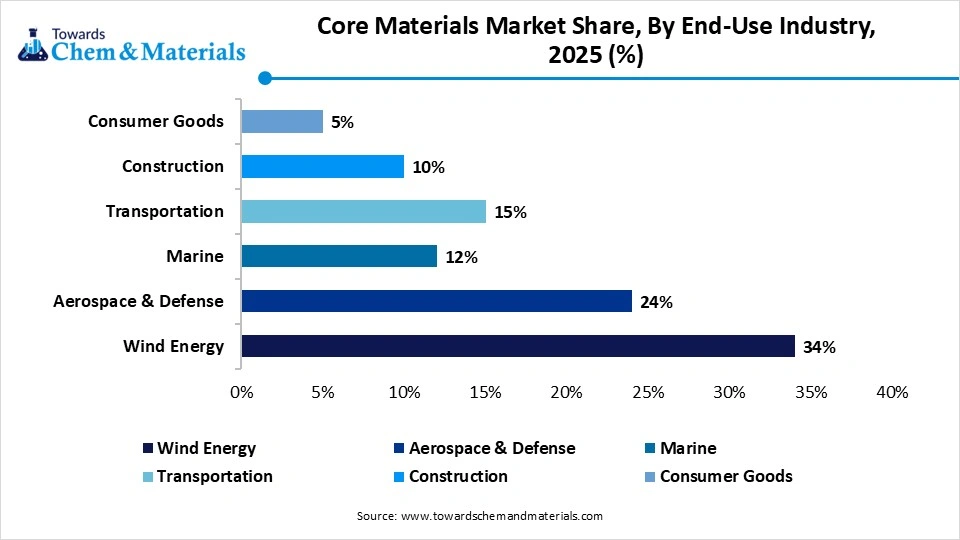 The aerospace & defense segment held 24% market share in 2025 and is expected to have the fastest growth with a CAGR of 9.20% in the forecast period, by demanding advanced, lightweight materials like honeycomb and foam cores. These materials deliver superior strength and durability, allowing manufacturers to improve fuel efficiency, increase payload capacity, and meet strict emissions regulations.
Core Materials Market Share by End-Use Industry, 2025 (%)
| By End-Use Industry | Revenue Share, 2025 (%) |
| Wind Energy | 34% |
| Aerospace & Defense | 24% |
| Marine | 12% |
| Transportation | 15% |
| Construction | 10% |
| Consumer Goods | 5% |
Regional Analysis
How did Asia Pacific Dominate the Core Materials Market in 2025?
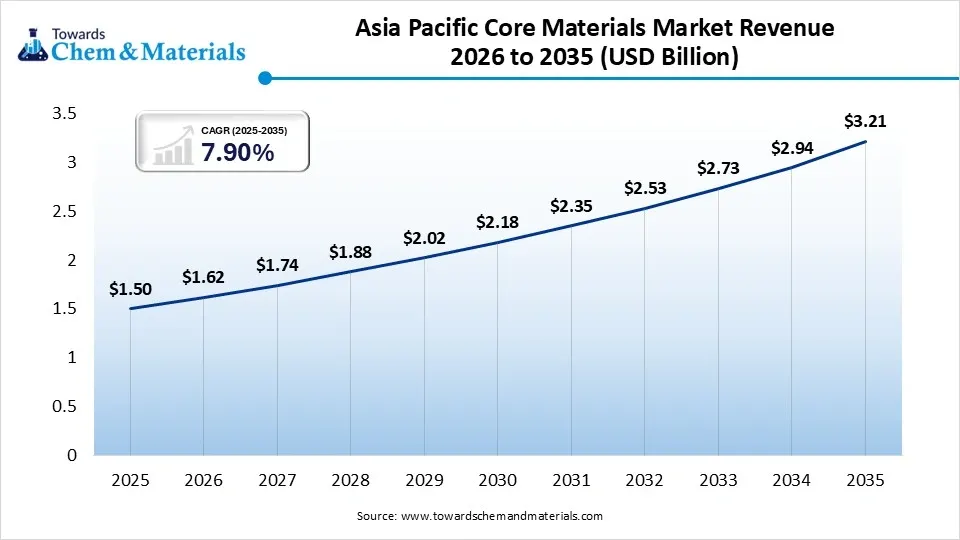
The Asia Pacific core materials market size was estimated at USD 1.50 billion in 2025 and is projected to reach USD 3.21 billion by 2035, growing at a CAGR of 7.90% from 2026 to 2035.Asia Pacific dominated the market with a share of 39% in 2025. Its leading position was driven by booming wind energy installations, massive manufacturing growth, and a strong regional demand for lightweight materials in countries like China, India, and South Korea. Governments significantly expanded renewable energy. Countries like China and India increased their production of light, strong wind turbine blades made from foam, PVC, and PET core materials. The region benefited from the localized production of cost-effective core materials and successful collaborations with major global manufacturers.
 India
India
- India is scaling up its renewable energy capacity. Core materials are highly sought after to manufacture longer, stronger, and more efficient wind turbine blades. Growing government targets for green energy directly push up this demand.
- Favorable government policies and financial incentives are boosting domestic manufacturing capabilities. This localization reduces supply-chain costs and makes core material products more accessible to local industries.
China
- China is the world's largest wind energy market. The construction of massive offshore and onshore wind turbines requires a high volume of foam and balsa core materials for lighter, longer, and more durable blades.
- China possesses a highly integrated local supply chain for the raw inputs used in core materials such as PET, PVC, and EVA. This means local manufacturers can produce large-scale, high-performance parts at very low costs.
North America Core Materials Market Growth Factor
The North America core materials market size was estimated at USD 1.04 billion in 2025 and is projected to reach USD 2.23 billion by 2035, growing at a CAGR of 7.93% from 2026 to 2035.North America held the market share of 27% in 2025 and is expected to experience fastest growth with a CAGR of 8.90% in the forecast period. This growth is mainly driven by a strong demand for lightweight, high-strength materials in the aerospace, wind energy, and automotive industries. Governments and businesses are building larger onshore and offshore wind turbines to create renewable energy. Materials like balsa wood and structural foams are needed to make massive, durable wind turbine blades.
U.S.
- The U.S. core materials market is growing primarily due to the rising demand for lightweight, durable composite materials
- Government policies push industries to cut greenhouse gases. Light, strong cores help lower fuel use and reduce carbon footprints.
- Long and strong wind turbine blades need specialized core materials like balsa wood and foam. The U.S. push for green energy pushes this demand up.
Canada
- Federal and provincial regulations forcing companies to reduce carbon emissions. Lightweight materials reduce fuel consumption and environmental impact in vehicles and airplanes.
- The expansion of onshore and offshore wind farms requires massive, strong, yet lightweight turbine blades. Canada's focus on clean energy directly drives the demand for these core materials.
Europe Core Materials Market Growth Factor
The Europe core materials market size was estimated at USD 0.89 billion in 2025 and is projected to reach USD 1.91 billion by 2035, growing at a CAGR of 7.94% from 2026 to 2035.Europe held the market share of 23% in 2025, driven largely by strict European Union carbon emission regulations, a push for renewable energy, and the automotive industry's need for lightweight composite materials. The European Union enforces strict rules to lower carbon emissions. This forces industries to build lighter vehicles and aircraft, which burn less fuel and pollute less. European manufacturers lead the production of luxury yachts and commercial ships. Foam and balsa cores are used here to create corrosion-resistant, lightweight, and durable hulls.
Germany
- Major German automakers like BMW, Volkswagen, and Mercedes-Benz are replacing heavy metal parts with lighter, composite materials. Using core materials like foams and honeycomb structures makes cars lighter.
- Germany has very strict laws to protect the environment and lower carbon pollution. This pushes material makers to invent eco-friendly, recyclable, and bio-based core materials so they can follow the law and meet customer demands.
Italy
- Italy has a strong aerospace sector. Aircraft makers use lightweight core materials to build plane wings and interior panels. Lighter planes use less fuel, which helps the environment.
- European laws push manufacturers to lower their carbon footprints. Core materials help meet these goals by making end-products more energy-efficient.
- Italy makes many recreational and luxury boats. Boat builders use core materials to make hulls that are fast, fuel-efficient, and resistant to water damage.
Latin America Core Materials Market Growth Factor
The Latin America core materials market size was estimated at USD 0.23 billion in 2025 and is projected to reach USD 0.53 billion by 2035, growing at a CAGR of 8.71% from 2026 to 2035.Latin America held the market share of 6% in 2025, due to the rising demand for lightweight, high-strength composite materials in key industries. Core materials like balsa wood, structural foams, and honeycombs act as the middle layer in "sandwiched" structures, making end products lighter, more fuel-efficient, and durable. The push for better fuel efficiency and reduced carbon emissions is forcing automakers and aerospace engineers to make vehicles lighter. Latin America, especially countries like Brazil, is investing heavily in renewable energy. Governments and urban planners in the region are pushing for "green" and low-carbon building materials.
Brazil
- The Brazilian core materials market is growing rapidly due to an increasing need for lightweight, high-strength composites. Key industries like wind energy, aerospace, and automotive use these materials to make products more durable and fuel-efficient.
- Brazil is heavily investing in wind power. Balsa wood is a highly popular core material for making large, durable wind turbine blades.
Argentina
The core materials market in Argentina is largely driven by the adoption of lightweight composite materials across several key industries. This growth is propelled by the need for better fuel efficiency, expanding renewable energy infrastructure, and increased demand for high-performance materials.
Middle East and Africa Core Materials Market Growth Factor
The Middle East and Africa core materials market size was estimated at USD 0.19 billion in 2025 and is projected to reach USD 0.45 billion by 2035, growing at a CAGR of 9.00% from 2026 to 2035.The Middle East and Africa held the market share of 5% in 2025, grows rapidly due to heavy government investments in renewable energy and aerospace. Core materials are lightweight, thick, and stiff materials used to create strong but light sandwich-like structures. They save fuel, improve speed, and are vital for modern construction and transportation. Countries like Saudi Arabia and the UAE are investing heavily in massive wind energy projects. Large wind turbine blades require lightweight structural cores like foam, balsa, and honeycomb to capture more wind and generate electricity efficiently.
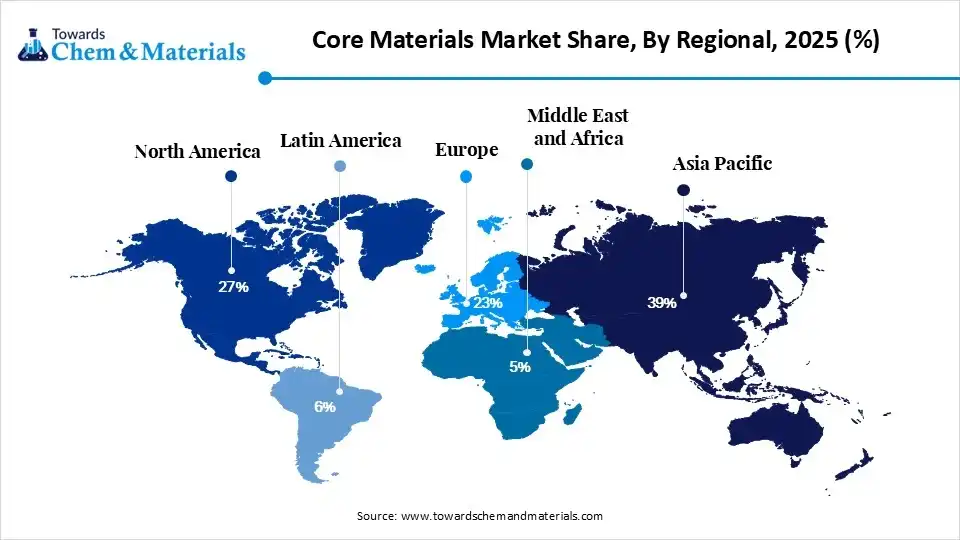 Core Materials Market Share, By Regional, 2025 (%)
| Regional | Revenue Share, 2025 (%) |
| Asia-Pacific | 39% |
| North America | 27% |
| Europe | 23% |
| Latin America | 6% |
| Middle East & Africa | 5% |
Saudi Arabia
- Saudi Arabia’s core materials market is primarily growing due to the Kingdom's Vision 2030 initiative, which drives massive demand for lightweight and durable materials like honeycomb core materials.
- Saudi Arabia is actively working to reduce its reliance on oil and gas exports by modernizing and creating local manufacturing hubs.
- Saudi Arabia is expanding its local industrial manufacturing capacity to avoid depending on imported equipment.
UAE
- The UAE construction market is massive. New megaprojects require modular, lightweight, and sustainable building materials. Builders use core materials to insulate buildings and speed up project completion.
- The UAE aerospace sector is the largest user of these materials. Airplanes and defense vehicles use cores like honeycomb to reduce weight. This cuts fuel use and improves flight performance.
- The UAE government is pushing strict eco-friendly building laws. Cities like Dubai and Abu Dhabi require builders to use materials that save energy and lower carbon footprints.
Recent Developments
- In June 2026, Vietnam's leading research institutes have developed strategic core technological capabilities in materials science, producing advanced polymer composites, specialized armour-piercing alloys, and high-performance protective coatings for the defense sector. These innovations meet international standards for quality and performance.(Source: en.nhandan.vn)
- In June 2026, Lonestar Electric Supply launched a new division named Star CORE (CapEx, Optimization, Reliability, and Execution) to manage complex power infrastructure projects from initial development through to final energization. Operating within the Houston-based distributor, the unit aims to streamline material coordination for large capital projects, leveraging partnerships with major manufacturers like ABB, Hitachi, and Killark(Source: www.mdm.com)
- In March 2026, Spur is launching Hardex Performance Easy XPP, an extruded polypropylene structural foam core designed for efficient thermal bonding at lower lamination temperatures. loped to meet the demands of modern composites manufacturing, the solution enhances surface quality, strengthens adhesion, increases productivity, and reduces overall processing costs.(Source: www.compositesworld.com)
Competitive Analysis
Competitive advantage is increasingly driven by material performance, customization capabilities, sustainable product development, global manufacturing networks, and expertise in advanced composite engineering.
Major players in the core materials market include 3A Composites, Gurit, DIAB Group, Hexcel Corporation, and Evonik Industries, which compete through advanced lightweight core technologies and composite material solutions.
- In June 2026, Deutsche Aircraft and Hexcel Corporation formed a long-term composite partnership to supply advanced materials for the D328eco regional aircraft programme, focusing on weight reduction and fuel efficiency, with a long term cooperation, industrial resilience, and technological excellence anchored in Europe.(Source: www.hexcel.com)
Hexcel Corporation announced it broke ground on a new Applications Center at Wichita State University’s National Institute for Aviation Research (NIAR) to help transition composite concepts into manufacturable solutions.(Source: investors.hexcel.com)
Top players in the Core Materials Market & Their Offerings
| Company | Company Type/Position | Major Headquarters | Geographic Presence | Core Materials Offerings | Key Offering/Strength |
| Diab Group / Ratos | Leading producer of composite core materials | Laholm | Europe, North America, Asia Pacific, Middle East | PVC foam cores, PET foam cores, sandwich composite core materials for wind energy, marine, and aerospace applications | Strong expertise in lightweight composite solutions and sustainable core materials |
| Gurit Holding AG | Global supplier of advanced composite materials | Wattwill | Europe, Asia Pacific, North America, Latin America | Structural core materials, PET foam cores, balsa wood cores, composite systems | Broad portfolio of core materials and engineering support for composite manufacturers |
| 3A Composites / Schweiter Technologies | Advanced lightweight materials manufacturer | Sins | Europe, North America, Asia Pacific | Foam core materials, composite panels, lightweight structural solutions | Strong innovation in lightweight construction and industrial composite applications |
| Armacell | High-performance foam materials supplier | Luxembourg City | Europe, North America, Asia Pacific, Middle East | PET foam core materials, structural foam solutions for wind, marine, transportation, and construction sectors | Advanced recyclable PET foam technologies and global manufacturing footprint |
| Hexcel Corporation | Aerospace and industrial composite materials leader | Stamford | North America, Europe, Asia Pacific | Honeycomb core materials, engineered sandwich structures, and aerospace-grade composite cores | Leadership in high-performance honeycomb cores for aerospace and defense applications |
Other Top Players Are
- Evonik Industries AG (Germany)
- The Gill Corporation (United States)
- Euro-Composites S.A. (Luxembourg)
- Plascore, Inc. (United States)
- Changzhou Tiansheng New Materials Co., Ltd. (China)
- Toray Industries, Inc. (Japan)
- Owens Corning (United States)
- Solvay S.A. (Belgium)
- BASF SE (Germany)
- CoreLite Inc. (United States)
- SGL Carbon SE (Germany)
- Huntsman Corporation (United States)
- Showa Aircraft Industry Co., Ltd. (Japan)
- Carbon-Core Corp. (United States)
- Saertex GmbH & Co. KG (Germany)
Segments Covered
By Material Type
- Foam Core
- PVC Foam
- PET Foam
- SAN Foam
- PMI Foam
- Polyurethane Foam
- Honeycomb Core
- Aluminum Honeycomb
- Nomex Honeycomb
- Thermoplastic Honeycomb
- Paper Honeycomb
- Balsa Core
- End-Grain Balsa
- Plain Balsa
- Others
- Cork Core
- Hybrid Core Materials
By End-Use Industry
- Wind Energy
- Wind Turbine Blades
- Nacelles
- Aerospace & Defense
- Aircraft Interiors
- Structural Components
- UAV Components
- Marine
- Commercial Vessels
- Recreational Boats
- Naval Platforms
- Transportation
- Automotive
- Rail
- Commercial Vehicles
- Construction
- Structural Panels
- Facades
- Infrastructure Components
- Consumer Goods
- Sports Equipment
- Industrial Products
By Manufacturing Process
- Continuous Lamination
- Vacuum Infusion
- Compression Molding
- Resin Transfer Molding (RTM)
- Prepreg Processing
- Others
By Density
- Low Density (<80 kg/m³)
- Medium Density (80–150 kg/m³)
- High Density (>150 kg/m³)
By Sales Channel
- Direct Sales
- OEM Contracts
- Distributors & Traders
- Online Procurement Platforms
By Regions
- North America
- U.S.
- Canada
- Mexico
- Rest of North America
- Latin America
- Brazil
- Argentina
- Rest of Latin America
- Europe
- Western Europe
- Germany
- Italy
- France
- Netherlands
- Spain
- Portugal
- Belgium
- Ireland
- UK
- Iceland
- Switzerland
- Poland
- Rest of Western Europe
- Eastern Europe
- Austria
- Russia & Belarus
- Türkiye
- Albania
- Rest of Eastern Europe
- Asia Pacific
- China
- Taiwan
- India
- Japan
- Australia and New Zealand,
- ASEAN Countries (Singapore, Malaysia)
- South Korea
- Rest of APAC
- MEA
- GCC Countries
- Saudi Arabia
- United Arab Emirates (UAE)
- Qatar
- Kuwait
- Oman
- Bahrain
- South Africa
- Egypt
- Rest of MEA
FAQ'
Question 1 : What is the current size of the global core materials market?
Answer : The global core materials market size is valued at an estimated USD 4.15 billion in 2026 and is projected to reach USD 8.12 billion by 2035, growing at a CAGR of 7.75%.
Question 2 : What are the main industrial uses of core materials?
Answer : Core materials are primarily used to manufacture lightweight sandwich composite structures. These structures are vital for making massive wind turbine blades, commercial aircraft interior and exterior panels, automotive bodies for electric vehicles, marine hulls, and high-performance building insulation.
Question 3 : Which region dominates the core materials market?
Answer : The Asia Pacific region dominates the market, securing a 39% revenue share in 2025. This leadership position is fueled by rapid urbanization and massive domestic manufacturing of wind turbine components in China and India.
Question 4 : Who are the top key players in the core materials market?
Answer : The top key players leading the global market include Diab Group (Ratos), Gurit Holding AG, 3A Composites (Schweiter Technologies), Armacell, Hexcel Corporation, Evonik Industries AG, The Gill Corporation, Euro-Composites S.A., and Toray Industries, Inc.
Question 5 : Why is the industry shifting toward PET foam cores?
Answer : The industry is rapidly adopting Polyethylene Terephthalate (PET) foam cores because they are highly recyclable and eco-friendly. Traditional materials like PVC foam are notoriously difficult to recycle, whereas PET cores help manufacturers meet strict environmental and decarbonization regulations.
Question 6 : What is the biggest challenge facing the core materials industry?
Answer : The primary restraint is the high production and raw material cost associated with advanced honeycomb and high-performance chemical foams. Additionally, when a product reaches its end of life, separating the core material from the strong outer composite skin for recycling remains a highly difficult and expensive process.
Meet the Team

Saurabh Bidwai
Principal Consultant
Saurabh Bidwai, a B.Tech Chemical Engineering graduate with 4+ years of experience, specializes in specialty chemicals, commodity chemicals, and engineered materials, offering valuable insights into market trends and emerging opportunities.

Aditi Shivarkar
Reviewed By
Aditi Shivarkar, with 14+ years in Chemical and Materials market research, specializes in Chemical and Materials. She ensures accurate, actionable insights, driving Towards Chemicals And Materials Analytics and Consulting excellence in industry trends and sustainability.