
Self-Healing Coatings Market Size, Share, Growth, Report 2026 to 2035
The self-healing coatings market report segmented By Form (Extrinsic, Intrinsic), By Application (Automotive, Aerospace, Building & Construction, Marine, Other Applications)-Global Industry Analysis, Size, Trends, Leading Companies, Regional Outlook, and Forecast 2026 to 2035
Content
What is the Self-Healing Coatings Market Size and Share?
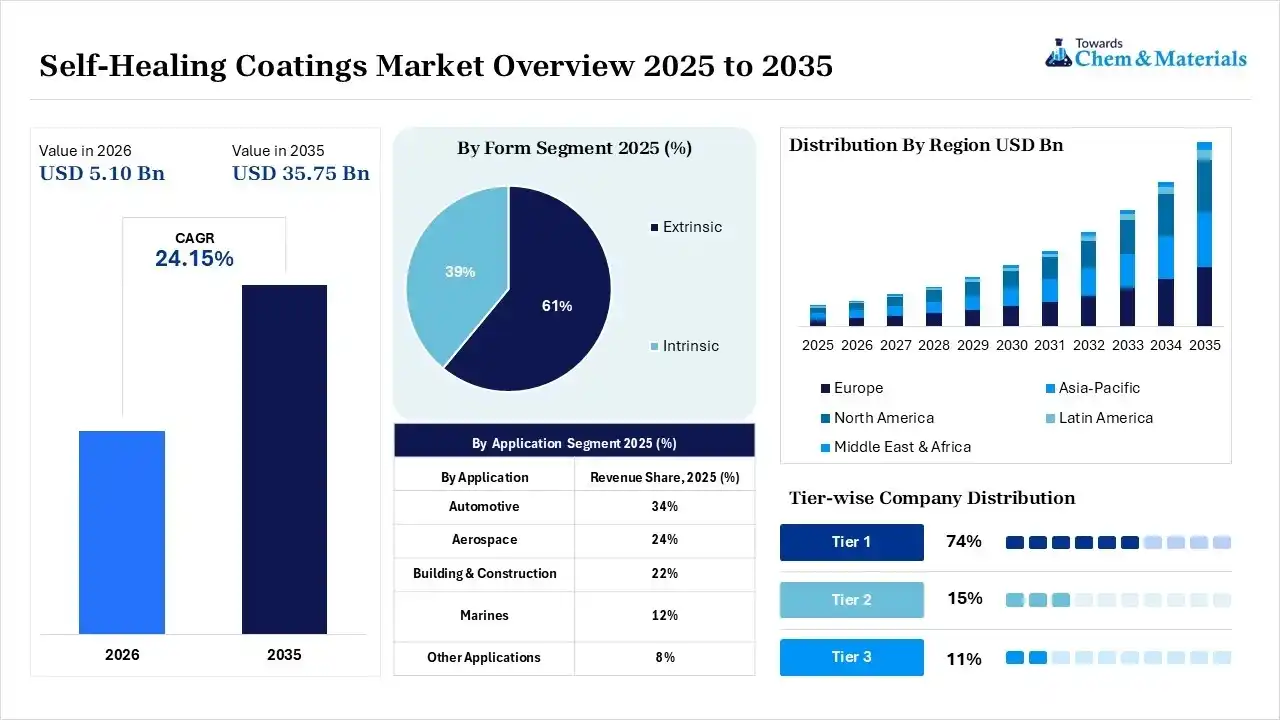
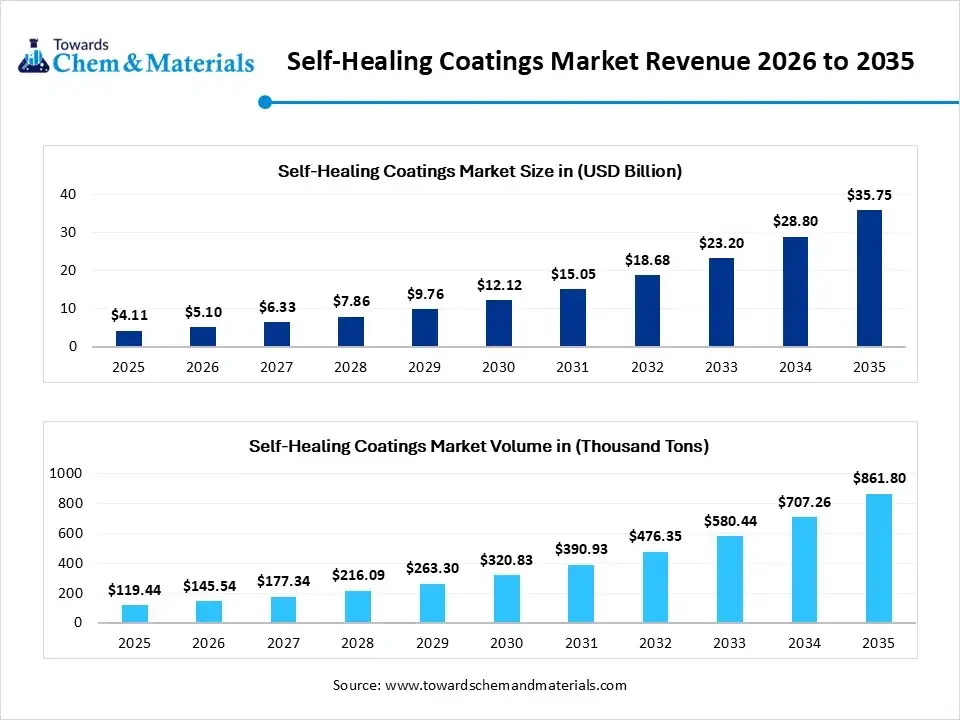
The self-healing coatings market size was valued at USD 4.11 billion in 2025, is estimated to reach USD 5.10 billion in 2026, and is projected to reach USD 35.75 billion by 2035, exhibiting a compound annual growth rate (CAGR) of 24.15% over the forecast period from 2026 to 2035.Europe dominated the self-healing coatings market with the largest revenue share of 32% in 2025 and is expected to grow at the fastest CAGR of 24.31% during the forecast period. In terms of volume, the self-healing coatings market is projected to grow from 119.44 thousand tons in 2025 to 861.80 thousand tons by 2035. growing at a CAGR of 21.85% from 2026 to 2035. The growing need for low-maintenance and durable materials in various sectors is the key factor driving market growth. Also, advancements in micro-encapsulation and reversible polymer chemistries are fuelling market growth further. Moreover, major market players such as BASF SE and Dow Chemical Company are heavily investing in nanotechnology and micro-encapsulation, leading to market growth soon.
Market Highlights
- By region, Europe dominated the market with the largest share of 32% in 2025. The growth of the region can be attributed to the stringent environmental regulations and ongoing push for low maintenance.
- By region, Asia Pacific held the market share of 30% in 2025 and is expected to grow at the fastest CAGR of 26.30% during the forecast period. The growth of the region can be credited to the rapid infrastructure investments and expanding electronics.
- By form, the extrinsic segment dominated the market with the largest share of 61% in 2025. The extrinsic coatings need external triggers or encapsulated agents to repair damage.
- By form, the intrinsic segment held the market share of 39% in 2025 and is expected to grow at the fastest CAGR of 26.20% during the forecast period. This coating has an ability to repair surface damage without depending too much on external microcapsules or agents.
- By application, the automotive segment dominated the market with the largest share of 34% in 2025. Automakers are applying these coatings to preserve structural integrity and vehicle aesthetics.
- By application, the aerospace segment held the market share of 24% in 2025 and is expected to grow at the fastest CAGR of 25.80% during the projected period. The market depended on innovative capsule-based and polymer-based designs intended to automatically repair microcracks.
Quick Stats at a Glance
- Market Estimated Size (2025): USD 4.11 Billion | CAGR (2026–2035): 24.15%
- Market Projected Size (2035): USD 4.11 Billion
- Europe: largest Market Revenue Share of 33% in 2025|USD 1.36 Billion
- Market Estimated Volume (2025): 119.44 Thousand Tons | Volume CAGR (2026–2035):21.85%
- Market Projected Volume (2035): 861.80 Thousand Tons
- Market Pricing (2025):
- Average Manufacturing Price (2025): USD 21,400/Ton
- Average Selling Price (2025): USD 26,900/Ton
- Pricing CAGR (2026–2035): 2.70%
The automotive sector needs strong coatings to safeguard vehicles from scratches, corrosion and environmental damage, minimising overall repair costs and enhancing vehicles' longevity. This coat contains offers convenient solutions, improving the appearance and strength of the materials, fuelling demand in this fast-paced industry. In addition, major regions such as North America and the Asia Pacific are investing heavily in advanced manufacturing technologies.
Also, aerospace applications need materials that withstand harsh temperatures and mechanical stress. These coatings enhance aircraft performance and safety by minimising maintenance costs, repairing micro-damages and growing overall operational efficiency.The integration of self-healing materials significantly improves device longevity and durability, effectively addressing consumer preferences for premium, extended-lifespan electronics.
Global Investment Flow for Self-Healing Coatings 2026
- The market is navigating a crucial bottleneck, where booming airline demand by stringent climate mandates is competing with slowing infrastructure investment. While commercial investment is remaining high.
- In its financial update for the first quarter of 2025, PPG Industries, Inc. recorded net sales of approximately $4.3 billion. The organization achieved year-over-year organic sales growth, increased by strategic pricing measures and extended volumes across multiple end-markets, despite persistent softness in certain construction-related industries.
- Large-scale frameworks are increasingly gaining momentum, especially in emerging economies such as Ghana and India.
Self-Healing Coatings Market Trends
- Increasing regulatory emphasis on sustainability and environmental compliance is the latest trend in the market shaping positive market growth. Self-healing coatings give a sustainable alternative to conventional coatings, as they can minimise waste by increasing the life of coated products.
- In recent years, investments in research and development for eco-friendly self-healing coatings have been increasing. Hence, market players are emphasising the development of self-healing coatings that utilise biodegradable materials and can decrease reliance on harmful chemicals.
- The ongoing innovations in material science are one of the future trends driving market expansion. Researchers are increasingly developing advanced polymeric materials that possess self-healing properties and that can automatically repair any damages or scratches.
Report Scope
| Report Metric | Details |
| Market Size and Volume in 2026 | USD 5.10 Billion / 145.54 Thousand Tons |
| Revenue Forecast in 2035 | USD 35.75 Billion / 861.80 Thousand Tons |
| Growth Rate | CAGR 24.15% |
| Base year estimation | 2025 |
| Forecast period | 2025-2035 |
| Dominant region | Europe |
| Segment covered | By Form, By Application, By Region |
| Key companies profiled | 3M, AkzoNobel N.V., Autonomic Materials, Inc., BASF SE, Covestro AG, FEYNLAB Inc., GVD Corporation, NEI Corporation, Solvay, spotLESS Materials Inc., Winn & Coales (Denso) Ltd., Revivify Coatings America |
AI-Powered Predictive Formulations in Smart Coatings
Artificial Intelligence (AI) is revolutionising the market by transitioning the industry from a trial-and-error and slow chemistry approach to robust data-driven materials informatics. Furthermore, generative AI models are facilitating the dispersion of nanomaterials within epoxy and polyurethane matrices, leading to market expansion further.
Supply Chain Analysis of the Self-Healing Coatings Market
- Production & Processing :It refers to the production stages where base polymers and chemical agents are put into autonomous repair systems. This method further involves the physical encapsulation of healing agents within hollow fibres, microcapsules or vascular networks. Production and processing are the most crucial and complex parts of the market. The various processing techniques create "smart" polymers which don't depend on capsules.
- Covestro AG (Germany): A prominent chemical supplier offering polyurethane raw materials (like Desmodur) that form the backbone of many intrinsic self-healing systems.
- Other Key Players: BASF SE (Germany) and 3M Company (US).
- Quality Testing and Certification :It includes the standardised validation process utilised to verify that a smart coating can precisely repair its own structural or cosmetic damage under real-world stress. Currently, major global certifications are a major challenge and restriction for the industry; no standardised, universal healing tests exist yet, compelling market players to rely on custom methods. These rigorous processes also ensure coatings should provide long-term protection against scratches, corrosion and harsh environmental wear.
- Autonomic Materials, Inc. (USA): Known for pioneering advanced microencapsulation technology (extrinsic formulations) that integrates seamlessly into heavy-duty industrial primers to deliver autonomous corrosion control.
- Other Key Players: PPG Industries, Inc., Covestro AG
- Distribution to Industrial Users :It includes the supply chain and delivery mechanisms used to offer these innovative, damage-repairing coatings to sectors such as aerospace, automotive and construction. It also includes direct manufacturer sales, specialised distributors, and technical application support. It needs accurate handling and specific application methods. Market players depended on direct distribution from chemical giants rather than retailers for several reasons. Industrial coatings are often catered to specific operating conditions for the customised formulations.
- Autonomic Materials, Inc. (US): Specialises directly in microcapsule-based self-healing additives and coatings for industrial and civil engineering.
- Other Key Players: NEI Corporation, PPG Industries
Self-Healing Coatings Market’s Regulatory Landscape: Global Regulations
| Country/Region | Key Regulations |
| United States | TSCA Compliance: Under the Toxic Substances Control Act (TSCA), any novel monomer, crosslinker, or capsule-shell material not listed on the TSCA Active Inventory must undergo a Pre-Manufacture Notice (PMN) review. |
| European Union | Any substance labeled a Substance of Very High Concern (SVHC) requires intensive individual authorization to enter the European marketplace, driving the current market shift toward bio-based capsule shells like chitosan or alginate. |
| China | MEE Order No. 12 (China REACH): The Ministry of Ecology and Environment manages the Inventory of Existing Chemical Substances in China (IECSC). Novel healing agents or synthetic polymer triggers require a highly stringent notification process similar to European REACH. |
Market Dynamics
Driver
Increasing Demand for Durable Coatings
The growing demand for durable coatings across different sectors such as aerospace, automotive and construction is the major factor driving market growth. These sectors are rapidly seeking coatings that can bear harsh environmental conditions and mechanical wear. In addition, this advancement highlights a wider industry shift toward materials engineered with self-healing properties. This innovation reduces the frequency of maintenance and replacements while enhancing overall durability.
Restraint
Complex Manufacturing Process
The use of cutting-edge polymers, nanomaterials and microcapsules increases overall manufacturing costs, which makes self-healing coatings less affordable and is, hence, the major factor hindering market growth. Moreover, creating reliable self-healing coatings involves complex methodologies, such as microencapsulation and exact formulation control. These demanding processes require specialised equipment and technical expertise.
Opportunity
Growing Healthcare-associated Infections (HCAIs)
The healthcare sector across the globe is experiencing a surge of the medical universities' market players towards the development of these coatings for medical devices, which is the key factor creating lucrative opportunities in the market. Implanted medical devices such as breast implants, artificial joints, contraceptive Intra-Uterine Devices (IUDs), etc. are heavily used to treat patients. Furthermore, various medical universities and industry manufacturers, including Solvay, Autonomic Materials Inc., and Beth Israel Deaconess Medical Center, are actively advancing technological innovations regarding the application of self-healing coatings in medical devices and components.
Segmental Insights
Form Insights
The extrinsic segment dominated the market with the largest share of 61% in 2025. The extrinsic coatings need external triggers or encapsulated agents to repair damage, which makes them highly preferred for large-scale consumer and industrial applications. In addition, extrinsic systems are easier and cheaper to integrate into current production lines and offer on-demand, immediate repair, leading to the segment expansion.
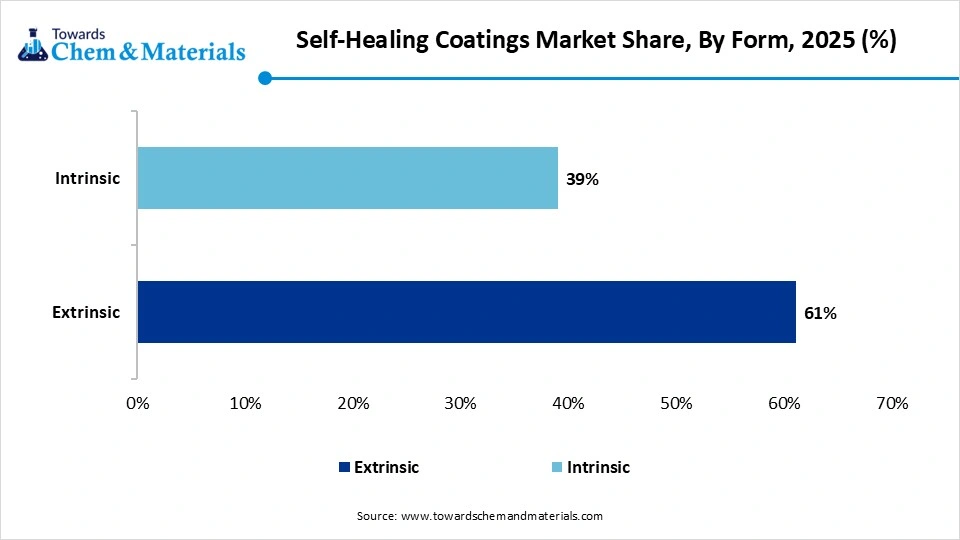
The intrinsic segment held the market share of 39% in 2025 and is expected to grow at the fastest CAGR of 26.20% during the forecast period. This coating has an ability to repair surface damage without depending too much on external microcapsules or agents. Also, they are highly sought after in innovative sectors such as finishes, automotive, aerospace, marine and electronics, where surface aesthetics and prevention are crucial.
Self-Healing Coatings Market Share,By Form, 2025 (%)
| By Form | Revenue Share, 2025 (%) |
| Extrinsic | 61% |
| Intrinsic | 39% |
Application Insights
The Automotive Segment Dominated the Market with 34% of Market Share in 2025
The automotive segment dominated the market with the largest share of 34% in 2025. Automakers are applying these coatings to preserve structural integrity and vehicle aesthetics. Automakers, particularly in brands such as Lexus, Nissan, and Mercedes-Benz, are using these coatings during initial manufacturing to ensure long-lasting factory finishes and to minimise warranty claims. Major market players such as AkzoNobel, Axalta Coating Systems and PPG Industries are fuelling innovation in this space.
The aerospace segment held the market share of 24% in 2025 and is expected to grow at the fastest CAGR of 25.80% during the projected period. The market depended on innovative capsule-based and polymer-based designs intended to automatically repair microcracks and resist pressure changes, extreme temperatures and UV degradation.
Furthermore, these abandoned protective barriers dramatically minimise structural fatigue and reduce maintenance downtime.
Self-Healing Coatings Market Share,By Application, 2025 (%)
| By Application | Revenue Share, 2025 (%) |
| Automotive | 34% |
| Aerospace | 24% |
| Building & Construction | 22% |
| Marines | 12% |
| Other Applications | 8% |
Regional Analysis
How did Europe Dominate the Self-Healing Coatings Market in 2025?
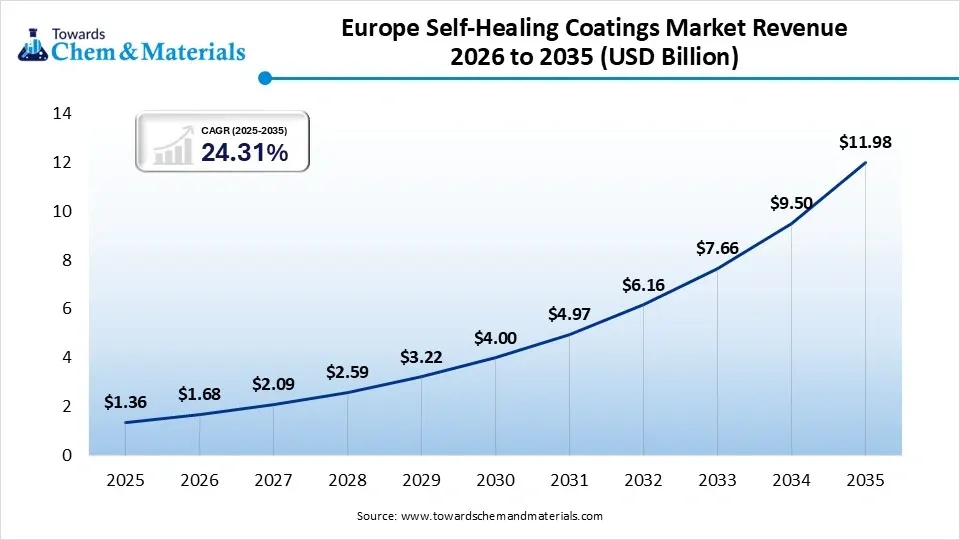
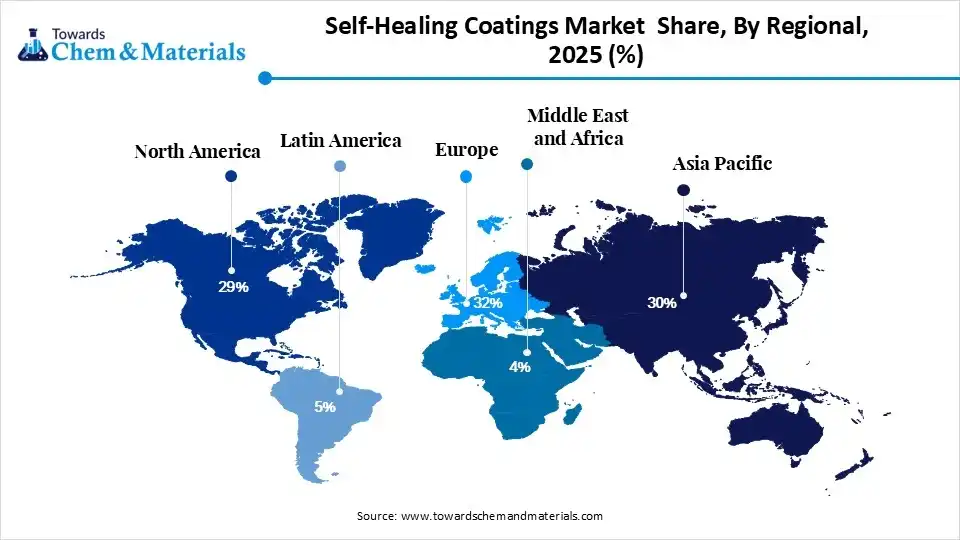
The Europe self-healing coatings market size was estimated at USD 1.36 billion in 2025 and is projected to reach USD 11.98 billion by 2035, growing at a CAGR of 24.31% from 2026 to 2035.Europe dominated the market with the largest share of 32% in 2025. The growth of the region can be attributed to the stringent environmental regulations and ongoing push for low maintenance and sustainable materials across building and construction. In addition, the region is a home to premium aerospace and automotive manufacturers who use these coatings to protect against corrosion and surface damage, leading to market growth soon.
Germany
- Major market players are continuously adopting self-healing clear coats and protective finishes to offer long-lasting scratch resistance, hence fuelling aesthetic durability.
- The presence of industry leaders such as Covestro AG and BASF SE fuels regional innovation. These companies actively invest in research and development.
The Asia Pacific self-healing coatings market size was estimated at USD 1.23 billion in 2025 and is projected to reach USD 10.90 billion by 2035, growing at a CAGR of 24.38% from 2026 to 2035.Asia Pacific held the market share of 30% in 2025 and was expected to grow at the fastest CAGR of 26.30% during the forecast period. The growth of the region can be credited to the rapid infrastructure investments and expanding electronics and automotive manufacturing in emerging economies. Furthermore, localised R&D investments, including institute and university-level advancements, are yielding sustainable and cost-effective nano-coatings.
China
- Rapid urbanisation and ongoing government initiatives require highly durable concrete structures. Self-coatings prevent corrosion and cracking in pipelines and bridges and large-scale public works.
- The need for micro-electronic coatings that self-repair to moisture or physical damage is increasing in the country’s vast electronics production ecosystem.
India
- Automakers are adopting capsule-filled primers to fulfil stringent long-term corrosion warranties and offer premium exterior finishes that resist environmental wear.
- Innovations in nanotechnology and microencapsulation techniques are making these coatings more cost-effective and applicable to everyday use.
The North America self-healing coatings market size was estimated at USD 1.19 billion in 2025 and is projected to reach USD 10.55 billion by 2035, growing at a CAGR of 24.39% from 2026 to 2035.North America held the market share of 29% in 2025. The growth of the region can be linked to the heavy government and private R&D investments in high-performance and smart materials along with the presence of advanced industrial infrastructure. Self-healing concrete is heavily used in crucial infrastructure in the U.S. and Canada to improve durability.
United States
- Major auto OEMs are heavily adopting capsule-filled primers and clear coats to meet stringent anti-corrosion warranties.
- Strong collaboration between US chemical suppliers and research institutions is fuelling innovation in both intrinsic and microcapsule healing technologies.
Canada
- Canada's extreme temperatures, heavy snowfall, and dependence on road salt accelerate the degradation of structures and vehicles, leading to country growth soon.
- The Canadian automotive industry is majorly concentrated in Ontario, which is a major consumer of scratch-resistant materials.
The Latin America self-healing coatings market size was estimated at USD 0.21 billion in 2025 and is projected to reach USD 1.97 billion by 2035, growing at a CAGR of 25.09% from 2026 to 2035.Latin America held the market share of 5% in 2025. The growth of the region can be driven by growing automotive production in emerging countries in Brazil and Mexico and growing demand for durable materials in the mining and oil and gas sectors. Moreover, the demand for crack-repairing and low-maintenance coatings for infrastructure combats early ageing and decreases lifecycle repair expenses.
Brazil
- The need for luxury vehicles and energy-efficient cars boosts the adoption of self-healing clear coats that autonomously repair micro-scratches.
- Brazil is home to major aerospace market players (like Embraer). The sector heavily relies on self-healing thermoplastic composites and coatings.
Argentina
- As a leading regional vehicle producer, Argentina's automotive supply chain is increasingly adopting self-healing clears and coatings.
- End-users are heavily viewing autonomous, self-repairing materials as a strategic way to lower lifecycle operational costs, impacting positive market growth soon.
The Middle East & Africa self-healing coatings market size was estimated at USD 0.16 billion in 2025 and is projected to reach USD 1.61 billion by 2035, growing at a CAGR of 25.97% from 2026 to 2035.The Middle East & Africa held the market share of 4% in 2025. The growth of the region can be attributed to the ongoing regional push towards low-maintenance and sustainable materials along with the extensive infrastructure megaprojects. In addition, the region heavily depends on wide, vulnerable pipeline networks and industrial facilities. Self-healing coatings offer crucial protection against rust and chemical degradation.
Saudi Arabia
- Giga-developments such as NEOM, the Red Sea Project, and Qiddiya are central to regional demand. These large-scale smart cities need advanced and autonomous repair coatings.
- Saudi Aramco's fuels towards advanced, high-durability pipeline and facility maintenance fuels are creating significant industrial demand.
UAE
- The UAE’s extreme temperatures, UV exposure, and high humidity propel the degradation of traditional coatings.
- The region's thriving luxury automotive market and advanced aviation sectors boost premium demand for scratch-resistant and protective clear coatings.
Self-Healing Coatings Market Share, By Regional, 2025 (%)
| Regional | Revenue Share, 2025 (%) |
| North America | 29% |
| Europe | 32% |
| Asia-Pacific | 30% |
| Latin America | 5% |
| Middle East & Africa | 4% |
Competitive Analysis
- The market growth is fuelled by the need for extended durability and decreased maintenance in automotive and infrastructure applications. Major market players are heavily investing in research and development to create cost-efficient alternatives.
- BASF is enhancing body shop operations for the future by advancing robotics-enabled paint applications. This technology ensures the exact and repeatable layer thickness required for sophisticated self-healing clears and smart coatings.
- Covestro's intrinsic self-healing material portfolio is principally designed for applications in automotive coatings, furniture manufacturing, and 3D direct-coating processes. These advanced formulations use raw material chemistries that facilitate self-repair through reversible polymer memory mechanisms.
Recent Developments
- In March 2026, the British Coatings Federation (BCF) published its 2026 Net Zero Roadmap, which verifies that emissions fell to 55,000 tonnes of carbon dioxide equivalent by 2024. Nevertheless, the organisation highlights that reaching complete net-zero emissions by 2050 will necessitate more extensive operational interventions and enhanced government assistance.(Source: www.european-coatings.com)
- In February 2026, Nippon Paint Malaysia conducted a soft launch for its new Invisible Armour Paint Protection Spray-On (AI-PPS), which is recognised as the nation's inaugural self-healing, spray-applied paint protection system. This innovative solution represents a significant advancement in automotive surfaces, developed through the company's extensive research in specialised coatings and polyurethane chemistry.(Source: www.nst.com)
Top Vendors in the Self-Healing Coatings Market & Their Offerings:
- 3M:3M is a prominent tier-one player in the self-healing coatings and materials market, which is projected to reach over $10 billion globally. The company leverages its proprietary polymer and adhesive technologies to provide durable, high-performance protective layers.
- AkzoNobel N.V.: AkzoNobel N.V. (Amsterdam, Netherlands) is a leading tier-1 player in the self-healing coatings market, which is projected to reach approximately $10 billion. Their strategic focus lies in R&D to develop autonomous and non-autonomous systems, helping end-users increasing product lifespans, reduce maintenance costs, and meet strict sustainability standards.
- Autonomic Materials, Inc.: Autonomic Materials, Inc. (AMI) is a pioneering market leader in polymer-based, microencapsulated self-healing technologies for coatings, sealants, and adhesives. Operating out of Champaign, Illinois, AMI holds exclusive licensing to foundational intellectual property from the University of Illinois
Other Key Players
- BASF SE
- Covestro AG
- FEYNLAB Inc
- GVD Corporation
- NEI Corporation
- Solvay
- spotLESS Materials Inc.
- Winn & Coales (Denso) Ltd.
- Revivify Coatings America
Segments Covered In The Report
By Form
- Extrinsic
- Microcapsule-Based Systems
- Polymer Microcapsules
- Ceramic Microcapsules
- Vascular Network Systems
- Single-Channel Networks
- Multi-Channel Networks
- Nanocontainer Systems
- Silica Nanocontainers
- Polymeric Nanocontainers
- Microcapsule-Based Systems
- Intrinsic
- Reversible Polymer Systems
- Diels-Alder Chemistry
- Supramolecular Bonding
- Shape Memory Systems
- Thermally Activated
- Light Activated
- Dynamic Covalent Systems
- Disulfide Bond Systems
- Imine Bond Systems
- Reversible Polymer Systems
By Application
- Automotive
- Exterior Coatings
- Interior Components
- Protective Underbody Coatings
- Aerospace
- Aircraft Exterior Coatings
- Structural Component Coatings
- Cabin Component Coatings
- Building & Construction
- Architectural Coatings
- Infrastructure Protection Coatings
- Industrial Flooring Coatings
- Marine
- Hull Coatings
- Deck Coatings
- Offshore Structure Coatings
- Other Applications
- Electronics
- Energy Equipment
- Industrial Machinery
By Regional
- North America
- Asia Pacific
- Europe
- Latin America
- Middle East and Africa
FAQ's
Question 1 : What are self healing coatings?
Answer : Self-healing coatings are advanced materials that can automatically repair surface scratches, microcracks, or structural damage without human intervention. They utilize built-in mechanisms like chemical microcapsules or reversible polymer bonds to restore their original protective properties after being damaged.
Question 2 : What is the difference between extrinsic and intrinsic coatings?
Answer : Extrinsic coatings use pre-loaded capsules or vascular networks embedded in the material that break open to release healing agents when a scratch occurs. Intrinsic coatings do not use capsules; instead, they are made from smart polymers that naturally reconnect their chemical bonds when triggered by heat, light, or pressure.
Question 3 : What are the primary applications of self healing coatings?
Answer : These coatings are heavily used in the automotive sector for scratch-resistant clear coats and the aerospace industry to repair micro-damage from extreme temperatures. They are also used in building infrastructure to prevent pipeline corrosion and in consumer electronics to extend device lifespans.
Question 4 : What is the future of the self healing coatings market?
Answer : The future of the market is moving toward data-driven materials informatics and the integration of artificial intelligence to design custom formulas faster. We are also seeing a major shift toward bio-based, eco-friendly capsules made from materials like chitosan and alginate to comply with global toxic substance control regulations.
Question 5 : Which are the top key players in the self-healing coatings market?
Answer : The top key players in the global self-healing coatings market include major chemical manufacturers and specialty material companies such as BASF SE, Covestro AG, 3M, AkzoNobel N.V., and Autonomic Materials, Inc. (AMI). Other important vendors driving innovation are PPG Industries, Inc., NEI Corporation, Solvay, and FEYNLAB Inc.
Meet the Team

Saurabh Bidwai
Principal Consultant
Saurabh Bidwai, a B.Tech Chemical Engineering graduate with 4+ years of experience, specializes in specialty chemicals, commodity chemicals, and engineered materials, offering valuable insights into market trends and emerging opportunities.

Aditi Shivarkar
Reviewed By
Aditi Shivarkar, with 14+ years in Chemical and Materials market research, specializes in Chemical and Materials. She ensures accurate, actionable insights, driving Towards Chemicals And Materials Analytics and Consulting excellence in industry trends and sustainability.