
Acrylonitrile Market Size, Share & Trends Analysis Report by 2026-2035
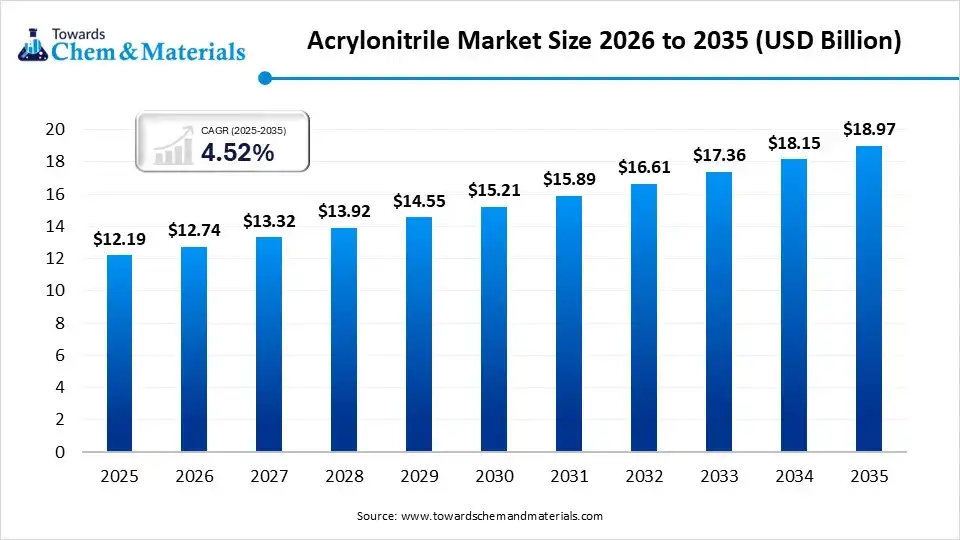
The global acrylonitrile market size is expected to grow from USD 12.74 billion in 2026 to USD 18.97 billion in 2035, growing at a CAGR of 4.52% from 2026 to 2035. The top key players in the market are SABIC, Ascend Performance Materials, INEOS Nitriles, AnQore, Asahi Kasei Corporation, Sumitomo Chemicals Co.Ltd., China Petrochemical Corporation, Cornerstone Chemicals, Toray Industries, Formosa Plastics Corporation, Jiangsu Sailboat Petrochemical, Jiangsu Shenghong Petrochemical, LG Chem, Mitsubishi Chemical Group Corporation., SGL Carbon, TONGSUH PETROCHEMICAL CORPORATION, LTD., PetroChina, Taekwaung Industrial
Content
Acrylonitrile Market Size, Share Analysis and Forecast 2035
The global acrylonitrile market size was estimated at USD 12.19 billion in 2025 and is expected to increase from USD 12.74 billion in 2026 to USD 18.97 billion by 2035, growing at a CAGR of 4.52% from 2026 to 2035. Asia Pacific dominated the acrylonitrile market with the largest revenue share of 52.00% in 2025.The market is driven by sustainability initiatives, toxicity regulations, emphasis on bio-based & low-emission materials, and rising demand in consumer & industrial applications. Acrylonitrile is a key carbon-based monomer that acts as a chemical intermediate, mainly produced by catalytic ammoxidation of propylene, valued for its versatility in making high-performance polymers and fibers across manufacturing and the petrochemical value chain. It offers chemical durability, mechanical strength, stability, and heat resistance, essential for consumer goods and industrial applications.
The acrylonitrile market is driven by its diversified applications in the production of ABS resins for plastics, nitrile rubber, and acrylic fibers for textiles, and carbon fibers in renewable energy and aerospace sectors. Additionally, as the market is moving toward green chemistry and bio-derived sources for sustainability, that accelerating R&D and corporate demand for low-carbon chemical value chains.
Market Highlights
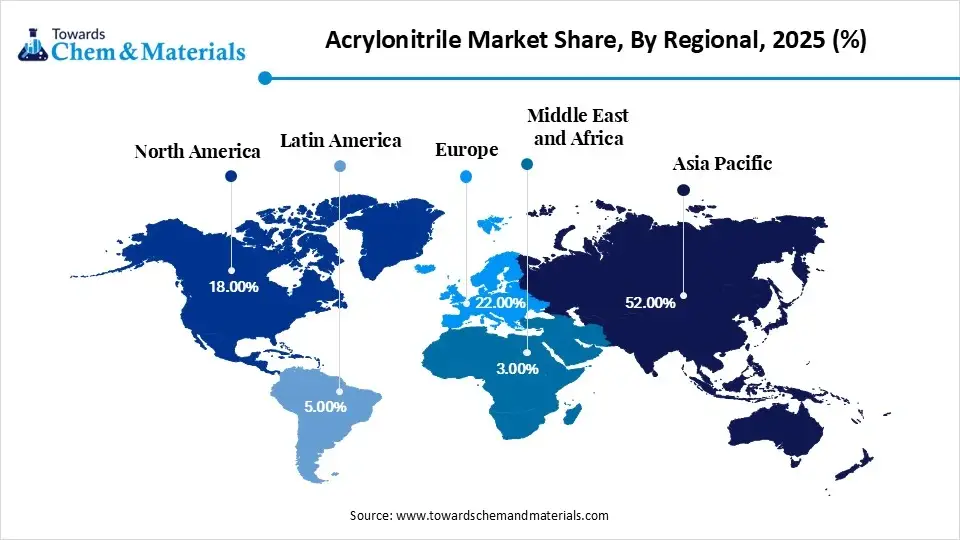
- The Asia Pacific dominated acrylonitrile market with the largest revenue share of 52.00% in 2025. due to its rapid industrialization, self-sufficiency, and expansion in the construction sector.
- By region, North America is expected to grow at the fastest CAGR from 2026 to 2035 due to investment and emphasis on automotive & electronics.
- By process technology, the ammoxidation segment dominated the market and accounted for the largest revenue share of 75.00% in 2025, due to its efficiency and precision.
- By process technology, the other production processes segment is expected to grow at the fastest CAGR during the forecast period due to its high-purity yield and diversified applications.
- By application, the ABS and SAN resins segment led the market with the largest revenue share of 49.00% in 2025, by offering chemical durability, driving the demand in automotive, construction, electronics, and consumer goods.
- By application, the acrylic fiber segment is expected to grow at the fastest CAGR in the market during the forecast period due to its high resistance to UV that driving its demand in textile and automotive interiors.
- By end-use industry, the automotive and transportation segment dominated the market and accounted for the largest revenue share of 45.00% in 2025, due to its advanced polymer consumption and high-performance industrial output.
- By end-use industry, the electrical and electronics segment is expected to grow at the fastest CAGR due to its superior properties and demand for digital electronic infrastructure.
Key Technological Shifts and AI in the Market
The acrylonitrile market is transforming with advanced materials science and digitalization. AI and machine learning optimize processes by analyzing reaction kinetics and real-time adjustment of variables, improving yield and reducing energy use.
The manufacturing process advancement, like propane ammoxidation, catalytic engineering innovations, while advanced testing and characterization enable structural integrity of CAN-based polymers by real-time monitoring. Additionally, a move towards circular chemistry using bio-based production techniques and renewable feedstocks makes acrylonitrile more sustainable and smarter.
Trade Analysis of the Market: Import and Export Statistics
- Taiwan exported 2,658 shipments of acrylonitrile.
- China exported 1,309 shipments of acrylonitrile.
- South Korea exported 941 shipments of acrylonitrile.
- From June 2024 to May 2025, the world exported 2,035 shipments of acrylonitrile.
Market Trends
- Pivot Toward End-User Markets: The shift toward sustainable, recycled, lightweight materials and advanced 5G infrastructure is driving its demand in automotive, construction, electronics, textiles, and energy storage.
- Adoption of Carbon Fiber: The market is shifting towards high-performance materials that are driving the adoption of carbon fiber in applications like aerospace, wind turbines, and defence.
- Stringent Regulatory Framework: The rising focus on safety, low-emission, and environmental impact is pushing manufacturers towards bio-based acrylonitrile initiatives and corporate sustainability commitments.
Report Scope
| Report Attribute | Details |
| Market Size in 2026 | USD 12.74 Billion |
| Revenue Forecast in 2035 | USD 18.97 Billion |
| Growth Rate | CAGR 4.52% |
| Forecast Period | 2026 - 2035 |
| Base Year | 2025 |
| Dominant Region | Asia Pacific |
| Segment Covered | By Process Technology, By Application, By End-Use Industry |
| Key companies profiled | SABIC, Ascend Performance Materials, INEOS Nitriles, AnQore, Asahi Kasei Corporation, Sumitomo Chemicals Co.Ltd., China Petrochemical Corporation, Cornerstone Chemicals, Toray Industries, Formosa Plastics Corporation, Jiangsu Sailboat Petrochemical, Jiangsu Shenghong Petrochemical, LG Chem, Mitsubishi Chemical Group Corporation., SGL Carbon, TONGSUH PETROCHEMICAL CORPORATION, LTD., PetroChina, Taekwaung Industrial |
Acrylonitrile Market: Value Chain Analysis
- Feedstock Procurement: The initial stage involves sourcing of raw materials like propylene and ammonia as key feedstock from the refinery and shale reservoirs for the ammoxidation process.
- Key players: ExxonMobil, SABIC, Shell plc., Nutrien, and LyondellBasell
- Acrylonitrile Synthesis and Manufacturing: The state involves the conversion of feedstock into acrylonitrile monomer using catalytic reactors and processes. This stage depends on energy optimization, efficiency, and AI-driven control.
- Key Players: Sinopec, INEOS Nitriles, PetroChina, Asahi Kasei Corporation, and Ascend Performance Materials.
- Derivatives and End-Use Applications: The stage includes polymerization of acrylonitrile derivatives into fibers, resins, and polyacrylonitrile used in end-use applications like lightweighting materials in automotive, consumer electronics, and renewable energy infrastructure.
- Key Players: Toray Industries, CHEMEI Corporation, Mitsubishi Chemicals, and LG Chem.
Regulatory Framework: Acrylonitrile Market
| Region | Regulatory Body | Focus |
| Globally | ISCC plus Certification, International Organization for Standardization (ISO), GHS, and CLP regulation | Focuses on sustainability and certification for bio-attributed acrylonitrile, and hazardous communication mandates safety |
| North America | Occupational Safety and Health Administration (OSHA), U.S. Environmental Protection Agency (EPA), Process Safety Management (PSM) | Focus on industrial safety and standards for healthful working conditions, especially in air monitoring and the medical sector. |
| Europe | EU Emissions Trading System (ETS), Occupational Exposure Limit, REACH/CMD4 | Sets regulations for emission trading and worker safety, and strict exposure limits |
| Asia Pacific | Ministry of New and Renewable Energy (MNRE), BIS QCO, and the environmental protection law | Promoting renewable energy and focusing on emission reduction. The standards for purity and quality are strict occupational health standards. |
Segmental Insights
Process Technology Insights
Why the Ammoxidation Segment Dominates the Acrylonitrile Market?
The ammoxidation segment dominated the market share 75.00% in 2025, representing the setting of industrial standards with its efficiency and accuracy. It uses the catalytic reaction of propylene, oxygen and ammonia, in fluidized-bed reactors to produce high-purity yields for downstream uses. Its versatility enables bio-based feedstocks to be integrated into existing systems, meeting sustainability goals. The process’s economic structure, with valuable co-products, creates an integrated cycle maximizing resource use. Additionally, the catalyst advancements make ammoxidation the leading process for global supply, supporting industries like automotive, textiles, and electronics through a sustainable chemical pathway.
The other production processes segment is the fastest-growing in the market during the forecast period, including propane-based technology and renewable biosynthetic pathways to lower petrochemical reliance. These use alkane feedstocks that offer high-purity yield and are more abundant and less volatile than olefins. Bio-catalytic methods convert lignocellulosic glycerol into monomers by fermentation and dehydration, aligning with ESG requirements for aerospace and electronics applications. The diverse pathway of these processes increases operational flexibility, ensuring supply stability and carbon footprint for resins and fibers.
Acrylonitrile Market Share, By Process Technology, 2025 (%)
| By Process Technology | Revenue Share, 2025 (%) |
| Ammoxidation Process | 75.00% |
| Other Production Process | 25.00% |
- Ammoxidation Process (75.00%) Why it dominates: "Accounts for 75.00% of the market, driven by its efficiency, cost-effectiveness, and widespread industrial adoption for large-scale acrylonitrile production."
- Other Production Process (25.00%) Why it is gaining momentum: "Holds 25.00% share, supported by ongoing technological advancements and development of alternative production methods for specialized applications."
Application Insights
How did the ABS and SAN segments hold the Largest Share in the Acrylonitrile Market?
The ABS and SAN segment held the largest revenue share 49.00% in the market in 2025, acting as a fundamental pillar for durable goods manufacturing. They offer effective resistance, gloss finish and thermal resistance, essential for consumer products and automotive parts. Their adaptability is driven by ABS for structural integrity and SAN for chemical resistance, that boosting the expansion. As manufacturing transitions toward circularity and decarbonization that fostering innovation in resins that integrate bio-attributed and recycled feedstocks without losing mechanical strength. Overall industry’s future and plastic economy depend on this segment.
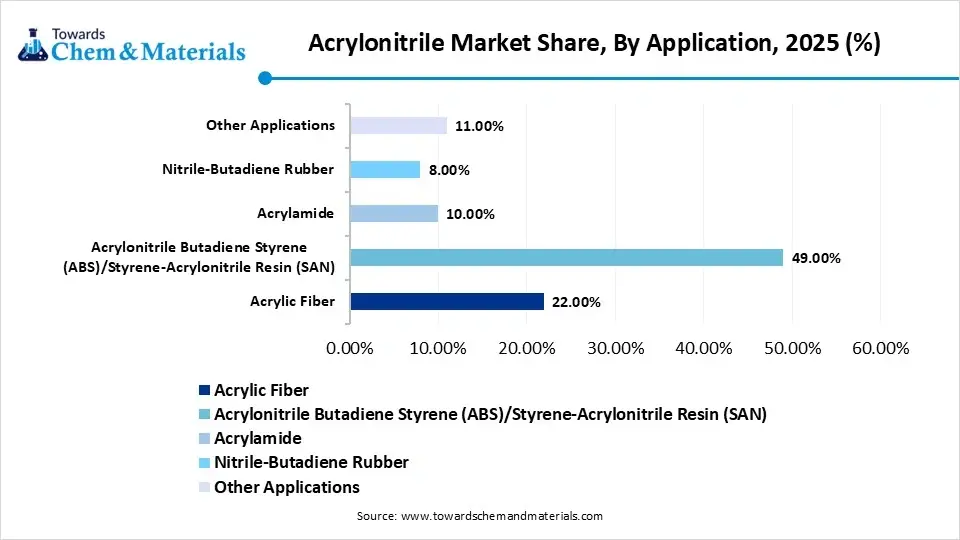
The acrylic fiber segment is experiencing the fastest growth in the market during the forecast period. The segment is known for bridging chemical synthesis and material engineering. Acrylonitrile gives fibers thermal retention, vibrant dyeability, and a wool-like softness resistant against environmental stressors in synthetic yarns, home furnishing and apparel. Acrylic fiber supplies high-performance precursors in carbon fibers for aerospace, defense, and wind energy, making it a strategic industry component. The segment leads green initiatives by implementing low-carbon feedstock and circular models, maintaining its role as a sustainable, high-value tool of the chemical value chain and global fashion brands.
Acrylonitrile Market Share,By Application, 2025 (%)
| By Application | Revenue Share, 2025 (%) |
| Acrylic Fiber | 22.00% |
| Acrylonitrile Butadiene Styrene (ABS)/Styrene-Acrylonitrile Resin (SAN) | 49.00% |
| Acrylamide | 10.00% |
| Nitrile-Butadiene Rubber | 8.00% |
| Other Applications | 11.00% |
- Acrylonitrile Butadiene Styrene (ABS)/Styrene-Acrylonitrile Resin (SAN) (49.00%) Why it dominates: "Accounts for 49.00% of the market, driven by extensive use in automotive, electronics, and consumer goods due to its strength, durability, and versatility."
- Acrylic Fiber (22.00%) Why it is gaining momentum: "Holds 22.00% share, supported by increasing demand in textiles and apparel for lightweight and durable fibers."
- Acrylamide (10.00%) Why it is gaining momentum: "Represents 10.00% of the market, driven by growing use in water treatment and chemical processing applications."
- Other Applications (11.00%) Why it is gaining momentum: "Accounts for 11.00% share, supported by diverse uses across specialty chemicals and industrial applications."
- Nitrile-Butadiene Rubber (8.00%) Why it is gaining momentum: "Captures 8.00% of the market, driven by increasing demand for synthetic rubber in automotive and industrial products."
End-Use Industry Insights
Which End-Use Industry Dominated the Acrylonitrile Market?
The automotive & transportation segment dominated the market share 45.00% in 2025. is a major driver of advanced polymer consumption into high-performance solutions. It relies on ABS resins and carbon fibers for structural integrity, resistance, and weight reduction, vital for modern vehicles. The demand is driven by electric vehicles' aim for improved efficiency and extended battery range. Acrylonitrile-based polymers are used in interior dashboards, safety parts, and exterior panels. The rise of autonomous technology enables the segment demand that offers chemical stability and durability with secure optimization. The automotive industry’s shift to bio- proven and circular feedstock that reshapes the market’s sustainability and long-term dominance.
The electrical and electronics segment is anticipated to grow fastest in the market during the forecast period, serving as high-performance polymers for digital infrastructure. It uses ABS and SAN resins for its resistance, stability, and aesthetic versatility in devices such as laptops, phones and telecommunication hardware. Acrylonitrile materials offer insulation and superior thermal properties critical for high-voltage and smart-grid components. The growth driven by sustainability goals and commercialization bio-attributed and recycled polymer grades requires environmental responsibility. Additionally, its fast innovation and expanding digital infrastructure make it a vital, high-growth and modern electronic infrastructure.
Acrylonitrile Market Share,By End-Use, 2025 (%)
| By End-Use | Revenue Share, 2025 (%) |
| Automotive & Transportation | 45.00% |
| Construction and Infrastructure | 18.00% |
| Electrical and Electronics | 15.00% |
| Textiles and Apparel | 12.00% |
| Other End-User Industries | 10.00% |
- Automotive & Transportation (45.00%) Why it dominates: "Accounts for 45.00% of the market, driven by strong demand for lightweight, durable materials such as ABS and synthetic rubber used in vehicle components."
- Construction and Infrastructure (18.00%) Why it is gaining momentum: "Holds 18.00% share, supported by increasing use of acrylonitrile-based materials in pipes, insulation, and structural applications."
- Electrical and Electronics (15.00%) Why it is gaining momentum: "Represents 15.00% of the market, driven by growing demand for durable plastics and components in electronic devices."
- Textiles and Apparel (12.00%) Why it is gaining momentum: "Accounts for 12.00% share, supported by rising use of acrylic fibers in clothing and industrial fabrics."
- Other End-User Industries (10.00%) Why it is gaining momentum: "Captures 10.00% of the market, driven by diverse applications across various industrial and specialty sectors."
Regional Insights
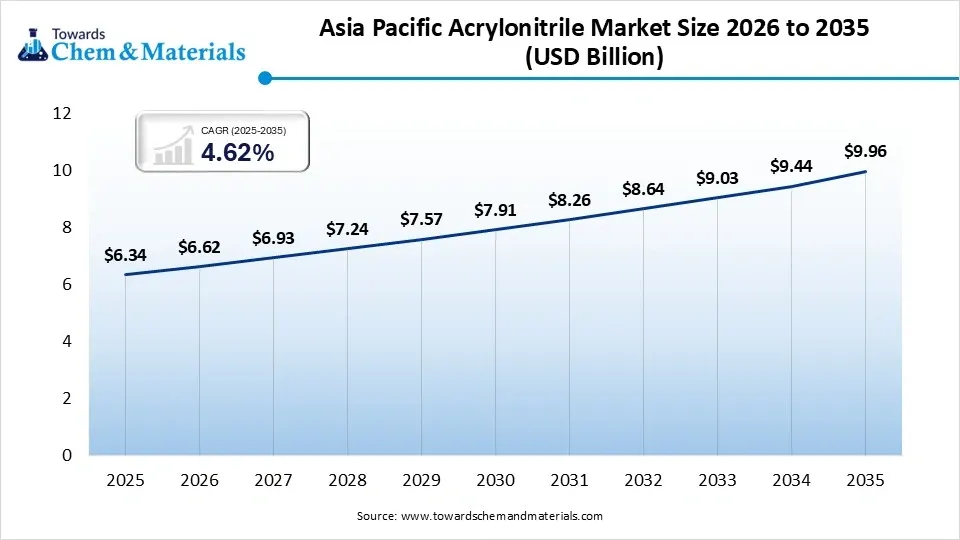
The Asia Pacific acrylonitrile market size was valued at USD 6.34 billion in 2025 and is expected to be worth around USD 9.96 billion by 2035, exhibiting at a compound annual growth rate (CAGR) of 4.62% over the forecast period from 2026 to 2035. Asia Pacific dominated the market share 52.00% in 2025 as the largest producer and consumer, driven by a shift toward self-sufficiency through large-scale manufacturing and advanced catalytic technologies integrated with petrochemical complexes. It is the key supplier for automotive, consumer electronics, and textile industries, with a focus on carbon fiber technology and bio-based chemicals. Its industrial scaling and digitalization position it as a central player in trade flows, innovation, and global pricing.
China Acrylonitrile Market Growth Trends
China’s market is shifting from a major importer to a self-sufficient producer and exporter. The expansions with advanced technology integration in the domestic sector are driving a highly competitive and flexible market environment. Regional industry focuses on high-end applications like carbon fiber and high-performance engineering plastics, supported by digitalization and sustainable systems aligning with environmental goals, which influences global supply and prices.
North America Acrylonitrile Market Growth Trends
North America acrylonitrile market segment accounted for the major revenue share of 18.00% in 2025.North America is expected to grow at the fastest CAGR in the market during the forecast period export-driven market with a structural feedstock advantage from low-cost shale resources, maintaining supply and price stability. Its domestic producer that focuses on advanced material science that involves producing high-modulus carbon fibers and integrating bio-based monomers, supporting aerospace, renewable energy, textile, and sustainable infrastructure in advanced industrial manufacturing.
U.S. Acrylonitrile Market Growth Trends
The U.S. market is a global leader and exporter, mainly along the Gulf Coast, with advantages in feedstock costs and abundant resources like shale-based propylene and ammonia, supporting high production. It is shifting toward specialty chemicals with investments in bio-based and low-carbon technologies, ensuring dominance in sustainable resources for aerospace and renewable energies with logistical and resource-driven infrastructure.
Europe Acrylonitrile Market Growth Trends
Europe acrylonitrile market segment accounted for the major revenue share of 22.00% in 2025.The Europe market is shifting toward circular chemistry and high-value specialization, making the region a global leader in sustainable manufacturing. The regional hub focuses on bio-based acrylonitrile for aerospace and electric vehicles. The strict regulations on occupational exposure limits are pushing manufacturers to adopt advanced filtration and containment technology. This, along with the rise in commercialization of bio-attributed monomers, keeps the European market at the forefront of environmental standards and innovation.
Acrylonitrile Market Share, By Regional, 2025 (%)
| Regional | Revenue Share, 2025 (%) |
| North America | 18.00% |
| Europe | 22.00% |
| Asia Pacific | 52.00% |
| Latin America | 5.00% |
| Middle East & Africa | 3.00% |
- Asia Pacific (52.00%) Why it dominates: "Accounts for 52.00% of the market, driven by strong chemical manufacturing base, high demand from automotive and textile industries, and rapid industrialization."
- Europe (22.00%) Why it is gaining momentum: "Holds 22.00% share, supported by advanced production technologies and increasing demand for high-performance materials."
- North America (18.00%) Why it is gaining momentum: "Represents 18.00% of the market, driven by steady demand across automotive, construction, and electronics sectors."
- Latin America (5.00%) Why it is gaining momentum: "Accounts for 5.00% share, supported by growing industrial activities and expanding manufacturing base."
- Middle East & Africa (3.00%) Why it is gaining momentum: "Captures 3.00% of the market, driven by gradual industrial development and increasing infrastructure investments."
Germany Acrylonitrile Market Growth Trends
Germany market is driven by its technological advancement and is integrated into automotive and aerospace value chains. It emphasizes high-performance carbon fibers and resins for electric vehicles, with a focus on circular chemistry and sustainability due to strict environmental standards and corporate emission limits. Additionally, its regulatory framework for quality and innovation in chemical engineering is boosting the market.
Recent Developments
- In June 2025, Borealis and AnQore announced a strategic partnership to produce and advance in the circular and renewable value chain for acrylonitrile. This alliance utilizes Borealis’s high-quality sustainable materials to support AnQore's sustainable specialist chemical value chains by promoting sustainable transformation.(Source: www.borealisgroup.com)
- In May 2025, Ascent Performance Materials announced the manufacturing of new high-purity grade acrylonitrile at its Texas plant to maximize commercial output by using purification equipment.(Source:www.ascendmaterials.com)
Top Market Players in the Acrylonitrile Market and Their Offerings
- SABIC: The primary global supplier of bio-renewable acrylonitrile and its derivatives, such as ABS granule products to the end-user industry.
- Ascend Performance Materials: The global leader that offers high-purity acrylonitrile and operates its manufacturing process in various applications like aerospace, pharmaceuticals, and advanced automotive composites.
- INEOS Nitriles: The major player offering bio-attributed acrylonitrile that focuses on a lower carbon footprint.
- AnQore
- Asahi Kasei Corporation
- Sumitomo Chemicals Co.Ltd.
- China Petrochemical Corporation
- Cornerstone Chemicals
- Toray Industries
- Formosa Plastics Corporation
- Jiangsu Sailboat Petrochemical
- Jiangsu Shenghong Petrochemical
- LG Chem
- Mitsubishi Chemical Group Corporation.
- SGL Carbon
- TONGSUH PETROCHEMICAL CORPORATION, LTD.
- PetroChina
- Taekwaung Industrial
Segment Covered in the Report
By Process Technology
- Ammoxidation Process
- Other Production Process
By Application
- Acrylic Fiber
- Acrylonitrile Butadiene Styrene (ABS)/Styrene-Acrylonitrile Resin (SAN)
- Acrylamide
- Nitrile-Butadiene Rubber
- Other Applications
By End-Use Industry
- Automotive & Transportation
- Construction and Infrastructure
- Electrical and Electronics
- Textiles and Apparel
- Other End-User Industries
By Region
- North America
- U.S.
- Canada
- Mexico
- Europe
- Germany
- UK
- France
- Italy
- Spain
- Asia Pacific
- China
- India
- Japan
- South Korea
- Latin America
- Brazil
- Argentina
- Middle East & Africa
- Saudi Arabia
- South Africa
FAQ's
Question 1 : What is the growth forecast for the global acrylonitrile market from 2026 to 2035?
Answer : The global acrylonitrile market is expected to grow at a CAGR of 4.52%, from USD 12.74 billion in 2026 to USD 18.97 billion by 2035.
Question 2 : Which regions dominate the acrylonitrile market, and where is the highest growth expected?
Answer : Asia Pacific dominates the acrylonitrile market, with North America expected to grow at the fastest CAGR during the forecast period from 2026 to 2035.
Question 3 : How are technological advancements like AI and sustainable processes impacting the acrylonitrile market?
Answer : AI-driven process optimizations and the shift toward bio-based feedstocks are enhancing acrylonitrile production efficiency and sustainability.
Question 4 : Who are the key players in the acrylonitrile market, and what are their offerings?
Answer : Key players include SABIC, Ascend Performance Materials, INEOS Nitriles, and Asahi Kasei Corporation, offering bio-renewable acrylonitrile and derivatives for various industries.
Meet the Team

Saurabh Bidwai
Principal Consultant
Saurabh Bidwai, a B.Tech Chemical Engineering graduate with 4+ years of experience, specializes in specialty chemicals, commodity chemicals, and engineered materials, offering valuable insights into market trends and emerging opportunities.

Aditi Shivarkar
Reviewed By
Aditi Shivarkar, with 14+ years in Chemical and Materials market research, specializes in Chemical and Materials. She ensures accurate, actionable insights, driving Towards Chemicals And Materials Analytics and Consulting excellence in industry trends and sustainability.