
Agricultural Adjuvants Market Size, Share & Trends Analysis Report by 2026-2035
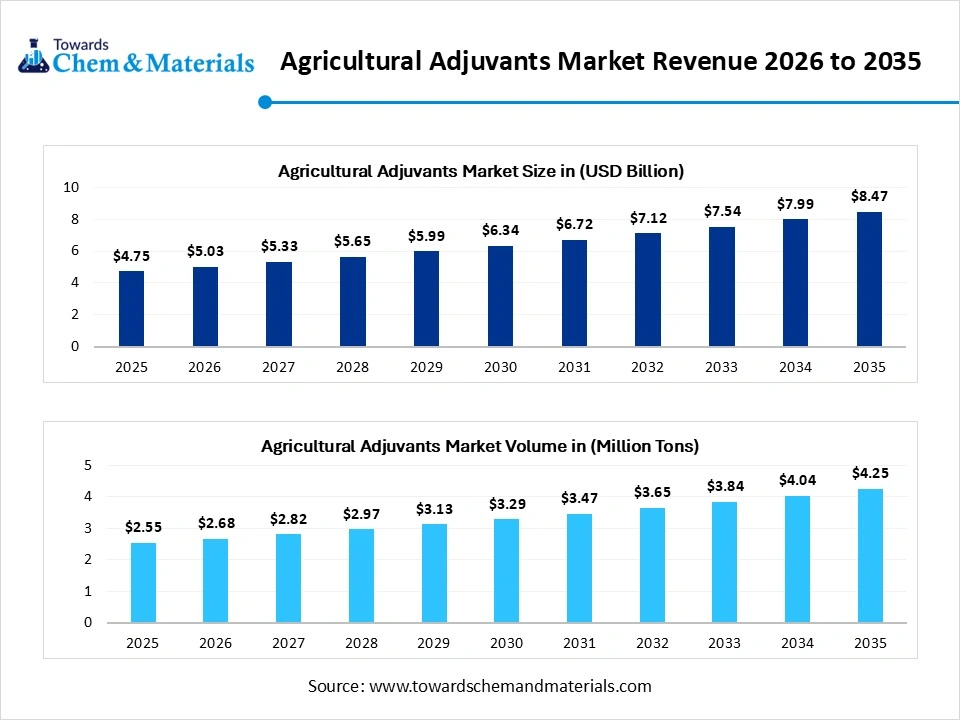
The agricultural adjuvants market was valued at USD 4.75 billion in 2025 and is estimated to reach USD 5.03 billion in 2026, further projected to grow significantly to USD 8.47 billion by 2035, registering a CAGR of 5.95% during the forecast period. In terms of volume, the market is expected to expand from 2.55 million tons in 2025 to 4.25 million tons by 2035, growing at a CAGR of 5.25%. The report provides detailed insights into market size, segment-wise data, regional trends, company profiles, competitive analysis, value chain evaluation, trade data, and comprehensive information on manufacturers and suppliers.
Content
Agricultural Adjuvants Market Demand, Size, and Growth Rate Forecast
The global agricultural adjuvants market was valued at USD 4.75 billion in 2025, is estimated to reach USD 5.03 billion in 2026, and is projected to reach USD 8.47 billion by 2035, growing at a CAGR of 5.95% from 2026 to 2035. In terms of volume, the agricultural adjuvants market is projected to grow from 2.55 million tons in 2025 to 4.25 million tons by 2035. growing at a CAGR of 5.25% from 2026 to 2035.
Key Takeaways
- By region, North America dominated the agricultural adjuvants market with 32% share in 2025.
- By region, Asia Pacific is expected to be the fastest-growing region in the market, with a CAGR of 7.80% in the forecast period.
- By type, the activator adjuvants segment dominated the market with 62% share in 2025 and sustain its position with the fastest growing CAGR of 7.1% during the forecast period.
- By formulation type, the liquid formulations segment dominated the market with 71% share in 2025 and sustain its position with the fastest growing CAGR of 7.0% during the forecast period.
- By application, the herbicides segment dominated the market with 46% share in 2025 and maintained its position with a rapid CAGR of 7.2% in the coming years.
- By crop type, the cereals and grains segment dominated the market with 38% share in 2025.
- By crop type, the fruit and vegetable segment is expected to be the fastest-growing in the market with a CAGR of 7.50% in the forecast period.
Market Size and Volume Forecast
- Market Estimated Size (2025): USD 4.75 Billion | CAGR (2026–2035): 5.95%
- Market Projected Size (2035): USD 8.47 Billion
- Market Volume (2025): 2.55 Million Tons (MT)| Volume CAGR (2026–2035): 5.25%
- Market Projected Volume (2035): 4.25 Million Tons (MT)
- Market Pricing (2025):
- Average Manufacturing Price: USD 1,460/Ton
- Average Selling Price: USD 2,069/Ton
- Pricing CAGR (2025–2035): 3.11%
Boosting Crop Protection with Smart Adjuvants
The support ingredient, which is primarily mixed with the crop protection sprays while making them work better and in smarter ways, is known as the agricultural adjuvants. The modern farming practices have offered substantial growth prospects for the manufacturing firms in recent years as manufacturers are looking for the effect and better products.
Agricultural Adjuvants Market Trends:
- The shift towards result-oriented farming has enabled the high-return ventures for the manufacturers in recent years The farmers have been seen using agricultural adjuvants for better crop yields instead of just extra product.
- The increased demand for customized products, such as the local climate-specific adjuvants, has generated value-added opportunities for industry participants in the current period.
- The major manufacturer has started the production of adjuvants according to local climate sustainability.
- The focused toward the modern and advanced farming practices, which are leading the sales of the advanced products like sprays, better fertilizers, and are expected to create lucrative opportunities for the agriculture adjuvants manufacturer during the forecast period.
Report Scope
| Report Attribute | Details |
| Market Size and Volume in 2026 | USD 5.03 Billion / 2.68 Million Metric Tons |
| Expected Size and Volume by 2035 | USD 8.47 Billion / 4.25 Million Metric Tons |
| Growth Rate from 2026 to 2035 | CAGR 5.95% |
| Forecast Period | 2026 - 2035 |
| Base Year | 2025 |
| Dominant Region | North America |
| Segment Covered | By Type, By Formulation Type, By Application, By Crop Type, By Technology, By End User and By Regions |
| Key companies profiled | Corteva Agriscience, BASF SE, Syngenta AG, Bayer AG, Nufarm Limited, Evonik Industries AG, Croda International PLC, Solvay SA, Clariant AG |
From Chemicals to Smart Farming Solutions
The adjuvant industry is actively moving from basic chemical helpers to smart, eco-friendly solutions. Moreover, the earlier adjuvants only helped pesticides stick or spread better. Now, companies are developing bio-based precision adjuvants that work with modern farming tools like drones and smart sprayers. These new products reduce chemical waste, improve crop safety, and support sustainable farming.
Supply Chain Analysis of the Agricultural Adjuvants Market
Distribution to Industrial Users
The agricultural adjuvants are distributed primarily to the agrochemical industry for in-formulation products and to commercial farming enterprises for tank-mix applications. Key users include large-scale producers of cereals, grains, and high-value horticulture, where they optimize pesticide efficacy and precision spraying.
Chemical Synthesis and Processing
Chemical synthesis of agricultural adjuvants involves the production of surfactants, oils, and polymers through processes like ethoxylation and esterification. Processing focuses on blending these active agents with stabilizers to ensure compatibility.
Regulatory Compliance and Safety Monitoring
Global regulatory compliance for agricultural adjuvants focuses on ensuring environmental safety and user protection through toxicological assessments. Monitoring programs track aquatic toxicity, soil persistence, and spray drift to prevent ecological damage.
Manufacturers must provide comprehensive Safety Data Sheets and adhere to strict labeling standards to guarantee product reliability and handling safety.
Agricultural Adjuvants Market Regulatory Landscape: Regulations
| Country Region | Regulatory Body | Key Regulations | Focus Areas |
| United States | Environmental Protection Agency (EPA), | Federal Insecticide, Fungicide, and Rodenticide Act (FIFRA): Regulates adjuvants primarily as "inert ingredients" within a pesticide formulation. | Reducing spray drift to protect non-target organisms, managing human health risks via residue limits, and streamlining the approval of bio-based or minimum-risk ingredients under FIFRA Section 25(b) |
| Europe | European Food Safety Authority (EFSA) | Regulation (EC) No 1107/2009: Specifically addresses adjuvants in Article 2(3)(d) (definition) and Article 58 (authorisation). | Maintaining high standards for aquatic toxicity and environmental persistence, harmonizing zonal authorisation procedures, and phasing out co-formulants listed in Annex III that pose health risks. |
| China | Ministry of Agriculture and Rural Affairs (MARA). | Regulation on the Administration of Pesticides (2017): Provides the overarching framework for pesticide and adjuvant management. | Limiting harmful solvents (e.g., benzene and toluene) in emulsifiable concentrates, banning toxic propellants like CFCs, and promoting high-efficiency bio-pesticides to meet green pest control coverage goals |
Market Dynamics
Drivers
Efficient Farming Through Better Adjuvants
The growing need for higher crop productivity is driving the industry growth nowadays. Moreover, the farmers have limited land but an increasing demand for food, so they must produce more from the same area. Also, the adjuvants help pesticides work better by improving spreading, sticking, and absorption.
Restraints
Poor Understanding Restricts Adjuvants Use
The lack of awareness and proper knowledge among farmers is likely to hinder the industry prospects during the forecast period. Moreover, many farmers still do not fully understand how adjuvants work or how to use them correctly.
Opportunity
Eco-Friendly Adjuvants Create Future Opportunities
The development of eco-friendly and bio-based adjuvants is likely to create significant advantages for the manufacturers during the projected period. Also, farmers and governments are becoming more concerned about environmental safety and soil health.
Segmental Insights
Type Insights
The Activator Adjuvants Segment Dominated the Agricultural Adjuvants market with 62% Market Share in 2025
The activator adjuvants segment dominated the market with 62% share in 2025 and its sustain position with the fastest growing CAGR of 7.1% during the forecast period, owing to farmers mainly needed better pesticide performance. These adjuvants help chemicals stick to leaves, spread evenly, and penetrate plant surfaces. This directly improves the effectiveness of herbicides and pesticides, which is critical for crop protection.
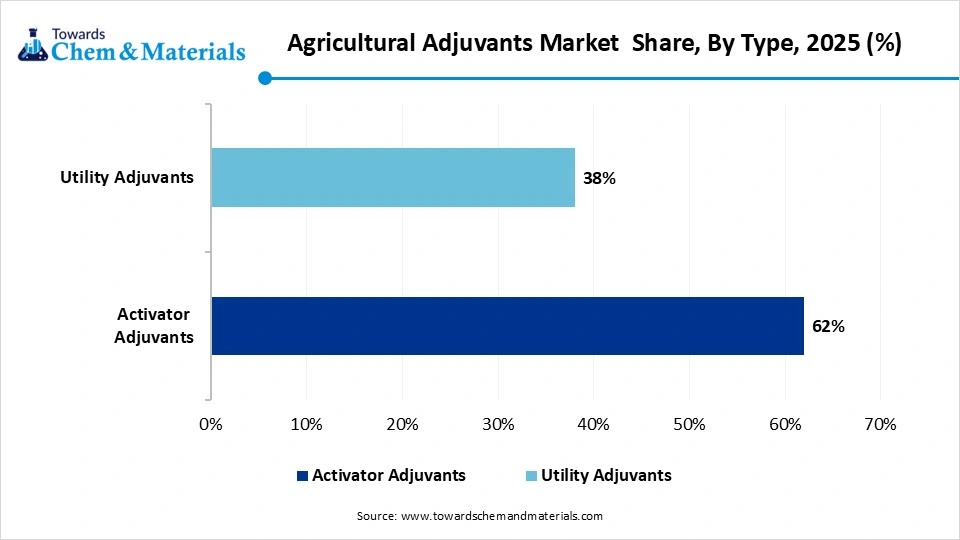
The utility adjuvants segment held 38% market share in 2025, due to farming becoming more advanced and precise. These adjuvants improve spray quality, reduce foam, adjust pH, and stabilize mixtures. As farmers use more complex chemical combinations and modern spraying equipment, they need better control over how solutions behave.
Formulation Type Insights
The Liquid Formulations Segment Dominated the Market with 71% Market Share in 2025
The liquid formulations segment dominated the market with 71% share in 2025 and sustain its position with the fastest growing CAGR of 7.0% during the forecast period, owing to they are easy to use and mix. Farmers prefer products that dissolve quickly in water and can be directly added to spray tanks. Liquids provide uniform coverage on crops and work well with existing spraying systems.
Agricultural Adjuvants Market Share, By Formulation Type, 2025 (%)
| By Formulation Type | Revenue Share, 2025 (%) |
| Liquid Formulations | 71% |
| Dry Formulations | 29% |
The dry formulations segment held 29% market share in 2025, owing to they are more stable and cost-effective in the long run. They have a longer shelf life and are easier to store and transport, especially in regions with extreme temperatures. Dry products also reduce packaging and shipping costs, making them more sustainable.
Application Insights
The Herbicides Segment Dominated the Agricultural Adjuvants Market with 46% Market Share in 2025
The herbicides segment dominated the market with 46% share in 2025 and maintained its position with a rapid CAGR of 7.2% in the coming years due to unwanted plant control being one of the biggest challenges in farming. Weeds compete with crops for nutrients, water, and sunlight, reducing yields. Farmers rely heavily on herbicides to manage this problem, and adjuvants improve their performance.
Agricultural Adjuvants Market Share, By Application, 2025 (%)
| By Application | Revenue Share, 2025 (%) |
| Herbicides | 46% |
| Fungicides | 21% |
| Insecticides | 19% |
| Plant Growth Regulators | 14% |
The fungicides segment held 21% market share in 2025, owing to the increase in crop diseases due to climate change and humidity. Fungal infections can spread quickly and damage large areas of crops. Farmers are becoming more aware of preventive crop protection, leading to higher fungicide use. Adjuvants help fungicides spread evenly and stick better, improving disease control.
The insecticides segment held 19% market share in 2025 due to pest attacks are becoming more unpredictable and severe. Climate change is increasing insect populations and spreading them to new regions. Farmers need stronger and more reliable pest control solutions.
The plant growth regulators segment 14% market share in 2025 as owing to farmers focusing on improving crop quality, not just quantity. These products help control plant growth, improve fruit size, and increase yield consistency. Adjuvants enhance their effectiveness by ensuring proper absorption and distribution.
Crop Type Insights
The Cereals & Grains Segment Dominated the Market with 38% Market Share in 2025
The cereals & grains segment dominated the market with 38% share in 2025 because they are the most widely grown crops globally. Crops like wheat, rice, and corn are staple foods, so they are cultivated on large areas. This creates high demand for pesticides and, in turn, adjuvants.
Fruits and vegetables segment held 24% share in 2025 and expected to be the fastest-growing in the market with a CAGR of 7.50% in the forecast period, owing to they are high-value crops. Farmers earn more profit from them compared to cereals. These crops require careful protection from pests and diseases, increasing the need for adjuvants. Consumers also demanding better quality, appearance, and shelf life.
Agricultural Adjuvants Market Share, By Crop Type, 2025 (%)
| By Crop Type | Revenue Share, 2025 (%) |
| Cereals & Grains | 38% |
| Oilseeds & Pulses | 22% |
| Fruits & Vegetables | 24% |
| Plantation Crops | 16% |
The oilseeds & pulses segment held the 22% market share in 2025, owing to rising demand for protein-rich and healthy foods. Governments are also promoting their cultivation to reduce import dependence. These crops require proper pest and disease management, increasing the use of adjuvants.
The plantation crops segment held 16% market share in 2025, owing to export demand. These crops need consistent quality and protection over long growing periods. Adjuvants help improve pesticide efficiency, reducing crop losses. Farmers are adopting better farming practices to meet international standards, which increases adjuvant use.
Regional Insights
How will North America Dominate the Agricultural Adjuvants Market in 2025?
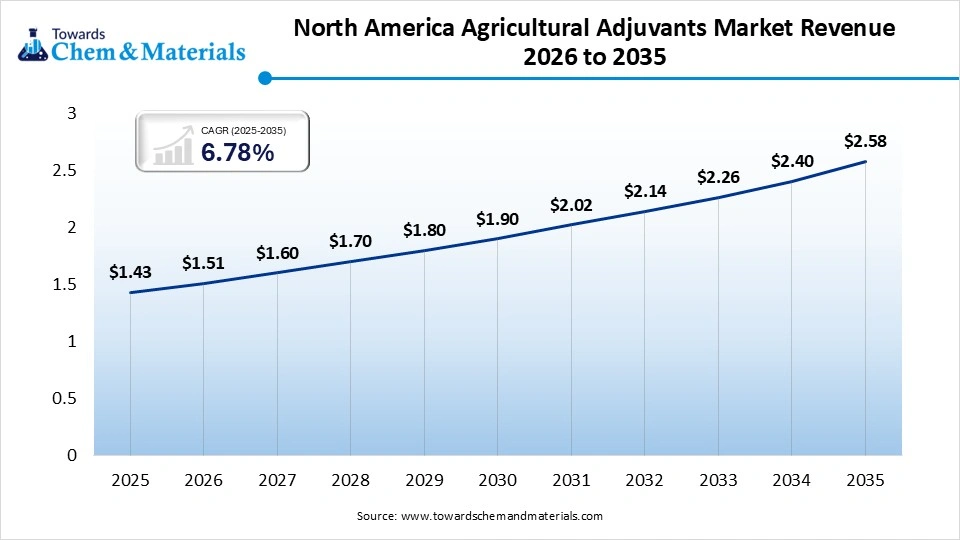
The North America agricultural adjuvants market size was estimated at USD 1.43 billion in 2025 and is projected to reach USD 2.58 billion by 2035, growing at a CAGR of 6.78% from 2026 to 2035. Farmers use modern equipment, precision agriculture, and high-quality inputs. This increases the demand for effective adjuvants. Strong awareness, better infrastructure, and large-scale commercial farming also support market growth.
High Tech Farming Drives Adjuvant Demand in the United States
United States maintained its dominance in the market, owing to large farms and high technology use. Farmers focus on maximizing yield and efficiency, which increases adjuvant demand. The country has strong research and development, leading to innovative products. Precision farming, drones, and smart spraying systems are widely used in this region.
Agricultural Adjuvants Market Evaluation in the Asia Pacific
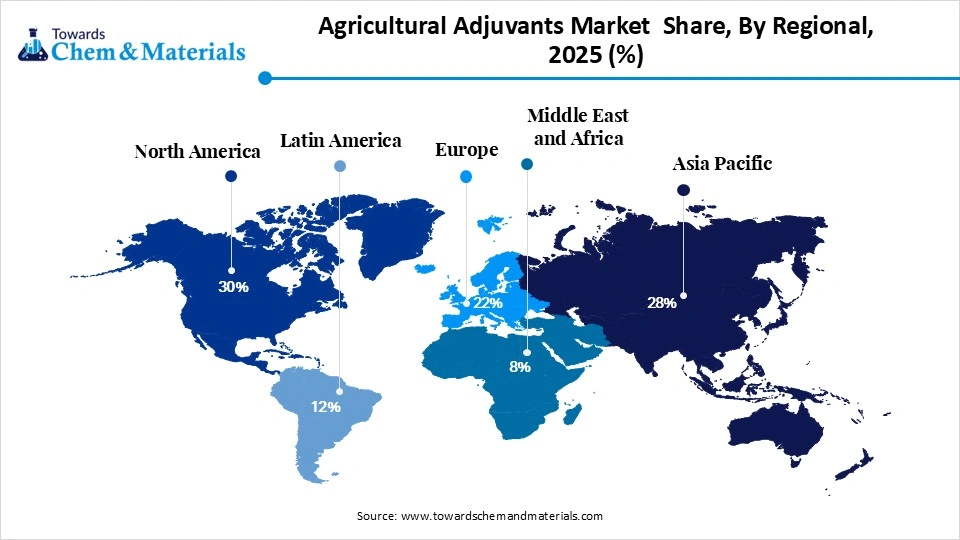
Asia Pacific held 27% market share in 2025 and is expected to be the fastest-growing region in the market with a CAGR of 7.80% in the forecast period, owing to rapid population growth and increasing food demand. Farmers are shifting from traditional to modern farming methods. Governments are supporting agricultural development with subsidies and training. Rising awareness about crop protection and productivity is increasing adjuvant use.
China Advances with Smart Farming Practices
China is expected to emerge as a prominent country for the agricultural adjuvants market in the coming years, due to agricultural modernization. The government is promoting efficient farming practices and reducing chemical waste. Farmers are adopting better crop protection methods, increasing adjuvant use. The country has a large farming population and high food demand.
Recent Developments
- In March 2026, Attune Agriculture unveiled its latest agriculture adjuvant. Also, a newly introduced adjuvant called Horizon A and its soil-applied adjuvant, which is designed to increase the performance of soil-applied insecticides and others, as per the company's claim.
Top Vendors in the Agricultural Adjuvants Market & Their Offerings
- Corteva Agriscience: Formed from the DowDuPont merger, Corteva is a pure-play agriculture leader. It develops high-performance activator and utility adjuvants designed to enhance the efficacy of its proprietary herbicides and fungicides. The company focuses on integrated solutions, combining advanced seed genetics with chemical crop protection and digital farming tools.
- BASF SE: This German chemical giant is a major provider of surfactants, solvents, and emulsifiers used in adjuvant formulations. BASF emphasizes "green chemistry," creating biodegradable products that improve pesticide penetration and rainfastness. Its extensive global R&D network focuses on reducing application rates while maintaining high crop yields and environmental safety.
- Syngenta AG: Owned by ChemChina, Syngenta is a global leader in crop protection and seeds. It manufactures a wide range of built-in and tank-mix adjuvants that optimize droplet size and reduce spray drift. The company invests heavily in precision application technologies, ensuring its adjuvant products are compatible with modern drone and nozzle systems
Agricultural Adjuvants Market Key Players
- Bayer AG
- Nufarm Limited
- Evonik Industries AG
- Croda International PLC
- Solvay SA
- Clariant AG
Agricultural Adjuvants Market Segments Covered in the Report
By Type
- Activator Adjuvants
- Surfactants
- Non-Ionic Surfactants
- Anionic Surfactants
- Cationic Surfactants
- Oil-Based Adjuvants
- Crop Oil Concentrates (COC)
- Methylated Seed Oils (MSO)
- Surfactants
- Utility Adjuvants
- Compatibility Agents
- Buffers & Acidifiers
- Drift Control Agents
- Defoaming Agents
- Water Conditioners
By Formulation Type
- Liquid Formulations
- Emulsifiable Concentrates
- Suspension Concentrates
- Dry Formulations
- Wettable Powders
- Water-Dispersible Granules
By Application
- Herbicides
- Pre-Emergence Herbicides
- Post-Emergence Herbicides
- Fungicides
- Insecticides
- Plant Growth Regulators
By Crop Type
- Cereals & Grains
- Wheat
- Rice
- Corn
- Oilseeds & Pulses
- Soybean
- Canola
- Lentils
- Fruits & Vegetables
- Leafy Vegetables
- Root Crops
- Fruits
- Plantation Crops
- Coffee
- Tea
- Cotton
By Technology
- Wetting Agents
- Spreading Agents
- Stickers
- Penetrants
- Drift Control Agents
By End User
- Farmers
- Agrochemical Companies
- Contract Applicators
By Regions
- North America
- U.S.
- Canada
- Mexico
- U.S.
- Europe
- Germany
- UK
- France
- Italy
- Spain
- Germany
- Asia Pacific
- China
- India
- Japan
- South Korea
- China
- Latin America
- Brazil
- Argentina
- Brazil
- Middle East & Africa
- Saudi Arabia
- South Africa
- Saudi Arabia
FAQ's
Question 1 : What are the key trends shaping the agricultural adjuvants market?
Answer : The greater shift towards modernisation of agriculture is the current industry trend.
Question 2 : Who are the key players in the agricultural adjuvants market?
Answer : Bayer AG, Nufarm Limited, and Evonik Industries AG are major players in the agricultural adjuvants market.
Question 3 : What are the major challenges faced by the market?
Answer : The primary challenge is Lack of awareness and technical knowledge among farmers regarding proper usage of adjuvants
Question 4 : Which region dominates the agricultural adjuvants market?
Answer : North America dominated the market in 2025, accounting for 32% market share, driven by advanced farming technologies and large-scale commercial agriculture.
Question 5 : Which region is expected to grow the fastest?
Answer : Asia Pacific is projected to be the fastest-growing region, with a CAGR of 7.80%, supported by rising population and increasing adoption of modern farming methods.
Meet the Team
Towards Chemical & Materials
Saurabh Bidwai, a B.Tech Chemical Engineering graduate with 4+ years of experience, specializes in specialty chemicals, commodity chemicals, and engineered materials, offering valuable insights into market trends and emerging opportunities.

Aditi Shivarkar
Reviewed By
Aditi Shivarkar, with 14+ years in Chemical and Materials market research, specializes in Chemical and Materials. She ensures accurate, actionable insights, driving Towards Chemicals And Materials Analytics and Consulting excellence in industry trends and sustainability.