
Antimicrobial Additives Market Size, Share & Trends Analysis Report by 2026-2035
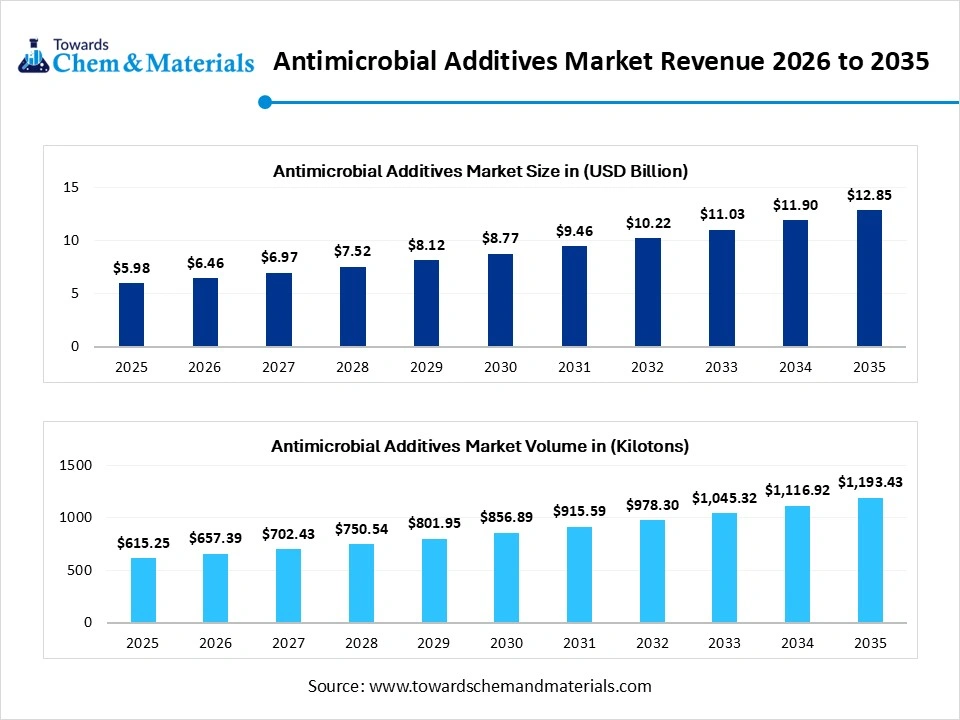
The antimicrobial additives market is witnessing steady growth, with its value projected to rise from USD 5.98 billion in 2025 to USD 12.85 billion by 2035, at a CAGR of 7.95%, while volume is expected to grow from 615.25 kilotons to 1,193.43 kilotons at a CAGR of 6.85%. This report offers in-depth insights into market size, segmentation, regional trends, company analysis, competitive benchmarking, value chain structure, trade flows, and detailed data on manufacturers and suppliers.
Content
Antimicrobial Additives Market Size, Share, Trends and Forecast Analysis
The global antimicrobial additives market was valued at USD 5.98 billion in 2025, is estimated to reach USD 6.46 billion in 2026, and is projected to reach USD 12.85 billion by 2035, growing at a CAGR of 7.95% from 2026 to 2035. In terms of volume, the antimicrobial additives market is projected to grow from 615.25 Kilotons in 2025 to 1,193.43 Kilotons by 2035. growing at a CAGR of 6.85% from 2026 to 2035.
Key Takeaways
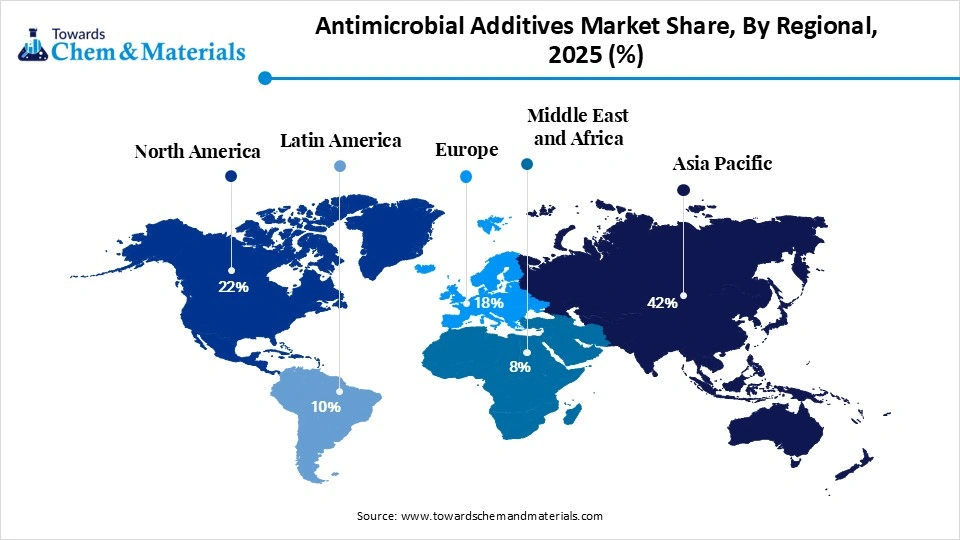
- Asia Pacific dominated the antimicrobial additives market with the largest revenue share of 42% in 2025.
- By type, the inorganic segment led the market with the largest revenue share of 65% in 2025.
- By application, the paints & coatings segment led the market with the largest revenue share of 38% in 2025.
- By end use, the healthcare segment led the market with the largest revenue share of 28% in 2025.
Market Size and Volume Forecast
- Market Estimated Size (2025): USD 5.98 Billion | CAGR (2026–2035): 7.95%
- Market Projected Size (2035): USD 12.85 Billion
- Market Volume (2025): 615.25 Kilotons (KT) | Volume CAGR (2026–2035): 6.85%
- Market Projected Volume (2035): 1,193.43 Kilotons (KT)
- Market Pricing (2025):
- Average Manufacturing Price: USD 5.66/kg
- Average Selling Price: USD 7.96/kg
- Pricing CAGR (2025–2035): 3.10%
Market Overview
The antimicrobial additives are a hygiene-enhanced solution represented as performance chemicals that are integrated with built-in protection against microscopic organisms. The rising focus on preventing initial bacterial attachment in biofilm is driving the market expansion. It acts as a biocidal agent that prevents bad odor, stains, and physical decay and offers mechanical stability, transparency and biocompatibility.
The stringent regulatory compliance for biocidal products and standardized lab protocols to ensure reduction in microbial rate and efficacy testing enable growth. The implementation is especially in food-grade packaging, antimicrobial textiles and medical devices that focus on hygiene and sustainability.
Antimicrobial Additives Market Trends
- Regulation for Infection Control: The rising healthcare-associated infection is a key driver for the adoption of antimicrobial additives, especially in surgical gowns and post-pandemic hygiene products.
- Revolution in Antimicrobial Additive Innovation: The new formulation of additives focuses on bacteria, viruses, and allergens, which are utilized to prevent microbial degradation, offering durability and hygiene.
Report Scope
| Report Attribute | Details |
| Market Size and Volume in 2026 | USD 5.03 Billion / 2.68 Million Metric Tons |
| Expected Size and Volume by 2035 | USD 8.47 Billion / 4.25 Million Metric Tons |
| Growth Rate from 2026 to 2035 | CAGR 5.95% |
| Forecast Period | 2026 - 2035 |
| Dominant Region | Asia Pacific |
| Segment Covered | By Type, By Application, By End Use and By Regions |
| Key companies profiled | NanoBioMatters Industries S.L, BASF SE, RTP Company, Milliken Chemical, BioCote Limited, Microban International, Clariant AG, PolyOne Corporation, Momentive Performance Materials Inc., Life Materials Technologies Limited, SteriTouch Limited, Sanitized AG, Dow Inc., LyondellBasell Industries Holdings B.V., Plastics Color Corporation, Lonza |
Key Technological Shifts and AI in the Antimicrobial Additives Market
The technological shift is defined by AI-driven molecular discovery and the integration of nanotechnology in the antimicrobial additives market. Machine learning enables the determination of minimum inhibitory concentration and determines novel antimicrobial compounds with precision-engineered performance.
The technological advancement boosts innovation in bio-based additives, biofilm-resistant surface, pH-responsive smart coating and non-leaching silver nanoparticles for intelligent healthcare and active packaging. Overall, AI enables performance and efficiency testing with high-tech protection.
Trade Analysis of the Antimicrobial Additives Market: Import and Export Statistics
- The United Kingdom exported 350 shipments of antimicrobial additives.
- The United States exported 119 shipments of antimicrobial additives.
- Russia exported 38 shipments of antimicrobial additives.
- From May 2024 to April 2025, the world exported 438 shipments of antimicrobial additives.
Supply Chain Analysis of the Antimicrobial Additives Market
Molecular Extraction and Synthesis:
The stage of high-purity chemical engineering where raw material providers focus on antimicrobial agents’ stability, where refined inorganic metals are converted into microscopic particles by ensuring degradation.
- Key Players: Nouryon, Lonza, AkzoNobel, and Evonik Industries
Formulation and Masterbatching:
The stage where the formulators create a masterbatch that contains antimicrobial agents that are dispersed within carrier resin by ensuring germ-killing power, thermal stability, and operational effectiveness.
- Key Players: Sanitized AG, Avient Corporation, BASF SE and Microban International
Functional Integration:
The final stage of additives becomes a marketable feature where brand owners incorporate these masterbatches into the production line. The finished product is used in healthcare, packaging, and consumer goods.
- Key Players: DuPont, Berry Global, Milliken & Company
Regulatory Framework: Antimicrobial Additives Market
| Region | Key Regulation | Regulatory Focus |
| North America | FIFRA (Federal Insecticide, Fungicide, and Rodenticide Act), EPA Standards | Focus on the intent of the additive that protects the consumer from germs. Registration of products to protect human and environmental risk assessment |
| Asia Pacific | Food Sanitation Act, GB Standards, FSSAI Regulation, and Drug and Cosmetic Act | Standard for food-contact materials, operated a positive list system, and focused on prohibiting harmful antibiotics in the local ecosystem. Additionally, self-regulation focuses on migration limits. |
| Europe | ECHA, BPR (Biocidal Products Regulation EU 528/2012) | The standards focus on endocrine disruption and long-term environmental toxicity, especially for active substances and biocidal products. |
Antimicrobial Additives Market Dynamics
Driver
The Competitive Supply Chain
The chemical formulator, medicine producer and end-use manufacturers are increasingly shifting towards the advancement of antimicrobial additives and hygiene-maintaining criteria that driving extensive investment and strategic investment between major players for the final antimicrobial use to the consumer.
Restraints
Higher Making Costs and Low Resilience
The antimicrobial additives contain expensive engineering processes that, unfortunately, drive high manufacturing costs over standard additives, while some additives loss its efficiency after a certain concentration, leading to variable performance.
Opportunity
Rising Focus on Bio-based and Clean Solutions
The key opportunity driven by manufacturers that are focusing on sustainability and green chemistry, which includes bio-based organic additives and plant-derived extracts as natural alternatives, while maintaining safety and recyclability.
Segmental Insights
Type Insights
The Inorganic Segment Dominated the Antimicrobial Additives Market in 2025
The inorganic segment dominated the market with the largest share in 2025, driven by its thermal resilience and higher longevity. The demand for sustainable manufacturing inorganic system utilized metal-based ions, including copper, zinc and silver, that embed protection directly into thermoplastic polymer, preventing microbial degradation. The segment is key for food packaging, medical, and construction sectors by maintaining non-leaching and broad-spectrum efficacy to meet circular economy goals.
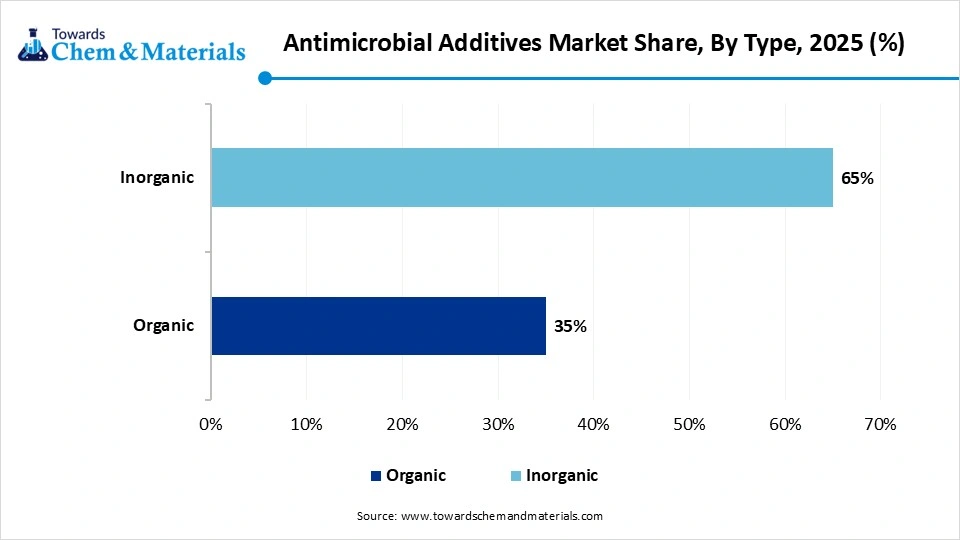
The organic segment is expected to grow at the fastest CAGR in the market over the forecast period due to its high precision, cost-effectiveness, and fast performance with operational efficiency. The organic type is a synthetic and bio-derived compound, similar to isothiazolinones, pyrithione, that is utilized in textiles, packaging, and liquid coating as a non-toxic, biodegradable alternative that kills bacteria. The stringent safety standards and consumer demand for environmental stability boost the expansion.
Application Insights
The Paints & Coatings Segment Dominated the Antimicrobial Additives Market in 2025
Paints & coatings segment dominated the market with the largest share in 2025 due to biocidal protection for residential and industrial surfaces and engineering, avoiding colonization of mold, bacteria and mildew. The paints & coatings integrate silver-ion and zinc-pyrithione technologies to form shielded industrial films and self-sanitizing coatings by ensuring long-term efficacy and color durability. Additionally, the segment focuses on low-VOC formulation and long-lasting microbial resistance to meet stringent safety standards.
Antimicrobial Additives Market Share, By Application, 2025 (%)
| By Application | Revenue Share, 2025 (%) |
| Plastics | 35% |
| Paints & Coatings | 38% |
| Pulp & Paper | 15% |
| Others | 12% |
Plastics segment expected to grow at the fastest CAGR in the market over the forecast period because of its ability to transform material into intrinsically hygienic surfaces and microbial resistance. The plastics manufacturers' focus on sustainable masterbatches and self-sanitizing polymers aligns with recycled plastic streams. The segment demand for structural durability makes it ideal for mass-volume goods by embedding inorganic ions during manufacturing.
Pulp & paper segment held the significant market share in 2025, driven by rising focus on bio-fouling inhibition and product sterility. The segment is injecting active agents into pulp slurry that resist bacterial and fungal growth by creating self-sanitizing sheets. The antimicrobial additives are essential for medical-based paper, hygiene-grade tissues and packaging by ensuring safety and microbial degradation. Additionally, the demand for biodegradability and recyclability in paper product boosting the expansion.
End Use Insights
The Healthcare Segment Dominated the Antimicrobial Additives Market in 2025
The healthcare segment dominated the market with the largest share in 2025, defined by the requirement of eliminating hospital-acquired infection using molecular-level sterility copper-based additive and silver-ion technology embedded into the healthcare sector, especially in manufacturing self-sanitizing catheters, patient equipment and surgical tools to protect against biofilms and multidrug-resistant bacteria. Additionally, the healthcare innovation focuses on the mechanical integrity of biocompatible additives and non-leaching defense to meet health safety standards.
Antimicrobial Additives Market Share, By End Use, 2025 (%)
| By End Use | Revenue Share, 2025 (%) |
| Healthcare | 28% |
| Packaging | 19% |
| Food & Beverage | 12% |
| Building & Construction | 15% |
| Automotive & Transportation | 10% |
| Textile | 9% |
| Consumer Goods | 7% |
The food and beverage segment is expected to grow at the fastest CAGR over the forecast period, driven by a rising population that demands food chain safety and food product longevity by ensuring pathogen control and hygiene barrier. The shift towards recycled food-grade plastics incorporates FDA compliance to create a shield against foodborne pathogens, and research focuses on non-migratory additives into packaging and processing hardware.
Packaging segment held the significant market share in 2025 due to innovation in the food and pharmaceutical sector to maintain product purity and protection, integrating recyclability and circular economy standards. The packaging sector focuses on active microbial shield and lowering food waste by permeating zinc and silver ion additives to avoid cross-contamination and ensuring extended shelf life, especially for fresh products and medical suppliers, ensuring hygiene.
Building & construction segment held notable market share in 2025, driven by demand for structural longevity in building and indoor air quality. The zinc and silver ion technology integrates into insulation, drywall and HVAC systems to prevent black mold and fungus growth in moisture-heavy construction. The focus on smart high-traffic public building infrastructure and built-in hygiene that offers durability, fire resistance and self-sanitizing surfaces in construction material.
Regional Insights
How Did The Asia Pacific Dominated The Antimicrobial Additives Market?
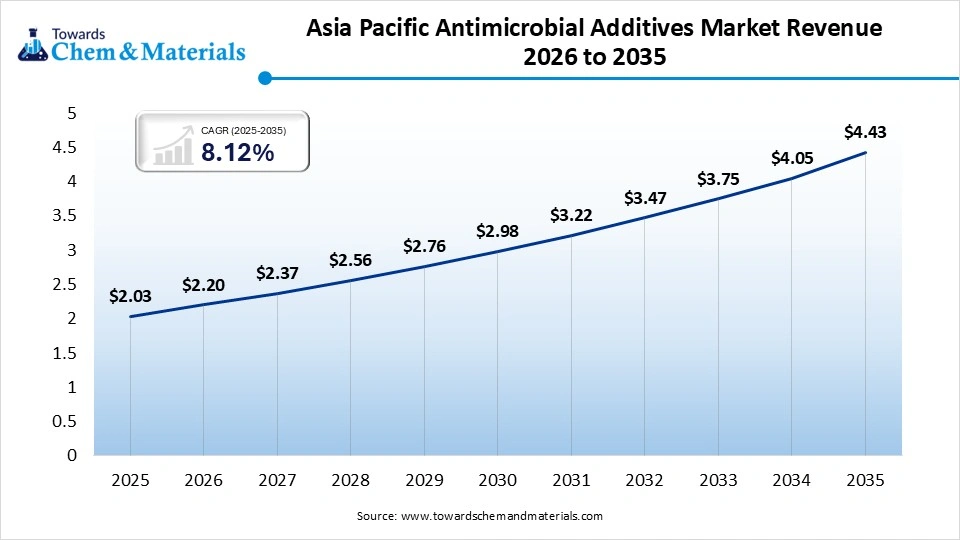
The Asia Pacific antimicrobial additives market size was estimated at USD 2.03 billion in 2025 and is projected to reach USD 4.43 billion by 2035, growing at a CAGR of 8.12% from 2026 to 2035 The regional substantial investment for self-sanitizing surfaces and public demand for protection of textiles through antimicrobial additives to prevent microbial damage to meet climatic and export safety standards is accelerating the domestic growth.
China Antimicrobial Additives Market Growth Trends
China's market expansion is influenced by its diversified consumer demand for hygiene-focused material and its self-sanitizing surface hub. The rapid urbanization driving scalability and cost-effective chemical systems, driving domestic growth. The major players in China are adopting silver and zinc-based technology, driving innovation for mass-produced consumer goods by using integrated antimicrobial masterbatch, fueling the expansion.
North America expected to grow at the fastest CAGR in the market during the forecast period, driven by a regional shift towards embedded protection and hygiene in medical, food-contact packaging and healthcare sectors. The domestic players are integrating metal-based ions and ensuring broad-spectrum efficacy. The region focuses on demand for microbial resistance in construction and bio-based additives to meet EPA and FDA compliance. Additionally, North America consumer demand for residual hygiene and sustainable solutions enables market expansion.
U.S Antimicrobial Additives Market Growth Trends
The United States market especially focuses on the integration of antimicrobial material into the molecular structure of synthetic and thermoplastic fibers. The U.S. based manufactures adopting inorganic metal ions in the medical and food-service sectors to meet stringent regulatory compliance. The regional shift towards green chemistry and recycled plastic that offer advanced infection control is driving the implementation of antimicrobial additives.
Recent Developments
- In October 2025, at K 2025, LG Electronics unveiled core product lines for LG PuroTec™, glass matrix-based antimicrobial additives in Germany. The solution targets industries including home appliances, construction, automotive, healthcare and packaging.
- In September 2025, Microban International's strategic collaboration with Curie Co to develop advanced bio-based preservation system cleaning products and coatings. Partnership merging Curie Co's organic acid platforms with Microban's Additive GS technology, allowing a water-soluble antimicrobial solution.
- In February 2025, Avient Corporation launched Cesa™ WithStand™ SX Low Haze additives as anti-microbial agents. The additives offer protection against fungi and bacteria growth by maintaining clarity and aesthetics for polycarbonate and plexiglass applications using recycled resin.
Top Companies in the Antimicrobial Additives Market
- NanoBioMatters Industries S.L
- BASF SE
- RTP Company
- Milliken Chemical
- BioCote Limited
- Microban International
- Clariant AG
- PolyOne Corporation
- Momentive Performance Materials Inc.
- Life Materials Technologies Limited
- SteriTouch Limited
- Sanitized AG
- Dow Inc.
- LyondellBasell Industries Holdings B.V.
- Plastics Color Corporation
- Lonza
Antimicrobial Additives Market Segment Covered in the Report
By Type
- Organic
- Inorganic
- Silver
- Copper
- Zinc
By Application
- Plastics
- Paints & Coatings
- Pulp & Paper
- Others
By End Use
- Healthcare
- Minimally Invasive Medical Products
- Endotracheal Tubes
- Wound dressing
- Surgical drapes
- Syringes
- Re-usable Medical items
- Hospital Bedding
- Dental trays
- Beds
- Hospital gowns
- Orthopedic devices
- Laparoscopic Instruments
- Medical Scrubs
- Packaging
- Food Packaging
- Active Packaging
- Controlled Release Packaging
- Non-Food Packaging
- Food Packaging
- Food & Beverage
- Bakery Food
- Beverages
- Dairy
- Meat Processing
- Building & Construction
- Insulation
- Faucets & Fixtures
- Door Hardware
- Sealants & Grouts
- Carpet
- Paints
- OSB
- Melamine
- Others
- Automotive & Transportation
- Passenger Cars
- Light Commercial Vehicles
- Heavy Commercial Vehicles
- Train
- Aeroplanes
- Textile
- Apparels
- Home Textiles
- Footwear
- Sport Textiles
- Non-woven
- Others
- Consumer Goods
- Cleaning Products
- Cosmetics
- Toys
- Others
By Regions
- North America
- U.S.
- Canada
- Mexico
- U.S.
- Europe
- Germany
- UK
- France
- Italy
- Spain
- Germany
- Asia Pacific
- China
- India
- Japan
- South Korea
- China
- Latin America
- Brazil
- Argentina
- Brazil
- Middle East & Africa
- Saudi Arabia
- South Africa
- Saudi Arabia
FAQ's
Question 1 : Which region dominates the antimicrobial additives market?
Answer : Asia Pacific dominated the market in 2025 due to strong manufacturing capabilities, growing population, and rising demand for hygiene-focused products.
Question 2 : Which region is expected to grow the fastest?
Answer : North America is expected to witness the fastest growth during the forecast period, driven by advanced healthcare infrastructure, regulatory compliance, and demand for sustainable antimicrobial solutions.
Question 3 : Which type segment holds the largest market share?
Answer : The inorganic segment dominated the market in 2025 due to its superior durability, thermal stability, and long-lasting antimicrobial effectiveness, particularly in silver, copper, and zinc-based additives.
Question 4 : Which type segment is expected to grow the fastest?
Answer : The organic segment is projected to grow at the fastest CAGR, driven by increasing demand for eco-friendly, biodegradable, and cost-effective antimicrobial solutions.
Question 5 : How is AI influencing the antimicrobial additives market?
Answer : AI is enabling faster discovery of antimicrobial compounds, optimizing formulations, and improving efficacy testing, which accelerates innovation and reduces development costs.
Meet the Team

Saurabh Bidwai
Principal Consultant
Saurabh Bidwai, a B.Tech Chemical Engineering graduate with 4+ years of experience, specializes in specialty chemicals, commodity chemicals, and engineered materials, offering valuable insights into market trends and emerging opportunities.

Aditi Shivarkar
Reviewed By
Aditi Shivarkar, with 14+ years in Chemical and Materials market research, specializes in Chemical and Materials. She ensures accurate, actionable insights, driving Towards Chemicals And Materials Analytics and Consulting excellence in industry trends and sustainability.