
Antimicrobial Plastic Market Manufacturers & Suppliers Company Analysis 2026-2035
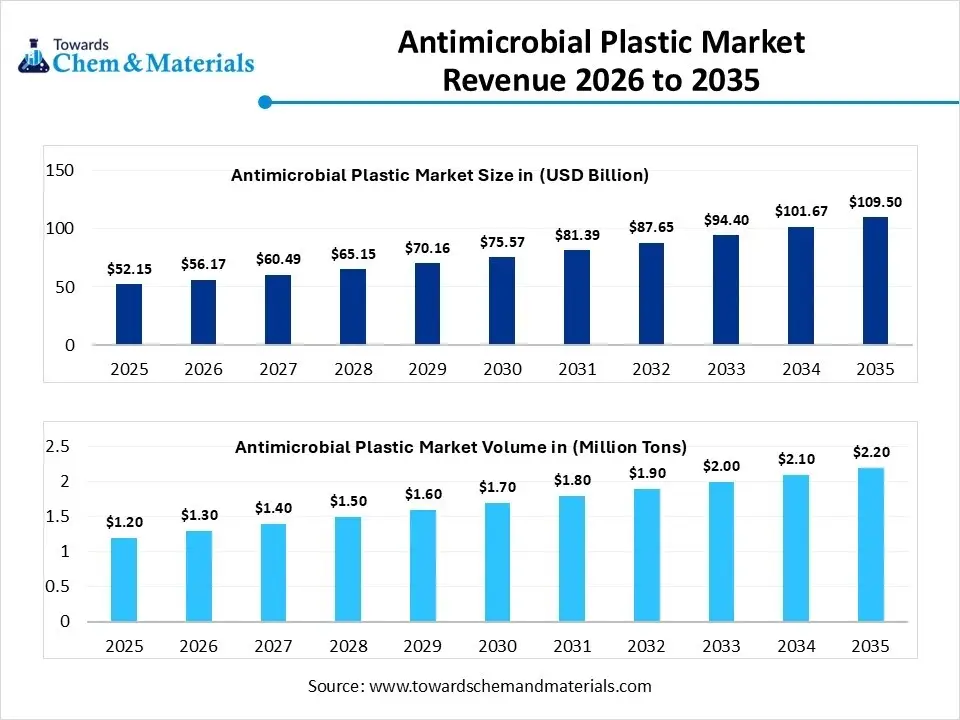
The global antimicrobial plastic market size is expected to grow from USD 56.17 billion in 2026 to USD 109.50 billion in 2035, growing at a CAGR of 7.7% from 2026 to 2035. The top key players in the market are BASF, Dow Inc, DuPont, Clariant, Lonza, Microban International, Tosaf Group, Avient Corporation, Sanitized AG, Milliken & Company, BioCote, LyondellBasell, PolyOne, Plastics Color Corporation, RTP Company - Global Forecast 2026 To 2035
Content
What is the Current Antimicrobial Plastic Market Size and Volume?
The global antimicrobial plastic market size was estimated at USD 52.15 billion in 2025 and is expected to increase from USD 56.17 billion in 2026 to USD 109.5 billion by 2035, growing at a CAGR of 7.7% from 2026 to 2035. In terms of volume, the market is projected to grow from 1.2 million tons in 2025 to 2.2 million tons by 2035. growing at a CAGR of 6.30% from 2026 to 2035. Asia Pacific dominated the Antimicrobial Plastic market with the largest volume share of 36.0% in 2025.The growing product demand in the healthcare sector is the key factor driving market growth. Also, a surge in hygiene awareness, coupled with the stringent environmental regulations, can fuel market growth further.
The market includes the manufacturing, formulation, and supply of plastic materials incorporated with antimicrobial agents to inhibit the growth of bacteria, fungi, mold, and other microorganisms on plastic surfaces. These materials are widely used in healthcare, packaging, consumer goods, automotive interiors, construction materials, and electronics to improve hygiene, reduce contamination, and enhance product lifespan.
Key Takeaways
- The Asia Pacific dominated the antimicrobial plastic market with the largest volume share of 36.0% in 2025.
- The antimicrobial plastic market in North America is expected to grow at a substantial CAGR of 7.07% from 2026 to 2035.
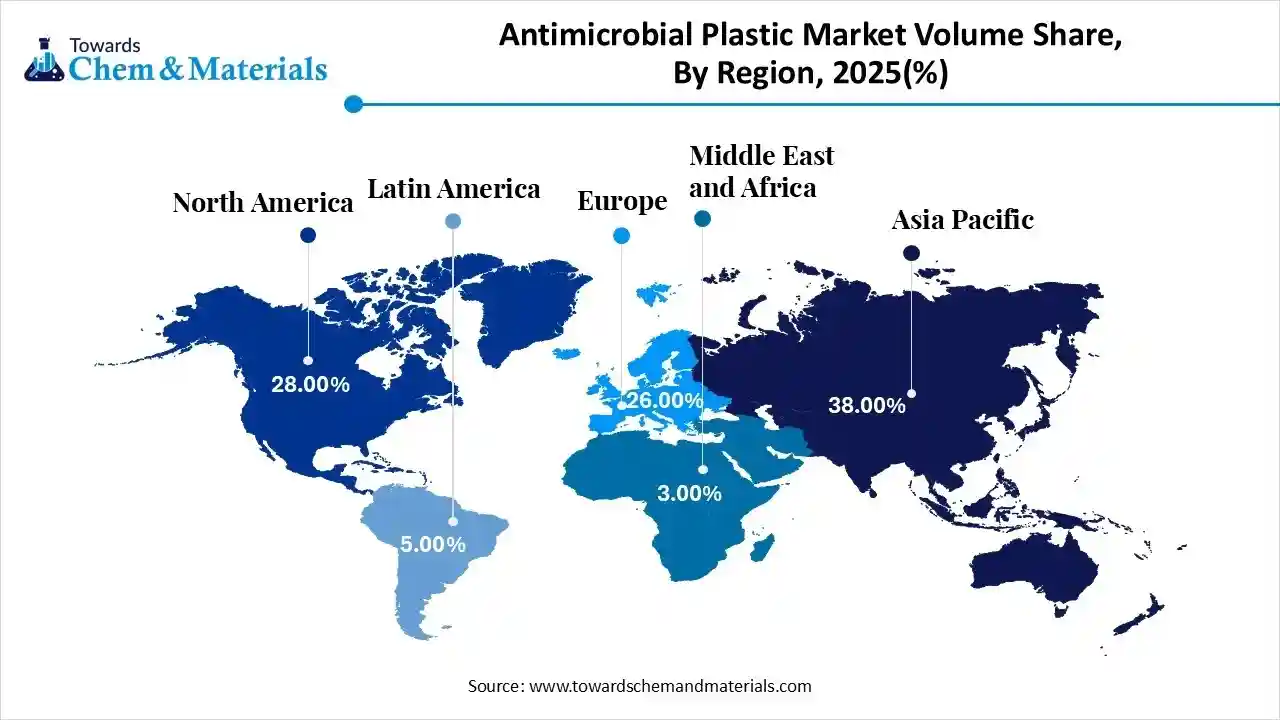
- The Europe antimicrobial plastic market segment accounted for the major volume share of 26.00% in 2025.
- By plastic type, the polyethylene (PE) segment dominated the market and accounted for the largest volume share of 26.00% in 2025.
- By plastic type, the engineering plastics segment is expected to grow at the fastest CAGR of 7.82% from 2026 to 2035 in terms of volume.
- By antimicrobial agent, the silver-based agents segment led the market with the largest revenue volume share of 38.0% in 2025.
- By application, the medical & healthcare segment dominated the market and accounted for the largest volume share of 30.0% in 2025.
Antimicrobial Plastic Market Trends
- The growing adoption of antimicrobial plastics in the healthcare sector is the latest trend in the market. The growing emphasis on hygiene, particularly in the domain of stringent hospital regulations and rapid innovations in antimicrobial additives, has facilitated the creation of effective plastics.
- The growing demand for sustainable antimicrobial solutions is shaping positive market growth in the near future. These solutions are specific to eco-conscious industries and consumers aligning with ongoing efforts to reduce carbon footprints and plastic waste.
- The growing antimicrobial plastic demand in the consumer goods sector is another major trend in the market. This is majorly fuelled by the rise in consumer awareness regarding safety and hygiene. Products like toys, kitchenware, and personal care items are rapidly adding antimicrobial plastics.
Report Scope
| Report Attribute | Details |
| Market Size and Volume in 2026 | USD 56.17 Billion / 1.3 Million Tons |
| Revenue Forecast in 2035 | USD 109.50 Billion / 2.2 Million Tons |
| Growth Rate | CAGR 7.7% |
| Forecast Period | 2026 - 2035 |
| Base Year | 2025 |
| Units Considered | Value (Billion / Million), Volume (Million Tons) |
| Dominant Region | Asia Pacific |
| Segment Covered | By Plastic Type, By Antimicrobial Agent, By Application, By Region |
| Key companies profiled | BASF, Dow Inc, DuPont, Clariant, Lonza, Microban International, Tosaf Group, Avient Corporation, Sanitized AG, Milliken & Company, BioCote, LyondellBasell, PolyOne, Plastics Color Corporation, RTP Company |
How Cutting-Edge Technologies Are Revolutionizing the Antimicrobial Plastic Market?
Advanced technologies such as AI-driven design and nanotechnology are revolutionising the market by creating more durable, effective, and sustainable materials and incorporating them smoothly into products. Furthermore, AI algorithms can process large datasets to optimise material discovery, forecast material performance, and enhance overall production efficiency.
Trade Analysis of the Antimicrobial Plastic Market: Import & Export Statistics
- In 2024, plastic waste exports were valued at $3.15 billion, according to trade data.
- India's plastics exports grew by 8% in FY 2024-25, reaching $12.5 billion, up from $11.5 billion in the prior fiscal year, demonstrating India's increasing strength in the global market for plastic products.
Antimicrobial Plastic Market Value Chain Analysis
- Feedstock Procurement: It involves the sourcing of raw materials essential to produce polymers and other antimicrobial agents to manufacture antimicrobial plastic products.
- Major Players: Dow Inc. & DuPont, BASF SE.
- Chemical Synthesis and Processing: It refers to the specialised production techniques used to combine active antimicrobial agents like zinc oxides or organic biocides into polymer matrices.
- Major Players: Covestro AG, Sanitized AG
- Packaging and Labelling :It involves the integration of antimicrobial agents directly into plastic materials to stop microbial growth, extending overall product shelf life.
- Major Players: Sealed Air Corporation, Berry Global
- Regulatory Compliance and Safety Monitoring: It is a critical stage for adhering to health, environmental, and safety (EHS) standards, fuelled by strict regulatory guidelines.
- Major Players: BioCote Limited, Sanitized AG
Antimicrobial Plastic Market 's Regulatory Landscape: Global Regulations
| Country/Region | Key Regulations |
| United States | The regulatory framework is a dual jurisdiction between the Environmental Protection Agency (EPA) and the Food and Drug Administration (FDA). |
| Europe | Regulation in Europe is primarily harmonized under the Biocidal Products Regulation (BPR, Regulation (EU) No 528/2012). The BPR aims to ensure a high level of protection for human health, animal health, and the environment. |
| Japan | Regulations are evolving with a focus on public health, food safety, and environmental standards. The Ministry of Economy, Trade and Industry (METI) and Ministry of Health, Labour and Welfare (MHLW) are key bodies. |
Segmental Insights
Plastic Type Insights
How Much Share Did the Polyethylene (PE) Segment Held in 2025?
The polyethylene (PE) segment volume was valued at 0.3 million tons in 2025 and is projected to reach 0.6 million tons by 2035, expanding at a CAGR of 7.13% during the forecast period from 2025 to 2035. The polyethylene (PE) segment dominated the market with nearly 26.0% share in 2025. The dominance of the segment can be attributed to its widespread use in packaging, consumer goods, and medical disposables. In addition, PE's lightweight nature, durability, and robust chemical resistance make it crucial for integrating various antimicrobial agents.
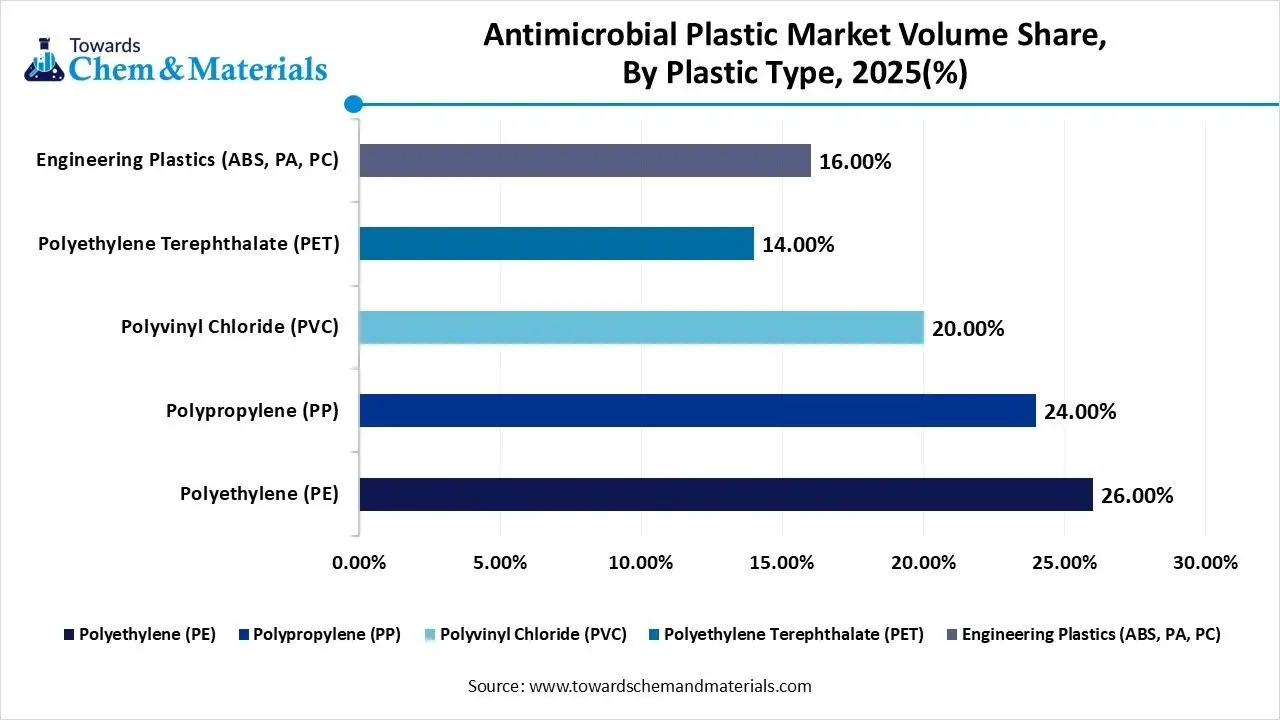
The engineering plastics segment volume was valued at 0.2 million tons in 2025 and is projected to reach 0.4 million tons by 2035, expanding at a CAGR of 7.82% during the forecast period from 2025 to 2035. The engineering plastics segment is expected to grow at the fastest CAGR over the forecast period. The growth of the segment can be credited to the increasing need for hygiene in high-performance areas, fuelled by a surge in consumer awareness regarding sustainability. Engineering plastics are increasingly used where durability and performance requirements are higher, such as in construction and automotive.
Antimicrobial Plastic Market Volume and Share, By Plastic Type, 2025-2035
| By Plastic Type | Market Volume Share (%), 2025 | Market Volume ( Million Tons)2025 | Market Volume (Million Tons)2035 | CAGR(%) 2026-2035 | Market Volume Share (%), 2035 |
| Polyethylene (PE) | 26.00% | 0.3 | 0.6 | 7.13% | 26.24% |
| Polypropylene (PP) | 24.00% | 0.3 | 0.5 | 6.58% | 23.12% |
| Polyvinyl Chloride (PVC) | 20.00% | 0.2 | 0.5 | 7.21% | 20.31% |
| Polyethylene Terephthalate (PET) | 14.00% | 0.2 | 0.3 | 6.34% | 13.22% |
| Engineering Plastics (ABS, PA, PC) | 16.00% | 0.2 | 0.4 | 7.82% | 17.11% |
Antimicrobial Agent Insights
Which Antimicrobial Agent Type Segment Dominated Antimicrobial Plastic Market in 2025?
The silver-based agents segment held a nearly 38.0% market share in 2025. The dominance of the segment can be linked to its broad-spectrum antimicrobial efficacy and long-lasting performance. Silver nanoparticles can smoothly be integrated into different polymers like PP, PVC, and PE, improving the overall plastic's antibacterial properties.
The organic antimicrobials segment is expected to grow at the fastest CAGR over the forecast period. The growth of the segment can be driven by rapid technological innovations in additive formulations, along with the growing emphasis on biodegradability and sustainability. Moreover, Organic antimicrobial additives are gaining traction in food-contact and consumer applications due to regulatory acceptance and lower metal content.
Application Insights
Which Application Type Segment Dominated Antimicrobial Plastic Market in 2025?
The medical & healthcare segment dominated the market with nearly 30.0% share in 2025. The dominance of the segment is owed to stringent hygiene requirements and infection control standards. Antimicrobial plastics provide chemical resistance, durability, biocompatibility, and stain resistance crucial for implants, surgical tools, and hospital furnishings, contributing to segment growth soon.
The packaging segment is expected to grow at the fastest CAGR over the forecast period. The growth of the segment is due to growing demand for longer shelf life, a surge in food safety concerns, and rapid urbanisation in emerging economies. Furthermore, the rising demand for microwaveable, ready-to-eat, and minimally processed foods benefits from antimicrobial packaging. Packaging applications are expanding rapidly, particularly in food and pharmaceutical packaging.
Regional Insights
The Asia Pacific antimicrobial plastic market size was valued at USD 18.75 billion in 2025 and is expected to be worth around USD 39.44 billion by 2035, exhibiting at a compound annual growth rate (CAGR) of 7.72% over the forecast period from 2026 to 2035.
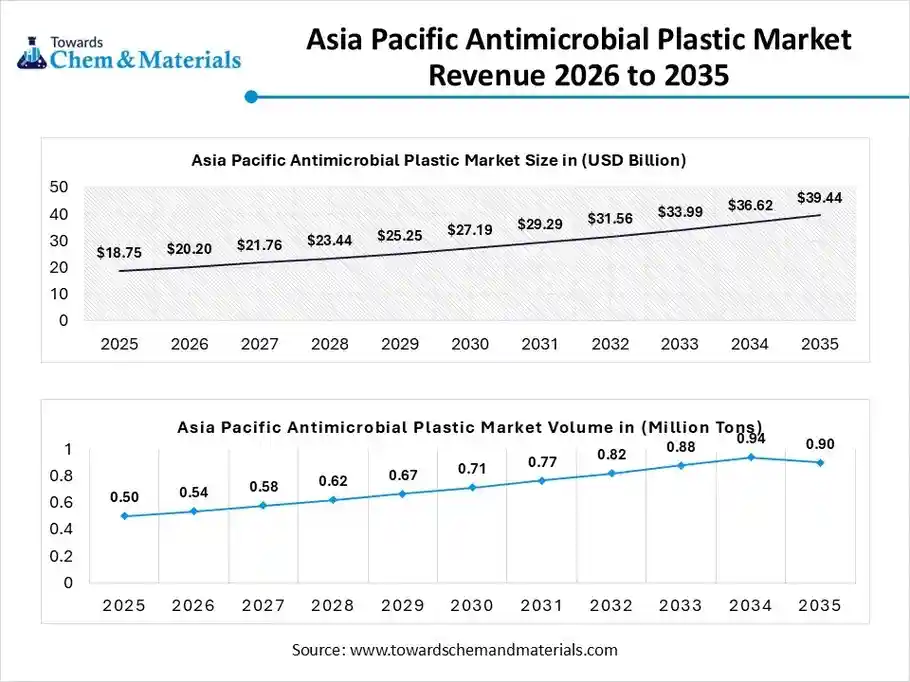
The Asia Pacific antimicrobial plastic volume was estimated at 0.5 million tons in 2025 and is projected to reach 0.9 million tons by 2035, growing at a CAGR of 7.41% from 2026 to 2035.Asia Pacific dominated the market with nearly 36.0% share in 2025. The growth of the region can be attributed to the increasing health awareness, ongoing industrialization, and urbanization. In addition, supportive government policies and health agendas in the emerging nations in the region optimise the use of antimicrobial materials.
China Antimicrobial Plastic Market Trends
In the Asia Pacific, China dominated the market owing to a growing demand for improved product safety and shelf life, along with the growing consumption of packaged foods. Also, the ongoing development of sustainable, effective, and innovative antimicrobial additives can impact positive market growth in the country further.
North America Antimicrobial Plastic Market Trends
The North America antimicrobial plastic volume was estimated at 0.3 million tons in 2025 and is projected to reach 0.6 million tons by 2035, growing at a CAGR of 7.07% from 2026 to 2035.North America expected to grow at the fastest CAGR over the forecast period. The growth of the region can be credited to the increasing product demand from major sectors such as automotive, packaging, healthcare, and construction. Moreover, government bodies such as the EPA and FDA are increasingly enforcing regulations that propel the demand for antimicrobial materials.
U.S. Antimicrobial Plastic Market Trends
In North America, the U.S. led the market due to a surge in the prevalence of hospital-acquired infections (HAIs) coupled with the rising need for advanced medical devices. The ongoing integration of cutting-edge materials such as nanofibers and graphene into plastic manufacturing is improving the filtration and protective properties of the material.
 Europe Antimicrobial Plastic Market Trends
The Europe antimicrobial plastic volume was estimated at 0.3 million tons in 2025 and is projected to reach 0.6 million tons by 2035, growing at a CAGR of 7.01% from 2026 to 2035. Europe held a significant market share in 2025. The growth of the region can be driven by a surge in consumer hygiene awareness and the increasing need for longer-shelf-life food packaging. Furthermore, robust emphasis on preventing Healthcare-Associated Infections (HAIs) fuels product use in hospital furniture, medical devices, and high-touch surfaces, supported by bodies like the ECDC.
Germany Antimicrobial Plastic Market Trends
The growth of the market in the country can be fuelled by heavy investment in healthcare, coupled with the stringent EU regulations boosting the adoption of safer materials. Also, major companies in the country are emphasizing combining some innovative features into products to fulfill consumer expectations and regulatory demands.
Global Antimicrobial Plastic Market Volume and Share, By Region, 2025-2035
| By Region | Market Volume Share (%), 2025 | Market Volume ( Million Tons)2025 | Market Volume (Million Tons)2035 | CAGR(%) 2026-2035 | Market Volume Share (%), 2035 |
| North America | 28.00% | 0.3 | 0.6 | 7.07% | 28.12% |
| Europe | 26.00% | 0.3 | 0.6 | 7.01% | 25.98% |
| Asia Pacific | 38.00% | 0.5 | 0.9 | 7.40% | 39.21% |
| Latin America | 5.00% | 0.1 | 0.1 | 5.80% | 4.51% |
| Middle East & Africa | 3.00% | 0.0 | 0.0 | 3.29% | 2.18% |
Recent Developments
- In September 2025, Sintex introduced India's first anti-microbial CPVC pipes in Chandigarh. The company has launched an extensive range of pipes, including UPVC, SWR, CPVC, Underground Drainage & Surface Drainage pipes and fittings. These pipes are manufactured to smoothly manage hot and cold water.(Source: www.babushahi.com)
Antimicrobial Plastic Market Companies
- BASF: BASF is a dominant global leader in the antimicrobial plastic market, leveraging its extensive chemical expertise to provide both dedicated antimicrobial polymers and additives.
- Dow Inc: Dow Inc. is a key player in the antimicrobial plastic additives market, leveraging its extensive research network and global presence to innovate solutions. The company primarily offers specialized additives that manufacturers incorporate into various plastic products to inhibit microbial growth.
- DuPont
- Clariant
- Lonza
- Microban International
- Tosaf Group
- Avient Corporation
- Sanitized AG
- Milliken & Company
- BioCote
- LyondellBasell
- PolyOne
- Plastics Color Corporation
- RTP Company
Segments Covered in the Report
By Plastic Type
- Polyethylene (PE)
- Polypropylene (PP)
- Polyvinyl Chloride (PVC)
- Polyethylene Terephthalate (PET)
- Engineering Plastics (ABS, PA, PC)
By Antimicrobial Agent
- Silver-Based Agents
- Copper-Based Agents
- Organic Antimicrobials
- Zinc-Based Agents
- Others
By Application
- Medical & Healthcare Products
- Packaging
- Consumer Goods
- Building & Construction
- Automotive & Transportation
By Region
- North America
- U.S.
- Canada
- Mexico
- Europe
- Germany
- UK
- France
- Italy
- Spain
- Asia Pacific
- China
- India
- Japan
- South Korea
- Latin America
- Brazil
- Argentina
- Middle East & Africa
- Saudi Arabia
- South Africa
FAQ's
Question 1 : What is the current size and growth of the antimicrobial plastic market?
Answer : The global antimicrobial plastic market was valued at USD 52.15 billion in 2025 and is expected to reach USD 109.5 billion by 2035, growing at a CAGR of 7.7%. In terms of volume, the market is projected to expand from 1.2 million tons in 2025 to 2.2 million tons by 2035, with a CAGR of 6.30%.
Question 2 : What are the key drivers of the antimicrobial plastic market?
Answer : The market is primarily driven by the growing demand for antimicrobial plastics in the healthcare sector, increasing hygiene awareness, and stringent environmental regulations. Additionally, the rising need for safer, longer-lasting products in consumer goods, automotive interiors, and electronics is fueling market growth.
Question 3 : How are technological advancements impacting the antimicrobial plastic market?
Answer : Advanced technologies such as AI-driven design and nanotechnology are enhancing the durability, performance, and sustainability of antimicrobial plastics. These innovations are making it easier to integrate antimicrobial agents into a variety of products, improving their efficacy and overall production efficiency.
Question 4 : Who are the leading companies in the antimicrobial plastic market?
Answer : The key players in the antimicrobial plastic market include BASF, Dow Inc., DuPont, Clariant, Lonza, Microban International, Tosaf Group, Avient Corporation, Sanitized AG, Milliken & Company, BioCote, LyondellBasell, PolyOne, Plastics Color Corporation, and RTP Company.
Meet the Team

Saurabh Bidwai
Principal Consultant
Saurabh Bidwai, a B.Tech Chemical Engineering graduate with 4+ years of experience, specializes in specialty chemicals, commodity chemicals, and engineered materials, offering valuable insights into market trends and emerging opportunities.

Aditi Shivarkar
Reviewed By
Aditi Shivarkar, with 14+ years in Chemical and Materials market research, specializes in Chemical and Materials. She ensures accurate, actionable insights, driving Towards Chemicals And Materials Analytics and Consulting excellence in industry trends and sustainability.