
Aqua Ammonia Market Size, Sales Volume, Production Efficiency, Export & Import Metrics, Adoption Rates, Recycling Rate, Pricing Trends, Market Positioning, and Customer Experience
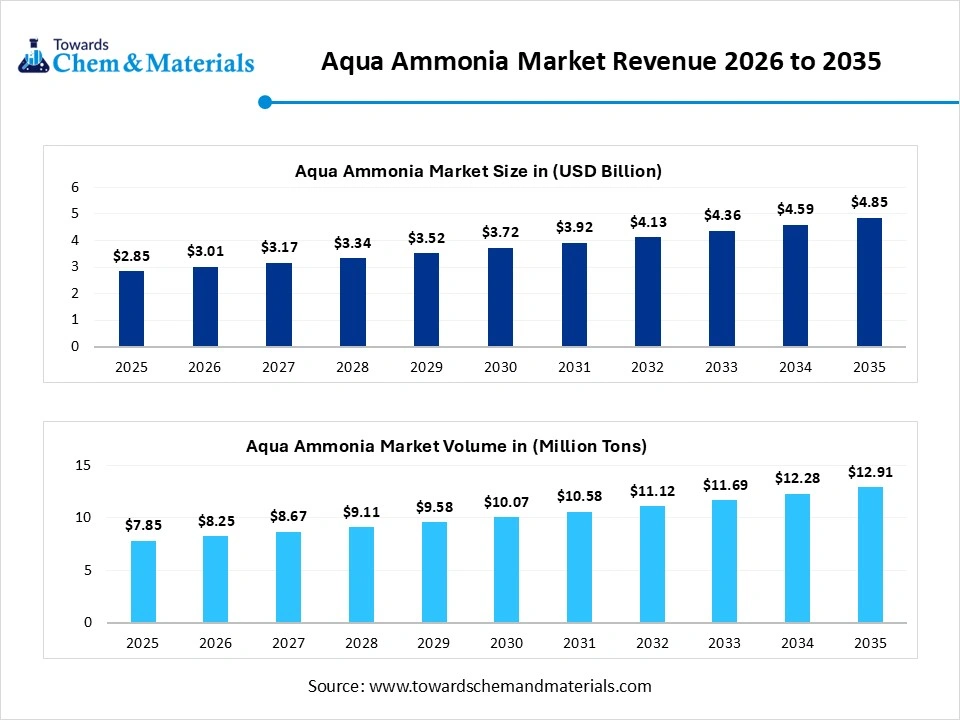
The aqua ammonia market is witnessing steady growth, increasing from USD 2.85 billion in 2025 to USD 4.85 billion by 2035, at a CAGR of 5.45%, with volume rising from 7.85 million tons to 12.91 million tons at a CAGR of 5.1%. The study offers a holistic view of the market including segmentation by product type, application, and industry verticals, supported by detailed regional insights. It further includes competitive benchmarking of leading players, value chain mapping from raw material sourcing to end-use, and trade data analysis highlighting import-export trends, along with detailed information on key manufacturers and suppliers.
Content
Aqua Ammonia Market Share and Trends, Import & Export Analysis
The global aqua ammonia market was valued at USD 2.85 billion in 2025, is estimated to reach USD 3.01 billion in 2026, and is projected to reach USD 4.85 billion by 2035, growing at a CAGR of 5.45% from 2026 to 2035. In terms of volume, the aqua ammonia market is projected to grow from 7.85 million tons in 2025 to 12.91 million tons by 2035. growing at a CAGR of 5.1% from 2026 to 2035.
Key Takeaways
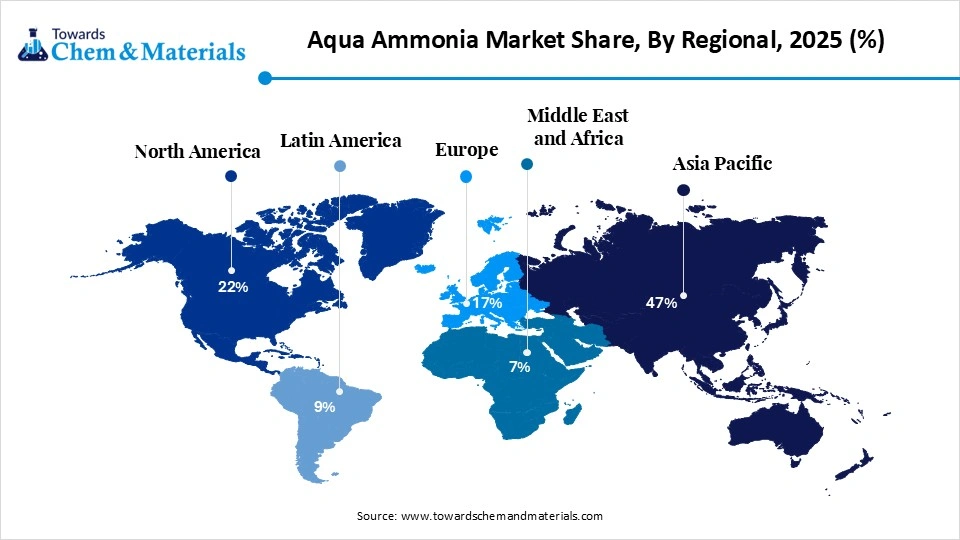
- By region, Asia Pacific dominated the aqua ammonia market in 2025, with 47% share, and is expected to be the fastest-growing in the market, with a CAGR of 6.20% in the forecast period.
- By region, North America is notably growing with 20% market share in 2025.
- By concentration, the medium concentration (20–30%) segment dominated the market with 46% share in 2025.
- By concentration, the high concentration (>30%) segment held the 25% market share in 2025 and is expected to be the fastest-growing in the market, with a CAGR of 5.90% in the forecast period.
- By application, the water treatment segment dominated the market with 38% share in 2025.
- By application, the refrigeration segment held the 10% market share in 2025 and is expected to be the fastest growing in the market with a CAGR of 6.10% in the forecast period.
- By end-use industry, the water & wastewater treatment segment dominated the market with 34% share in 2025.
- By end-use industry, the food and beverage segment held the 11% market share in 2025 and is expected to be the fastest-growing in the market, with a CAGR of 6.00% in the forecast period.
- By distribution channel, the direct sales segment dominated the market with 44% share in 2025.
- By distribution channel, the bulk supply contracts segment held the 23% market share in 2025 and is expected to be the fastest-growing in the market, with a CAGR of 5.80% in the forecast period.
Market Size and Volume Forecast
- Market Estimated Size (2026): USD 3.01 Billion | CAGR (2026–2035): 5.45%
- Market Projected Size (2035): USD 4.85 Billion
- Market Volume (2025): 7.85 Million Tons (MT) | Volume CAGR (2026–2035): 5.1%
- Market Projected Volume (2035): 12.91 Million Tons (MT)
- Market Pricing (2025):
- Average Manufacturing Price: USD 219/ton
- Average Selling Price: USD 329/ton
- Pricing CAGR (2025–2035): 3.8%
Industrial Demand Strengthens Ammonia Market
The liquid solution formed when ammonia gas mixes with water is known as the aqua ammonia. Furthermore, the greater demand from sectors such as the textile, farming, and cleaning has actively strengthened the foundation for the future sector growth during the forecast period. Also, the water purification systems are emerging as the primary consumer of aqua ammonia nowadays.
Recent Market Trends:
- The heavy shift toward the safer chemicals over the harsher chemicals has increased return on investment for manufacturers in recent years. Also, by breaking down more easily than heavy industrial chemicals, the aqua ammonia has gained major industry attention in recent years.
- The greater usage in water management systems is supporting the stronger cash flows for manufacturing enterprises in the current period. Also, the heavy industries and governments are seen as investing heavily in water purification systems, which can lead to the sales of aqua ammonia
- The increasing usage of aqua ammonia in modern agriculture practices is likely to elevate the earning potential for producers in the coming years. Also, farmers are observed using aqua ammonia to improve and maintain soil health, while reducing waste, in recent years, as per observations.
Report Scope
| Report Attribute | Details |
| Market Size and Volume in 2026 | USD 3.01 Billion / 7.85 Million Metric Tons |
| Expected Size and Volume by 2035 | USD 4.85 Billion / 12.91 Million Metric Tons |
| Growth Rate from 2026 to 2035 | CAGR 5.45% |
| Forecast Period | 2026 - 2035 |
| Dominant Region | Asia Pacific |
| Segment Covered | By Concentration, By Application, By End-Use Industry, By Distribution Channel and By Region |
| Key companies profiled | Yara International ASA, CF Industries Holdings, Inc., Nutrien Ltd., BASF SE, OCI N.V., EuroChem Group AG, Koch Industries (Koch Fertilizer, LLC) |
Digital Systems Improve Ammonia Safety
The industry has been actively moving from manual handling to smart and automated systems in recent years. Earlier, aqua ammonia was handled using basic storage and manual monitoring, which was risky and inefficient. Also, now, industries are using sensors, automation, and real-time monitoring systems to track ammonia levels, detect leaks instantly, and control usage more safely. This makes operations smoother and reduces accidents.
Supply Chain Analysis of the Aqua Ammonia Market:
Distribution to Industrial Users
- Aqua ammonia is distributed to industrial users primarily via dedicated tanker trucks or railcars for large-scale operations, such as power plant emissions control.
- For smaller facilities, it is supplied in drums or IBC totes. Safety is critical during transport, requiring specialized pumping systems and airtight connections to prevent hazardous vapor release.
Chemical Synthesis and Processing
- Aqua ammonia is synthesized by dissolving anhydrous ammonia gas into demineralized water.
- This exothermic process requires controlled cooling to manage the heat generated. The resulting aqueous solution is then filtered and adjusted to specific concentrations, typically 19% to 29%, ensuring high purity for industrial or laboratory use.
Regulatory Compliance and Safety Monitoring
- Industrial aqua ammonia is strictly regulated by agencies like OSHA and EPA, requiring detailed Safety Data Sheets (SDS) and spill prevention protocols.
- Safety monitoring involves continuous gas sensors to detect ammonia leaks, specialized secondary containment systems, and rigorous employee training on Personal Protective Equipment (PPE) to mitigate chemical burns and inhalation risks.
Aqua Ammonia Market Regulatory Landscape: Regulations
| Country Region | Regulatory Body | Key Regulations | Focus Areas |
| United States | Environmental Protection Agency (EPA), | OSHA 29 CFR 1910.119: Process Safety Management (PSM) applies to aqua ammonia processes with concentrations of 44% or greater. Some guidelines also reference 20% or greater at thresholds of 20,000 lbs. | Accident prevention, emergency response coordination with local authorities, and strict workplace exposure limits specifically a Permissible Exposure Limit (PEL) of 50 ppm over an 8-hour shift |
| Europe | European Chemicals Agency (ECHA) REACH Regulation (EC) | 1907/2006: Governs the registration, evaluation, and authorization of chemicals; requires comprehensive safety testing data for ammonia producers | Reducing pollutants, nitrogen discharge control, and ensuring safe water reuse in industrial effluents. |
| China | Ministry of Ecology and Environment (MEE) | State Council Decree 591: The overarching "Regulations on Safe Management of Hazardous Chemicals." Articles 15 and 79 specifically mandate compliance with China GHS obligations (SDS and labeling). | Whole-supply-chain management (from manufacture to transport), licensing for downstream users, and recent initiatives like the Three-Year Action Plan to fight air pollution |
Market Dynamics
Driver
Green Transition Supports Ammonia Adoption
The shift toward low-carbon and environmentally friendly chemicals is heavily driving the industry growth nowadays. Industries are under pressure to reduce emissions and adopt sustainable inputs, and aqua ammonia fits well because it has a lower environmental impact compared to many synthetic alternatives.
Restraint
Safety Concerns Limit Aqua Ammonia Growth
Hazardous and careful handling of aqua ammonia is likely to create growth barriers for the industry during the forecast period. Also, this increases storage and transportation costs. Many small industries avoid using it due to safety concerns and strict regulations.
Opportunity
Eco Trends Accelerate Ammonia Market Potential
The push for clean water and sustainability is expected to create lucrative opportunities for manufacturers in the coming years. As governments invest more in wastewater treatment plants, demand for aqua ammonia will increase. Another major opportunity is in green refrigeration systems, where ammonia is gaining popularity as an eco-friendly alternative.
Segmental Insights
Concentration Insights
The Medium Concentration (20–30%) Segment Dominated The Aqua Ammonia Market With 46% Market Share In 2025
The medium concentration (20–30%) segment dominated the market with 46% share in 2025, owing to because it offers the best balance between safety and effectiveness. It is strong enough for industrial applications like water treatment and agriculture, yet not as dangerous as high-concentration variants. This makes it easier to store, transport, and use without heavy safety investments.
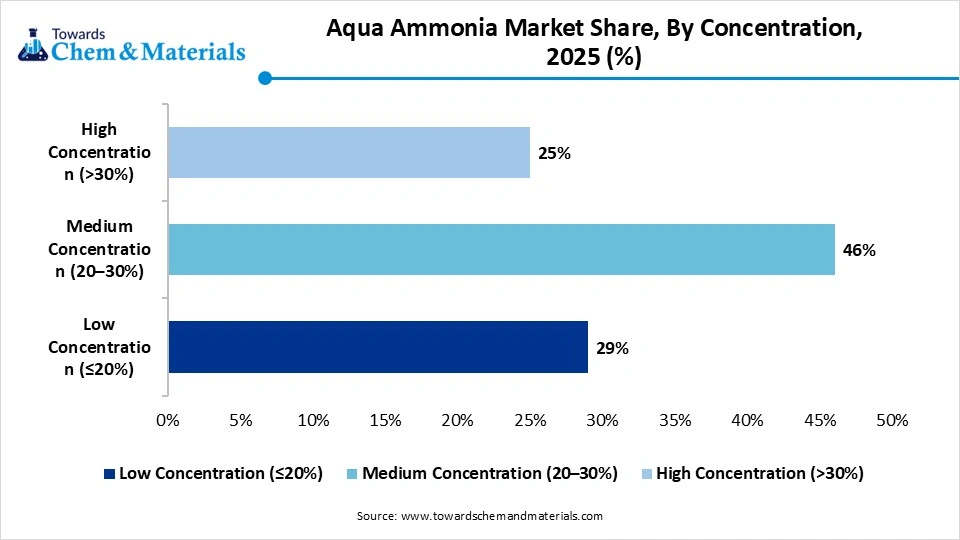
The low concentration (≤20%) segment held 29% market share in 2025, as industries are becoming more safety-conscious and regulation-driven. Smaller businesses and municipal applications prefer lower concentrations since they are easier to handle and pose less risk to workers. It is increasingly used in small-scale water treatment and cleaning applications.
The high concentration (>30%) segment held the 25% market share in 2025 and is expected to be the fastest-growing in the market, with a CAGR of 5.90% in the forecast period due to efficiency and cost advantages at scale. Large industries prefer concentrated solutions because they reduce transportation costs and storage space. With improving safety technologies and better handling systems, industries are becoming more confident in using higher concentrations.
Application Insights
The Water Treatment Segment Dominated the Market with 38% Market Share in 2025
The water treatment segment dominated the market with 38% share in 2025, owing to aqua ammonia plays a key role in pH control and disinfection processes. Municipal water systems and industrial wastewater plants rely heavily on it to maintain water quality standards. With increasing pollution and stricter environmental laws, water treatment demand is rising rapidly.
Aqua Ammonia Market Share, By Application, 2025 (%)
| By Application | Revenue Share, 2025 (%) |
| Water Treatment | 38% |
| Agriculture | 22% |
| Industrial Cleaning | 14% |
| Refrigeration | 10% |
| Chemical Processing | 16% |
The agriculture segment held the 22% market share in 2025, owing to the rising need for higher crop productivity. Aqua ammonia provides nitrogen, which is essential for plant growth. Farmers are increasingly adopting efficient fertilizers to improve yield. Additionally, population growth is increasing food demand, pushing farmers to use more nutrient-rich solutions.
The refrigeration segment held the 10% market share in 2025 and is expected to be the fastest-growing in the market, with a CAGR of 6.10% in the forecast period, due to ammonia being a natural and environmentally friendly refrigerant. As industries move away from harmful greenhouse gases, ammonia-based systems are gaining popularity.
End-Use Industry Insights
The Water & Wastewater Treatment Segment Dominated The Aqua Ammonia Market With 34% Market Share In 2025
The water & wastewater treatment segment dominated the market with 34% share in 2025, owing to every industry and city needs water treatment. Aqua ammonia is essential for maintaining safe water standards and treating industrial waste. Governments are investing heavily in wastewater infrastructure, especially in developing countries.
Aqua Ammonia Market Share, By End-Use Industry, 2025 (%)
| By End-Use Industry | Revenue Share, 2025 (%) |
| Water & Wastewater Treatment | 34% |
| Agriculture | 21% |
| Chemicals | 17% |
| Food & Beverage | 11% |
| Pharmaceuticals | 9% |
| Others | 8% |
The agriculture segment held 21% market share in 2025, as increasing food demand and land productivity challenges. Aqua ammonia helps improve soil fertility and crop yield. Farmers are adopting better nutrient management practices, and ammonia-based solutions are a key part of that.
The food and beverage segment held the 11% market share in 2025 and is expected to be the fastest-growing in the market, with a CAGR of 6.00% in the forecast period, due to rising demand for processed and stored food. Aqua ammonia is widely used in refrigeration and food processing. As global consumption of packaged food increases, the need for cold storage and preservation grows.
Distribution Channel Insights
The Direct Sales Segment Dominated the Market with 44% Market Share in 2025
The direct sales segment dominated the market with 44% share in 2025, owing to large buyers preferring to buy directly from manufacturers. This ensures better pricing, consistent quality, and reliable supply. Industries like water treatment and agriculture often require bulk quantities, making direct deals more efficient.
Aqua Ammonia Market Share, By Distribution Channel, 2025 (%)
| By Distribution Channel | Revenue Share, 2025 (%) |
| Direct Sales | 44% |
| Distributors & Wholesalers | 33% |
| Bulk Supply Contracts | 23% |
The distributors and wholesalers segment held the 33% market share in 2025, owing to small and medium businesses preferring easy and flexible purchasing options. Distributors provide smaller quantities and faster delivery. They also offer local support and better accessibility.
The bulk supply contracts segment held the 23% market share in 2025 and is expected to be the fastest-growing in the market, with a CAGR of 5.80% in the forecast period, due to stability and cost efficiency. Large industries prefer long-term agreements to avoid price fluctuations and supply disruptions. These contracts ensure consistent availability and predictable costs.
Regional Insights
How will Asia Pacific Dominate the Aqua Ammonia Market in 2025?
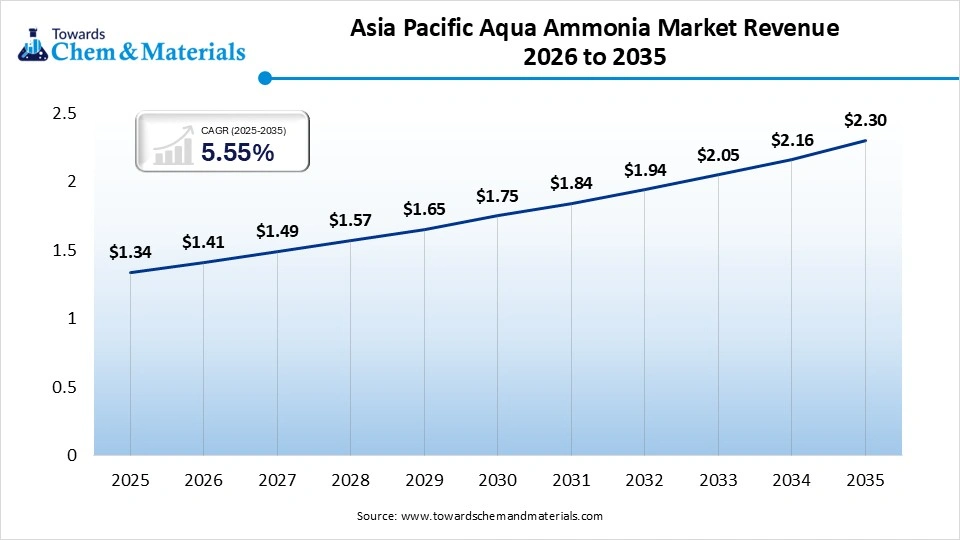
The Asia Pacific aqua ammonia market size was estimated at USD 1.34 billion in 2025 and is projected to reach USD 2.30 billion by 2035, growing at a CAGR of 5.55% from 2026 to 2035. Countries in this region are investing heavily in water treatment and agriculture. Increasing manufacturing activities also drive demand. Lower production costs and strong chemical industries make the region a major supplier.
Strong Chemical Sector Fuels China's Growth
China maintained its dominance in the market, owing to its massive industrial base and strong chemical production capacity. It has large-scale water treatment projects and a growing agricultural sector. Government policies supporting pollution control and sustainable practices increase demand.
Aqua Ammonia Market Evaluation in North America
North America is notably growing with 20% market share in 2025, owing to advanced technology and strict environmental regulations. Industries in the region are adopting safer and more efficient chemical handling systems, enabling the use of high-concentration ammonia. Strong investment in water treatment infrastructure and sustainable solutions also supports growth. Innovation and automation will further drive demand in this region.
United States Emerges as Aqua Ammonia Leader
The United States is expected to emerge as a prominent country for the aqua ammonia market in the coming years, due to its developed industrial sector and strong environmental policies. It has advanced wastewater treatment systems and a large agricultural industry. The country is also focusing on sustainable refrigeration solutions and increasing ammonia use.
Recent Development
- In July 2025, The Blended Products unveiled the aqua ammonia, which has high purity and is known as the Aquamonia 245. Moreover, this newly launched aqua ammonia is a higher-grade solution and available in bulk options as per the company's claim.
Top Vendors in the Aqua Ammonia Market & Their Offerings:
- Yara International ASA: Headquartered in Norway, Yara is a global leader in ammonia production and sustainable crop nutrition. The company leverages an extensive logistics network to provide high-purity aqua ammonia for industrial applications, including NOx emissions reduction (SNCR/SCR systems). Yara focuses on decarbonizing the industry through "green ammonia" initiatives and digital farming tools.
- CF Industries Holdings, Inc.: Based in the United States, CF Industries is one of the world’s largest manufacturers of nitrogen products. It operates massive integrated production complexes, primarily in North America, supplying aqua ammonia for agricultural and industrial use. The company is currently pivoting toward clean energy by investing heavily in blue and green ammonia production.
- Nutrien Ltd.: Formed by the merger of Agrium and PotashCorp, Canadian-based Nutrien is the world’s largest provider of crop inputs and services. It produces aqua ammonia through its extensive nitrogen-manufacturing operations, serving global industrial markets and a vast retail network. Nutrien emphasizes sustainable mining and manufacturing to support global food security.
Aqua Ammonia Market Key Players
- BASF SE
- OCI N.V.
- EuroChem Group AG
- Koch Industries (Koch Fertilizer, LLC)
Aqua Ammonia Marke Segments Covered in the Report
By Concentration
- Low Concentration (≤20%)
- Medium Concentration (20–30%)
- High Concentration (>30%)
By Application
- Water Treatment
- Municipal Water Treatment
- Industrial Wastewater Treatment
- Agriculture
- Fertilizer Production
- Soil Treatment
- Industrial Cleaning
- Surface Cleaning
- Equipment Cleaning
- Refrigeration
- Industrial Refrigeration Systems
- Chemical Processing
- Intermediate Chemicals
- pH Control Applications
By End-Use Industry
- Water & Wastewater Treatment
- Agriculture
- Chemicals
- Food & Beverage
- Pharmaceuticals
- Others
By Distribution Channel
- Direct Sales
- Distributors & Wholesalers
- Bulk Supply Contracts
By Region
- North America:
- U.S.
- Canada
- Mexico
- Rest of North America
- Latin America:
- Brazil
- Argentina
- Rest of Latin America
- Europe:
- Western Europe
- Germany
- Italy
- France
- Netherlands
- Spain
- Portugal
- Belgium
- Ireland
- UK
- Iceland
- Switzerland
- Poland
- Rest of Western Europe
- Eastern Europe
- Austria
- Russia & Belarus
- Türkiye
- Albania
- Rest of Eastern Europe
- Asia Pacific:
- China
- Taiwan
- India
- Japan
- Australia and New Zealand,
- ASEAN Countries (Singapore, Malaysia)
- South Korea
- Rest of APAC
- MEA:
- GCC Countries
- Saudi Arabia
- United Arab Emirates (UAE)
- Qatar
- Kuwait
- Oman
- Bahrain
- South Africa
- Egypt
- Rest of MEA
- GCC Countries
FAQ's
Question 1 : What is the current size and future outlook of the aqua ammonia market?
Answer : The global aqua ammonia market was valued at USD 2.85 billion in 2025 and is projected to reach USD 4.85 billion by 2035, growing at a CAGR of 5.45%. In volume terms, it is expected to increase from 7.85 million tons to 12.91 million tons over the same period.
Question 2 : Which region dominates the aqua ammonia market and why?
Answer : Asia Pacific dominates the market with a 47% share in 2025 due to strong industrial growth, expanding agriculture, and heavy investments in water treatment infrastructure. The region is also expected to grow the fastest.
Question 3 : How is North America performing in the aqua ammonia market?
Answer : North America holds around 20% market share in 2025, driven by advanced technologies, strict environmental regulations, and increasing adoption of safe chemical handling systems.
Question 4 : Which concentration segment leads the aqua ammonia market?
Answer : The medium concentration segment (20–30%) leads with a 46% share due to its balance between safety and efficiency, making it ideal for industrial and municipal applications.
Question 5 : Which concentration segment is expected to grow the fastest?
Answer : The high concentration segment (>30%) is expected to grow the fastest at a CAGR of 5.90% due to cost efficiency in transportation and storage for large-scale industries.
Meet the Team

Saurabh Bidwai
Principal Consultant
Saurabh Bidwai, a B.Tech Chemical Engineering graduate with 4+ years of experience, specializes in specialty chemicals, commodity chemicals, and engineered materials, offering valuable insights into market trends and emerging opportunities.

Aditi Shivarkar
Reviewed By
Aditi Shivarkar, with 14+ years in Chemical and Materials market research, specializes in Chemical and Materials. She ensures accurate, actionable insights, driving Towards Chemicals And Materials Analytics and Consulting excellence in industry trends and sustainability.