
Aquaculture Market Trends, Sales Volume, Production Cost, Fulfillment Cycle Time, Export & Import Flows, Pricing Metrics, Recycling Rate, Adoption Rates, and Distribution Performance
The aquaculture market was valued at USD 322.85 billion in 2025 and is expected to grow to USD 344.97 billion in 2026, reaching USD 626.25 billion by 2035, expanding at a CAGR of 6.85% during the forecast period. In volume terms, the market is projected to increase from 148.85 million tons in 2025 to 265.31 million tons by 2035, at a CAGR of 5.95%. This report provides comprehensive coverage of market size, segment-wise data by species and farming methods, regional performance across key geographies, and detailed analysis of leading companies. It further includes competitive landscape insights, value chain evaluation, trade data, and in-depth information on manufacturers and suppliers shaping the industry.
Content
Aquaculture Market Size, Share and Trends Report 2035
According to Towards Chemicals and Materials Analytics and Consulting, the global aquaculture market was valued at USD 322.85 billion in 2025, is estimated to reach USD 344.97 billion in 2026, and is projected to reach USD 626.25 billion by 2035, growing at a CAGR of 6.85% from 2026 to 2035. In terms of volume, the aquaculture market is projected to grow from 148.85 million tons in 2025 to 265.31 million tons by 2035. growing at a CAGR of 5.95% from 2026 to 2035.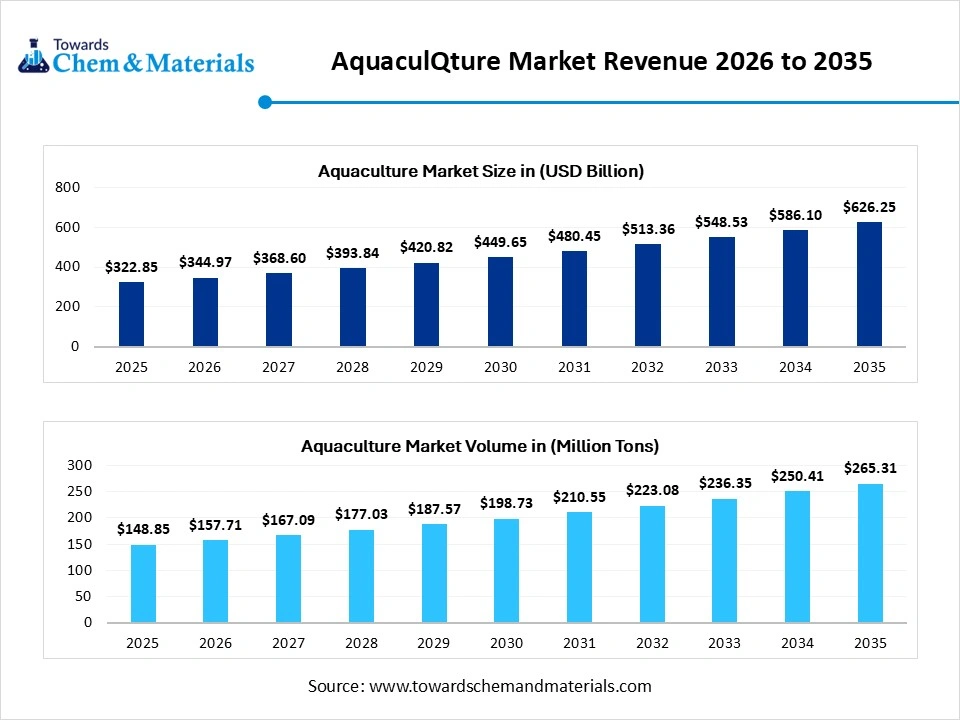
Key Takeaways
- By region, Asia Pacific dominated the market with the largest share of 46% in 2025 and is expected to grow at the fastest CAGR of 7.3% % over the forecast period.
- By region, Europe held the market share of 18% in 2025.
- By species, the fish segment dominated the market with the largest share of 49% in 2025.
- By species, the crustaceans segment is expected to grow at the fastest CAGR of 7.4% over the forecast period.
- By culture environment, the freshwater segment dominated the market with the largest share of 52% in 2025.
- By culture environment, the marine water segment is expected to grow at the fastest CAGR of 7.2% over the forecast period.
- By farming method, the semi-intensive aquaculture segment dominated the market with the largest share of 38% in 2025.
- By farming method, the intensive aquaculture segment is expected to grow at the fastest CAGR of 7.8% during the forecast period.
- By production type, the inland aquaculture segment dominated the market with the largest share of 55% in 2025.
- By production type, the offshore aquaculture segment is expected to grow at the fastest CAGR of 8.1% over the forecast period.
- By distribution channel, the retail segment dominated the market with the largest share of 34% in 2025.
- By distribution channel, the food service segment is expected to grow at the fastest CAGR of 6.8% during the forecast period.
- By end-use, the human consumption segment dominated the market with the largest share of 82% in 2025.
- By end-use, the pharmaceuticals segment is expected to grow at the fastest CAGR of 7.3% over the projected period.
Market Size and Volume Forecast
- Market Estimated Size (2026): USD 344.97 Billion | CAGR (2026–2035): 6.85%
- Market Projected Size (2035): USD 626.25 Billion
- Market Volume (2025): 148.85 Million Tons (MT) | Volume CAGR (2026–2035): 5.95%
- Market Projected Volume (2035): 265.31 Million Tons (MT)
- Market Pricing (2025):
- Average Manufacturing Price: USD 1,859/ton
- Average Selling Price: USD 2,410/ton
- Pricing CAGR (2025–2035): 3.4%
What is Aquaculture Market?
The market involves the industrial farming of aquatic organisms such as crustaceans, mollusks, fish, and aquatic plants in specific environments, including marine, freshwater, and brackish waters. This industry emphasizes fulfilling global seafood demand, minimizing pressure on wild fisheries using techniques like feeding, stocking, and predator protection.
Aquaculture Market Trends
Increasing adoption of sustainable technologies within aquaculture is the latest trend in the market, shaping positive market growth. New technologies like aquaponics and recirculating Aquaculture systems (RAS) sound more beneficial than conventional production methods.
Major market players are rapidly gaining information regarding Aquaculture products because of their benefits and a much lower cost as compared to other alternatives. Combining multi-trophic polyculture technology to minimize organic waste and growing fish output will create lucrative opportunities in the market soon.
Increasing demand for functional aquafeeds is improving overall fish health. Functional aquafeeds, which are enriched with immunostimulants, probiotics, and enzymes, are experiencing increasing demand. These feeds promote disease prevention, enhance growth performance, and minimize overall antibiotic dependency.
Report Scope
| Report Attribute | Details |
| Market Size and Volume in 2026 | USD 344.97 Billion / 157.71 Million Tons |
| Expected Size and Volume by 2035 | USD 626.25 Billion / 265.31 Million Tons |
| Growth Rate from 2026 to 2035 | CAGR 6.85% |
| Forecast Period | 2026 - 2035 |
| Dominant Region | Asia-Pacific |
| Segment Covered | By Species, By Culture Environment, By Farming Method, By Production Type, By Distribution Channel, By End-use, By Region |
| Key companies profiled | Cermaq ASA, Cooke Aquaculture Inc., Eastern Fish Co., Huon Aquaculture Group Pty Ltd., International Fish Farming Co. - Asmak, RoyMarine Harvest ASA, Nireus Aquaculture S.A, Promarisco, Selonda Aquaculture S.A. |
How Cutting-Edge Technologies Are Revolutionizing the Aquaculture Market?
Advanced technologies are transforming the market from a labor-intensive industry into a sustainable and data-driven sector. Key advancements include Internet of Things (IoT) for real-time environmental monitoring and Artificial Intelligence (AI) for predictive analytics. Furthermore, algorithms analyse extensive data streams to optimise feeding schedules, forecast growth patterns, and help in the early detection of diseases.
Supply Chain Analysis of the Aquaculture Market
Feedstock Procurement
It refers to the strategic process of sourcing essential raw materials, like fish oil, fishmeal, corn, and soybean meal, to manufacture high-quality fish feed.
- Major Players: Cargill, ADM
Chemical Synthesis and Processing
It involves manufacturing specialized compounds for disease control, water treatment, and nutritional enhancement to raise yields in intensive farming systems.
- Major Players: Aller Aqua Group, Skretting
Packaging and Labelling
It includes specialized materials and informational standards used to safeguard, preserve and detect farm-raised seafood products.
- Major Players: Smurfit Kappa, DS Smith
Regulatory Compliance and Safety Monitoring
It involves adhering to stringent food safety, environmental, and animal welfare standards to ensure sustainable production.
- Major Players: Cermaq Group AS, AKVA Group
Aquaculture Market's Regulatory Landscape: Global Regulations
| Country/Region | Key Regulations |
| European Union | Governed by the Common Fisheries Policy (CFP) and Water Framework Directive. Focuses on Unified Standards for safety and environmental protection across member states. |
| China | As the world's largest producer (~36% of global output), it focuses heavily on production volume but is increasingly implementing stricter environmental and disease control mandates. |
| India |
Regulated by the Ministry of Fisheries, Animal Husbandry and Dairying. Key laws include the Coastal Regulation Zone (CRZ) Notification under the Environmental Protection Act 1986, which restricts development in sensitive coastal areas. |
Market Dynamics
Driver
Increasing Global Seafood Demand
Growing global consumption of seafood, fuelled by population growth and urbanization, is a major factor driving market growth. As wild fish stocks come down due to overfishing, aquaculture offers a reliable solution to fulfil demand for protein-rich food, especially in emerging nations with limited access to conventional fisheries.
Restraint
Environmental concerns
Aquaculture operations can contribute to habitat destruction, water pollution, and the rapid spread of disease to the wild population. Overuse of antibiotics and improper waste management further harm marine ecosystems, which is the major factor hindering market growth. These lead to public resistance and regulatory hurdles, limiting growth in certain regions.
Opportunity
Surge in the Adoption of Indoor Fishing
Certain innovations in water circulation and filtration systems have facilitated the adoption of indoor fishing methods to expand at an exponential rate, presenting lucrative opportunities in the market. Fish farming is an effective solution for creating animal protein, which has a low impact on environmental degradation.
Segmental Insights
Species Insights
The Fish Segment Dominated the Market with 49% of Market Share in 2025
The fish segment dominated the market with the largest share of 49% in 2025. The dominance of the segment can be attributed to its high global consumption rate and technological innovations, which enhance yield efficiency. Demand for affordable protein supports volume growth.
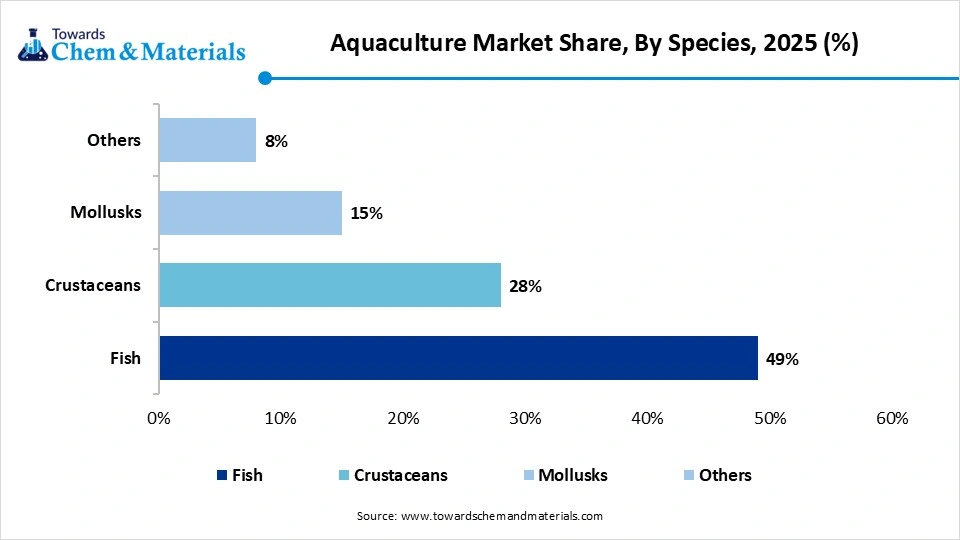
The crustaceans segment held the 28% market share in 2025 and is expected to grow at the fastest CAGR of 7.4% over the forecast period. The growth of the segment can be credited to the growing demand for shrimp farming and intensive farming techniques, enhancing output. High-value species increase profitability further.
The mollusks segment held the market share of 15% in 2025. The growth of the segment can be linked to the increasing demand for oysters and mussels, coupled with the adoption of environmental sustainability goals. Low-input farming reduces overall operational costs.
Culture Environment Insights
The Freshwater Grade Segment Dominated the Market with 52% of Market Share in 2025
The freshwater segment dominated the market with the largest share of 52% in 2025. The dominance of the segment is driven by its lower operational cost requirements and the availability of abundant freshwater resources. Carp and tilapia currently dominate the production.
The marine water segment held the market share of 31% in 2025 and is expected to grow at the fastest CAGR of 7.2% over the forecast period. The growth of the segment is owing to rising seafood demand and the expansion of offshore farming. High-value species such as salmon drive segment growth further.
The brackish water segment held the market share of 17% in 2025. The growth of the segment is due to increasing export demand and its competition with shrimp farming. Moreover, coastal regions offer a suitable environment.
Farming Method Insights
The Semi-Intensive Aquaculture Segment Dominated the Market with 38% of Market Share in 2025
The semi-intensive aquaculture segment dominated the market with the largest share of 38% in 2025. The dominance of the segment can be credited to its wide adoption in developing regions and moderate technology adoption. A balanced input-output ratio improves profitability further.
The intensive aquaculture segment held the market share of 36% in 2025 and is expected to grow at the fastest CAGR of 7.8% during the forecast period. The growth of the segment can be linked to the increasing demand for advanced technologies and the use of high-productivity systems to maximize output.
The extensive aquaculture segment held the market share of 26% in 2025. The dominance of the segment can be attributed to the need for low investments to support small-scale farmers, and natural feeding reduces overall costs. However, limited productivity impacts market growth.
Production Type Insights
Inland Aquaculture Segment Dominated the Market with 55% of Market Share in 2025
The inland aquaculture segment dominated the market with the largest share of 55% in 2025. The dominance of the segment can be driven by its lower costs and government support for inland operations. Large-scale freshwater farming further dominated the production.
The offshore aquaculture segment held the market share of 15% in 2025 and is expected to grow at the fastest CAGR of 8.1% over the forecast period. The growth of the segment is owing to increasing investments in deep-sea farming and the expansion of advanced cage systems. It also reduces coastal environmental pressure.
The coastal aquaculture segment held the market share of 30% in 2025. The growth of the segment is due to ongoing infrastructure development and an increase in export demand, which increases production. Coastal areas support fish and shrimp farming.
Distribution Channel Insights
The Retail Segment Dominated the Market with 34% of Market Share in 2025
The retail segment dominated the market with the largest share of 34% in 2025. The dominance of the segment can be attributed to the surge in the availability of seafood and supermarkets, along with the rapid urbanisation in emerging economies. Developments in cold chains improve supply.
The food service segment held the market share of 26% in 2025 and is expected to grow at the fastest CAGR of 6.8% during the forecast period. The growth of the segment can be credited to the increasing restaurant consumption and expansion of the hospitality sector. Premium seafood demand increases usage further.
The direct sales segment held the market share of 22% in 2025. The growth of the segment can be linked to the lower distribution costs, which enhance margin and support from the local market for direct farm sales.
End-use Insights
The Human Consumption Segment Dominated the Market with 82% of Market Share in 2025
The human consumption segment dominated the market with the largest share of 82% in 2025. The dominance of the segment can be driven by increasing global protein demand and population growth. The health benefits of seafood increase its consumption.
The pharmaceuticals segment held the market share of 5% in 2025 and is expected to grow at the fastest CAGR of 7.3% over the projected period. The growth of the segment is owing to the rise in drug development and innovation in marine bioactive compounds. Research investments further impact positive market growth.
The Nutraceuticals segment held the market share of 6% in 2025. The growth of the segment is due to increasing demand for omega-3 fatty acids and a surge in global health awareness. The functional food trend further supports market expansion.
Regional Insights
How did Asia Pacific Dominate the Aquaculture Market in 2025?
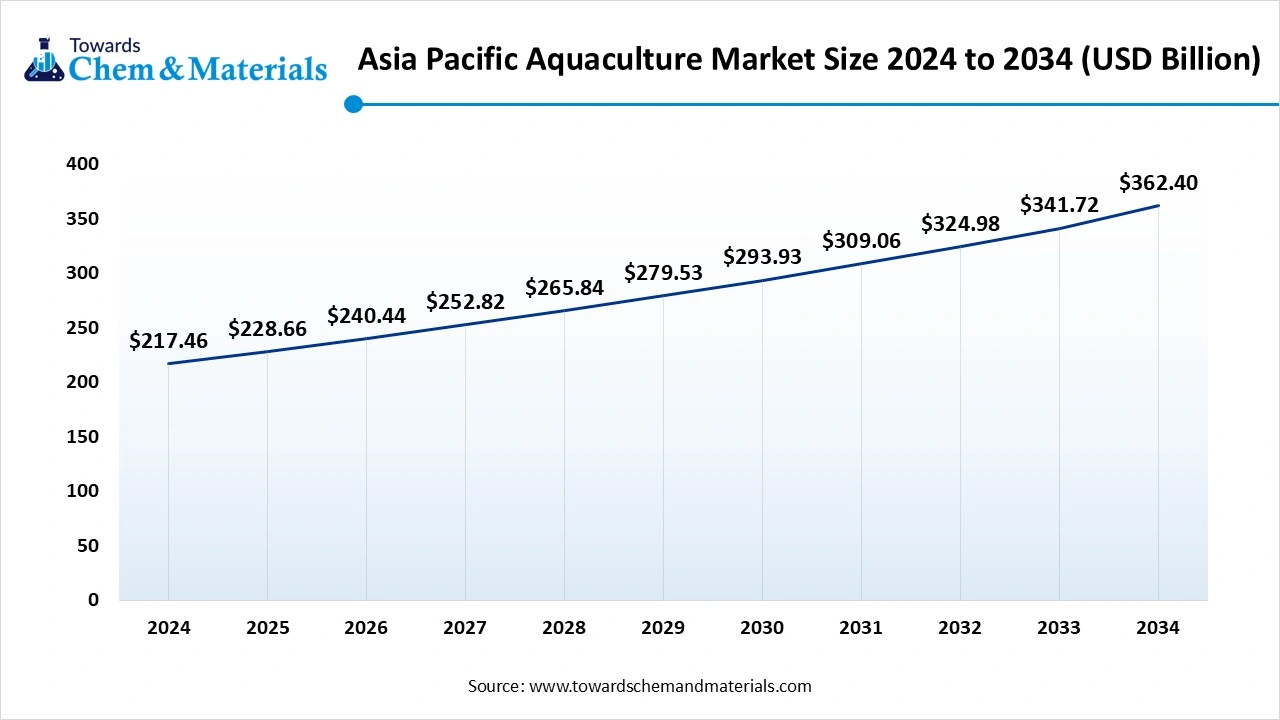
The Asia Pacific aquaculture market size was estimated at USD 148.51 billion in 2025 and is projected to reach USD 291.21 billion by 2035, growing at a CAGR of 6.97% from 2026 to 2035. The dominance and growth of the region can be attributed to the increasing consumption of seafood and technological innovations in the production process. In addition, governments in the emerging nations are heavily investing in infrastructure and enforcing policies to ensure food safety and support export initiatives.
China Aquaculture Market Trends
In the Asia Pacific, China dominated the market owing to the growing adoption of automated systems and the growth of offshore farming to improve sustainability and productivity. Also, the ongoing investments are increasingly being made in indoor desert farming and offshore culture, where greenhouse technology and salty soil facilitate seafood cultivation in non-conventional regions.
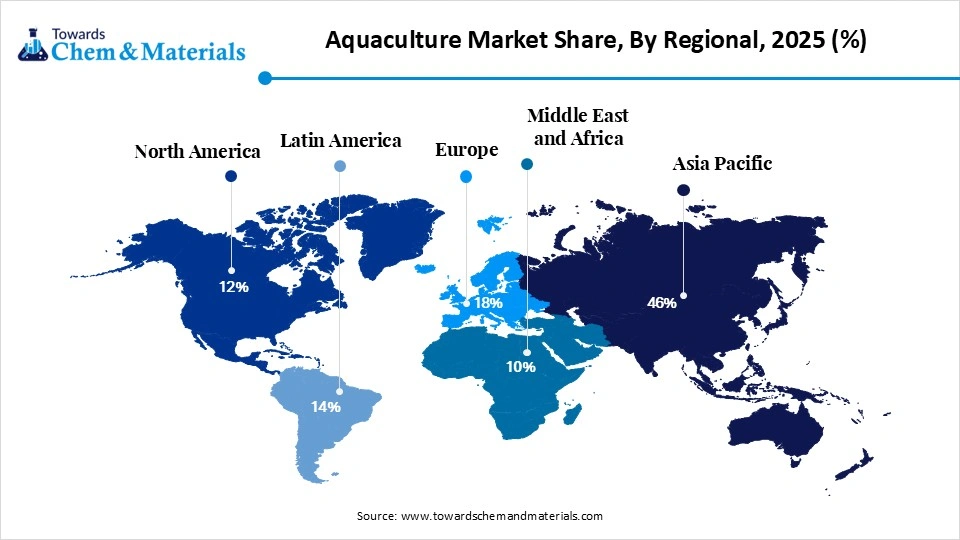
Europe held the market share of 18% in 2025. The growth of the region can be credited to the rising consumer awareness regarding its health benefits, along with the growing demand for sustainably sourced seafood.Furthermore, favourable regulatory frameworks and government policies optimise sustainable practices and enhance market accessibility.
Germany Aquaculture Market Trends
The growth of the market in the country is due to rapid innovations in Recirculating Aquaculture Systems (RAS), coupled with the ongoing R&D in feed efficiency and fish genetics. Moreover, EU and national policies, like the European Maritime and European Green Deal, incentivise modern and eco-friendly upgrades and resource efficiency.
Recent Development
- In April 2026, the Zimbabwe government unveiled its inaugural marketing roadmap for farmed tilapia, a strategic initiative designed to elevate aquaculture into a vital pillar of national food security and economic growth. Formulated through extensive cross-sector collaboration and data-driven consultations in Harare and Manicaland.
Companies in the Aquaculture Market
- Cermaq ASA
- Cooke Aquaculture Inc.
- Eastern Fish Co.
- Huon Aquaculture Group Pty Ltd.
- International Fish Farming Co. - Asmak
- RoyMarine Harvest ASA
- Nireus Aquaculture S.A
- Promarisco
- Selonda Aquaculture S.A.
- Alpha Group Ltd.: Alpha Group Ltd. is a recognized high-tech enterprise and key player in the aquaculture market, specializing in high-end feed production, shrimp hatchery operations, and international seafood processing.
- Blue Ridge Aquaculture: Blue Ridge Aquaculture is the largest indoor tilapia facility in the United States, producing over 4 million pounds of fish annually. Based in Virginia, the company is recognized as a key player in the U.S. aquaculture market, utilizing advanced recirculating aquaculture systems (RAS) to provide sustainable, locally sourced seafood.
Aquaculture Market Segments Covered in the Report
By Species
- Fish
- Freshwater Fish
- Carp
- Tilapia
- Catfish
- Marine Fish
- Salmon
- Tuna
- Seabass
- Freshwater Fish
- Crustaceans
- Shrimp
- Prawns
- Crabs
- Mollusks
- Oysters
- Mussels
- Clams
- Others
By Culture Environment
- Freshwater
- Ponds
- Tanks
- Recirculating Aquaculture Systems (RAS)
- Marine Water
- Coastal Aquaculture
- Offshore Aquaculture
- Brackish Water
By Farming Method
- Extensive Aquaculture
- Semi-Intensive Aquaculture
- Intensive Aquaculture
By Production Type
- Inland Aquaculture
- Coastal Aquaculture
- Offshore Aquaculture
By Distribution Channel
- Direct Sales
- Retail
- Supermarkets/Hypermarkets
- Specialty Stores
- Food Service
- Export Markets
By End-use
- Human Consumption
- Pharmaceuticals
- Nutraceuticals
- Cosmetics
- Others
By Region
- North America:
- U.S.
- Canada
- Mexico
- Rest of North America
- Latin America:
- Brazil
- Argentina
- Rest of Latin America
- Europe:
- Western Europe
- Germany
- Italy
- France
- Netherlands
- Spain
- Portugal
- Belgium
- Ireland
- UK
- Iceland
- Switzerland
- Poland
- Rest of Western Europe
- Eastern Europe
- Austria
- Russia & Belarus
- Türkiye
- Albania
- Rest of Eastern Europe
- Asia Pacific:
- China
- Taiwan
- India
- Japan
- Australia and New Zealand,
- ASEAN Countries (Singapore, Malaysia)
- South Korea
- Rest of APAC
- MEA:
- GCC Countries
- Saudi Arabia
- United Arab Emirates (UAE)
- Qatar
- Kuwait
- Oman
- Bahrain
- South Africa
- Egypt
- Rest of MEA
- GCC Countries
FAQ's
Question 1 : Which region dominates the aquaculture market?
Answer : Asia Pacific leads the market with a 46% share in 2025 and is also the fastest-growing region, driven by strong production in countries like China and India.
Question 2 : Which species segment holds the largest market share?
Answer : The fish segment dominates with 49% market share in 2025, supported by high global consumption and efficient farming practices.
Question 3 : Which segment is expected to grow the fastest by species?
Answer : The crustaceans segment (especially shrimp) is projected to grow at the fastest CAGR of 7.4%, driven by high export demand and profitability.
Meet the Team

Saurabh Bidwai
Principal Consultant
Saurabh Bidwai, a B.Tech Chemical Engineering graduate with 4+ years of experience, specializes in specialty chemicals, commodity chemicals, and engineered materials, offering valuable insights into market trends and emerging opportunities.

Aditi Shivarkar
Reviewed By
Aditi Shivarkar, with 14+ years in Chemical and Materials market research, specializes in Chemical and Materials. She ensures accurate, actionable insights, driving Towards Chemicals And Materials Analytics and Consulting excellence in industry trends and sustainability.