
Artificial Intelligence (AI) in Textile Market Size | Companies Analysis 2025- 2035
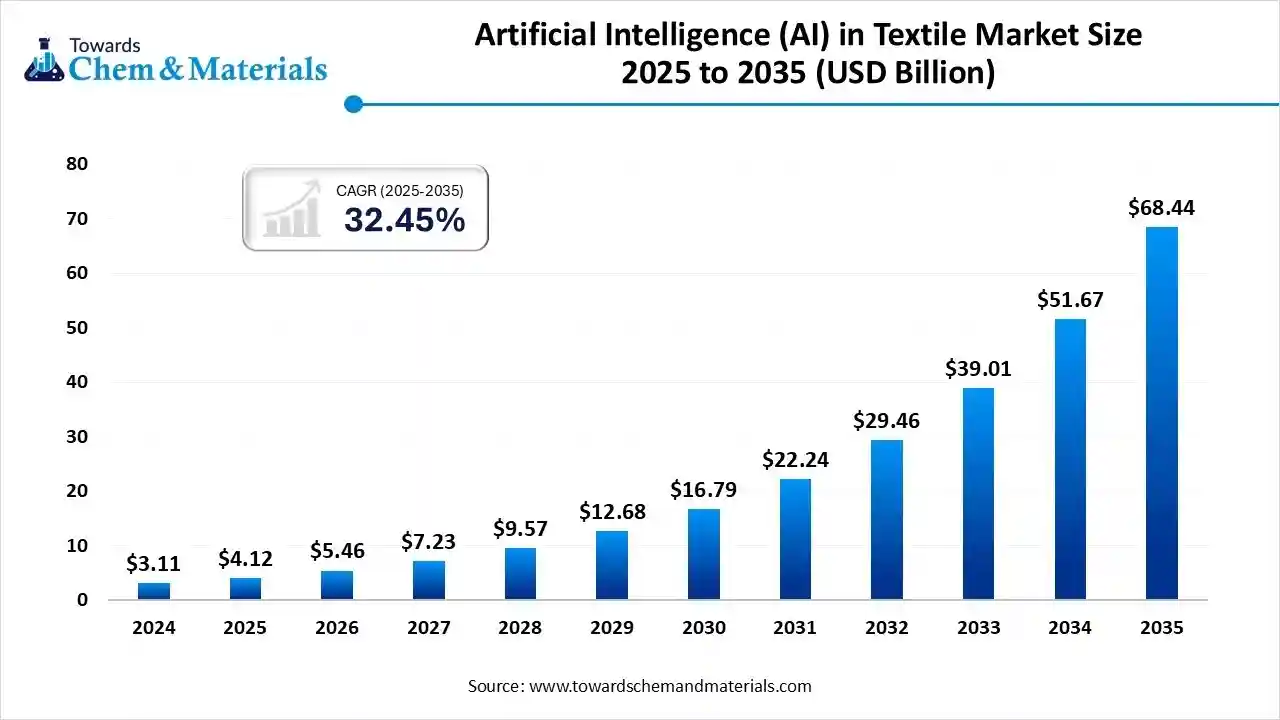
The global artificial intelligence (AI) in textile market is projected to grow from USD 4.12 billion in 2025 to USD 68.44 billion by 2035, growing at a compound annual growth rate (CAGR) of 32.45% over the forecast period from 2025 to 2035. Major companies include Microsoft Corporation, IBM Corporation, Google LLC, Amazon Web Services (AWS), SAP SE, Oracle Corporation, General Vision Inc., Salesforce Inc., Adobe Inc., Huawei Technologies Co., Ltd., Nvidia Corporation, Siemens AG
Content
What is the Current AI in Textile Market Size and Share?
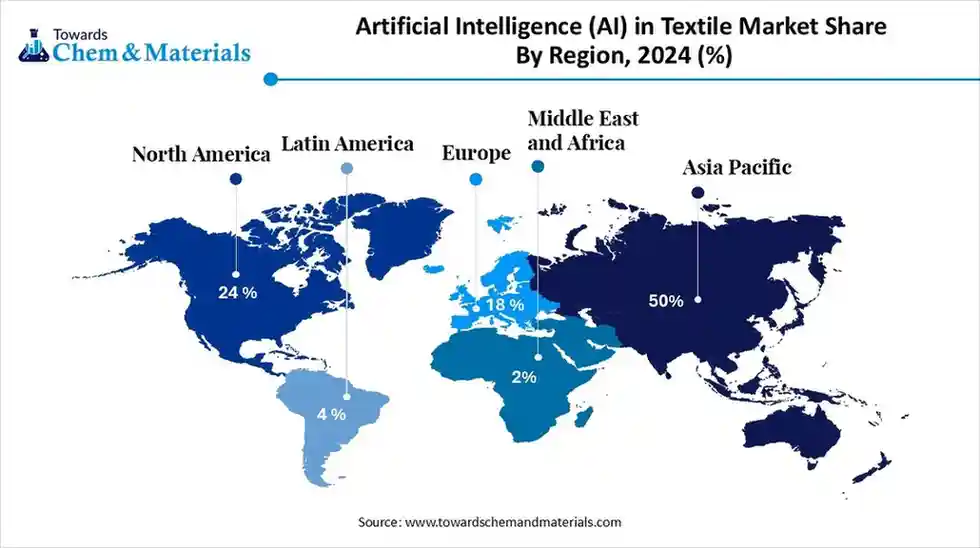
The global artificial intelligence (AI) in textile market size is calculated at USD 4.12 billion in 2025 and is predicted to increase from USD 5.46 billion in 2026 and is projected to reach around USD 68.44 billion by 2035, The market is expanding at a CAGR of 32.45% between 2025 and 2035. Asia Pacific dominated the artificial intelligence (AI) in textile market with a market share of 50% the global market in 2024. the growing production of personalised textiles and the increasing need for efficient textile sorting drive market growth.
Key Takeaways
- By region, Asia Pacific held approximately a 50% share in the artificial intelligence (AI) in textile market in 2024.
- By region, North America is growing at the highest 28% CAGR in the market during the forecast period.
- By technology, the machine learning and deep learning segment held a 38% share in the artificial intelligence (AI) in textile market in 2024.
- By technology, the computer vision in textile segment is expected to grow at a 25% CAGR in the market for artificial intelligence (AI) in textile during the forecast period.
- By solution, the software platforms segment held a 45% share in the artificial intelligence (AI) in textile market in 2024.
- By solution, the hardware and edge devices segment is expected to grow at the fastest CAGR of 22% in the market during the forecast period.
- By application, the quality inspection segment held a 32% share in the market in 2024.
- By application, the predictive maintenance segment is expected to grow at the fastest CAGR in the market during the forecast period.
- By end-use, the apparel & fashion manufacturing segment held a 40% share in the artificial intelligence (AI) in textile market in 2024.
- By end-use, the nonwoven & hygiene products segment is expected to grow at the fastest CAGR of 27% in the market during the forecast period.
Artificial Intelligence (AI) in Textile Market: Factors Behind Rapid Growth
Artificial intelligence in textile market growth is driven by the need for automating complex tasks, a focus on lowering environmental impact, the development of new textile patterns, the customization of textile products, managing production schedules, and increasing consumer interest in made-to-order.
What is Artificial Intelligence in Textiles?
- Artificial intelligence (AI) in textiles is the process of using AI in the textile industry to improve & automate processes like supply chain management, quality control, and design. AI automates tasks like folding, cutting, and sewing fabrics. AI easily detects flaws and offers consistent color matching.
Artificial Intelligence (AI) in Textile Market Outlook:
- Industry Growth Overview: Between 2025 and 2034, the industry is expected to see accelerated growth in high-margin niches such as smart fabrics, textile customization, and wearable technology. Growth is being reinforced by on-demand textile production and the development of intelligent fabrics, particularly in the Asia-Pacific, Europe, and North America.
- Global Expansion: Leading players are expanding globally to align with evolving consumer demand, efficiency, and sustainability, particularly into the United States, Asia Pacific, and Eastern Europe. For instance, Delvify, a UK-based company, uses AI to produce sustainable textiles and is expanding its R&D in the Asia Pacific, including Japan, Singapore, and Hong Kong.
- Major Investors: Capital firms, large technological corporations, and fashion brands are actively entering the space, drawn by customization, product quality, creativity, and operational efficiency. Companies like Microsoft Corporation, Nvidia Corporation, H&M Group, Adidas, and others are heavily investing in AI in textiles. For instance, Sun Tekstil made a strategic investment in Refabric that uses AI for marketing and development of textile products.
Report Scope
| Report Attributes | Details |
| Market Size in 2026 | USD 5.46 Billion |
| Expected Size by 2035 | USD 68.44 Billion |
| Growth Rate from 2025 to 2035 | CAGR 32.45% |
| Base Year of Estimation | 2024 |
| Forecast Period | 2026 - 2035 |
| Leading Region | Asia Pacific |
| Fastest Growing Region | North America |
| Segment Covered | By Technology, By Solution / Offering, By Application, By End-Use / Textile Segment, By Region |
| Key Companies Profiled | Microsoft Corporation, IBM Corporation, Google LLC, Amazon Web Services (AWS), SAP SE, Oracle Corporation, General Vision Inc., Salesforce Inc., Adobe Inc., Huawei Technologies Co., Ltd., Nvidia Corporation, Siemens AG |
Role of Artificial Intelligence (AI) in Textile Industry
Artificial intelligence (AI) plays an important role in the textile industry, with a strong focus on manufacturing optimization, efficiency improvement, and quality control. AI helps in pattern making, fabric inspection, supply chain optimization, and personalised marketing. AI plays a crucial role in the development of smart textiles by enabling color- or temperature-changing sensors. AI helps create personalised fits that automatically adjust to different body types and supports reducing fabric waste. AI optimizes supply chain by offering demand forecasting, inventory management, and logistics optimization.
- AI is transforming the textile industry. AI strongly focuses on creating more creative designs and a smarter manufacturing process.
- For instance, Zara uses AI for supply chain management, demand forecasting, and inventory optimization.
- For instance, the Adidas company uses AI-powered robotics in manufacturing processes to create various textile products.
- Trade Analysis of Artificial Intelligence (AI) in Textile Market: Import & Export Statistics
- Bangladesh exported $48.9B of textiles in 2023. (Source: oec.world)
- Vietnam exported $42.1B of textiles in 2023.(Source: oec.world )
- The United States imported $122B of textiles in 2023.(Source: oec.world)
- Germany imported $54B of textiles in 2023.(Source: oec.world)
Artificial Intelligence (AI) in Textile Market Value Chain Analysis
- Feedstock Procurement: Feedstock procurement involves sourcing raw materials such as polyester, wool, cotton, and silk for textile production.
- Key Players: Fashinza, GEP, Blue Yonder, Oracle SCM Cloud, Coupa.
- Chemical Synthesis and Processing : The chemical synthesis & processing involve enhancing the efficiency of steps like pretreatment, coloration, and finishing.
- Key Players: BASF, Solvay S.A., The Lubrizol Corporation, Huntsman International LLC, LANXESS AG
- Quality Testing and Certifications : Quality testing involves testing properties such as defects, materials, pattern consistency, & sizing, and certifications include GOTS, ISO 14001, and OEKO-TEX.
- Key Players: Bureau Veritas, TUV SUD Group, SGS, Intertek, IDFL, Hohenstein, FLOCERT
From Design to Delivery: How AI Reinvents the Textile Chain
| Textile Processing Stages | AI Technologies | AI Software |
| Design & Development |
|
|
| Manufacturing |
|
|
| Quality Control |
|
|
| Supply Chain Management & Retail |
|
|
Segmental Insights
Technology Insights
Why the Machine Learning & Deep Learning Segment Dominates the AI in Textile Market?
- The machine learning & deep learning segment dominated the AI in textile market with a 38% share in 2024. The focus on fabric defect detection and automation of complex manufacturing tasks increases demand for ML & DL. The strong focus on enhancing customer satisfaction and maintaining higher quality standards requires ML & DL. The focus on trend prediction and development of smart textiles increases demand for ML & DL, driving the overall market growth.The computer vision segment is the fastest-growing in the market during the forecast period.
- The growing need to detect minute defects such as fiber misalignments, oil spots, tears, and color variations is driving demand for computer vision. The strong focus on automating fabric inspection and automations of tasks like inventory management & sorting requires computer vision. The increasing need to optimize material use and the development of customized products require computer vision, supporting overall market growth.
- The natural language processing (NLP) segment is significantly growing in the market. The strong focus on predicting fashion trends and avoiding overproduction increases demand for NLP. The increasing need to enhance the customer experience, such as customer service and personalised solutions, requires NLP. The growing need for demand forecasting of specific textile products and the focus on supply chain optimization require NLP, supporting the overall market growth.
Solution Insights
How did the Software Platforms Segment hold the Largest Share in the AI in textile Market?
- The software platforms segment held the largest revenue share of 45% in the AI in textile market in 2024. The growing demand for customer relationship management and supply chain optimization requires software platforms. The lower initial cost and rapid integration with sensors & cameras help market growth. The strong focus on product customization and focus on personalized product recommendations requires software platforms, driving the overall market growth.
- The hardware & edge devices segment is expected to grow the fastest in the market during the forecast period. The textile processes like quality control, material sourcing, and defect detection require hardware & edge devices. The need to adjust smart fabric properties and automate processes such as machine calibration & defect detection requires hardware & edge devices. The strong focus on predicting potential equipment failures supports the overall market growth.
- The professional services segment is growing rapidly in the market. The strong focus on bridging the gap between medium-sized and small-sized enterprises requires professional services. The integration between machinery & systems and the development of tailored solutions requires professional services. The growing adoption of sustainable manufacturing practices and the focus on accurate color matching are driving overall market growth, requiring professional services.
Application Insights
Which Application Segment Dominated the AI in Textile Market?
- The quality inspection segment dominated the AI in textile market with a 32% share in 2024. The growing need to inspect garments and fabrics requires AI. The inspection of qualities like color, fiber properties, stitching, fiber grading, coating, yarn quality, and patterns requires AI. The increasing need for faster inspection and defect identification in textile products is driving overall market growth.
- The predictive maintenance segment is the fastest-growing in the market during the forecast period. The focus on preventing unexpected breakdowns and predicting machine failures requires AI. The growing need to schedule maintenance and extend machine life increases demand for AI. The growing demand to minimize unplanned downtime and enhance operational efficiency is driving AI adoption, supporting overall market growth.
- The process optimization segment is significantly growing in the market. The growing demand for streamlined production processes, like fabric finishing and yarn manufacturing, requires increased demand for AI. Optimizing production schedules and detecting defects in algorithms requires AI. The increasing need to optimize supply chain management and achieve cost efficiency supports overall market growth.
End-Use Insights
Why did the Apparel & Fashion Manufacturing Segment hold the Largest Share in the Artificial Intelligence (AI) in Textile Market?
- The apparel & fashion manufacturing segment held the largest revenue share of 40% in the artificial intelligence (AI) in textile market in 2024. The changing fashion trends and the focus on customized textile designs increase the demand for AI in textiles. The growing demand for formal & casual clothing, along with fashion recycling trends, is increasing demand for AI. The growing expansion of e-commerce and the streamlining of design processes require AI, driving overall market growth.
- The nonwoven & hygiene products segment is expected to grow the fastest in the market during the forecast period. The growing adoption of nonwoven manufacturing processes and the focus on improving the properties of nonwoven materials require AI. The growing manufacturing of sanitary napkins and diapers requires AI in textiles. The increasing awareness of hygiene and a strong focus on personal care are driving demand for nonwoven & hygiene products, supporting overall market growth.
- The technical & industrial segment is growing rapidly in the market. Growing industries such as defense, automotive, and medical are increasing the demand for technical textiles. The rise in construction project development and the expansion of agricultural activities increase demand for technical textiles. Strong government support for technical textiles and increasing awareness of their use across diverse industrial activities are driving overall market growth.
Regional Insights
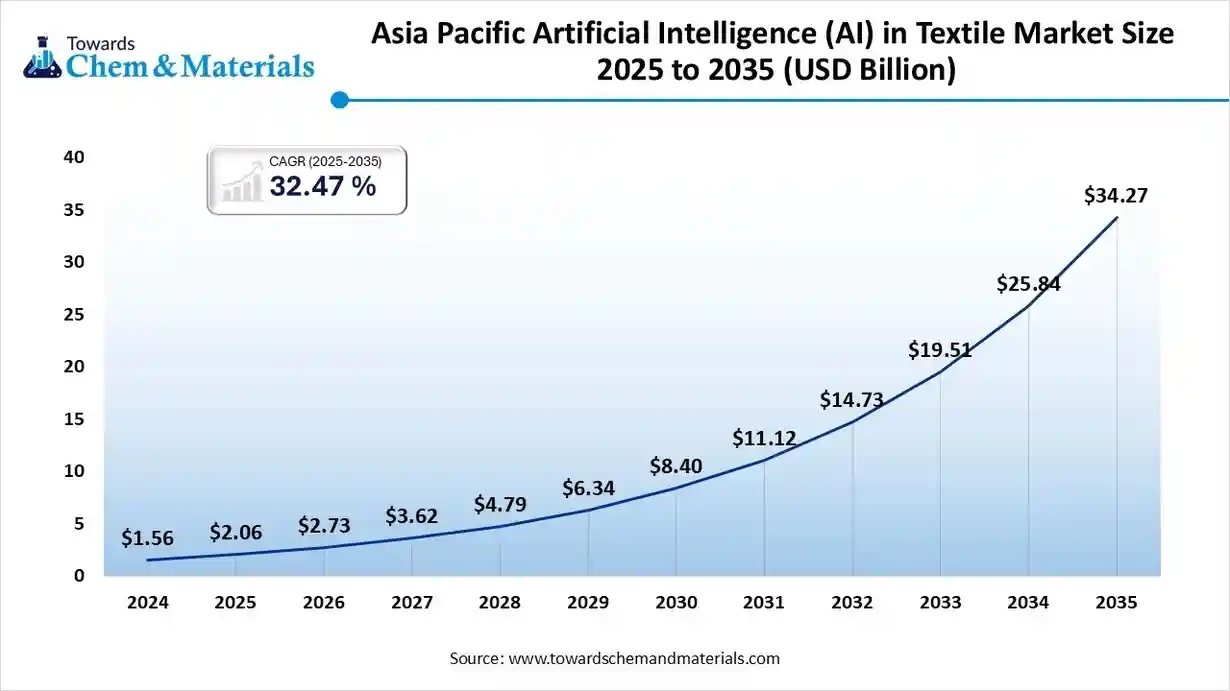
The Asia Pacific artificial intelligence (AI) in textile market size was valued at USD 2.06 billion in 2025 and is expected to surpass around USD 34.27 billion by 2035, expanding at a compound annual growth rate (CAGR) of 32.47% over the forecast period from 2025 to 2035. Asia Pacific dominated the AI in textiles market, with approximately 50% share in 2024.
The well-established textile manufacturing hubs in countries such as India, Vietnam, China, and Bangladesh are driving demand for AI in textiles. The growing demand for technical & everyday textiles, along with strong government support for the adoption of AI in textiles, is driving market growth. The growing demand for customized products and the strong presence of e-commerce are driving the need for AI in textiles. The presence of advanced digital infrastructure and the smart factory revolution drives the overall market growth.
Threading Intelligence: AI Transforming China’s Textile Industry
China is a key contributor to the AI in textile market. The presence of a large textile manufacturing infrastructure and focus on personalised shopping experiences increases demand for AI in textiles. The well-established e-commerce platforms and the strong consumer focus on personalised shopping experiences are driving the adoption of AI in textiles. The presence of companies like Shein and a focus on sustainability support the overall market growth.
- China exported $261B of textiles in 2023.(Source: oec.world)
North America Artificial Intelligence (AI) in Textile Market Trends
North America is expected to experience the fastest market growth during the forecast period. The presence of a strong technological infrastructure and increasing investment in textile startups & giants help the market growth. The stringent sustainability goals and focus on personalised product recommendations increase demand for AI in textiles. The growing trend of intelligent fabrics and the presence of advanced manufacturing technologies, such as automated sewing & weaving, drive overall market growth.
From Cotton to Code: How AI is Transforming United States Textiles
The United States is a major contributor to the artificial intelligence (AI) in textile market. The strong presence of advanced technological infrastructure, such as internet connectivity & data centers, supports market growth. The strong focus on automated textile manufacturing and the trend of intelligent fabrics increases demand for AI in textiles. The growing demand for smart textiles in medical and technical applications supports the overall market growth.
- The United States exported $24.7B of textiles in 2024.(Source: oec.world)
Europe Artificial Intelligence (AI) in Textile Market Trends
Europe is growing at a notable rate in the artificial intelligence (AI) in textile market. Ongoing textile innovations, such as advanced materials, automation, and smart fabrics, are driving market growth. The strong focus on eco-friendly textile production and the rise in textile customization require AI. The growing demand for smart textiles in industries like construction, healthcare, and automotive drives the overall market growth.
From Looms to Algorithms: Germany’s Role in AI-Driven Fabric Manufacturing
Germany contributes to the growth of the artificial intelligence (AI) in textile market. The growing demand for smart textiles across sectors like metalworking, machinery, and electronics is driving demand for AI. The strong focus on sustainability in textiles and the increasing need for automated manufacturing processes require AI. The focus on lowering fabric waste and complex textile manufacturing processes supports the overall market growth.
Germany exported $30.7B of textiles in 2023.(Source: oec.world)
South America Artificial Intelligence (AI) in Textile Market Trends
South America is significantly growing in the artificial intelligence (AI) in textile market. The growing demand for sustainable & smart textiles across industries such as automotive, healthcare, and sports requires AI. The abundance of raw materials and a focus on textile personalisation increase demand for AI. The focus on reducing chemical use, water, & energy, and on developing sustainable textiles, requires AI, driving overall market growth.
Brazil Artificial Intelligence (AI) in Textile Market Trends
Brazil is notably growing in the artificial intelligence (AI) in textile market. The strong government support through initiatives like the Texbrasil program and the strong presence of textile companies require AI. The focus on automating textile manufacturing and advancing sustainability trends requires AI. The development of intelligent fabrics and the need for personalised products support the overall market growth.
- Brazil exported $6.08B of textiles in 2024.(Source: oec.world)
Middle East & Africa Artificial Intelligence (AI) in Textile Market Trends
The Middle East & Africa are growing in the artificial intelligence (AI) in textile market. The strong focus on predicting fashion trends and developing personalised products increases demand for AI. The modern manufacturing technologies and the development of smart textiles require AI. The growing investment in AI infrastructure in countries like the UAE & Saudi Arabia, and increasing consumer demand for modern textiles, drive the overall market growth.
Artificial Intelligence (AI) in Textile Market Share, By Region, 2024 (%)
| Regional | Revenue Share |
| North America | 24% |
| Europe | 18% |
| Asia Pacific | 50% |
| Latin America | 4% |
| Middle East and Africa | 2% |
United Arab Emirates Artificial Intelligence (AI) in Textile Market Trends
The United Arab Emirates is growing rapidly in the AI textile market. The strong government support for Industry 4.0 and smart textile manufacturing requires the use of AI. The growing development of smart factories and a well-established textile manufacturing base requires AI. The strong focus on sustainable practices, automation, and supply chain management in AI in textiles supports the overall market growth.
Recent Developments
- In January 2025, DataBeyond launched an AI tool, the AI Hyperspectral Optical Sorter, to sort blended fabrics in China. The tool sorts textiles containing 30-80% nylon, cotton, polyester, and spandex. The tool supports the large textile and recycling industry.(Source: tech.yahoo.com)
- In October 2025, Fu Hsun Fiber Industries launched a fabric defect detection system, FabGoalie AI, at TITAS 2025. The system consists of features like a GUI and specialized hardware. The system detects various defects like dye stains, broken yarn, creases, oil stains, holes, snagging, and color differences.(Source: www.indiantextilemagazine.in)
- In October 2024, France’s Lectra launched an AI-powered platform, Valia Fashion. The platform automates processes like fabric cutting, apparel production, and order processing. The platform optimizes material consumption and fabric-cutting equipment use. The platform is useful across medium, on-demand, small, and large production facilities.(Source: www.fibre2fashion.com)
Top Companies in the Artificial Intelligence (AI) in Textile Market
- Microsoft Corporation – Microsoft offers Microsoft Cloud solutions tailored for the apparel and textile industry, enabling digital transformation through AI, IoT, and data analytics. Its cloud ecosystem enhances production visibility, supply chain transparency, and sustainable manufacturing practices across textile operations.
- IBM Corporation – IBM develops AI-driven tools that improve supply chain efficiency, predict fashion and consumer trends, and optimize inventory and product mix. Its Watson AI and blockchain technologies support end-to-end transparency and predictive analytics in textile and apparel ecosystems.
- Google LLC – Google provides advanced software solutions and AI-enabled analytics for the development of wearable technology and smart textiles. The company’s Google Cloud and AI platforms assist in fabric innovation, predictive demand analysis, and sustainable product design.
- Amazon Web Services (AWS) – AWS offers cloud computing, AI, and data analytics solutions that optimize design, manufacturing, and supply chain management for textile companies. Its scalable digital infrastructure supports real-time production monitoring and demand forecasting.
- SAP SE – SAP provides integrated enterprise software solutions for textile industry operations, including SAP S/4HANA and SAP Fashion Management. These tools streamline procurement, production, logistics, and retail processes while enabling sustainability tracking and efficient resource planning.
- Oracle Corporation – Oracle delivers cloud-based ERP and SCM platforms that enhance textile industry operations. Its Oracle Cloud Infrastructure (OCI) and AI-driven analytics optimize manufacturing, logistics, and customer engagement for apparel producers and suppliers.
- General Vision Inc. – General Vision focuses on neuromorphic AI and pattern recognition systems used in textile quality control, defect detection, and visual inspection. The company’s cognitive computing technology enables real-time fabric monitoring and process optimization.
- Salesforce Inc. – Salesforce offers CRM and AI-based analytics tools that enable apparel and textile brands to understand customer preferences and enhance product lifecycle management. Its Customer 360 platform integrates marketing, sales, and supply chain insights to strengthen brand-customer relationships.
- Adobe Inc. – Adobe provides design and visualization software such as Adobe Illustrator and Adobe Substance 3D, which are widely used in fashion and textile product development. The company’s digital design tools support sustainable prototyping, virtual fashion design, and creative collaboration.
- Huawei Technologies Co., Ltd. – Huawei delivers cloud computing, IoT, and AI infrastructure to improve efficiency in textile manufacturing. Its smart factory and 5G-enabled connectivity solutions enhance automation, predictive maintenance, and energy management in textile production.
- Nvidia Corporation – Nvidia provides GPU-powered AI and simulation platforms for textile innovation, including material modeling, virtual sampling, and production process optimization. Its technologies enable advanced visual computing and AI-driven automation in digital textile design.
- Siemens AG – Siemens develops industrial automation and digital twin technologies for the textile and apparel sectors. Its Siemens Digital Industries Software supports smart manufacturing, machine connectivity, and lifecycle management, improving precision, productivity, and sustainability in textile production.
Segments Covered
By Technology
- Machine Learning & Deep Learning
- Computer Vision
- Natural Language Processing (NLP)
- Predictive Analytics
- Digital Twins & Simulation
By Material
- Plastics & Polymers (PE, PET, PVC, PP, etc.)
- Glass
By Solution / Offering
- Software Platforms
- Professional Services
- Hardware & Edge Devices
- Managed / Cloud Services
By Application
- Quality Inspection
- Predictive Maintenance
- Process Optimization
- Supply Chain & Demand Forecasting
- Product Design & Development
- Retail & E-Commerce Personalization
By End-Use / Textile Segment
- Apparel & Fashion Manufacturing
- Technical & Industrial Textiles
- Home Textiles
- Nonwoven & Hygiene Products
- Yarn & Fabric Production
Regional Outlook
- North America
- U.S.
- Canada
- Mexico
- Europe
- Germany
- UK
- France
- Italy
- Spain
- Asia Pacific
- China
- India
- Japan
- South Korea
- Latin America
- Brazil
- Argentina
- Middle East & Africa
- Saudi Arabia
- South Africa
FAQ's
Question 1 : What is the current market size and forecast for the global AI in textile market?
Answer : The global artificial intelligence in the textile market is projected to grow from USD 4.12 billion in 2025 to USD 68.44 billion by 2035, with a compound annual growth rate (CAGR) of 32.45%. This growth is driven by the increasing automation in textile manufacturing processes, the rise in personalized textiles, and the demand for smarter supply chains and production systems.
Question 2 : What are the key factors driving the growth of the AI in textile market?
Answer : Automation and Efficiency: AI is significantly improving textile manufacturing processes, such as fabric defect detection, quality inspection, and supply chain management, driving operational efficiency. Customization and Personalization: AI enables the development of personalized textiles, such as custom-fit apparel and smart fabrics, which are in high demand. Sustainability: With a focus on reducing textile waste and optimizing material usage, AI contributes to more sustainable manufacturing practices. Technological Advancements: Machine learning, computer vision, and deep learning technologies are enabling better predictive maintenance, real-time quality control, and product design. Consumer Trends: Increasing interest in smart textiles, wearable technology, and made-to-order clothing is driving the adoption of AI in the textile sector.
Question 3 : Which region dominates the AI in textile market and which region is expected to grow the fastest?
Answer : Asia Pacific: Dominates the market with a share of 50% in 2024. The region has established textile manufacturing hubs in countries like China, India, and Bangladesh, which are investing heavily in AI to enhance production and improve efficiency. North America: Expected to grow at the highest CAGR of 28% during the forecast period. The region is focusing on integrating AI into textile manufacturing to meet the growing demand for smart textiles and personalized products.
Question 4 : What are the key technologies driving AI adoption in the textile industry?
Answer : Machine Learning & Deep Learning: Dominated the market with 38% share in 2024. These technologies are key for automating tasks such as fabric defect detection and manufacturing optimization. Computer Vision: Expected to grow at 25% CAGR, computer vision is essential for fabric inspection, identifying defects, and automating sorting processes. Natural Language Processing (NLP): Growing in demand for predicting fashion trends, enhancing customer experience, and improving supply chain management. Predictive Analytics: Enables textile companies to forecast demand, optimize production schedules, and reduce waste.
Question 5 : How is AI improving textile manufacturing processes?
Answer : Automating Fabric Inspection: AI-driven systems detect fabric defects such as tears, oil spots, and color variations, ensuring high-quality production. Optimizing Supply Chains: AI helps in demand forecasting, inventory management, and logistics optimization, improving efficiency across the supply chain. Enhancing Product Design: AI-driven design tools help textile companies create innovative patterns and personalize fabrics, including smart textiles with color-changing properties or sensors. Predictive Maintenance: AI is used to predict machine failures, reducing downtime and enhancing operational efficiency in textile production facilities.
Question 6 : Who are the leading companies in the AI in textile market?
Answer : Microsoft Corporation, IBM Corporation, Google LLC, Amazon Web Services (AWS), SAP SE, Oracle Corporation, General Vision Inc., Salesforce Inc., Adobe Inc., Huawei Technologies Co., Ltd., Nvidia Corporation, Siemens AG
Meet the Team

Saurabh Bidwai
Principal Consultant
Saurabh Bidwai, a B.Tech Chemical Engineering graduate with 4+ years of experience, specializes in specialty chemicals, commodity chemicals, and engineered materials, offering valuable insights into market trends and emerging opportunities.

Aditi Shivarkar
Reviewed By
Aditi Shivarkar, with 14+ years in Chemical and Materials market research, specializes in Chemical and Materials. She ensures accurate, actionable insights, driving Towards Chemicals And Materials Analytics and Consulting excellence in industry trends and sustainability.