
Asia-Pacific Polyamide Market Size, Share & Trends Analysis Report by 2026-2035
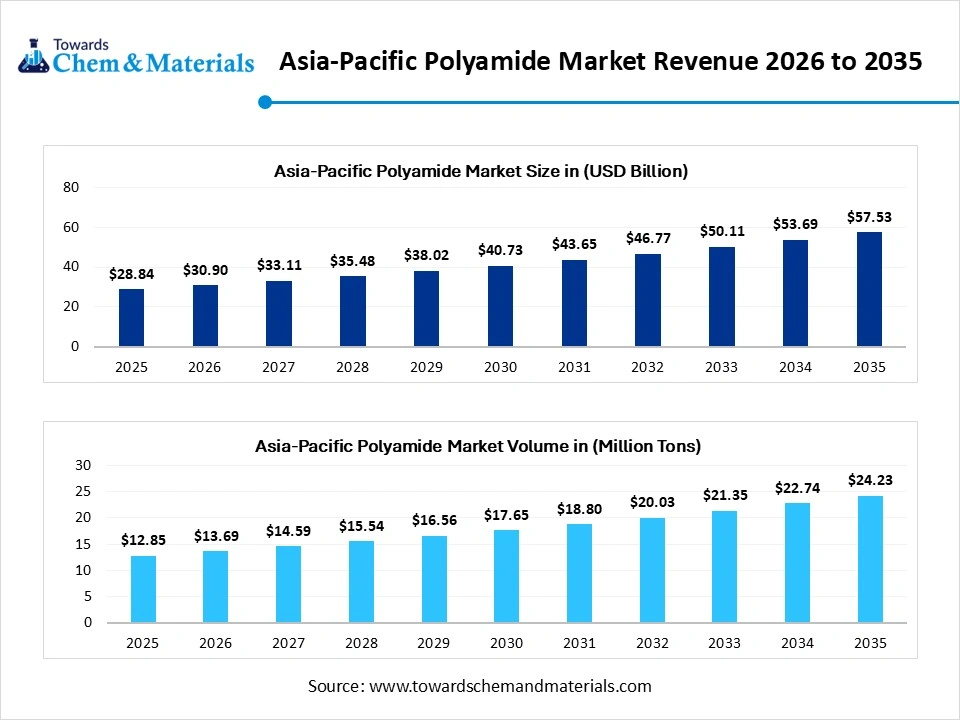
The Asia-Pacific polyamide market is expected to witness strong growth, increasing from USD 28.84 billion in 2025 to USD 57.53 billion by 2035, at a 7.15% CAGR, while volume consumption rises from 12.85 million tons to 24.23 million tons, growing at 6.55% CAGR. The study covers in-depth segmentation data across polyamide types (PA6, PA66, specialty polyamides), applications, and end-use sectors such as automotive, electrical & electronics, and packaging. It also delivers regional insights, detailed company analysis, competitive benchmarking, value chain mapping, and trade flow evaluation, along with key manufacturer and supplier landscape analysis.
Content
Asia-Pacific Polyamide Market Trends, Growth and Market Size Analysis
The global Asia-Pacific polyamide market size was estimated at USD 28.84 billion in 2025 and is expected to be worth around USD 57.53 billion by 2035, growing at a CAGR of 7.15% from 2026 to 2035. In terms of volume, the Asia-Pacific polyamide market is projected to grow from 12.85 million tons in 2025 to 24.23 million tons by 2035. growing at a CAGR of 6.55% from 2026 to 2035.
Key Takeaways
- By country, China dominated the Asia-Pacific polyamide market in 2025, with a significant industry share expected to sustain its position while growing with a rapid CAGR in the forecast period, due to its strong manufacturing base and large industrial sector.
- By country, India held the second largest share in 2025 and expects notable growth with the rapid CAGR during the forecast period, due to its fast-growing economy and expanding industrial base.
- By type, the polyamide 6 (PA6) segment dominated the market with 46% share in 2025, owing to its simplicity, flexibility, and use everywhere.
- By type, the biobased polyamide segment is expected to experience the fastest growth in the market with 8.2% CAGR during the forecast period, due to they are environmentally friendly and made from renewable resources.
- By form, the fiber segment dominated the market with 52% share in 2025, owing to polyamide fibers being widely used in textiles and apparel.
- By form, the engineering plastics segment expects the fastest growth in the market with 7.6% CAGR during the forecast period, due to increasing demand in the automotive and electronics industries.
- By application, the textile segment dominated the market with 32% share in 2025, owing to polyamide being one of the most widely used materials in clothing and fabrics.
- By application, the automotive segment expects the fastest growth in the market with 7.8% CAGR during the forecast period, due to the increasing need for lightweight and fuel-efficient vehicles.
- By end-use industry, the automotive and transportation segment dominated the market with 29% share in 2025 and sustain its position with a greater CAGR of 7.6% during the forecast period, owing to polyamides are essential for making lightweight, strong, and durable components.
Asia-Pacific Polyamide Marke Size and Volume Forecast
- Market Estimated Size (2025): USD 28.84 Billion | CAGR (2026–2035): 7.15%
- Market Projected Size (2035): USD 57.53 Billion
- Market Volume (2025): 12.85 Million Tons (MT) | Volume CAGR (2026–2035): 6.55%
- Market Projected Volume (2035): 24.23 Million Tons (MT)
- Market Pricing (2025):
- Average Manufacturing Price: USD 2,059/ton
- Average Selling Price: USD 2,799/ton
- Pricing CAGR (2025–2035): 3.11%
Polyamide: A Powerful Synthetic Polymer
The type of synthetic polymer that contains repeating amide bonds in its structure is known as the polyamide. Moreover, it is widely known as nylon and is used in many industries because of its strength, flexibility, and resistance to wear. Also, the polyamides can be either natural (like proteins such as silk) or synthetic (like nylon 6 and nylon 66).
Market Trends:
- The growing demand from the automotive industry has offered substantial growth prospects for the industry in recent years. Moreover, the manufacturers have been focusing on reducing vehicle weight to improve fuel efficiency and meet environmental regulations in the past few years.
- The increasing focus on sustainability and eco-friendly materials is seen as a driver of future opportunities for manufacturers in the current period. Also, Companies are developing bio-based polyamides made from renewable resources to reduce environmental impact.
- The rapid expansion of the electrical and electronics industry is likely to enable high-return ventures for manufacturers in the coming years. Moreover, the polyamides are widely used because they provide excellent insulation, heat resistance, and durability.
Report Scope
| Report Attributes | Details |
| Market Size in 2026 | USD 30.90 Billion |
| Projected Market Size in 2035 | USD 57.53 Billion |
| CAGR (2026 - 2035) | 7.15% |
| Leading Region | Asia-Pacific |
| Market Segmentation | By Type, By Form, By Application, By End-Use Industry, By Processing Technology and By Country |
| Top Key Players | Highsun Holding Group, Shenma Industrial Co., Ltd., Sinochem International, Toray Industries, Asahi Kasei, SRF Limited |
Advanced and Eco-Friendly Polyamide Innovations
The industry has observed a major shift toward advanced and sustainable technologies in recent years. Also, the manufacturers are moving from traditional petroleum-based polyamides to bio-based alternatives made from renewable resources. Another key shift is the development of high-performance polyamides with better heat resistance, strength, and durability. Automation and smart manufacturing are also improving production efficiency and product quality in the current period.
Trade Analysis of Asia-Pacific Polyamide Market: Import & Export Statistics
- China has emerged as the leading exporter of polyamide with 47,302 shipments between the June 2024 to May 2025, while South Korea with 20,636 shipments, has been following in recent years.
- India has been seen sophisticated imports of polyamide with 22,987 shipments in the current period, as per the published report.
Supply Chain Analysis of the Asia-Pacific Polyamide Market
Distribution to Industrial Users
- In the Asia-Pacific region, polyamide is primarily distributed to the automotive sector for lightweight engine components and fuel systems. It also serves the electrical industry in insulators and connectors.
- The packaging sector and consumer goods markets further drive demand, utilizing the material for its high thermal resistance and durability.
Chemical Synthesis and Processing
- In the Asia-Pacific region, polyamide synthesis primarily involves the polymerisation of monomers like adipic acid and hexamethylenediamine.
- Processing techniques such as injection moulding and extrusion transform these resins into durable components. Regional manufacturers focus on enhancing thermal stability and mechanical strength to meet rigorous industrial standards.
Regulatory Compliance and Safety Monitoring
- Regulatory compliance for Asia-Pacific polyamide focuses on meeting regional standards for chemical safety and environmental impact. Safety monitoring involves rigorous testing for thermal stability and mechanical integrity.
- Manufacturers must adhere to guidelines governing hazardous substances and waste management to ensure worker safety and product reliability across diverse industrial applications.
Asia-Pacific Polyamide Market Regulatory Landscape: Regulations
| Country Region | Regulatory Body | Key Regulations | Focus Areas |
| China | Ministry of Ecology and Environment (MEE) | GB 4806.7-2023: Specifically governs "Food-Contact Use Plastic Materials and Articles," consolidating previous standards for resins and materials. | Reducing greenhouse gas emissions from petrochemical production (aligned with a 65% reduction goal by 2030), managing Primary Aromatic Amines (PAAs) in food-contact plastics, and standardising bio-based polyamide identification via GB/T 39514-2020 |
| India | Bureau of Indian Standards (BIS). | IS 13463:2022: Specifies requirements for Polyamide 6 materials intended for moulding and extrusion. | Ensuring mechanical integrity (tensile strength and elongation) and chemical resistance for safety-critical applications in marine, construction, and defense sectors. |
| Japan | Ministry of Economy, Trade and Industry (METI) | Chemical Substances Control Law (CSCL): The primary framework for evaluating new and existing chemicals to prevent environmental pollution. | Managing PBT (Persistent, Bioaccumulative, and Toxic) substances and regulating trace impurities in Class I Specified Chemical Substances. Recent amendments (2025) expanded exemptions for trace impurities to reduce industry compliance burdens. |
Segmental Insights
Type Insights
The Polyamide 6 (PA6) Segment Dominated the Asia-Pacific Polyamide Market with 46% Market Share in 2025
The polyamide 6 (PA6) segment dominated the market with 46% share in 2025, owing to it offers an excellent balance of performance and cost. It is easy to process, making it suitable for mass production in industries like textiles and automotive. This material has good strength, flexibility, and chemical resistance, which makes it useful in many applications. It is also widely available and more affordable compared to other polyamides. Manufacturers prefer polyamide 6 because it works well in both fiber and engineering plastic forms.
Polyamide 66 (PA66) held the second largest share of 28% in 2025, owing to it offers higher strength and better heat resistance compared to polyamide 6. It performs exceptionally well in demanding applications such as automotive engine parts and electrical components. Although it is slightly more expensive, its superior mechanical properties make it valuable where performance is critical. Industries choose polyamide 66 for durability and long-term reliability.
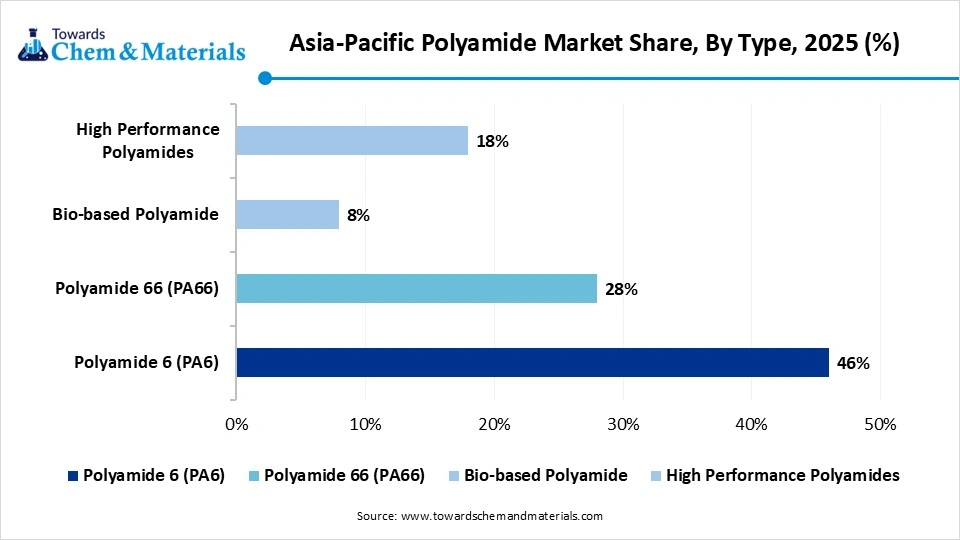
High-performance polyamide held the third largest share of 18% in 2025 due to its advanced properties like extreme heat resistance, chemical stability, and strength. They are used in aerospace, automotive, and electronics industries where standard materials cannot perform well. Although they are more expensive, their unique capabilities make them highly valuable for critical applications.
The biobased polyamide segment is expected to be the fastest growing in the market with 8.2% CAGR during the forecast period due to they are environmentally friendly and made from renewable resources. As sustainability becomes a global priority, industries are shifting toward materials that reduce carbon footprint. Governments and consumers are also supporting eco-friendly products, increasing demand.
Form Insights
The Fiber Segment Dominated the Market with 52% Market Share in 2025
The fiber segment dominated the market with 52% share in 2025, owing to polyamide fibers being widely used in textiles and apparel. They are strong, lightweight, and resistant to wear, making them ideal for clothing, carpets, and industrial fabrics. Their flexibility and comfort make them popular in fashion and sportswear.
Asia-Pacific Polyamide Market Share, By Form, 2025 (%)
| By Form | Revenue Share, 2025 (%) |
| Fiber | 52% |
| Engineering Plastics | 48% |
Application Insights
The Textile Segment Dominated the Asia-Pacific Polyamide Market with 32% Market Share in 2025
The textile segment dominated the market with 32% share in 2025, owing to polyamide being one of the most widely used materials in clothing and fabrics. It offers strength, elasticity, and comfort, making it ideal for everyday wear and sportswear. The fashion industry relies heavily on polyamide for durable and stylish products. A growing population and changing fashion trends are increasing the demand for textiles globally.
Asia-Pacific Polyamide Market Share, By Application, 2025 (%)
| By Application | Revenue Share, 2025 (%) |
| Textiles | 32% |
| Automotive | 22% |
| Electrical & Electronics | 16% |
| Packaging | 11% |
| Consumer Goods | 10% |
| Industrial Applications | 9% |
The automotive segment is expected to be the fastest-growing in the market with 7.8% CAGR during the forecast period due to the increasing need for lightweight and fuel-efficient vehicles. Polyamides help reduce vehicle weight while maintaining strength and safety. They are used in engine components, interiors, and electrical systems. With the rise of electric vehicles, the demand for advanced materials is growing rapidly.
The electrical & electronics segment held the third largest share of 16% in 2025, owing to polyamides providing excellent insulation and heat resistance. They are used in connectors, circuit breakers, and electronic housings. As technology advances, the demand for reliable and durable materials increases.
The packaging segment held the fourth largest share of 11% in 2025, owing to polyamides' offering strength and barrier properties. They help protect products from moisture, air, and damage. Food and industrial packaging benefit from polyamide materials. As e-commerce and food delivery services expand, the need for reliable packaging increases.
End-Use Industry Insights
The Automotive and Transportation Segment Dominated the Market with 29% Market Share in 2025
The automotive and transportation segment dominated the market with 29% share in 2025 and sustain its position with a greater CAGR of 7.6% during the forecast period, owing to polyamides are essential for making lightweight, strong, and durable components. They help improve fuel efficiency and reduce emissions. These materials are used in engines, interiors, and structural parts. The global growth of the automotive sector drives high demand for polyamides.
Asia-Pacific Polyamide Market Share, By End-Use Industry, 2025 (%)
| By End-Use Industry | Revenue Share, 2025 (%) |
| Automotive & Transportation | 29% |
| Textile & Apparel | 26% |
| Electrical & Electronics | 17% |
| Packaging | 12% |
| Consumer Goods | 9% |
| Industrial Manufacturing | 7% |
The textile and apparel segment held the second largest share of 26% in 2025, owing to the consistent global demand for clothing and fabrics. Polyamides are widely used because of their comfort, durability, and flexibility. The fashion industry continuously evolves, creating a steady demand for high-quality materials.
The electrical and electronics segment held the third largest share of 17% in 2025, due to the increasing use of polyamides in advanced devices. These materials offer safety, insulation, and durability. The growth of digital technology and smart devices continues to support demand.
The packaging segment held the fourth largest share of 10% in 2025, owing to rising demand for safe and efficient product handling. Polyamides provide strength and protection, making them suitable for various packaging needs. The growth of online shopping and food delivery supports this segment.
Country Insights
How will China dominate the Asia-Pacific Polyamide Market in 2025?
China maintained its dominance in the market, owing to its strong manufacturing base and large industrial sector. The country has well-developed automotive, textile, and electronics industries, which create high demand for polyamides. It also benefits from cost-effective production, advanced infrastructure, and easy access to raw materials. Also, the government's support for industrial growth and exports further strengthens its position.
India’s Rising Power in the Polyamide Market Growth Future
India is expected to emerge as a prominent country for the Asia-Pacific polyamide market in the coming years, due to its fast-growing economy and expanding industrial base. The country is investing heavily in manufacturing, automotive, and infrastructure development. Rising demand for textiles, automobiles, and electronics is creating strong growth opportunities. Government initiatives like Make in India are encouraging local production and innovation nowadays. India also has a large workforce and an increasing focus on sustainability, including bio-based materials.
Recent Development
- In November 2025, Evonik expanded the production capacity of polyamide in China while prioritizing long-chain polymers. Moreover, the company is going to focus heavily on EVs and sports products, which are primarily based on long-chain polyimides as per the company's claim.
Top Vendors in the Asia-Pacific Polyamide Market & Their Offerings
- Highsun Holding Group (HSCC): Founded in 1984, Highsun is a leading multinational integrated into the full polyamide value chain. It is recognized as the world's largest producer of caprolactam and a major supplier of Nylon 6 chips and filaments. The group operates 31 manufacturing centers globally, serving more than 60 countries.
- Shenma Industrial Co., Ltd.: This state-owned giant is a global leader in Polyamide 66, ranking first in Asia for PA66 salt and chip production. Shenma specializes in high-performance materials for automotive airbags, tire cord fabrics, and industrial yarns. Its primary markets include aerospace, automotive, and electronics across more than 40 Fortune 500 partners.
- Guangdong Xinhui Meida Nylon Co., Ltd.: Now operating as Guangdong Highsun Meida New Materials, this company was the first in China to utilize advanced world-level Nylon 6 technology. With an annual capacity of 200,000 tons of PA6 chips, it serves the civilian spinning, engineering plastics, and injection moulding industries through a diverse range of specialized resins.
- Sinochem International Corporation: A state-holding listed company based in Shanghai, Sinochem International is a key manufacturer of Nylon 66 chips and aramid fibers. Its nylon 66 operations, including a major plant in Ningxia, focus on breaking supply bottlenecks for intermediates like hexamethylene diamine to support China's growing high-end engineering plastics and textile sectors.
Other Key Players
- Toray Industries, Inc.
- Asahi Kasei Corporation
- Mitsui Chemicals, Inc.
- Unitika Ltd.
- Zig Sheng Industrial Co., Ltd.
- SRF Limited
- Century Enka Limited
Asia-Pacific Polyamide Market Segments Covered in the Report
By Type
- Polyamide 6 (PA6)
- Polyamide 66 (PA66)
- Bio-based Polyamide
- High Performance Polyamides (HPPA)
- Polyamide 11 (PA11)
- Polyamide 12 (PA12)
- Polyphthalamide (PPA)
By Form
- Fiber
- Filament Yarn
- Staple Fiber
- Engineering Plastics
- Reinforced
- Unreinforced
By Application
- Textiles
- Apparel
- Industrial Textiles
- Automotive
- Under-the-Hood Components
- Interior Components
- Electrical Components
- Electrical & Electronics
- Connectors
- Circuit Components
- Packaging
- Flexible Packaging
- Rigid Packaging
- Consumer Goods
- Industrial Applications
By End-Use Industry
- Automotive & Transportation
- Textile & Apparel
- Electrical & Electronics
- Packaging
- Consumer Goods
- Industrial Manufacturing
By Processing Technology
- Injection Molding
- Extrusion
- Blow Molding
- Fiber Spinning
By Country
- China
- Taiwan
- India
- Japan
- Australia and New Zealand,
- ASEAN Countries (Singapore, Malaysia)
- South Korea
- Rest of APAC
FAQ's
Question 1 : What are the key trends shaping the Asia-Pacific polyamide market?
Answer : The modernization of the automobile industry is the current industry trend.
Question 2 : Who are the key players in the Asia-Pacific polyamide market?
Answer : Toray Industries, Inc., Asahi Kasei Corporation, and Mitsui Chemicals, Inc. are major players in the Asia-Pacific polyamide market.
Question 3 : Which polyamide segment is expected to grow the fastest?
Answer : The bio-based polyamide segment is expected to grow the fastest, at a CAGR of 8.2%, driven by increasing environmental awareness and demand for sustainable materials.
Question 4 : Which form segment holds the largest market share?
Answer : The fiber segment leads with a 52% share in 2025, primarily due to its extensive use in textiles, apparel, carpets, and industrial fabrics.
Question 5 : Which application dominates the polyamide market?
Answer : The textile segment dominates with a 32% market share, owing to the widespread use of polyamide fibers in clothing, sportswear, and fashion products.
Meet the Team

Saurabh Bidwai
Principal Consultant
Saurabh Bidwai, a B.Tech Chemical Engineering graduate with 4+ years of experience, specializes in specialty chemicals, commodity chemicals, and engineered materials, offering valuable insights into market trends and emerging opportunities.

Aditi Shivarkar
Reviewed By
Aditi Shivarkar, with 14+ years in Chemical and Materials market research, specializes in Chemical and Materials. She ensures accurate, actionable insights, driving Towards Chemicals And Materials Analytics and Consulting excellence in industry trends and sustainability.