
Asphalt Market Size, Share, Growth, Report 2026 to 2035
The Asphalt Market report segmented based on Type, Product Grade, Application, and End-Use Industry. By Type, the market is classified into Hot Mix Asphalt (HMA), Warm Mix Asphalt (WMA), Cold Mix Asphalt, Polymer Modified Asphalt (PMA), Asphalt Emulsion, and Oxidized Asphalt. By Product Grade, it is categorized into Penetration Grade Asphalt, Performance Grade (PG) Asphalt, Viscosity Grade Asphalt, and Modified Asphalt Grades. By Application, the market is divided into Road Construction & Paving, Roofing, Waterproofing, Industrial Applications, and Others. By End-Use Industry, the segmentation includes Transportation Infrastructure, Building & Construction, Industrial Manufacturing, and Energy & Utilities sectors.
Content
What is the current Asphalt Market Size and Share?
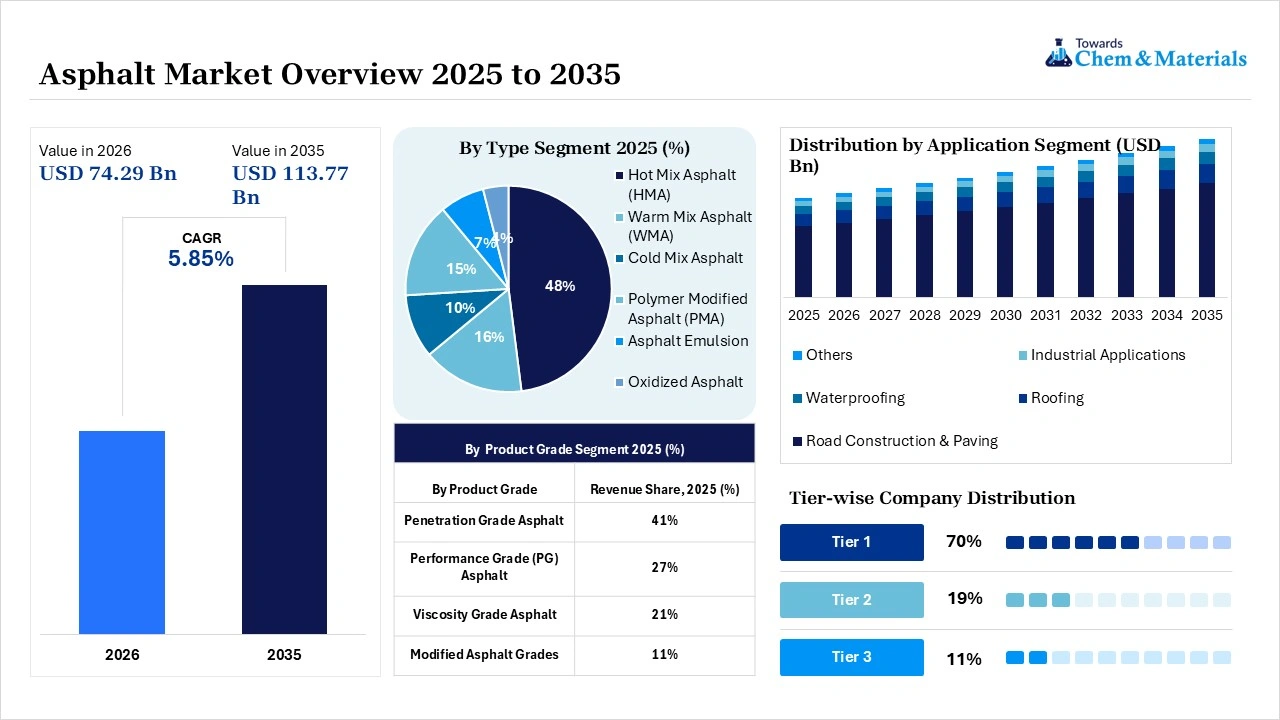
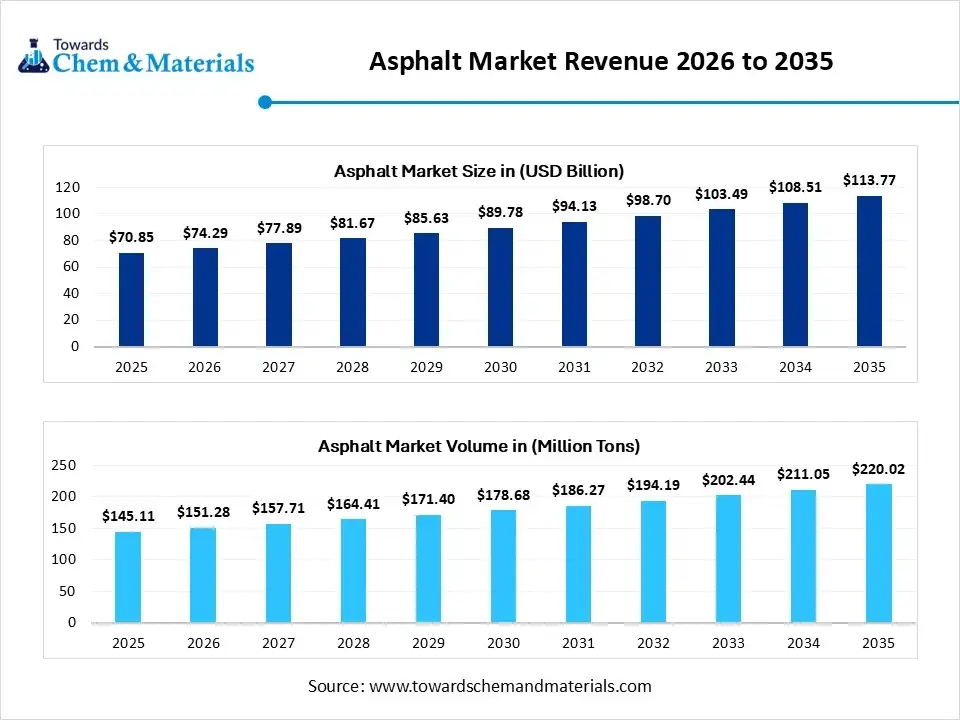
The global asphalt market size was valued at USD 70.85 billion in 2025, is estimated to reach USD 74.29 billion in 2026, and is projected to reach USD 113.77 billion by 2035, exhibiting a compound annual growth rate (CAGR) of 5.85% over the forecast period from 2026 to 2035.Asia Pacific dominated the asphalt market with the largest revenue share of 39.0% in 2025 and is expected to grow at the fastest CAGR of 4.98% during the forecast period. In terms of volume, the asphalt market is projected to grow from 145.11 million tons in 2025 to 220.02 million tons by 2035. growing at a CAGR of 5.25% from 2026 to 2035. Increasing government investments in infrastructure development is the key factor in driving market growth. Also, ongoing urbanization in developing countries coupled with the rising need for sustainable solutions can fuel market growth further.
Market Highlights
- By region, Asia Pacific dominated the market with the largest share of 39.0% in 2025 and is expected to grow at the fastest CAGR of 6.00% over the forecast period. The dominance and growth of the region can be attributed to the extensive highway and airport construction projects.
- By region, North America held the market share of 24.00% in 2025. The growth of the segment can be credited to the extensive federal infrastructure spending and growing need for recycled and sustainable paving materials.
- By type, the hot mix asphalt (HMA) segment dominated the market with the largest share of 48.0% in 2025. The dominance of the segment can be attributed to its high durability.
- By type, the warm mix asphalt (WMA) segment held a market share of 16.00% in 2025 and is expected to grow at the fastest CAGR of 6.1% over the forecast period. The growth of the segment can be credited to the surge in the compaction window.
- By product grade, the penetration grade asphalt segment dominated the market with the largest share of 41.0% in 2025. The dominance of the segment can be attributed to the ongoing transition towards better polymer-modified asphalt.
- By product grade, the performance grade (PG) asphalt segment held a market share of 27.00% in 2025 and is expected to grow at the fastest CAGR of 5.9% in 2025. The dominance and growth of the segment can be credited to the changing infrastructure demands.
- By application, the road construction & paving segment dominated the market with the largest share of 72.0% in 2025. The dominance of the segment can be attributed to the increasing demand to maintain aging highways.
- By application, the others segment held the market share of 3.00% in 2025 and is expected to grow at the fastest CAGR of 5.5% over the forecast period. The growth of the segment can be credited to the increasing need for moisture-resistant construction materials.
- By end-use industry, the transportation infrastructure segment dominated the market with the largest share of 68.0% in 2025. The dominance of the segment can be attributed to the rapid investment in roadway expansion.
- By end-use industry, the energy & utilities segment held the market share of 4.00% in 2025 and is expected to grow at the fastest CAGR of 5.00% during the projected period. The growth of the segment can be credited to the ongoing push towards green energy.
The market includes the manufacturing, distribution, and application of asphalt (bitumen) and asphalt concrete. It is an important sub-sector of the infrastructure and construction sector, emphasizing materials used for paving, waterproofing, roads, and roofing. The market is rapidly shifting towards polymer-modified binders to enhance pavement durability and fulfill sustainability regulations.
The growing integration of reclaimed asphalt pavement shows an increasing industry commitment to environmental sustainability. This practice conserves natural resources and delivers distinct economic advantages by lowering overall aggregate production costs. The market is driven by technological innovation, environmental mandates, and the demand for resilient infrastructure.
Asphalt Market Trends
- Increasing demand for road infrastructure is the latest trend in the market, shaping positive market growth. Governments and private organizations are allocating significant budgets for the maintenance and construction of roads, bridges, and highways.
- Government funding programs and initiatives are playing a key role in market expansion. Many countries are enforcing infrastructure development plans that focus on road maintenance and construction, supported by significant financial resources.
- Ongoing innovations towards sustainable practices are another major factor driving the growth of the market. As the development business is promoting green initiatives, there is an increasing need for innovative asphalt creation. This includes the production and extensive usage of hot-mix asphalt.
Report Scope
| Report Attributes | Details |
| Market Size and Volume in 2026 | USD 74.29 Billion / 151.28 Million Tons |
| Revenue Forecast in 2035 | USD 113.77 Billion / 220.02 Million Tons |
| Growth Rate | CAGR 5.85% |
| Base Year of Estimation | 2025 |
| Forecast Period | 2025 - 2035 |
| High Impact Region | Asia Pacific |
| Segment Covered | By Type, By Product Grade, By Application, By End-Use Industry, By Regions |
| Key Companies Profiled | Exxon Mobil Corporation, Marathon Petroleum Corporation, Royal Dutch Shell, United Refining Company, Boral, Valero Marketing and Supply Company, HEIDELBERGCEMENT AG, CEMEX S.A.B. de C.V., China Petroleum & Chemical Corporation |
How Are Cutting-Edge AI Technologies Revolutionizing the Asphalt Market?
Artificial intelligence is revolutionizing the market by transitioning operations from reactive to proactive. By using IoT sensors, machine learning, and autonomous equipment, the sector is facilitating material usage and enhancing paving precision. Furthermore, ML models process past project performance to refine asphalt mix designs and ensure better sustainability and durability.
Supply Chain Analysis of the Asphalt Market
- Feedstock Procurement :It includes the sourcing and purchasing of essential raw materials, mainly heavy crude oil and petroleum residues required to manufacture liquid asphalt/bitumen.
- Major Players: Shell plc, ExxonMobil Corporation
- Chemical Synthesis and Processing :It includes the industrial segment's emphasis on altering the chemical and molecular composition of asphalt to design better material properties.
- Major Players: BASF SE, Dow Inc.
- Packaging and Labeling :It is a crucial section that defines how asphalt (bitumen) products are contained, stored, transported, and detected across the supply chain.
- Major Players: TotalEnergies, Shell plc
- Regulatory Compliance and Safety Monitoring :It includes the specialized industry sector's emphasis on ensuring that asphalt manufacturing, testing, mixing, and paving operations comply with global environmental standards.
- Major Players: Anton Paar GmbH, Cemex S.A.B. de C.V.
Asphalt Market's Regulatory Landscape: Global Regulations
| Country/Region | Key Regulations |
| United States | The U.S. Environmental Protection Agency (EPA) enforces strict Clean Air Act Title V operating permits for asphalt plants. These laws strictly cap Volatile Organic Compounds (VOCs), sulfur dioxide and particulate matter (PM). |
| Germany | Air Quality Standards: Operates under TA Luft (Technical Instructions on Air Quality Control), which mandates strict emission limits for carcinogenic substances, organic substances, and nitrogen oxides during asphalt production. |
| China | The Ministry of Ecology and Environment (MEE) executes ultra-low emission standards for heavy industries. Asphalt mixing plants in key regions must adopt enclosed storage, advanced fabric filter baghouses, and continuous emission monitoring systems (CEMS). |
Market Dynamics
Driver
Ongoing Infrastructure Expansion
The large-scale infrastructure projects focusing on improving transportation networks are the major factor driving market growth. Government-led initiatives are propelling the demand for high-grade asphalt in road construction, expressways, and highways. In addition, rapid urbanization is driving the expansion of commercial and residential infrastructure, hence accelerating the demand for high-performance paving solutions. A surge in investments in industrial corridors and metro rail networks is fostering greater reliance on modified asphalt.
Restraint
Environmental and Regulatory Hurdles
Conventional hot-mix asphalt manufacturing creates an extensive greenhouse gas footprint, requiring stringent government regulations, which is the key factor hindering the growth of the market. Standard mixing plants confront scrutiny as conventional phases can spike localized air pollution. While Reclaimed Asphalt Pavement (RAP) significantly reduces material waste, inherent inconsistencies in aggregate gradation and binder properties make it difficult to maintain uniform structural integrity across varying production batches.
Opportunity
Technological Advancements in Asphalt Production
Asphalt production innovations in the asphalt manufacturing process are creating lucrative opportunities in the market. Advancements like warm-mix asphalt technology are increasingly gaining traction, enabling less energy consumption and fewer emissions during manufacturing. Furthermore, continuous advancement of high-performance asphalt mixtures enhances road infrastructure longevity and durability. These innovations are necessary to meet contemporary transportation demands while ensuring industry compliance with environmental mandates and sustainability goals.
Segmental Insights
Type Insights
The hot mix asphalt (HMA) segment dominated the market with the largest share of 48.0% in 2025. The dominance of the segment can be attributed to its high durability, better load-bearing capacity, and capability to handle heavy vehicular traffic on highways. In addition, aggressive government spending on highway expansions can fuel segment growth further.
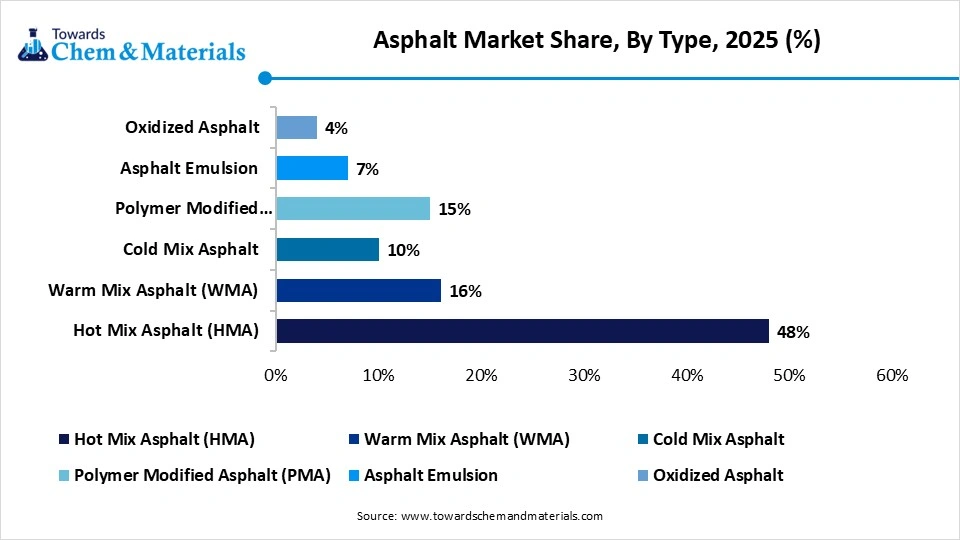
The warm mix asphalt (WMA) segment held a market share of 16.00% in 2025 and is expected to grow at the fastest CAGR of 6.1% over the forecast period. The growth of the segment can be credited to the surge in the compaction window for smooth transportation and decreased fuel consumption. WMA enables enhanced workability in harsh weather conditions.
The polymer modified asphalt (PMA) segment held the market share of 15.00% in 2025. The growth of the segment can be linked to the surge in infrastructure investments in developing countries along with the demand to bear harsh weather conditions. PMA showcases improved elasticity and superior performance in severe temperature conditions.
The cold mix asphalt segment held the market share of 10.00% in 2025. The growth of the segment can be driven by its cost-effectiveness and versatility for emergency repairs and seasonal patching. CMA can be smoothly applied in different temperatures, which makes it beneficial for emergency pothole repairs.
Asphalt Market Share, By Type, 2025 (%)
| By Type | Revenue Share, 2025 (%) |
| Hot Mix Asphalt (HMA) | 48% |
| Warm Mix Asphalt (WMA) | 16% |
| Cold Mix Asphalt | 10% |
| Polymer Modified Asphalt (PMA) | 15% |
| Asphalt Emulsion | 7% |
| Oxidized Asphalt | 4% |
Product Grade Insights
The penetration grade asphalt segment dominated the market with the largest share of 41.0% in 2025. The dominance of the segment can be attributed to the ongoing transition towards better polymer-modified asphalt for harsh climates and the surge in investments in global transportation infrastructure.
The performance grade (PG) asphalt segment held a market share of 27.00% in 2025 and is expected to grow at the fastest CAGR of 5.9% in 2025. The dominance and growth of the segment can be credited to the changing infrastructure demands and increasing demand to bear extreme climate changes. The PG system enables micro-level grading catered to specific regions.
The viscosity grade asphalt segment held the market share of 21.00% in 2025. The growth of the segment can be linked to the growing need for standardized quality products and rapid urbanization across the globe. The incorporation of modifiers is boosting their usage in high-stress and specialized applications.
The modified asphalt grades segment held the market share of 11.00% in 2025. The growth of the segment can be driven by the ongoing push towards sustainable construction along with the surge in infrastructure investments. Moreover, increasing populations need highly durable binders.
Asphalt Market Share, By Product Grade, 2025 (%)
| By Product Grade | Revenue Share, 2025 (%) |
| Penetration Grade Asphalt | 41% |
| Performance Grade (PG) Asphalt | 27% |
| Viscosity Grade Asphalt | 21% |
| Modified Asphalt Grades | 11% |
Application Insights
The road construction & paving segment dominated the market with the largest share of 72.0% in 2025. The dominance of the segment can be attributed to the increasing demand to maintain aging highways and innovations in recyclable technologies. Asphalt remains one of the most extensively used paving materials because of its high tensile strength.
The others segment held the market share of 3.00% in 2025 and is expected to grow at the fastest CAGR of 5.5% over the forecast period. The growth of the segment can be credited to the increasing need for moisture-resistant construction materials and the surge in consumer spending on leisure spaces.
The roofing segment held a market share of 12.00% in 2025. The growth of the segment can be linked to the increasing demand from the commercial and residential sectors coupled with the need for building maintenance. Market players are rapidly manufacturing reflective and efficient asphalt roofing products to fulfill green building standards.
The waterproofing segment held a market share of 8.00% in 2025. The growth of the segment can be driven by the increasing need for durable roofing materials and the transition towards sustainable asphalt coatings in residential and commercial construction.
Asphalt Market Share, By Application, 2025 (%)
| By Application | Revenue Share, 2025 (%) |
| Road Construction & Paving | 72% |
| Roofing | 12% |
| Waterproofing | 8% |
| Industrial Applications | 5% |
| Others | 3% |
End-Use Industry Insights
The transportation infrastructure segment dominated the market with the largest share of 68.0% in 2025. The dominance of the segment can be attributed to the rapid investment in roadway expansion and airport runway construction, especially in emerging economies. The introduction of polymer-modified asphalts can significantly increase the lifespan of roads.
The energy & utilities segment held the market share of 4.00% in 2025 and is expected to grow at the fastest CAGR of 5.00% during the projected period. The growth of the segment can be credited to the ongoing push towards green energy and the ongoing growth of solar and wind energy projects across the globe.
The building & construction segment held a market share of 21.00% in 2025. The growth of the segment can be linked to strong government investments in infrastructure rehabilitation and increasing adoption of sustainable materials. Asphalt is a crucial waterproofing agent used for sealing flat roofs.
The industrial manufacturing segment held a market share of 7.00% in 2025. The growth of the segment can be driven by growing demand to repair aging roadways and rapid expansion of the energy sector globally. Protective applications promote asset longevity further, impacting positive market growth.
Asphalt Market Share, By End-Use Industry, 2025 (%)
| By End-Use Industry | Revenue Share, 2025 (%) |
| Transportation Infrastructure | 68% |
| Building & Construction | 21% |
| Industrial Manufacturing | 7% |
| Energy & Utilities | 4% |
Regional Insights
How did Asia Pacific Dominate the Asphalt Market in 2025?
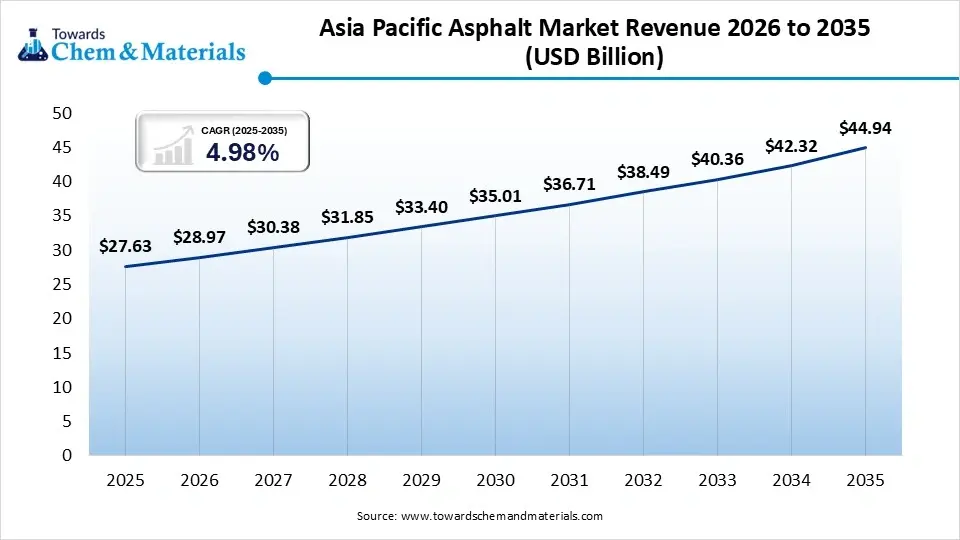
The Asia Pacific asphalt market size was estimated at USD 27.63 billion in 2025 and is projected to reach USD 44.94 billion by 2035, growing at a CAGR of 4.98% from 2026 to 2035.Asia Pacific dominated the market with the largest share of 39.0% in 2025 and is expected to grow at the fastest CAGR of 6.00% over the forecast period. The dominance and growth of the region can be attributed to the extensive highway and airport construction projects and heavy government infrastructure investments. In addition, the region is increasingly adopting innovative paving technologies, such as Warm Mix Asphalt (WMA).
 China
China
- The demand to handle increased vehicle traffic and changing climatic conditions drives strong demand for specialty additives.
- Government mandates for green infrastructure are fueling the adoption of sustainable processes, including warm-mix asphalt technologies.
India
- Extensive investments in rural road connectivity under different initiatives heavily fuel the demand in rural heavy states in the north and central belts.
- The increasing population creates a need to expand and maintain urban transit systems and parking lots.
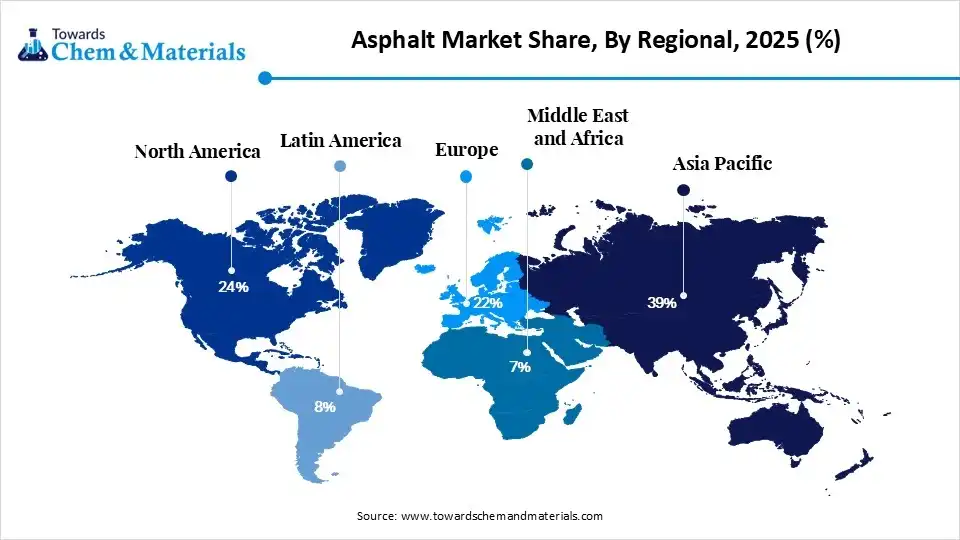
The North America asphalt market size was estimated at USD 17.00 billion in 2025 and is projected to reach USD 27.87 billion by 2035, growing at a CAGR of 5.07% from 2026 to 2035.North America held a market share of 24.00% in 2025. The growth of the segment can be credited to the extensive federal infrastructure spending and growing need for recycled and sustainable paving materials. Furthermore, rapid population shifts to urban centers boost the demand to convert land for commercial, residential, and transportation use, which needs new infrastructure.
United States
- Rapid population growth and ongoing expansion in states like Texas and Florida need continuous new road construction.
- State mandates emphasize heavily incorporating recycled materials into their asphalt mixes to meet strict local carbon emissions regulations.
Canada
- Severe Canadian weather cycles need constant, cyclical repair and resurfacing of existing pavements, creating a baseline of high demand for asphalt.
- There is a growing adoption of Recycled Asphalt Pavement (RAP) and Warm-Mix Asphalt (WMA), which significantly reduces greenhouse gas emissions and fuel consumption.
The Europe asphalt market size was estimated at USD 15.59 billion in 2025 and is projected to reach USD 25.60 billion by 2035, growing at a CAGR of 5.08% from 2026 to 2035.Europe held a market share of 22.00% in 2025. The growth of the region can be linked to the increasing government investment in highway construction and a robust regulatory push towards climate-resilient and sustainable paving materials. Also, stringent EU decarbonization efforts have facilitated an extensive market shift towards "green" asphalt.
Germany
- Ongoing government funding, along with EU investments, ensures steady demand for roadway expansion and bridge refurbishments.
- The integration of smart manufacturing, automated asphalt pumps, and cutting-edge mixing plants is lowering operational costs, leading to market growth soon.
Asphalt Market Share, By Regional, 2025 (%)
| Regional | Revenue Share, 2025 (%) |
| North America | 24% |
| Europe | 22% |
| Asia-Pacific | 39% |
| Latin America | 8% |
| Middle East & Africa | 7% |
The Latin America asphalt market size was estimated at USD 5.67 billion in 2025 and is projected to reach USD 9.67 billion by 2035, growing at a CAGR of 5.48% from 2026 to 2035.Latin America held a market share of 8.00% in 2025. The growth of the region can be driven by ongoing urbanization and an increase in private and public investments in transportation networks. There is a robust regional shift towards using sustainable substitutes, like bio-based asphalt additives, which align well with global sustainability mandates.
Brazil
- A rise in population and increasing urbanization necessitate constant development and maintenance of both urban road networks and interstate highways.
- Materials such as waste rubber-modified asphalt and advanced asphalt fibers are increasingly favored for their thermal stability and crack resistance in extreme climates.
Argentina
- Ongoing population growth in major urban hubs across the country needs the constant repair, maintenance, and expansion of city road networks.
- The country's emphasis on long-term environmental sustainability is supporting a gradual transition toward eco-friendly solutions.
The Middle East and Africa asphalt market size was estimated at USD 4.96 billion in 2025 and is projected to reach USD 8.53 billion by 2035, growing at a CAGR of 5.57% from 2026 to 2035.The Middle East & Africa held a market share of 7.00% in 2025. The growth of the region is owing to the extensive government-led infrastructure investments and ongoing regional economic diversification initiatives. Moreover, the extreme temperatures across the MEA region need specialized polymer-modified bitumen to avoid rutting, cracking, and premature degradation of asphalt pavements.
Saudi Arabia
- Expansion of smart cities and tourism hubs (such as NEOM) needs extensive new road networks and airport runways.
- Surges in drilling activities have boosted a localized spike in demand for specialized products like sulfonated asphalt, which is utilized as an additive in drilling fluids.
UAE
- Government mandates for sustainable construction are heavily boosting the demand for low-temperature and warm-mix asphalt.
- Stricter regulatory standards regarding road safety and material testing have led to an increased need for precise asphalt mixing and production equipment.
Recent Developments
- In December 2025, Arisinfra Solutions entered a Memorandum of Understanding (MoU) with JS Infra Solutions to explore a strategic collaboration within the asphalt and road infrastructure materials ecosystem. Operating at the execution layer, JS Infra Solutions is recognized as one of the top ten asphalt producers in the Mumbai region.(Source: constructionweekonline)
Top Companies List
- Exxon Mobil Corporation
- Marathon Petroleum Corporation
- Royal Dutch Shell
- United Refining Company
- Boral
- Valero Marketing and Supply Company
- HEIDELBERGCEMENT AG
- CEMEX S.A.B. de C.V.:
- China Petroleum & Chemical Corporation
Segments Covered
By Type
- Hot Mix Asphalt (HMA)
- Dense-Graded HMA
- Stone Matrix Asphalt
- Open-Graded HMA
- Warm Mix Asphalt (WMA)
- Organic Additive WMA
- Chemical Additive WMA
- Foamed Asphalt WMA
- Cold Mix Asphalt
- Emulsion-Based Cold Mix
- Cutback Asphalt Mix
- Polymer Modified Asphalt (PMA)
- SBS Modified Asphalt
- EVA Modified Asphalt
- Crumb Rubber Modified Asphalt
- Asphalt Emulsion
- Cationic Emulsion
- Anionic Emulsion
- Non-Ionic Emulsion
- Oxidized Asphalt
- Roofing Grade
- Industrial Grade
By Product Grade
- Penetration Grade Asphalt
- 40/50 Grade
- 60/70 Grade
- 80/100 Grade
- 100/120 Grade
- Performance Grade (PG) Asphalt
- PG 58
- PG 64
- PG 70
- PG 76
- Viscosity Grade Asphalt
- VG-10
- VG-20
- VG-30
- VG-40
- Modified Asphalt Grades
- Polymer Modified
- Rubber Modified
- Chemical Modified
By Application
- Road Construction & Paving
- Highways
- Urban Roads
- Rural Roads
- Airport Runways
- Roofing
- Residential Roofing
- Commercial Roofing
- Industrial Roofing
- Waterproofing
- Building Foundations
- Tunnels
- Bridges
- Industrial Applications
- Pipe Coatings
- Adhesives & Sealants
- Soundproofing Materials
- Others
- Recreational Surfaces
- Railway Infrastructure
By End-Use Industry
- Transportation Infrastructure
- Highway Authorities
- Municipal Road Projects
- Airport Authorities
- Building & Construction
- Residential Construction
- Commercial Construction
- Industrial Construction
- Industrial Manufacturing
- Chemical Processing
- Coatings Production
- Specialty Products
- Energy & Utilities
- Pipeline Infrastructure
- Utility Protection Systems
By Region
- North America
- U.S.
- Canada
- Europe
- Germany
- UK
- France
- Italy
- Spain
- SwedenDenmark
- Norway
- Asia Pacific
- China
- Japan
- India
- South Korea
- Thailand
- Latin America
- Brazil
- Mexico
- Argentina
- Middle East and Africa (MEA)
- South Africa
- UAE
- Saudi Arabia
- Kuwait
FAQ's
Question 1 : What is the main factor driving the global asphalt market?
Answer : The primary driver is massive government funding for expanding and repairing public transportation networks. Public and private organizations worldwide are dedicating huge budgets to fix aging expressways, build new airport runways, and handle rising vehicle traffic.
Question 2 : Why is Warm Mix Asphalt growing so quickly?
Answer : Warm Mix Asphalt is growing at the fastest rate because it offers a longer compaction window and works well in cold weather. More importantly, it requires less energy to manufacture, which significantly reduces fuel consumption and plant emissions for paving companies.
Question 3 : How does the industry reuse old pavement to stay sustainable?
Answer : The industry uses Reclaimed Asphalt Pavement (RAP), which involves grinding up old roads and mixing the material back into new batches. This process conserves natural aggregate resources, prevents waste from going to landfills, and lowers overall production costs.
Question 4 : What are the biggest environmental challenges for the asphalt industry?
Answer : Traditional hot-mix asphalt plants face tight regulatory scrutiny because the high-temperature manufacturing process creates a large greenhouse gas footprint. Plant operators must constantly update their facilities with enclosed storage and filtering systems to meet strict clean air standards.
Question 5 : Who are the top companies operating in the global asphalt market?
Answer : The top companies profiled in the market include Exxon Mobil Corporation, Marathon Petroleum Corporation, Royal Dutch Shell, United Refining Company, and Boral.Other major players dominating global production and distribution include Valero Marketing and Supply Company, HEIDELBERGCEMENT AG, CEMEX S.A.B. de C.V., and China Petroleum and Chemical Corporation (Sinopec).
Meet the Team

Saurabh Bidwai
Principal Consultant
Saurabh Bidwai, a B.Tech Chemical Engineering graduate with 4+ years of experience, specializes in specialty chemicals, commodity chemicals, and engineered materials, offering valuable insights into market trends and emerging opportunities.

Aditi Shivarkar
Reviewed By
Aditi Shivarkar, with 14+ years in Chemical and Materials market research, specializes in Chemical and Materials. She ensures accurate, actionable insights, driving Towards Chemicals And Materials Analytics and Consulting excellence in industry trends and sustainability.