
Bio-Based Polyethylene Furanoate Market Size, Share, Growth, Report 2026 to 2035
Bio-Based Polyethylene Furanoate Market Report is Segmented By Product Type (Polyethylene Furanoate (PEF) Resin, PEF Compounds, PEF Preforms), By Application(Packaging, Fibers & Textiles, Automotive Components, Electronics), By End-Use Industry (Food & Beverage, Textile Industry, Automotive Industry, Electronics Industry, Consumer Goods), By Processing Technology (Injection Molding, Extrusion, Blow Molding, Compression Molding), By Distribution Channel (Direct Sales, Distributors, Online Channels), -Global Industry Analysis, Size, Trends, Leading Companies, Regional Outlook, and Forecast 2026 to 2035.
Content
What is the Current Bio-Based Polyethylene Furanoate Market Size and Share?
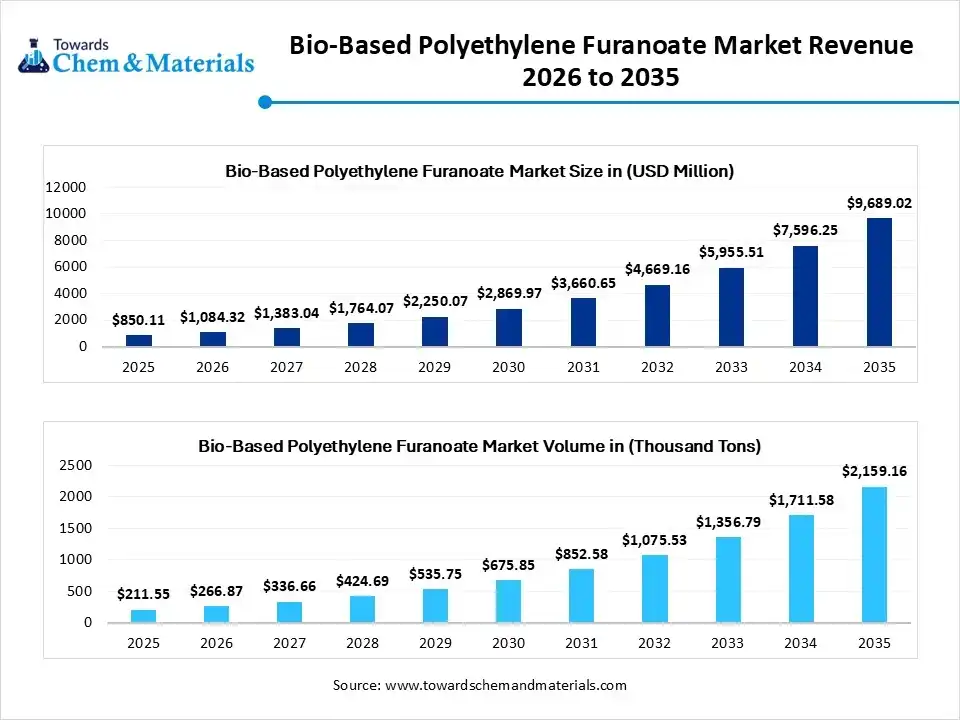
The global bio-based polyethylene furanoate market size was estimated at USD 850.11 million in 2025 and is expected to increase from USD 1,084.32 million in 2026 to USD 9,689.02 million by 2035, growing at a CAGR of 27.55% from 2026 to 2035. In terms of volume, the bio-based polyethylene furanoate industry is projected to grow from 211.55 thousand tons in 2025 to 2,159.16 thousand tons by 2035, exhibiting a compound annual growth rate (CAGR) of 26.15% over the forecast period from 2026 to 2035. Increasing demand for sustainable, plant-based packaging is the key factor driving market growth. Also, a surge in investments in circular economy technologies, coupled with the increasing investments in large-scale production, can fuel market growth further.
It is a 100% bio-based, recyclable, and sustainable polymer extracted from renewable plant sugars, created to replace traditional, oil-based polyethylene terephthalate (PET) in textiles, packaging, and electronics. PEF gives higher thermal stability, better barrier properties, and lower carbon emissions. The market is mainly fuelled by the increasing demand for plant-based, sustainable packaging with substantial growth in the food and beverage industry.
Bio-based polyethylene furanoate (PEF) offers superior mechanical and moisture-barrier properties compared to conventional plastic. Furthermore, owing to its higher tensile strength, PEF requires fewer additives than polyethylene terephthalate (PET) and possesses compatibility with current PET recycling streams at concentrations up to 5%. Growing concerns regarding environmental toxicity and the depletion of crude oil reserves are driving the adoption of bio-based polyethylene furanoate (PEF). Furthermore, rising stringent regulatory frameworks restricting the use of petro-based plastics in specialized sectors, such as medical devices and food packaging, are projected to bolster growth in the market over the forecast period.
Market Highlights
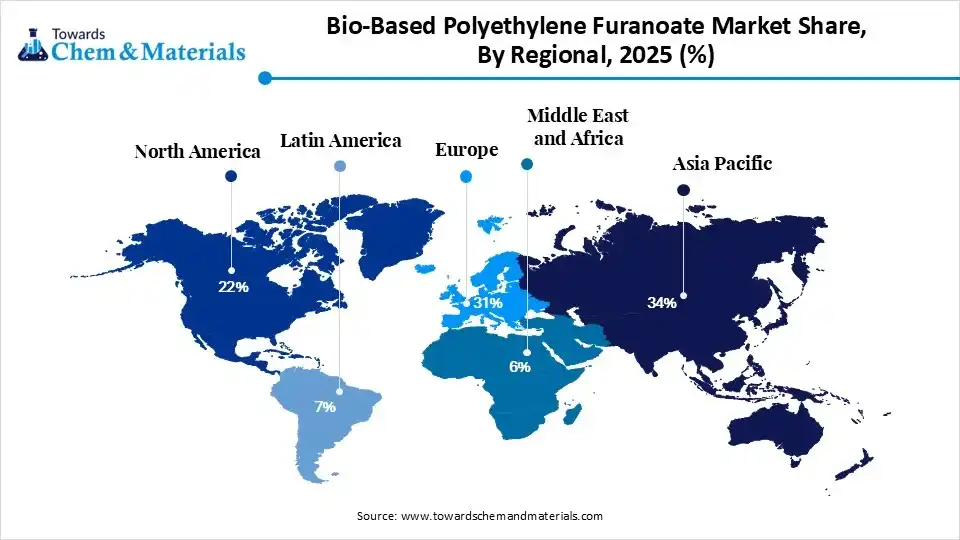
- By region, Asia Pacific dominated the market with the largest share of 34% in 2025 and is expected to grow at the fastest CAGR of 29.6% over the forecast period. The dominance and growth of the region can be credited to the increasing demand for packaging materials.
- By region, Europe held the market share of 31% in 2025. The growth of the region can be attributed to the increasing investments in commercialization by leading companies.
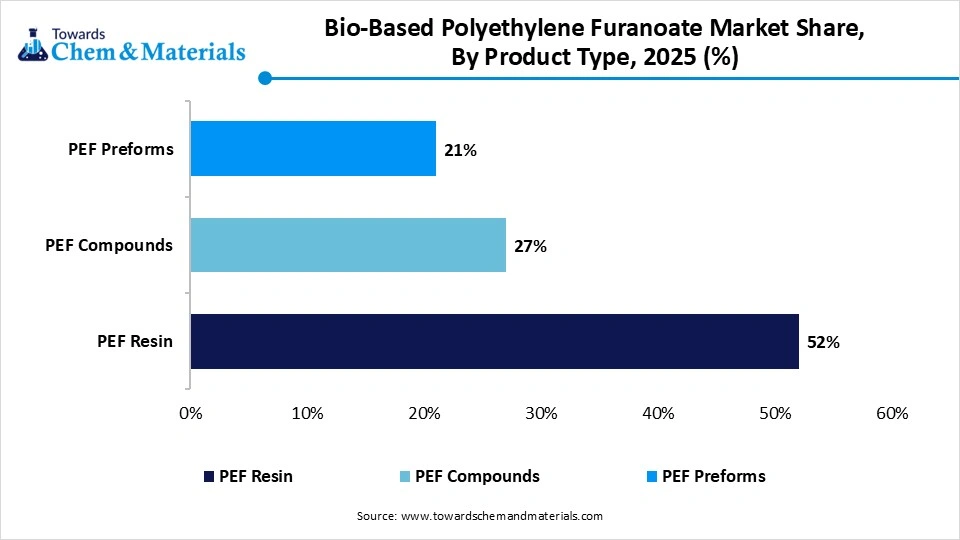
- By product type, the PEF resin segment dominated the market with the largest share of 52% in 2025 and is expected to grow at the fastest CAGR of 28.3% over the forecast period. The dominance and growth of the segment can be attributed to the increasing demand for core materials.
- By application, the packaging segment dominated the market with the largest share of 61% in 2025 and is expected to grow at the fastest CAGR of 28.9% over the forecast period. The dominance and growth of the segment can be driven by increasing product demand from the beverage and food industry.
- By end-use industry, the food & beverage segment dominated the market with the largest share of 58% in 2025 and is expected to grow at the fastest CAGR of 29.4% during the forecast period. The dominance and growth of the segment can be attributed to the growing adoption of PEF from the beverage companies.
- By processing technology, the injection molding dominated the market with 36% share in 2025. The growth of the segment is driven by rising packaging sector.
- By processing technology, the blow molding segment expected to grow at the fastest CAGR of 28.1% over the projected period. The growth of the segment can be driven by growing demand for beverage packaging.
- By distribution channel, the direct sales segment dominated the market with the largest share of 54% in 2025. The dominance of the segment can be attributed to the increasing preference for direct procurement.
- By distribution channel, the online channels segment is expected to grow at the fastest CAGR of 30.2% over the study period. The growth of the segment can be credited to the increasing adoption of online channels from SMEs.
Market Size and Volume Forecast
- Market Estimated Size (2025): USD 850.11 Million | CAGR (2026–2035): 27.55%
- Market Projected Size (2035): USD 9,689.02 Million
- Market Volume (2025): 211.55 Thousand Tons | Volume CAGR (2026–2035): 26.15%
- Market Projected Volume (2035): 2,159.16 Thousand Tons
- Market Pricing (2025):
- Average Manufacturing Price: USD 3,660 per ton
- Average Selling Price: USD 4,870 per ton
- Pricing CAGR (2025–2035): 4.25%
Recent Market Trends
- Increasing demand for bio-based polyethylene furanoate (PEF) in the food industry is the latest trend in the market, shaping positive market growth. It has a superior and robust resistance property compared to conventional polyethylene furanoate.
- The increasing consumer awareness of environmental issues is fuelling the growth of the market. As individuals increasingly become informed about the detrimental effects of conventional plastics, there is an ongoing transition towards products manufactured from sustainable materials.
- Technological innovations in the manufacturing processes are another major factor driving market growth.
- Advancements like enhanced catalytic processes and fermentation methods are increasingly being developed to increase yield and minimize overall production costs.
How Are Cutting-Edge Technologies Revolutionizing the Bio-Based Polyethylene Furanoate Market?
Advanced technologies are transforming the market by optimizing large-scale and cost-effective production of FDCA (furan dicarboxylic acid) from renewable plant sugars. Furthermore, various technologies are emphasizing making PEF compatible with current PET recycling streams to encourage adoption of more rapid circular economy principles, contributing to market growth soon.
Report Scope
| Report Attribute | Details |
| Market Size and Volume in 2026 | USD 1,084.32 Million/ 266.87 Thousand Tons |
| Revenue Forecast in 2035 | USD 9,689.02 Million/ 2,159.16 Thousand Tons |
| Growth Rate | CAGR 27.55% |
| Forecast Period | 2026 - 2035 |
| Base Year | 2025 |
| Dominant Region | Europe |
| Segment Covered | By Product Type, By Application, By End-Use Industry, By Processing Technology, By Distribution Channel, By Regions |
| Key companies profiled | Swicofil AG, Avantium, Toyobo Co. Ltd. (Japan), Ava Biochem AG (Switzerland), Swire Pacific Limited (U.K.), WIFAG-Polytype Holding AG (Switzerland), Toray Industries Inc (Japan), ALPLA (Austria), Mitsui & Co., Ltd. (Japan), Gevo (U.S.), and The Coca-Cola Company (U.S.). |
Supply Chain Analysis of the Bio-Based Polyethylene Furanoate Market
Feedstock Procurement
- It involves the strategic sourcing and acquisition of bio-based resources required to produce mono-ethylene glycol (MEG) and 2,5-furandicarboxylic acid (FDCA), the core monomers for PEF.
- Major Players: Avantium, Origin Materials
Chemical Synthesis and Processing
- It refers to the industrial methods utilized to convert biomass-derived building blocks into the final polymer. It is crucial as it determines the polymer's quality, purity, and ability to replace petroleum-based plastics.
- Major Players: AVA Biochem AG, Origin Materials (USA)
Packaging and Labelling
- It refers to the development of containers, mainly flexible films, bottles, and specialized labels that use PEF's superior gas barrier properties to replace conventional PET plastics.
- Major Players: The Coca-Cola Company (US), PepsiCo (US)
Regulatory Compliance and Safety Monitoring
- It emphasizes ensuring its safety for food contact and adhering to stringent international regulations regarding the circular economy and bioplastic standards.
- Major Players: Avantium N.V., AVA Biochem AG (
Bio-Based Polyethylene Furanoate Market's Regulatory Landscape: Global Regulations
| Country/Region | Key Regulations |
| European Union (EU) | PEF has received food contact approval for various applications, including acidic foods and beverages with less than 20% alcohol, meeting EU Framework Regulation (EC) No 1935/2004. |
| United States (USA) | In October 2024, the U.S. Food and Drug Administration (FDA) granted Food Contact Notification (FCN) approval for Avantium's PEF, allowing it to be used for all food types, including those stored at room temperature, refrigerated, or frozen. |
| Japan | As of June 1, 2025, Japan’s Food Sanitation Law Positive List system includes FDCA (the monomer for PEF) as an approved substance, enabling PEF usage in food-contact materials. |
Market Dynamics
Driver
Versatility of Polyethylene Furanoate
The versatility of polyethylene furanoate is the major factor driving the growth of the market. These biopolymers can be used in different applications such as textiles, packaging, and automotive components. Its key properties, like high barrier performance and thermal stability, make it convenient for an extensive range of products. Current market trends indicate a notable increase in demand from sectors such as food packaging regarding the adoption of polyethylene furanoate (PEF). Driven by the demand for sustainable, bio-based alternatives to conventional plastics.
Restraints
Volatile Prices
Fluctuating raw material prices are the major factor hindering the growth of the market. Uneven availability of the raw materials at certain locations is restraining market expansion further. The high capital expenditure (CAPEX) associated with constructing specialized biorefineries specifically for precise fermentation and polymerization instrumentation poses a significant barrier to entry that is often insurmountable for small-scale market entrants.
Opportunity
Increasing Demand for Sustainable Packaging Alternatives
Bio-based polyethylene furanoate (PEF) is increasingly gaining traction as a renewable alternative to petroleum-based PET, fuelled by growing consumer and regulatory pressure to minimize plastic pollution. Polyethylene furanoate (PEF) exhibits superior barrier properties, offering up to 10 times greater oxygen resistance compared to conventional polyethylene terephthalate (PET), hence significantly extending the shelf life of food and beverage products. This makes PEF an optimal material for bottle and film applications. It is derived entirely from plant-based furandicarboxylic acid (FDCA) and ethylene glycol.
Segmental Insights
Product Type Insights
Bio-Based Polyethylene Furanoate Market Share, By Product Type, 2025 (%)
| By Product Type | Revenue Share, 2025 (%) |
| PEF Resin | 52% |
| PEF Compounds | 27% |
| PEF Preforms | 21% |
The PEF Resin Segment Dominated the Bio-Based Polyethylene Furanoate Market with 52% of Market Share in 2025
The PEF resin segment dominated the market with the largest share of 52% in 2025 and is expected to grow at the fastest CAGR of 28.3% over the forecast period. The dominance and growth of the segment can be attributed to the increasing demand for core materials, rising with the shift towards bio-based packaging. Its high barrier properties drive adoption in beverage bottles.
The PEF compounds segment held the market share of 27% in 2025. The growth of the segment can be credited to the increasing demand from the automotive and electronics industries, along with its ability to enhance processing flexibility. Custom formulations improve mechanical and thermal properties further.The PEF preforms held the market share of 21% in 2025. The growth of the segment can be linked to the ongoing expansion of the bottle manufacturing facilities and their growing adoption in the beverages sector. Integration in packaging lines will fuel efficiency soon.
Application Insights
Bio-Based Polyethylene Furanoate Market Share, By Application, 2025 (%)
| By Application | Revenue Share, 2025 (%) |
| Packaging | 61% |
| Fibers & Textiles | 17% |
| Automotive Components | 12% |
| Electronics | 10% |
The Packaging Segment Dominated the Market with 61% of Market Share in 2025
The packaging segment dominated the market with the largest share of 61% in 2025 and is expected to grow at the fastest CAGR of 28.9% over the forecast period. The dominance and growth of the segment can be driven by increasing product demand from the beverage and food industry along with a push towards sustainable replacement of PET. Its superior barrier properties further extend the shelf life of products.
The fibers & textiles segment held the market share of 17% in 2025. The growth of the segment is owing to the increasing traction of bio-based fiber in the fashion industry and its ability to improve the durability and recyclability of the product. The demand specifically rises from eco-conscious consumers.
The automotive components segment held the market share of 12% in 2025. The growth of the segment is due to a surge in EV production across the globe, coupled with the growing demand for lightweight materials to support fuel efficiency goals. Bio-based polymers minimize carbon footprint.
End-Use Industry Insights
Bio-Based Polyethylene Furanoate Market Share, By End-Use Industry, 2025 (%)
| By End-Use Industry | Revenue Share, 2025 (%) |
| Food & Beverage | 58% |
| Textile Industry | 15% |
| Automotive Industry | 11% |
| Electronics Industry | 9% |
| Consumer Goods | 7% |
The Food & Beverage Segment Dominated the Market with 58% of Market Share in 2025
The food & beverage segment dominated the market with the largest share of 58% in 2025 and is expected to grow at the fastest CAGR of 29.4% during the forecast period. The dominance and growth of the segment can be attributed to the growing adoption of PEF from the beverage companies for sustainable packaging and increasing regulatory pressure from the government. It has improved barrier properties and enhanced product preservation.
The textile industry segment held the market share of 15% in 2025. The growth of the segment can be credited to the ongoing innovations in fiber performance and the growing demand for sustainable textiles. Bio-based fiber minimizes environmental impact in the short term.
The automotive industry segment held the market share of 11% in 2025. The growth of the segment can be linked to the rapid expansion of the EV sector and its ability to improve automotive performance. Lightweight and sustainable materials are increasingly gaining traction further.
Processing Technology Insights
| By Processing Technology | Revenue Share, 2025 (%) |
| Injection Molding | 36% |
| Extrusion | 28% |
| Blow Molding | 26% |
| Compression Molding | 10% |
The Injection Molding Segment Dominated The Market With 36% Share In 2025
The injection molding segment dominated the market with 36% share in 2025. The growth of the segment is owing to its extensive use in preform manufacturing and the expansion of the packaging industry. Its high precision and scalability drive adoption further.
The blow molding segment held the 26% market share in 2025 and is expected to grow at the fastest CAGR of 28.1% over the projected period. The growth of the segment can be driven by growing demand for beverage packaging and a surge in bottle production across the globe. Compatibility with current PET lines supports its adoption soon.
The extrusion segment held the market share of 28% in 2025. The growth of the segment is due to a surge in demand for films and sheets, coupled with the need for continuous processing. Application in flexible packaging boosts adoption in the near future.
Distribution Channel Insights
Bio-Based Polyethylene Furanoate Market Share, By Distribution Channel, 2025 (%)
| By Distribution Channel | Revenue Share, 2025 (%) |
| Direct Sales | 54% |
| Distributors | 29% |
| Online Channels | 17% |
The Direct Sales Segment Dominated the Market with 54% of Market Share in 2025
The direct sales segment dominated the market with the largest share of 54% in 2025. The dominance of the segment can be attributed to the increasing preference for direct procurement for bulk supply from large manufacturers, along with the enforcement of long-term contracts to ensure stability. Market players are further controlling the price.
The online channels segment held the market share of 17% in 2025 and is expected to grow at the fastest CAGR of 30.2% over the study period. The growth of the segment can be credited to the increasing adoption of online channels from SME's and digital procurement rapidly gaining traction. Its transparency enhances buyer engagement.
The distributors segment held the market share of 29% in 2025. The growth of the segment can be attributed due to its expanding reach across various regions and industries, along with efficient logistics. It supports smaller buyers with flexible volumes.
Regional Insights
How did Europe Dominate the Bio-Based Polyethylene Furanoate Market in 2025?
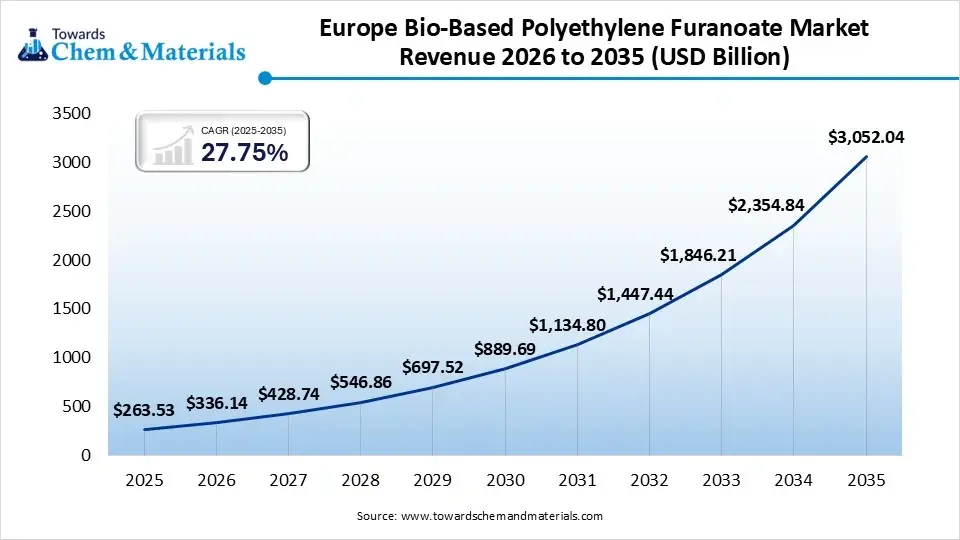
Europe Bio-Based Polyethylene Furanoate Market size was estimated at USD 263.53 million in 2025 and is projected to reach USD 3,052.04 million by 2035, growing at a CAGR of 27.75% from 2026 to 2035.Europe held the market share of 31% in 2025. The growth of the region can be attributed to the increasing investments in commercialization by leading companies and the ongoing enforcement of stringent environmental regulations to boost PEF adoption. In addition, growing demand from eco-conscious consumers in Switzerland, Spain, and Germany for sustainable packaging is impelling market players to adopt bio-based alternatives.
Asia Pacific Dominate the Bio-Based Polyethylene Furanoate Market
Asia Pacific dominated the market with the largest share of 34% in 2025 and is expected to grow at the fastest CAGR of 29.6% over the forecast period. The dominance and growth of the region can be credited to the increasing demand for packaging materials and rapid urbanisation in emerging economies such as China and India. Furthermore, heavy investments in bio-based technology and increasing manufacturing infrastructure across the region are propelling the market supply.
China Bio-Based Polyethylene Furanoate Market Trends
In the Asia Pacific, China dominated the market owing to the increasing need for sustainable packaging and the rise in investments in bio-based polymer research. Moreover, robust, supportive government regulations focusing on carbon reduction are driving the transition towards biodegradable and bio-based materials such as PEF.
Germany Bio-Based Polyethylene Furanoate Market Trends
The growth of the market in the country is due to increasing consumer demand for sustainable packaging and the growing need for better bio-based alternatives to PET, especially in the automotive and beverage industries. Also, major market players in the country are heavily involved in the development and commercialization of bio-based chemical intermediates, leading to the country's growth in the near future.
Bio-Based Polyethylene Furanoate Market Share, By Regional, 2025 (%)
| Regional | Revenue Share, 2025 (%) |
| North America | 22% |
| Europe | 31% |
| Asia-Pacific | 34% |
| Latin America | 7% |
| Middle East & Africa | 6% |
Recent Development
- In May 2025, Avantium N.V., a specialist in renewable and circular polymers, entered into a capacity reservation agreement with BIOVOX, a leader in sustainable healthcare plastics. This partnership secures supplies of Avantium's plant-based polyethylene furanoate (PEF) for use in specialized pharmaceutical applications.(Source: worldbiomarketinsights.com)
Bio-Based Polyethylene Furanoate Market Companies
- Swicofil AG: Swicofil AG is recognized as a key player in the evolving Polyethylene Furanoate (PEF) market, providing high-quality yarn and fiber solutions as part of its sustainable portfolio. Swicofil facilitates the industrial adoption of PEF, a 100% bio-based alternative to PET.
- Avantium: Avantium is a leader in the polyethylene furanoate (PEF) market, pioneering 100% plant-based, recyclable plastic with superior barrier properties. Utilizing YXY® technology, Avantium converts plant-based sugars into FDCA, making PEF a high-performance alternative to PET for packaging, films, and fibers.
Other Companies in the Market
- Toyobo Co. Ltd. (Japan)
- Ava Biochem AG (Switzerland)
- Swire Pacific Limited (U.K.)
- WIFAG-Polytype Holding AG (Switzerland)
- Toray Industries Inc (Japan)
- ALPLA (Austria)
- Mitsui & Co., Ltd. (japan)
- Gevo (U.S.)
- The Coca-Cola Company (U.S.)
Segments Covered in the Report
By Product Type
- Polyethylene Furanoate (PEF) Resin
- Bottle Grade PEF
- Film Grade PEF
- Fiber Grade PEF
- PEF Compounds
- Reinforced PEF
- Blended PEF
- PEF Preforms
- Injection Molded Preforms
- Extruded Preforms
By Application
- Packaging
- Bottles
- Beverage Bottles
- Food Containers
- Films
- Flexible Packaging
- Barrier Films
- Bottles
- Fibers & Textiles
- Apparel Fibers
- Industrial Fibers
- Automotive Components
- Interior Components
- Lightweight Structural Parts
- Electronics
- Insulation Materials
- Specialty Films
By End-Use Industry
- Food & Beverage
- Textile Industry
- Automotive Industry
- Electronics Industry
- Consumer Goods
By Processing Technology
- Injection Molding
- Extrusion
- Blow Molding
- Compression Molding
By Distribution Channel
- Direct Sales
- Distributors
- Online Channels
By Regions
- North America
- U.S.
- Canada
- Mexico
- Europe
- Germany
- UK
- France
- Italy
- Spain
- Asia Pacific
- China
- India
- Japan
- South Korea
- Latin America
- Brazil
- Argentina
- Middle East & Africa
- Saudi Arabia
- South Africa
FAQ's
Question 1 : What exactly is Bio-Based PEF made from?
Answer : It is a 100 percent bio-based polymer made from renewable plant sugars. Specifically, it uses building blocks like FDCA (2,5-furandicarboxylic acid) to replace the petroleum-based components found in traditional plastic.
Question 2 : Is PEF actually better for the environment than PET?
Answer : Yes! PEF has a significantly lower carbon footprint than traditional PET. Because it is made from plants that absorb CO2 while growing, and it requires less energy to produce, it’s a much greener choice.
Question 3 : Can I recycle PEF with my regular plastics?
Answer : Yes, PEF is compatible with existing PET recycling streams in concentrations up to 5%. This means it won\'t \"clog up\" the current recycling systems as we transition to more sustainable materials.
Question 4 : What is the biggest challenge facing the PEF market?
Answer : Currently, the main hurdles are the high cost of building specialized biorefineries and the fluctuating prices of raw plant materials. However, as production scales up, these costs are expected to drop.
Question 5 : Who are the major companies making PEF?
Answer : Key leaders in the space include Avantium (which pioneered the technology), Toyobo, Swicofil, and major end-users like The Coca-Cola Company and ALPLA.
Meet the Team

Saurabh Bidwai
Principal Consultant
Saurabh Bidwai, a B.Tech Chemical Engineering graduate with 4+ years of experience, specializes in specialty chemicals, commodity chemicals, and engineered materials, offering valuable insights into market trends and emerging opportunities.

Aditi Shivarkar
Reviewed By
Aditi Shivarkar, with 14+ years in Chemical and Materials market research, specializes in Chemical and Materials. She ensures accurate, actionable insights, driving Towards Chemicals And Materials Analytics and Consulting excellence in industry trends and sustainability.