
Biomethane Market Size, Production Volume, Sales Performance, Export & Import Dynamics, Adoption Rates, Recycling Rate, Material Efficiency, Market Share Analysis, and Demand Trends
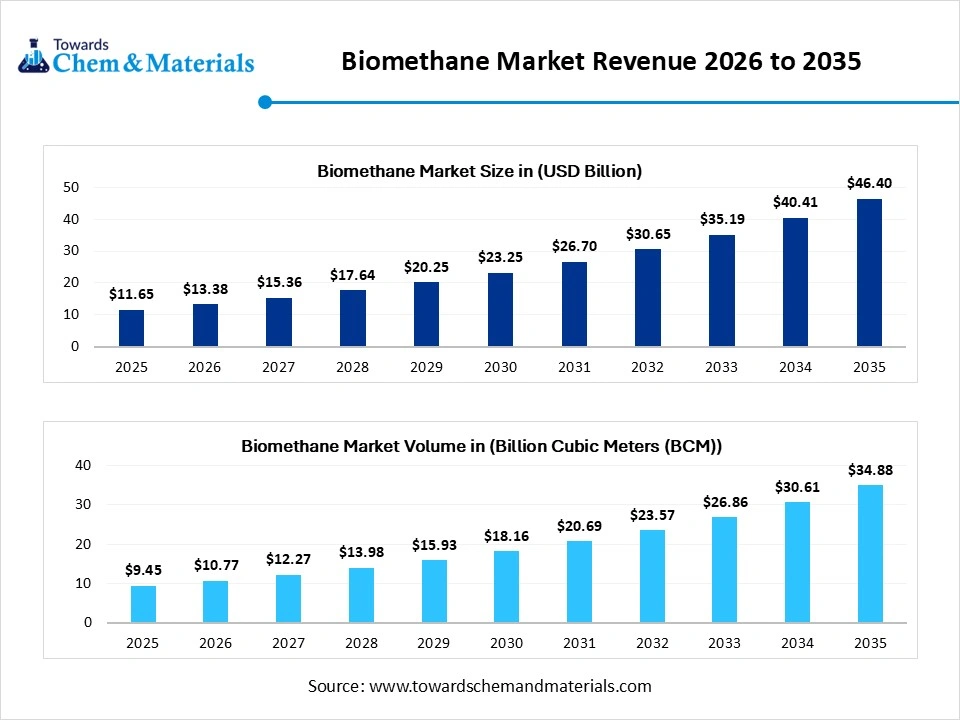
The biomethane market is experiencing strong growth, increasing from USD 11.65 billion in 2025 to USD 13.38 billion in 2026 and projected to reach USD 46.4 billion by 2035, growing at a CAGR of 14.82%. In volume terms, the market is expected to expand from 9.45 million tons in 2025 to 34.88 million tons by 2035 at a CAGR of 13.95%. This report covers detailed market size analysis, segment-wise data, regional performance, key company profiles, competitive landscape, value chain analysis, trade flows, and comprehensive manufacturer and supplier insights.
Content
Biomethane Market Size, Share and Trends Report 2035
According to Towards Chemicals and Materials Analytics and Consulting, the global biomethane market was valued at USD 11.65 billion in 2025, is estimated to reach USD 13.38 billion in 2026, and is projected to reach USD 46.4 billion by 2035, growing at a CAGR of 14.82% from 2026 to 2035. In terms of volume, the biomethane market is projected to grow from 9.45 million tons in 2025 to 34.88 million tons by 2035. growing at a CAGR of 13.95% from 2026 to 2035.
Key Takeaways
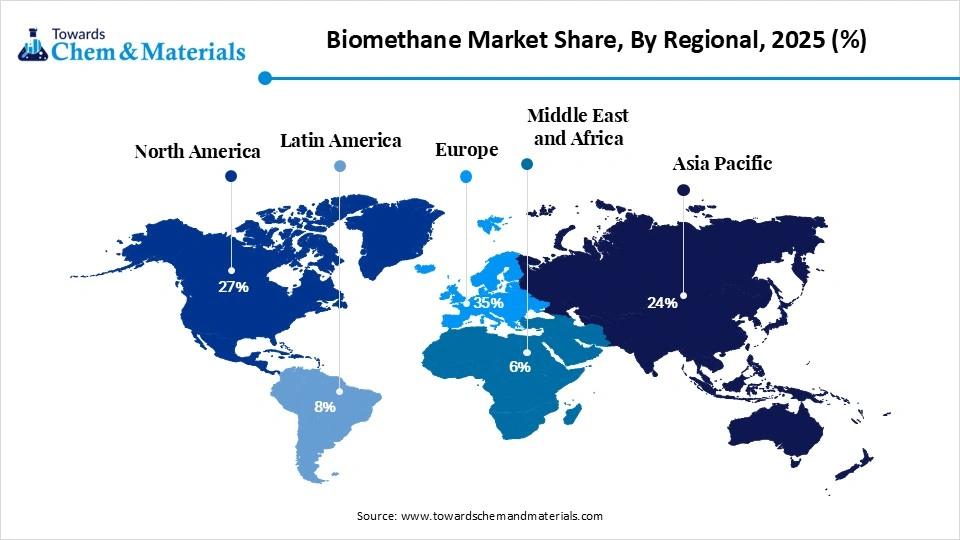
- By region, Europe dominated the market with a share of 35% in 2025.
- By region, Asia Pacific held the market share of 24% in 2025 and is expected to sustain its position while growing with a CAGR of 16.2% in the forecast period.
- By feedstock, the agriculture segment dominated the market with 38% share in 2025 and is expected to have the fastest growth with a CAGR of 15.20% in the forecast period.
- By production technology, the anaerobic digestion segment dominated the market with 72% share in 2025.
- By production technology, the gasification segment held 18% market share in 2025 and is expected to have the fastest growth with a CAGR of 15.8% in the forecast period.
- By application, the power generation segment is experiencing growth in 2025.
- By application, the transportation fuel segment is experiencing growth in 2025.
- By end-use industry, the utilities segment dominated the market with 34% share in 2025.
- By end-use industry, the transportation segment held 22% market share in 2025 and is expected to have the fastest growth with a CAGR of 16.8% in the forecast period.
- By distribution channel, the grid injection segment dominated the market with 46% share in 2025 and is expected to have the fastest growth with a CAGR of 14.9% in the forecast period.
Market Size and Volume Forecast
- Market Estimated Size (2026): USD 13.38 Billion | CAGR (2026–2035): 14.25%
- Market Projected Size (2035): USD 46.40 Billion
- Market Volume (2025): 9.45 Billion Cubic Meters (BCM) | Volume CAGR (2026–2035): 13.95%
- Market Projected Volume (2035): 34.88 Billion Cubic Meters (BCM)
- Market Pricing (2025):
- Average Manufacturing Price: USD 0.48/Nm³
- Average Selling Price: USD 0.75/Nm³
- Pricing CAGR (2025–2035): 3.8%
Market Overview
What Is The Significance Of The Biomethane Market?
The biomethane market is significant as a critical driver for decarbonization, offering a renewable alternative to natural gas that reduces greenhouse gas emissions and fosters a circular economy by converting waste into energy.
Biomethane acts as a low-carbon, renewable energy source that helps tackle climate change. It provides a key solution for decarbonizing hard-to-abate sectors. Producing biomethane domestically helps countries reduce their reliance on imported fossil fuels.
Biomethane Market Growth Trends:
- Rapid Expansion in Transport: The transport sector is a major driver, with increasing use of bio-CNG and bio-LNG for heavy-duty vehicles to reduce reliance on diesel.
- Technological Advancements: Enhanced biogas upgrading technologies, such as membrane separation, pressure swing adsorption, and water scrubbing, are improving efficiency, lowering costs, and enabling higher purity biomethane production.
- Market Integration and Sector Coupling: Biomethane is increasingly integrated with other renewable systems and used in industrial processes to provide stable, low-carbon energy.
Report Scope
| Report Attribute | Details |
| Market Size and Volume in 2026 | USD 13.38 Billion / 10.77 Million Metric Tons |
| Market Size and Volume in 2026 | USD 46.4 Billion / 34.88 Million Metric Tons |
| Growth Rate from 2026 to 2035 | CAGR 14.82% |
| Forecast Period | 2026 - 2035 |
| Dominant Region | Europe |
| Segment Covered | By Feedstock, By Production Technology, By Application, By End-Use Industry, By Distribution Channel and By Region |
| Key companies profiled | Air Liquide, Engie, Nature Energy Biogas A/S, Gasum, Terega Solutions, Waga Energy, Chevron, Kinder Morgan, Archaea Energy, Envitec Biogas AG, Future Biogas Ltd., E.ON SE, Verbio Vereinigte Bioenergie AG, South Hills RNG |
Key Technological Shifts In The Biomethane Market:
The biomethane market is experiencing a rapid shift towards advanced purification (membrane separation), digital optimization (AI/IoT), and waste valorization to boost efficiency and cut costs. Key technological advances include enhanced pretreatment to increase yields, bioelectromethanogenesis for CO2 capture, and bio-LNG production. The integration of AI, Industrial IoT, and cloud computing is enabling real-time monitoring and predictive maintenance of bioreactors, which reduces operational costs and optimizes production.
Supply Chain Analysis of Biomethane Market:
Biogas Upgrading & Processing
Biomethane is produced by upgrading biogas generated from anaerobic digestion of organic waste, agricultural residues, and sewage sludge through purification processes such as pressure swing adsorption, membrane separation, and water scrubbing.
- Key players: EnviTec Biogas, Air Liquide, Engie, TotalEnergies
Quality Testing and Certification
Biomethane must meet gas purity standards, calorific value specifications, and environmental compliance regulations for injection into gas grids or use as vehicle fuel.
- Key players: U.S. Environmental Protection Agency, Ministry of Petroleum and Natural Gas, International Organization for Standardization, European Commission
Distribution to Industrial Users
Biomethane is supplied to natural gas grid operators, transportation fuel providers, power generation companies, and industrial energy users as a renewable energy source.
- Key players: EnviTec Biogas, Engie, TotalEnergies.
Biomethane Regulatory Landscape: Global Regulations
| Country / Region | Regulatory Body | Key Regulations | Focus Areas | Notable Notes |
| U.S. | Environmental Protection Agency (EPA); Department of Energy (DOE) | Renewable Fuel Standard (RFS); Clean Air Act; Renewable Natural Gas (RNG) Programs | Renewable gas certification, emissions reduction, fuel standards | The U.S. supports biomethane (RNG) through RFS credits (RINs), promoting its use in transportation and energy sectors. |
| Europe | European Commission; European Environment Agency (EEA) | Renewable Energy Directive (RED II); Gas Package Regulations | Renewable gas targets, carbon reduction, and grid injection standards | The EU promotes biomethane through renewable energy targets and supports grid injection with strict quality standards. |
| Germany | Federal Network Agency (BNetzA); Federal Ministry for Economic Affairs and Climate Action | Renewable Energy Sources Act (EEG); Gas Grid Access Ordinance | Feed-in tariffs, grid access, and renewable gas incentives | Germany is a leading biomethane producer with strong policy support and incentives for biogas upgrading and grid injection. |
| China | National Development and Reform Commission (NDRC); Ministry of Ecology and Environment (MEE) | Renewable Energy Law; Biogas Development Policies | Waste-to-energy, renewable gas production | China promotes biomethane production from agricultural and municipal waste under renewable energy initiatives. |
| India | Ministry of Petroleum and Natural Gas (MoPNG); Ministry of New and Renewable Energy (MNRE) | SATAT Scheme; National Bioenergy Mission | Compressed biogas (CBG), waste utilization, and renewable energy | India supports biomethane through the SATAT initiative, promoting compressed biogas production from organic waste. |
| Brazil | National Agency of Petroleum, Natural Gas and Biofuels (ANP); Ministry of Mines and Energy | RenovaBio Policy; National Biofuels Policy | Biofuel incentives, carbon reduction | Brazil is expanding biomethane use through biofuel policies and incentives for renewable gas production. |
Market Dynamics
Drivers
What are the Key Growth Drivers of the Biomethane Market?
The key growth drivers of the global biomethane market are the urgent demand for renewable, low-carbon energy, strict regulatory mandates (like RED III) aimed at reducing greenhouse gas emissions, and the expansion of the circular economy through waste-to-energy projects. Rising investments in infrastructure and advancements in upgrading technologies are also key.
Restrains
What are the Key Growth Restraints of the Biomethane Market?
Key growth restraints for the biomethane market include high capital expenditures (CAPEX) for plant construction and infrastructure, significant operational costs, and limited/seasonal feedstock availability. High production costs relative to conventional natural gas make projects dependent on subsidies, while technical complexities in upgrading and rigid regulatory permitting processes hinder expansion.
Opportunities
What are the Key Growth Opportunities of the Biomethane Market?
Key growth opportunities in the biomethane market are driven by rapid adoption in transportation fuel like bio-CNG/LNG, integration into the circular economy through waste-to-energy projects, and policy-driven demand for decarbonization. The market is shifting from biogas to upgrading facilities for higher-value, grid-injectable Renewable Natural Gas (RNG), with strong growth in the agricultural and municipal waste sectors.
Segmental Insights
Feedstock Insights
The Agricultural Waste Segment Dominated The Market With 38% Market Share In 2025
The agricultural waste segment dominated the market with 38% shares in 2025 and is expected to have the fastest growth with a CAGR of 15.20% in the forecast period, driven by the need for sustainable waste management, high methane yields from manure and crop residues, and strong government incentives to boost renewable energy. This segment allows farmers to reduce emissions while creating extra income streams. The decentralized nature of these sources promotes the establishment of small-to-medium-scale biogas facilities in rural areas, strengthening local energy security.
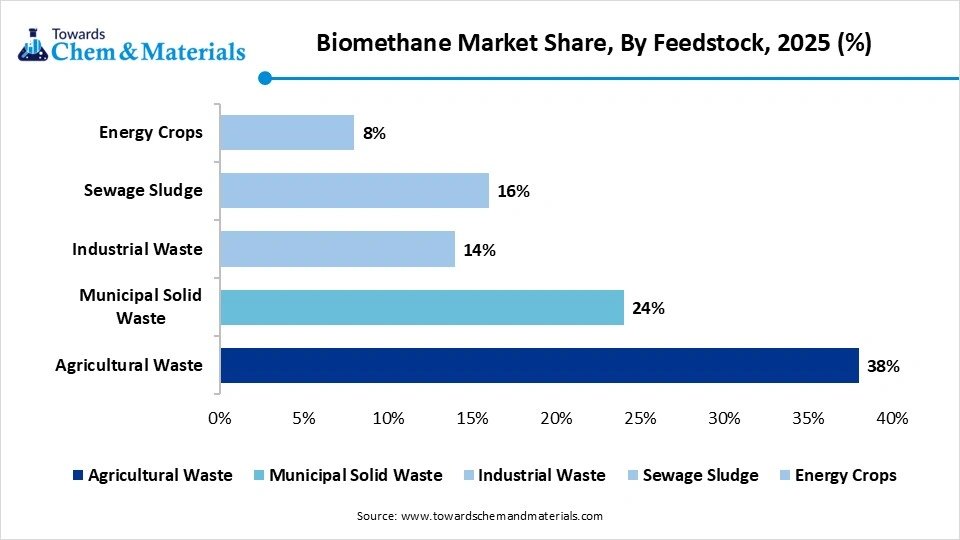
The municipal solid waste segment held 24% market share in 2025, driven by the urgent need to manage rising urban waste volumes, strict landfill diversion regulations, and the shift toward circular economy models significant investments from governments and private firms are accelerating the deployment of waste-to-energy projects, treating food waste, garden waste, and biodegradable packaging. MSW-based biomethane helps cities achieve net-zero targets by treating organic waste and preventing methane leakage from landfills.
The sewage sludge segment held 16% market share in 2025, driven by its high potential to produce renewable natural gas (RNG) through anaerobic digestion. tightening environmental regulations, the need for sustainable waste management in growing cities, and advanced upgrading technologies that allow utilities to turn wastewater residues into high-value energy are the key growth drivers which supports growth of the market.
The industrial waste segment held 14% market share in 2025, driven by the need for cost-effective waste management, strict environmental regulations on wastewater, and the high energy potential of industrial food waste. This segment is increasingly utilized to create renewable natural gas (RNG), allowing industries to cut disposal costs while meeting sustainability goals.
Production Technology Insights
The Anaerobic Digestion Segment Dominated The Market With 72% Market Share In 2025
The anaerobic digestion segment dominated the market with 72% share in 2025, driven by its cost-effectiveness, ability to process diverse organic waste, and strong government subsidies for waste-to-energy projects in regions. AD solves two problems at once, converting organic waste (sludge, manure, food waste) into renewable fuel while creating, in some cases, nutrient-rich digestate for fertilizer. AD is a more mature and lower-cost technology, making it ideal for immediate, widespread deployment.
Biomethane Market Share, By Production Technology, 2025 (%)
| By Production Technology | Revenue Share, 2025 (%) |
| Anaerobic Digestion | 72% |
| Gasification | 18% |
| Power-to-Gas | 10% |
The gasification segment held 18% market share in 2025 and is expected to have the fastest growth with a CAGR of 15.8% in the forecast period, it enables the conversion of dry, woody, and lingo-cellulosic feedstocks like forestry residues, industrial waste into high-quality syngas, which biological processes cannot easily digest. This versatility significantly broadens the feedstock base beyond conventional agricultural waste. Increasing investment in advanced WTE systems and strict regulations against landfilling are pushing for technology that converts waste into high-value fuel. Innovations in gasification technology have boosted syngas yield and quality, lowering operational risks.
The Power-to-Gas segment held 10% market share in 2025 by chemically upgrading biogas into higher-purity biomethane using renewable hydrogen, thereby increasing total output. This approach addresses demand for decarbonization, provides long-term energy storage, and helps meet strict environmental regulations. PtG helps meet global net-zero emissions targets by 2050. The resulting biomethane is a sustainable, low-carbon alternative to fossil fuels that can be injected into existing natural gas pipelines.
Application Insights
The Power Generation Segment Is Experiencing Growth In 2025
The power generation segment is experiencing growth in 2025, driven by the need for dispatchable renewable electricity, decarbonization goals, and high compatibility with existing natural gas infrastructure. It is a dominant application due to rising demand for clean energy in residential and commercial sectors, including heating and cooking, as well as upgrading old biogas plants for higher efficiency.
The transportation fuel segment experiencing growth in 2025, driven by the need for low-carbon alternatives to diesel in heavy-duty vehicles, strong policy incentives (such as EU's RED II and Renewable Natural Gas mandates), and its compatibility with existing Compressed Natural Gas (CNG) and Liquefied Natural Gas (LNG) infrastructure. It is expanding due to high-volume use in logistics and public transit.
Biomethane Market Share, By Application, 2025 (%)
| By Application | Revenue Share, 2025 (%) |
| Anaerobic Digestion | 72% |
| Gasification | 18% |
| Power-to-Gas | 10% |
The heating segment experiencing growth in 2025, driven by its role as a "drop-in" substitute for natural gas in existing infrastructure, strong policy support for decarbonization (e.g., REPowerEU), and rising demand for renewable residential, commercial, and industrial heating solutions.
The industrial use experiencing growth in 2025, driven by the urgent need for cost-effective decarbonization in hard-to-abate sectors like high-temperature heating, chemicals, and manufacturing. Industries are adopting biomethane as a direct, drop-in replacement for natural gas to cut Scope 1 emissions without changing existing machinery.
End-Use Industry Insights
The Utilities Segment Dominated The Market With 34% Market Share In 2025
The utilities segment dominated the market with 34% share in 2025, driven by the need to decarbonize gas grids, meet renewable energy mandates, and achieve energy security by substituting imported natural gas with renewable alternatives. Utilities are increasingly acting as both investors in production plants and key off-takers, injecting, or feeding, purified biomethane directly into existing pipelines.
The transportation segment held 22% market share in 2025 and is expected to have the fastest growth with a CAGR of 16.8% in the forecast period, driven by the urgent need to decarbonize heavy-duty logistics and public transport through cost-effective, drop-in alternatives to diesel. Biomethane acts as a "drop-in" fuel, utilizing existing natural gas vehicle (CNG/LNG) fleets and filling station infrastructure, avoiding high costs associated with converting vehicles.
Biomethane Market Share, By End-Use Industry, 2025 (%)
| By End-Use Industry | Revenue Share, 2025 (%) |
| Utilities | 34% |
| Transportation | 22% |
| Industrial | 18% |
| Residential | 14% |
| Commercial | 12% |
The industrial segment held 18% market share in 2025, by acting as a key solution for decarbonizing high-temperature heating, chemicals, and manufacturing processes. Driven by carbon regulations and the need to replace natural gas, industrial users are increasingly adopting biomethane. The industrial segment is utilizing its own organic waste including sewage sludge, wastewater, and agricultural byproducts to produce on-site, cost-effective energy.
The residential segment held 14% market share in 2025, driven by the urgent need to decarbonize residential heating and cooking, supported by expanding grid injection infrastructure, and rising consumer demand for renewable energy sources. Governments are implementing policies that encourage replacing natural gas with biomethane in residential buildings to meet emissions reduction targets.
Distribution Channel Insights
The Grid Injection Segment Dominated The Market With 46% Market Share In 2025
The grid injection segment dominated the market with 46% share in 2025 and is expected to have the fastest growth with a CAGR of 14.9% in the forecast period, by enabling the direct, large-scale injection of upgraded biogas into existing natural gas infrastructure. Injecting biomethane into existing networks allows for the use of current infrastructure for renewable gas distribution, reducing reliance on imported fossil gas.
Biomethane Market Share, By Distribution Channel, 2025 (%)
| By Distribution Channel | Revenue Share, 2025 (%) |
| Grid Injection | 46% |
| On-site Consumption | 32% |
| Bottled/Compressed Supply | 22% |
The on-site consumption segment held 32% market share in 2025, driven by the demand for localized, reliable, and low-carbon energy in agriculture and industry, with on-site direct usage. Upgraded biomethane (Bio-CNG) is directly fueling municipal fleets, waste trucks, and agricultural machinery, offering a cleaner alternative to diesel. On-site production enables companies to create their own secure, sustainable, and reliable source of energy, mitigating dependency on imported fossil fuels.
The bottled/compressed gas supply segment held 22% market share in 2025, driven by its role as a drop-in, cleaner substitute for fossil fuels in transportation and industry. This growth is propelled by its ability to be transported easily to areas lacking natural gas grid infrastructure, its use in heavy-duty vehicles, and increasing government incentives. Strong government support, such as India's SATAT initiative, is fueling the construction of hundreds of CBG plants to produce and bottle bio-CNG, creating a significant, localized market.
Regional Insights
How did Europe Dominate the Biomethane Market in 2025?
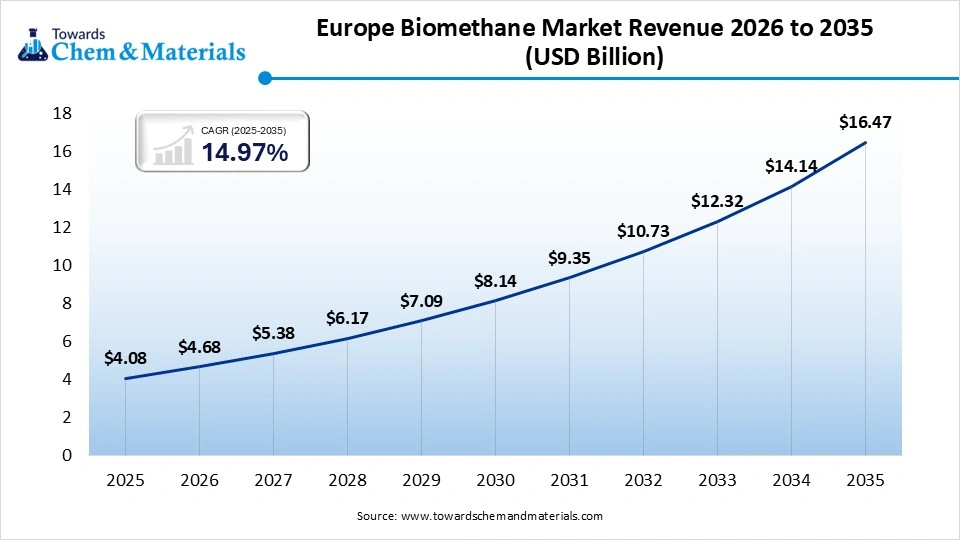
The Europe biomethane market size was estimated at USD 4.08 billion in 2025 and is projected to reach USD 16.47 billion by 2035, growing at a CAGR of 14.97% from 2026 to 2035 With over 1,600 plants, the region accelerated production via feedstock-specific incentives and heavy investment in grid integration, ensuring security of supply. Europe's approach transitioned from solely increasing volume to prioritizing high-emission-reduction gases, ensuring a competitive edge in both domestic energy supply and decarbonizing industrial processes.
Germany Biomethane Market Growth Factor
Germany's biomethane market is driven by strong regulatory support, urgent decarbonization targets, and significant investment in agricultural waste-to-energy projects. The market is highly supported by the Renewable Energy Directive (RED II & III) and national mandates such as the Federal Emission Control Act which compel fuel providers to reduce GHG emissions. Germany has a strong base for production, with a high concentration of biogas plants, many of which are transitioning to produce biomethane from organic waste, livestock manure, and agricultural residues.
Asia Pacific Biomethane Market Growth Factor
Asia Pacific held the market share of 24% in 2025 and is expected to have the fastest growth with a CAGR of 16.2% in the forecast period, due to increasing government initiatives for renewable energy, strict waste management regulations, and high organic waste availability. Key drivers include rising energy demand, rapid urbanization in countries like China and India, and the urgent need to reduce greenhouse gas emissions. Governments in the region are implementing policies, subsidies, and incentives to promote waste-to-energy initiatives, encouraging investments in biogas infrastructure.
India Biomethane Market Growth Factor
The India Biomethane market is poised for rapid expansion, driven by government-mandated mandates like the SATAT scheme, massive availability of organic waste, reducing reliance on imported natural gas, and accelerating industrial/transportation decarbonization efforts. With nearly 46% of India's natural gas demand currently met through imports, biomethane is recognized as a critical domestic renewable source to boost energy security.
Recent Developments
- In February 2025, AstraZeneca, a UK-Swedish pharma giant, collaborated with Future Biogas to launch a biomethane plant in the UK without public subsidies. This initiative is to control and eliminate the CO2 emissions and to strengthen the UK’s renewable energy infrastructure.
- In March 2025, TotalEnergies launched its 8th biomethane production unit in the BioNorrois plant. This will be the largest production plant, a step towards renewable energy production, and a shift towards decarbonization.
Top players in the Biomethane Market & Their Offerings:
- OPAL Fuels Inc.: OPAL Fuels develops biomethane projects primarily from landfill and agricultural waste, supplying renewable fuel for transportation markets.
- Shell plc (Shell Biogas): Shell is a leading player in biomethane through its renewable gas division. The company produces and upgrades biogas into biomethane for grid injection, transportation fuel, and industrial use, and has strengthened its position through acquisitions such as Nature Energy.
- BP p.l.c.: BP is expanding into biomethane via its bioenergy segment, particularly through renewable natural gas (RNG) projects in North America and Europe. The company focuses on reducing carbon intensity in gas supply chains.
- TotalEnergies SE: TotalEnergies invests in biomethane and RNG projects globally, converting organic waste into renewable gas for transportation, industry, and grid applications
Biomethane Market Top Players Are
- Air Liquide
- Engie
- Nature Energy Biogas A/S
- Gasum
- Terega Solutions
- Waga Energy
- Chevron
- Kinder Morgan
- Archea Energy
- Envitec Biogas AG
- Future Biogas Ltd.
- E.ON SE
- Verbio Vereinigte Bioenergie AG
- South Hills RNG
Biomethane Market Segments Covered:
By Feedstock
- Agricultural Waste
- Crop Residues
- Animal Manure
- Municipal Solid Waste (MSW)
- Organic Household Waste
- Commercial Waste
- Industrial Waste
- Food Processing Waste
- Pulp & Paper Waste
- Sewage Sludge
- Wastewater Treatment Plants
- Industrial Sludge
- Energy Crops
- Maize Silage
- Grass Silage
By Production Technology
- Anaerobic Digestion (AD)
- Wet AD
- Dry AD
- Gasification
- Thermal Gasification
- Plasma Gasification
- Power-to-Gas
- Biological Methanation
- Catalytic Methanation
By Application
- Power Generation
- CHP (Combined Heat & Power)
- Electricity Generation
- Transportation Fuel
- Compressed Biomethane (Bio-CNG)
- Liquefied Biomethane (Bio-LNG)
- Heating
- Residential Heating
- District Heating
- Industrial Use
- Process Heat
- Steam Generation
By End-Use Industry
- Utilities
- Transportation
- Industrial
- Residential
- Commercial
By Distribution Channel
- Grid Injection
- On-site Consumption
- Bottled/Compressed Gas Supply
By Region
- North America:
- U.S.
- Canada
- Mexico
- Rest of North America
- Latin America:
- Brazil
- Argentina
- Rest of Latin America
- Europe:
- Western Europe
- Germany
- Italy
- France
- Netherlands
- Spain
- Portugal
- Belgium
- Ireland
- UK
- Iceland
- Switzerland
- Poland
- Rest of Western Europe
- Eastern Europe
- Austria
- Russia & Belarus
- Türkiye
- Albania
- Rest of Eastern Europe
- Asia Pacific:
- China
- Taiwan
- India
- Japan
- Australia and New Zealand,
- ASEAN Countries (Singapore, Malaysia)
- South Korea
- Rest of APAC
- MEA:
- GCC Countries
- Saudi Arabia
- United Arab Emirates (UAE)
- Qatar
- Kuwait
- Oman
- Bahrain
- South Africa
- Egypt
- Rest of MEA
- GCC Countries
FAQ's
Question 1 : What are the key factors driving growth in the biomethane market?
Answer : Key growth drivers include increasing demand for low-carbon and renewable energy, strong government regulations and incentives, expansion of waste-to-energy initiatives, and advancements in biogas upgrading technologies.
Question 2 : Why is the biomethane market important for global decarbonization?
Answer : Biomethane plays a crucial role in reducing greenhouse gas emissions, replacing fossil fuels, and supporting a circular economy by converting organic waste into renewable energy.
Question 3 : Which region dominates the biomethane market?
Answer : Europe dominated the market in 2025 with a 35% share, driven by strong regulatory frameworks, advanced infrastructure, and high adoption of renewable gas technologies.
Question 4 : Which region is expected to grow the fastest in the biomethane market?
Answer : The Asia Pacific region is expected to witness the fastest growth, with a CAGR of 16.2%, supported by rising energy demand, urbanization, and government-backed renewable initiatives.
Question 5 : Which feedstock segment leads the biomethane market?
Answer : The agricultural waste segment led the market with a 38% share in 2025, driven by high methane yield, availability of raw materials, and supportive government policies.
Meet the Team

Saurabh Bidwai
Principal Consultant
Saurabh Bidwai, a B.Tech Chemical Engineering graduate with 4+ years of experience, specializes in specialty chemicals, commodity chemicals, and engineered materials, offering valuable insights into market trends and emerging opportunities.

Aditi Shivarkar
Reviewed By
Aditi Shivarkar, with 14+ years in Chemical and Materials market research, specializes in Chemical and Materials. She ensures accurate, actionable insights, driving Towards Chemicals And Materials Analytics and Consulting excellence in industry trends and sustainability.