
Carbon Disulfide Market Manufacturers & Suppliers Company Analysis 2026-2035
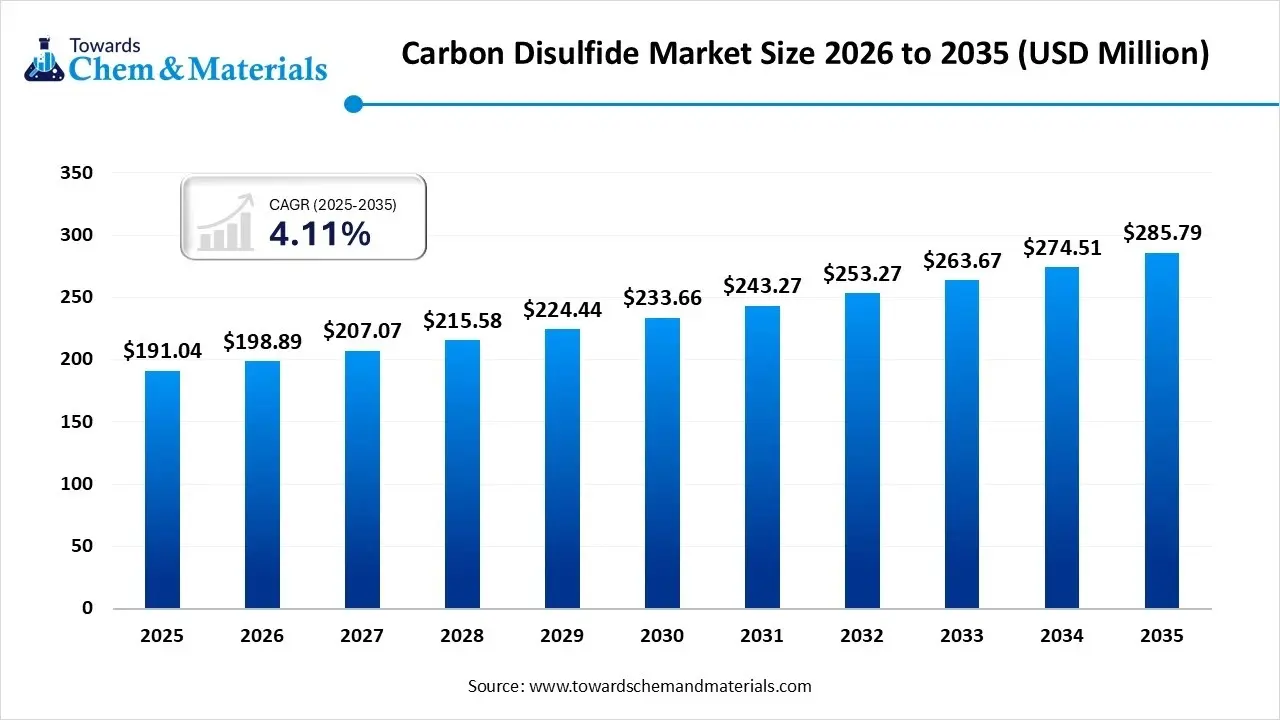
The global carbon disulfide market size is expected to grow from USD 198.89 million in 2026 to USD 285.79 million in 2035, growing at a CAGR of 4.11% from 2026 to 2035. The top key players in the market are Akzo Nobel N.V.; Merck KGaA; GFS Chemicals Inc.; PPG Industries, Inc.; Alfa Aesar; Univar Solutions Inc.; Jiangsu Jinshan Chemical Co. Ltd.; Arkema; Shikoku Chemicals Corporation; Zhuzhou Jinyuan Chemical Industry Co.,Ltd.; Shanghai Baijin Chemical Group Co., Ltd.; Jiaonian Ruixing Chemical; Tedia. -Global Forecast 2026 To 2035
Content
What is the Current Carbon Disulfide Market Size and Share?
The global carbon disulfide market size was estimated at USD 191.04 million in 2025 and is expected to increase from USD 198.89 million in 2026 to USD 285.79 million by 2035, growing at a CAGR of 4.11% from 2026 to 2035. Asia Pacific dominated the carbon disulfide market with the largest revenue share of 42.00% in 2025. Growing demand from various industries and requirements for pest control and soil health management fuel the market growth.
Market Highlights
- The Asia-Pacific dominated the carbon disulfide market with the largest revenue share of 42.00% in 2025.
- By purity, the pure segment dominated the market and accounted for the largest revenue share of 65.00% in 2025.
- By application, the rubber segment led the market with the largest revenue share of 30.00% in 2025.
- By end use, the agriculture segment dominated the market and accounted for the largest revenue share of 38.00% in 2025.
Market Overview
Carbon disulfide is a combination of carbon & sulphur at very high temperatures, and it is a clear colourless liquid. It is used as raw material in the production of viscose rayon, chemicals, pesticides, and cellophane. It has a pungent smell. The carbon disulfide market is classified into two types pure and impure. Carbon disulfide has wide applications such as rust removal from metal, petroleum well cleaning, solvent for components, and many more. The rising demand from various industries like agriculture, pharmaceuticals, textiles, chemicals, and packaging drives the growth of the market. Demand for cellulose-based products from textile and packaging industries needs carbon disulfide. Carbon disulfide shaping the textile industry.
The rising consumer demand for sustainable and eco-friendly fabric increases the production of viscose rayon. Carbon disulfide is an important compound in the textile industry. To produce viscose solution carbon disulfide reacts with cellulose and caustic soda. Viscose rayon is used in various textile products such as fabrics, yarn, and tire cords. These fibers improve the material's softness, durability, and versatility. Carbon disulfide is a cost-effective alternative to expensive chemicals in the textile industry. Viscose rayon fiber has excellent moisture absorption quality, and it is biodegradable. carbon disulfide fibers easily combine with other fibers, and it has great colour absorption properties. The rising technological advancement in the textile industry drives the growth of the market.
Market Trends
- Rising sustainability awareness: The growing awareness about eco-friendly products leads to the adoption of sustainable production practices. Consumers are aware of environmental concerns that increase demand for carbon disulfide.
- Growing demand for rayon and cellophane: Rising demand for rayon and cellophane from the textile industry key factor for the market’s growth.
- Rising demand for bio-based alternatives: As the adoption of sustainability is growing there is a rising demand for bio-based alternatives in the textile and agriculture industry. This helps to reduce the use of harmful chemicals.
- Environmental regulations: Rising environmental rules and regulation helps manufacturers to innovate eco-friendly alternatives.
- Growing chemical industry: The growing usage of chemicals in agrochemicals and specialty chemicals increases demand for carbon disulfide.
- Booming industrialization: The growing industrialization in many countries demands higher production of carbon disulfide.
Market Scope
| Report Coverage | Details |
| Market Size in 2026 | USD 198.89 Million |
| Expected Market Size in 2035 | USD 285.79 Million |
| Projected CAGR 2025 to 2035 | 4.11% |
| Dominant Region | Asia Pacific |
| Base Year | 2025 |
| Segments Covered | Application, region |
| Key Companies Profiled | Akzo Nobel N.V.; Merck KGaA; GFS Chemicals Inc.; PPG Industries, Inc.; Alfa Aesar; Univar Solutions Inc.; Jiangsu Jinshan Chemical Co. Ltd.; Arkema; Shikoku Chemicals Corporation; Zhuzhou Jinyuan Chemical Industry Co.,Ltd.; Shanghai Baijin Chemical Group Co., Ltd.; Jiaonian Ruixing Chemical; Tedia. |
Market Opportunity
Growing adoption of sustainability choice
The rising consumer awareness about environmental issues demands sustainable choices. Carbon disulfide helps in numerous ways to promote sustainability. Carbon disulfide contributes to improving manufacturing processes to developing energy-efficient technologies. The textile industry is giving preference to sustainability and that demands environment-friendly choices. To produce viscous fiber carbon disulfide is used as raw material. Viscous is a renewable source and it is made up of wood pulp and other chemical ingredients. These environment-friendly choices help to reduce pollution, lower energy consumption and reduce waste. Carbon disulfide also helps in creating sustainable packaging solutions for products. Carbon disulfide helps lower carbon footprint and reduces greenhouse gas emissions. Growing adoption of sustainable choices in packaging, textiles, and many more industries will help in the rapid growth of the market.
Market Challenge
Health risks due to exposure to carbon disulfide
With the several advantages of carbon disulfide in various industries, there are some health risks associated with carbon disulfide exposure. Health problems like neurological damage, cardiovascular issues, skin problems, and reproductive problems limit the usage of carbon disulfide. In females, menstrual disturbances have been noticed due to high exposure. Breathing in a carbon-disulfide environment for a long time affects the nervous system and causes changes in nerve functions.
It causes various skin problems like irritation, redness, chemical burns, blistering, skin exfoliation, and pain. In several cases, coma, convulsions, and death can happen due to high exposure of carbon disulfide which is one of the leading factors that restrains growth of the market.
Value Chain Analysis
Research and Development (R&D)
- Focuses on improving production efficiency, environmental compliance, and exploring novel applications.
- Key Players: Arkema Group, Nouryon, Shanghai Baijin Chemical Group, and BASF SE.
Raw Material Procurement
- Securing primary feedstocks: sulfur and a carbon source like charcoal or natural gas.
- Key Players: Saudi Aramco, Exxon Mobil Corporation, Shell plc, BP p.l.c., and BHP Group Limited.
Manufacturing and Production
- Processing raw materials in chemical plants to produce crude carbon disulfide via reaction, condensation, and scrubbing.
- Key Players: Shanghai Baijin Chemical Group, Nouryon, Arkema Group, Akzo Nobel, and GFS Chemicals.
Distribution and Logistics
- Specialized and safe handling, storage, and transportation due to the hazardous nature of the chemical.
- Key Players: Univar Solutions Inc., Nexeo Solutions, Brenntag SE, and IMCD N.V.
Application and End-Use Industries
- Used as a chemical intermediate in rayon production, agrochemicals, rubber chemicals, and pharmaceuticals.
- Key Players: Aditya Birla Group, Reliance Industries Limited, and Bayer AG.
Waste Management and Recycling
- Managing toxic emissions and waste using closed-loop recovery systems and emissions control technologies.
- Key Players: Waste Management, Inc., Republic Services, Inc., Veolia Environnement S.A., and SUEZ S.A.
Global Regulations for Carbon Disulfide Use and Emissions
| Country | Occupational Exposure Limit (OEL) (8-hr TWA) | Key Regulatory Focus |
| U.S. | 20 ppm (OSHA Legal PEL) | OSHA (safety), EPA (environment), EPCRA reporting. |
| EU | 1-10 ppm (Varies by state) | Strict adherence to REACH regulations and stringent environmental directives for emissions. |
| Australia | 10 ppm | Safe Work Australia standards and general environmental protection acts. |
| India & China | 1-10 ppm (Varies) | Balancing industrial output (rayon production) with developing environmental and safety standards. |
Segmental Insights
By Purity
The pure segment dominated the carbon disulfide market in 2025,accounting for 65.00% of total revenue.The market is growing due to high purity and less contamination. Industries are giving preference to precision and safety for solvent production and chemical synthesis increases demand for pure carbon disulfide.
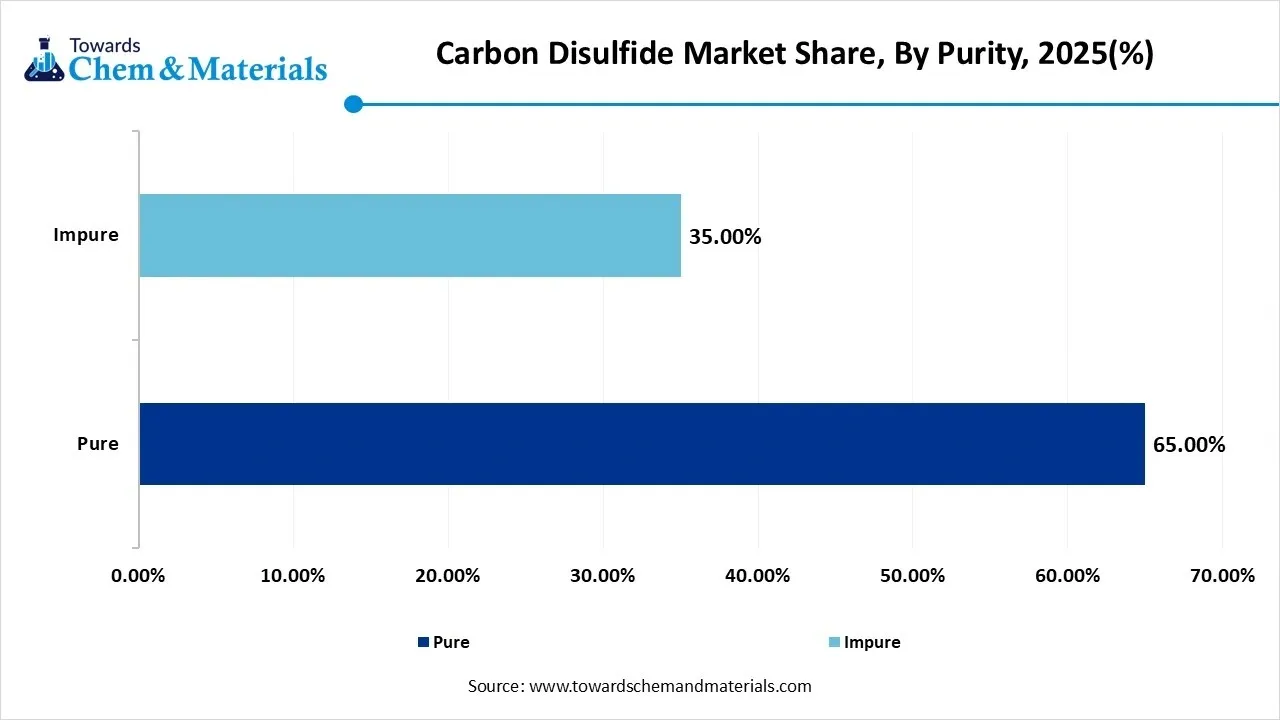
Whereas the impure segment expects a significant growth in the market during the forecast period. The rising demand from various industries like rubber manufacturing, mining, and pest control drives the growth of the market. The lower production cost and used applications that require high precision and safety drive the growth of the market.
Carbon Disulfide Market Share, By Purity, 2025(%)
| By Purity | Revenue Share, 2025 (%) |
| Pure | 65.00% |
| Impure | 35.00% |
By End Use
The agriculture segment dominated the carbon disulfide market in 2025,accounting for 38.00% of total revenue.
The need for pest control, crop protection, and soil fumigation drives the growth of the market. It is used in seed treatment and preventing the spreading of diseases. Carbon disulfide helps control in control the spread of fungi and nematodes and it improves the quality of soil.
The chemical dithiocarbamates used in pest control are made from carbon disulfide. Whereas the packaging segment anticipated the significant growth in the market during the forecast period. The growing demand for cellophane, rayon, and other cellulosic fibers drives the growth of the market. This material provides flexibility, strength, and biodegradability of packaging materials. To develop sustainable and high-performance packaging, carbon disulfide is used in the chemical process. Additionally, consumer demand for eco-friendly sustainable packaging fuels the growth of the market.
Carbon Disulfide Market Share, By End use, 2025(%)
| End Use | Revenue Share, 2025 (%) |
| Agriculture | 38.00% |
| Pharmaceuticals | 18.00% |
| Packaging | 12.00% |
| Textile | 15.00% |
| Cosmetics | 7.00% |
| Other | 10.00% |
By Application
The rubber section dominated the carbon disulfide market in 2025, accounting for 30.00% of total revenue.In the process of vulcanization, carbon disulfide is used. It provides elasticity, durability, and strength to rubber. The rising demand for the automotive industry for rubber products drives the growth of the market. The growing requirement to produce tires and other automotive products fuels the growth of the market. Whereas the rayon is expecting a significant growth in the market during the forecast period. Rising production of viscose rayon in the textile industry drives the growth of the market. The increasing consumer preference for sustainable fabrics propels the growth of the market.
Carbon Disulfide Market Share, By Application, 2025(%)
| By Application | Revenue Share, 2025 (%) |
| Rubber | 30.00% |
| Rayon | 25.00% |
| Perfumes | 12.00% |
| Cleaning Carbon Nanotubes | 9.00% |
| Cellophane | 14.00% |
| Others | 10.00% |
Regional Insights
The Asia Pacific carbon disulfide market size was valued at USD 80.24 million in 2025 and is expected to be worth around USD 120.03 million by 2035, exhibiting at a compound annual growth rate (CAGR) of 5.87% over the forecast period from 2026 to 2035. The Asia Pacific dominated the carbon disulfide market with the largest revenue share of 42% in 2025
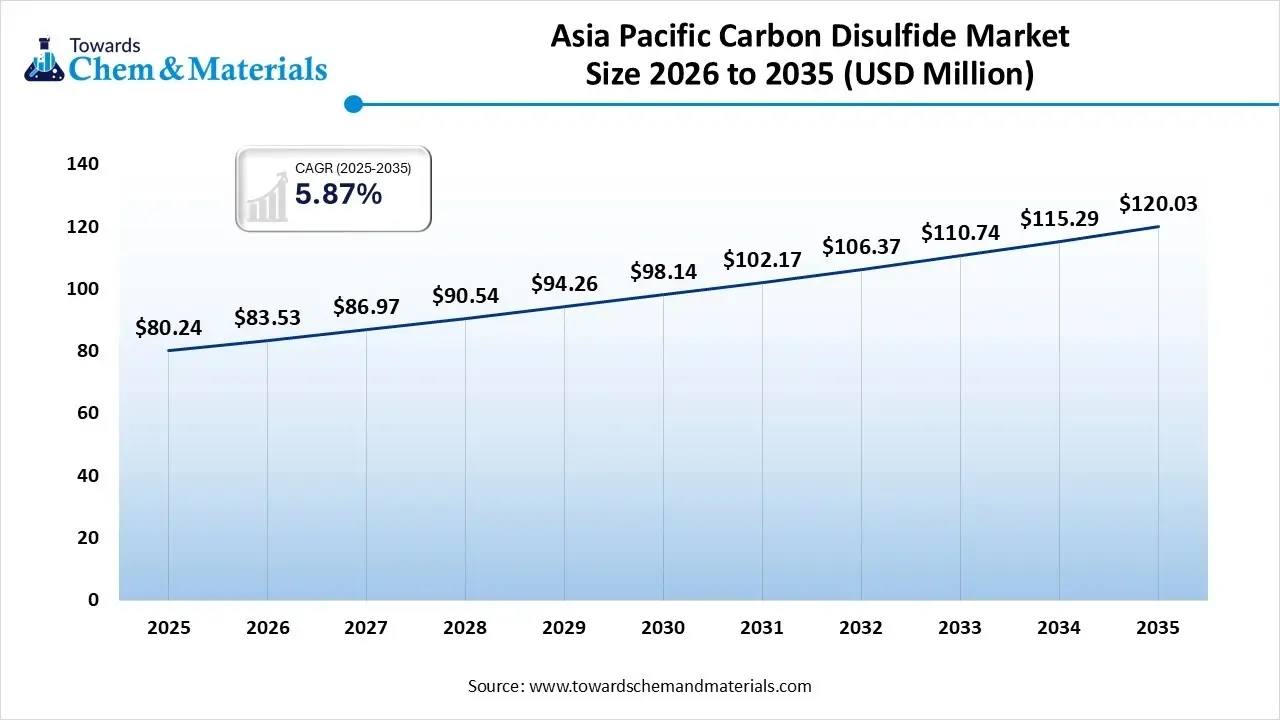
The fastest-growing civilization and industrialization in the Asia Pacific countries like India, China, and Japan drive the growth of the market. The rising demand from textile, agriculture, and chemical industries fuels the growth of the carbon disulfide market. Additionally, the well-established agriculture sector in the region drives the need for soil sterilization, pest control, and soil fumigation fuels the growth of the market.
China holds the largest share of the carbon disulfide market in 2024. The rising industrialization in the country drives the growth of the market. The growing requirement for cellulose and cellulosic fiber from various industries fuels the growth of the market. Moreover, the agriculture industry in the region demands carbon disulfide for pest control, soil sterilization, soil fumigation, and seed treatment help to grow the market in the region.
North America exploring the growth of carbon disulfide
North America expects a significant growth in the market during the forecast period. The growing demand for carbon disulfide from textile and agricultural industries drives the growth of the market in the region. In the agriculture sector, carbon disulfide is widely used in seed treatment, pest control management, and soil sterilization. The growing demand for agrochemical production fuels the market growth. Furthermore, the production of cellulose-based material and rayon demands carbon disulfide because this market is growing rapidly.
The U.S. holds the largest share of the carbon disulfide market in the North American region. The rising demand from textiles and agriculture for rayon and other cellulose-based products propels the growth of the market in the region. Rapid innovation in the agricultural sector demands carbon disulfide. Furthermore, in the agricultural sector carbon disulfide is needed for soil fumigation and pest control fuels the growth of the market.
How will Europe emerge in the Carbon Disulfide Market?
Europe has a notable carbon disulfide market with a significant focus on high-purity grades for specialized applications. The region is expected to witness substantial growth, driven by its emphasis on sustainability and the demand for biodegradable packaging and textiles like rayon and cellophane. Strict environmental regulations in Europe have prompted manufacturers to adopt greener, more efficient production methods, ensuring steady growth in applications such as specialty chemicals and pharmaceuticals. Agricultural advancements in the region also rely on carbon disulfide for pest control and soil health management.
Germany Carbon Disulfide Market Trends
Germany holds a leading position in the European carbon disulfide market, known for high-value, quality-focused industrial applications. The country has a strong chemical and pharmaceutical industry that requires high-purity carbon disulfide as an essential intermediate in synthesizing various drugs and additives. While agriculture is a growing segment, the market is mainly driven by the presence of global leaders like Merck KGaA and a focus on advanced, specialized chemical processes, ensuring a consistent demand for carbon disulfide in complex manufacturing.
How will Latin America become a key player in the Carbon Disulfide Market?
Latin America is expected to experience significant growth in the carbon disulfide market during the forecast period. This growth is fueled by expanding agricultural activities, especially in countries like Brazil and Argentina, where carbon disulfide is vital for pest control and soil fumigation to enhance crop yields. Additionally, the region's growing textile industry is boosting the demand for rayon production, which relies on carbon disulfide. Economic development, rising industrial activity, and the increasing need for sustainable agricultural practices also drive market expansion.
Brazil Carbon Disulfide Market Trends
Brazil is the largest carbon disulfide market in Latin America, driven by substantial investments in the agricultural and rubber sectors. The country's extensive agricultural industry widely uses carbon disulfide for pest management, seed treatment, and soil sterilization, supporting crop protection and increasing yields. Furthermore, the expanding automotive industry increases demand for rubber products, where carbon disulfide is a key accelerator in vulcanization, further stimulating market growth.
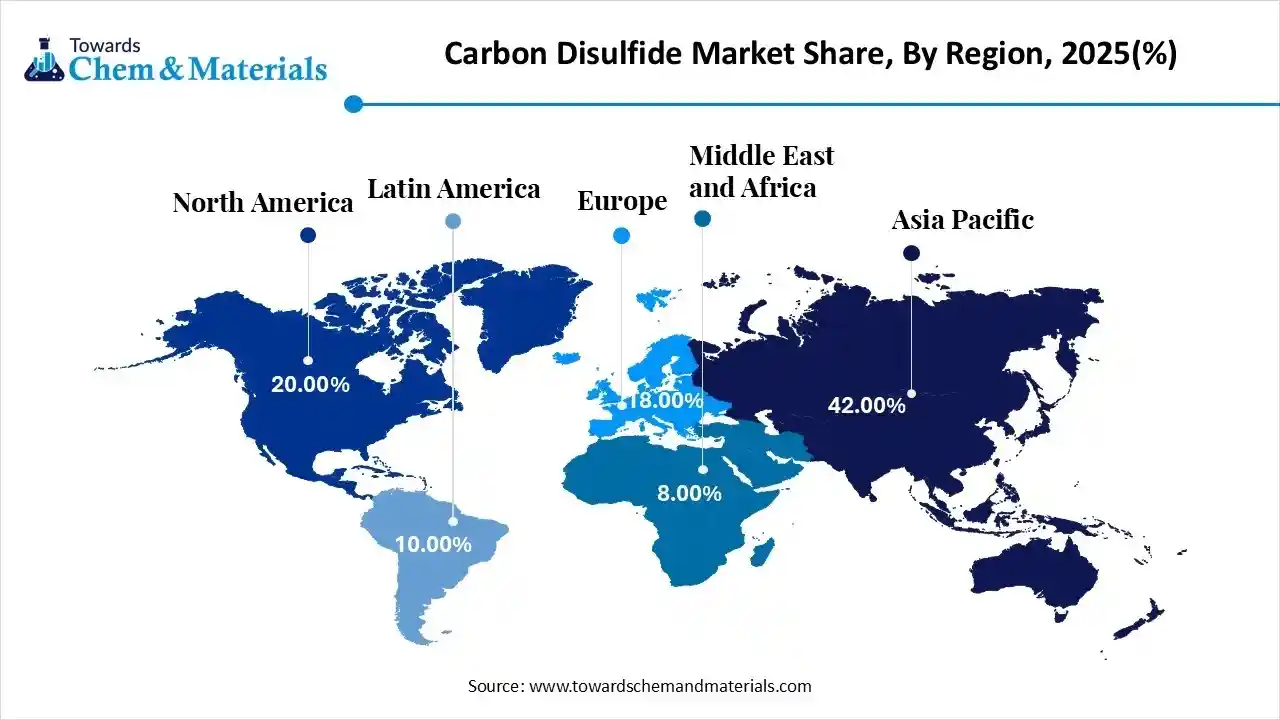
Carbon Disulfide Market Share, By Region, 2025(%)
| By Region | Revenue Share, 2025 (%) |
| North America | 20.00% |
| Europe | 18.00% |
| Asia Pacific | 42.00% |
| Latin America | 10.00% |
| Middle East & Africa | 8.00% |
How will the Middle East and Africa expand the Carbon Disulfide Market?
The carbon disulfide market in the Middle East and Africa is growing steadily, linked to developing industrial activities and infrastructure projects. Demand primarily stems from applications in mining, industrial rubber production, and chemical intermediates. The region is also shifting toward economic diversification into technology and healthcare sectors, requiring specialty chemicals. Additionally, an expanding agricultural footprint and the need for effective pest management solutions contribute to rising demand.
UAE Carbon Disulfide Market Trends
The UAE plays a vital role as a regional hub for trade, logistics, and specialized applications. The country is heavily investing in infrastructure and smart city projects, which indirectly support industries that require carbon disulfide. Although the market is niche, there is demand for applications related to the oil and gas sector and growing healthcare facilities. The UAE's status as a technology and innovation hub attracts investments in data centers and research, which could drive future adoption of high-purity carbon disulfide solutions.
Recent Development
- In May 2024, the Green Alliance launched a charity project in Mabeskraal, South Africa, using Africa's first electric earth-moving machinery to drill a 150-meter-deep well with a solar pump, providing clean water to over 25,000 households.(Source: www.prnewswire.com)
Top Companies List
- GFS Chemicals Inc.
- Akzo Nobel N.V.
- PPG Industries, Inc.
- American Elements
- KANTO CHEMICAL CO., INC.
- Arkema
- Merck KGaA
- Alfa Aesar
- Tedia
- Jiaonian Ruixing Chemical
- Nouryon
- Liaonian Ruixing Chemical Group Co. Ltd.
- Perchem Fine & Specialty Chemicals
Segment Covered in the report
By Application
- Rubber
- Rayon
- Perfumes
- Cleaning Carbon Nanotubes
- Cellophane
- Others
By Purity
- Pure
- Impure
By End use
- Agriculture
- Pharmaceuticals
- Packaging
- Textile
- Cosmetics
- Other
By Geography
- North America
- Asia Pacific
- Europe
- Latin America
- Middle East & Africa
FAQ's
Question 1 : What is the current carbon disulfide market size and what is its projected growth rate through 2035?
Answer : The global carbon disulfide market was valued at USD 191.04 million in 2025 and is projected to reach USD 285.79 million by 2035, growing at a CAGR of 4.11% from 2026 to 2035.
Question 2 : What are the key growth drivers and emerging trends shaping the carbon disulfide market?
Answer : The market is driven by rising demand from agriculture, textiles, and rubber industries, increasing production of viscose rayon and cellophane, growing sustainability adoption, and expansion of agrochemical applications.
Question 3 : Which region holds the largest market share in the carbon disulfide industry and why?
Answer : Asia Pacific leads the carbon disulfide market with a 42% revenue share in 2025 due to rapid industrialization, strong textile manufacturing, and high agricultural demand in countries like China and India.
Question 4 : Who are the leading companies operating in the carbon disulfide market?
Answer : Key players include Akzo Nobel N.V., Arkema, Merck KGaA, GFS Chemicals Inc., PPG Industries Inc., Nouryon, American Elements, Alfa Aesar, and KANTO CHEMICAL CO., INC.
Meet the Team

Saurabh Bidwai
Principal Consultant
Saurabh Bidwai, a B.Tech Chemical Engineering graduate with 4+ years of experience, specializes in specialty chemicals, commodity chemicals, and engineered materials, offering valuable insights into market trends and emerging opportunities.

Aditi Shivarkar
Reviewed By
Aditi Shivarkar, with 14+ years in Chemical and Materials market research, specializes in Chemical and Materials. She ensures accurate, actionable insights, driving Towards Chemicals And Materials Analytics and Consulting excellence in industry trends and sustainability.