
Cellulose Nanocrystal Reinforced Biopolymers Market Manufacturers & Suppliers Company Analysis 2026-2035
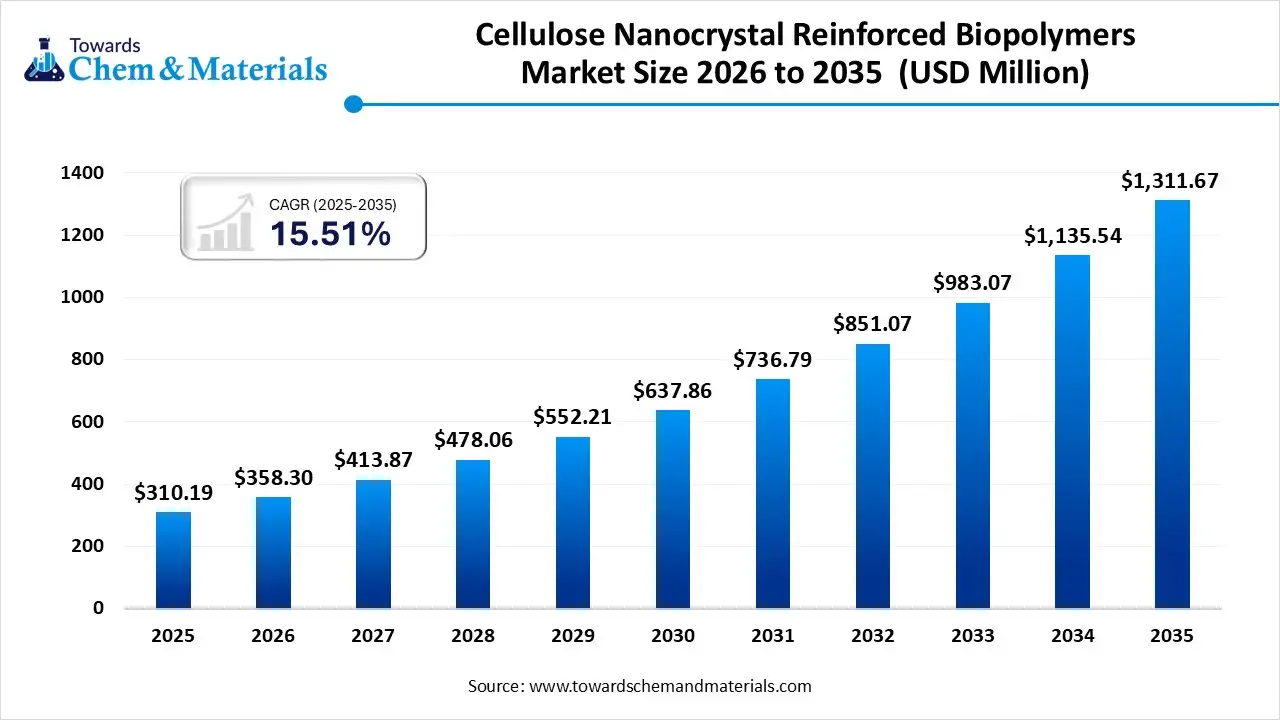
The global cellulose nanocrystal reinforced biopolymers market size is expected to grow from USD 358.30 million in 2026 to USD 1,311.67 million in 2035, growing at a CAGR of 15.51% from 2026 to 2035. The top key players in the market are Chromatic Technologies Inc., LCR Hallcrest, RTP Company, Val Creations, BASF SE, Kiran Holographics, 3M Company, Kiran Holographics, 3M Company, CelluForce / Borregaard AS, API (American Process Inc.)-Global Forecast 2026 To 2035
Content
What is the Current Cellulose Nanocrystal Reinforced Biopolymers Market Size and Share?
The global cellulose nanocrystal reinforced biopolymers market size was estimated at USD 310.19 million in 2025 and is expected to increase from USD 358.30 million in 2026 to USD 1,311.67 million by 2035, growing at a CAGR of 15.51% from 2026 to 2035. North America dominated the cellulose nanocrystal reinforced biopolymers market with the largest revenue share of 39.00% in 2025.The market is driven by rising demand for high-performance and eco-friendly products across sectors, as these attributes drive growth. the Cellulose Nanocrystal (CNC) reinforced biopolymers market is significant for enabling high-performance, sustainable materials by combining the renewability of bio-based plastics with the superior mechanical strength, low density, and biodegradability of CNCs. These materials provide a sustainable alternative in packaging, automotive, and medical industries by addressing environmental concerns, improving thermal stability, and enhancing barrier properties at low filler levels.
Market Highlights
- The North America dominated the cellulose nanocrystal reinforced biopolymers market with the largest revenue share of 39.00% in 2025. Significant investments in pilot plants and manufacturing infrastructure enabled the scaling of production to meet demand.
- By product, the PLA + CNC segment dominated the market and accounted for the largest revenue share of 42.82% in 2025. The material has gained significant traction in packaging, 3D printing (FDM), and medical applications.
- By product, the PHA + CNC segment is expected to grow at the fastest CAGR of 15.9% from 2026 to 2035 in terms of share. Used extensively in single-use items, biomedical applications, and lightweight composites.
- By end use, the packaging segment led the market with the largest revenue share of 37.83% in 2025, strict environmental regulations regarding landfill waste and a growing consumer shift towards biodegradable packaging.
- By end use, the biomedical & healthcare segment is expected to grow at a considerable CAGR of 16.0% The market is expanding rapidly, transitioning from niche laboratory use to commercial scale.
Key Technological Shifts in The Cellulose Nanocrystal Reinforced Biopolymers Market:
The cellulose nanocrystal reinforced biopolymers market is undergoing a significant transformation, shifting from laboratory-scale research to early commercial-scale, driven by the demand for sustainable, high-performance materials. Key technological shifts are centered around improving the dispersion, interfacial adhesion, and cost-effective production of CNCs to create superior, biodegradable, and sustainable alternatives to conventional plastics.
Trade Analysis of Cellulose Nanocrystal Reinforced Biopolymers Market: Import & Export Statistics
According to Global Export Data, between June 2024 and May 2025 (TTM), the world exported a total of 49,929 Cellulose shipments through 6,226 verified exporters and 8,610 buyers, reflecting a 6% year-over-year increase.
The leading importers of Cellulose are India, the United States, and Vietnam. In terms of exports, China with 40,665 shipments, the United States with 40,269 shipments, and India with 19,019 shipments, are the top global exporters.
Market Growth Trends:
- Shift from Lab to Commercialization: The industry is moving beyond research into early-stage commercial application, with significant investments in pilot plants to improve CNC production efficiency and scalability.
- Performance Optimization: Surface modification of CNCs is a major trend to ensure better dispersion and strong interfacial bonding within biopolymer matrices, such as PLA, for improved strength.
- Sustainable Alternatives: Companies are focusing on using CNCs to boost the mechanical properties of biopolymers for use in lightweight composites and biomedical applications.
Report Scope
| Report Attribute | Details |
| Market Size and Volume in 2026 | USD 358.30 Million |
| Revenue Forecast in 2035 | USD 1,311.67 Million |
| Growth Rate | CAGR 15.51% |
| Forecast Period | 2026 - 2035 |
| Base Year | 2025 |
| Dominant Region | Asia Pacific |
| Segment Covered | By Product, By End-use, By Regions |
| Key companies profiled | Chromatic Technologies Inc., LCR Hallcrest, RTP Company, Val Creations, BASF SE, Kiran Holographics, 3M Company, Kiran Holographics, 3M Company, CelluForce / Borregaard AS, API (American Process Inc.) |
Market Value Chain Analysis
Nanocellulose Extraction & Biopolymer Compounding
- Cellulose nanocrystals (CNCs) are produced through acid hydrolysis or enzymatic treatment of cellulose-rich biomass, followed by purification, surface modification, and dispersion into biodegradable polymer matrices such as PLA, PHA, starch-based polymers, and other bio-resins.
- Key players: CelluForce, UPM-Kymmene Corporation, Stora Enso, Borregaard
Quality Testing and Certification
- CNC-reinforced biopolymers require certifications ensuring biodegradability, compostability, mechanical performance, food-contact safety (where applicable), and regulatory compliance.
- Key players: ISO (International Organization for Standardization), ASTM International, European Chemicals Agency (REACH), TÜV SÜD
Distribution to Industrial Users
- Cellulose nanocrystal reinforced biopolymers are supplied to sustainable packaging manufacturers, automotive interior component producers, consumer goods companies, electronics casing manufacturers, and biomedical material developers.
- Key players: Stora Enso, UPM-Kymmene Corporation, Borregaard.
Cellulose Nanocrystal Reinforced Biopolymers Regulatory Landscape: Global Regulations
| Country / Region | Regulatory Body / Agency | Key Regulations / Policies | Focus Areas |
| United States | EPA (Environmental Protection Agency) FDA (Food and Drug Administration) OSHA (Occupational Safety and Health Administration) |
TSCA (Toxic Substances Control Act) – chemical inventory & reporting FDA food contact material rules (21 CFR for food packaging) OSHA hazard communication & nanomaterial safety guidance |
Chemical safety & hazard communication Food packaging compliance Nanomaterial handling & exposure limits |
| European Union | European Chemicals Agency (ECHA) European Commission EFSA (European Food Safety Authority) |
REACH – registration, evaluation & restriction of chemicals CLP – classification & labeling EU Food Contact Materials Regulation (EC No. 1935/2004) Circular Economy/Single-Use Plastics directives |
Chemical registration & hazard data Hazard classification & labeling Food contact safety Sustainability and recycling targets |
| India | Ministry of Environment, Forest and Climate Change (MoEFCC) Central Pollution Control Board (CPCB) FSSAI (Food Safety & Standards Authority of India) |
Air/Water Acts – emissions & effluent limits Hazardous chemical handling rules Plastic Waste Management Rules (including biodegradable material provisions) |
Environmental compliance Chemical safety Product standards & waste management |
| Middle East & Africa | UAE: MOCCAE Saudi Standards, Metrology and Quality Org. (SASO) South Africa: Department of Forestry, Fisheries and the Environment (DFFE) |
Environmental protection laws Hazard communication (GHS-aligned) Product & safety standards |
Environmental compliance Chemical hazard communication Product labeling |
Segmental Insights
Product Insights
Which Product Segment Dominated the Cellulose Nanocrystal Reinforced Biopolymers Market in 2025?
The PLA + CNC segment dominated the market share 42.82% in 2025, by offering a high-performance, sustainable, and scalable alternative to conventional plastics, supporting the growth of the market. PLA+CNC compounds are a direct "drop-in" replacement for fossil-based rigid plastics, offering superior moisture barrier properties, which extend the shelf-life of products, and further the growth of the market.
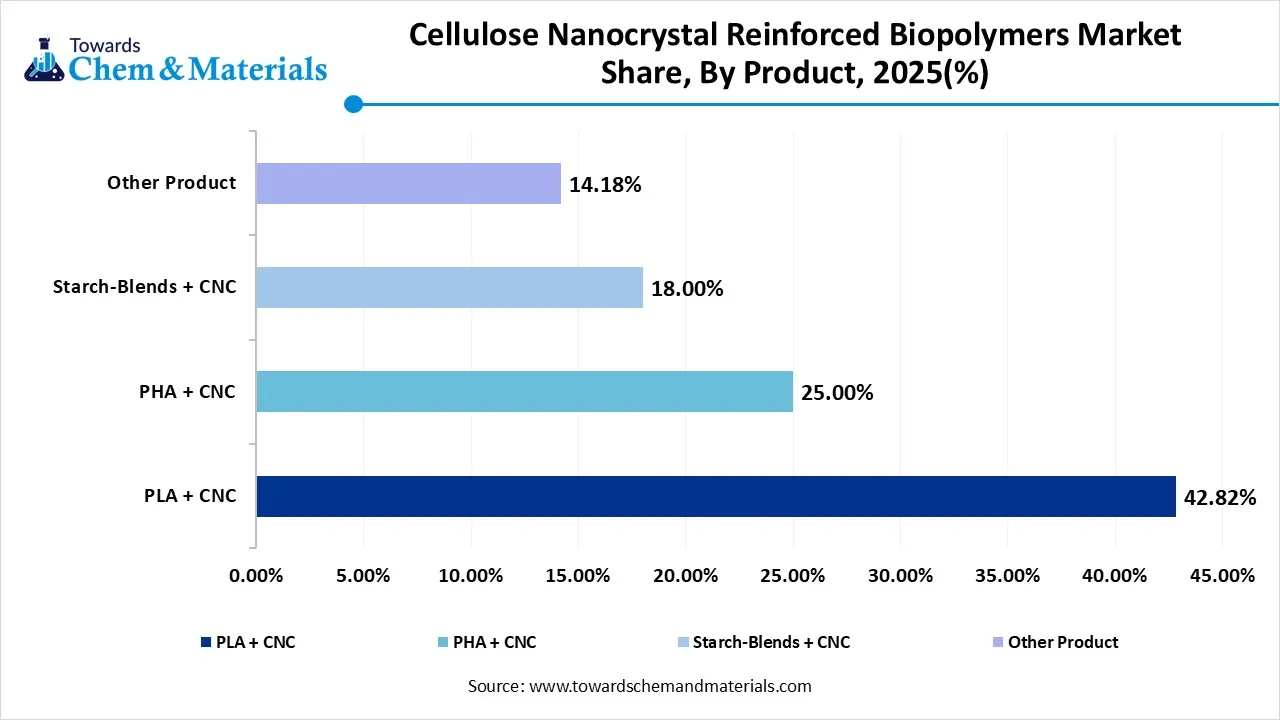
The PHA + CNC segment is projected to grow at the fastest CAGR 15.9% between 2026 and 2035 in the market, driven by its ability to overcome the inherent brittleness of PHA, making it ideal for sustainable, high-performance packaging. This combination enhances mechanical resilience and biodegradability, propelling the growth of the market. The growing demand for eco-friendly, biodegradable alternatives to traditional plastics drives this segment.
Cellulose Nanocrystal Reinforced Biopolymers Market Share, By Product, 2025 (%)
| By Product | Revenue Share, 2025 (%) |
| PLA + CNC | 42.82% |
| PHA + CNC | 25.00% |
| Starch-Blends + CNC | 18.00% |
| Other Product | 14.18% |
End-use Insights
How did the Packaging Segment Dominate the Cellulose Nanocrystal Reinforced Biopolymers Market in 2025?
The packaging segment dominated the market share 37.83% in 2025, driven by intense demand for sustainable, high-barrier, and eco-friendly alternatives to conventional plastic. CNCs enhanced mechanical strength and reduced permeability to moisture/gases, enabling lighter, cost-effective packaging solutions. CNC reinforcement significantly improves the tensile strength, durability, and barrier properties of biodegradable packaging, fueling the growth of the market
The biomedical & healthcare segment is projected to grow at the fastest CAGR 16.0% between 2026 and 2035 in the market, driven by its biocompatibility and use in drug delivery and tissue engineering, fueling growth. The biomedical segment is increasingly adopting CNC-reinforced biopolymers for advanced applications such as wound dressings, scaffolds, and biosensors, supporting the growth and expansion of the market.
Cellulose Nanocrystal Reinforced Biopolymers Market Share, By End-use, 2025 (%)
| By End-use | Revenue Share, 2025 (%) |
| Packaging | 37.83% |
| Automotive | 20.00% |
| Biomedical & Healthcare | 15.00% |
| Consumer Goods | 10.00% |
| Other End Uses | 17.17% |
Regional Insights
The North America cellulose nanocrystal reinforced biopolymers market size was valued at USD 120.97 million in 2025 and is expected to be worth around USD 518.11 million by 2035, exhibiting at a compound annual growth rate (CAGR) of 15.54% over the forecast period from 2026 to 2035. North America dominated the market share 39.00% in 2025, driven by intense R&D, strong government support for sustainable materials, and high-value applications in automotive, aerospace, and packaging, which fueled the growth of the market in the region.
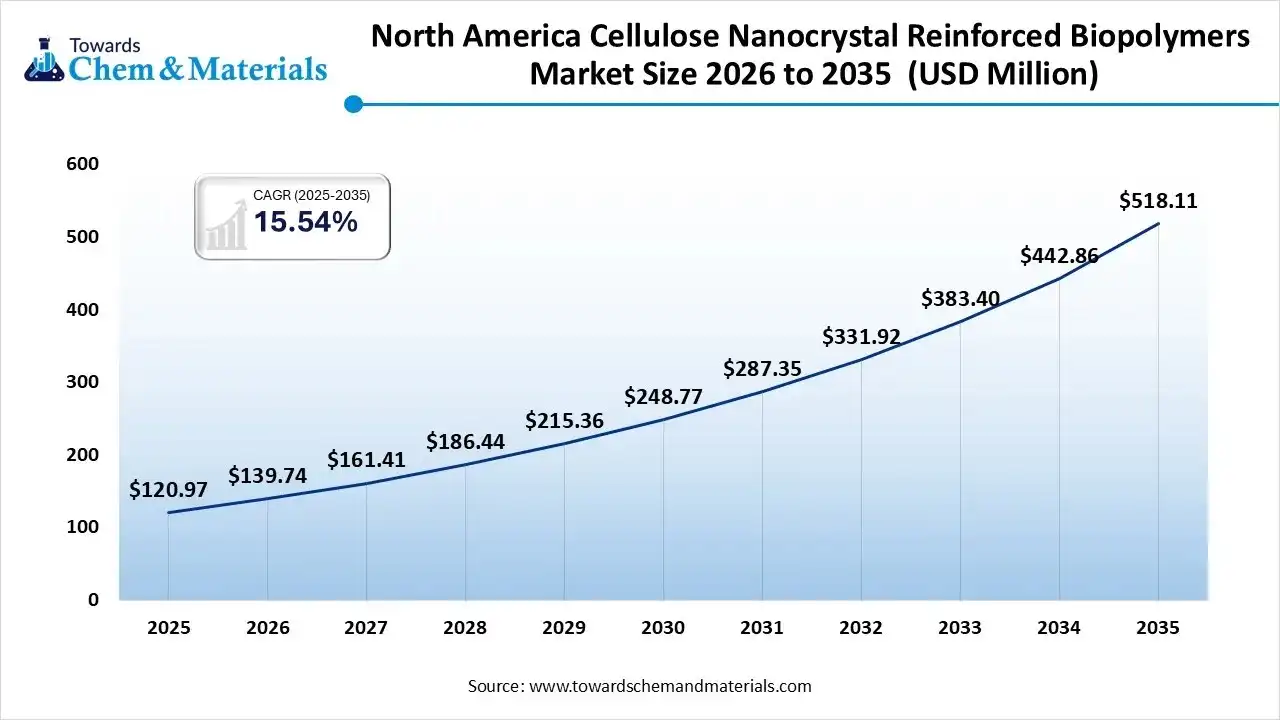
The region benefited from early commercial adoption of CNCs to replace plastics. Strong partnerships between universities and companies, particularly in the region, facilitated the translation of lab-scale innovations to industrial-scale production of CNCs.
U.S. Cellulose Nanocrystal Reinforced Biopolymers Market Growth Factor
The U.S. cellulose nanocrystal reinforced biopolymers market is experiencing rapid growth, driven by surging demand for sustainable, biodegradable packaging and high-performance, lightweight materials, supporting growth. The other key growth factors include superior mechanical reinforcing properties, increased R&D investment, and favorable environmental regulations, pushing to replace conventional plastics, propelling the growth and expansion of the market in the country.
Asia Pacific cellulose nanocrystal reinforced biopolymers market segment accounted for the major revenue share of 18.00% in 2025. Asia Pacific is expected to have the fastest growth in the market in the forecast period between 2026 and 2035, driven by surging demand for sustainable packaging, government support for green technologies, and the high availability of agricultural and wood-based feedstocks, fueling the growth of the market. Key factors include the need for lightweight, high-performance, and biodegradable materials in industries like automotive, healthcare, and consumer goods.
India Cellulose Nanocrystal Reinforced Biopolymers Market Growth Factor
The India market is primarily driven by rising demand for sustainable packaging, stringent environmental regulations against single-use plastics, and the need for high-performance, biodegradable materials, which fuels the growth of the market. Growth is further accelerated by the automotive and biomedical sectors' shift toward lightweight and biocompatible composites, which supports the expansion of the market.
Europe Cellulose Nanocrystal Reinforced Biopolymers Market Growth Factor
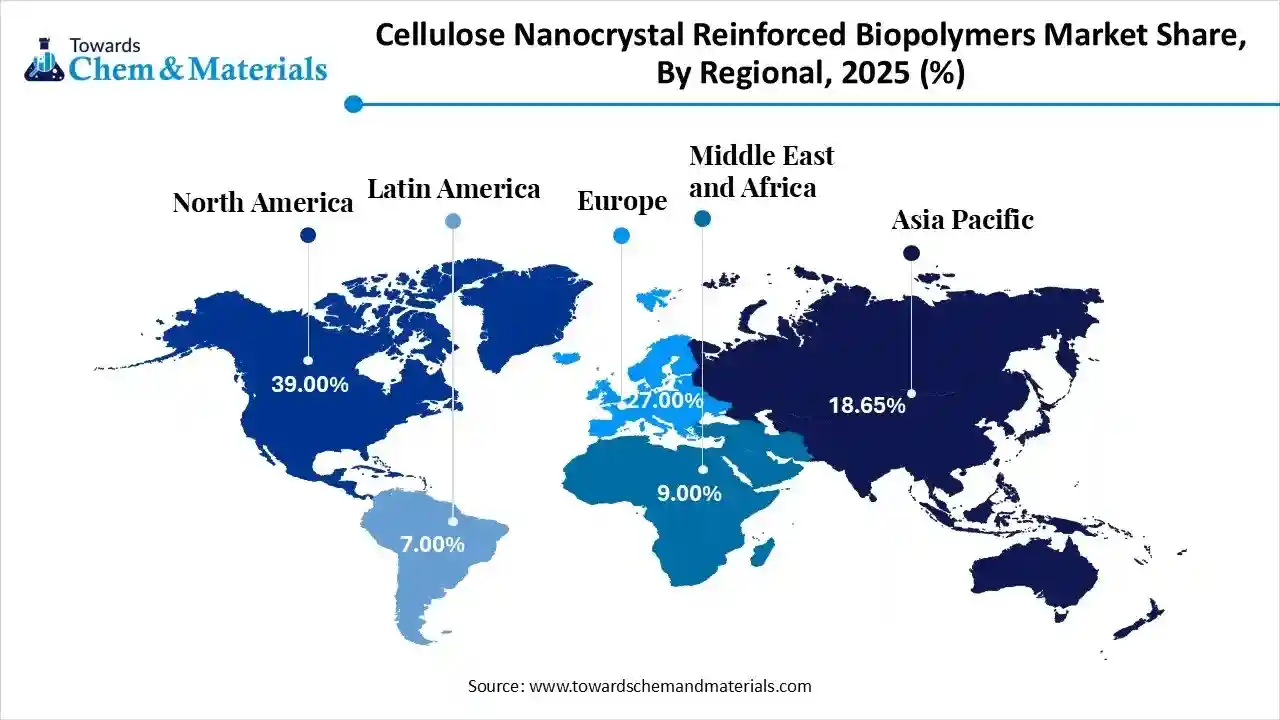
Europe cellulose nanocrystal reinforced biopolymers market segment accounted for the major revenue share of 27.00% in 2025. The European market is driven by high demand for sustainable, biodegradable materials in packaging, automotive, and medical sectors, which fuels the growth of the market in the region. The European Union’s commitment to a circular economy, favoring green, biodegradable materials, is the primary driver. EU Horizon programs provide funding for bio-based materials research, promoting adoption in packaging.
Cellulose Nanocrystal Reinforced Biopolymers Market Share, By Regional, 2025 (%)
| Regional | Revenue Share, 2025 (%) |
| North America | 39.00% |
| Europe | 27.00% |
| Asia Pacific | 18.00% |
| Latin America | 7.00% |
| Middle East & Africa | 9.00% |
Germany Cellulose Nanocrystal Reinforced Biopolymers Market Growth Factor
The German market is rapidly expanding, driven by intense demand for sustainable packaging, lightweight automotive materials, and advanced biomedical applications. Rising consumer and regulatory pressure for eco-friendly, biodegradable, and renewable materials drives adoption in packaging and composites. Germany is positioned as a leading market in Europe, with significant growth potential, particularly in high-performance green materials.
Recent Developments
- In September 2025, CelluShield is a bio-sourced, water-based barrier coating launched by CelluForce, designed to replace multi-material laminates with recyclable mono-material structures in flexible packaging. It achieves high barrier efficiency at a low coat weight, meeting FDA and Health Canada requirements, and is NexTrex™ certified recyclable.(Source: celluforce.com)
Top players in the Cellulose Nanocrystal Reinforced Biopolymers Market & Their Offerings:
- Chromatic Technologies Inc.: Produces advanced cellulose nanocrystal (CNC) additives and engineered biopolymer compounds tailored for sustainable packaging, coatings, composites, and specialty polymer blends that benefit from enhanced mechanical properties and biodegradability.
- LCR Hallcrest: Supplies functional nanocellulose materials (including CNC) used to reinforce biopolymer matrices like PLA and PHA, improving strength, barrier properties, and environmental performance for packaging and engineered components.
- RTP Company: RTP Company offers custom biopolymer compounds and CNC-reinforced thermoplastics optimized for performance applications in automotive, consumer goods, and eco-focused engineering plastics.
- Val Creations: Val Creations develops cellulose nanocrystal reinforced biopolymer masterbatches and additives used to enhance stiffness, heat resistance, and processability of biodegradable polymers like PLA.
- BASF SE: BASF integrates cellulose nanocrystals into bio-based polymer systems to enhance performance in packaging, automotive, and specialty polymer sectors with a focus on sustainability and regulatory compliance.
- Kiran Holographics
- 3M Company
- Kiran Holographics
- 3M Company
- CelluForce / Borregaard AS
- API (American Process Inc.)
Segments Covered:
By Product
- PLA + CNC
- PHA + CNC
- Starch-Blends + CNC
- Other Product
By End-use
- Packaging
- Automotive
- Biomedical & Healthcare
- Consumer Goods
- Other End Uses
By Regions
- North America
- U.S.
- Canada
- Mexico
- Europe
- Germany
- UK
- France
- Italy
- Spain
- Asia Pacific
- China
- India
- Japan
- South Korea
- Latin America
- Brazil
- Argentina
- Middle East & Africa
- Saudi Arabia
- South Africa
FAQ's
Question 1 : What is the current size and forecast growth of the cellulose nanocrystal reinforced biopolymers market?
Answer : The global market size for cellulose nanocrystal reinforced biopolymers is USD 310.19 million in 2025, expected to reach USD 1,311.67 million by 2035, growing at a CAGR of 15.51% from 2026 to 2035.
Question 2 : What are the key growth drivers in the cellulose nanocrystal reinforced biopolymers market?
Answer : The market is driven by the rising demand for sustainable, high-performance materials across sectors such as packaging, automotive, and biomedical industries.
Question 3 : Which regions are dominating the cellulose nanocrystal reinforced biopolymers market, and where is the fastest growth expected?
Answer : Asia Pacific dominated the market in 2025, and is expected to experience the fastest growth from 2026 to 2035, driven by demand for eco-friendly packaging and government support.
Question 4 : Who are the leading companies in the cellulose nanocrystal reinforced biopolymers market?
Answer : Leading companies include CelluForce, BASF SE, RTP Company, Chromatic Technologies Inc., and LCR Hallcrest, focusing on sustainable, high-performance materials.
Meet the Team

Saurabh Bidwai
Principal Consultant
Saurabh Bidwai, a B.Tech Chemical Engineering graduate with 4+ years of experience, specializes in specialty chemicals, commodity chemicals, and engineered materials, offering valuable insights into market trends and emerging opportunities.

Aditi Shivarkar
Reviewed By
Aditi Shivarkar, with 14+ years in Chemical and Materials market research, specializes in Chemical and Materials. She ensures accurate, actionable insights, driving Towards Chemicals And Materials Analytics and Consulting excellence in industry trends and sustainability.