
Chemical Recycling Of Plastics Market Size, Share, Growth, Report 2026 to 2035
The global chemical recycling of plastics market report segmented By Type (Depolymerization, Dissolution, and Conversion), By Product (PE, PET, PP, PVC, PS, and Others), By End-Use (Packaging, Automotive, Building & Construction, Electrical & Electronics, Textiles, and Others)-Global Industry Analysis, Size, Trends, Leading Companies, Regional Outlook, and Forecast 2026 to 2035
Content
What is the current Chemical Recycling of Plastics Market Size and Share?
The global chemical recycling of plastics market size was valued at USD 16.19 billion in 2025, is estimated to reach USD 18.59 billion in 2026, and is projected to reach USD 64.65 billion by 2035, exhibiting a compound annual growth rate (CAGR) of 14.85% over the forecast period from 2026 to 2035. In terms of volume, the chemical recycling of plastics industry is projected to grow from 10.25 million tons in 2025 to 36.85 million tons by 2035. growing at a CAGR of 13.65% from 2026 to 2035. The market growth is propelled by sustainability commitments for polymer, the circular economy, improved consumer preference for recycled plastics, and R&D investment for chemical recycling infrastructure.
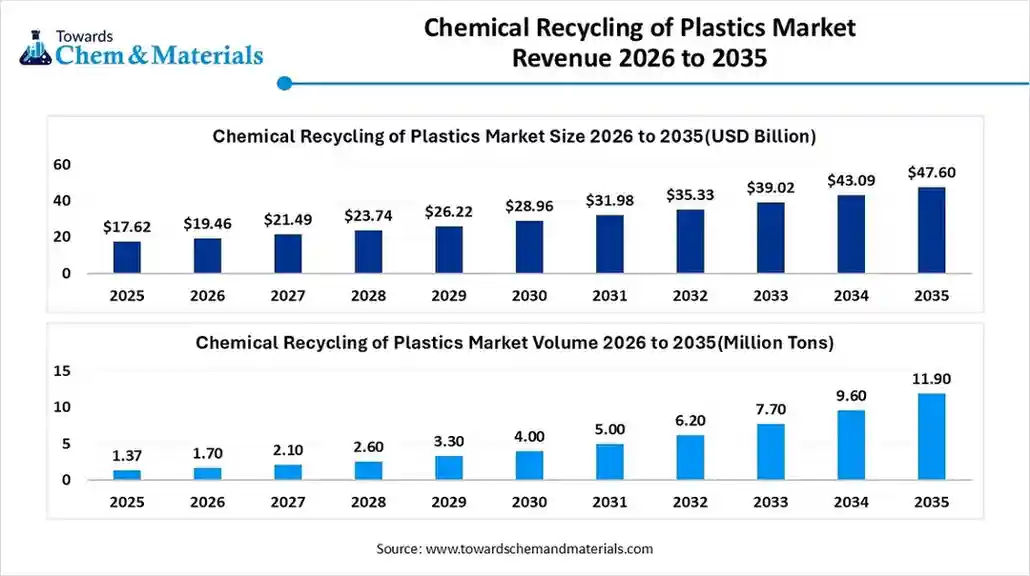
The chemical recycling of plastics market represents a key to the circular economy targets. The global transition towards plastics management aligns with recycling infrastructure for the massive volumes of post-consumer and post-industrial plastics. Chemical recycling is a method of breaking down plastic waste into long polymer chains by providing high-purity and performance driven materials. The stringent regulatory compliance for sustainability and consumer preference for recycled content are fueling the market expansion. The government support for taxing virgin plastic use, extended producer responsibility laws, and mandated recycled content commitment provide stable supply of high-value recycled plastics.
The chemical recycling utilized advancement processes like gasification, pyrolysis, and solvolytic depolymerization that make low-value plastics into high-value monomers, petrochemical feedstock, and synthetic analysis. The manufacturers focus on virgin-quality recycled resin for food-based and medical devices. The manufacturers are increasingly investing in recycling infrastructure and strategic joint agreements for processing scaling. The strategic partnership to integrate chemical output into a highly optimized chemical manufacturing chain through refinery cooperation that boosts the global and domestic growth.
The shift towards automated industrial commercialization necessitates massive capital expenditure, which is accelerating the development of advanced chemical reactors and conversion infrastructure. The mass balance accounting protocols are driving the chemical recycling of plastics as a clean alternative. The technology provider is focused on catalyst innovation, automated pre-sorting by ensuring optimized operational efficiency, and lowering feedstock contamination by balancing production cost and long-term economic viability.
Market Highlights
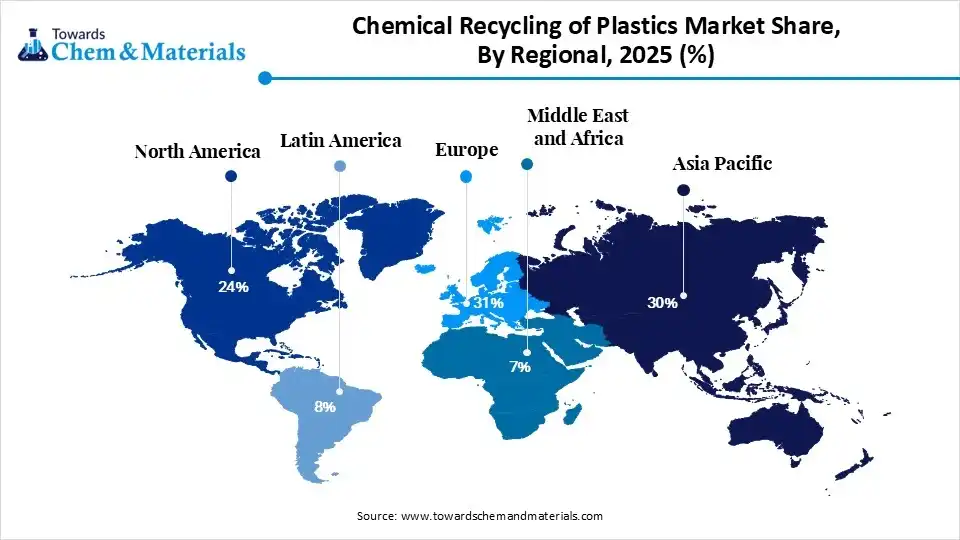
- By region, Europe dominated the chemical recycling of plastics market by holding 31% share in 2025, driven by stringent circular economy compliance and recycling investment for recycled polymers.
- By region, Asia Pacific held the 30% market share in 2025 and is expected to grow at the fastest with a CAGR of 16.4% during the forecast period due to plastic recycling investment and availability of recycled waste feedstock.
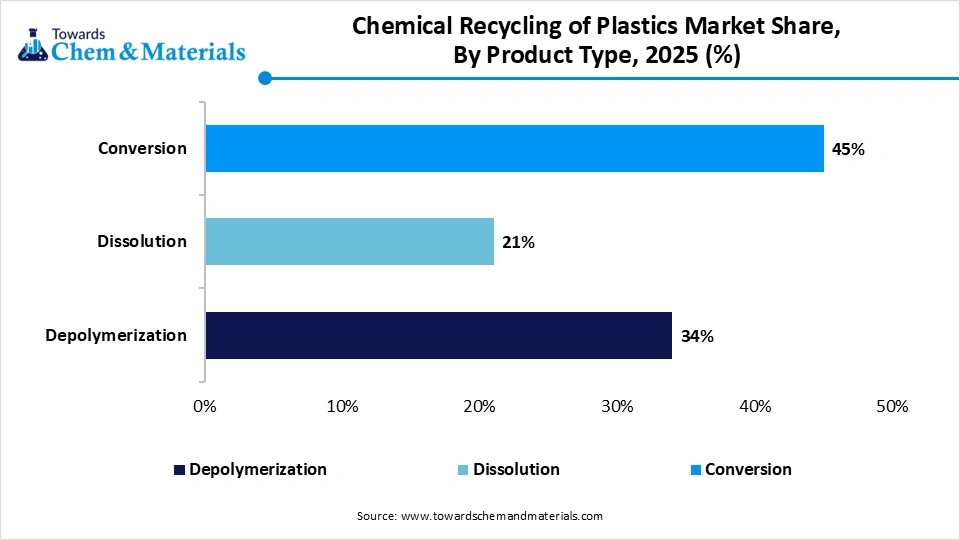
- By type, the conversion segment dominated the market with the largest share of 45% in 2025 and is expected to grow at the fastest CAGR of 16.30% over the forecast period, driven by energy recovery initiatives and the integration of recycled oil into refinery operations through pyrolysis and gasification technologies.
- By product, the PE segment dominated the market with the largest share of 27% in 2025 due to continuous demand for recycled polyethylene in packaging and industrial sectors.
- By product, the PET segment held 25% market share in 2025 and is expected to grow at the fastest CAGR of 15.8% over the forecast period due to PET recycling investments and integration of depolymerization technologies into food and packaging applications.
- By end-use, the packaging segment dominated the market with the largest share of 43% in 2025 and is expected to grow at the fastest CAGR of 15.7% over the forecast period due to regulatory compliance and high-volume demand for recycled content in flexible packaging and consumer brands.
Chemical Recycling of Plastics Market Trends
- Focus on Circular Economy principles: The circular economy principles are reshaping plastic recycling infrastructure. This principle pushes innovation in material recovery and the purity of waste to meet sustainability targets.
- Extended Producer Responsibility (EPR): The strong EPR frameworks are transitioning the operational responsibility of post-consumer waste management to producers and recyclers through substantial investment in chemical recycling infrastructure.
- Advanced Recycling Incorporation: The technological advancement in recycling, such as pyrolysis, gasification, and chemical depolymerization, allows unrecyclable plastics to be broken down into high-value monomers and reused for consumer goods.
Report Scope
| Report Attribute | Details |
| Market Size Value in 2026 | USD 18.59 Billion / 11.65 Million tons |
| Revenue Forecast in 2035 | USD 64.65 Billion / 36.85 Million Tons |
| Growth Rate | CAGR 14.85% |
| Forecast Period | 2026 - 2035 |
| Base Year | 2025 |
| Dominant Region | Europe |
| Segment Covered | By Type, By Product, By End-Use, By Region |
| Key companies profiled | Agilyx, BASF SE, MaireTecnimont S.p.A., INEOS AG, Recycling Technologies, Veolia Environnement SA, JEPLAN, INC., Eastman Chemical Company, SABIC, LyondellBasell Industries Holdings B.V. |
Key Technological Shifts and AI in the Chemical Recycling of Plastics Market
The technological integration in the chemical recycling of plastics market is transforming traditional recycling into an AI-driven robotic recovery ecosystem. The non-recyclable materials, like flexible plastics, e-waste components, and mixed construction materials, are recycled through robotic sorting with higher-quality outputs. The technological shift reduced reliance on manual labor and increased operational efficiency.
The AI-powdered waste sorting combined with NIR spectroscopy identify plastics waste by offering classification and higher-purity. IoT smart bins for automated waste isolation significantly advance the quality and quantity of recovered materials. Additionally, machine learning lowers emissions and improves recovery, scalability of waste management, and next-generation circular economy assets.
Supply Chain Analysis of the Chemical Recycling of Plastics Market
- Waste Segregation and Pre-Treatment: In this stage, plastic waste is characterized and then separated at the source to reduce contamination and improve recycling efficiency. The segregated waste is collected from generators to the processing site with the integration of advanced optical sorting.
- Key Players: ALBA Group, Waste Management Inc., LyondellBasell, Veolia, SUEZ, and Stadler Anlagenbau
- Plastics Processing and Refining: By using advanced technologies, plastic feedstock waste is converted into reusable polymers and chemical building blocks through pyrolysis, depolymerisation, hydro-processing, and gasification by ensuring low-toxicity and high-purity of plastic.
- Key Players: Carbios, Enerkem, Ineos Styrolution, Anellotech, Quantafuel, and Axens
- Polymerisation and End-Use: In this stage, circular olefins capture and run through polymerisation to recycled plastics, which are supplied to commercial consumer goods and end-product manufacturing to meet mass balance certification that provides a new income source for market growth.
- Key Players: TotalEnergies, SABIC, ExxonMobil, Borealis, Chevron Phillips Chemical, and BASF SE
Regulatory Framework: Chemical Recycling of Plastics Market
| Region | Key Regulations | Regulatory Focus |
| Global | Basel Convention Plastic Waste Amendments, ISCC PLUS, and ISO Standards | Standards for cross-border feedstock shipping and chain of custody auditing for contaminated mixed plastic scrap. Regional borders to route certified chemical recycling infrastructure. |
| European Union | EU PPWR, EU Plastic Food Contact Regulations, and SUPD Mass Balance Implementing Act | Mandates plastic pyrolysis oil and fuel-use excluded accounting model. The regional circularity targets for steam crackers, recycled credits, and co-products. |
| North America | US EPA CAA Reclassification, Clean Air Act Rule, and State-Level Model Legislation | Regulations for plastic classification and plastic-to-fuel boundaries focus on advanced recycling facilities and plastic-to-fuel conversions. Claims for regional green marketing |
| Asia Pacific | Regional EPR Alignment and Plastic Waste Circularity Mandates | Chemical recycling regulation, as verified, extended producer responsibility path. Focus on converting complex plastic waste into plastic polymers through advanced processing. |
| Latin America | MERCOSUR Waste Management harmonization & Regional Circular Economy Platform | Focus on plastic waste trade and processing to align domestic regulatory standards for advanced chemical recycling and carbon credit tracking. |
Chemical Recycling of Plastics Market Dynamics
Driver
Government Initiatives and Strategic Partnership
The government tax incentives and chemical park schemes are accelerating the development of the regional chemical recycling facilities, molecular recycling, driving the investment in advanced recycling technologies, like pyrolysis, depolymerization, to increase recycling rates. The public-private collaboration between recyclers, consumer brands, and waste management companies allows optimization in the manufacturing process to meet EPR targets and circular economy commitments. Additionally, an AI-driven sorting model and innovation programme convert plastic waste into monomers to meet official recycling validation.
Restraints
High Capital Expenditure and Operational Cost
The chemical recycling needs high and advanced molecular recycling facility through higher capital investment. The intensive energy use requires higher operational advancement for high-temperature thermal cracking by replacing fossil-derived virgin plastics. The recycling facility's higher operational cost restrains the market expansion.
Opportunity
Value Chain Expansion
The value chain expansion is a pivotal opportunity in the chemical recycling market, characterized by an integrated alliance between plastic waste management companies and end-use manufacturers. The increasing value chain integration offers a major opportunity for strategic investment in R&D that accelerate innovation to increase purity and operational efficiency. Additionally, the expanding infrastructure for hard-to-recycle plastics and circular products align government mandates, accelerating the market expansion.
Segmental Insights
Type Insights
The conversion segment dominated the market with the largest share of 45% in 2025 and is expected to grow at the fastest CAGR of 16.30% over the forecast period. The growth is driven by its processing ability for highly-contaminated, multi-layer, and low-grade post-consumer plastics. The conversion type is key for high-purity liquid hydrocarbons and valuable monomers, by utilizing advanced pyrolysis and gasification. The segment maintains its leadership through its continuous catalyst innovation and automated pre-treatment system that make them key for high-value industrial commercialization.
The depolymerization segment held the 34% market share in 2025, serving as a key for precision of chemical recycling, that offering high-value solution for clean, polyethylene terephthalate, and nylon streams. The depolymerization deploys chemical, glycolytic, and enzymatic solvolysis. The rising focus on industrial scalability and circularity in high-performance textiles and food-grade packaging is boosting the demand for depolymerization. The segment is key for closed-loop, cradle-to-cradle manufacturing to align with technological advancement.
The dissolution segment held the 21% market share in 2025, due to tis high-efficiency and known as solvent-driven purification. The segment focuses on complex, multi-layer plastics such as polystyrene and polypropylene by utilizing selective solvent extraction and precipitant separation. The dissolution allows recyclers to produce high-quality food-contact reins to meet carbon-neutrality targets and stringent hazardous waste standards. Additionally, the shift towards solvent recovery logistics and making dissolution a key or multi-layer
Chemical Recycling of Plastics Market Share, By Product Type, 2025 (%)
| By Type | Revenue Share, 2025 (%) |
| Depolymerization | 34% |
| Dissolution | 21% |
| Conversion | 45% |
Product Insights
The PE segment dominated the market with the largest share of 27% in 2025.The development is driven by stringent single-use plastics compliance and its industrial-scale circular economy investments. The polyethylene is a hydrocarbon structure act as a key feedstock for large-scale pyrolysis reactors, offering high-purity liquid hydrocarbons and synthetic crudes. The manufacturers' focus on recycled PE into existing petrochemical steam crackers ensures virgin-grade, circular resins.
The PET segment held the 25% market share in 2025 and is expected to grow at the fastest CAGR of 15.8% over the forecast period, due to its demand in closed-loop circularity, especially in the synthetic textile and rigid packaging sectors. The PET leverages chemical processing to recover purified terephthalic acid and dimethyl terephthalate to yield high-value monomers. As consumer and industry demand for ultra-pure, circular plastics to meet mandatory recycled content quotas and corporate sustainability goals driving the market growth.
The PP segment held the 18% market share in 2025, representing a key product for multi-layer packaging, automotive, and textiles sectors. The PP utilized advanced thermochemical pyrolysis to offer high-yield pyrolysis oil and standard monomer intermediates. The manufacturer is increasingly adopting certified food-contact recycled polypropylene grades as a circular asset. The substantial investment in recycling infrastructure and offtake agreements is driving the scalability of PP in the global and domestic markets.
The other segment held 11% market share in 2025, due to its industrial framework and rising consumer preference for recycled specialty polymers include polycarbonate, polyamide, ABS, and multi-layer plastic, which promotes the adoption of advanced recycling technologies that offer durability by lowering environmental impact. The major market player focuses on the circular economy, and substantial investment in plastics processing is accelerating market growth.
The PVC segment held 10% market share in 2025, driven by its ability to release highly corrosive hydrogen chloride gas and hazardous dioxins during chemical processing. The manufacturers utilized a multi-stage dichlorination system and specialized solvolytic extraction to convert hazardous chlorine fraction into valuable industrial chemical salts, pyrolysis oils, and monomer feedstocks. The innovation focuses on catalytic optimization and complex PVC waste into a clean and circular manufacturing alternative.
Chemical Recycling of Plastics Market Share, By Product, 2025 (%)
| By Product | Revenue Share, 2025 (%) |
| PE | 27% |
| PET | 25% |
| PP | 18% |
| PVC | 10% |
| PS | 9% |
| Others | 11% |
End-Use Insights
The packaging segment dominated the market with the largest share of 43% in 2025 and is expected to grow at the fastest CAGR of 15.7% over the forecast period. The fast-moving consumer goods demand for certified food-grade recycled polymers to meet single-use plastic bans. The food, beverage, flexible, and industrial packaging focus on integration of advanced thermochemical recycling to lower environmental impact and maximize the purity of plastic. The packaging sector is shifting towards virgin-equivalent materials to meet safety standards and avoid non-compliance penalties by maintaining structural integrity.
The automotive segment held the 17% market share in 2025, driven by manufacturers' focus on the adoption of recycled content in composite dashboards, polymer bumpers, and multi-material interior textiles. The stringent end-of-life vehicle standards and corporate fleet sustainability commitment are driving the integration of chemical recycling infrastructure in the automotive sector. The rising focus on polyolefin pyrolysis to broke contaminate and multi-component plastic materials into high-purity synthetic crude and monomer intermediate, boosting the recycling infrastructure growth.
The building & construction segment held the 14% market share in 2025 due to demand for advanced chemical recycling in flooring, piping, weather-resistant window frames, fittings, & insulation panels. The developers focus on implementing a specialized two-stage thermal process and catalytic dichlorination to meet green building compliance. Overall, the building and construction sector transforms clean hydrocarbons into high-strength, structural-grade construction materials by maintaining consumer safety.
The electrical & electronics segment held 11% market share in 2025, the growth is accelerated by the rising demand for circular supply chains in home appliances, electrical housings, consumer electronics, & computing hardware. The advanced recycling infrastructure is driving the specialized extraction solvents and catalytic cracking to remove hazardous brominated flame retardants. The advanced recycling technologies offer high performance, superior heat resistance, and structural tolerance, key to the next-generation electrical and electronics sector.
Chemical Recycling of Plastics Market Share, By End-use, 2025 (%)
| By End-use | Revenue Share, 2025 (%) |
| Packaging | 43% |
| Automotive | 17% |
| Building & Construction | 14% |
| Electrical & Electronics | 11% |
| Textiles | 9% |
| Others | 6% |
Regional Analysis
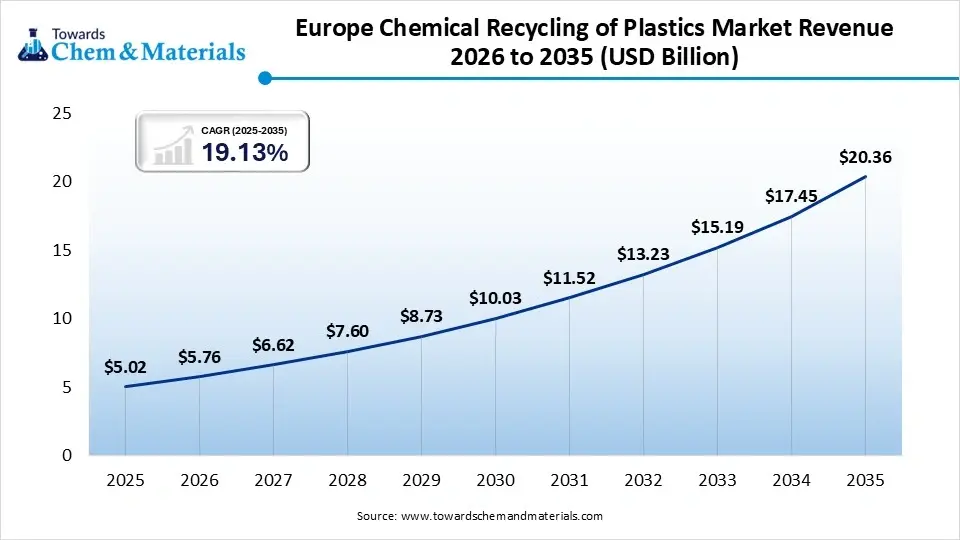
The Europe chemical recycling of plastics market size was estimated at USD 5.02 billion in 2025 and is projected to reach USD 20.36 billion by 2035, growing at a CAGR of 19.13% from 2026 to 2035.Europe dominated the market by holding a 31% share in 2025, driven by its advanced recycling infrastructure and stringent recycled-content mandates. The region focuses on transforming mixed plastic waste into high-purity plastics through the utilization of pyrolysis and gasification technologies. The automotive and consumer demand for recycled polymers through domestic circular networks strengthens their dominance in chemical recycling infrastructure.
Germany
- The stringent PPWR mass balance mandates and plastic-to-fuel bans allow petrochemical companies to integrate advanced recycling infrastructure into the domestic market.
- Germany represents in high-capital investment in infrastructure and import of unrefined pyrolysis oil through diversified petrochemical hubs.
United Kingdom
- The UK transition towards high-efficiency hydrothermal and pyrolysis infrastructure. The regional corporate sustainability commitment is driving the local market expansion.
- The UK government tax credits and financial penalties for plastics reinforced domestic players for innovation in chemical recycling technologies.
The Asia Pacific chemical recycling of plastics market size was estimated at USD 4.86 billion in 2025 and is projected to reach USD 19.72 billion by 2035, growing at a CAGR of 15.03% from 2026 to 2035. Asia Pacific held the 30% market share in 2025 and is expected to grow at the fastest with a CAGR of 16.4% during the forecast period. The regional growth is fueled by their technological advancement and their shift towards resource recovery. The Asia-Pacific focuses on a sustainability framework and circular polymers through large-scale molecular depolymerization and catalytic cracking facilities. The domestic manufacturer shifts towards high-grade feedstock by integrating chemical recycling infrastructure, accelerating the regional expansion.
China
- China market growth is driven by strong government support for mechanical sorting and the industrial consolidation trend towards chemical recycling.
- The domestic players are increasingly investing in high-capacity thermal cracking reactors and the conversion of low-grade agricultural and municipal plastic waste.
India
- India is witnessing significant growth through its stringent extended producer responsibility compliance and recycled content commitments.
- The domestic automotive manufacturers and technology providers focus on implementing decentralized sorting and advanced processing through recycling and microcollection hubs.
The North American chemical recycling of plastics market size was estimated at USD 3.89 billion in 2025 and is projected to reach USD 15.84 billion by 2035, growing at a CAGR of 16.88% from 2026 to 2035. North America held the 24% market share in 2025, driven by heavy capital investment in pyrolysis and gasification facilities. The regional extended producer responsibility and stringent regulatory compliance are reinforcing the demand for recycled content food packaging. North America's rapid capacity expansion is converting complex plastic waste into virgin-grade circular feedstock through the integrated supply chain and regional petrochemical companies.
United States
- The US market is expanding through its plastics permitting laws that allow classification of advanced recycling in end-use manufacturing. The domestic trend focuses on mass-balanced accounting and certified circular resin that fueling the domestic growth.
- The regulatory shift is reshaping the market growth through public-private capital investment to construct large-scale pyrolysis facilities.
Canada
- The growth is fueled by strict provincial landfill bans and waste-stream investment in single-use plastics and flexible packaging.
- The domestic surge towards solvent-based dissolution and purification technologies allows recycling for the separation of high-density plastics and municipal waste into high-purity plastics for industrial production lines.
The Latin American chemical recycling of plastics market size was estimated at USD 1.30 billion in 2025 and is projected to reach USD 5.50 billion by 2035, growing at a CAGR of 15.52% from 2026 to 2035. Latin America held the 8% market share in 2025. The region focuses on modernization in solid waste infrastructure through advanced chemical recycling. The chemical manufacturers are increasingly investing in commercial thermal cracking units, enabling the domestic expansion. The growing circular economy targets expanding the replacement of imported virgin resins with domestic recycled grade feedstock. Latin America is integrating a waste collection network into a high-tech value chain through strategic collaboration.
Chemical Recycling of Plastics Market Share, By Region, 2025 (%)
| Regional | Revenue Share, 2025 (%) |
| North America | 24% |
| Europe | 31% |
| Asia-Pacific | 30% |
| Latin America | 8% |
| Middle East & Africa | 7% |
Brazil
- The market growth is driven by commercial advancement that is supported by national logistics mandates.
- The regional pyrolysis reactors and major manufacturing hubs allow industrial plastic scrap and flexible packaging.
Mexico
- The Mexican government focuses on strict circularity compliance & food-regulatory-compliant packaging, accelerating the domestic investment in PET depolymerization.
- The growth is accelerated by its global export demand and domestic manufacturing supply for automotive components and consumer goods infrastructure.
The Middle East and Africa chemical recycling of plastics market size was estimated at USD 1.13 billion in 2025 and is projected to reach USD 4.85 billion by 2035, growing at a CAGR of 15.68% from 2026 to 2035. The Middle East & Africa held the 7% market share in 2025, due to their decarbonization mandates and their manufacturing hub for certified circular polymers. MEA integration advanced thermal pyrolysis into a petrochemical complex to transform low-grade waste into high-grade chemical feedstock. The domestic players investing in recycled-content resins and downstream export portfolios are accelerating the market expansion.
Saudi Arabia
- The market expansion is driven by capital-heavy investment in state-funded Vision 2030 initiatives for constructing advanced recycling facilities that align with well-established petrochemical hubs.
- The strategic focus allows traditional oil export transformation towards high-value certified circular polymers, which boosts the domestic expansion.
Recent Developments
- In March 2026, MUFG Band Ltd. signed an MoU with Mitsubishi Chemical Corporation (MCC) and Refinverse Group, Inc. to launch a joint circular economy proof-of-concept system design to collect office plastic waste. The initiative focuses on advanced domestic recycling of plastic waste and establishes a sustainable system for collecting and repurposing office materials.(Source: www.indianchemicalnews.com)
- In February 2025, PolyCycl, which offers a novel solution for recycling, announced the launch of Generation VI chemical recycling pyrolysis technology, enabling the conversion of hard-to-recycle plastics and the formation of a plastic circular economy.(Source: www.indianchemicalnews.com)
Top Companies in the Market
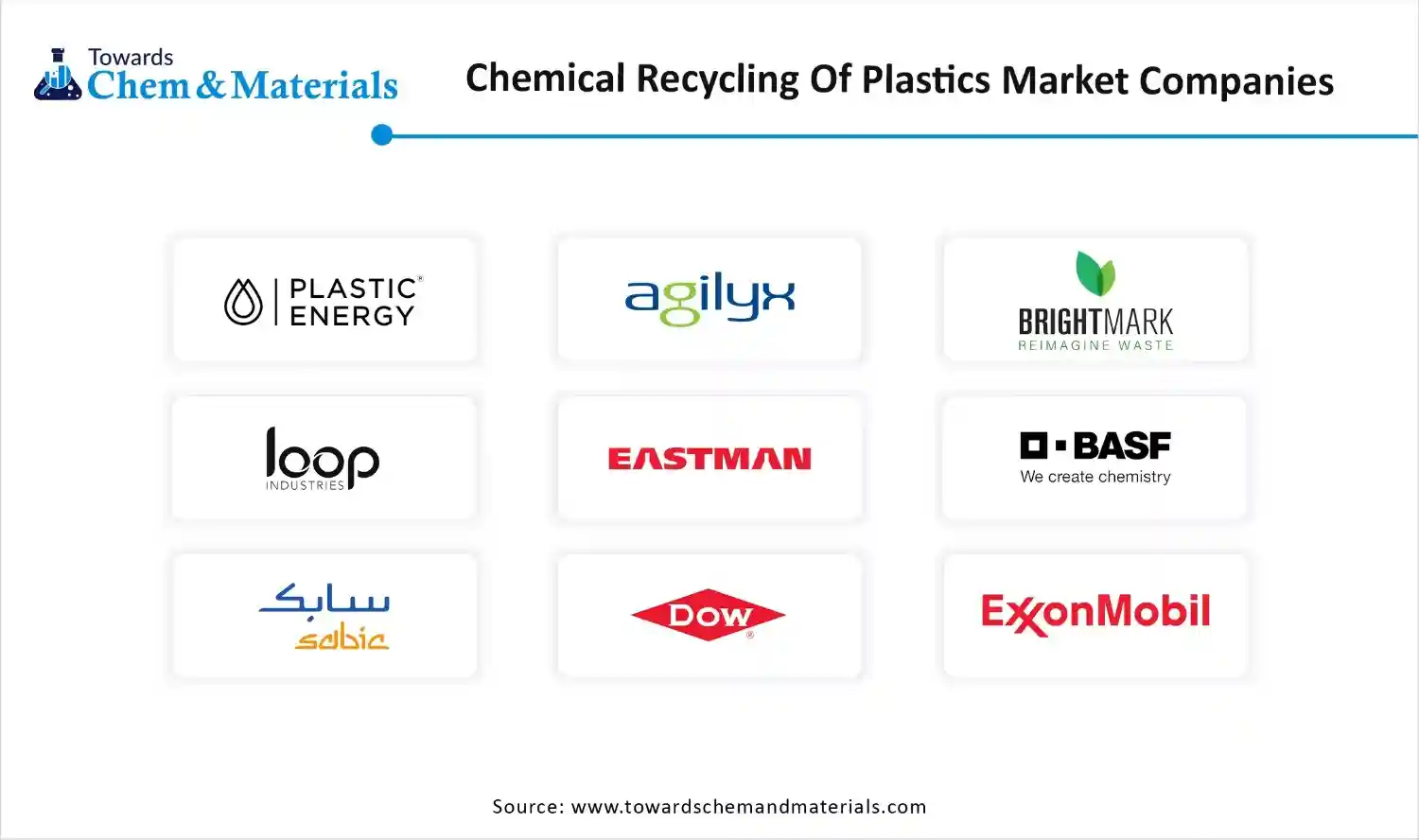
- Agilyx
- BASF SE
- MaireTecnimont S.p.A.
- INEOS AG
- Recycling Technologies
- Veolia Environnement SA
- JEPLAN, INC.
- Eastman Chemical Company
- SABIC
- LyondellBasell Industries Holdings B.V.
Segment Covered in the Report
By Type
- Depolymerization
- Glycolysis
- Methanolysis
- Hydrolysis
- Enzymatic Depolymerization
- Dissolution
- Selective Dissolution
- Solvent-Based Purification
- Precipitation & Recovery Processes
- Conversion
- Pyrolysis
- Gasification
- Catalytic Cracking
- Hydrothermal Processing
By Product
- PE
- HDPE
- LDPE
- LLDPE
- PET
- Bottle-Grade PET
- Fibre-Grade PET
- Food-Grade Recycled PET
- PP
- Homopolymer PP
- Copolymer PP
- PVC
- Rigid PVC
- Flexible PVC
- PS
- General Purpose PS
- Expanded PS
- High Impact PS
- Others
- Polycarbonate
- Polyamide
- ABS
- Multi-layer Plastics
By End-Use
- Packaging
- Food Packaging
- Beverage Packaging
- Flexible Packaging
- Industrial Packaging
- Automotive
- Interior Components
- Exterior Components
- Under-the-Hood Applications
- Building & Construction
- Pipes & Fittings
- Insulation Materials
- Flooring & Panels
- Electrical & Electronics
- Consumer Electronics
- Wiring Components
- Electrical Housings
- Textiles
- Recycled Fibers
- Industrial Fabrics
- Apparel Textiles
- Others
- Agriculture
- Consumer Goods
- Healthcare
By Region
- North America
- U.S.
- Canada
- Mexico
- Europe
- Germany
- UK
- France
- Italy
- Spain
- Asia Pacific
- China
- India
- Japan
- South Korea
- Latin America
- Brazil
- Argentina
- Middle East & Africa
- Saudi Arabia
- South Africa
FAQ's
Question 1 : What is the current size of the chemical recycling of plastics market?
Answer : The global chemical recycling of plastics market size was valued at USD 16.19 billion in 2025 and is estimated to reach USD 18.59 billion in 2026. It is projected to scale up to USD 64.65 billion by 2035, growing at a steady CAGR of 14.85%.
Question 2 : Which region holds the largest share in the chemical recycling of plastics market?
Answer : Europe held the largest market share at 31% in 2025, driven by strict mandates like the EU Plastic Packaging Waste Regulations. The Asia-Pacific region follows closely with a 30% market share and is expected to grow the fastest at a CAGR of 16.4%.
Question 3 : Who are the top key players in the chemical recycling of plastics market?
Answer : The top key players leading the market include Agilyx, BASF SE, MaireTecnimont, INEOS, Recycling Technologies, Veolia, JEPLAN, Eastman Chemical Company, SABIC, and LyondellBasell.
Question 4 : What is the chemical recycling of plastics market used for?
Answer : The market focuses on breaking down low-value, contaminated, or multi-layer plastic waste into high-value monomers, petrochemical feedstocks, and synthetic crude. These outputs are used to manufacture virgin-quality recycled plastics for food packaging, automotive parts, electronics housings, and building materials.
Question 5 : What is driving the growth of the chemical recycling market?
Answer : The growth is primarily driven by strict government regulations, extended producer responsibility laws, and massive corporate commitments to net-zero goals. Advanced technological integrations, including AI-driven robotic waste sorting, are also lowering operational costs and improving processing efficiency.
Meet the Team

Saurabh Bidwai
Principal Consultant
Saurabh Bidwai, a B.Tech Chemical Engineering graduate with 4+ years of experience, specializes in specialty chemicals, commodity chemicals, and engineered materials, offering valuable insights into market trends and emerging opportunities.

Aditi Shivarkar
Reviewed By
Aditi Shivarkar, with 14+ years in Chemical and Materials market research, specializes in Chemical and Materials. She ensures accurate, actionable insights, driving Towards Chemicals And Materials Analytics and Consulting excellence in industry trends and sustainability.