
Conductive Polymer Fibers Market Manufacturers & Suppliers Company Analysis 2026-2035
The global conductive polymer fibers market size is expected to grow from USD 634.83 million in 2026 to USD 1,835.37 million in 2035, growing at a CAGR of 12.52% from 2026 to 2035. The top key players in the market are Chromatic Technologies Inc, OliKrom, LCR Hallcrest, Eeonyx, Heraeus Holdings, Agfa-Gevaert, Matsui International, BASF SE, Solvay, Ranbar Pigment, 3M Company-Global Forecast 2026 To 2035
Content
What is the Current Conductive Polymer Fibers Market Size and Share?
The global conductive polymer fibers market size was estimated at USD 1,835.37 million in 2025 and is expected to increase from USD 634.83 million in 2026 to USD 1,835.37 million by 2035, growing at a CAGR of 12.52% from 2026 to 2035. Asia Pacific dominated the conductive polymer fibers market with the largest revenue share of 39.00% in 2025. The growth is driven by innovation, rising demand for smart wearable textiles, investments in R&D and consumer demand for greener products.
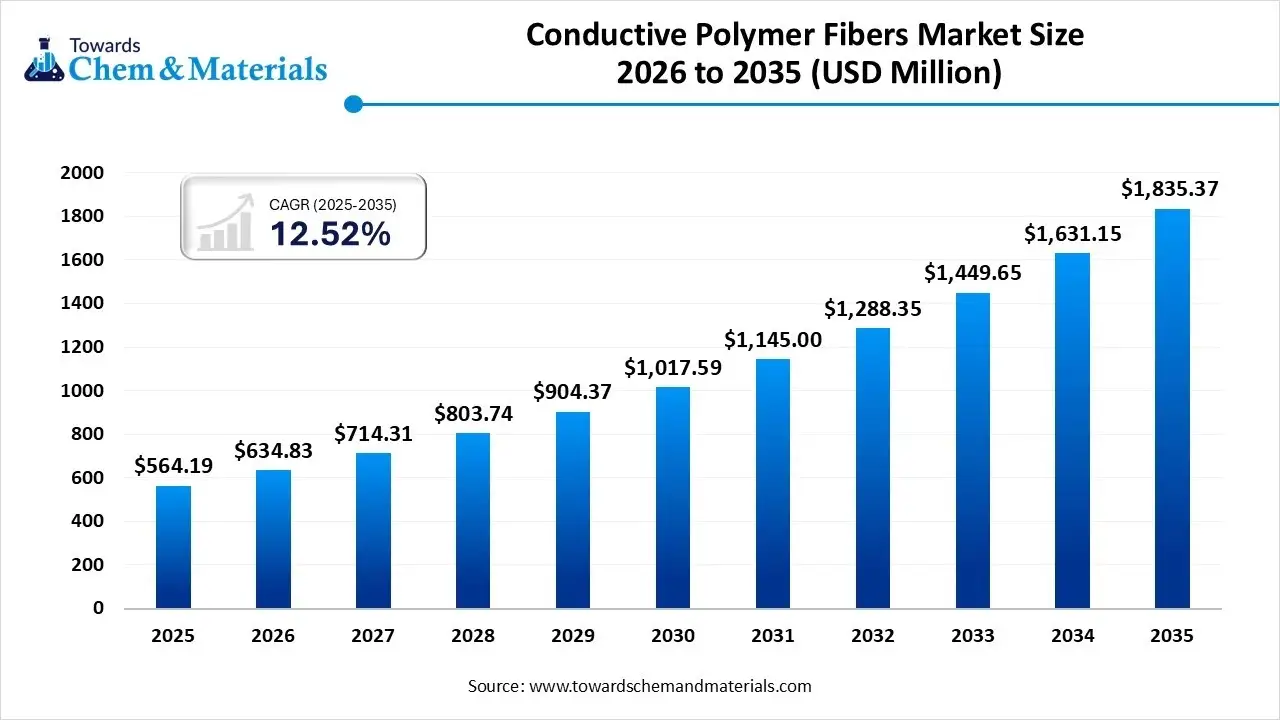
Market Highlights
- The Asia Pacific dominated the conductive polymer fibers market with the largest revenue share of 39.00% in 2025.
- By material type, the composite conductive fibers segment held the largest share 55.00% in the market in 2025 due to its structural integrity, percolation efficiency and electrical conductivity.
- By material type, the poly(3,4-ethylenedioxythiophene) (PEDOT) fibers segment is expected to grow at the fastest CAGR 13.65% during the forecast period due to its film processability, conductivity and flexibility.
- By application, the antistatic & ESD protection fabrics segment dominated the market 36.00%, driven by its long-term reliability and static-safe ecosystem.
- By application, the smart textiles & wearable electronics segment is anticipated to grow at the fastest CAGR 13.15% in the market during the forecast period due to its demand for fitness, garments with embedded sensors for monitoring health and performance.
Market Overview
The conductive polymer fibers characterized by their molecular versatility, biocompatibility and mechanical resilience. As the industry is shifting towards sustainable and lightweight solution it is a breakthrough in wearable technology and smart textiles. Incorporating materials like PEDOT: PSS into textiles creates flexible, durable smart yarns for sensors, healthcare, and automotive uses.
The rising demand for EMI shielding and biocompatible sensors is boosting the expansion. Their mechanical resilience under stress and processability make them essential for high-performance, automotive sensory surfaces, aerospace for weight reduction and comfortable wearables.
Conductive Polymer Fibers Market Trends
- Effort on Circular Economy and Sustainability: The trend driving innovation of recyclable-compatible, hybrid conductive materials, bio-based polymer and production of sustainable fiber to lower environmental impact and carbon footprint.
- Industrial Application Development: The rising demand for smart textiles, automotive interiors, medical hygiene products, and bioelectronics, by offering high-durability and environmental resistance driving the adoption.
- Robust Government Funding: The government mandates pushing manufacturers towards sustainable and smart solutions that promote technological advancement and substantial investment for innovation.
Report Scope
| Report Attribute | Details |
| Market Size and Volume in 2026 | USD 634.83 Million |
| Revenue Forecast in 2035 | USD 1,835.37 Million |
| Growth Rate | CAGR 12.52% |
| Forecast Period | 2026 - 2035 |
| Base Year | 2025 |
| Dominant Region | Asia Pacific |
| Segment Covered | By Material Type, By Application, By Region |
| Key companies profiled | Chromatic Technologies Inc, OliKrom, LCR Hallcrest, Eeonyx, Heraeus Holdings, Agfa-Gevaert, Matsui International, BASF SE, Solvay, Ranbar Pigment, 3M Company |
Key Technological Shifts and AI in the Conductive Polymer Fibers Market
The technological advancement refined the market by transitioning towards nano-engineering with AI-driven manufacturing. The innovation is integrating liquid metals and carbon fillers for stretchability and self-healing. AI and machine learning, like generative adversarial networks and Bayesian optimization accelerates discovery of sustainable, high-conductivity materials and turn fabric into connected sensors, enabling real-time biometric data processing. The digital twins are integrated into manufacturing processes to lower defect rates and offer durability in defence & automotive sensors. Additionally, the ultra-smart fibers and human-machine interfaces are accelerating the market growth.
Trade Analysis of the Conductive Polymer Fibers Market: Import and Export Statistics
- China exported 432 shipments of conductive polymer fibers.
- Vietnam exported 106 shipments of conductive polymer fibers.
- The United States exported 7 shipments of conductive polymer fibers.
- From May 2024 to April 2025, the world exported 304 shipments of conductive polymer fibers.
Market Value Chain Analysis
- Raw Materials Supply and Synthesis: The stage show sourcing and production of high-purity monomer, dopants and base polymers using solvent systems that focus on purity control.
- Key Players: BASF SE. Sinopec, DuPont and LyondellBasell
- Formulation and Compounding: The polymerization of raw feedstock into conductive masterbatches and dispersions with optimization using techniques like core-sheath spinning, melt and fiber spinning.
- Key Players: Covestro, RTP Company, Solvay, Heraeus, Soliyan, Chromatic Technologies and Olikrom
- Application and Distribution: The final stage of conductive fibers into smart fabrics, EMI shielding gaskets and EMI shielding with interconnectivity and lifecycle management.
- Key Players: 3M Company, LG Chem, Agfa-Gevaert, LCR Hallcrest, Kyocera AVX and Samsung SDI.
Regulatory Framework: Conductive Polymer Fibers Market
| Region | Key Regulations | Regulatory Focus |
| European Union | REACH, ATEX Directives, RoHS | Focus on monitoring of synthetic polymers to avoid bioaccumulation of toxic substances in smart garments and electronics |
| Asia Pacific | Japan CSCL, Environmental Standards, China RoHS | The standards for managing the environmental impact of large-scale polymer synthesis. |
| North America | TSCA, FDA guidance, EPA, ANSI/ESD | Focus on regulating chemical manufacturing and conductive additives, especially for consumer wearables and medical sensors. |
| Global | IPC, IEC-61340 and ISO standards | The standards focus on testing of electrical durability in e-textiles and to check surface resistivity |
Segmental Insights
Material Type Insights
Why the Composite Conductive Fibers Segment Dominates the Conductive Polymer Fibers Market?
The composite conductive fibers segment dominated the market in 2025 accounting for 55.00% of total revenue, is defined as of material synthesis that offers high-performance hybrid materials that combine flexible polymers with nano-carbon or metallic fillers. The segment enables structural integrity and optimised internal networks through AI, these composites resist oxidation and mechanical weakness, maintaining electrical conductivity under extreme conditions like elongation. By utilizing machine learning, manufacturers create lightweight filaments for biometric sensors, EMI shielding, and stretchable energy storage. Overall, this segment is suited for edge-integrated electronics and mission-critical applications that needing softness and high data bandwidth.
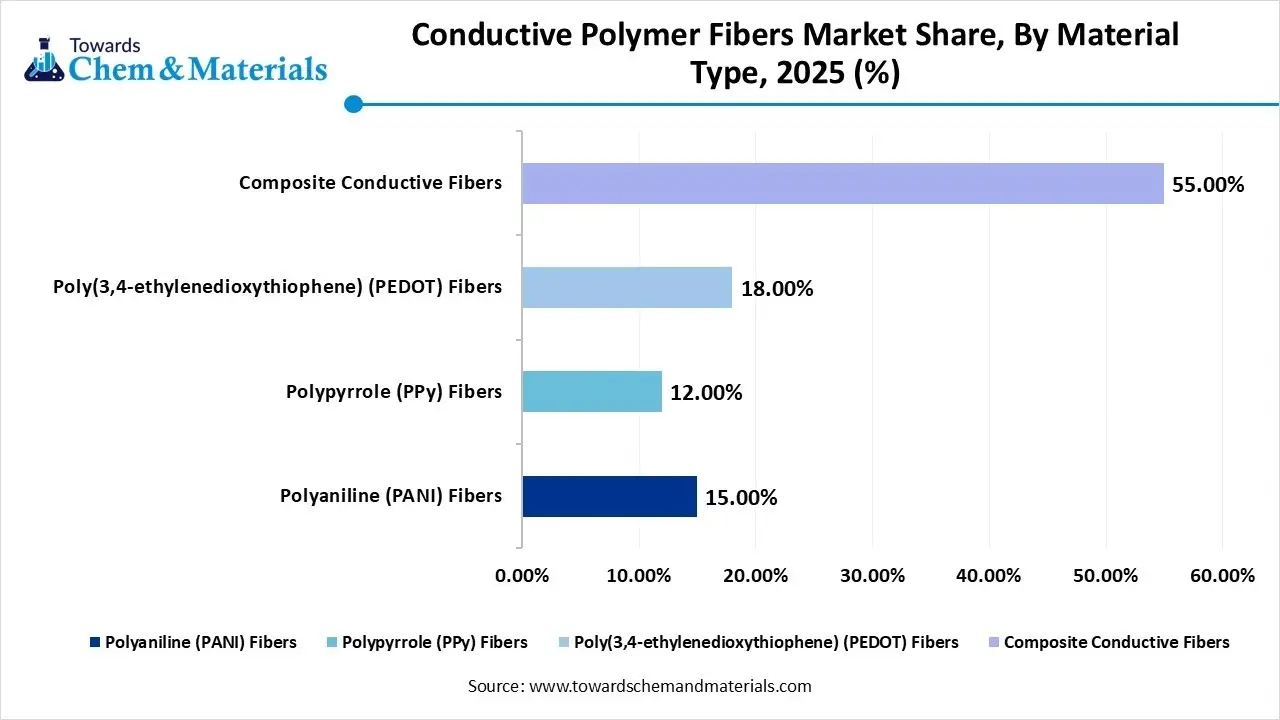
The poly(3,4-ethylenedioxythiophene) (PEDOT) fibers segment is the fastest-growing in the market during the forecast period serve as the key pillar of the conductive polymer fibers market, bridging the gap in electronics and textile-grade substrates. This conjugated structure enables rapid electron transport in materials by creating intrinsically conductive fabrics that can sense, heat, or transmit data without metallic wires. Its chemical stability, thermal degradation, low impedance, and oxidation resistance make it ideal for advanced medical electrodes and neural interfaces by enabling transparent, breathable, and highly conductive wearables, which are driving its adoption in wearable technology.
Conductive Polymer Fibers Market Share, By Material Type, 2025 (%)
| Material Type | Revenue Share, 2025 (%) |
| Polyaniline (PANI) Fibers | 15.00% |
| Polypyrrole (PPy) Fibers | 12.00% |
| Poly(3,4-ethylenedioxythiophene) (PEDOT) Fibers | 18.00% |
| Composite Conductive Fibers | 55.00% |
Application Insights
How did the Antistatic & ESD Protection Fabrics Segment hold the Largest Share in the Conductive Polymer Fibers Market?
The antistatic & ESD protection fabrics segment held the largest revenue share in the market in 2025 accounting for 36.00% of total revenue, The segment growth is driven by evolution in safety, where conductive polymers are woven into fibres to create permanent static shields. These fibres dissipate electrical charges reliably over time, suitable for cleanroom garments and semiconductor fabrication by offering intrinsic conductivity, while providing lightweight, breathable protection without stiffness. Additionally, this segment integrates seamlessly into static-safe ecosystems by maintaining shielding efficiency.
The smart textiles & wearable electronics segment is experiencing the fastest growth in the market during the forecast period. The market is being integrated by conductive polymers into garments that monitor physiology, harvest energy, and provide feedback. These fibers endure stretching and moisture exposure, offering high electrical fidelity in a comfortable, biocompatible interface. The rising focus on self-neutralizing textile and seamless combination of human-machine communication is leading the segment towards modern electronics and smart second skin.
Conductive Polymer Fibers Market Share, By Application, 2025 (%)
| Application | Revenue Share, 2025 (%) |
| Antistatic & ESD Protection Fabrics | 36.00% |
| Smart Textiles & Wearable Electronics | 20.00% |
| EMI Shielding & Conductive Composites | 15.00% |
| Heating & Energy Storage Textiles | 12.00% |
| Sensors & Biomedical | 10.00% |
| Other Applications | 7.00% |
Regional Insights
How did Asia Pacific Dominate the Conductive Polymer Fibers Market?
The Asia Pacific conductive polymer fibers market size was valued at USD 220.03 million in 2025 and is expected to be worth around USD 724.97 million by 2035, exhibiting at a compound annual growth rate (CAGR) of 12.54% over the forecast period from 2026 to 2035 accounting for 39.00% of total revenue,combining a large textile base with advanced electronics and transition towards AI-enhanced large-scale production for high-performance smart yarns with wash durability and electrical stability, supporting wearable technology.
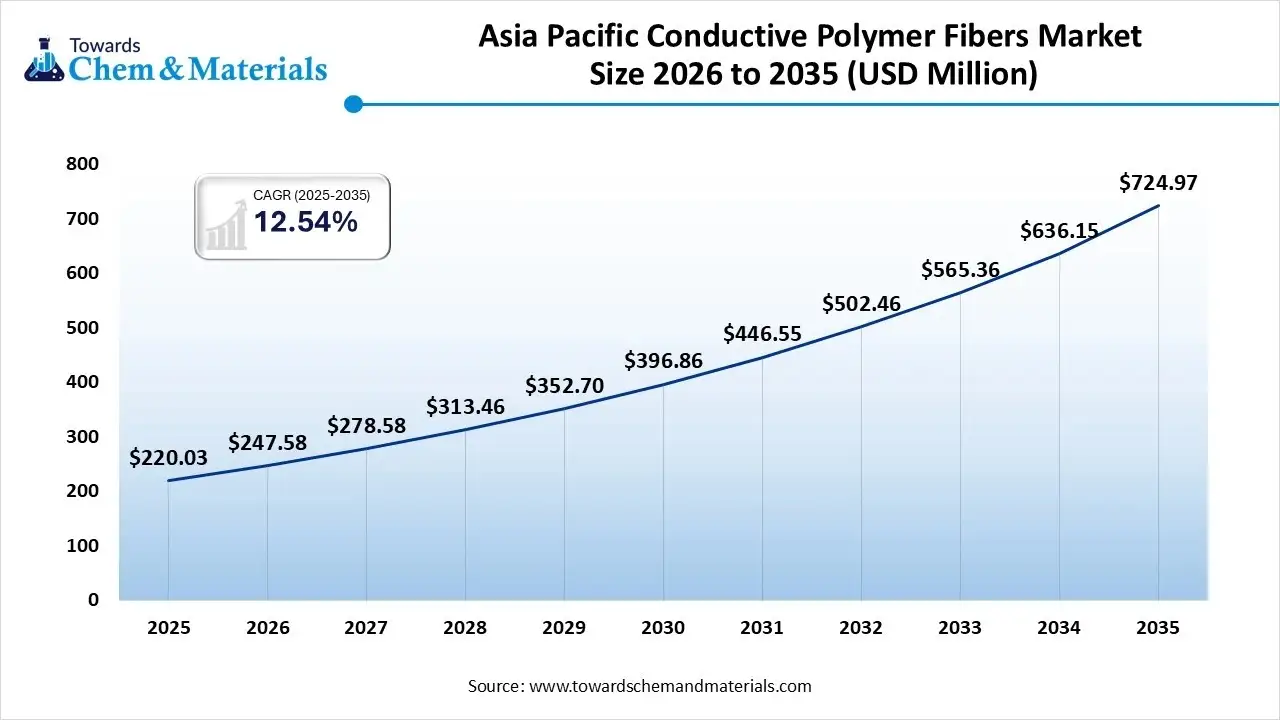
The regional substantial investments in computational materials science enable rapid fibre prototyping for health and automotive applications for domestic and global growth, which sets global standards through vertical supply chains and skilled labor for commercialization and advanced polymer processing.
India Conductive Polymer Fibers Growth Trends
India market shows dynamic growth driven by its emerging convergence of textile infrastructure with AI-driven materials research. The strong government supported by strategic initiatives that focus on self-reliance and technology-driven production, especially in healthcare and defence textiles. The region is shifting towards real-time monitoring by utilising Industry 4.0 technologies for cost-effective, environmentally friendly production to meet stringent environmental standards.
North America dominated the conductive polymer fibers market with the largest revenue share of 20.00% in 2025.The growth is due to the cooperation between innovation through Silicon Valley's expertise and advanced aerospace material science. The region is blending AI and machine learning to develop resilient smart textiles for medical and defence uses by offering molecular precision and an integrated communication system. The region continuous growth fuel by venture capital and federal support to scale discoveries into industrial products. Additionally, integrating edge computing for advanced human-machine interfaces solidifies regional development.
U.S. Conductive Polymer Fibers Growth Trends
The U.S. market is characterized by molecular engineering using AI. The domestic growth in advanced manufacturing for producing fibers with near-metallic conductivity and mechanical resistance is boosting the adoption. The technological shift is pushing its application in aerospace, defense, and healthcare, emphasising sustainability and autonomous quality control for resilient applications.
 Europe Conductive Polymer Fibers Growth Trends
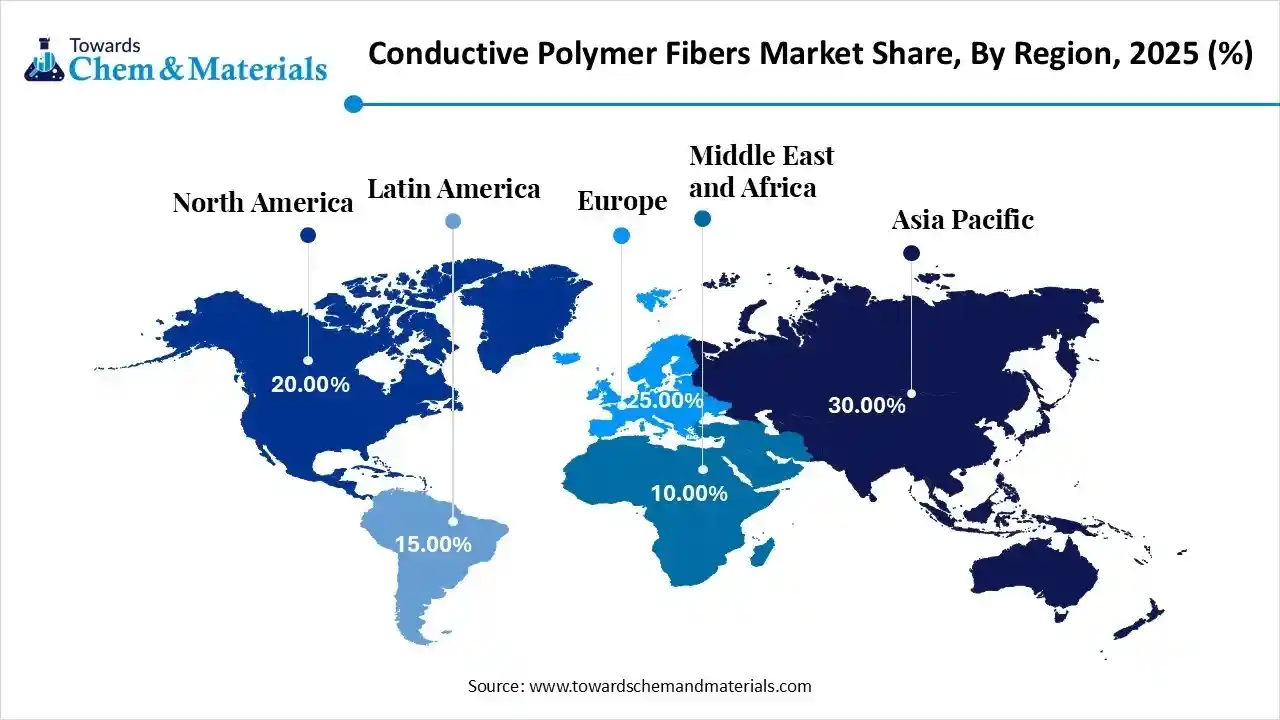
Europe dominated the conductive polymer fibers market with the largest revenue share of 25.00% in 2025. Europe market shows notable growth, driven by its global standard in precision and regulation-driven innovation, using AI to develop sustainable, high-performance fibers with superior electrical output. The region focuses on bio-based polymers and closed-loop manufacturing for clinical-grade medical textiles and automotive interiors by providing mechanical longevity and durability. The region is promoting circular economy principles and recyclability that driving safe and ecologically responsible infrastructure.
Conductive Polymer Fibers Market Share, By Regional, 2025 (%)
| Region | Revenue Share, 2025 (%) |
| Asia Pacific | 30.00% |
| Europe | 25.00% |
| North America | 20.00% |
| Latin America | 15.00% |
| Middle East & Africa | 10.00% |
Germany Conductive Polymer Fibers Growth Trends
Germany market leads in high-precision engineering with AI-driven synthesis of high-purity polymers and a regulatory framework. The region's innovation towards high-purity polymers is driving its demand in automotive electrification and skin-based biosensor applications. Additionally, the region is advancing organic electronics and recyclable fibres under Industry 4.0 by promoting environmental sustainability and industrial durability.
Recent Developments
- In September 2025, TripleW and Sulzer successfully launched the first commercial-scale production of PLA derived from food waste. This launch support waste-to-fiber breakthrough is a crucial step towards sustainable manufacturing for the circular economy.(Source: www.sulzer.com)
- In February 2025, Loomia Technologies and the Advanced Functional Fabrics of America announced strategic partnership on specialized heated fabric known as Gento Heater. The collaboration and product are designed for ultra-cold environments utilizing advanced flexible electronics.(Source: textiletechsource.com)
Top Players in the Conductive Polymer Fibers Market and Their Offering
- Chromatic Technologies Inc: The global company that focuses on smart colour-changing and functional fibers especially for safe and consumer goods.
- OliKrom: The company offer smart fibers that respond to environmental incentives such as temperature and pressure
- LCR Hallcrest
- Eeonyx
- Heraeus Holdings
- Agfa-Gevaert
- Matsui International
- BASF SE
- Solvay
- Ranbar Pigment
- 3M Company
Segment Covered in the Report
By Material Type
- Polyaniline (PANI) Fibers
- Polypyrrole (PPy) Fibers
- Poly(3,4-ethylenedioxythiophene) (PEDOT) Fibers
- Composite Conductive Fibers
By Application
- Smart Textiles & Wearable Electronics
- Antistatic & ESD Protection Fabrics
- EMI Shielding & Conductive Composites
- Heating & Energy Storage Textiles
- Sensors & Biomedical
- Other Applications
By Region
- North America
- U.S.
- Canada
- Mexico
- Europe
- Germany
- UK
- France
- Italy
- Spain
- Asia Pacific
- China
- India
- Japan
- South Korea
- Latin America
- Brazil
- Argentina
- Middle East & Africa
- Saudi Arabia
- South Africa
FAQ's
Question 1 : What is the current market size and growth forecast for the Conductive Polymer Fibers market?
Answer : The global Conductive Polymer Fibers market was valued at USD 1,835.37 million in 2025 and is expected to grow at a CAGR of 12.52%, reaching USD 1,835.37 million by 2035.
Question 2 : What are the key drivers of growth in the Conductive Polymer Fibers market?
Answer : The growth of the Conductive Polymer Fibers market is driven by innovation in smart textiles, rising demand for wearable electronics, and investments in sustainable and eco-friendly materials.
Question 3 : Who are the leading companies operating in the Conductive Polymer Fibers market?
Answer : Leading companies in the Conductive Polymer Fibers market include Chromatic Technologies Inc., OliKrom, LCR Hallcrest, Eeonyx, Heraeus Holdings, and BASF SE.
Question 4 : How are regulatory changes impacting the Conductive Polymer Fibers market?
Answer : Regulatory changes, such as REACH, RoHS, and environmental standards in various regions, are pushing manufacturers towards sustainable production and eco-friendly materials in the Conductive Polymer Fibers market.
Meet the Team

Saurabh Bidwai
Principal Consultant
Saurabh Bidwai, a B.Tech Chemical Engineering graduate with 4+ years of experience, specializes in specialty chemicals, commodity chemicals, and engineered materials, offering valuable insights into market trends and emerging opportunities.

Aditi Shivarkar
Reviewed By
Aditi Shivarkar, with 14+ years in Chemical and Materials market research, specializes in Chemical and Materials. She ensures accurate, actionable insights, driving Towards Chemicals And Materials Analytics and Consulting excellence in industry trends and sustainability.