
Construction Chemicals Market : Driving the Future of Smart and Sustainable Construction
The global Construction Chemicals market, valued at USD 80.40 billion in 2026, is projected to reach USD 145.97 billion by 2035, growing at a CAGR of 6.85%. Driven by rapid urbanization, infrastructure expansion, and rising demand for residential construction, the market is propelled by concrete admixtures, waterproofing chemicals, and protective coatings. Asia Pacific dominates with a 46% market share, followed by North America. The market is evolving with sustainability trends, leading to eco-friendly, low-VOC, and energy-efficient building materials. Innovations in advanced additives, repair solutions, and coatings are fueling growth, particularly in the infrastructure and residential sectors.
Content
Construction Chemicals Market Size, Share, Growth, Report 2026 to 2035
The global construction chemicals market size was estimated at USD 75.25 billion in 2025 and is expected to be worth around USD 145.97 billion by 2035, growing at a CAGR of 6.85% from 2026 to 2035. In terms of volume, the Construction Chemicals market is projected to grow from 97.00 million tons in 2025 to 163.18 million tons by 2035. growing at a CAGR of 5.95% from 2026 to 2035. The growth of the market is driven by rapid global urbanization, massive infrastructure development, and increasing residential construction demand.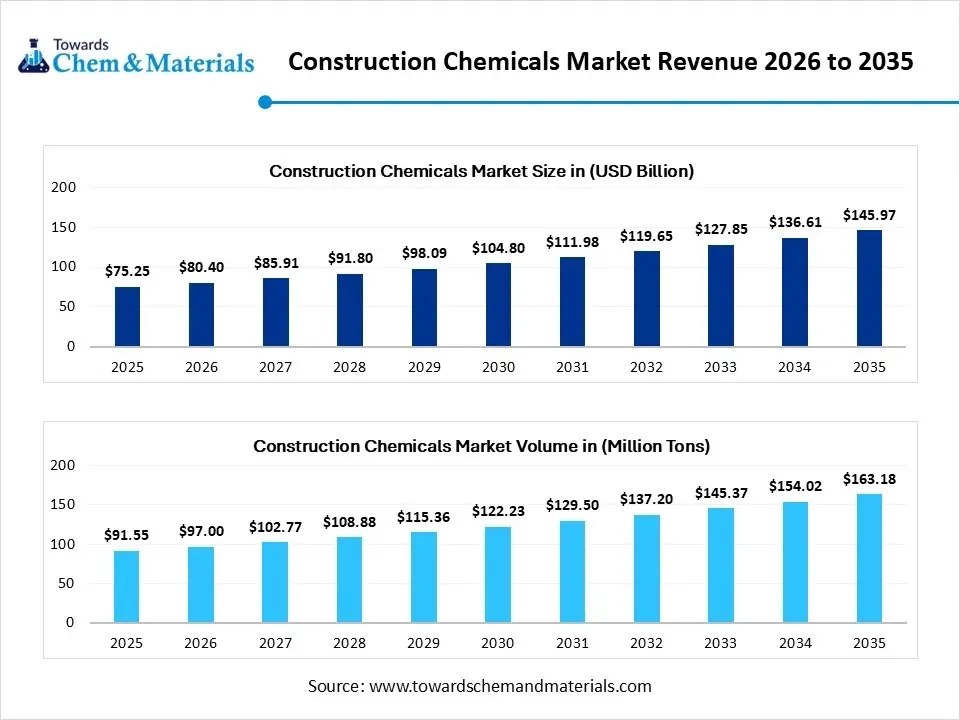
Market Highlights
- By region, Asia Pacific dominated the market with a share of 46% in 2025 and is expected to sustain its position while growing with a CAGR of 7.5% in the forecast period.
- By region, North America held the market share of 18% in 2025.
- By product type, the concrete admixtures segment dominated the market with 38% share in 2025.
- By product type, the waterproofing chemicals segment held 20% market share in 2025 and is expected to have the fastest growth with a CAGR of 7.4% in the forecast period.
- By application, the residential construction segment dominated the market with 42% share in 2025.
- By application, the infrastructure segment held 20% market share in 2025 and is expected to have the fastest growth with a CAGR of 7.5% in the forecast period.
- By end-use industry, the buildings segment dominated the market with 55% share in 2025.
- By end-use industry, the infrastructure segment held 30% market share in 2025 and is expected to have the fastest growth with a CAGR of 7.6% in the forecast period.
- By form, the liquid segment dominated the market with 46% share in 2025 and is expected to have the fastest growth with a CAGR of 6.9% in the forecast period.
Construction Chemicals Market Size and Forecast
- Market Estimated Size (2025): USD 75.25 Billion | CAGR (2026–2035): 6.85%
- Market Projected Size (2035): USD 145.97 Billion
- Market Volume (2025): 91.55 Million Tons | Volume CAGR (2026–2035): 5.95%
- Market Projected Volume (2035): 91.55 Million Tons
- Market Pricing (2025):
- Average Manufacturing Price (2025): USD 620 per ton
- Average Selling Price (2025): USD 880 per ton
- Pricing CAGR (2025–2035): 3.25%
Market Overview
What Is The Significance Of The Construction Chemicals Market?
The construction chemicals market is essential for improving the durability, strength, and sustainability of modern infrastructure while accelerating construction speeds. These specialty products, such as concrete admixtures, waterproofing, and protective coatings, ensure structural longevity, reduce maintenance costs, and enable faster completion times, particularly for residential and infrastructure projects. Concrete admixtures reduce water content and increase strength and workability, crucial for high-rise buildings.
Construction Chemicals Market Growth Trends:
- Infrastructure Growth & Repair: Rapid expansion in residential and infrastructure sectors is fueling demand for high-performance protective, repair, and rehabilitation chemicals.
- Technological Advancements: Growing utilization of intelligent coatings, such as Nano-Coating and fire-protection coatings, to enhance structural durability.
- Sustainability & Green Chemicals: Increasing adoption of low-VOC sealants, eco-friendly concrete additives, and bio-based membranes to meet green building certifications.
Report Scope
| Report Attribute | Details |
| Market Size and Volume in 2026 | USD 80.40 Billion / 97.00 Million Tons |
| Revenue Size and Volume Forecast in 2035 | USD 145.97 Billion / 163.18 Million Tons |
| Growth Rate | CAGR 6.85% |
| Forecast Period | 2026 - 2035 |
| Base Year | 2025 |
| Dominant Region | Asia Pacific |
| Segment Covered | By Product Type, By Application, By End-Use Industry, By Form, By Regions |
| Key companies profiled |
BASF SE, Saint-Gobain, Fosroc International Ltd, RPM International Inc, Pidilite Industries Ltd, JSW, MAPEI S.p.A., Sika AG, Ashland, 3M, Arkema, Evonik Industries, Henkel AG & Co. KGaA, Dow, Thermax Limited, Saint-Gobai,Wacker Chemie AG. |
Key Technological Shifts In The Construction Chemicals Market:
The construction chemicals market is experiencing a significant technological transformation, shifting from basic additives toward high-performance, intelligent, and sustainable solutions. Driven by rapid urbanization, infrastructure modernization, and stringent environmental regulations, key technological shifts focus on enhancing durability, reducing carbon footprints, and enabling smarter construction practices. Sustainability is the primary driver of innovation, transitioning from regulatory compliance to a competitive necessity.
Supply Chain Analysis of Construction Chemicals Market:
Chemical Production & Formulation
- Construction chemicals are produced through the formulation of admixtures, sealants, waterproofing agents, adhesives, and protective coatings to enhance the durability, strength, and performance of construction materials.
- Key players: Sika, BASF, Fosroc, MAPEI
Quality Testing and Certification
- Construction chemicals must comply with performance standards, environmental regulations, and safety certifications for structural integrity and long-term durability.
- Key players: International Organization for Standardization, ASTM International, Bureau of Indian Standards, European Chemicals Agency
Distribution to Industrial Users
- Construction chemicals are supplied to infrastructure developers, residential and commercial construction projects, industrial facilities, and renovation and repair sectors.
- Key players: Sika, Fosroc, MAPEI.
Construction Chemicals Regulatory Landscape: Global Regulations
| Country / Region | Regulatory Body | Key Regulations | Focus Areas | Notable Notes |
| United States | Environmental Protection Agency (EPA); Occupational Safety and Health Administration (OSHA) | Clean Air Act; Toxic Substances Control Act (TSCA); OSHA Hazard Communication Standard | VOC emissions, worker safety, and chemical handling | The U.S. regulates construction chemicals (admixtures, sealants, coatings) with strict emission limits and safety standards, driving the adoption of low-VOC and eco-friendly materials. |
| European Union | European Commission; European Chemicals Agency (ECHA) | REACH Regulation; CLP Regulation; Construction Products Regulation (CPR) | Chemical registration, sustainability, product certification | The EU enforces stringent environmental and safety standards, promoting sustainable construction chemicals and CE-certified materials. |
| China | Ministry of Ecology and Environment (MEE); Ministry of Housing and Urban-Rural Development (MOHURD) | Environmental Protection Law; Green Building Standards | Emissions control, green construction | China is increasingly regulating construction chemicals to support green building initiatives and reduce environmental impact. |
| India | Ministry of Environment, Forest and Climate Change (MoEFCC); Bureau of Indian Standards (BIS) | Environment Protection Act; BIS Standards; Green Building Codes | Sustainable construction, quality compliance | India is promoting eco-friendly construction chemicals aligned with infrastructure growth and smart city initiatives. |
| Japan | Ministry of Land, Infrastructure, Transport and Tourism (MLIT) | Building Standards Act; Chemical Substances Control Law (CSCL) | Structural safety, material performance | Japan enforces strict standards for durability, seismic resistance, and high-performance construction materials. |
| Germany | Federal Environment Agency (UBA); Deutsches Institut für Normung (DIN) | DIN Standards; EU Green Building Regulations | Sustainable construction, emissions reduction | Germany leads in sustainable construction practices, emphasizing low-carbon and high-performance chemical formulations. |
Market Dynamics
Drivers
What are the Key Growth Drivers of the Construction Chemicals Market?
Key growth drivers of the construction chemicals market include rapid urbanization, increasing infrastructure investment (highways, bridges), and the urgent need for sustainable, eco-friendly building materials. Key drivers are often synonymous with "market catalysts," "industry boosters," and "growth factors," including rising demand for concrete durability, waterproofing, and repair, particularly in high-growth regions like Asia-Pacific.
Restrains
What are the Key Growth Restraints of the Construction Chemicals Market?
Key growth restraints in the construction chemicals market include high price volatility of raw petrochemical materials (acrylics, epoxy resins), strict government regulations regarding VOC emissions, lack of trained professionals, and high product costs limiting adoption in developing regions. These constraints often cause smaller contractors to revert to traditional methods, hampering premium product growth.
Opportunities
What are the Key Growth Opportunities of the Construction Chemicals Market?
Key growth opportunities in the construction chemicals market include rising demand for sustainable, green, and low-VOC products, along with advancements in smart, IoT-enabled, and self-healing materials. Accelerated urbanization, infrastructure development (bridges, highways, smart cities), and specialized admixtures for increased durability are driving market expansion.
Segmental Insights
Product Type Insights
The Concrete Admixtures Segment Dominated The Market With 38% Market Share In 2025
The concrete admixtures segment dominated the market with 38% share in 2025, driven by rapid urbanization, infrastructure development, and demand for durable, high-performance concrete. This segment dominates the construction chemicals industry. Increasing use of Ready-Mix Concrete (RMC) and the need for specialized properties such as high strength, durability, and improved workability drive the adoption of specifically, water reducers and superplasticizers.
The waterproofing chemicals segment held 20% market share in 2025 and is expected to experience the fastest growth, with a CAGR of 7.4% over the forecast period, driven by rapid urbanization, infrastructure expansion, and stricter building codes. Demand is shifting toward performance-engineered, high-durability systems that prevent water damage and extend service life, particularly in the Asia Pacific.
The protective coatings segment held 14% market share in 2025, driven by rising infrastructure projects, urbanization, and the need for durability, these coatings are essential for corrosion protection in bridges, commercial buildings, and industrial structures, with epoxy-based solutions leading the market. There is a surge in demand for specialized coatings that offer corrosion resistance, water resistance, and UV protection to protect assets in harsh environments.
Application Insights
The Residential Construction Segment Dominated The Market With 42% Market Share In 2025
The residential construction segment dominated the market with 42% share in 2025, driven by rapid urbanization, rising housing demand, and a shift toward sustainable, high-performance building materials. Valued for increasing durability and energy efficiency, key products like waterproofing, adhesives, and concrete admixtures are in high demand. Use of concrete admixtures and integral waterproofing is crucial for improving structural longevity and performance in modern homes.
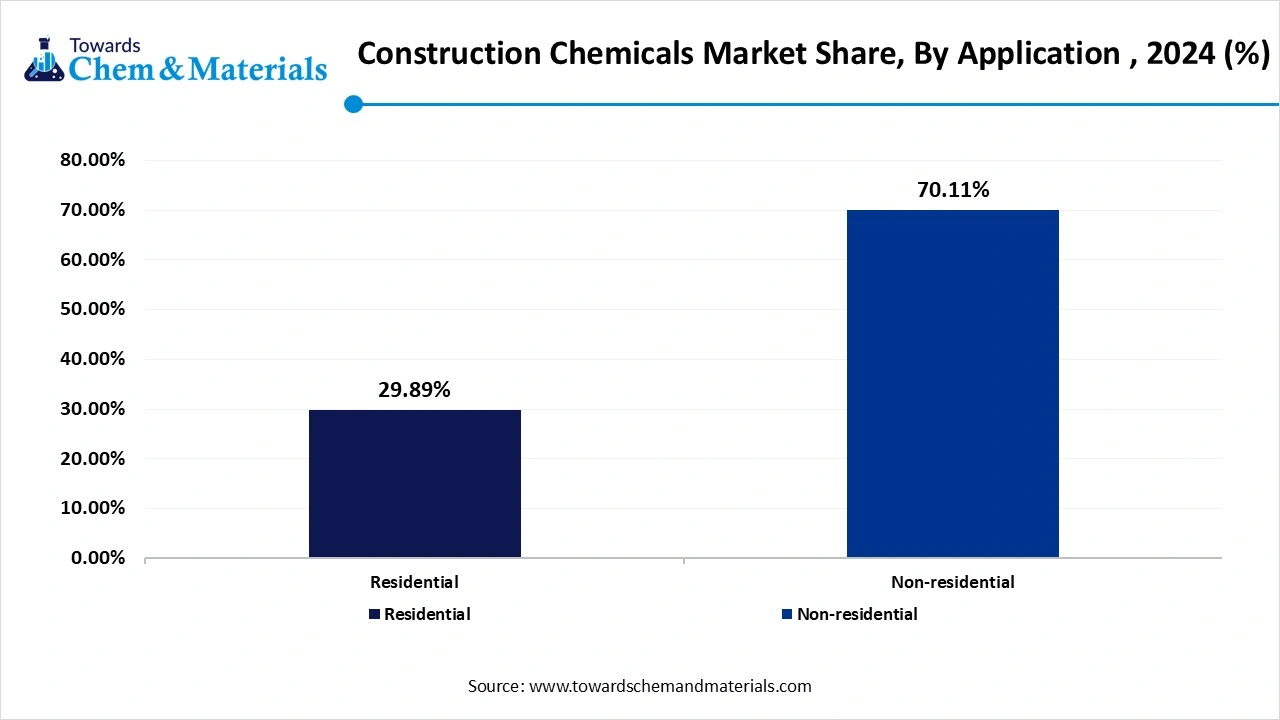
The commercial construction segment held 23% market share in 2025, driven by rapid urbanization, increased investment in smart cities, and a demand for high-performance, sustainable buildings. Non-residential, including commercial, projects are dominating demand through infrastructure expansion and renovation, with specialized chemicals enhancing durability, efficiency, and environmental performance.
The infrastructure segment held 20% market share in 2025 and is expected to experience the fastest growth, with a CAGR of 7.5% over the forecast period. This surge is propelled by rapid urbanization, massive government investment in projects like roads, bridges, and smart cities, and the need for enhanced durability in structures, particularly in developing regions like Asia-Pacific. Infrastructure projects necessitate advanced chemicals to ensure longevity and resist environmental stressors.
Construction Chemicals Market Share, By Application, 2025 (%)
| By Application | Revenue Share, 2025 (%) |
| Residential Construction | 42% |
| Commercial Construction | 23% |
| Industrial Construction | 15% |
| Infrastructure | 20% |
End-Use Industry Insights
The Buildings Segment Dominated The Market With 55% Market Share In 2025
The buildings segment dominated the market with 55% share in 2025, driven by rapid urbanization, rising disposable income, and government housing initiatives. Increasing population migration to cities fuels demand for housing and, subsequently, for protective coatings, sealants, and concrete admixtures that ensure building durability.
The infrastructure segment held 30% market share in 2025 and is expected to experience the fastest growth, with a CAGR of 7.6% over the forecast period. Driven by massive public/private investment in roads, bridges, tunnels, and metro systems, the sector relies heavily on concrete admixtures, waterproofing, and protective coatings to enhance durability and accelerate construction schedules.
The industrial segment held 15% market share in 2025. Growth is fueled by large-scale projects, including industrial facilities, smart cities, and infrastructure development, which demand high-performance concrete admixtures, waterproofing, and protective coatings. Developing regions are witnessing high rates of industrial construction, which drives the demand for specialized additives and concrete technologies.
Form Insights
The Liquid Segment Dominated The Market With 46% Market Share In 2025
The liquid segment dominated the market with 46% share in 2025 and is expected to experience the fastest growth, with a CAGR of 6.9% over the forecast period, driven by the demand for high-performance, durable, and sustainable concrete in infrastructure. Liquid water-reducing agents, accelerators, and superplasticizers are essential for improving workability and strength, with admixtures representing a key high-growth product category.
The powder segment held 38% market share in 2025, driven by convenience, consistent quality, and ease of transport. The increasing use of precast modules and concrete panels requires specialized adhesive and grout powders to ensure strong, durable joints. This growth is spurred by rapid urbanization, rising infrastructure projects, and a shift toward sustainable, high-performance, and ready-to-use materials in residential and commercial sectors.
The paste segment held 16% market share in 2025, driven by high demand for repair mortars, tile adhesives, and advanced waterproofing solutions. This growth is heavily supported by the increasing renovation and rehabilitation of aging infrastructure, along with a shift toward precast, modular construction requiring high-performance bonding agents.
Regional Insights
How did Asia Pacific Dominate the Construction Chemicals Market in 2025?
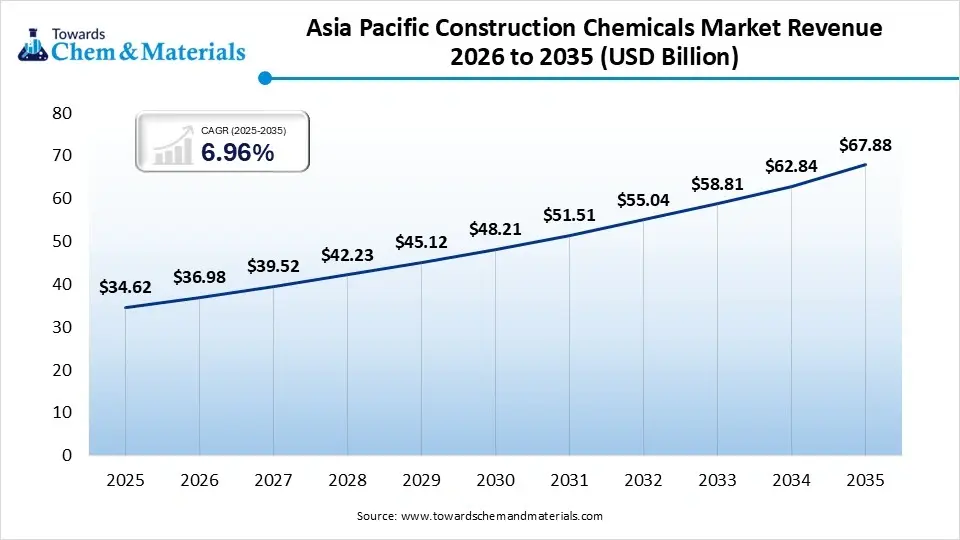
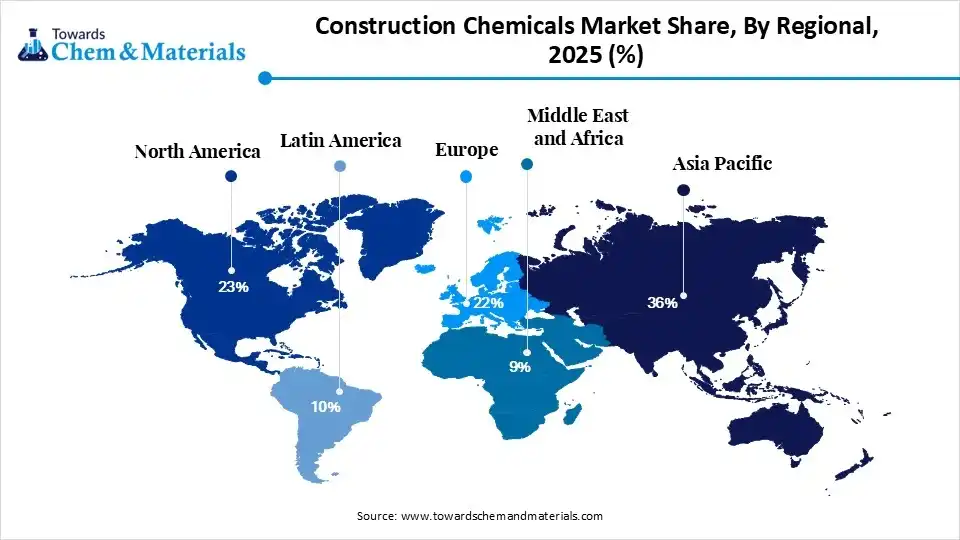
Asia Pacific dominated the market with a share of 46% in 2025 and is expected to sustain its position while growing with a CAGR of 7.5% in the forecast period, driven by massive infrastructure expansion, rapid urbanization, and high-volume residential projects in China and India. Key factors included government-backed smart city initiatives, rising demand for high-performance waterproofing and concrete admixtures, and the adoption of green building materials. Major investments in smart city projects, such as India's Smart Cities Mission and massive urban renewal projects in China, stimulated market demand
India Construction Chemicals Market Growth Factor
The Indian construction chemicals market is experiencing robust growth, driven by massive infrastructure investments, rapid urbanization, and increasing demand for durable, sustainable building materials. Key drivers include the Smart Cities Mission, AMRUT, and PMAY housing schemes, which increase the need for waterproofing, concrete admixtures, and protective coatings. Increasing awareness of sustainability has boosted the adoption of low-VOC (volatile organic compound) coatings, eco-friendly membranes, and thermal insulation products.
North America Construction Chemicals Market Growth Factor
North America held the market share of 18% in 2025, driven by federal infrastructure spending, rising demand for sustainable "green" building materials, and rapid adoption of advanced concrete admixtures and precast construction methods. Strict environmental regulations in regions like California, Washington, and British Columbia are accelerating the shift toward eco-friendly products, including low-carbon binders, sustainable coatings, and waterproofing systems.
U.S. Construction Chemicals Market Growth Factor
The U.S. construction chemicals market is driven by aging infrastructure repair, high home-improvement spending, and strict, eco-friendly building regulations. Key growth factors include rising demand for durable concrete admixtures, waterproofing systems, and sustainable, energy-efficient materials. The surge in prefabrication techniques requires specialized adhesives, coatings, and sealants to enhance efficiency in construction. Massive investments in roads, bridges, and infrastructure resilience against climate change are fueling demand.
Recent Developments
- In April 2026, Bigbloc Construction launched a new chemicals unit in Umargaon, Gujarat, to produce tile adhesives, wall putty, and waterproofing solutions. This strategic move leverages synergies with their core AAC block business to provide a comprehensive range of sustainable building materials(Source:www.whalesbook.com)
- In August 2025, Ramco Cements launched "Hard Worker," a new brand portfolio featuring 20 specialized construction chemical products, aiming to become a comprehensive "Construction Solution Provider". The company targets ₹2,000 crore in revenue within 4-5 years by leveraging its existing distribution network for a pan-India rollout of waterproofing, tiling, and repair products.(Source: www.icicidirect.com)
Top Companies List
- BASF SE: BASF provides a wide range of construction chemicals, including admixtures, waterproofing solutions, and performance additives under its Master Builders Solutions portfolio. The company emphasizes innovation and sustainability.
- Saint-Gobain: Saint-Gobain offers construction chemicals through its building materials division, including mortars, sealants, and insulation materials, with a strong focus on energy-efficient buildings.
- Fosroc International Ltd.: Fosroc specializes in concrete and cement additives, protective coatings, and repair solutions, serving infrastructure and industrial construction sectors.
- RPM International Inc.: RPM provides construction chemicals such as sealants, coatings, and roofing systems through its subsidiaries, targeting infrastructure and commercial construction.
- Pidilite Industries Ltd.: Pidilite is a key player in India, known for adhesives, waterproofing products, and construction chemicals widely used in residential and commercial projects.
Other Top Players Are
- JSW
- MAPEI S.p.A.
- Sika AG
- Ashland
- 3M
- Arkema
- Evonik Industries
- Henkel AG & Co. KGaA
- Dow
- Thermax Limited.
- Saint-Gobain
- Wacker Chemie AG
Segments Covered
By Product Type
- Concrete Admixtures
- Water Reducers
- Plasticizers
- Superplasticizers
- Accelerators
- Retarders
- Air Entraining Agents
- Water Reducers
- Waterproofing Chemicals
- Membrane Systems
- Sheet Membranes
- Liquid Applied Membranes
- Integral Waterproofing Compounds
- Membrane Systems
- Protective Coatings
- Epoxy Coatings
- Polyurethane Coatings
- Acrylic Coatings
- Adhesives & Sealants
- Tile Adhesives
- Construction Sealants
- Silicone Sealants
- Polyurethane Sealants
- Repair & Rehabilitation
- Concrete Repair Mortars
- Structural Strengthening Systems
- Fiber Reinforced Polymers (FRP)
- Flooring Compounds
- Epoxy Flooring
- Cementitious Flooring
- Grouts & Anchors
- Cementitious Grouts
- Resin-based Grouts
By Application
- Residential Construction
- New Housing
- Renovation & Repair
- Commercial Construction
- Offices
- Retail Spaces
- Hospitality
- Industrial Construction
- Manufacturing Units
- Warehouses
- Infrastructure
- Roads & Highways
- Bridges
- Tunnels
- Airports
By End-Use Industry
- Buildings
- Residential Buildings
- Commercial Buildings
- Infrastructure
- Transportation Infrastructure
- Energy Infrastructure
- Industrial
- Manufacturing
- Oil & Gas Facilities
By Form
- Liquid
- Powder
- Paste
FAQ's
Question 1 : What is the projected market size and growth rate for the Construction Chemicals industry through 2035?
Answer : The global construction chemicals market is projected to reach USD 145.97 billion by 2035, growing at a CAGR of 6.85% from its 2026 valuation of USD 80.40 billion, with a forecasted volume of 163.18 million tons.
Question 2 : Which product segments and regions are leading the growth in the construction chemicals market?
Answer : The concrete admixtures segment dominates the market with a 38% share, while the waterproofing chemicals segment is expected to grow the fastest at a 7.4% CAGR; geographically, the Asia Pacific region leads with a 46% share, driven by massive infrastructure expansion in China and India.
Question 3 : Who are the key players and leading companies in the global Construction Chemicals market?
Answer : The market\'s top players include industry leaders such as BASF SE, Sika AG, Saint-Gobain, Fosroc International Ltd, and Pidilite Industries Ltd, alongside major specialized firms like MAPEI S.p.A., RPM International Inc, and Dow.
Question 4 : What exactly are construction chemicals?
Answer : They are specialized chemical formulations used in construction to improve the performance, durability, and protection of structures. Common examples include concrete additives, waterproofing membranes, and protective coatings.
Question 5 : How does green building affect this market?
Answer : Green building codes require materials to have low emissions and a lower carbon footprint. This has forced the industry to develop intelligent coatings and sustainable concrete additives that use fewer resources and don\'t release harmful gases (VOCs) into the air.
Meet the Team

Saurabh Bidwai
Principal Consultant
Saurabh Bidwai, a B.Tech Chemical Engineering graduate with 4+ years of experience, specializes in specialty chemicals, commodity chemicals, and engineered materials, offering valuable insights into market trends and emerging opportunities.

Aditi Shivarkar
Reviewed By
Aditi Shivarkar, with 14+ years in Chemical and Materials market research, specializes in Chemical and Materials. She ensures accurate, actionable insights, driving Towards Chemicals And Materials Analytics and Consulting excellence in industry trends and sustainability.