
Copper Wire & Cable Market Size, Share & Trends Analysis Report by 2026-2035
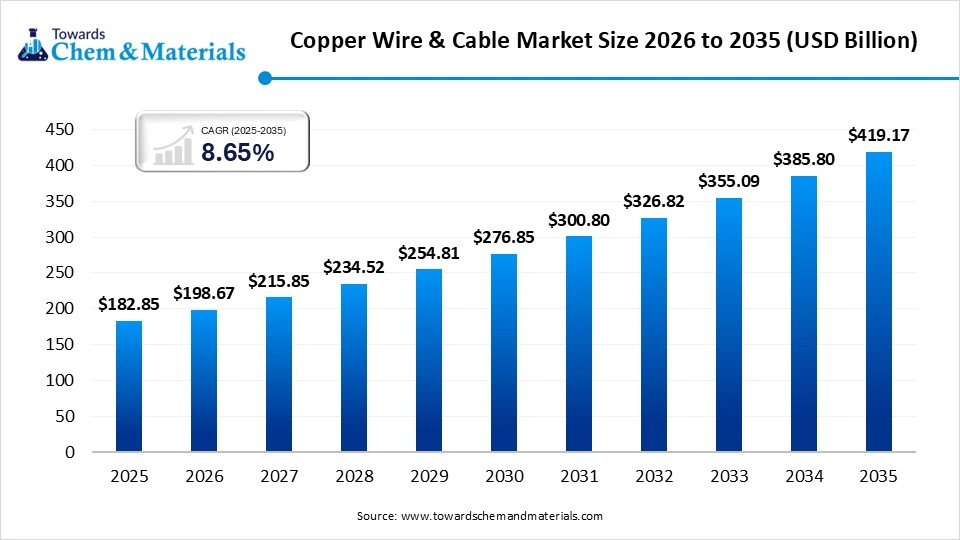
The global copper wire & cable market size is expected to grow from USD 198.67 billion in 2026 to USD 419.17 billion in 2035, growing at a CAGR of 8.65% from 2026 to 2035. The top key players in the market are Prysmian Group, Nexans SA, Sumitomo Electric, Aviva Metals, Belden, Inc., CommScope Holding Company, Inc., Elcowire Group AB, Hitachi Metals Ltd, Nexans SA, Ningbo Jintian Copper Co., Ltd., Prysmian Group, Schneider Electric SE, Tongling Jingda Special Magnet Wire Co Ltd.
Content
Copper Wire & Cable Market Size, Share, Growth and Forecast 2026-2035
The global copper wire and cable market size was estimated at USD 182.85 billion in 2025 and is expected to increase from USD 198.67 billion in 2026 to USD 419.17 billion by 2035, growing at a CAGR of 8.65% from 2026 to 2035. Asia Pacific dominated the copper wire and cable market with the largest revenue share of 44.00% in 2025.The growth is driven by rapid urbanization, technological advancement, resource sustainability, and an expanding automotive and energy transition ecosystem. The copper wire & cable market is vital to modern development, serving as the pillar of urban infrastructure, energy, and digital communication. The copper's conductivity and thermal efficiency are important for power transmission due to its ductility and strength, which position it to be drawn into fine filaments. The industry is focused on global energy transition, where copper is crucial to renewable energy and automotive electrification, from electric vehicle wiring to subsea cables connecting wind farms. Additionally, copper's recyclability and energy efficiency accelerate the adoption of the market as the most sustainable choice for a low- carbon future and modern telecommunication infrastructure.
Market Highlights
- By region, Asia Pacific dominated the market in 2025 due to significant regional investment and urbanization.
- By region, North America is expected to grow at the fastest CAGR from 2026 to 2035 due to the regulatory framework and investment in renewable energy infrastructure.
- By insulation material, the polyvinyl chloride (PVC) segment held the largest in the market in 2025 due to its dielectric strength, mechanical and chemical inertness.
- By insulation material, the cross-linked polyethylene (XLPE) segment is expected to grow at the fastest CAGR during the forecast period due to thermal resistance, moisture resistance and reliability.
- By voltage type, the low-voltage (LV) segment dominated the market, driven by its demand for commercial, residential and industrial use that offers operational reliability.
- By voltage type, the medium voltage (MV)segment is expected to grow at the fastest CAGR in the market during the forecast period due to its industrial application in smart grids and operational stability.
- By application, the building and construction segment dominated the market due to demand for modern green buildings and focus on sustainability.
- By application, the power distribution segment is anticipated to grow at the fastest CAGR in the market during the forecast period due to shift towards decarbonization and energy-efficient power systems.
Trade Analysis of the Copper Wire & Cable Market: Import and Export Statistics
- Vietnam exported 157,035 shipments of copper wire and cable.
- China exported 51,038 shipments of copper wire and cable.
- South Korea exported 37,794 shipments of copper wire and cable.
- From July 2024 to June 2025, the world exported 121,577 shipments of copper wire and cable.
Market Trends
- Growth of Energy Transition Infrastructure: The shift towards decarbonized power and renewable installation in wind and solar power systems in high-capacity submarine cables and interconnectors is driving this trend in energy generation.
- Focus on Material Science and Insulation: The focus on technologically advanced polymers like XLPE, LSZH materials that offer operational longevity, fire safety and environmental stability.
- The Automotive Transformation: The automotive sector is transitioning towards electric vehicles that accelerate the use of copper wiring harness, stator windings, and busbars due to its ability to support high-voltage power distribution and battery components that drive modern transportation and expansion of DC fast-charging networks.
Key Technological Shifts and AI in the Copper Wire & Cable Market
AI and technological advancement are transforming the market from traditional manufacturing into a precision-driven ecosystem. The shift combining materials science with automated quality control, driving AI-based analytics optimize extrusion and purity, ensuring high electrical and thermal standards.
Smart sensing technologies, including fibre- optic sensors and IoT monitoring, provide real- time tracking and proactive maintenance, reducing renewable grid failures. The upsurge of AI infrastructure and data-driven centers driving demand for high- speed copper interconnects capable of supporting heavy workloads and cooling systems in the digital economy.
Report Scope
| Report Attribute | Details |
| Market Size in 2026 | USD 198.67 Billion |
| Revenue Forecast in 2035 | USD 419.17 Billion |
| Growth Rate | CAGR 8.65% |
| Forecast Period | 2026 - 2035 |
| Base Year | 2025 |
| Dominant Region | Asia Pacific |
| Segment Covered | By Insulation Material, By Voltage Type, By Application, By Region |
| Key companies profiled | Prysmian Group, Nexans SA, Sumitomo Electric, Aviva Metals, Belden, Inc., CommScope Holding Company, Inc., Elcowire Group AB, Hitachi Metals Ltd, Nexans SA, Ningbo Jintian Copper Co., Ltd., Prysmian Group, Schneider Electric SE, Tongling Jingda Special Magnet Wire Co Ltd. |
Copper Wire & Cable Market: Supply Chain Analysis
- Extraction and Refining of Feedstock: The initial stage of extracting copper ore and using electro-refining to produce high-purity cathode for electrical applications. The scrap recovery is also initiated in this stage.
- Key Players: Codelco, Rio Tinto, Glencore, Freeport-McMoRan
- Processing and Manufacturing: The copper cathode is converted into a functional product using continuous casting and wire drawing. The annealing process for heat-treating the wire that offers flexibility and conductivity, and applying insulation like PVC, XLPE.
- Key Players: Nexans, Sumitomo Electric, Southwire Company, Prysmian Group, and Polycab
- End-Use Integration: The stage of finished wire and cables is utilized in power grids, automotive, construction, and telecommunication sectors using specialized logistics that are driven by urbanization and green energy infrastructure.
- Key Players: ABB & Siemens, Adani Green Energy, Amazon, Microsoft, Schneider Electric, Tesla, and Volkswagen
Regulatory Framework: Copper Wire & Cable Market
| Key Region | Key Regulations | Regulatory Focus |
| European Union | CPR (Construction Products Regulation), LVD (Low Voltage Directives), REACH Regulations | Focus on safety and classification of cables based on heat release, flame spread, and smoke acidity mandates for CE marking |
| United States | NEC (National Electrical Code), UL Standards, IEEE | Focus on ampacity, insulation integrity, and the standardized vertical wire flame test to prevent electrical fires in buildings. |
| Asia Pacific | CCC (China Compulsory Certification), GB Standards, BIS (Bureau of Indian Standards), ISI, and CEA Regulations. | Stringent safety and quality standards for the domestic supply of copper wires in household and power systems. Mandatory ISI marking for power and telecommunication cables. |
| International | IEC (International Electrotechnical Commission), ISO Standards | Mandate minimum conductivity levels and harmonize technical specifications for voltage ratings and cable safety. |
Segmental Insights
Insulation Material Insights
Why the Polyvinyl Chloride (PVC)Segment Dominates the Copper Wire & Cable Market?
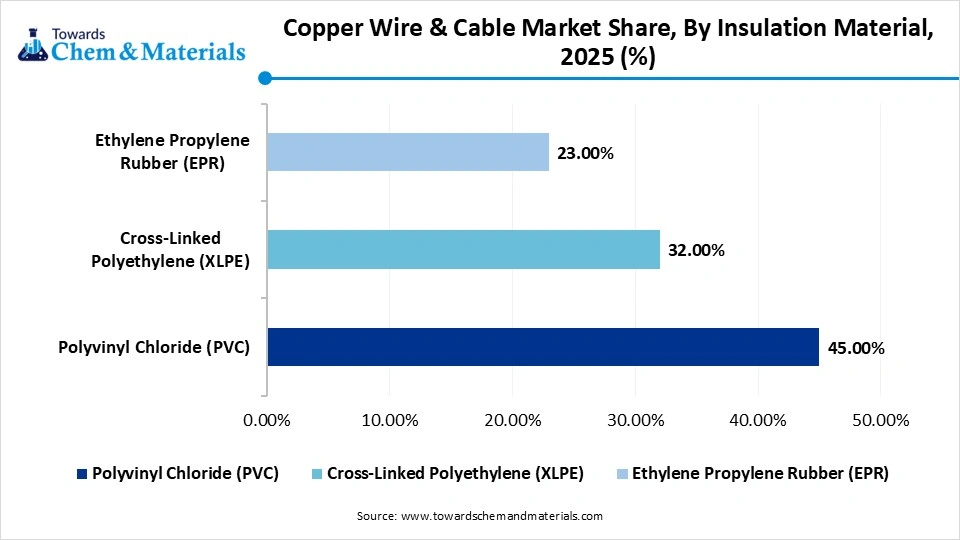
The polyvinyl chloride (PVC) segment dominated the market share 45.00% in 2025, serving as an insulator offering dielectric strength, chemical inertness, and mechanical resilience. It can be engineered as flexible sheathing that shields copper. It is important for safety in residential and industrial wiring, ensuring stability under thermal loads by acting as a flame-retardant thermoplastic. The segment's low maintenance and high processability enable fast extrusion. Additionally, PVC is a cost-effective, durable standard for electrical and telecommunications infrastructure, providing high performance and long-term integrity.
The cross-linked polyethylene (XLPE) segment is the fastest-growing in the market during the forecast period, driven by its ability to resist thermal and mechanical conditions in modern electrification. Its molecular structure is synthesized using a cross-linking process that forms a strong network, avoiding melting during overloads and short-circuit surges, making it key for high voltage applications, especially underground grids and subsea interconnectors. The XLPE offers dielectric strength, low power loss, and moisture resistance, ensuring a reliable, maintenance-free, long-term operational solution, supporting renewable energy and industrial power demands.
Copper Wire & Cable Market Share, By Insulation Material, 2025 (%)
| By Insulation Material | Revenue Share, 2025 (%) |
| Polyvinyl Chloride (PVC) | 45.00% |
| Cross-Linked Polyethylene (XLPE) | 32.00% |
| Ethylene Propylene Rubber (EPR) | 23.00% |
- Polyvinyl Chloride (PVC) (45.00%) Why it dominates: "Accounts for 45.00% of the market, driven by its cost-effectiveness, flexibility, and widespread use across residential, commercial, and industrial wiring applications."
- Cross-Linked Polyethylene (XLPE) (32.00%) Why it is gaining momentum: "Holds 32.00% share, supported by increasing demand for high-performance insulation with superior thermal resistance and durability in power transmission applications."
- Ethylene Propylene Rubber (EPR) (23.00%) Why it is gaining momentum: "Represents 23.00% of the market, driven by its excellent electrical properties and suitability for harsh environmental and industrial conditions."
Voltage Type Insights
How did the Low Voltage (LV) Segment hold the Largest Share in the Copper Wire & Cable Market?
The low voltage (LV) segment held the largest revenue share in the market share 47.00% in 2025. powering residential, commercial, and industrial needs in the market. The expansion is driven by smart technology and urbanization where copper's electrical conductivity and flexibility drive it as a medium for interior wiring, lighting, and user connectivity. The rising surge towards electrification of heating and integration of distributed energy resources requires operational safety and thermal stability that make the LV segment indispensable for efficient and reliable operation amidst digital growth.
The medium voltage (MV) segment is experiencing the fastest growth in the market during the forecast period. vital bridge between high- voltage transmission and domestic end-user networks. The segment is expanding through grid modernization and renewable projects due to the demand for dielectric requirements aligning with technological advancement. Copper's conductivity and toughness are indispensable for operational stability amongst fluctuating loads for industrial automation and heavy-duty applications. Additionally, MV supports smart grids and decentralized power systems in urban infrastructure and industrial manufacturing.
Copper Wire & Cable Market Share, By Voltage Type, 2025 (%)
| By Voltage Type | Revenue Share, 2025 (%) |
| Low Voltage (LV) | 47.00% |
| Medium Voltage (MV) | 31.00% |
| High Voltage (HV) | 22.00% |
- Low Voltage (LV) (47.00%) Why it dominates: "Accounts for 47.00% of the market, driven by extensive use in residential, commercial, and industrial electrical distribution systems with high installation volumes."
- Medium Voltage (MV) (31.00%) Why it is gaining momentum: "Holds 31.00% share, supported by increasing demand in industrial applications and urban power distribution networks."
- High Voltage (HV) (22.00%),Why it is gaining momentum: "Represents 22.00% of the market, driven by expanding power transmission infrastructure and investments in grid modernization projects."
Application Insights
Which Application Dominated the Copper Wire & Cable Market?
The building and construction segment dominated the market share 39.00% in 2025, due to the rising focus on critical electrical infrastructure for urban and modern green buildings. Copper's conductivity and thermal stability ensure safety and energy efficiency, which are essential for durability in wiring, HVAC systems, and lighting infrastructure. The segment ductility and recyclability are supported by smart city initiatives that are integrated with digital connectivity. Overall, the surge towards smart, sustainable engineering aligned with green building standards, boosting the growth of the segment.
The power distribution segment is anticipated to grow fastest in the market during the forecast period. Defined by connecting generation to end- users, transforming with grid modernization to support the integration of renewable energy. Copper's electrical conductivity, thermal efficiency, and resistance minimise losses and ensure reliable, high- capacity energy flow across distribution networks of smart cities. Additionally, the shift toward decarbonization in this segment is gaining momentum by enabling stable, energy- efficient global power systems, resilient against environmental and load stresses.
Regional Insights
The Asia Pacific copper wire & cable market size was valued at USD 80.45 billion in 2025 and is expected to be worth around USD 186.53 billion by 2035, exhibiting at a compound annual growth rate (CAGR) of 8.77% over the forecast period from 2026 to 2035. Asia Pacific dominated the market share 44.00% in 2025, driven by substantial investments in power grids and urban infrastructure expansion with high-volume demand. As the region transitions from fossil fuels to large-scale renewable infrastructure, it necessitates the demand for copper cabling. The strong government initiatives ensure the modernization of electrical networks and operational efficiency to meet industrial safety standards. The rising production for domestic and export markets is driven by regional and international companies. The regional surge for electric vehicle shifts and data hubs is fueling the demand for innovation and advanced components. Overall, the Asia Pacific set standards for fire safety, material quality, and environmental sustainability in cables and wire manufacturing.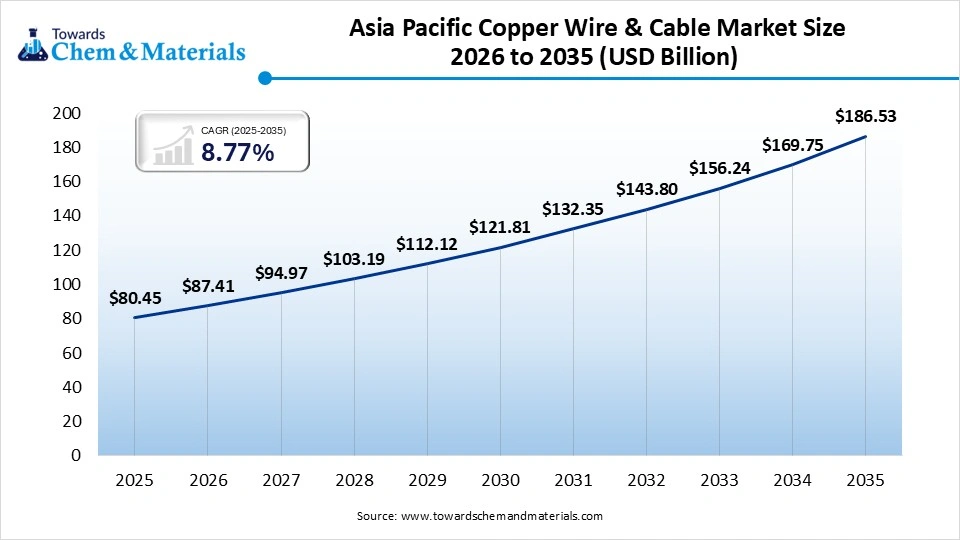
China Copper Wire & Cable Market Growth Trends
China maintain dominance in the market due to its vast production and consumption, with significant investments in ultra-high-voltage lines and automotive electrification. The China Compulsory Certification promotes safety and quality compliance. The major regional players focus on high-purity copper and advanced electronics, driving domestic expansion. As the industry shifts toward green manufacturing and copper recycling, the region is at the forefront in trade events and expanding capacity, reinforcing its leadership in renewable energy and high-speed rail cabling infrastructure
North America is expected to grow at the fastest CAGR in the market during the forecast period, driven by a regulatory framework and private investments in grid modernization and renewable energy infrastructure. The regional stringent regulations emphasize environmental and safety standards, with a focus on fire-resistant materials in building and construction. The supply chain initiative in reshoring and tariffs pushes manufacturers to increase domestic capacity. The rising industrial acquisitions and rising focus on innovations for high-speed data transmission and rural broadband enable the growth. Additionally, North America's energy transition promotes underground cabling and high-efficiency conductors, transforming the competitive landscape in the region.
U.S. Copper Wire & Cable Market Growth Trends
The U.S. market is transforming with national investment in grid upgrades, domestic manufacturing and technological advancement. The regional trade policies include tariffs encouraging onshoring to minimize the dependence on imports. The regulation focuses on safety and reliability through electrical codes, residential projects and certifications. As a U.S. based company, it is shifting towards domestic capacity for high-voltage lines, EV infrastructure, and renewable links, boosting the regional expansion by acquisitions and investments to strengthen local supply chains.
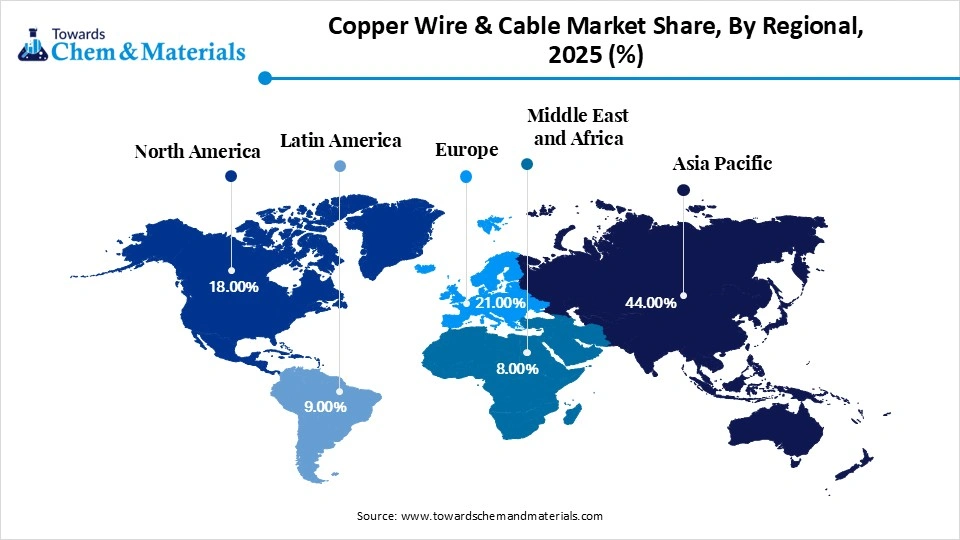
Copper Wire & Cable Market Share, By Regional, 2025 (%)
| Regional | Revenue Share, 2025 (%) |
| North America | 18.00% |
| Europe | 21.00% |
| Asia Pacific | 44.00% |
| Latin America | 9.00% |
| Middle East & Africa | 8.00% |
- Asia Pacific (44.00%) Why it dominates: "Accounts for 44.00% of the market, driven by rapid urbanization, large-scale infrastructure development, and strong demand from construction and power sectors."
- Europe (21.00%) Why it is gaining momentum: "Holds 21.00% share, supported by investments in renewable energy projects and modernization of electrical grid infrastructure."
- North America (18.00%) Why it is gaining momentum: "Represents 18.00% of the market, driven by steady demand in construction, energy, and industrial sectors along with grid upgrade initiatives."
- Latin America (9.00%) Why it is gaining momentum: "Accounts for 9.00% share, supported by expanding electrification projects and infrastructure development."
- Middle East & Africa (8.00%) Why it is gaining momentum: "Captures 8.00% of the market, driven by increasing investments in power generation and transmission infrastructure."
Europe Copper Wire & Cable Market Growth Trends
Europe copper wire & cable market segment accounted for the major revenue share of 21.00% in 2025. Europe's market is driven by a shift toward decarbonization and energy independence that demands offshore wind and cross-border grids. The regional key regulation for construction, fire safety and environmental standards, promoting sustainability through net-zero carbon copper and recycling. Additionally, the regional manufacturers collaborate and invest in high-voltage projects and recyclable insulation innovations. Europe enhances EV infrastructure and focuses on production for high-conductivity and fire-resistant cables.
Germany Copper Wire & Cable Market Growth Trends
Germany market shows notable growth due to the automotive, renewable, and digital sectors. The regional strict regulations focus on eco-friendly, halogen-free products and low-smoke with strategic agreements for grid modernization and offshore wind. The global and domestic supply chain combines to produce wiring for EVs and industry automation. Germany invests in resilience and smart buildings and construction sectors to meet demand for advanced cabling solutions to empower its global presence.
Recent Developments
- In February 2026, Nexans signed a €600 million, 7-year agreement with Enedis for the supply of medium-voltage cables in France. The strategic agreement focuses on the expansion of France's EV network and modernization to boost low-carbon medium-voltage cables.(Source: www.nexans.fr)
- In March 2025, Major Indian market players Adani Enterprises and Birla Groups officially entered the wires and cables business in a high double-digit growth sector. The strategic move focuses on leveraging the presence in the copper industry.(Source: economictimes.indiatimes.com)
Top Companies in the Copper Wire & Cable Market and Their Offerings
- Prysmian Group: The global leader in extra-high voltage submarine cables and flextel copper cables for telecommunication. The industry focuses on large-scale energy transition.
- Nexans SA: The global provider of transmission cables, fire-resistant cables, and specialized copper conductors that focus on copper purity for building, telecommunication, and mining.
- Sumitomo Electric: The leader in high-voltage DC technology and precision electronics that offer ultra-thin electronic wire, semiconductor cables, automotive wire harnesses, and XLPE cables.
- Aviva Metals
- Belden, Inc.
- CommScope Holding Company, Inc.
- Elcowire Group AB
- Hitachi Metals Ltd
- Nexans SA
- Ningbo Jintian Copper Co., Ltd.
- Prysmian Group
- Schneider Electric SE
- Tongling Jingda Special Magnet Wire Co Ltd.
Segment Covered in the Report
By Insulation Material
- Polyvinyl Chloride (PVC)
- Cross-Linked Polyethylene (XLPE)
- Ethylene Propylene Rubber (EPR)
By Voltage Type
- Low Voltage (LV)
- Medium Voltage (MV)
- High Voltage (HV)
By Application
- Building and Construction
- Power Distribution
- Telecommunication
- Automotive
- Oil and Gas
- Renewable Energy
By Region
- North America
- U.S.
- Canada
- Mexico
- Europe
- Germany
- UK
- France
- Italy
- Spain
- Asia Pacific
- China
- India
- Japan
- South Korea
- Latin America
- Brazil
- Argentina
- Middle East & Africa
- Saudi Arabia
- South Africa
FAQ's
Question 1 : What is the current size and future forecast of the global copper wire & cable market?
Answer : The global copper wire & cable market is valued at USD 198.67 billion in 2026 and is projected to reach USD 419.17 billion by 2035, growing at a CAGR of 8.65%.
Question 2 : What are the key growth drivers and trends in the copper wire & cable market?
Answer : Market growth is driven by rapid urbanization, renewable energy expansion, EV adoption, and increasing demand for high-performance, sustainable electrical infrastructure.
Question 3 : Which segments and regions offer the highest investment opportunities in the copper wire & cable market?
Answer : Asia Pacific dominates currently, while North America is the fastest-growing region, with XLPE insulation and power distribution applications offering strong future potential.
Question 4 : Who are the leading companies and how is technology transforming competition in the copper wire & cable market?
Answer : Key players like Prysmian Group, Nexans, and Sumitomo Electric are leveraging AI-driven manufacturing, advanced materials, and smart grid technologies to gain competitive advantage.
Meet the Team

Saurabh Bidwai
Principal Consultant
Saurabh Bidwai, a B.Tech Chemical Engineering graduate with 4+ years of experience, specializes in specialty chemicals, commodity chemicals, and engineered materials, offering valuable insights into market trends and emerging opportunities.

Aditi Shivarkar
Reviewed By
Aditi Shivarkar, with 14+ years in Chemical and Materials market research, specializes in Chemical and Materials. She ensures accurate, actionable insights, driving Towards Chemicals And Materials Analytics and Consulting excellence in industry trends and sustainability.