
Electrical Steel Market Size, Production Volume, Sales Performance, Export & Import Dynamics, Adoption Rates, Recycling Rate, Material Efficiency, Market Share Analysis, and Demand Trends
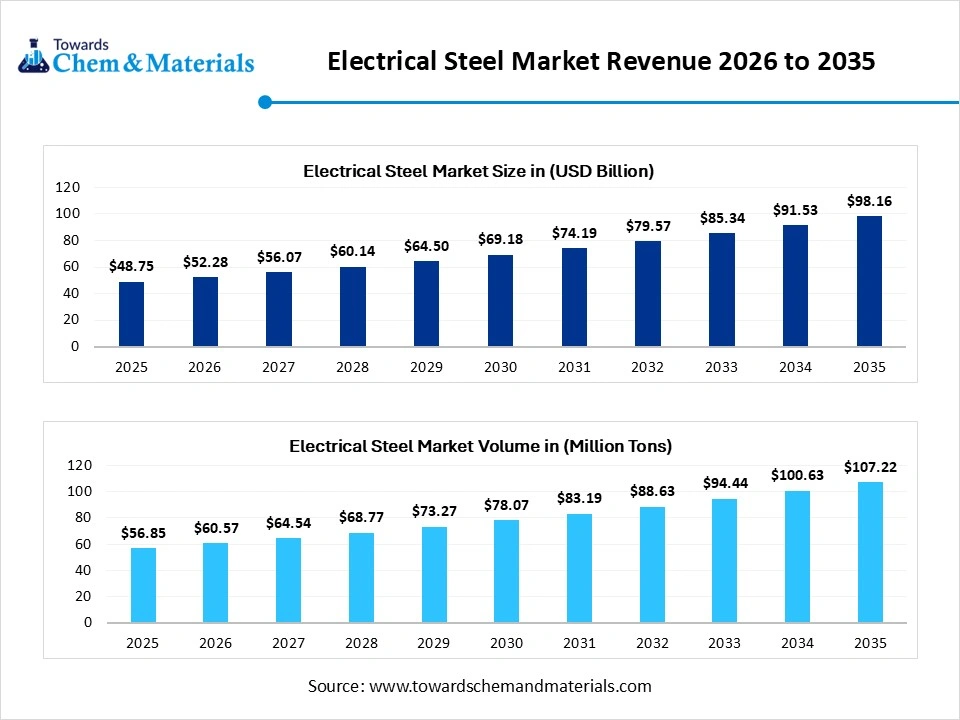
The electrical steel market is witnessing steady growth, with a valuation of USD 48.75 billion in 2025, rising to USD 52.28 billion in 2026, and expected to reach USD 98.16 billion by 2035, growing at a CAGR of 7.25%. The market volume is projected to increase from 56.85 million tons in 2025 to 107.22 million tons by 2035, at a CAGR of 6.55%. This report covers detailed market size analysis, segment-wise data, regional performance, key company profiles, competitive analysis, value chain assessment, and trade data, along with comprehensive insights into manufacturers and suppliers.
Content
Electrical Steel Market Analysis, Demand and Growth Rate Forecast
The global electrical steel market was valued at USD 48.75 billion in 2025, is estimated to reach USD 52.28 billion in 2026, and is projected to reach USD 98.16 billion by 2035, growing at a CAGR of 7.25% from 2026 to 2035. In terms of volume, the electrical steel market is projected to grow from 56.85 million tons in 2025 to 107.22 million tons by 2035. growing at a CAGR of 6.55% from 2026 to 2035.
Key Takeaways
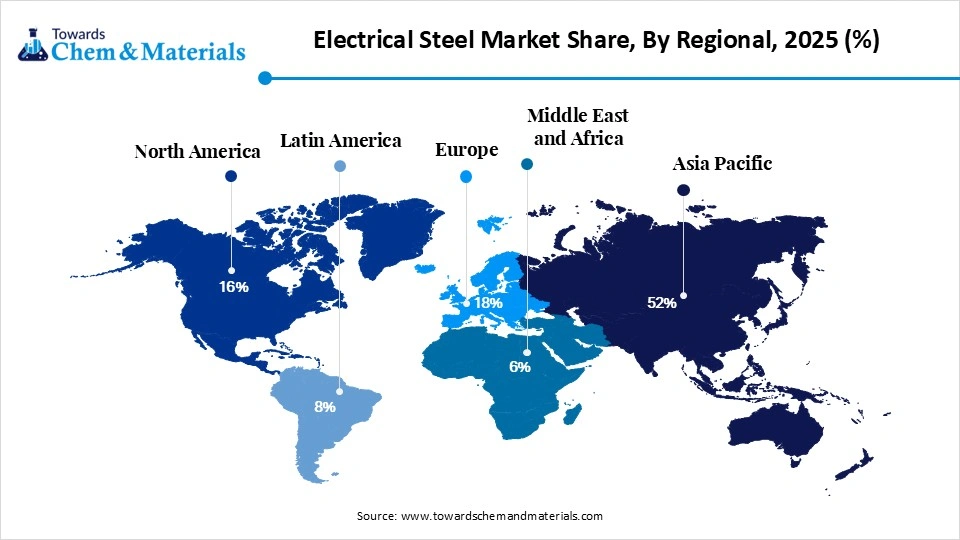
- By region, Asia Pacific dominated the electrical steel market by holding a 52% share in 2025 and is expected to grow at the fastest with a CAGR of 8.1% during the forecast period.
- By region, Europe held the 18% market share in 2025 and expects notable growth in the market with 6.70% CAGR during the forecast period.
- By type, the non-grain-oriented electrical steel (NGOES) segment dominated the market with the largest share of 62% in 2025 and is expected to grow at the fastest CAGR of 7.6% over the forecast period.
- By thickness, the medium gauge segment dominated the market with the largest share of 44% in 2025
By thickness, the thin gauge segment held 32% market share in 2025 and is expected to grow at the fastest CAGR of 7.8% over the forecast period. - By application, the transformers segment dominated the market with the largest share of 36% in 2025
By application, the motors segment held 30% market share in 2025 and is expected to grow at the fastest CAGR of 8.2% over the forecast period. - By end-use industry, the energy & power segment dominated the market with the largest share of 40% in 2025
- By end-use industry, the automotive segment held 22% market share in 2025 and is expected to grow at the fastest CAGR of 8.5% over the forecast period.
- By processing type, the fully processed steel segment dominated the market with the largest share of 58% in 2025 and is expected to grow at the fastest CAGR of 7.4% over the forecast period.
- By coating type, the insulating coatings segment dominated the market with the largest share of 68% in 2025 and is expected to grow at the fastest CAGR of 7.3% over the forecast period.
Market Size and Volume Forecast
- Market Estimated Size (2025): USD 48.75 Billion | CAGR (2026–2035): 7.25%
- Market Projected Size (2035): USD 98.16 Billion
- Market Volume (2025): 56.85 Million Tons | Volume CAGR (2026–2035):6.55%
- Market Projected Volume (2035): 107.22 Million Tons
- Market Pricing (2025):
- Average Manufacturing Price: USD 729/ton
- Average Selling Price: USD 988/ton
- Pricing CAGR (2025–2035): 3.15%
Market Overview
- Electrical steel is represented as a high-performance magnetic substrate engineered from silicon-alloyed iron for efficient conversion of energy with minimal thermal dissipation and maximum magnetic permeability. It acts as a key asset for energy transition infrastructure, especially for electrification and grid modernization. The industry is categorized into grain-oriented steel for power transformers and non-grain-oriented steel for high-speed propulsion systems.
- The manufacturers focus on decarbonization and transition towards premium specialty grade that accelerating innovation in high-silicon formulation and ultra-thin gauge to meet regulatory standards. Additionally, electrical steel set critical standards for advanced mobility and clean energy solutions.
Electrical Steel Market Trends
- Focus on Decarbonization and Circular Economy: The manufacturers are moving towards an electrical steel scrap-segregation programme to lower the carbon footprint and adoption of green steel by maintaining magnetic permeability.
- Investment in Thin-Gauge Development: The industry is increasingly investing in ultra-thin gauge and high-silicon content to lower energy loss by ensuring tension and gauge uniformity.
Report Scope
| Report Attribute | Details |
| Market Size and Volume in 2026 | USD 52.28 Billion / 60.57 Million Tons |
| Expected Size and Volume by 2035 | USD 98.16 Billion / 107.22 Million Tons |
| Growth Rate from 2026 to 2035 | CAGR 7.25% |
| Forecast Period | 2026 - 2035 |
| Dominant Region | Asia-Pacific |
| Segment Covered | By Type, By Thickness, By Application, By End-Use Industry, By Processing Type, By Coating Type and By Regions |
| Key companies profiled | Nippon Steel Corporation, Benxi Steel Group Co., Ltd., JFE Steel Corporation, NLMK, Voestalpine Group, Arnold Magnetic Technologies, ArcelorMittal S.A., POSCO (Pohang Iron & Steel Co.), China Baowu Steel Group, Thyssenkrupp Electrical Steel GmbH, Cleveland-Cliffs Inc. (AK Steel), Tata Steel Limited, CSC Steel Sdn. Bhd., Aperam S.A., Waelzholz Group, Ansteel Group Corporation, HBIS Group (Hebei Iron & Steel), Nucor Corporation, Metglas Inc. (Hitachi Metals Group), Advanced Technology & Materials Co. Ltd. (AT&M) |
Key Technological Shifts and AI in the Electrical Steel Market
- The electrical steel market is transforming towards real-time process optimization through Industry 4.0 and autonomous quality control. The machine is utilized in furnace temperature and coating applications with net-zero defects and optimal magnetic absorptivity. The technological shift enables precision through AI-based computer vision.
- The digital transition allow manufacturer for integration of digital twin technology enables the advancement of new and ultra-thin frequency alloy compositions by enhancing functionality for smart grid and next-generation electric vehicle motors.
Supply Chain Analysis of the Electrical Steel Market
Raw material Sourcing and Extraction:
The key stage of extraction and sourcing of iron ore, metallurgical coal, silicon, ferroalloys, and other scrap metal through major mining hub and focus on a lower carbon footprint.
- Key Players: Rio Tinto, ArcelorMittal, Sinosteel, BHP, Cleveland-Cliffs, and Tata Steel
Specialized Steel Formulation and Processing:
The key industrial stage of raw steel conversion into technical electrical steel sheets, including grain-oriented steel and non-grain-oriented steel through advanced argon oxygem decarburization process, annealing, and specialized rolling.
- Key Players: POSCO, Voestalpine AG, Nippon Steel Corporation, JFE Steel, and Baowu Steel Group
End-User Integration and Fabrication:
The final stage of lamination stamping, core-coil assembly, slitting, and precision cutting is used in energy generation, transportation, and industrial appliances.
- Key Players: GE Vernova, ABB, Toyota, Siemens, and Volkswagen Group
Regulatory Framework: Electrical Steel Market
| Region | Key Regulation | Regulatory Focus |
| Global | IEC International Standards | Focus on a harmonized technical framework for magnetic loss and performance of motors and transformers. |
| United States | DOE 2029 Amended Standards | Mandates driving the transition towards amorphous steel and pushes for a mix of GOES |
| India | IS CRNO and GO standards, BEE Star Labelling, and Steel Quality Control Orders | Mandatory certification for the import of electrical steel and quality control use in motors and transformers. |
| European Union | Ecodesign Directives and ESPR | Focus on decarbonization and low reduction for transformers and adopting premium GO grade to avoid amorphous steel import reliance. |
| China | GB Standards for Motor Efficiency | Grade-based standard for thin-gauge NGO steel and industrial motors for the domestic market. |
Electrical Steel Market Dynamics
Driver
Industrial Shift Towards Automation
The paid industrialization and consumption are reshaping the trend by infrastructure project focuses on grid modernization and electrification. The transition is driving demand for high-permeability GOES and NGOES with high-magnetic flux density and ultra-low high -frequency loss in manufacturing plants.
Restraints
Silicon and Alloy Value Chain Volatility
The electric steel needs high-purity ferrosilicon where silicon price volatility is interconnected to energy prices in geopolitical infrastructure that leading unpredictable project cost and steel mill profit margins.
Opportunity
On-Shoring Incentives and Sustainability Goals
The carbon border adjustment mechanism creates a key opportunity for leading players to invest in domestic production of automotive-grade steel to reduce reliance on imports. The sustainability targets focus on advancing low-carbon and recyclable electrical steel solutions to meet the premium market.
Segmental Insights
Type Insights
Non-Grain-Oriented Electrical Steel (NGOES) Segment Dominated the Electrical Steel Market with 62% of Market Share in 2025
Non-grain-oriented electrical steel (NGOES) segment dominated the market with the largest share of 62% in 2025 and is expected to grow at the fastest CAGR of 7.6% over the forecast period. It serves as an isotropic type, designed for multi-directional magnetic flux, and is known for its disordered grain structure. The NGO electrical steel is key in rotating equipment, industrial servomotors, and hydroelectric generators. The demand for high-silicon NGO grades and energy-efficient innovation to improve rotational torque and reduce eddy current losses is driving the segment expansion.
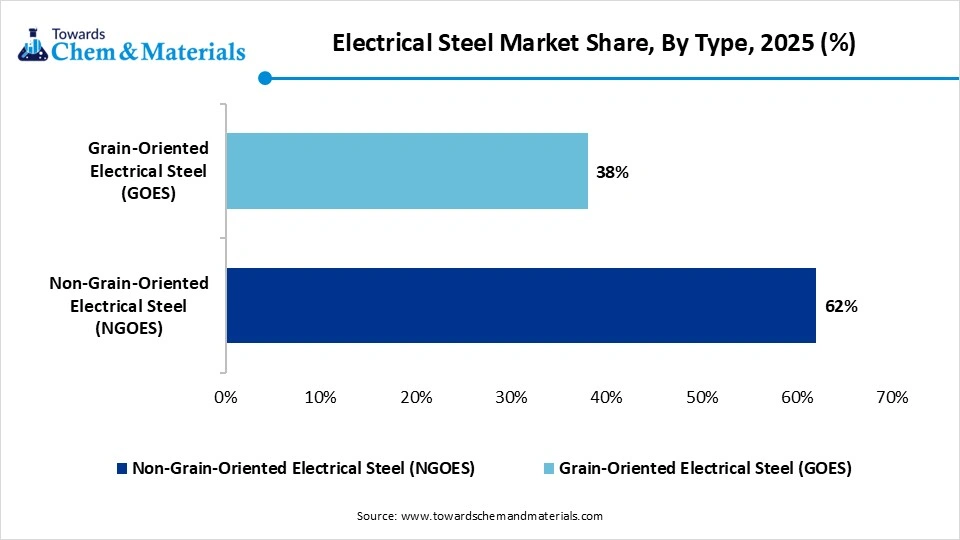
Grain-oriented electrical steel (GOES) segment held the 38% market share in 2025, due to its linear crystal alignment, and acts as an anisotropic type that offers high-efficient pathway for unidirectional magnetic flux. GOES is essential in stationary applications, power, and distribution transformers. The industrial move towards decarbonization and rising demand for premium laser-etched grade to lower energy dissipation is accelerating the growth. The segment is a key pillar of the modern power grid and the integration of renewable energy.
Thickness Insights
Medium Gauge Segment Dominated the Electrical Steel Market with 44% of Market Share in 2025
The medium gauge segment dominated the market with the largest share of 44% in 2025, driven by its ability to support high-capacity loads that balance magnetic efficiency and mechanical resilience. The medium gauge is utilized in stationary motors, heavy industrial, and large-scale power transformers. The segment offers structural integrity and maintains cost-effectiveness for stamping and stacking. As the industry focuses on manufacturing scalability and material strength, the medium gauge becomes key for the high-volume market standard.
Electrical Steel Market Share, By Thickness, 2025 (%)
| By Thickness | Revenue Share, 2025 (%) |
| Medium Gauge (0.35–0.65 mm) | 44% |
| Thin Gauge (<0.35 mm) | 32% |
| Thick Gauge (>0.65 mm) | 24% |
The thin gauge segment held the 32% market share in 2025 and is expected to grow at the fastest CAGR of 7.8% over the forecast period, driven by the requirement to lower energy dissipation in high-speed applications. The segment growth is driven by its innovation that offers excellent thermal management and superior operational frequencies. The thin gauge is crucial for decarbonization of logistics to enhance torque and efficiency of EV powertrains and aerospace. The segment is essential in next-generation electromagnetic cores to align with maximum power density.
The thick gauge segment held the 24% market share in 2025, known for its heavy-load stability and mechanical durability. The thick gauge is an economical solution for large-scale generators and static industrial infrastructure by ensuring high-frequency efficiency. The segment is required for base-load power generation and utility-scale energy technologies by ensuring structural resilience and a cost-efficient pathway.
Application Insights
The Transformers Segment Dominated the Electrical Steel Market with 36% of Market Share in 2025
The transformers segment dominated the market with the largest share of 36% in 2025, acting as a key pillar for high-voltage transmission and urban distribution. The high consumption of grain-oriented steel and the global shift towards decarbonized grids are boosting the market growth. The transformer application focuses on stringent green energy mandates and efficiency standards that drive the adoption of high-permeability alloys with minimal energy loss for the power utility framework.
The motors segment held the 30% market share in 2025 and is expected to grow at the fastest CAGR of 8.2% over the forecast period, driven by demand for motors in electric vehicle and industrial applications, where this application converts electrical energy into mechanical propulsion. The shift toward e-mobility and industrial automation is boosting its consumer base due to its ability to handle omnidirectional flux. The segment is key for material innovation that focuses on improving power density and rotational efficiency.
Electrical Steel Market Share, By Application, 2025 (%)
| By Application | Revenue Share, 2025 (%) |
| Transformers | 36% |
| Motors | 30% |
| Generators | 20% |
| Inductors & Reactors | 14% |
The generators segment held the 20% market share in 2025, due to the decarbonization shift to maximize generation efficiency and structural resilience in renewable energy systems. The generators act as utility-scale power solutions that utilize non-grain-oriented steel to handle multi-directional magnetic flux and superior torque in wind, turbine, and hydroelectric facilities. The segment transition towards high-induction alloys enables the market expansion.
The inductors & reactors segment held 14% market share in 2025. It represents a power-stabilization application that maintains energy storage and filtering within a complex electrical system. The rapid expansion of EV charging networks and demand for renewable energy inverters to mitigate harmonic distortion is fueling the segment growth. The industry focuses on high-frequency material and high-permeability grade to enhance thermal stability and operational efficiency in clean energy and modern smart grids.
End-Use Industry Insights
The Energy & Power Segment Dominated the Electrical Steel Market with 40% of Market Share in 2025
The energy & power segment dominated the market with the largest share of 40% in 2025, driven by demand for the electricity value chain from generation to power grid distribution. The energy & power industry integration uses grain-oriented steel for high-voltage transmission and non-grain-oriented steel for utility-scale turbines. The segment expansion driven by energy security mandates and regulatory-driven renewable energy facilities enables the implementation of high-efficiency specialty grades and low carbon content in the energy transition.
The automotive segment held the 22% market share in 2025 and is expected to grow at the fastest CAGR of 8.5% over the forecast period, due to the transition towards e-mobility and demand for electric and hybrid vehicles. The automotive manufacturers focus on high-frequency alloys and premium thin-gauge lamination to lower thermal loss. The segment is focusing maximum energy density and longevity, that make automotive a key driver of high-value specialty steel demand.
Electrical Steel Market Share, By End-Use Industry, 2025 (%)
| By End-Use Industry | Revenue Share, 2025 (%) |
| Energy & Power | 40% |
| Automotive | 22% |
| Manufacturing | 15% |
| Consumer Appliances | 13% |
| Industrial Equipment | 10% |
The manufacturing segment held the 15% market share in 2025. It acts as an operational catalyst that drives large consumers of non-grain-oriented electrical steel for industrial automation. The shift towards Industry 4.0 and industry electrification in heavy-duty pumps, high-torque motors, and precision robotics is boosting market growth.
Manufacturers focus on enhancing thermal stability and automation in modern production lines, accelerating growth.
The consumer appliances segment held 13% market share in 2025, because electric steel is utilized in household goods, motors, and compressors. The stringent energy-efficiency labelling and implementation of inverter technology reinforce the transition to ultra-thin gauge lamination. The consumer appliance focuses on balancing cost-efficiency with superior thermal stability and noise reduction to meet the emerging demand of smart home infrastructure.
Processing Type Insights
Fully Processed Steel Segment Dominated the Electrical Steel Market with 58% of Market Share in 2025
Fully processed steel segment dominated the market with the largest share of 58% in 2025 and is expected to grow at the fastest CAGR of 7.4% over the forecast period. It is a key processing type in which the producer completes magnetic development and surface insulation before delivery. Fully processed steel valued for performance uniformity that eliminate need for final annealing for high-performance manufacturing and power transformers. The shift towards streamlined industrial workflows and continuous magnetic permeability in complex production batches is reshaping the market growth.
Electrical Steel Market Share, By Processing Type, 2025 (%)
| By Processing Type | Revenue Share, 2025 (%) |
| Fully Processed Steel | 58% |
| Semi-Processed Steel | 42% |
Semi-processed steel segment held the 42% market share in 2025 due to its cost-effectiveness and customization, which requires final annealing to activate its magnetic stability. The process offers superior mechanical precision in high-volume stamping and general-purpose applications. As manufacturers prefer lower material cost and focus on controlling grain development and stress relief, semi-processed steel is a key processing type during production control.
Coating Type Insights
Insulating Coatings Segment Dominated the Electrical Steel Market with 68% of Market Share in 2025
The insulating coatings segment dominated the market with the largest share of 68% in 2025 and is expected to grow at the fastest CAGR of 7.3% over the forecast period. It represents a suppressor of eddy current losses that includes ASTM-classified C3 organic coatings to C5 and C6 inorganic-hybrid systems to enhanced performance of electric vehicle motors and transformers. The coating manufacturer focuses on innovation of chromium-free and low-VOC solutions by maintaining dielectric strength and corrosion resistance for smart grid and electrification infrastructure.
Electrical Steel Market Share, By Coating Type, 2025 (%)
| By Coating Type | Revenue Share, 2025 (%) |
| Insulating Coatings | 68% |
| Non-Coated Electrical Steel | 32% |
The non-coated electrical steel segment held the 32% market share in 2025, driven by demand for cost-driven and large-scale manufacturing for intermittent-duty motors and scale-based insulation. Non-coated segment eliminates surface films by offering higher punchability and weldability by serving as an economical base to develop its magnetic potential.
Regional Insights
How Did the Asia Pacific Dominated the Electric Steel Market in 2025?
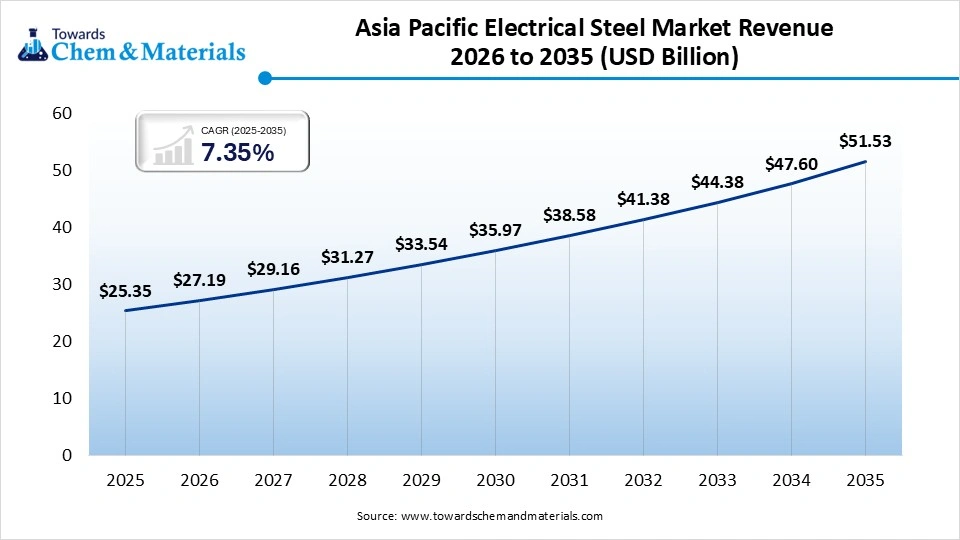
The Asia Pacific electrical steel market size was estimated at USD 25.35 billion in 2025 and is projected to reach USD 51.53 billion by 2035, growing at a CAGR of 7.35% from 2026 to 2035. The regional growth is driven by substantial investment in grid modernization and a renewable energy manufacturing hub. The region focuses on the production of large0scale non-grained oriented steel for motors and grain-oriented steel for power transformers. The regional shift towards green steel through governmental initiative and innovation of high-permeability grade driving domestic scaling.
China Electrical Steel Market Growth Trends
China market is a key hub for the supply of electric vehicles and renewable energy infrastructure. China focuses on domestic capacity expansion of electric steel, supported by leading players. The regional export strategies and ultra-high voltage grid projects position China as a key pillar of the international energy infrastructure framework.
Europe held the 18% market share in 2025 and expects notable growth in the market with 6.70%CAGR during the forecast period, driven by its stringent regulatory compliance and its carbon-neutral strategy for automotive electrification. The region focuses on premium, ultra-thin, and NGO steel for eco-friendly transformers and motors. The European manufacturers focus on a decarbonized supply chain and hydrogen-based manufacturing by setting a standard for rapidly expanding wind energy and smart grid infrastructure.
Germany Electrical Steel Market Growth Trends
Germany market is observing significant growth, that make them key hub for premium automotive motor lamination and high-efficiency transformers. The region is shifting toward C) 2-lower green steel and manufacturing of thin-gauge. Germany's stringent energy efficiency laws and domestic supply chain of the hydrogen ecosystem are accelerating the advancement of grid and renewable energy projects.
Recent Developments
- In April 2026, Tata Steel expanded its strategic collaboration with Google Cloud to deploy over 300 specialized AI agents across the global value chain. The partnership focuses on architecting the future of steel and operational efficiency through an agentic AI strategy.
- In December 2025, ArcelorMittal France is scheduled to start a new three-unit production of electrical steel units in Mardyck. The site is supported by €25 million ($29.06m), that focus on high-grade electrical steels for automotive, industrial, and energy applications.
Top Companies in the Electrical Steel Market
- Nippon Steel Corporation
- Benxi Steel Group Co., Ltd.
- JFE Steel Corporation
- NLMK
- Voestalpine Group
- Arnold Magnetic Technologies
- ArcelorMittal S.A.
- POSCO (Pohang Iron & Steel Co.)
- China Baowu Steel Group
- Thyssenkrupp Electrical Steel GmbH
- Cleveland-Cliffs Inc. (AK Steel)
- Tata Steel Limited
- CSC Steel Sdn. Bhd.
- Aperam S.A.
- Waelzholz Group
- Ansteel Group Corporation
- HBIS Group (Hebei Iron & Steel)
- Nucor Corporation
- Metglas Inc. (Hitachi Metals Group)
- Advanced Technology & Materials Co. Ltd. (AT&M)
Electrical Steel Market Segment Covered in the Report
By Type
- Grain-Oriented Electrical Steel (GOES)
- Conventional GOES
- High Permeability (Hi-B) GOES
- Non-Grain-Oriented Electrical Steel (NGOES)
- Fully Processed NGOES
- Semi-Processed NGOES
By Thickness
- Thin Gauge (<0.35mm)
- Medium Gauge (0.35-0.65 mm)
- Thick Gauge (>0.65 mm)
By Application
- Transformers
- Power Transformers
- Distribution Transformers
- Motors
- Industrial Motors
- Electric Vehicle Motors
- Generators
- Turbine Generators
- Wind Generators
- Inductors & Reactors
By End-Use Industry
- Energy & Power
- Automotive
- Manufacturing
- Consumer Appliances
- Industrial Equipment
By Processing Type
- Fully Processed Steel
- Semi-Processed Steel
By Coating Type
- Insulating Coatings
- Organic Coatings
- Inorganic Coatings
- Non-Coated Electrical Steel
By Regions
- North America:
- U.S.
- Canada
- Mexico
- Rest of North America
- Latin America:
- Brazil
- Argentina
- Rest of Latin America
- Europe:
- Western Europe
- Germany
- Italy
- France
- Netherlands
- Spain
- Portugal
- Belgium
- Ireland
- UK
- Iceland
- Switzerland
- Poland
- Rest of Western Europe
- Eastern Europe
- Austria
- Russia & Belarus
- Türkiye
- Albania
- Rest of Eastern Europe
- Asia Pacific:
- China
- Taiwan
- India
- Japan
- Australia and New Zealand,
- ASEAN Countries (Singapore, Malaysia)
- South Korea
- Rest of APAC
- MEA:
-
- GCC Countries
- Saudi Arabia
- United Arab Emirates (UAE)
- Qatar
- Kuwait
- Oman
- Bahrain
-
- South Africa
- Egypt
- Rest of MEA
- MEA:
FAQ's
Question 1 : What is the current size of the electrical steel market?
Answer : The global electrical steel market was valued at USD 48.75 billion in 2025 and is estimated to reach USD 52.28 billion in 2026, reflecting steady growth driven by rising electrification and industrial demand.
Question 2 : What is the projected growth rate of the electrical steel market?
Answer : The market is expected to grow at a CAGR of 7.25% from 2026 to 2035, reaching approximately USD 98.16 billion by 2035.
Question 3 : What is driving the demand for electrical steel?
Answer : Key demand drivers include rapid electrification, expansion of renewable energy infrastructure, electric vehicle (EV) adoption, grid modernization, and industrial automation.
Question 4 : Which region dominates the electrical steel market?
Answer : Asia Pacific dominates the market with a 52% share in 2025 and is expected to grow at the fastest CAGR of 8.1% due to strong manufacturing capacity and infrastructure investments.
Question 5 : Which region is expected to show notable growth?
Answer : Europe is expected to grow steadily at a CAGR of 6.70%, driven by strict energy efficiency regulations and decarbonization initiatives.
Meet the Team

Saurabh Bidwai
Principal Consultant
Saurabh Bidwai, a B.Tech Chemical Engineering graduate with 4+ years of experience, specializes in specialty chemicals, commodity chemicals, and engineered materials, offering valuable insights into market trends and emerging opportunities.

Aditi Shivarkar
Reviewed By
Aditi Shivarkar, with 14+ years in Chemical and Materials market research, specializes in Chemical and Materials. She ensures accurate, actionable insights, driving Towards Chemicals And Materials Analytics and Consulting excellence in industry trends and sustainability.