
Electronic Hydrofluoric Acid Market Size, Share & Trends Analysis Report by 2026-2035
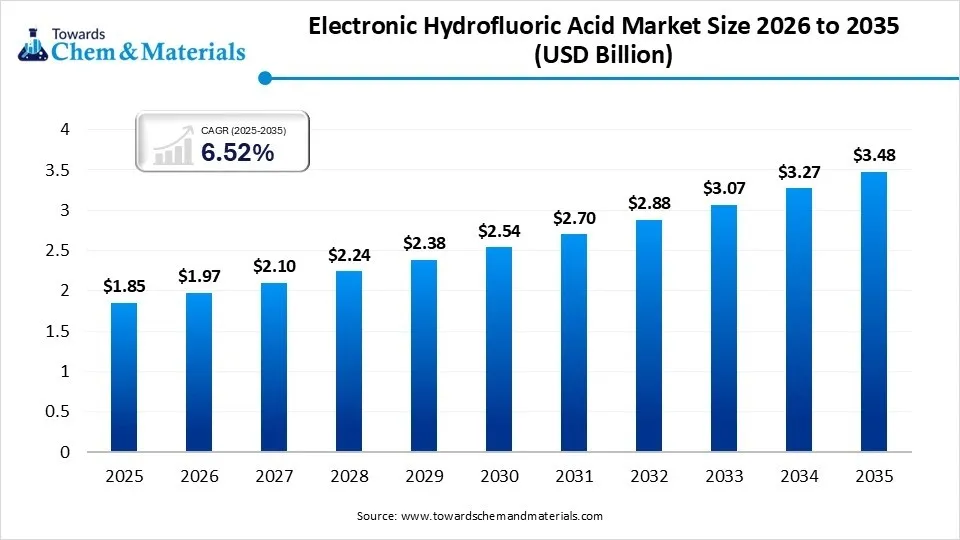
The global electronic hydrofluoric acid market size is expected to grow from USD 1.97 billion in 2026 to USD 3.48 billion in 2035, growing at a CAGR of 6.52% from 2026 to 2035. The top key players in the market are Stella Chemifa Corporation, Zhejiang Juhua/Do-Fluoride, Daikin Industries, Honeywell International Inc., Solvay S.A., KMG Chemicals Inc., Merck KGaA, Fujifilm Corporation, Linde plc, Air Products and Chemicals Inc., Showa Denko K.K., Mitsubishi Gas Chemical Company Inc.-Global Forecast 2026 To 2035
Content
Electronic Hydrofluoric Acid Market Size and Forecast 2026 – 2035
The global electronic hydrofluoric acid size was estimated at USD 1.85 billion in 2025 and is expected to increase from USD 1.97 billion in 2026 to USD 3.48 billion by 2035, growing at a CAGR of 6.52% from 2026 to 2035. Asia Pacific dominated the electronic hydrofluoric acid with the largest revenue share of 40.00% in 2025.The growth is driven by demand for ultra-high purity grades, technological innovation and focus on high-selectivity etching chemistry.
Market Highlights
- By region, Asia Pacific dominated the market by holding approximately 40% share in 2025 due to its specialty chemical supply chain and semiconductor fabrication infrastructure.
- By region, North America is expected to grow at the fastest CAGR from 2026 to 2035 due to expanding domestic manufacturing and a high-performance computing hub.
- By grade, the UP-SSS grade segment held the largest, approximately 33% share in the market in 2025 due to its ultra-high purity used in advanced semiconductor nodes.
- By grade, the UP-S grade segment is expected to grow at the fastest CAGR during the forecast period due to its surface cleaning and ultra-purity with process stability.
- By type, the fluorite-based segment dominated with approximately 70 % share in the market, driven by its demand in upstream manufacturing and high operational yield.
- By type, the fluorosilicic acid-based segment is expected to grow at the fastest CAGR in the market during the forecast period due to its circular economy pathway and resource efficiency.
- By application, the semiconductor wafers segment dominated with a held approximately 60.34% share in the market, driven by its liquid etchant property and demand in modern chip production.
- By application, the display panels segment is anticipated to grow at the fastest CAGR in the market during the forecast period due to its demand in glass thinning and visual performance.
The Role of Ultra-High Purity HF in Semiconductor Fabrication
Electronic hydrofluoric acid is an ultra-high purity acid essential for semiconductor and microelectronics, used in surface cleaning, deoxidation, and silicon dioxide removal during wafer fabrication. Its purity prevents lattice defects, ensuring the functional integrity of integrated circuits, logic chips, and 3D NAND. It acts as a key raw material that supports high- precision photolithography and wet etching, crucial for wafer passivation and nanometer- scale patterning. The rising demand for specialty chemicals integrated with high- performance computing, AI hardware, and photovoltaic is playing a vital role as a functional etchant and for achieving device reliability and production yield, especially in thin-film transistors and optoelectronic components.
Recent Market Trends
- Revolution Towards Molecular Purity: The shift towards high-purity grades, which is important for sub-nanometer logic nodes and 3D NAND framework, is driving this trend by preventing lattice defects and maintaining ppt contamination.
- Focus on Green Chemistry and Circular Economy: The rising eco-conscious consumer is boosting the development of spent acid recycling and chemical regeneration systems. The trend focuses on sustainable byproduct utilization pathways by reducing environmental impact.
- Expert Logistics and Next-Zero Contamination Packaging: The surge for high-purity fluoropolymer-lined containers and an automated chemical delivery system to maintain molecular integrity during wet etching and surface cleaning processes is driving this trend.
- Strategic Vertical Integration: The transition towards vertical integration enables direct access to acid-grade fluorspar and stabilized supply chain to maintain the quality of an anhydrous hydrofluoric acid pioneer and mineral security.
Report Scope
| Report Attribute | Details |
| Market Size in 2026 | USD 1.97 Billion |
| Revenue Forecast in 2035 | USD 3.48 Billion |
| Growth Rate | CAGR 6.52% |
| Forecast Period | 2026 - 2035 |
| Base Year | 2025 |
| Dominant Region | Asia Pacific |
| Segment Covered | By Grade, By Type, By Application, By Region |
| Key companies profiled | Stella Chemifa Corporation, Zhejiang Juhua/Do-Fluoride, Daikin Industries, Honeywell International Inc., Solvay S.A., KMG Chemicals Inc., Merck KGaA, Fujifilm Corporation, Linde plc, Air Products and Chemicals Inc., Showa Denko K.K., Mitsubishi Gas Chemical Company Inc. |
Key Technological Shifts and AI in the Electronic Hydrofluoric Acid Market
Technological Shift and Artificial Intelligence are pushing the electronic hydrofluoric acid market toward ultra-high-purity standards for a sub-nanometer framework. AI- enabled manufacturing by maintaining contamination level. While with machine learning for optimizing purification to achieve ppt purity for next-generation logic nodes. The implementation of automated process control for the production of high-performance computing hardware enhances wafer yields, selective etching, and surface cleaning.
Additionally, generative AI increases demand for advanced fluorine and particulate-free chemical solutions, supporting complex GAA and 3D NAND structures by preserving structural integrity. The industry is transforming towards smart manufacturing with real- time monitoring and predictive analytics, ensuring chemical stability in microelectronics and semiconductors.
Electronic Hydrofluoric Acid Market: Supply Chain Analysis
- Feedstock Procurement: The initial stage of mining, resource extraction of high-purity acid-grade fluorspar and chemical reaction with a reagent, such as sulfuric acid, to synthesise anhydrous hydrofluoric acid. The process also involves initial trace metals sourcing using vertical integration.
- Key Players: Orbia (Mexichem), Zhejiang Juhua, Do-Fluoride (DFD), Minersa Group, Gulf Fluor
- Advanced Purification and Manufacturing: The stage of AHF multistage rectification, sub-boiling distillation and ion exchange to achieve parts-per-trillion purity levels and ultra-low particulate for the manufacturing of UP-S, UP-SSS.
- Key Players: Stella Chemifa, Morita Chemical, Solvay, Honeywell International, Kanto Chemical, Formosa Daikin
- Application and End-Use Integration: The final stage of distribution of purified acid in fluoropolymer-lined packaging, semiconductor fabrication and display panels. The key liquid etchant and surface cleaning agent is integrated with an automated chemical delivery system for electronics by increasing operational yield.
- Key Players: TSMC, Samsung Electronics, Intel Corporation, SK Hynix, BOE Technology, Micron Technology
Regulatory Framework: Electronic Hydrofluoric Acid Market
| Region | Key Regulation | Regulatory Focus |
| Global | SEMI C28 and C29 and DOT Hazardous Materials Regulations and GHS | Standards for purity classification and water fab certification analytical procedure. Regulation for the safety of international transport and handling of corrosive materials |
| United States | TSCA, OSHA, CFR Regulations, CHIPS Act, EPA CAA/CWA | The focus on onshore supply chain worker protection using permissible exposure limits. Funding for the domestic purification hub and stringent air and water emission standards for the semiconductor. |
| European Union | REACH Regulation and CLP Regulation | The regulation focuses on green chemistry and risk assessment. The registration of chemical properties and restriction of hazardous substances for fluorine-based materials in electronics to protect the environment and health |
| China | Environmental Management of New Chemical Substances and Catalogue of Hazardous Chemicals | Strict mandates production and usage licences, waste disposal and export controls to maintain fluorspar reserves for domestic semiconductor self-reliance. |
Segmental Insights
Grade Insights
Why the UP-SSS Grade Segment Dominates the Electronic Hydrofluoric Acid Market?
The UP-SSS grade segment dominated the market with approximately 33% share in 2025, representing a mission-critical ultra-high-purity (UHP) agent for advanced semiconductor processes and specialty chemical engineering. It serves as a crucial liquid etchant and surface cleaner for sub-nanometer logic chips and high-density memory. The segment is well-defined by trace metal control and particulate-free composition at parts-per-trillion levels to prevent defects and higher wafer yields. Its expansion is accelerated by EUV lithography and GAA transistor designs as raw material. Additionally, UP-SSS is a pillar of next-generation microelectronics that offers precise etching and cleaning properties for AI hardware, 3D NAND, and quantum computing.
The UP-S grade segment is the fastest-growing in the market during the forecast period, driven by its surface cleaning and ultra-high-purity standards. segment characterised by demanding trace metal control and low particulates in applications involving microelectronics, logic chips, high-density integrated circuits, and LCDs by reducing microscopic defects and contamination of the lattice as a processing reagent. The UP-S balances ultra-purity with process stability, enabling precise removal of silicon dioxide layers and surface passivation for automotive electronics and memory devices.
Electronic Hydrofluoric Acid Market Share By Grade, 2025 (%)
| By Grade | Revenue Share, 2025 (%) |
| UP Grade | 32.15% |
| UP-S Grade | 32.98% |
| UP-SSS Grade | 34.87% |
- UP-SSS Grade (34.87%) Why it dominates: "Accounts for 34.87% of the market, driven by its ultra-high purity levels required for advanced semiconductor manufacturing and precision electronics applications."
- UP-S Grade (32.98%) Why it is gaining momentum: "Holds 32.98% share, supported by strong demand in semiconductor fabrication processes requiring high purity and consistent performance."
- UP Grade (32.15%) Why it is gaining momentum: "Represents 32.15% of the market, driven by widespread use in standard electronic cleaning and etching applications across the electronics industry."
Type Insights
How did the Fluorite-Based Segment hold the Largest Share in the Electronic Hydrofluoric Acid Market?
The fluorite-based segment held the largest revenue share of approximate 70% in the market in 2025. vital for the upstream production of the global ultra-high-purity chemical industry as a raw material. The segment is created by high-precision reaction of acid-grade fluorspar with sulfuric acid to produce anhydrous hydrofluoric acid (AHF). The fluorite-based segment offers chemical stability and molecular purity vital for microelectronics, semiconductor applications and wafer fabrication. Additionally, it's critical for high-performance computing, advanced wet etching and 3D NAND memory, ensuring precise silicon layer removal and high operational yield.
The fluorosilicic acid-based segment is experiencing the fastest growth in the market during the forecast period. foundation of a sustainable, circular economy pathway, transforming hexafluorosilicic acid from phosphate fertilizer processing into UHP hydrofluoric acid. This segment reduces reliance on traditional mineral sources and represents a key raw material required for wafer etching and surface cleaning by using rectification and defluorination. The fluorosilicic acid growth is driven by supply chain diversification and resource efficiency, and it offers a reliable precursor for integrated circuits and high-density memory.
Electronic Hydrofluoric Acid Market Share By Type , 2025 (%)
| By Type | Revenue Share, 2025 (%) |
| Fluorite-based | 70.00% |
| Fluorosilicic acid-based | 30.00% |
Application Insights
Which Application Dominated the Electronic Hydrofluoric Acid Market?
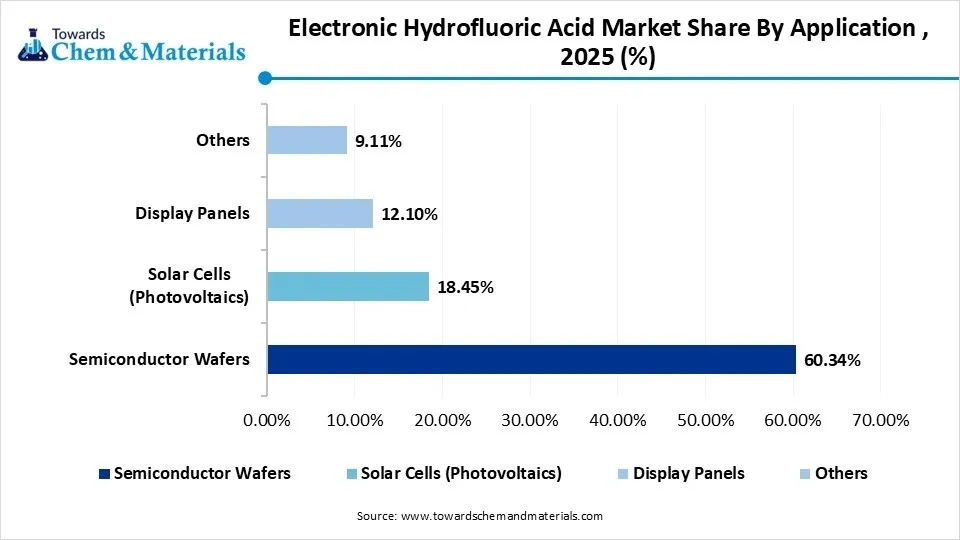
The semiconductor wafers segment dominated the market with approximately 60.34% share in 2025. serves as an indispensable liquid etchant and ultra-clean reagent for wafer fabrication and microfabrication infrastructure. The electronic hydrofluoric acid maintains surface integrity during critical cleaning, deoxidation, and etching of silicon dioxide layers. As the semiconductor industry focuses on nanometer-scale nodes and incorporates 3D NAND, the demand for ppt increases for high yields and AI-based processors, HPC, and advanced memory devices. This acid is vital for photolithography and modern chip manufacturing.
The display panels segment is anticipated to grow fastest in the market during the forecast period, due to utilization of hydrofluoric acid for glass thinning and patterning thin-film transistors in liquid crystal displays and OLED screens. The acid is essential for optoelectronics, ensuring surface smoothness, transparency, and trace metal control for pixel quality. Additionally, the material supports the manufacturing of smartphones, TVs, and automotive displays, driven by trends toward flexible displays and micro-LEDs, by offering particulate-free chemical stability for device resilience and visual performance.
Electronic Hydrofluoric Acid Market Share By Application , 2025 (%)
| By Application | Revenue Share, 2025 (%) |
| Semiconductor Wafers | 60.34% |
| Solar Cells (Photovoltaics) | 18.45% |
| Display Panels | 12.10% |
| Others | 9.11% |
- Semiconductor Wafers (60.34%) Why it dominates: "Accounts for 60.34% of the market, driven by extensive use in wafer cleaning and etching processes essential for semiconductor manufacturing."
- Solar Cells (Photovoltaics) (18.45%) Why it is gaining momentum: "Holds 18.45% share, supported by rising investments in renewable energy and increasing production of photovoltaic cells."
- Display Panels (12.10%) Why it is gaining momentum: "Represents 12.10% of the market, driven by growing demand for advanced display technologies in consumer electronics."
- Others (9.11%) Why it is gaining momentum: "Accounts for 9.11% share, supported by diverse applications across specialized electronic and industrial processes."
Regional Insights
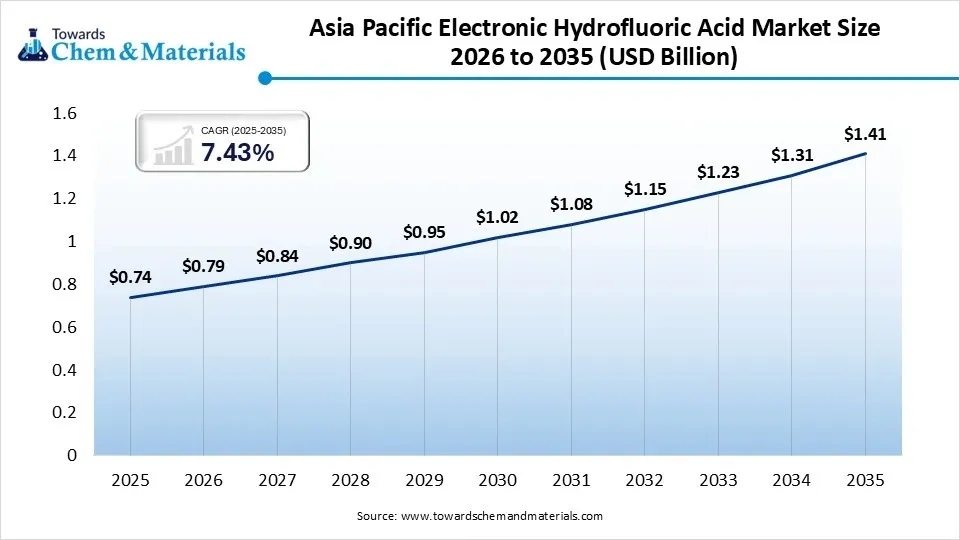
The Asia Pacific electronic hydrofluoric acid market size was valued at USD 0.74 billion in 2025 and is expected to be worth around USD 1.41 billion by 2035, exhibiting at a compound annual growth rate (CAGR) of 7.43% over the forecast period from 2026 to 2035. Asia Pacific dominated the market with approximately 40% share in 2025, central to semiconductor fabrication and display manufacturing. The region's demand for ultra-high purity (UHP) etchants that enable scalability. The region boasts a strong specialty chemical supply chain, focusing on fluorite- based production and purification to support integrated circuits and devices. The region maintains its dominance in adopting next-generation purity standards to meet strict contamination needs. Additionally, Asia Pacific vertical integration and robust wet chemistry infrastructure make it a basis of the global microelectronics and optoelectronics industry.
China Electronic Hydrofluoric Acid Market Growth Trends
The China market is driven by its industrial framework and controls the fluorspar supply chain by producing anhydrous hydrofluoric acid, critical for semiconductor, photovoltaic, and display industries. The region is shifting toward UP-SS and UP-SSS grades meeting contamination edges for localized advanced logic and 3D NAND. The domestic expansion driven by a goal of supply chain self-sufficiency and nanometer-scale manufacturing and key pillar for 5G infrastructure.
North America Electronic Hydrofluoric Acid Market Growth Trends
Electronic Hydrofluoric Acid Market segment accounted for the major revenue share of 20.00% in 2025. North America is expected to grow at the fastest CAGR in the market during the forecast period, due to its focus on UHP standards and expanding domestic semiconductor fabrication. The region serves as a high-performance computing hub, especially for aerospace, computing and defense sectors. North America's emphasis on supply chain resilience and the advancement of onshore purification. The region's semiconductor fabrication initiative and strategic investment make it vital for AI, automotive electronics, and 5G devices
U.S. Electronic Hydrofluoric Acid Market Growth Trends
The United States market is defined by supply chain reliance that aims for semiconductor self-sufficiency. The region is a hub for next-generation memory and logic nodes. Through governmental initiatives and stringent regulation prioritising ultra-high purity grades. The rising local purification infrastructure and domestic semiconductor fabrication facilities that integrated with technological advancement, united state is set a standard for the microelectronic ecosystem.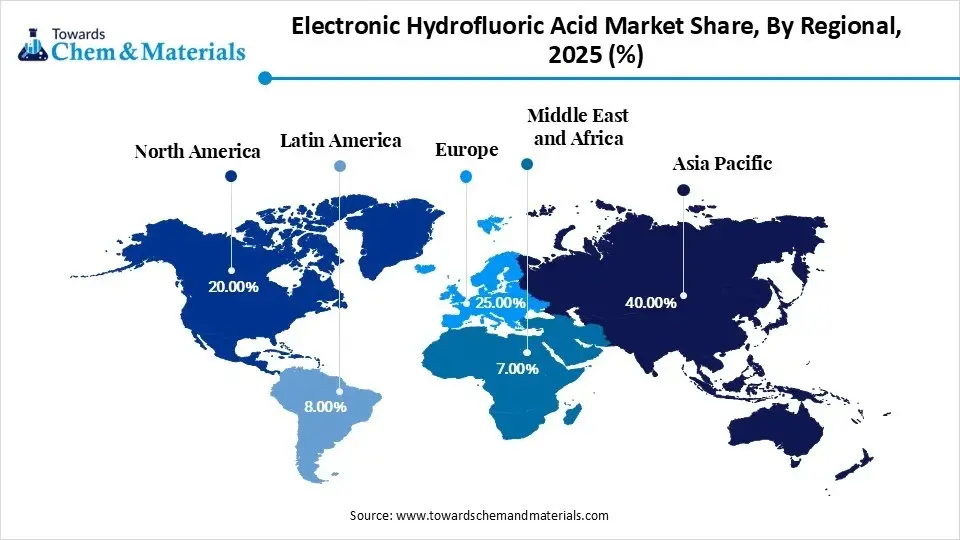
Europe Electronic Hydrofluoric Acid Market Growth Trends
Europe Electronic Hydrofluoric Acid Market segment accounted for the major revenue share of 25.00% in 2025. Europe's market is experiencing significant growth driven by its specialized, innovation-driven sector emphasising environmental sustainability, UHP standards. The region is defined by its green chemistry and circular economy initiatives. The regional expansion is promoted by industrial applications such as power semiconductors, aerospace, automotive electronics, and industrial automation, aligning with EU policies that are pushing the region towards a regulatory-driven specialty chemical ecosystem.
Electronic Hydrofluoric Acid Market Share, By Regional, 2025 (%)
| Regional | Revenue Share, 2025 (%) |
| North America | 20.00% |
| Europe | 25.00% |
| Asia Pacific | 40.00% |
| Latin America | 8.00% |
| Middle East & Africa | 7.00% |
- Asia Pacific (40.00%) Why it dominates: "Accounts for 40.00% of the market, driven by strong semiconductor manufacturing base, high electronics production, and presence of major chip fabrication facilities."
- Europe (25.00%) Why it is gaining momentum: "Holds 25.00% share, supported by advanced electronics manufacturing capabilities and increasing investments in semiconductor technologies."
- North America (20.00%) Why it is gaining momentum: "Represents 20.00% of the market, driven by growing semiconductor innovation, research activities, and expansion of fabrication facilities."
- Latin America (8.00%) Why it is gaining momentum: "Accounts for 8.00% share, supported by gradual growth in electronics manufacturing and industrial development."
- Middle East & Africa (7.00%) Why it is gaining momentum: "Captures 7.00% of the market, driven by increasing investments in technology infrastructure and emerging electronics sector."
Germany Electronic Hydrofluoric Acid Market Growth Trends
Germany is witnessing steady growth in the market in terms of innovation and industrial applications. The regional advanced semiconductor clusters' technological synergy is boosting the region towards a key pillar of the electronics system. Additionally, Germany focuses on domestic silicon fabs, and the electric vehicle shift that promoted sustainability and strict regulation compliance. The government initiatives for fluorine resource management are driving the rapid growth.
Recent Developments
- In February 2026, Navin Fluorine International Ltd. commenced commercial operations at its new, large-scale anhydrous hydrofluoric acid (AHF) manufacturing facility in Dahej. The following major capital investment is to foster the specialty chemical supply chain for the electronics sector.(Source: investeepedia.com)
- In January 2026, Tanfac Industries announced the investment of Rs 495 Cr to establish a new downstream fluorinated chemicals manufacturing plant with an extensive capacity of 20000 tonnes per annum at Tamil Nadu. The focus on raising the expansion up to Rs 500 crore by equity share sales to institutional investors.(Source: economictimes.indiatimes.com)
Top Companies in the Electronic Hydrofluoric Acid Market and Their Offerings
- Stella Chemifa Corporation: The global leader offers 12N purity grades, ultra-high-purity hydrofluoric acid, buffered hydrofluoric acid and specialized LAL series etchants required for sub-5nm logic nodes and 3D NANS architectures.
- Zhejiang Juhua/Do-Fluoride: The offer UP-SD UP-SSS grade electronic HF and lithium hexafluorophosphate precursor and vertically integrated supply of UHP etchants for the microelectronic and photovoltaic sector.
- Daikin Industries: The strategic leader in next-generation nodes, G5-grade electronic HF and high-purity fluoropolymer-based etching solution needed for gate-all-around transistor fabrication and EUV lithography.
- Honeywell International Inc.: The global leader focus on contamination control and domestic production by offer electronic grade 49% Hf and trace-metal -free processing materials for onshore semiconductor manufacturing and computing hardware.
- Solvay S.A.
- KMG Chemicals Inc.
- Merck KGaA
- Fujifilm Corporation
- Linde plc
- Air Products and Chemicals Inc.
- Showa Denko K.K.
- Mitsubishi Gas Chemical Company Inc.
Segment Covered in the Report
By Grade
- UP Grade
- UP-S Grade
- UP-SSS Grade
By Type
- Fluorite-based
- Fluorosilicic acid-based
By Application
- Semiconductor Wafers
- Solar Cells (Photovoltaics)
- Display Panels
- Others
By Region
- North America
- U.S.
- Canada
- Mexico
- Europe
- Germany
- UK
- France
- Italy
- Spain
- Asia Pacific
- China
- India
- Japan
- South Korea
- Latin America
- Brazil
- Argentina
- Middle East & Africa
- Saudi Arabia
- South Africa
FAQ's
Question 1 : What is the projected market size and growth rate of the electronic hydrofluoric acid market from 2026 to 2035?
Answer : The electronic hydrofluoric acid market is projected to grow from USD 1.97 billion in 2026 to USD 3.48 billion by 2035 at a CAGR of 6.52%.
Question 2 : What are the key growth drivers shaping the electronic hydrofluoric acid market?
Answer : Rising demand for ultra-high purity chemicals in semiconductor fabrication, advancements in AI-driven manufacturing, and growth in high-performance computing and electronics are key drivers.
Question 3 : How are technological innovations and AI transforming the electronic hydrofluoric acid market?
Answer : AI-enabled process optimization, real-time contamination monitoring, and advanced purification technologies are enhancing ppt-level purity and improving semiconductor manufacturing efficiency.
Question 4 : Who are the leading companies operating in the electronic hydrofluoric acid market?
Answer : Major players include Stella Chemifa Corporation, Daikin Industries, Honeywell International, Solvay, Merck KGaA, Fujifilm Corporation, Linde plc, and Air Products and Chemicals Inc.
Meet the Team

Saurabh Bidwai
Principal Consultant
Saurabh Bidwai, a B.Tech Chemical Engineering graduate with 4+ years of experience, specializes in specialty chemicals, commodity chemicals, and engineered materials, offering valuable insights into market trends and emerging opportunities.

Aditi Shivarkar
Reviewed By
Aditi Shivarkar, with 14+ years in Chemical and Materials market research, specializes in Chemical and Materials. She ensures accurate, actionable insights, driving Towards Chemicals And Materials Analytics and Consulting excellence in industry trends and sustainability.