
Energy Materials Market Size, Share & Trends Analysis Report by 2026-2035
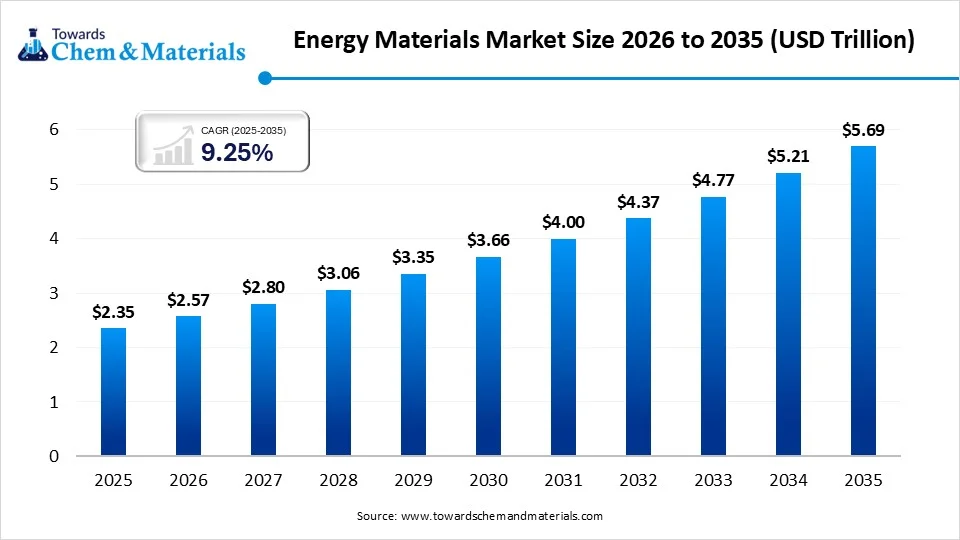
The global energy materials market size is expected to grow from USD 2.57 trillion in 2026 to USD 5.69 trillion in 2035, growing at a CAGR of 9.25% from 2026 to 2035. The top key players in the market areLG Energy Solution, Ltd, Panasonic Holdings Corporation, Samsung SDI Co., Ltd.,Albemarle Corporation, Umicore SA, Johnson Matthey plc, Sociedad Química y Minera de Chile S.A. (SQM), BASF SE, Sumitomo Metal Mining Co., Ltd., Contemporary Amperex Technology Co., Limited (CATL)-Global Forecast 2026 To 2035
Content
What is the Current Energy Materials Market Size and Share?
The global energy materials market size was estimated at USD 2.35 trillion in 2025 and is expected to increase from USD 2.57 trillion in 2026 to USD 5.69 trillion by 2035, growing at a CAGR of 9.25% from 2026 to 2035. Asia Pacific dominated the energy materials market with the largest revenue share 45.00% in 2025. The ongoing shift towards decarbonized power systems is the key factor driving market growth. Also, an increase in emphasis on circular economy principles, coupled with the surge in investment in infrastructure projects, can fuel market growth further. The market encompasses the development, manufacturing, and supply of materials crucial for energy creation, conversion, storage, and efficiency. It also includes innovative components such as photovoltaics, battery chemistries, and fuel cell components, emphasizing increasing safety, efficiency, and sustainability for renewable energy systems.
Market Highlights
- By region, Asia Pacific dominated the market with the largest share 45.00% in 2025. The dominance of the region can be attributed to the extensive ongoing investments in renewable energy.
- By region, North America is expected to grow at the fastest CAGR over the forecast period. The growth of the region can be credited to the rapid growth of the grid-scale energy storage.
- By material type, the metals & alloys segment dominated the market and accounted for the largest revenue share of 54.60% in 2025. The dominance of the segment can be attributed to the increasing investments in grid modernization.
- By material type, the battery & electrochemical materials segment is expected to grow at the fastest CAGR over the forecast period. The growth of the segment can be credited to the rapid innovations in lithium-ion.
- By application, the transmission & distribution infrastructure segment led the market with the largest revenue share of 25.70% in 2025. The dominance of the segment can be linked to the increasing electricity demand.
- By application, the energy storage systems segment is expected to grow at the fastest CAGR over the forecast period. The growth of the segment can be driven by the increasing integration of renewable energy.
Market Trends
- The growing demand for high precision weapons such as smart explosives nd guided munitions is the latest trend in the market, shaping positive market growth. Governments across the globe are heavily investing in cutting-edge explosives for hypersonic missiles, modern warfare, and counter-terrorism operations.
- The development of more efficient, safer, and sustainable energetic materials is revolutionising the market. Major companies are emphasizing nano-structured materials, low-toxicity explosives, and high-density formulations that offer longer shelf life, better performance, and improved safety.
- The ongoing integration of smart materials into different applications is increasingly becoming prevalent. These materials can adapt to environmental changes, improve energy efficiency by facilitating performance based on real-time conditions.
Report Scope
| Report Attribute | Details |
| Market Size in 2026 | USD 2.57 Trillion |
| Revenue Forecast in 2035 | USD 5.69 Trillion |
| Growth Rate | CAGR 9.25% |
| Forecast Period | 2026 - 2035 |
| Base Year | 2025 |
| Dominant Region | Asia Pacific |
| Segment Covered | By Material Type, By Application, By Region |
| Key companies profiled | LG Energy Solution, Ltd, Panasonic Holdings Corporation, Samsung SDI Co., Ltd.,Albemarle Corporation, Umicore SA, Johnson Matthey plc, Sociedad Química y Minera de Chile S.A. (SQM), BASF SE, Sumitomo Metal Mining Co., Ltd., Contemporary Amperex Technology Co., Limited (CATL) |
How Cutting-Edge Technologies Are Revolutionizing the Energy Materials Market?
Advanced technologies are revolutionizing the energy materials market by boosting material discovery, improving performance and minimizing costs, optimizing its overall storage and distribution. Furthermore, robotics, AI, and high-performance computing are rapidly being used to create self-driving and autonomous labs that discover new materials more efficiently and in much less time than traditional methods.
Trade Analysis of the Energy Materials Market Import & Export Statistics
- In 2024, U.S. total energy exports reached a record high of approximately 30.92 quadrillion British thermal units (quads), growing by roughly 4% over 2023 levels.
- In 2024, imported petroleum products (including gasoline and distillates) constituted approximately 16% of total U.S. energy imports while representing about 37% of total energy exports, according to U.S. Energy Information Administration data.
- In 2024, Chinese equipment exports reached $177bn. Alongside this, Chinese firms announced $58bn in overseas clean-energy manufacturing projects and $24bn in power generation/storage deals between 2023 and 2024.
- As of April 1, 2024, India holds one of the world's largest coal reserves, with total estimated stock rising by 11.21 billion tonnes (a 2.97% increase) to 389.42 billion tonnes for the 2023-24(P) period compared to 2022-23, according to Ministry of Statistics and Program Implementation data.
Energy Materials Market Supply Chain Analysis
Feedstock Procurement
- It refers to the strategic process of sourcing, acquiring, and monitoring raw or intermediate materials necessary to produce energy products like batteries, biofuels, and renewable energy components.
- Major Players: Drax Group plc, Enviva Inc.
Chemical Synthesis and Processing
- It refers to the artificial execution of chemical reactions and physical manipulations to produce innovative materials for energy applications like solar cells, batteries, and fuel cells.
- Major Players: Umicore, LG Chem
Packaging and Labelling
- It involves the specialized containment, protection, and detection of materials crucial for energy storage and generation, like solar panels and specialized chemicals.
- Major Players: Ball Corporation, Sealed Air Corporation
Regulatory Compliance and Safety Monitoring
- It involves adhering to stringent safety, environmental, and quality standards to ensure operational safety, manage hazardous materials, and meet sustainability goals.
- Major Players: Schneider Electric SE, ABB Ltd
Energy Materials Market's Regulatory Landscape: Global Regulations
| Country/Region | Key Regulations |
| United States | The One Big Beautiful Bill Act (OBBBA), signed July 2025, restructures clean energy incentives. Stringent Foreign Entity of Concern (FEOC) rules take effect in 2026, requiring at least 55% of project costs to come from non-prohibited foreign suppliers to qualify for full credits |
| European Union | The EU Battery Regulation will impose mandatory carbon footprint declarations and due diligence for industrial batteries starting in 2026. By February 2027, a full electronic "Battery Passport" for lifecycle traceability will be required. |
| China | A February 2025 policy shift now requires 100% of solar and wind generation to be traded on the wholesale market, removing mandatory energy storage as a grid-connection prerequisite. |
| India | From June 1, 2026, solar developers must use locally manufactured PV cells. The Electricity (Amendment) Rules 2025 formally recognize Energy Storage Systems (ESS) as a distinct grid element and allow for consumer-owned storage. |
Segmental Insights
Material Type Insights
How Much Share Did Metals & Alloys Segment Held in Energy Materials Market in 2025?
The metals & alloys segment dominated the market with the largest share 54.60% in 2025. The dominance of the segment can be attributed to the increasing investments in grid modernization and renewable energy infrastructure, along with the ongoing demand for corrosion-resistant and lightweight materials. In addition, the adoption of additive production enables the customization and enhanced efficiency in manufacturing high-performance alloy components.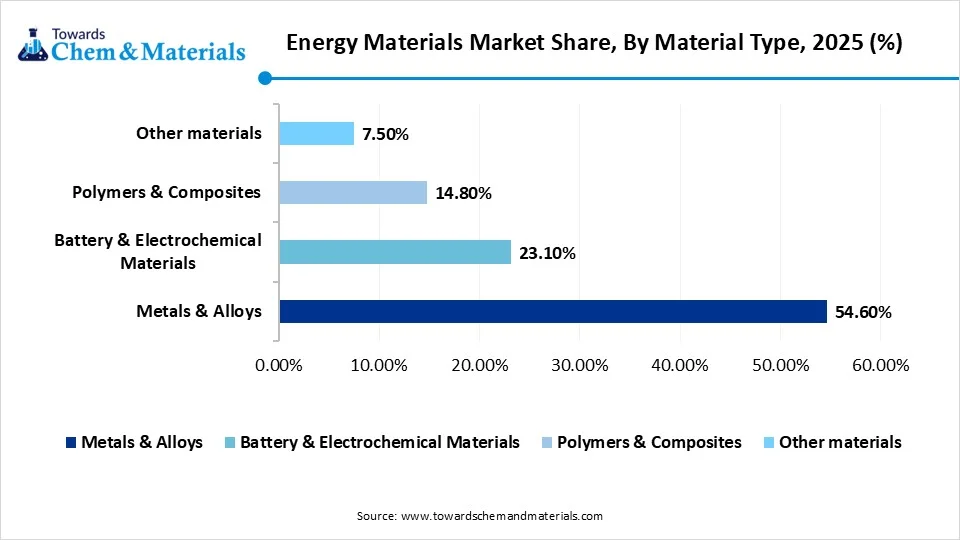
The battery & electrochemical materials segment is expected to grow at the fastest CAGR over the forecast period. The growth of the segment can be credited to the rapid innovations in lithium-ion and solid-state technologies. Increasing incorporation of wind and solar energy into power grids is fuelling demand for stationary and large-scale battery storage solutions, contributing to segment growth soon.
Energy Materials Market Share, By Material Type , 2025 (%)
| By Material Type | Revenue Share, 2025 (%) |
| Metals & Alloys | 54.60% |
| Battery & Electrochemical Materials | 23.10% |
| Polymers & Composites | 14.80% |
| Other materials | 7.50% |
Application Insights
Which Application Dominated the Energy Materials Market in 2025?
The transmission & distribution infrastructure segment held the largest market share 25.70% in 2025. The dominance of the segment can be linked to the increasing electricity demand, rapid urbanisation, and integration of renewable energy. Furthermore, the ongoing adoption of electric vehicles (EVs) with the extensive development of charging networks is substantially raising the load on distribution systems.
The energy storage systems segment is expected to grow at the fastest CAGR over the forecast period. The growth of the segment can be driven by increasing integration of renewable energy, along with the growing demand for grid modernization. Moreover, utilities are rapidly investing in storage to offer ancillary services, improve reliability, and minimize power outages, leading to segment growth.
Energy Materials Market Share, By Application , 2025 (%)
| By Application | Revenue Share, 2025 (%) |
| Renewable Power Generation | 22.40% |
| Energy Storage Systems | 18.30% |
| Transmission & Distribution Infrastructure | 25.70% |
| Electric Mobility | 20.10% |
| Hydrogen & Fuel Cell Systems | 8.60% |
| Other Applications | 4.90% |
Regional Insights
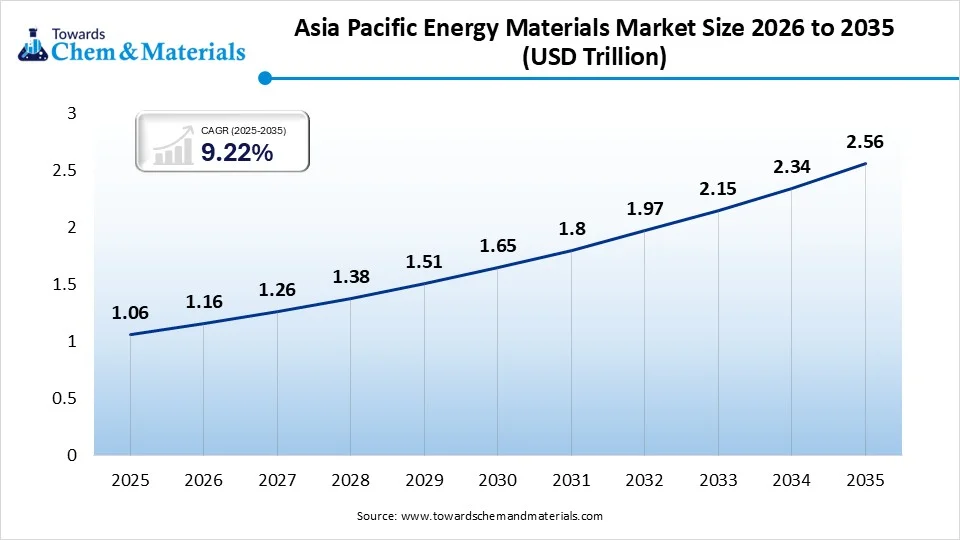
The Asia Pacific energy materials market size was valued at USD 1.06 billion in 2025 and is expected to be worth around USD 2.56 billion by 2035, exhibiting at a compound annual growth rate (CAGR) of 9.22% over the forecast period from 2026 to 2035. Asia Pacific dominated the market with the largest share 45.00% in 2025. The dominance of the region can be attributed to the extensive ongoing investments in renewable energy and the wide adoption of EVs, particularly in emerging economies such as China and India. In addition, there is a substantial shift towards Lithium Iron Phosphate (LFP) materials because of their cost-effectiveness and safety for mass-market EVs and energy storage.
China Energy Materials Market Trends
In the Asia Pacific, China dominated the market owing to the extensive investments in wind, solar, and battery storage, along with the rapid transition towards industrial decarbonization. Also, countries manufacture the majority of the world's battery cells and refine most essential minerals, promoting the massive demand for Electric Vehicles (EVs) and grid storage.
North America Energy Materials Market Trends
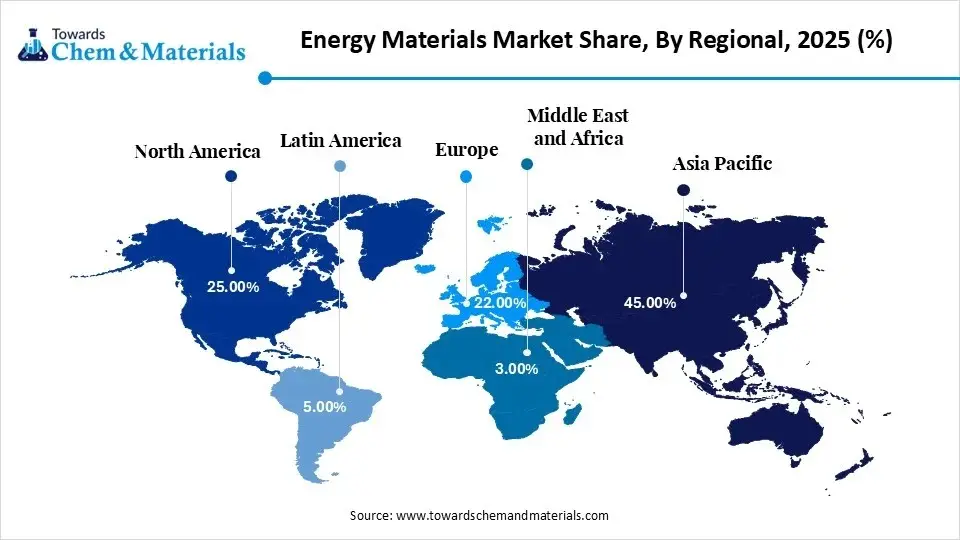
North America energy materials market segment accounted for the major revenue share 25.00% in 2025.North America is expected to grow at the fastest CAGR over the forecast period. The growth of the region can be credited to the rapid growth of the grid-scale energy storage and the growing need for lightweight materials in the aerospace/automotive sectors. Additionally, extensive investments in R&D for cutting-edge materials like solid-state batteries, nanomaterials, and phase-change materials are propelling market growth further.
U.S. Energy Materials Market Trends
In North America, the U.S. led the market due to the rise in demand for battery materials and substantial investment in domestic supply chain resiliency. Moreover, corporate initiatives for sustainability and decarbonization are increasing the need for efficient construction, insulation, and energy management materials.
Europe Energy Materials Market Trends
Europe energy materials market segment accounted for the major revenue share 22.00% in 2025.Europe is expected to grow at a notable CAGR over the forecast period. The growth of the region can be driven by the rapid innovations in high-performance materials and recycling processes, coupled with the supportive EU regulatory standards. Furthermore, the aerospace, automotive, and construction sectors are using more high-performance and lightweight materials to fulfil sustainability goals.
Energy Materials Market Share, By Regional, 2025 (%)
| Regional | Revenue Share, 2025 (%) |
| North America | 25.00% |
| Europe | 22.00% |
| Asia Pacific | 45.00% |
| Latin America | 5.00% |
| Middle East & Africa | 3.00% |
Germany Energy Materials Market Trends
The growth of the market in the country can be boosted by the growing emphasis on securing raw materials to minimize import dependence and substantial investment in green hydrogen infrastructure. The integration of heat pumps and electric mobility is dramatically increasing the demand for batteries and advanced motors.
Recent Developments
- In October 2025, Brown University School of Engineering and Panasonic Energy Co., Ltd. launched a joint development initiative to enhance lithium-ion battery performance. The collaboration focuses on diagnosing materials degradation mechanisms to advance next-generation, high-performance battery technology.(Source: engineering.brown.edu)
- In June 2025, Redwood Materials, the battery recycling firm founded by former Tesla CTO JB Straubel, launched a new business unit called Redwood Energy to repurpose retired EV batteries for grid-scale energy storage. This volume accounts for approximately 90% of all lithium-ion battery recycling in North America.(Source:www.evinfrastructurenews.com)
Energy Materials Market Companies
- LG Energy Solution, Ltd: LG Energy Solution (LGES) is a global leader in the battery and energy materials market, currently ranking as the world's third-largest electric vehicle (EV) battery manufacturer with an 11% market share.
- Panasonic Holdings Corporation: Panasonic Holdings Corporation is a global leader in the energy materials market, primarily through its subsidiary Panasonic Energy Co., Ltd. The company focuses on the development and manufacture of lithium-ion batteries, which are critical for electric vehicles (EVs) and social infrastructure.
- Samsung SDI Co., Ltd.: Samsung SDI Co., Ltd. is a global leader in producing rechargeable batteries for electric vehicles (EVs), Energy Storage Systems (ESS), and electronic materials (semiconductors/displays).
Albemarle Corporation - Umicore SA
- Johnson Matthey plc
- Sociedad Química y Minera de Chile S.A. (SQM)
- BASF SE
- Sumitomo Metal Mining Co., Ltd.
- Contemporary Amperex Technology Co., Limited (CATL)
Segments Covered in the Report
By Material Type
- Metals & Alloys
- Battery & Electrochemical Materials
- Polymers & Composites
- Other materials
By Application
- Renewable Power Generation
- Energy Storage Systems
- Transmission & Distribution Infrastructure
- Electric Mobility
- Hydrogen & Fuel Cell Systems
- Other Applications
By Region
- North America
- U.S.
- Canada
- Mexico
- Europe
- Germany
- UK
- France
- Italy
- Spain
- Asia Pacific
- China
- India
- Japan
- South Korea
- Latin America
- Brazil
- Argentina
- Middle East & Africa
- Saudi Arabia
- South Africa
FAQ's
Question 1 : What is the current size and growth forecast of the global energy materials market?
Answer : The global energy materials market is projected to grow from USD 2.57 trillion in 2026 to USD 5.69 trillion by 2035, with a CAGR of 9.25%.
Question 2 : What are the key growth drivers of the energy materials market?
Answer : The ongoing transition to decarbonized power systems, investments in infrastructure, and the adoption of renewable energy materials are key drivers fueling market growth.
Question 3 : How are cutting-edge technologies impacting the energy materials market?
Answer : Advanced technologies like AI, robotics, and high-performance computing are revolutionizing material discovery, optimizing storage, and minimizing costs, enhancing energy material performance.
Question 4 : Who are the leading companies in the energy materials market and what are their strategies?
Answer : Leading companies like LG Energy Solution, Panasonic, and Samsung SDI are focusing on the development of high-performance lithium-ion batteries, energy storage systems, and advanced materials for renewable energy applications.
Meet the Team

Saurabh Bidwai
Principal Consultant
Saurabh Bidwai, a B.Tech Chemical Engineering graduate with 4+ years of experience, specializes in specialty chemicals, commodity chemicals, and engineered materials, offering valuable insights into market trends and emerging opportunities.

Aditi Shivarkar
Reviewed By
Aditi Shivarkar, with 14+ years in Chemical and Materials market research, specializes in Chemical and Materials. She ensures accurate, actionable insights, driving Towards Chemicals And Materials Analytics and Consulting excellence in industry trends and sustainability.