
Ethylene Vinyl Acetate Market Size, Share & Growth Analysis 2026-2035
The Ethylene Vinyl Acetate Market segmented By Type (Very Low Density Ethylene Vinyl Acetate, Low Density Ethylene Vinyl Acetate, Medium Density Ethylene Vinyl Acetate, High Density Ethylene Vinyl Acetate), By Application (Film, Injection Molding, Compounding and Wire & Cable, Others Non-Extrusion, Others Extrusion, Extrusion Coating, Printing Ink), By End-Use Industry (Footwear & Foams, Packaging, Agriculture, Photovoltaic Panels, Pharmaceuticals, Others)-Global Industry Analysis, Size, Trends, Leading Companies, Regional Outlook, and Forecast 2026 to 2035
Content
What is the Ethylene Vinyl Acetate Market Size and Share?
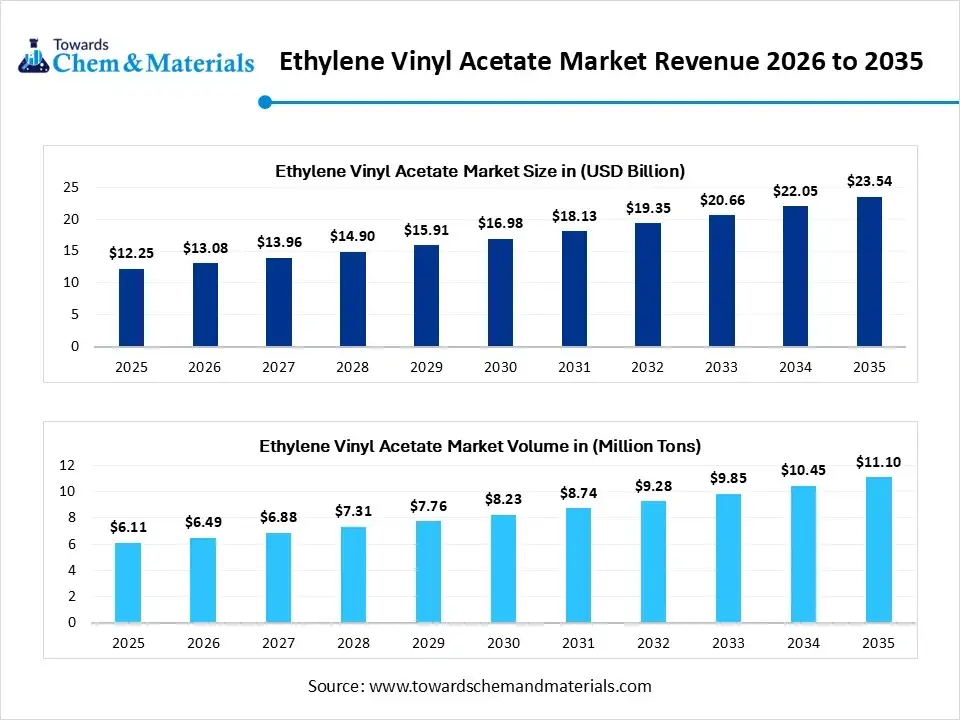
The global ethylene vinyl acetate market size was valued at USD 12.25 billion in 2025, is estimated to reach USD 13.08 billion in 2026, and is projected to reach USD 23.54 billion by 2035, exhibiting a compound annual growth rate (CAGR) of 6.75% over the forecast period from 2026 to 2035. Asia Pacific dominated the ethylene vinyl acetate market with the largest revenue share of 49 in 2025 and is expected to grow at the fastest CAGR of 8.65% during the forecast period. In terms of volume, the ethylene vinyl acetate Industry is projected to grow from 6.11 million tons in 2025 to 11.10 million tons by 2035. growing at a CAGR of 6.15% from 2026 to 2035.
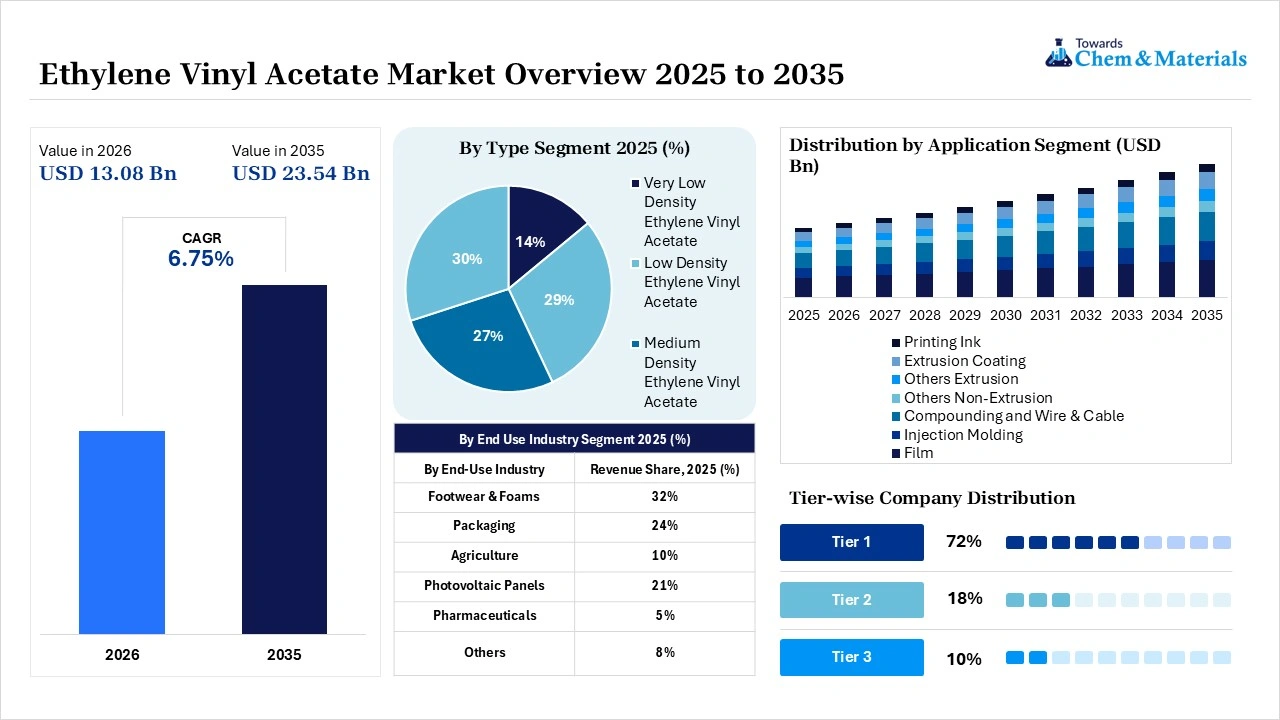
The Increasing demand for solar photovoltaic encapsulants is the key factor in driving market growth. Also, a rise in sustainable, flexible packaging coupled with stringent environmental regulations can fuel market growth further. The market encompasses the manufacturing, distribution, and sale of a diverse thermoplastic copolymer heavily used in packaging films, footwear, hot-melt adhesives, and biomedical applications. It is valued for its low temperature, excellent flexibility, toughness, shock-absorbing qualities, and stress-crack resistance. The transition towards renewable infrastructure depends heavily on advanced EVA films. The market is currently experiencing a strategic shift toward product customization and specialized applications. To meet the precise technical requirements of diverse industries,manufacturers are intensifying their research and development investments to pioneer innovative formulations. This evolving landscape is expected to cultivate deeper collaboration between producers and end-users, hence fostering a more integrated and resilient supply chain.
Market Highlights
- By region, Asia Pacific dominated the market with the largest share of 49.0% in 2025 and is expected to grow at the fastest CAGR of 7.80% over the forecast period. The dominance and growth of the region can be attributed to the rapid growth of the manufacturing sector.
- By region, North America held the market share of 18.00% in 2025. The growth of the region can be credited to the growing demand for solar panel encapsulation.
- By type, the high density ethylene vinyl acetate segment dominated the market with 30.0% share in 2025 and is expected to grow at the fastest CAGR of 8.40% over the forecast period. The growth of the segment can be credited to its high stiffness.
- By application, the film segment dominated the market with the largest share of 28.0% in 2025. The dominance of the segment can be attributed to the increasing demand from packaging.
- By application, the printing ink segment held a market share of 6.0% in 2025 and is expected to grow at the fastest CAGR of 7.10% over the forecast period. The growth of the segment can be credited to the growing demand for sustainable hot melt inks.
- By end-use industry, the footwear & foams segment dominated the market with the largest share of 32.0% in 2025. The dominance of the segment can be attributed to the increasing demand for shock-absorbing shoes.
- By end-use industry, the photovoltaic panels segment held a market share of 21.0% in 2025 and is expected to grow at the fastest CAGR of 9.30% over the forecast period. The growth of the segment can be credited to the surge in need for utility-scale solar projects.
Market Trends
- Increasing product demand in the packaging sector is the latest trend in the market, shaping positive market growth. Also, this surge is mainly driven by the material's excellent flexibility, clarity, and resistance to UV radiation, which makes it a crucial choice for different packaging applications.
- The increasing demand for sustainable energy solutions, especially in the solar energy sector, is another major factor in driving market expansion. Ethylene vinyl acetate is a vital material utilized in the manufacturing of solar panel encapsulants, which helps in protecting photovoltaic cells from environmental factors.
- Innovations in polymerization techniques and the ongoing development of new catalysts are improving the overall quality and efficiency of ethylene vinyl acetate production. These advances can minimize overall manufacturing costs and enhance the materials' properties.
Report Scope
| Report Attributes | Details |
| Market Size and Volume in 2026 | USD 13.08 Billion / 6.49 Million Tons |
| Revenue Forecast in 2035 | USD 23.54 Billion / 11.10 Million Tons |
| Growth Rate | CAGR 6.75% |
| Base Year of Estimation | 2025 |
| Forecast Period | 2025 - 2035 |
| High Impact Region | Asia Pacific |
| Segment Covered | By Type, By Application, By End-Use Industry, By Region |
| Key Companies Profiled | LyondellBasell Industries N.V. (Netherlands), Celanese Corporation (USA), E.I. du Pont de Nemours and Company (USA), Hanwha Chemical Corporation (South Korea), Braskem S.A. (Brazil), LG Chem Ltd. (South Korea), Arkema S.A. (France), Saudi Basic Industries Corporation (SABIC) (Saudi Arabia), BASF SE (Germany), Formosa Plastics Corporation (Taiwan), TotalEnergies SE (France) |
How Are Cutting-Edge AI Technologies Revolutionizing the Ethylene Vinyl Acetate Market?
AI is revolutionizing the market by boosting material R&D, facilitating petrochemical manufacturing, and fueling precision manufacturing in end-use applications such as 3D-printed footwear and solar panels. Furthermore, AI-driven process monitors, and digital twins optimize chemical reactions, substantially minimizing energy consumption.
Supply Chain Analysis of the Ethylene Vinyl Acetate Market
- Feedstock Procurement:It refers to the essentials of raw materials, mainly ethylene and vinyl acetate monomer (VAM), utilized to manufacture EVA copolymers.
- Major Players: ExxonMobil, Dow
- Chemical Synthesis and Processing:It refers to the chemical utilized to create the raw polymer resin, while "processing" includes the mechanical methods utilized to turn those raw resins into useful industrial or consumer products.
- Major Players: Sinopec Corporation, LyondellBasell Industries
- Packaging and Labeling:It refers to the use of EVA-based hot-melt adhesives and EVA copolymers in flexible packaging, extrusion coatings, and industrial applications.
- Major Players: Celanese Corporation, Hanwha Solutions
- Regulatory Compliance and Safety Monitoring:It ensures products are convenient and safe for end users, are environmentally sustainable, and fulfilling global manufacturing standards. It includes stringent testing for toxicity and chemical migration across different sectors.
- Major Players: DuPont de Nemours, Inc., Saudi Basic Industries Corporatio
Ethylene Vinyl Acetate Market's Regulatory Landscape: Global Regulations
| Country/Region | Key Regulations |
| European Union (EU) | Food Contact Regulations: EVA used in food packaging must adhere to EU Regulation No 10/2011 regarding plastic materials intended to come into contact with food |
| United States | For packaging and medical applications, EVA is regulated by the Food and Drug Administration (FDA) under 21 CFR 177.1350 (ethylene-vinyl acetate copolymers). This specifies allowable vinyl acetate content percentages based on the type of food contact. |
| China | Food Contact (GB 4806.6-2016): EVA polymers are officially regulated under Standard SN# 101. While ethylene has no specific restrictions, Vinyl Acetate is bound by a strict Specific Migration Limit (SML) of 12 mg/kg |
Market Dynamics
Driver
The increasing use of ethylene vinyl acetate in the automotive sector is the major factor in driving market growth. This material is preferred for its exceptional adhesion properties and resistance to extreme temperatures, which makes it convenient for different automotive components, such as interior and exterior parts. In addition, the lightweight properties of ethylene vinyl acetate (EVA) align well with industry goals, leading to an increase in its adoption.
Restraint
Increasing Regulatory Pressures
Growing regulatory pressures regarding sustainability practices create a major challenge for market penetration, which is the key factor in hindering market expansion. Governments across the globe are enforcing stringent environmental regulations, needing companies to fulfill higher standards for minimizing carbon emissions. Moreover, the accelerated consumer demand for eco-friendly goods exerts additional pressure on manufacturers to innovate and satisfy sustainability expectations.
Opportunity
Research and Development Efforts
Ongoing research and development efforts have facilitated the introduction of innovative EVA products with enhanced properties like improved flexibility, adhesion, and durability. These innovations are further increasing the application areas of EVA by attracting new consumers. Furthermore, ethylene-vinyl acetate (EVA) is utilized in critical infrastructure applications, including wire and cable insulation, protective coatings, and industrial sealants. The integration of technological advancements and the prioritization of hygiene and safety are accelerating the adoption of EVA in medical applications.
Segmental Insights
Type Insights
The high density ethylene vinyl acetate segment dominated the market with 30.0% share in 2025 and is expected to grow at the fastest CAGR of 8.40% over the forecast period. The dominance of the segment can be credited to its high stiffness, better strength, and improved thermal and UV stability. High-density EVA gives improved tensile strength and greater chemical resistance.
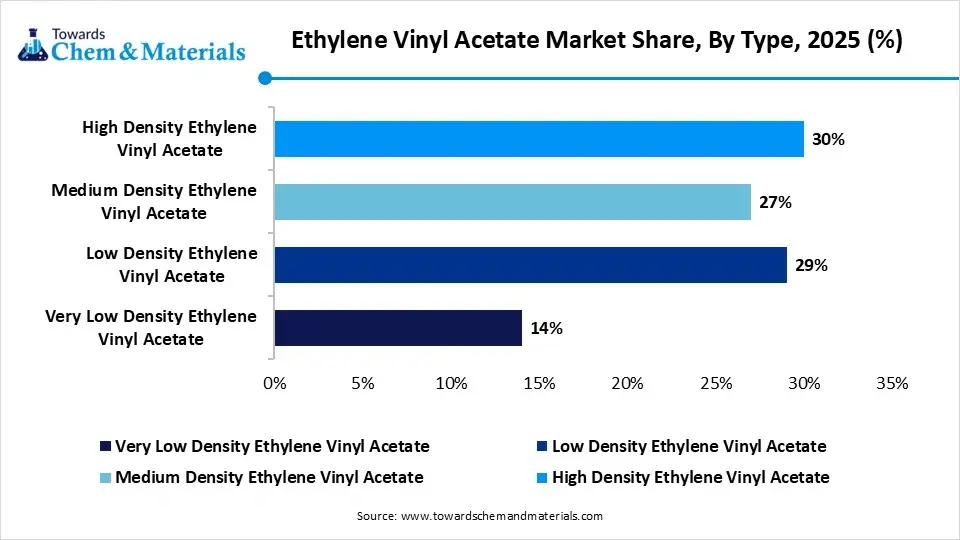 The low density ethylene vinyl acetate segment held the 29.0% market share in 2025. The growth of the segment can be attributed to the increasing demand for photovoltaic (solar) cell encapsulation and surge in manufacturing flexible and lightweight footwear.
The medium density ethylene vinyl acetate segment held a market share of 27.00% in 2025. The growth of the segment can be linked to its better shock absorption, flexibility, and elasticity coupled with the surge in demand for automotive components. Market players are focusing on medium-density EVA in athletic shoe soles further.
The very low density ethylene vinyl acetate segment held a market share of 14.00% in 2025. The growth of the segment can be driven by its low-temperature toughness, excellent flexibility, and high clarity. VLD-EVA is increasingly used for multilayer food and medical packaging films, leading to segment growth soon.
Application Insights
The film segment dominated the market with the largest share of 28.0% in 2025. The dominance of the segment can be attributed to the increasing demand from the packaging and agriculture sectors along with the extensive adoption of flexible packaging materials. This film acts as a crucial sealing and insulating layer for solar photovoltaic (PV) cells.
The printing ink segment held a market share of 6.0% in 2025 and is expected to grow at the fastest CAGR of 7.10% over the forecast period. The growth of the segment can be credited to the growing demand for sustainable hot melt inks and the expanding flexible packaging industry. EVA copolymers give excellent bonding strength and flexibility.
The compounding and wire & cable segment held a market share of 22.00% in 2025. The growth of the segment can be linked to the ongoing transition towards zero-halogen cables and rising technological integration in telecommunications and automotive sectors.
The injection molding segment held a market share of 14.00% in 2025. The growth of the segment can be driven by its exceptional flexibility, processability, and stress-crack resistance. The surge in production of comfortable, lightweight, and durable footwear in emerging regions can fuel market growth soon.
End-Use Industry Insights
The footwear & foams segment dominated the market with the largest share of 32.0% in 2025. The dominance of the segment can be attributed to the increasing demand for shock-absorbing, lightweight, and comfortable shoe components along with the rapid transition towards functional and molded foam footwear.The photovoltaic panels segment held the market share of 21.0% in 2025 and is expected to grow at the fastest CAGR of 9.30% over the forecast period. The growth of the segment can be credited to the surge in need for utility-scale solar projects and the rise in government incentives for solar installations.
The packaging segment held a market share of 24.00% in 2025. The growth of the segment can be linked to the rapid expansion in e-commerce and ready-to-eat foods coupled with the advancements in bio-based EVA. Also, EVA exhibits excellent performance and flexibility at extremely low temperatures.
The agriculture segment held a market share of 10.00% in 2025. The growth of the segment can be driven by increasing use of EVA copolymer films in crop protection and greenhouse covers along with their excellent thermal insulation. EVA films facilitate the greenhouse microclimate by retaining heat during cold nights.
Regional Insights
How did Asia Pacific Dominate the Ethylene Vinyl Acetate Market in 2025?
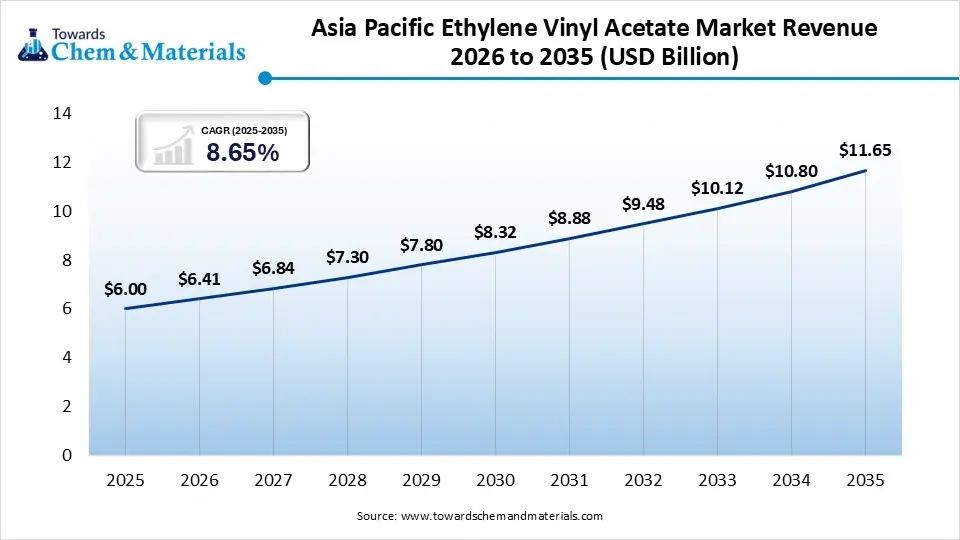
The Asia Pacific ethylene vinyl acetatemarket size was estimated at USD 6.00 billion in 2025 and is projected to reach USD 11.65 billion by 2035, growing at a CAGR of 8.65% from 2026 to 2035.Asia Pacific dominated the market with the largest share of 49.0% in 2025 and is expected to grow at the fastest CAGR of 7.80% over the forecast period. The dominance and growth of the region can be attributed to the rapid growth of the manufacturing sector and robust investments in the renewable energy sector. In addition, major players are expanding their EVA manufacturing facilities to fulfill the increasing renewable energy demand.
 China
China
- China's extensive solar photovoltaic (PV) farm constructions and robust renewable energy goals are the major market drivers.
- The rapidly growing e-commerce and food and beverage sectors are fueling the demand for EVA in films, laminates, and hot-melt adhesives.
India
- EVA films are crucial for encapsulating photovoltaic (PV) cells to protect them against environmental damage.
- The material's flexibility and toughness make it crucial for hot-melt adhesives and protective packaging films.
The North America ethylene vinyl acetatemarket size was estimated at USD 2.21 billion in 2025 and is projected to reach USD 4.35 billion by 2035, growing at a CAGR of 7.01% from 2026 to 2035.North America held a market share of 18.00% in 2025. The growth of the region can be credited to the growing demand for solar panel encapsulation and sustainable packaging solutions. Furthermore, the region's large pharmaceutical and food and beverage industries mainly rely on EVA-based films and adhesives.
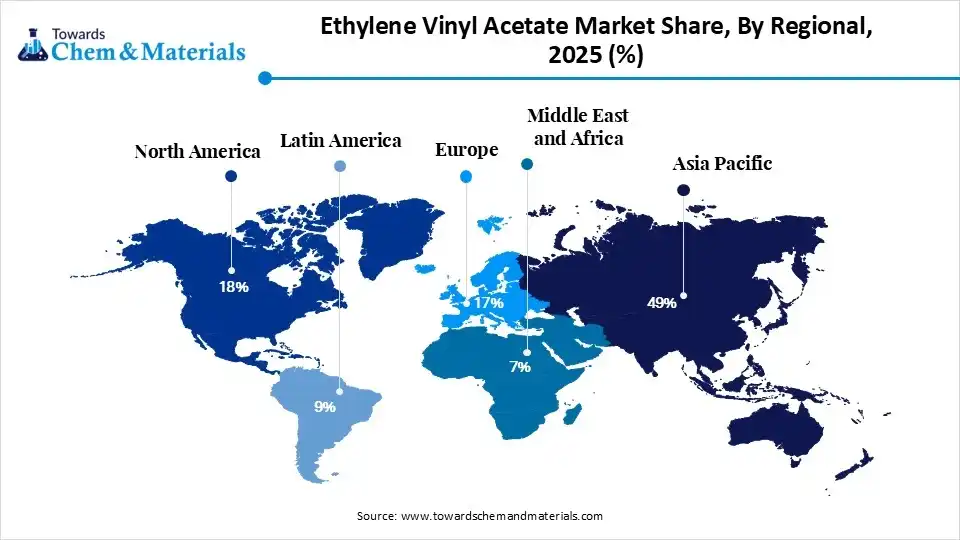
Ethylene Vinyl Acetate Market Share, By Regional, 2025 (%)
| Regional | Revenue Share, 2025 (%) |
| Asia-Pacific | 49% |
| North America | 18% |
| Europe | 17% |
| Latin America | 9% |
| Middle East & Africa | 7% |
United States
- Increasing utility-scale solar farms and supportive North American clean energy policies drive massive demand.
- EVA's flexibility, clarity, and low-temperature sealing characteristics make it highly sought after for flexible packaging films and industrial adhesives.
Canada
- The shift toward sustainable, flexible films and hot-melt adhesives for e-commerce and food and beverage sectors is a major factor driving market growth.
- The footwear and sports equipment industry is witnessing growth due to increasing consumer need for durable and lightweight footwear.
The Europ ethylene vinyl acetatemarket size was estimated at USD 2.08 billion in 2025 and is projected to reach USD 4.12 billion by 2035, growing at a CAGR of 7.07% from 2026 to 2035.Europe held a market share of 17.00% in 2025. The growth of the region can be driven by ongoing advancements in sustainable and flexible industrial materials along with the intensive sustainability mandates. Also, the region is emphasizing more bio-based and recyclable polymers, pushing market players to develop and adopt bio-based EVA alternatives.
 Germany
- Increasing demand for bio-based and sustainable packaging films along with the expanding German automotive and footwear sectors.
- EVA is heavily used for interior trims, acoustic insulation, and lightweight components, impacting positive market growth soon.
The Latin America ethylene vinyl acetatemarket size was estimated at USD 1.10 billion in 2025 and is projected to reach USD 2.24 billion by 2035, growing at a CAGR of 7.37% from 2026 to 2035.Latin America held a market share of 8.00% in 2025. The growth of the region can be linked to the growing footwear production sector and increasing demand for flexible packaging. Moreover, innovations in EVA technology offer improved UV resistance and recyclability, aligning perfectly with regional sustainability goals and mandates.
Brazil
- EVA granules are extensively used to manufacture lightweight, comfortable, and durable shoe midsoles and slippers.
- Brazilian market players benefit from local technical skills, strong regional trade distribution for South America, and regulatory backing from agencies like ANVISA and IBAMA.
Argentina
- The transition toward solar energy is a primary driver. EVA is crucial for encapsulating photovoltaic cells, protecting them from moisture and weather degradation.
- Argentina's strong shoe industry uses EVA extensively for lightweight, flexible, and durable shoe soles and athletic footwear components.
The Middle East & Africa ethylene vinyl acetatemarket size was estimated at USD 0.86 billion in 2025 and is projected to reach USD 1.77 billion by 2035, growing at a CAGR of 7.48% from 2026 to 2035.The Middle East & Africa held a market share of 8.00% in 2025. The growth of the region is owing to the rise in investment in renewable energy and the expanding footwear sector. In addition, the increasing disposable income due to the surge in population is driving the demand for comfortable and lightweight casual footwear, where EVA is a main material for soles.
Saudi Arabia
- Investments in solar energy projects need EVA for encapsulating photovoltaic (PV) cells. The increasing solar footprint in the region directly drives specialty EVA demand.
- The surge in localized e-commerce and the food and beverage sector creates high demand for flexible, lightweight, and protective EVA packaging films.
UAE
- The rise in online shopping and rapid e-commerce growth have driven demand for lightweight, flexible, and protective packaging materials where EVA is extensively used.
- Ongoing government and private investments in large-scale infrastructure and real estate projects need high-quality EVA for adhesives, sealants, and coatings.
Recent Development
- In July 2025, Asian Paints Limited announced that its Board of Directors approved a scheme of amalgamation with its wholly owned subsidiary, Asian Paints (Polymers) Private Limited, to enhance operational efficiencies and minimize corporate redundancies.(Source:scanx.trade)
Ethylene Vinyl Acetate Market Companies
- Exxon Mobil Corporation: ExxonMobil is one of the leading global producers of ethylene vinyl acetate (EVA) resins and polymers. Their product solutions cater to the rapidly growing multi-billion dollar ethylene vinyl acetate market, which is driven primarily by the packaging, agricultural, and automotive sectors.
- Dow Inc.: Dow Inc. is a global market leader in the Ethylene Vinyl Acetate market, driven by its flagship ELVAX™ copolymer resin portfolio. They compete as a primary producer, specializing in high-performance, sustainable, and renewable-focused EVA grades utilized in flexible packaging, solar modules, and industrial foams.
Other Companies in the Market
- LyondellBasell Industries N.V. (Netherlands)
- Celanese Corporation (USA)
- E.I. du Pont de Nemours and Company (USA)
- Hanwha Chemical Corporation (South Korea)
- Braskem S.A. (Brazil)
- LG Chem Ltd. (South Korea)
- Arkema S.A. (France)
- Saudi Basic Industries Corporation (SABIC) (Saudi Arabia)
- BASF SE (Germany)
- Formosa Plastics Corporation (Taiwan)
- TotalEnergies SE (France)
Segments Covered in the Report
By Type
- Very Low Density Ethylene Vinyl Acetate
- Ultra-Flexible EVA Grades
- Specialty Foam EVA Grades
- Low Density Ethylene Vinyl Acetate
- General-Purpose EVA
- Flexible Packaging EVA
- Medium Density Ethylene Vinyl Acetate
- Wire & Cable EVA
- Industrial Compounding EVA
- High Density Ethylene Vinyl Acetate
- Photovoltaic Encapsulation EVA
- High-Performance Industrial EVA
By Application
- Film
- Agricultural Films
- Packaging Films
- Stretch Films
- Injection Molding
- Footwear Components
- Consumer Goods Components
- Compounding and Wire & Cable
- Wire Insulation
- Cable Sheathing
- Others Non-Extrusion
- Adhesives
- Sealants
- Others Extrusion
- Profiles
- Tubing
- Extrusion Coating
- Carton Coating
- Flexible Packaging Coating
- Printing Ink
- Solvent-Based Inks
- Specialty Printing Inks
By End-Use Industry
- Footwear & Foams
- Sports Footwear
- Casual Footwear
- Foam Products
- Packaging
- Flexible Packaging
- Protective Packaging
- Agriculture
- Greenhouse Films
- Mulch Films
- Photovoltaic Panels
- Solar Module Encapsulation
- Backsheet Applications
- Pharmaceuticals
- Drug Packaging
- Medical Components
- Others
- Automotive
- Consumer Goods
- Electronics
By Region
- North America
- U.S.
- Canada
- Europe
- Germany
- UK
- France
- Italy
- Spain
- Sweden
- Denmark
- Norway
- Asia Pacific
- China
- Japan
- India
- South Korea
- Thailand
- Latin America
- Brazil
- Mexico
- Argentina
- Middle East & Africa
- South Africa
- UAE
- Saudi Arabia
- Kuwait
FAQ's
Meet the Team

Saurabh Bidwai
Principal Consultant
Saurabh Bidwai, a B.Tech Chemical Engineering graduate with 4+ years of experience, specializes in specialty chemicals, commodity chemicals, and engineered materials, offering valuable insights into market trends and emerging opportunities.

Aditi Shivarkar
Reviewed By
Aditi Shivarkar, with 14+ years in Chemical and Materials market research, specializes in Chemical and Materials. She ensures accurate, actionable insights, driving Towards Chemicals And Materials Analytics and Consulting excellence in industry trends and sustainability.