
Europe AI in Chemicals Market Size, Share, Trends, Growth and Forecast 2026-2035
The Europe AI in chemicals market report is Segmented By Component(Software, Hardware, Services), By Technology(Machine Learning, Natural Language Processing, Computer Vision, Context-Aware Computing, Predictive Analytics, Digital Twin Technology, Generative AI), By Deployment Mode(Cloud-Based, On-Premise, Edge Deployment), By Application(Process Optimization, Predictive Maintenance, Supply Chain Optimization, Drug Discovery & Molecular Design, Quality Control & Inspection, Safety & Risk Management, Emission Monitoring & Sustainability, Research & Development Automation), By End User(Specialty Chemicals, Petrochemicals, Agrochemicals, Pharmaceutical Chemicals, Polymers & Plastics, Industrial Gases, Paints & Coatings, Fertilizers, Adhesives & Sealants), By Enterprise Size(Large Enterprises, Medium Enterprises, Small Enterprises), By Function(Production, Research & Development, Supply Chain & Logistics, Sales & Marketing, Regulatory Compliance, Environmental Management)- Global Industry Analysis, Size, Share, Growth, Trends, Regional Analysis And Forecast 2026 To 2035
Content
What is the current Europe AI in Chemicals Market Size and Share?
The Europe AI in chemicals market size was valued at USD 626.85 million in 2025, is estimated to reach USD 821.86 million in 2026, and is projected to reach USD 9,408.53 million by 2035, exhibiting a compound annual growth rate (CAGR) of 31.11% over the forecast period from 2026 to 2035. The market growth is propelled by generative chemistry, European manufacturers' shift towards AI-driven automation, R &D focus on digital formulation, and regulatory compliance.
The Europe AI in chemicals market represent key for industrial advancement by combining high-performance computing with traditional process engineering. The domestic manufacturers are focused on the implementation of advanced machine learning and deep neural networks using diversified molecular datasets. Regional enterprise deploys AI-based automation and predictive maintenance for superior chemical efficiency and high-speed process optimization. Europe focuses on digital formulation that enables R&D of specialized polymers, high-performance catalysts, and advanced chemicals by offering a lower time-to-market for novel chemicals.
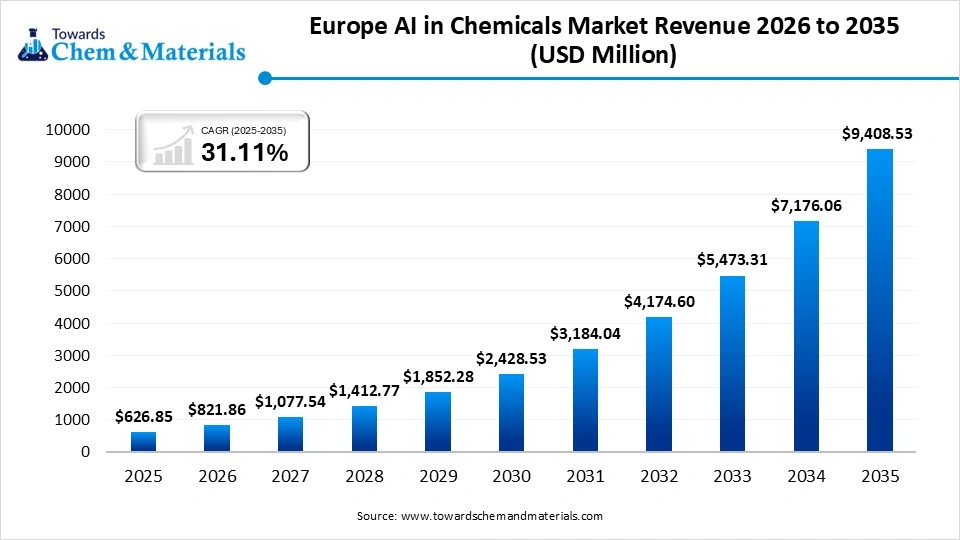
Europe revolution towards synchronization of IoT sensors by integrating virtual screening and real-time monitoring ensures that the chemical facilities can run continuous simulation models. European regulatory framework reinforces AI technologies adoption by applying predictive modeling towards carbon capture optimization. The region adopting digital twin for chemical synthesis, thermal dynamics, and pressure variance. The rising demand for sustainability boosts the transition towards bio-based chemical substitution and waste-stream reduction, accelerating the domestic expansion.
The AI in chemicals creates a system that offers prevention in toxic chemical leaks and optimizes energy use during highly resource-intensive manufacturing phases, which drives their utilization in Europe. The technological shift aligns with the green chemistry initiative allow European innovators to design sustainable chemicals. The regional data directives currently aim at value transparency, auditable algorithms by ensuring automated operational conclusions that make the European market safe, verified, and compliant in the chemicals sector to meet regional data privacy and worker safety standards.
Market Highlights
- By country, Germany dominated the Europe AI in chemicals market by holding a 29% share in 2025, driven by government support and deployment of AI in chemical manufacturing.
- By country, Rest of Europe held the 11% market share in 2025 and is expected to grow at the fastest with a CAGR of 17.80% during the forecast period due to substantial investment and sustainability compliance.
- By component, the software segment dominated the market with the largest share of 48% in 2025, driven by the requirement for optimized chemical plant efficiency and digital transformation initiatives.
- By component, the services segment held 25% market share in 2025 and is expected to grow at the fastest CAGR of 35.18% over the forecast period due to rising support for modernizing legacy systems for consulting and services.
- By technology, the machine learning segment dominated the market with the largest share of 29% in 2025 due to demand for real-time analytics and enhancement in process efficiency.
- By technology, the digital twin technology segment held 12% market share in 2025 and is expected to grow at the fastest CAGR of 35.11% over the forecast period due to its ability for virtual simulation and enhancement in operation sustainability.
- By deployment mode, the cloud-based segment dominated the market with the largest share of 54% in 2025 and is expected to grow at the fastest CAGR of 34.41% over the forecast period driven by lower upfront investment and demand for AI processing scalability for complex chemical datasets.
- By application, the process optimization segment dominated the market with the largest share of 24% in 2025 fuel by demand for improved yields and lower energy use in chemical production by maintaining cost competitiveness.
- By application, the drug discovery & molecular design segment held 14% market share in 2025 and is expected to grow at the fastest CAGR of 35.62% over the forecast period due to AI chemical formulation discovery processes and enhanced innovation efficiency.
- By end user, the specialty chemicals segment dominated the market with the largest share of 22% in 2025 due to demand for high-performance chemicals and advanced analytics to enhance manufacturing resilience.
- By end user, the pharmaceutical chemicals segment held 16% market share in 2025 and is expected to grow at the fastest CAGR of 35.84% over the forecast period riven by process automation and regulatory compliance for advanced quality monitoring solutions.
- By enterprise size, the large enterprises segment dominated the market with the largest share of 63% in 2025, driven by strong financial capacity and an advanced digital network.
- By enterprise size, the medium enterprises segment held 25% market share in 2025 and is expected to grow at the fastest CAGR of 33.94% over the forecast period, driven by the adoption of cloud AI solutions to enhance operational flexibility and cost competitiveness.
- By function, the production segment dominated the market with the largest share of 31% in 2025 due to AI's ability to optimize chemical production efficiency and energy management.
- By function, the research & development segment held 24% market share in 2025 and is expected to grow at the fastest CAGR of 35.66% over the forecast period, driven by advanced computational chemistry adoption and demand for molecular discovery efficiency.
Recent Market Trends
- Shift Towards Automated Discovery: The European Union strengthens REACH compliance, driving the shift towards a chemical-driven foundation model focus on molecular graph, SMILE strings, and quantum chemistry by ensuring performance optimization.
- Focus on Decentralized Edge-AI: The rising domestic focus on safety is driving the operators to deploy edge-AI processing hardware into an explosion-proof control room for higher output.
Report Scope
| Report Attribute | Details |
| Market Size in 2026 | USD 821.86 Million |
| Revenue Forecast in 2035 | USD 9,408.53 Million |
| Growth Rate | CAGR 31.11% |
| Forecast Period | 2026 - 2035 |
| Base Year | 2025 |
| Segment Covered | By Component, By Technology, By Deployment Mode, By Application, By End User, By Enterprise Size, By Function, By Countries |
| Key companies profiled | Schneider Electric, Hexagon AB, Brenntag S.E., Manuchar N.V., Iktos, Honeywell International Inc., Alphabet Inc Class A, IBM, Microsoft Corp, Google, AWS, NVIDIA Corp, Siemens, SAP, International Business Machines Corp. |
Supply Chain Analysis of the Europe AI in Chemicals Market
- Hardware Infrastructure and Data Ingestion: the stage of computational foundation and technology inputs like enterprise GPU clusters, ATX-certified hardware enclosures, edge fast Fourier transforms, and a hybrid cloud network for the collection and processing of chemical datasets.
- Key Players: Siemens AG, ABB Europe, Schneider Electric, NVIDIA Europe, and Bosch Rexroth
- Chemistry Models and Platform Advancement: The stage to translate raw structural data, SMILE strings, and crystalline geometry in GNN and molecular simulators. The technical inputs involve thermodynamic digital twins, an automated REACH screener, and graph neural networks.
- Key Players: IBM Research Europe, DeepMind Technologies, Schrodinger GmbH, and Eviden
- Industrial Execution: The stage of training AI algorithms directly into the automated synthesis lab and recycling infrastructure. The technical inputs like carbon tracking software, catalyst flexibility algorithms inovle for creation of real-time chemical products.
- Key Players: BASF SE, Indorama Venture Europe, Evonik Industries AG, and Solvay SA
Regulatory Framework: Europe AI in Chemicals Market
| Region | Primary Regulations | Regulatory Focus |
| European Union | EU AI Act Supported by REACH and ECHA regulations | Classification for automated chemical process control and high-risk AI systems. Focus on validating AI-generated molecular discovery and QSAR relationships. |
| Germany | Federal Data Protection Act and National AI Act Execution Strategy | Factory floor data security and IP leakage prevention in automated batch formulation and cloud networks. |
| Netherlands | Dutch Data Protection Authority AI Oversight Program | Focus on algorithmic transparency and structural bias mitigation within chemical load forecasting and raw material pricing algorithms. |
| France | CNIL Industrial AI Governance Framework | Standards for safety validation in predictive asset management |
Europe AI in Chemicals Market Dynamics
Driver
Regional Competitive Focus for Industrial Precision
The chemical manufacturers are inclined towards an energy-intensive model where the Europe company utilized an AI-deep reinforcement learning model to ensure thermodynamics and adjustment in energy inputs through real-time monitoring. The rising European industrial expansion is boosting the surge in demand for ultra-pure electronic-grade chemicals, which allows the adoption of computer vision and predictive models that enable filtration and synthesis systems through optimized production batches.
Restraints
High Heterogeneity of Data Assets
The traditional European chemical manufacturing plants run on a mix of legacy distributed control systems and disconnected data sheets. This data sheet required high capital investment and time for training precise machine learning models. The integration of AI-driven technology restrains manufacturers from delaying new rollout which restrains the market expansion.
Opportunity
Emerging European Focus on Green Engineering and Real-Time Carbon Accounting
The European REACH regulation is pushing manufacturers for new opportunities to utilize generative AI to design alternative molecules for the production of novel chemical structures to meet non-toxic and purity standards. Additionally, the chemical producers integrate AI models with lifecycle assessment software to track energy inputs and raw material sourcing by lowering logistics emissions in batch production, which fuels the opportunity to adopt verified and real-time low-carbon product certification.
Segmental Insights
Component Insights
The software segment dominated the market with the largest share of 48% in 2025. The regional expansion is driven by modern industrial demand for cloud-native platforms, simulation & modeling software, and specialized machine learning codebases. Software demand to run molecular property prediction to minimize research timelines for novel polymers and sustainable chemicals. European enterprise-grade software applications and AI-based laboratory informatics provide real-time autonomous process control and continuous monitoring in manufacturing practices.
The services segment held the 25% market share in 2025 and is expected to grow at the fastest CAGR of 35.18% over the forecast period, functioning as an optimized and complex algorithmic component utilized in Europe chemical enterprises. The region focuses on implementing specialised system integration through consulting, managed AI services, and maintenance services for operational support. The AI-driven specialized services offer data engineering workflows to meet European regulatory compliance by maintaining automated chemical processes
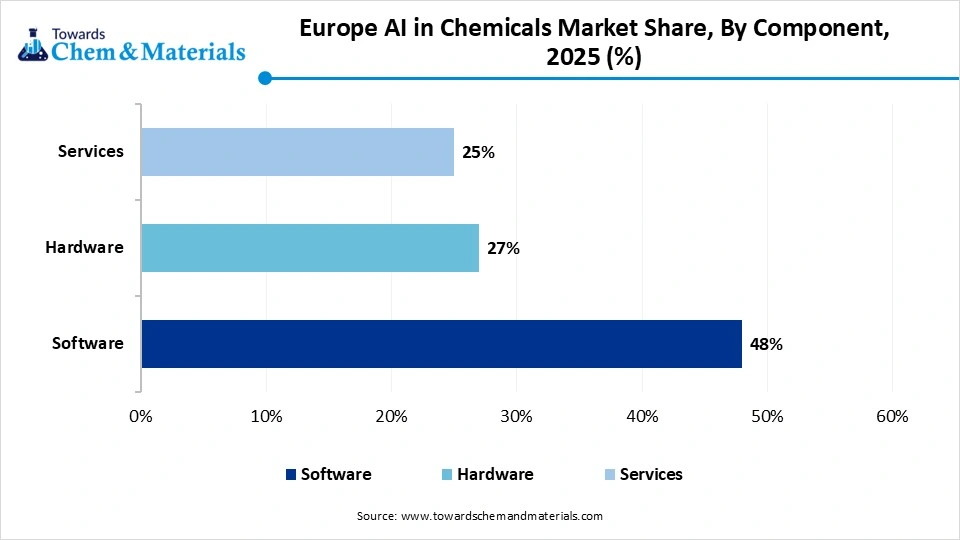
The hardware segment held the 27% market share in 2025, fueled by intelligence-driven industrial datasets. The segment maintains its leadership in high-performance computing clusters and decentralized edge processing nodes to maintain complex molecular simulations. Additionally, hardware components like edge AI processors, industrial IoT sensors, and robotics are installed in chemical facilities to calculate automated fluid dynamics, thermal spikes, and toxic chemical synthesis in an explosive environment.
Technology Insights
The machine learning segment dominated the market with the largest share of 29% in 2025. Europe focuses on advanced supervised learning frameworks and deep neural network engineering for identifying optimal compound stability and toxicological setup. The European chemical corporation utilized machine learning algorithms to run predictive formulation. Deploying reinforcement learning into a chemical process control system enables autonomous process optimization and adjusts temperature and flow rates by providing superior product yield to meet carbon- emission targets.
The predictive analytics segment held the 16% market share in 2025, serving as a key technology that combine statistical modeling framework with real-time operational data. The domestic chemical operators are adopting proactive intelligence to run high-fidelity reaction simulation and compound stability. By converting a continuous asset sensor stream, predictive analytics enables automated supply forecasting by eliminating costly downtime and improving precision in high-volume production in the European chemicals market.
Europe AI in Chemicals Market Share, By Technology, 2025 (%)
| By Technology | Revenue Share, 2025 (%) |
| Machine Learning | 29% |
| Natural Language Processing | 11% |
| Computer Vision | 13% |
| Context-Aware Computing | 8% |
| Predictive Analytics | 16% |
| Digital Twin Technology | 12% |
| Generative AI | 11% |
The digital twin technology segment held the 12% market share in 2025 and is expected to grow at the fastest CAGR of 35.11% over the forecast period. It is valued for its virtual validation in Europe chemical processing sector. This technology synthesizes real-time sensor telemetry with complex thermodynamic equations to provide accurate digital replicas of production lines. European chemical enterprises used simulation models to predict fluid dynamics, stress tests, and equipment safety in cyberspace. Additionally, digital twin drives autonomous anomaly detection and precise asset optimization by maximizing operational outputs and minimizing unsafe chemical emissions.
The computer vision segment held 13% market share in 2025, acting as automated visual intelligence across European chemicals infrastructure. This segment integrates industrial optical arrays with convolutional neural networks to run continuous and real-time quality inspection and safety monitoring across regional volatile processing sectors. Chemical manufacturers implement process surveillance for identifying structural defects in polymers and subtle color variations during continuous manufacturing. Overall, computer vision offers automated hazard detection and traceability of invisible chemical gases through thermal imaging to meet worker safety.
Deployment Mode Insights
The cloud-based segment dominated the market with the largest share of 54% in 2025 and is expected to grow at the fastest CAGR of 34.41% over the forecast period, driven by Europe chemical intelligence sector that focuses on scalability. The rising utilization of elastic-cloud infrastructure and remote-hyper-scale data units by avoiding the high capital expenses of domestic server maintenance. Additionally, domestic off-site chemical enterprises integrate software-as-a-service delivery models and execute resource-heavy molecular modeling for upgradation in production lines and scaling of deep learning workloads.
Europe AI in Chemicals Market Share, By Deployment Mode, 2025 (%)
| By Deployment Mode | Revenue Share, 2025 (%) |
| Cloud-Based | 54% |
| On-Premise | 33% |
| Edge Deployment | 13% |
The on-premise segment held the 33% market share in 2025, driven by a revolution towards preserving proprietary data, where Europe chemical market depends on localized server mainframes and private infrastructure. Regional chemical enterprises utilize this air-gapped deployment strategy to protect molecular patents and eliminate external cloud data. By adopting intensive chemical reaction modeling, maintaining zero network latency for real-time chemical operations, and autonomous factor control in chemical infrastructure, boosting the domestic expansion.
The edge deployment segment held the 13% market share in 2025. Europe's demand for real-time operational processing enables this decentralized framework installation in ruggedized processing nodes and smart production machinery. The domestic chemical manufacturers execute immediate valve adjustment, monitor volatile thermodynamic volatility, and activate automated safety shutdowns instantly. Edge deployment allows continuous autonomous operation by maintaining industrial telemetry safety.
Application Insights
The process optimization segment dominated the market with the largest share of 24% in 2025. It represents a yield and energy efficiency optimization that transform Europe chemical manufacturing practices. Process optimization integrates real-time prescription analytics and a closed-loop control system into the production line. European chemical manufacturers demand autonomous optimization for thermal fluctuation and pressure differentials during continuous systems. Additionally, the rising adoption of an autonomous calibration system for superior molecular purity and preventing raw material waste to meet the carbon-neutrality commitment is accelerating the applicational demand.
The predictive maintenance segment held the 15% market share in 2025, driven by regional focus towards the prevention of catastrophic equipment failures and uncertainty in manufacturing practices. Predictive maintenance combines continuous acoustic and vibration telemetry with deep anomaly-detection algorithms. The European chemical operators deploy proactive diagnostic engines to monitor high-pressure reactors, distillation columns, and cryogenic pipelines to meet stringent asset-integrity mandates. Europe's shift towards data-driven ecosystems aims to remove hazardous chemical leaks and emergency repair overheads.
Europe AI in Chemicals Market Share, By Application, 2025 (%)
| By Application | Revenue Share, 2025 (%) |
| Process Optimization | 24% |
| Predictive Maintenance | 15% |
| Supply Chain Optimization | 13% |
| Drug Discovery & Molecular Design | 14% |
| Quality Control & Inspection | 11% |
| Safety & Risk Management | 8% |
| Emission Monitoring & Sustainability | 7% |
| Research & Development Automation | 8% |
The drug discovery & molecular design segment held the 14% market share in 2025 and is expected to grow at the fastest CAGR of 35.62% over the forecast period. The expansion is driven by the European transition towards biomedical innovation. This segment utilizes generative chemistry and high-velocity computational screening to target complex atomic interactions. The European pharmaceutical sector adopts AI-driven technology for superior chemical repositories, compound safety, metabolic stability, and binding capabilities. By automating novel therapeutics and specialized polymers, this application lowers preclinical timelines and optimizes molecular integrity.
The supply chain optimization segment held 13% market share in 2025, functioning as a key logistical shield for Europe chemical industry to prevent volatile shipping lanes and protect environmental safety. This application adopts prescriptive logistics networks and an automated transport framework. Additionally, Europe chemical manufacturers and distributors utilized a predictive distribution platform to synchronize factor output and calculate precise transport carbon footprint by lowering inventory overhead to meet stringent EU reporting mandates.
End User Insights
The specialty chemicals segment dominated the market with the largest share of 22% in 2025, key for industrial AI execution align with eco-compliant alternatives by ensuring automated digital workflows. The stringent REACH compliance and downstream demand for generative molecular design and graph neural networks fueled the formulation of high-performance polymers, electronic-grade solvents, and specialized coatings.
The petrochemicals segment held the 18% market share in 2025. Europe is utilizing reinforcement learning for high-frequency sensor matrices. The stringent EU green deal carbon caps and refiners deploy automation into distillation columns and steam crackers to optimize raw oil fractioning. The petrochemicals sector allow producer for autonomous thermodynamic process tuning by ensuring maximum raw monomer yield and buffer operations.
Europe AI in Chemicals Market Share, By End User, 2025 (%)
| By End User | Revenue Share, 2025 (%) |
| Specialty Chemicals | 22% |
| Petrochemicals | 18% |
| Agrochemicals | 11% |
| Pharmaceutical Chemicals | 16% |
| Polymers & Plastics | 12% |
| Industrial Gases | 7% |
| Paints & Coatings | 6% |
| Fertilizers | 5% |
| Adhesives & Sealants | 3% |
The pharmaceutical chemicals segment held the 16% market share in 2025 and is expected to grow at the fastest CAGR of 35.84% over the forecast period. Europe is key for molecular generative AI that integrates automated closed-loop synthesis to meet EMA clinical data compliance and shorten patent lifecycles. Active pharmaceutical ingredient manufacturers utilized deep generative transformers to map a complex molecular docking setup. The pharmaceutical sector focuses on the scalability of digital drug discovery for metabolic pathways and optimization of molecular purity.
The polymers & plastics segment held 12% market share in 2025, driven by EU circular economy initiatives and advancements in polymer processing practices. The Europe advancement in material simulation and allow plastic synthesizers to integrate deep learning models. The polymers sector shifts towards autonomous macromolecular property optimization for catalytic formulation across degraded batches and high-performance polymers to meet eco-certified goals.
UEnterprise Size Insights
The large enterprises segment dominated the market with the largest share of 63% in 2025. It is key for the European AI-chemical ecosystem that focuses on deploying enterprise-wide industrial AI scaling. This multinational enterprise utilized custom on-premises supercomputing clusters and hybrid cloud engineering to automate molecular R&D and chemical plant operations. The substantial investment for generative knowledge graphs enables the commercialization of REACH-compliant alternatives by maintaining high-localized operating costs.
Europe AI in Chemicals Market Share, By Enterprise Size, 2025 (%)
| By Enterprise Size | Revenue Share, 2025 (%) |
| Large Enterprises | 63% |
| Medium Enterprises | 25% |
| Small Enterprises | 12% |
The medium enterprises segment held the 25% market share in 2025 and is expected to grow at the fastest CAGR of 33.94% over the forecast period, due to EU AI Act compliances where mid-market manufacturers inject specialized machine learning plug-ins into well-established batch-processing hardware. The Europe AI chemicals utilized cost-effective SaaS deployment infrastructure and multivariable optimization loops. The medium enterprises focus on profit margins and local supply chain resilience, that riving the domestic growth.
The small enterprises segment held the 12% market share in 2025, functioning as a hyper-focus and key innovator in Europe AI chemicals framework. The small enterprise utilizes micro-SaaS platforms by leveraging pre-trained chemistry foundation models and cloud-hosted algorithmic discovery tools. The rising demand for highly efficient and expensive physical testing infrastructure allowing small enterprise o engineered bio-based chemicals to address domestic supply chains with minimal overhead costs.
Function Insights
The production segment dominated the market with the largest share of 31% in 2025. It serves as a key for operational cost containment by embedding deep-learning algorithms into instrumental systems and physical piping. Chemical producers adopt real-time thermodynamic optimization models and controller systems in chemical synthesis, multi-stage distillation, and blending lines. The autonomous multivariable process tuning allows production lines to adjust catalytic feed rates, neutralize micro-anomalies, and slash utility consumption.
Research & development segment held the 24% market share in 2025 and is expected to grow at the fastest CAGR of 35.66% over the forecast period. The rising demand for accelerated molecular design and high-speed predictive digital software to meet the REACH hazardous substance bans. The innovation cycles and corporate laboratories inject generative transformers into early-stage chemical screening workflows. The European market focuses on automated retrosynthetic pathways and non-toxic specialty chemicals, where AI offers enhanced molecular discovery efficiency and shortens experimentation cycles.
Europe AI in Chemicals Market Share, By Function, 2025 (%)
| By Function | Revenue Share, 2025 (%) |
| Production | 31% |
| Research & Development | 24% |
| Supply Chain & Logistics | 15% |
| Sales & Marketing | 9% |
| Regulatory Compliance | 11% |
| Environmental Management | 10% |
The supply chain & logistics segment held the 15% market share in 2025. It represents a key system for operational risk mitigation in Europe chemicals distribution networks. The stringent scope 3 carbon tracking mandates allow deployment of deep reinforcement learning models and predictive load forecasting algorithms. These autonomous multivariable inventory and route optimization protocols allowing supply chain to balance minimal-buffer safety stocks to optimize operational margins.
The regulatory compliance segment held the 11% market share in 2025, driven by the EU AI Act and REACH hazardous substance bans, embedding an explainable AI (XAI) framework into chemical control loops and R&D datasheets. The regulatory compliance is a protection for legal risk automation for continuous conformity logging and risk monitoring.
Country Insights
How Did the Germany Dominated the Europe AI in Chemicals Market in 2025?
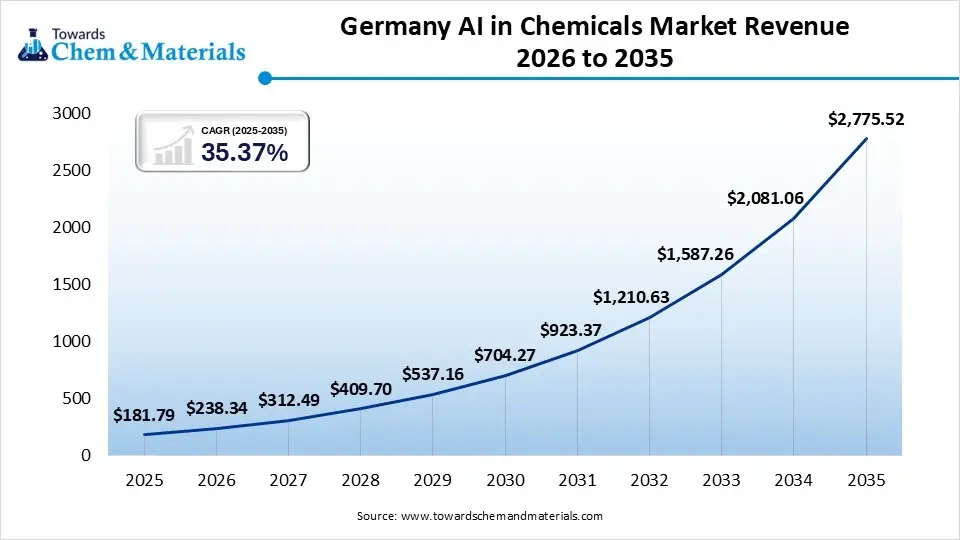
The Germany AI in Chemicals market size was estimated at USD 181.79 million in 2025 and is projected to reach USD 2,775.52 million by 2035, growing at a CAGR of 35.37% from 2026 to 2035. Germany dominated the market by holding a 29% share in 2025, serving as an economically viable hub for Europe's industrial AI deployment. The stringent EU AI Act compliance mandates reinforce German market players to leverage domestic on-premise supercomputing clusters and edge-AI nodes. German manufacturers synthesize REACH-compliant specialty compounds with unified thermodynamic process tuning.
The rest of Europe held the 11% market share in 2025 and is expected to grow at the fastest, with a CAGR of 17.80% during the forecast period, key for computational chemistry implementing cloud-based deep learning networks or material design and circular resource tracking. By injecting a graph neural network into the European R&D and logistics network, boost the regional growth. The country utilized SaaS-driven generative transformers to prevent heavy capital demand through a specialized innovation hub.
Europe AI in Chemicals Market Share,By Countries, 2025 (%)
| By Countries | Revenue Share, 2025 (%) |
| Germany | 29% |
| UK | 21% |
| France | 17% |
| Italy | 12% |
| Spain | 10% |
| Rest of Europe | 11% |
The UK held a 21% market share in 2025 and is expected to experience notable growth in the market with a 16.90% CAGR during the forecast period. The country is a key hub for generative molecular discovery that combines an academic ecosystem with advanced software infrastructure. The UK deploys deep generative transformers for automated R&D fueled by research funding and short development timelines. The country focuses on domestic chemical manufacturing scalability and high-value specialty chemical patents.
Recent Developments
- In March 2026, Iktos announced the strategic collaboration with Chemspeed to accelerate AI-Orchestrated laboratory automation in pharmaceutical-scale R&D. This partnership boosts pharmaceutical companies to accelerate discovery programs, increase laboratory productivity, and automate chemical research.(Source: iktos.ai)
- In October 2025, CEN and CENELEC confirmed their full commitment to deliver comprehensive, inclusive, and high-quality European Standards in support of the Artificial Intelligence Act (AIA). The focus is to accelerate the development of key standards for artificial intelligence.(Source: www.cencenelec.eu)
Top Companies in the Market
- Schneider Electric
- Hexagon AB
- Brenntag S.E.
- Manuchar N.V.
- Iktos
- Honeywell International Inc.
- Alphabet Inc Class A
- IBM
- Microsoft Corp
- Google, AWS
- NVIDIA Corp
- Siemens
- SAP
- International Business Machines Corp.
Segment Covered in the Report
By Component
- Software
- Machine Learning Platforms
- Predictive Analytics Software
- Simulation & Modeling Software
- Digital Twin Platforms
- AI-Driven Laboratory Informatics
- Hardware
- Edge AI Processors
- High-Performance Computing Infrastructure
- Industrial IoT Sensors
- Robotics & Automation Hardware
- Services
- Consulting Services
- Integration & Deployment
- Managed AI Services
- Maintenance & Support
By Technology
- Machine Learning
- Supervised Learning
- Unsupervised Learning
- Reinforcement Learning
- Natural Language Processing
- Scientific Literature Mining
- Regulatory Intelligence
- Chatbot & Virtual Assistant Systems
- Computer Vision
- Quality Inspection
- Safety Monitoring
- Process Surveillance
- Context-Aware Computing
- Predictive Analytics
- Digital Twin Technology
- Generative AI
By Deployment Mode
- Cloud-Based
- Public Cloud
- Private Cloud
- Hybrid Cloud
- On-Premise
- Edge Deployment
By Application
- Process Optimization
- Yield Optimization
- Energy Efficiency Optimization
- Production Scheduling
- Predictive Maintenance
- Supply Chain Optimization
- Demand Forecasting
- Inventory Optimization
- Logistics optimization
- Drug Discovery & Molecular Design
- Quality Control & Inspection
- Safety & Risk Management
- Emission Monitoring & Sustainability
- Research & Development Automation
By End User
- Specialty Chemicals
- Petrochemicals
- Agrochemicals
- Pharmaceutical Chemicals
- Polymers & Plastics
- Industrial Gases
- Paints & Coatings
- Fertilizers
- Adhesives & Sealants
By Enterprise Size
- Large Enterprises
- Medium Enterprises
- Small Enterprises
By Function
- Production
- Research & Development
- Supply Chain & Logistics
- Sales & Marketing
- Regulatory Compliance
- Environmental Management
By Countries
- Europe:
- Western Europe
- Germany
- Italy
- France
- Netherlands
- Spain
- Portugal
- Belgium
- Ireland
- UK
- Iceland
- Switzerland
- Poland
- Rest of Western Europe
- Eastern Europe
- Austria
- Russia & Belarus
- Türkiye
- Albania
- Rest of Eastern Europe
FAQ's
Question 1 : What is the current size of the Europe AI in chemicals market?
Answer : The Europe AI in chemicals market size is estimated at USD 821.86 billion in 2026. It is expected to grow dramatically to reach USD 9,408.53 billion by 2035.
Question 2 : Which European country leads the market in AI chemical integration?
Answer : Germany holds the largest market share at 29 percent, established as the leading regional hub for automated batch formulation and factory floor data security.
Question 3 : Why is software the largest component segment?
Answer : Software commands a 48 percent market share because companies need specialized machine learning codebases, cloud-native analysis platforms, and molecular property simulators to reduce laboratory research timelines.
Question 4 : How does artificial intelligence help with European sustainability goals?
Answer : AI platforms allow companies to run predictive modeling for carbon capture, optimize chemical synthesis to reduce waste, and discover bio-based material alternatives to comply with strict EU climate rules.
Question 5 : What is the fastest growing application for AI in European chemistry?
Answer : The drug discovery and molecular design segment is expanding at the fastest pace, growing at a CAGR of 35.62 percent as pharmaceutical labs adopt generative chemistry models to map complex atomic interactions.
Meet the Team

Saurabh Bidwai
Principal Consultant
Saurabh Bidwai, a B.Tech Chemical Engineering graduate with 4+ years of experience, specializes in specialty chemicals, commodity chemicals, and engineered materials, offering valuable insights into market trends and emerging opportunities.

Aditi Shivarkar
Reviewed By
Aditi Shivarkar, with 14+ years in Chemical and Materials market research, specializes in Chemical and Materials. She ensures accurate, actionable insights, driving Towards Chemicals And Materials Analytics and Consulting excellence in industry trends and sustainability.