
Europe Green Building Materials Market Size, Share & Trends Analysis Report by 2026-2035
The Europe green building materials market, valued at USD 199.45 billion in 2025, is expected to reach USD 222.43 billion by 2026, growing at a CAGR of 11.52% from 2026 to 2035. The market's growth is primarily driven by the rising environmental awareness and increasing government incentives for energy-efficient construction. Western Europe led the market in 2025, accounting for 50% of the market share, while Northern Europe is anticipated to grow at the fastest pace, fueled by strict regulations promoting energy-efficient buildings. Insulation materials dominate the market, with green concrete expected to grow at the fastest rate due to advancements in production. The residential sector holds the largest market share, with the commercial sector set to grow rapidly, driven by a push for sustainable buildings. The market is also benefiting from innovations in energy-efficient technologies and a growing focus on recyclability and sustainability. Key players include Saint-Gobain, BASF, and Owens Corning.
Content
Europe Green Building Materials Market Size, Share, Growth and Forecast 2026-2035
The Europe green building materials market size was valued at USD 199.45 billion in 2025, is estimated to reach USD 222.43 billion in 2026, and is projected to reach USD 593.42 billion by 2035, growing at a CAGR of 11.52% from 2026 to 2035 The surge in environmental awareness is the key factor driving market growth. Also, a rise in government incentives coupled with innovations in building technologies can fuel market growth further.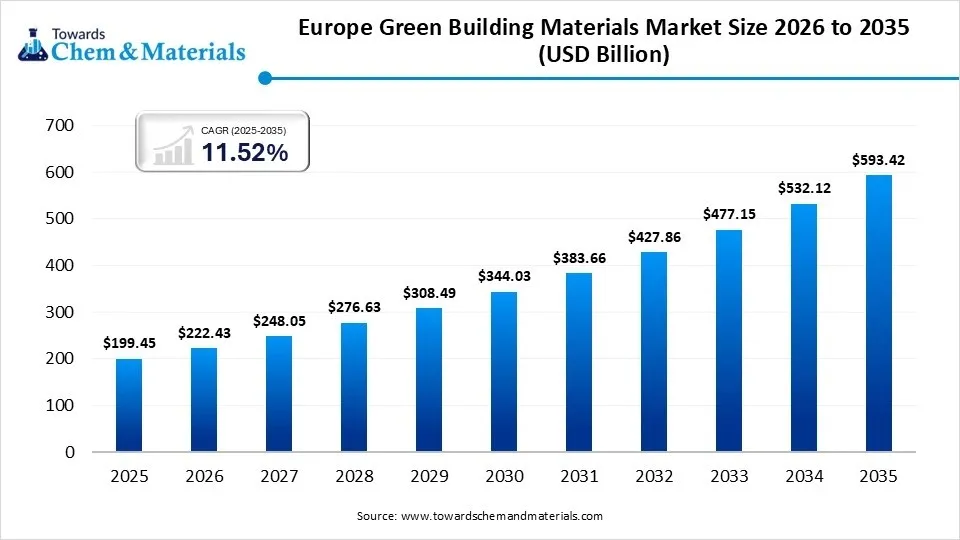
Key Takeaways
- By region, the Western Europe region dominated the market with a 50% market share in 2025. The dominance of the region can be attributed to the ongoing implementation of various government initiatives.
- By region, the Northern Europe region is expected to grow at the fastest CAGR over the forecast period. The growth of the region can be credited to the strict regulations supporting energy-efficient buildings.
- By material type, the insulation materials segment held a 40% Europe green building materials market share in 2025. The dominance of the segment can be attributed to the increasing concerns associated with shifting climatic conditions.
- By material type, the green concrete segment is expected to grow at the fastest CAGR over the forecast period. The growth of the segment is attributed to the ongoing advancements in concrete production.
- By end use- application, the residential segment led the market by holding 45% market share in 2025. The dominance of the segment can be linked to the changing consumer inclination towards healthier living spaces.
- By end use- application, the commercial segment is expected to grow at the fastest CAGR over the projected period. The growth of the segment can be driven by increasing focus on minimizing carbon footprints to improve the sustainability of commercial structures.
- By technology, the energy-efficient technologies segment dominated the market with 35% market share in 2025 and is expected to sustain its dominance over the forecast period. The dominance of the segment is owed to the growing demand for cost-effective and sustainable building solutions.
- By technology, the recyclability & sustainability segment is expected to grow at a notable CAGR during the projected period. The growth of the segment is due to the rising focus on the circular economy in construction.
Innovations in Building Technologies are Expanding Market Growth
The European green building materials market refers to the market for materials used in the construction and renovation of buildings that are designed to minimize their environmental impact. These materials are energy-efficient, sustainable, and environmentally friendly. They focus on reducing waste, enhancing energy efficiency, and improving indoor air quality.
The market includes materials used in insulation, flooring, roofing, paints, windows, and other building components, with a growing emphasis on eco-friendly alternatives, energy savings, and sustainable sourcing. Major players in the market are increasingly focusing on advancements, acquisitions, and strategic collaborations to expand their market presence in the region.
What Are the Key Trends Influencing the Europe Green Building Materials Market?
- There is a surge in demand for sustainable construction materials because of the increasing adoption of eco-friendly practices across various industries, with construction being the latest trend in the market. Also, the growing awareness among most people regarding the benefits of sustainable construction materials is boosting market growth soon.
- The increase in the construction of smart cities is another trend shaping positive market growth.
- Smart cities use data and technology to improve sustainability, create efficiencies, and enhance overall quality-of-life factors for people working and living in the city. Green building materials provide better energy efficiency by minimizing the needs of buildings and infrastructure.
- Technological innovations in material science, like eco-friendly insulation and smart energy systems, are making green buildings more affordable and accessible, contributing to market expansion soon. There is a growing focus on redeveloping existing buildings to enhance their climate resilience and environmental performance.
How is the Government Supporting the Europe Green Building Materials Market?
Governments in the region are actively promoting the market through a combination of financial incentives, regulations, and public procurement policies. These efforts are minimizing carbon emissions by improving energy efficiency and supporting sustainable construction practices. Moreover, schemes such as LEED and BREEAM optimise the utilisation of sustainable materials in construction techniques, impacting positive market growth soon.
Report Scope
| Report Attribute | Details |
| Market Size in 2026 | USD 222.43 Billion |
| Expected Size by 2035 | USD 593.42 Billion |
| Growth Rate from 2025 to 2035 | CAGR 11.52% |
| Base Year of Estimation | 2025 |
| Forecast Period | 2025 - 2035 |
| Segment Covered | By Material Type, By End-Use Application, By Technology, By Region |
| Key Companies Profiled | Saint-Gobain, Rockwool International, BASF SE, Kingspan Group, Johns Manville (a Berkshire Hathaway company), Owens Corning, CSR Limited, Knauf Insulation, Sika AG, Mineral Resources Limited, Etex Group, Interface, Inc., 3M, Boral Limited, Dow Inc., Green Building Council (GBC), Solvay SA, Titan Cement International S.A., USG Corporation, Kingspan Insulated Panels |
Market Opportunity
Innovations in Green Building Materials
Green building materials have experienced a substantial development in recent years, with an emphasis on eco-friendly and sustainable alternatives for insulation, creating lucrative opportunities in the market. Furthermore, mycelium composites, a latest class of green building materials, are increasingly gaining traction. Made from mycelium, these composites provide exceptional insulation properties and are easily biodegradable.
- In April 2025, T2Earth, a green building materials company, introduced the OnWood Plywood, a sustainable, fire-resistant wood. Designs without toxic chemicals, this product offers a sustainable design and Class A fire retardancy, giving developers and builders a higher-performing option.(Source: www.woodworkingnetwork.com)
Market Challenges
Need for Specialized Labor
Green building projects necessitate skilled labor with high expertise in BIM, energy-efficient design, and sustainable construction methods, which leads to higher labor costs, hampering market growth. Moreover, deploying renewable energy systems like geothermal and smart technologies, such as HVAC, adds further to the upfront investment, which again increases the overall implementation costs.
Country Insight
The Western Europe region dominated the market with a 50% market share in 2025. The dominance of the region can be attributed to the ongoing implementation of various government initiatives, which focus on smart renovations utilising green building materials to improve the sustainability of Europe's housing sector. In addition, innovations in ventilation, smart heating, and air conditioning (HVAC) systems are propelling energy usage in green buildings.
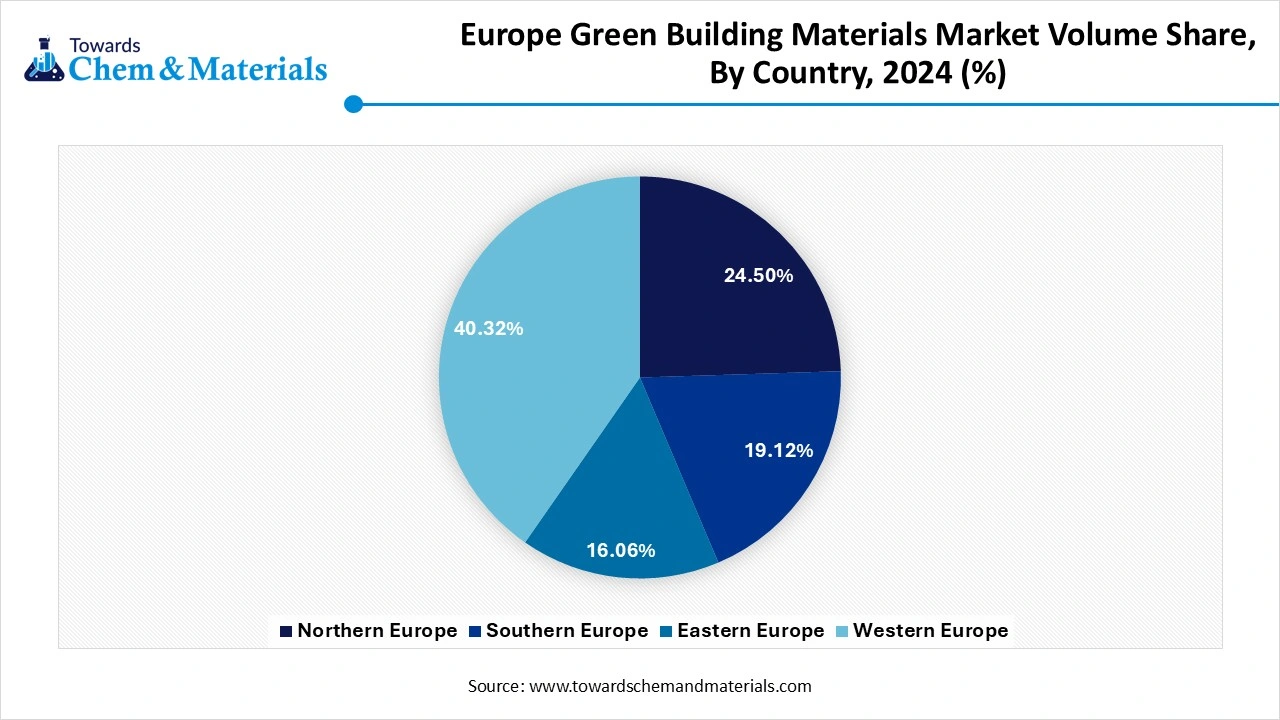
Europe Green Building Materials Market Volume Share, By Region, 2025-35 (%)
| By Region | Volume Share, 2024 (%) | Market Volume Million Tons - 2024 | Volume Share, 2034 (%) | Market Volume Million Tons - 2034 | CAGR (2025 - 2034) |
| Northern Europe | 24.50% | 41.6 | 23.12% | 94.0 | 9.47% |
| Southern Europe | 19.12% | 32.5 | 20.10% | 81.7 | 10.80% |
| Eastern Europe | 16.06% | 27.3 | 17.67% | 71.9 | 11.36% |
| Western Europe | 40.32% | 68.5 | 39.11% | 159.1 | 9.81% |
| Total | 100.00% | 169.9 | 100.00% | 406.7 | 9.12% |
The Northern Europe region is expected to grow at the fastest CAGR over the forecast period. The growth of the region can be credited to the strict regulations supporting energy-efficient buildings, raised environmental awareness, and innovations in material science. Furthermore, northern European regions are especially emphasizing enhancing energy efficiency in buildings, which directly impacts the positive regional growth.
Who is the Top 5 Biggest Construction Companies in Europe?
| Company | Revenue 2024 (First nine months) (EUR Million) |
| Bouygues SA | 41,500 |
| ACS SA | 29,702 |
| VINCI SA | 23,545 |
| Eiffage SA | 14,834 |
| Strabag SE | 13,618 |
Segmental Insight
Material Type Insight
Which Material Type Segment Dominated the Europe Green Building Materials Market in 2024?
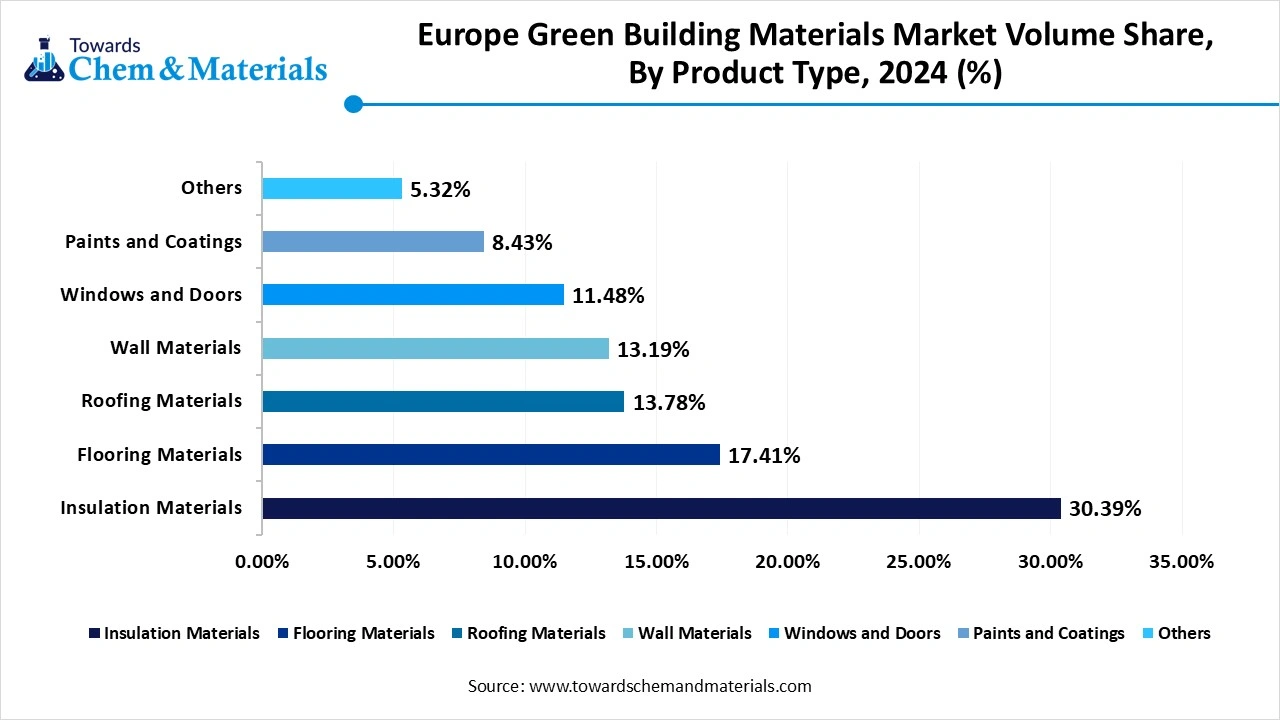
The insulation materials segment held a 40% market share in 2024. The dominance of the segment can be attributed to the increasing concerns associated with shifting climatic conditions, along with the growing need for energy-efficient insulation materials. Additionally, green insulation possesses superior properties to conventional insulation materials to emphasize minimizing carbon emissions and energy consumption.
The green concrete segment expects the fastest growth over the forecast period. The growth of the segment is due to the ongoing advancements in concrete production, such as the use of substitute raw materials with improved performance characteristics, which are enabling green concrete to become more appealing. Both commercial and residential sectors are witnessing growing adoption of green concrete due to its performance benefits.
Europe Green Building Materials Volume Share, By Material Type, 2024-2034 (%)
| By Product Type | Volume Share, 2024 (%) | Market Volume Tons - 2024 | Volume Share, 2034 (%) | Market Volume Tons - 2034 | CAGR (2025 - 2034) |
| Insulation Materials | 30.39% | 51.6 | 29.58% | 120.3 | 9.85% |
| Flooring Materials | 17.41% | 29.6 | 16.41% | 66.7 | 9.46% |
| Roofing Materials | 13.78% | 23.4 | 14.30% | 58.2 | 10.64% |
| Wall Materials | 13.19% | 22.4 | 15.12% | 61.5 | 11.87% |
| Windows and Doors | 11.48% | 19.5 | 9.50% | 38.6 | 7.89% |
| Paints and Coatings | 8.43% | 14.3 | 9.22% | 37.5 | 11.28% |
| Others | 5.32% | 9.0 | 5.87% | 23.9 | 11.39% |
| Total | 100% | 169.9 | 100% | 406.7 | 9.12% |
End-Use Application Insight
Why the Residential Segment Held a Largest Europe Green Building Materials Market Share in 2024?
The residential segment led the market by holding 45% market share in 2024. The dominance of the segment can be linked to the changing consumer inclination towards healthier living spaces, coupled with the innovations in material science. Moreover, many European governments are offering subsidies and incentives for green building projects, further driving the adoption of green building practices in the residential sector, fuelling market growth shortly.
The commercial segment is expected to grow at the fastest CAGR over the projected period. The growth of the segment can be driven by increasing focus on minimizing carbon footprints to improve the sustainability of commercial structures. Also, the surge in research and development in green building technologies in emerging economies is boosting the adoption of sustainable materials in the commercial sector.
Technology Insight
How Did the Energy-Efficient Technologies Segment Dominated the Europe Green Building Materials Market in 2024?
The energy-efficient technologies segment dominated the market with 35% market share in 2024 and is expected to sustain its dominance over the forecast period. The dominance of the segment is owed to the growing demand for cost-effective and sustainable building solutions along with the rapid advancements in green building materials, like energy-efficient windows and advanced insulation, which are enabling green building to become more affordable and accessible in the region, leading to segment expansion soon in the market.
The recyclability & sustainability segment is expected to grow at a notable CAGR during the projected period. The growth of the segment is due to the rising focus on the circular economy in construction, emphasizing recycling, reuse, and reducing waste. Furthermore, governments across the region are increasingly implementing regulations and policies to facilitate sustainable construction across Europe.
Recent Developments
- In March 2025, the European Commission introduced the Clean Industrial Deal, a deal designed to boost Europe's industrial competitiveness while propelling Europe's decarbonisation efforts. The deal is in response to the increasing geopolitical tensions across the globe.(Source: www.globalelr.com )
Top Companies List
- Saint-Gobain
- Rockwool International
- BASF SE
- Kingspan Group
- Johns Manville (a Berkshire Hathaway company)
- Owens Corning
- CSR Limited
- Knauf Insulation
- Sika AG
- Mineral Resources Limited
- Etex Group
- Interface, Inc.
- 3M
- Boral Limited
- Dow Inc.
- Green Building Council (GBC)
- Solvay SA
- Titan Cement International S.A.
- USG Corporation
- Kingspan Insulated Panels
Segments Covered
By Material Type
- Insulation Materials
- Rigid Foam Insulation
- Spray Foam Insulation
- Fiberglass Insulation
- Cellulose Insulation
- Mineral Wool Insulation
- Flooring Materials
- Recycled Wood Flooring
- Bamboo Flooring
- Cork Flooring
- Rubber Flooring
- Linoleum Flooring
- Roofing Materials
- Solar Roof Panels
- Green Roofing
- Reflective Roofing
- Metal Roofing (recycled)
- Wall Materials
- Recycled Steel
- Clay Brick
- Timber
- Concrete with low carbon emissions
- Windows and Doors
- Low-emissivity Windows
- Triple-glazed Windows
- Thermally Broken Windows
- Sustainable Wood Doors
- Paints and Coatings
- Low VOC Paints
- Natural Paints
- Eco-Friendly Sealants and Coatings
- Others
- Green Concrete
- Recycled Steel
- Green Adhesives
By End-Use Application
- Residential
- Commercial
- Industrial
- Institutional (Hospitals, Schools, Government Buildings)
By Technology
- Energy-Efficient Technologies
- Passive Design Techniques
- Solar Panel Integration
- Smart Building Materials (Smart Windows, Energy Monitoring Systems)
- Recyclability & Sustainability
- Recycled Content Materials
- Biodegradable Building Materials
- Materials with Reduced Carbon Footprint
- Water Conservation Technologies
- Water-Resistant Materials
- Water-Permeable Paving
- Green Roofs for Stormwater Management
By Region
- Western Europe
- Northern Europe
- Southern Europe
- Eastern Europe
FAQ's
Question 1 : What is the Europe Green Building Materials Market volume?
Answer : The Europe green building materials market size was valued at USD 199.45 billion in 2025, is estimated to reach USD 222.43 billion in 2026, and is projected to reach USD 593.42 billion by 2035, growing at a CAGR of 11.52% from 2026 to 2035
Question 2 : What are the current trends in the Europe Green Building Materials Market?
Answer : Energy-Efficient Technologies: The rise in demand for cost-effective, energy-efficient building solutions such as solar panels, advanced insulation, and smart building materials. Sustainable Construction Materials: There is growing interest in materials that promote sustainability, such as green concrete, recyclable steel, and low-VOC paints. Smart Cities Development: The integration of green materials in smart cities is driving innovation in building technologies, promoting sustainability and enhancing energy efficiency. Circular Economy Practices: Increasing focus on recyclability and sustainability in construction, with more emphasis on using recycled and biodegradable materials.
Question 3 : Which regions are leading the Europe Green Building Materials Market, and why?
Answer : Western Europe holds the largest share of the market due to strong government support and initiatives promoting sustainable construction practices. Northern Europe is expected to experience the fastest growth, driven by strict regulations supporting energy-efficient buildings. Southern and Eastern Europe are also witnessing growth, with a rising focus on sustainable building materials and increased investments in green construction technologies.
Question 4 : What are the leading companies in the Europe Green Building Materials Market?
Answer : Saint-Gobain, Rockwool International, BASF SE, Kingspan Group, Johns Manville (a Berkshire Hathaway company), Owens Corning, CSR Limited, Knauf Insulation, Sika AG, Mineral Resources Limited, Etex Group, Interface, Inc., 3M, Boral Limited, Dow Inc., Green Building Council (GBC), Solvay SA, Titan Cement International S.A., USG Corporation, Kingspan Insulated Panels
Meet the Team

Saurabh Bidwai
Principal Consultant
Saurabh Bidwai, a B.Tech Chemical Engineering graduate with 4+ years of experience, specializes in specialty chemicals, commodity chemicals, and engineered materials, offering valuable insights into market trends and emerging opportunities.

Aditi Shivarkar
Reviewed By
Aditi Shivarkar, with 14+ years in Chemical and Materials market research, specializes in Chemical and Materials. She ensures accurate, actionable insights, driving Towards Chemicals And Materials Analytics and Consulting excellence in industry trends and sustainability.