
Europe Sustainable Aviation Fuel (SAF) Market Size, Share, Growth, Report 2026 to 2035
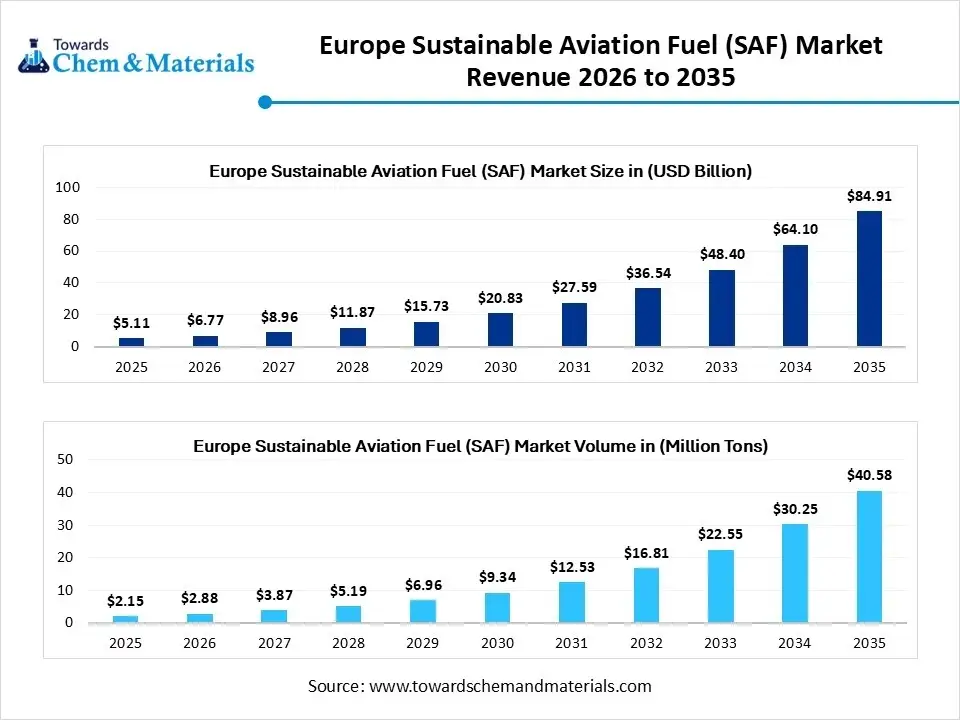
The global Europe sustainable aviation fuel (SAF) market size is expected to grow from USD 5.11 billion in 2026 to USD 84.91 billion in 2035, growing at a CAGR of 32.45% from 2026 to 2035. The top key players in the market are Neste, TotalEnergies, Shell, BP (Air BP), Eni, SkyNRG, Repasol, Air France-KLM Group, Lufthansa Group
Content
What is the Current Size of the Europe Sustainable Aviation Fuel (SAF) Market and Its Projected Growth?
The Europe sustainable aviation fuel (SAF) market size was estimated at USD 5.11 billion in 2025 and is expected to increase from USD 6.77 billion in 2026 to USD 84.91 billion by 2035, growing at a CAGR of 32.45% from 2026 to 2035. In terms of volume, the market is projected to grow from 2.15 million tons in 2025 to 40.58 million tons by 2035. growing at a CAGR of 34.15% from 2026 to 2035.The greater shift towards sustainability and minimization of carbon emissions has fueled the industry's growth in recent years.
Market Highlights
- By country, Germany dominated the Europe sustainable aviation fuel (SAF) market in 2025, due to the country's combination of strong aviation activity, industrial fuel planning, and early coordination between airports, fuel producers, and technical research groups.
- By country, The United Kingdom is anticipated to capture a greater portion of the market with a significant CAGR in the future due to the country having very high flight movement through major international airports and strong long-distance aviation demand.
- By feedstock, the used cooking oil segment dominated the market with 38% share in 2025, owing to its already being collected in large volumes from restaurants, food factories, hotels, and catering systems across many European countries.
- By feedstock, the municipal solid waste segment expects the fastest growth in the market with 19.5% CAGR during the forecast period, due to cities generating huge daily waste volumes continuously, creating a very large long-term feedstock source.
- By production technology, the HEFA segment dominated the market with 52% share in 2025, owing to its use of feedstocks like used cooking oil and animal fats that are already collected in many European countries.
- By production technology, the power-to-liquid segment expects the fastest growth in the market with 22.4% CAGR during the forecast period, due to it can produce aviation fuel using renewable electricity, water, and captured carbon instead of depending only on biological materials.
- By fuel type, the biobased SAF segment dominated the market with 64% share in 2025, owing to its uses feedstocks such as used cooking oil, animal fats, and agricultural residues that are already available through existing collection systems in many European countries.
- By fuel type, the synthetic SAF segment expects the fastest growth in the market with 21.8% CAGR during the forecast period, due to it can be produced using renewable electricity, hydrogen, and captured carbon instead of depending only on biological raw materials.
- By application, the commercial aviation segment dominated the market with 72% share in 2025, owing to passenger airlines consuming the highest total fuel volume every day through regular domestic and international flights.
- By application, the business and general aviation segment expects the fastest growth in the market with 18.9% CAGR during the forecast period. due to smaller fleets often adopt new fuel systems more quickly in selected operations where fuel planning is easier.
- By blending ratio, the below 30% segment dominated the market with 58% share in 2025, owing to airlines first preferring lower sustainable aviation fuel mixing levels when introducing new fuel into daily operations.
- By blending ratio, Above 50% segment expects the fastest growth in the market with 21.3% CAGR during the forecast period, due to the future fuel supply being expected to improve as more sustainable aviation fuel production plants start operating across Europe.
Market Size and Volume Forecast
- Market Size (2025): USD 5.11 Billion | CAGR (2026–2035): 32.45%
- Market Projected Size (2035): USD 84.91 Billion
- Market Volume (2025): 2.15 Million Tons (MT) | Volume CAGR (2026–2035): 34.15%
- Market Projected Volume (2035): 40.58 Million Tons (MT)
- Market Pricing (2025):
- Average Manufacturing Price: USD 1,370/Ton
- Average Selling Price: USD 1,870/Ton
- Pricing CAGR (2026–2035): 2.94%
Cleaner Skies Through Renewable Aviation Fuel
The fuel is primarily made from renewable materials, which include waste cooking oil, plant oils, agricultural waste, and other non-fossil sources. Instead, the usage of traditional crude oil is called the sustainable aviation fuel. Moreover, by playing a major role in the reduction of environmental pressure without any changes in aircraft activity, the sustainable aviation fuel is likely to create greater advantages during the forecast period.
Recent Market Trends:
- The sustainable aviation fuel is likely to be adopted as a long-term planning solution by major airlines, which have enabled the sector to explore untapped potential in recent years. Also, several manufacturers have been putting heavy investment in R&D programmes in the past few years.
- The creation of partnerships between fuel suppliers and airports while building greater storage facilities and fuel movements is driving strategic transformation and sectoral scalability in the current period. Also, the airports are expected to play major roles in these activities nowadays.
- The heavy focus on reliable fuel availability by buyers is likely to allow stakeholders to capitalize on growth opportunities during the forecast period. Also, the buyers are looking for better services, including regular fuel supply and its operations.
Report Scope
| Report Attribute | Details |
| Market Size in 2026 | USD 6.77 Billion / 2.88 Million Tons |
| Revenue Forecast in 2035 | USD 84.91 Billion / 40.58 Million Tons |
| Growth Rate | CAGR 32.45% |
| Forecast Period | 2026 - 2035 |
| Base Year | 2025 |
| Segment Covered | By Feedstock, By Production Technology, By Fuel Type, By Application, By Blending Ratio, By Country |
| Key companies profiled | Neste, TotalEnergies, Shell, BP (Air BP), Eni, SkyNRG, Repasol, Air France-KLM Group, Lufthansa Group |
Flexible Feedstocks Driving Future Fuel Aviation
The industry is moving towards more flexible feedstock processing systems. Earlier, many fuel systems focused mainly on one raw material source. Now producers increasingly want technology that can handle different waste oils, residues, and renewable inputs without major process changes. Also, the fuel plants now aim to accept many raw materials instead of depending on only one supply stream. This matters because feedstock availability changes by region and season.
Supply Chain Analysis of the Europe Sustainable Aviation Fuel (SAF) Market:
Distribution to Industrial Users
- In Europe, Sustainable Aviation Fuel (SAF) distribution is driven by the RefuelEU Aviation initiative, mandating increasing blend ratios at major airports.
- Fuel suppliers utilize existing hydrant infrastructure and "book-and-claim" systems to deliver SAF to commercial airlines, corporate flight departments, and military operators, ensuring logistical efficiency across the continent.
Chemical Synthesis and Processing
- European SAF is primarily synthesized via HEFA (Hydroprocessed Esters and Fatty Acids) by refining waste oils and fats.
- Emerging Alcohol-to-Jet (AtJ) and Power-to-Liquids (e-fuels) processes convert bio-ethanol or captured CO2 and green hydrogen into synthetic hydrocarbons, ensuring "drop-in" compatibility with existing jet engines and infrastructure.
Regulatory Compliance and Safety Monitoring
- In Europe, Sustainable Aviation Fuel (SAF) is governed by the ReFuelEU Aviation regulation, mandating specific blending targets at EU airports.
- Compliance requires Sustainability Certificates (e.g., ISCC) to verify greenhouse gas savings. Safety monitoring ensures SAF meets ASTM D7566 standards, guaranteeing "drop-in" compatibility and airworthiness for commercial jet engines.
Europe Sustainable Aviation Fuel (SAF) Market Regulatory Landscape: Regulations
| Country Region | Regulatory Body | Key Regulations | Focus Areas |
| Germany | Federal Ministry for Digital and Transport (BMDV) | Federal Emission Control Act (BImSchG): Specifically, Sections 37a–37h, which mandate greenhouse gas (GHG) reduction quotas for fuel suppliers | Leading the global market in Power-to-Liquid (PtL) technology, Germany has a specific PtL sub-quota of 0.5% in 2026, rising to 2% by 2030, which exceeds the EU's 2030 target |
| United Kingdom | Department for Transport (DfT) | UK SAF Mandate (2025): Formally the Renewable Transport Fuel Obligations (SAF) Order 2024. | : Rapid domestic scaling with a higher 2030 target of 10% SAF blend. The The UK also focuses on HEFA caps (Hydroprocessed Esters and Fatty Acids) to prevent over-reliance on limited waste-oil feedstocks and encourage advanced pathways |
| France | Ministry for the Ecological Transition and the Directorate General for Civil Aviation (DGAC). | Environment Code (Code de l'environnement): Incorporates the national SAF roadmap and blending mandates. |
Leveraging France's low-carbon electricity mix (nuclear and renewables) to become a hub for synthetic fuel production. France also emphasizes "sovereign" production to reduce energy dependency. |
Segmental Insights
Feedstock Insights
The Used Cooking Oil Segment Dominated the Europe Sustainable Aviation Fuel (SAF) Market with 38% Market Share in 2025
The used cooking oil segment dominated the market with 38% share in 2025, owing to its already being collected in large volumes from restaurants, food factories, hotels, and catering systems across many European countries. Also, it is easier to process compared with some other waste materials because the oil already contains energy-rich organic content suitable for fuel conversion. Moreover, the collection systems for used oil already exist in many cities, making the supply more practical.
The agriculture residues segment held the second largest share of 19% in 2025 due to crop leftovers such as straw, husks, and plant remains that are available after farming seasons in many regions. These materials are useful because they do not compete directly with food use and still contain energy value for conversion. Moreover, agricultural residue appears in large volumes during harvest periods.
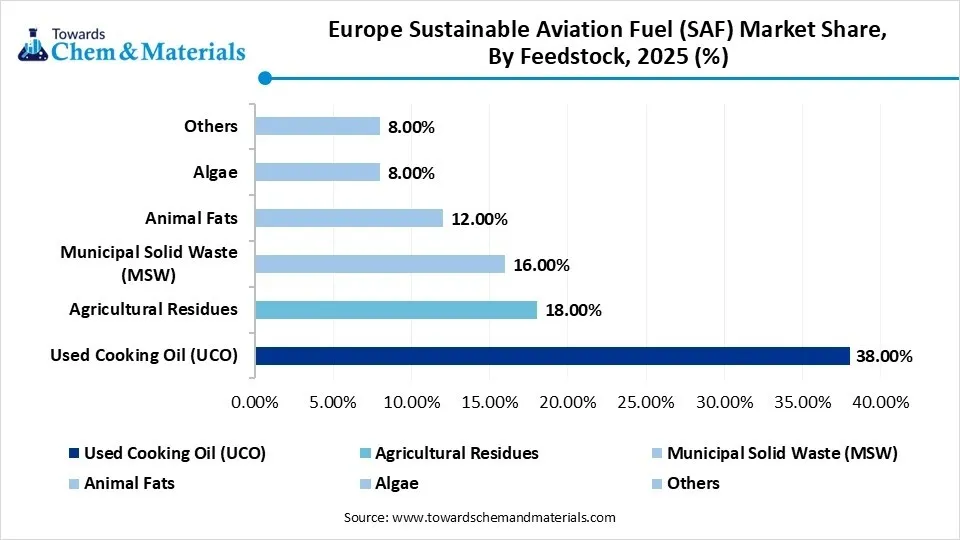
The municipal solid waste expected to be the fastest growing in the market with 19.5% CAGR during the forecast period due to cities generating huge daily waste volumes continuously, creating a very large long-term feedstock source. Also, this includes paper waste, food waste, packaging residues, and other urban organic materials that can be processed for fuel production. Furthermore, the city's waste supply keeps growing with the urban population. Also, fuel producers may increasingly prefer materials that are always available every day.
The animal fats segment held the fourth largest share of 13% in 2025, owing to they are available mainly from meat processing and food industry waste streams, but supply is more limited compared with used oils or city waste. They can be converted into aviation fuel effectively, yet collection depends on specific industrial channels.
Europe Sustainable Aviation Fuel (SAF) Market Share, By Feedstock, 2025 (%)
| By Feedstock | Revenue Share, 2025 (%) |
| Used Cooking Oil (UCO) | 38.00% |
| Agricultural Residues | 19.00% |
| Municipal Solid Waste (MSW) | 16.00% |
| Animal Fats | 13.00% |
| Algae | 6.00% |
| Others | 8.00% |
- Used Cooking Oil (UCO) leads the market with a share of 38.00%. UCO is a widely used feedstock due to its availability and efficiency in producing sustainable aviation fuel.
- Agricultural Residues account for 18.00% of the market. These residues, such as crop leftovers, are increasingly used for SAF production, contributing to sustainability in the aviation sector.
- Municipal Solid Waste (MSW) holds 16.00% of the market. MSW is used as a feedstock for SAF to reduce landfill waste and contribute to more sustainable fuel sources for aviation.
- Animal Fats make up 12.00% of the market. These fats are a valuable source of renewable feedstock for SAF, contributing to its production in the aviation industry.
- Algae represents 6.00% of the market. Algae is a promising feedstock due to its high energy content and potential for large-scale, sustainable production of aviation fuel.
- Others account for 8.00% of the market. This category includes various other feedstocks used in smaller volumes for SAF production in Europe.
Production Technology Insights
The HEFA Segment Dominated the Market with 52% Market Share in 2025
The HEFA segment dominated the market with 52% share in 2025, owing to its use of feedstocks like used cooking oil and animal fats that are already collected in many European countries. Also, fuel producers prefer this method because it works with existing refining knowledge and gives aviation fuel that fits current aircraft requirements without major technical difficulty.
The Fischer-Tropsch (FT) segment held the second largest share of 16% in 2025 due to it allows fuel production from gas created from biomass or waste materials, giving flexibility beyond oil-based feedstocks. Moreover, this process is valuable because different raw materials can enter one conversion pathway after gasification.
The alcohol-to-jet (ATJ) segment held the third largest share of 12% in 2025, owing to alcohol feedstocks such as ethanol that can be converted into aviation fuel, but the process still faces supply balance and cost challenges compared with stronger leading technologies. Moreover, alcohol feedstocks are also needed in other industries, which affects fuel production priorities.
The power to liquid segment is expected to be the fastest growing in the market with 22.4% CAGR during the forecast period due to it can produce aviation fuel using renewable electricity, water, and captured carbon instead of depending only on biological materials. Moreover, this gives future producers more freedom when waste oils and organic feedstocks become limited. Also, the renewable electricity capacity is growing across Europe.
Europe Sustainable Aviation Fuel (SAF) Market Share, By Production Technology, 2025 (%)
| By Production Technology | Revenue Share, 2025 (%) |
| HEFA | 52.00% |
| Fischer-Tropsch (FT) | 16.00% |
| Alcohol-to-Jet (ATJ) | 12.00% |
| Power-to-Liquid (PtL) | 14.00% |
| Hydrothermal Liquefaction (HTL) | 6.00% |
- HEFA (Hydroprocessed Esters and Fatty Acids) leads the market with a share of 52.00%. HEFA is the most widely used production technology for SAF, primarily due to its compatibility with existing jet engine infrastructure.
- Fischer-Tropsch (FT) accounts for 16.00% of the market. FT technology is used to convert biomass and other feedstocks into liquid hydrocarbons for sustainable aviation fuel production.
- Alcohol-to-Jet (ATJ) holds 12.00% of the market. ATJ technology is gaining traction for its ability to convert alcohols into high-energy jet fuels, contributing to the sustainable fuel mix.
- Power-to-Liquid (PtL) makes up 14.00% of the market. PtL technology is seen as a promising future solution, utilizing renewable electricity to convert carbon dioxide into sustainable aviation fuel.
- Hydrothermal Liquefaction (HTL) represents 6.00% of the market. HTL technology is a newer method that converts wet biomass into liquid hydrocarbons, providing an alternative pathway for SAF production.
Fuel Type Insights
The Bio-Based SAF Segment Dominated the Europe Sustainable Aviation Fuel (SAF) Market with 64% Market Share in 2025
The biobased SAF segment dominated the market with 64% share in 2025, owing to its uses feedstocks such as used cooking oil, animal fats, and agricultural residues that are already available through existing collection systems in many European countries. Moreover, the producers prefer this fuel type because current processing technologies can convert these materials into aviation fuel without major changes to aircraft operation.
The synthetic SAF segment is expected to be the fastest growing in the market with 21.8% CAGR during the forecast period due to it can be produced using renewable electricity, hydrogen, and captured carbon instead of depending only on biological raw materials. Also, this gives future producers more flexibility when waste- based feedstocks become limited or expensive.
The hybrid SAF segment held the third largest share of 16% in 2025, owing to because it combines biological and synthetic production advantages in one fuel pathway. This helps producers balance feedstock availability while improving fuel supply flexibility during market growth. Also, the hybrid systems allow a gradual transition between today's bio-based production and future synthetic fuel expansion.
Europe Sustainable Aviation Fuel (SAF) Market Share, By Fuel Type, 2025 (%)
| By Fuel Type | Revenue Share, 2025 (%) |
| Biofuel-based SAF | 64.00% |
| Synthetic SAF (e-fuels) | 24.00% |
| Hybrid SAF | 12.00% |
- Biofuel-based SAF leads the market with a share of 64.00%. Biofuels, derived from organic materials like used cooking oil and agricultural residues, remain the dominant source for sustainable aviation fuel production.
- Synthetic SAF (e-fuels) accounts for 24.00% of the market. E-fuels, produced using renewable electricity to synthesize fuel from CO2, are gaining interest as a scalable solution for reducing aviation emissions.
- Hybrid SAF makes up 12.00% of the market. Hybrid SAF combines biofuels and synthetic components to create a more versatile and sustainable aviation fuel, leveraging the advantages of both technologies.
Application Insights
The Commercial Aviation Segment Dominated the Market with 72% Market Share in 2025
The commercial aviation segment dominated the market with 72% share in 2025, owing to passenger airlines consuming the highest total fuel volume every day through regular domestic and international flights. Also, the large aircraft flying many scheduled routes need a continuous fuel supply, which naturally creates the biggest demand for sustainable aviation fuel. Moreover, commercial airlines face strong pressure to show environmental progress while keeping flights operational.
The military aviation segment held the second largest share of 16% in 2025, owing to defense aircraft also requiring fuel planning, but operational approval moves more carefully than commercial airline adoption. Also, the military fleets must ensure full engine reliability before changing fuel systems, so adoption often happens gradually. Moreover, the military fuel demand is important but smaller in visible market volume compared with large passenger aviation networks.
The business and general aviation segment is expected to be the fastest growing in the market with 18.9% CAGR during the forecast period, due to smaller fleets often adopt new fuel systems more quickly in selected operations where fuel planning is easier. Moreover, private operators, charter services, and corporate aircraft can test sustainable fuel use on limited routes without needing huge supply volumes immediately.
Europe Sustainable Aviation Fuel (SAF) Market Share, By Application, 2025 (%)
| By Application | Revenue Share, 2025 (%) |
| Commercial Aviation | 72.00% |
| Military Aviation | 16.00% |
| Business & General Aviation | 12.00% |
- Commercial Aviation leads the market with a share of 72.00%. SAF is predominantly used in commercial aviation, supporting the industry's efforts to reduce carbon emissions and enhance sustainability.
- Military Aviation accounts for 16.00% of the market. Military aviation is adopting SAF to lower its environmental footprint and meet sustainability targets for defense operations.
- Business & General Aviation holds 12.00% of the market. SAF is increasingly being used in business jets and general aviation to promote greener operations and align with sustainability goals.
Blending Ratio Insights
The Below 30% Segment Dominated the Europe Sustainable Aviation Fuel (SAF) Market with 58% Market Share in 2025
The below 30% segment dominated the market with 58% share in 2025, owing to airlines first preferring lower sustainable aviation fuel mixing levels when introducing new fuel into daily operations. Moreover, the lower blending makes fuel handling easier because aircraft engines, airport fuel systems, and supply chains continue working under familiar operating conditions.
The 30%-50% segment held the second largest share of 27% in 2025, owing to it representing a middle step between early low blending and future high blending use. Also, the airlines that move beyond very small SAF often test moderate blending levels before increasing further. Furthermore, this range allows fuel suppliers to spread available sustainable fuel across selected routes without fully committing to high-blend operations.
Above 50% segment is expected to be the fastest growing in the market with 21.3% CAGR during the forecast period, due to future fuel supply being expected to improve as more sustainable aviation fuel production plants start operating across Europe. Also, the higher blending becomes more realistic when larger fuel volumes are available regularly, and airlines gain more technical confidence through long-term use.
Europe Sustainable Aviation Fuel (SAF) Market Share, By Blending Ratio, 2025 (%)
| By Blending Ratio | Revenue Share, 2025 (%) |
| Below 30% | 58.00% |
| 30%–50% | 27.00% |
| Above 50% | 15.00% |
- Below 30% leads the market with a share of 58.00%. SAF is most commonly blended with conventional jet fuel in lower proportions, enabling a gradual transition toward sustainable aviation practices.
- 30%–50% accounts for 27.00% of the market. This blending ratio is increasingly used as airlines and operators aim for higher sustainability while balancing fuel performance and availability.
- Above 50% holds 15.00% of the market. A higher blending ratio is becoming more common as SAF production increases, pushing the aviation industry closer to fully sustainable fuel solutions.
Country Insights
How will Germany dominate the Europe Sustainable Aviation Fuel (SAF) Market in 2025?
Germany maintained its dominance in the market, owing to the country's combination of strong aviation activity, industrial fuel planning, and early coordination between airports, fuel producers, and technical research groups. Large airports create regular fuel demand, while industrial systems support organized fuel handling and blending preparation. Also, Germany often moves carefully but early when new industrial fuel systems become commercially practical.
United Kingdom Driving the Future of Cleaner Aviation
The United Kingdom is expected to emerge as a prominent country for the Europe sustainable aviation fuel (SAF) market in the coming years, due to the country having very high flight movement through major international airports and strong long-distance aviation demand. This creates natural pressure to expand cleaner aviation fuel use across commercial operations. Also, the future fuel projects are closely linked with large airport systems, where sustainable fuel can enter daily supply chains more easily. Moreover, when many aircraft move every day, fuel transition becomes more important and more visible.
Recent Developments
- In February 2026, World Fuel Services and Neste established a strategic collaboration with a five-year deal. Also, the motive behind this collateral deal is to expand sustainable aviation fuel in Europe, as per the published report.(Source: www.indianchemicalnews.com)
- In March 2026, Octopus Energy Generation is likely to invest in an innovative project in Europe, which is associated with a sustainable aviation fuel facility. Also, this facility has aimed to develop SAF from the biomass, and the investment is nearly $6 billion as per the published report.(Source: www.bioenergy-news.com)
Top Vendors in the Europe Sustainable Aviation Fuel (SAF) Market & Their Offerings:
- Neste: Headquartered in Finland, Neste is the world’s leading producer of Sustainable Aviation Fuel (SAF). Its "Neste MY Sustainable Aviation Fuel" is produced from 100% renewable waste and residue raw materials. With major refineries in Porvoo, Singapore, and Rotterdam, Neste is rapidly expanding capacity to meet soaring global and European demand.
- TotalEnergies: This French multi-energy major is a key European SAF producer, leveraging its extensive refinery network to transition toward biofuels. TotalEnergies produces SAF from waste and residues at its French sites, such as La Mède and Grandpuits, aiming to lead the decarbonization of the aviation sector through integrated supply chains.
- Shell: Shell is a global leader in aviation fuel, actively investing in SAF production facilities and supply infrastructure. Through its "Aviation" division, Shell collaborates with airlines and airports worldwide, focusing on diverse pathways including HEFA and advanced synthetic fuels to achieve its goal of becoming a net-zero emissions business.
- BP (Air BP): Air BP, the specialized aviation division of BP, provides SAF to over 300,000 flights annually. By investing in waste-to-fuel technologies and strategic partnerships, BP aims to scale up SAF availability across its global network, supporting the aviation industry’s transition to lower-carbon operations through consistent supply and technical expertise.
- Eni
- SkyNRG
- Repasol
- Air France-KLM Group
- Lufthansa Group
Segments Covered in the Report
By Feedstock
- Used Cooking Oil (UCO)
- Agricultural Residues
- Corn Stover
- Wheat Straw
- Municipal Solid Waste (MSW)
- Organic Waste
- Industrial Waste
- Algae
- Animal Fats
- Others (Forestry Residues, Energy Crops)
By Production Technology
- HEFA (Hydroprocessed Esters and Fatty Acids)
- Fischer-Tropsch (FT)
- Coal-to-Liquid (CTL)
- Gas-to-Liquid (GTL)
- Biomass-to-Liquid (BTL)
- Alcohol-to-Jet (ATJ)
- Ethanol-to-Jet
- Isobutanol-to-Jet
- Power-to-Liquid (PtL)
- Electrofuels (e-SAF)
- Hydrothermal Liquefaction (HTL)
By Fuel Type
- Biofuel-based SAF
- Synthetic SAF (e-fuels)
- Hybrid SAF
By Application
- Commercial Aviation
- Passenger Aircraft
- Cargo Aircraft
- Military Aviation
- Business & General Aviation
- By Blending Ratio
- Below 30%
- 30%–50%
- Above 50%
FAQ's
Question 1 : What is the current size and projected growth of the Europe Sustainable Aviation Fuel (SAF) market?
Answer : The Europe SAF market is projected to reach USD 6.77 billion by 2026 and USD 84.91 billion by 2035, growing at a CAGR of 32.45%, with volume growth from 2.15 million tons in 2025 to 40.58 million tons by 2035.
Question 2 : Which countries are leading the adoption of Sustainable Aviation Fuel (SAF) in Europe, and why?
Answer : Germany leads the market due to its strong aviation activity, industrial fuel planning, and early collaboration between airports, fuel producers, and research groups. The United Kingdom is expected to capture a larger share of the market in the future due to its high flight movement and strong demand for long-distance aviation.
Question 3 : What feedstocks and production technologies are driving growth in the European SAF market?
Answer : The used cooking oil segment dominates with a 38% market share in 2025, followed by agricultural residues and municipal solid waste. The HEFA (Hydroprocessed Esters and Fatty Acids) production technology leads the market with 52% market share, while Power-to-Liquid (PtL) is expected to grow the fastest at a CAGR of 22.4%.
Question 4 : How are regulatory initiatives like ReFuelEU Aviation shaping the future of the Europe SAF market?
Answer : Regulatory initiatives such as the ReFuelEU Aviation regulation mandate increasing blending ratios of SAF at European airports, ensuring the growth of the market and compliance through sustainability certificates. This creates a favorable environment for SAF adoption by requiring fuel suppliers to meet GHG reduction quotas.
Meet the Team

Saurabh Bidwai
Principal Consultant
Saurabh Bidwai, a B.Tech Chemical Engineering graduate with 4+ years of experience, specializes in specialty chemicals, commodity chemicals, and engineered materials, offering valuable insights into market trends and emerging opportunities.

Aditi Shivarkar
Reviewed By
Aditi Shivarkar, with 14+ years in Chemical and Materials market research, specializes in Chemical and Materials. She ensures accurate, actionable insights, driving Towards Chemicals And Materials Analytics and Consulting excellence in industry trends and sustainability.