
Ferrous Sulfate Market Size, Share & Trends Analysis Report by 2026-2035
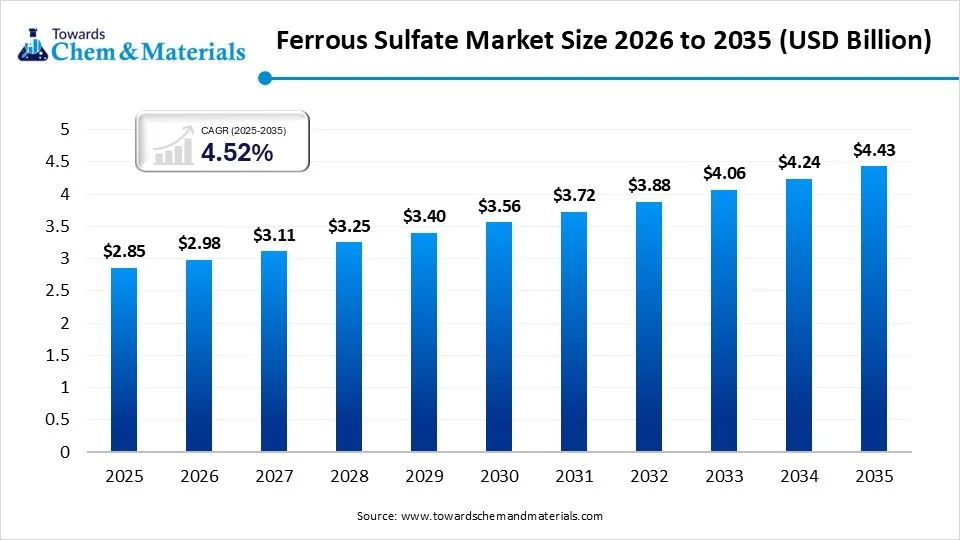
The global ferrous sulfate market size is expected to grow from USD 2.98 billion in 2026 to USD 4.43 billion in 2035, growing at a CAGR of 4.52% from 2026 to 2035. The top key players in the market are BASF SE, Venator Materials PLC, Crown Technology Inc., Rech Chemical Co. Ltd., Kemira Oyj, Coogee Chemicals Pty Ltd, Chemland Group, Pencco, Inc., KRONOS Worldwide, Inc., Guangxi Jintao Titanium Co. Ltd., Hong Yield Chemical Industrial Co., Ltd., Kemira Oyj-Global Forecast 2026 To 2035
Content
What is the Current Ferrous Sulfate Market Size and Share?
The global ferrous sulfate market size was estimated at USD 2.85 billion in 2025 and is expected to increase from USD 2.98 billion in 2026 to USD 4.43 billion by 2035, growing at a CAGR of 4.52% from 2026 to 2035. Asia Pacific dominated the ferrous sulfate market with the largest revenue share of 43.00%in 2025. The growth of the market is driven by the increased demand, wastewater treatment regulations, and demand from various sectors. The ferrous sulfate market is important as a cost-effective, versatile agent across various industries, driven by demand in water treatment, agriculture, and iron-deficiency therapies. It acts as a primary coagulant in industrial water purification, provides essential micronutrients for crops, and is a common pharmaceutical treatment for iron-deficiency anemia. Market growth is driven by increasing infrastructure projects, stricter environmental regulations on wastewater, and higher agricultural demand for improved soil quality.
Market Highlights
- The Asia Pacific dominated ferrous sulfate market with the largest revenue share of 43.00% in 2025. driven by high demand across industrial, agricultural, and pharmaceutical sectors.
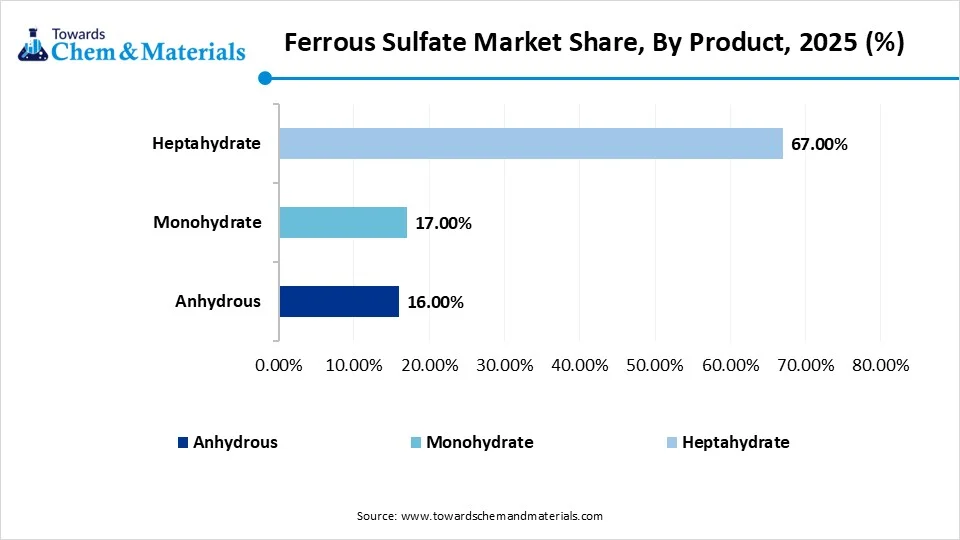
- By product, the Ferrous sulfate heptahydrate segment dominated the market and accounted for the largest revenue share of 67.00% in 2025, driven by its high demand in water treatment, agriculture, and animal feed.
- By product, the Anhydrous ferrous sulfate segment is projected to grow at the fastest CAGR between 2026 and 2035, due to its high iron concentration (no water molecules), enhanced stability, and reduced transportation weight.
- By form, the solid segment led the market with the largest revenue share of 85.00% in 2025. Due to its broad suitability across agriculture, feed additives, pharmaceuticals, and industrial processing.
- By form, the liquid segment is projected to grow at the fastest CAGR 4.3% between 2026 and 2035, driven by its increasing adoption in municipal and industrial water treatment for superior.
- By application, the water and wastewater treatment segment dominated the market and accounted for the largest revenue share of 34.00% in 2025. Driven by high demand and performance, fueling growth.
- By application, the pharmaceuticals and nutraceuticals segment is projected to grow at the fastest CAGR between 2026 and 2035, the growing demand and properties application drives growth.
Trade Analysis Of Ferrous Sulfate Market: Import & Export Statistics
- Based on Global Export Data, between July 2024 and June 2025 (TTM), 2,773 shipments of Ferrous Sulphate were exported worldwide by 508 verified exporters to 836 buyers, reflecting a 21% year-over-year increase.
- Vietnam, Sri Lanka, and Indonesia are the top importers of Ferrous Sulphate. Conversely, China leads as the primary exporter with 3,610 shipments, followed by India with 2,366 shipments and Malaysia with 890 shipments.
Top-performing Global Ferrous Sulphate Exporters by volume:
- Pacific Iron Products Sdn. Bhd.: 382 shipments (39%)
- V. V. Titanium Pigments Pvt. Ltd.: 114 shipments (12%)
- KUNSHAN SUNKAN CHEMICALS CO LTD: 90 shipments (9%)
Ferrous Sulfate Market Growth Trends:
- Sustainability Trends: Manufacturers are moving towards more environmentally friendly production techniques and higher-value, specific products.
- Agricultural Demand: Rising agricultural focus on micronutrient deficiencies (iron) to improve crop yield is driving demand.
- Water Treatment Dominance: Ferrous sulfate is increasingly used for phosphate removal, wastewater treatment, and sludge conditioning in both municipal and industrial sectors.
Report Scope
| Report Attribute | Details |
| Market Size in 2026 | USD 2.98 Billion |
| Revenue Forecast in 2035 | USD 4.43 Billion |
| Growth Rate | CAGR 4.52% |
| Forecast Period | 2026 - 2035 |
| Base Year | 2025 |
| Dominant Region | Asia Pacific |
| Segment Covered | By Product, By Form, By Application, By Regions |
| Key companies profiled | BASF SE, Venator Materials PLC, Crown Technology Inc., Rech Chemical Co. Ltd., Kemira Oyj, Coogee Chemicals Pty Ltd, Chemland Group, Pencco, Inc., KRONOS Worldwide, Inc., Guangxi Jintao Titanium Co. Ltd., Hong Yield Chemical Industrial Co., Ltd., Kemira Oyj |
Key Technological Shifts In The Ferrous Sulfate Market:
The global ferrous sulfate market is undergoing significant technological changes driven by demand for higher purity, environmental goals, and the rapid growth of the electric vehicle (EV) industry. The industry is shifting toward recovering ferrous sulfate as a byproduct from titanium dioxide and steel production, supporting a circular economy. Innovations in product formulations, including granular and microencapsulated variants, are improving storage stability, regulating release rates, and making handling easier for agricultural and industrial uses.
Ferrous Sulfate Market -- Supply Chain Analysis
Chemical Production & Processing
- Ferrous sulfate is produced as a byproduct of steel pickling or through chemical synthesis and is processed into crystalline or granular forms for industrial, agricultural, and pharmaceutical applications.
- Key players: Venator Materials, Kemira, Crown Technology, Rech Chemical.
Quality Testing and Certification
- Ferrous sulfate must meet purity standards, environmental compliance requirements, and safety regulations for agricultural, water treatment, and pharmaceutical uses.
- Key players: International Organization for Standardization, U.S. Food and Drug Administration, European Chemicals Agency, Food Safety and Standards Authority of India.
Distribution to Industrial Users
- Ferrous sulfate is supplied to water treatment plants, agriculture and fertilizer manufacturers, pharmaceutical companies, and pigment production industries.
- Key players: Kemira, Crown Technology, Rech Chemical.
Ferrous Sulfate Regulatory Landscape: Global Regulations
| Country / Region | Regulatory Body | Key Regulations | Focus Areas | Notable Notes |
| US | Environmental Protection Agency (EPA); Food and Drug Administration (FDA) | Federal Food, Drug, and Cosmetic Act; Toxic Substances Control Act (TSCA); Safe Drinking Water Act | Pharmaceutical use, water treatment chemicals, and environmental safety | Ferrous sulfate is regulated as a pharmaceutical ingredient, food additive, and water treatment chemical, requiring compliance with safety and purity standards. |
| Europe | European Chemicals Agency (ECHA); European Food Safety Authority (EFSA) | REACH Regulation; Food Additives Regulation (EC) No. 1333/2008 | Chemical registration, food fortification, and environmental safety | Ferrous sulfate is widely used for iron fortification in food and feed and must meet strict safety and labeling regulations across EU countries. |
| China | National Health Commission (NHC); Ministry of Ecology and Environment (MEE) | Food Safety Law; Environmental Protection Law | Nutritional fortification, industrial chemical production, and environmental monitoring | Ferrous sulfate used in food supplements and fertilizers requires regulatory approval and adherence to national safety standards. |
| India | Food Safety and Standards Authority of India (FSSAI); Central Pollution Control Board (CPCB) | Food Safety and Standards Act; Fertilizer Control Order | Nutritional supplements, fertilizers, and industrial chemical handling | In India, ferrous sulfate is regulated for use in iron supplements, agricultural fertilizers, and water treatment applications. |
| Japan | Ministry of Health, Labour and Welfare (MHLW); Ministry of Economy, Trade and Industry (METI) | Food Sanitation Act; Chemical Substances Control Law (CSCL) | Food fortification, pharmaceutical quality standards, and chemical safety | Japan regulates ferrous sulfate for use in pharmaceuticals and food products with strict quality and safety requirements. |
| Brazil | National Health Surveillance Agency (ANVISA); Brazilian Institute of Environment and Renewable Natural Resources (IBAMA) | Brazilian Food Supplement Regulations; Environmental Safety Laws | Nutritional supplement regulation, environmental protection | Ferrous sulfate used in dietary supplements and fertilizers must comply with ANVISA health standards and environmental regulations. |
Segmental Insights
Product Insights
Which Product Dominated the Ferrous Sulfate Market in 2025?
The Ferrous sulfate heptahydrate segment dominated the market share 67.00% in 2025, due to its high-volume, cost-effective production as a co-product of industrial processes, which fuels the growth of the market. Its widespread availability, ease of dissolution, and lower cost compared to other forms make it preferred for agriculture, water treatment, and industrial applications, supporting the growth of the market.
The Anhydrous ferrous sulfate segment is projected to grow at the fastest CAGR in the market between 2026 and 2035, due to its high iron concentration, low moisture content, and, consequently, superior efficiency in pharmaceutical and industrial applications. This grade offers better stability and lower transportation costs, leading to increased adoption in precision, high-concentration formulations.
Ferrous Sulfate Market Share, By Product , 2025 (%)
| By Product | Revenue Share, 2025 (%) |
| Anhydrous | 16.00% |
| Monohydrate | 17.00% |
| Heptahydrate | 67.00% |
Form Insights
How did the Solid Segment Dominate the Ferrous Sulfate Market in 2025?
The solid segment dominated the market share 85.00% in 2025. Its dominance stems from superior stability, longer shelf life, and ease of storage compared to liquids, fueling the growth of the market. It is essential for bulk industrial applications like agriculture and wastewater treatment due to its cost-effectiveness, which further increases the demand. It is often produced as a byproduct of steel manufacturing, allowing for lower production costs, and its solid form allows for efficient, high-volume shipping.
The liquid segment is projected to grow at the fastest CAGR in the market between 2026 and 2035, driven by its increasing adoption in municipal and industrial water treatment operations, fueling the growth of the market. The liquid form (often used as a solution) is preferred in automated treatment systems because it improves dosing accuracy, reduces preparation time, and minimizes dust generation/handling losses compared to solid forms.
Ferrous Sulfate Market Share, By Form, 2025 (%)
| By Form | Revenue Share, 2025 (%) |
| Solid | 85.00% |
| Liquid | 15.00% |
Application Insights
Which Application Dominated the Ferrous Sulfate Market in 2025?
The water and wastewater treatment segment dominated the market share 34.00% in 2025, due to its critical role as a cost-effective coagulant and flocculant for phosphorus removal, odor control, and sludge conditioning, supporting growth. Stringent global environmental regulations, such as those from the US EPA and EU, mandate continuous, high-volume chemical dosing, driving consistent, recurring demand for industrial and municipal water treatment, further fueling the growth of the market.
The pharmaceuticals and nutraceuticals segment is projected to grow at the fastest CAGR in the market between 2026 and 2035, driven by rising demand for iron deficiency anemia treatments and fortified health products, which fuel the growth of the market. This high-growth segment, particularly in high-purity grades, is expanding due to increasing awareness of iron deficiency, supporting the growth of the market.
Ferrous Sulfate Market Share, By Application , 2025 (%)
| By Application | Revenue Share, 2025 (%) |
| Water & Wastewater Treatment | 34.00% |
| Agriculture | 18.00% |
| Animal Feed Additives | 10.00% |
| Pharmaceuticals & Nutraceuticals | 8.00% |
| Construction Materials | 12.00% |
| Chemical Processing | 10.00% |
| Other Applications | 8.00% |
Regional Insights
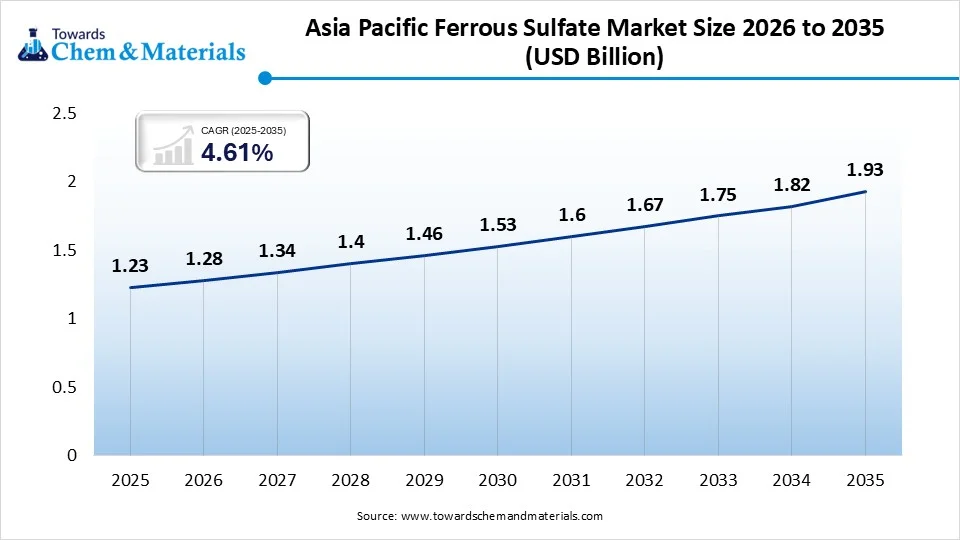
The Asia Pacific ferrous sulfate market size was valued at USD 1.23 billion in 2025 and is expected to be worth around USD 1.93 billion by 2035, exhibiting at a compound annual growth rate (CAGR) of 4.61% over the forecast period from 2026 to 2035.Asia Pacific dominated the market share 43.00% in 2025, fueled by high demand for water treatment for phosphorus removal, agricultural micronutrient fertilizers, and expanding pharmaceutical applications for anemia. Major drivers are escalating industrialization in China and India, stricter environmental regulations, and a push towards sustainable farming practices. Additionally, increased use in pigment manufacturing and cement production further boosts market expansion, especially with rapid infrastructure development in emerging regions.
India Ferrous Sulfate Market Growth Factor
The ferrous sulfate market in India is mainly driven by high demand for agricultural micronutrients, particularly to address iron chlorosis, and by increasing water and wastewater treatment activities. Additionally, rapid urbanization, expanding construction activities, and the growth of the Lithium Iron Phosphate (LFP) battery market, particularly in the Asia Pacific region, further drive demand. Ferrous sulfate is widely used in fertilizers to correct iron deficiency in soil, a vital step for enhancing crop yields, making it essential for India's agricultural sector.
Europe Ferrous Sulfate Market Growth Factor
Europe ferrous sulfate market segment accounted for the major revenue share of 22.00% in 2025. Europe is expected to the fastest growth in the market in the forecast period between 2026 and 2035, driven by strict environmental regulations that require wastewater treatment, particularly for phosphate removal and industrial sludge management. Major growth drivers include the rising agricultural demand for micronutrients and the increased use of micronutrients in pharmaceutical applications to combat iron deficiency. Additionally, strict EU regulations for industrial and municipal water treatment are boosting demand, as ferrous sulfate effectively removes phosphates and conditions sludge.

Germany Ferrous Sulfate Market Growth Factor
The ferrous sulfate market in Germany is propelled by strict environmental regulations that mandate advanced water treatment, such as phosphate removal, and a rising demand for agricultural micronutrients. Additionally, growth is fueled by applications in construction, pigment production, and pharmaceuticals. Germany's rigorous environmental standards require iron-based coagulants for municipal and industrial wastewater treatment, especially for phosphorus removal and sludge conditioning.
North America Ferrous Sulfate Market Growth Factor
North America ferrous sulfate market segment accounted for the major revenue share of 18.00% in 2025.The North American ferrous sulfate market is driven by high demand in water treatment, agriculture, and the pharmaceutical industries. Key growth factors include rising iron deficiency anemia cases, boosting food/supplement demand, stringent water quality regulations requiring effective coagulants, and increased use in agriculture for soil nutrient correction. Rising awareness of iron deficiency anemia and increasing adoption of dietary supplements/fortified foods significantly drive market growth.
Ferrous Sulfate Market Share, By Regional, 2025 (%)
| Regional | Revenue Share, 2025 (%) |
| North America | 18.00% |
| Europe | 22.00% |
| Asia Pacific | 43.00% |
| Latin America | 9.00% |
| Middle East & Africa | 8.00% |
U.S. Ferrous Sulfate Market Growth Factor
The U.S. ferrous sulfate market is fueled by increasing demand in water treatment, agriculture (as a micronutrient fertilizer), and pharmaceuticals (for iron deficiency). Major growth drivers are escalating infrastructure investments, growing industrial wastewater treatment requirements, and a higher incidence of anemia. Awareness of health issues related to iron deficiency and anemia has heightened the use of oral iron supplements and food fortification, leading to swift growth in this sector. The market features steady growth in the U.S., with ferrous sulfate monohydrate seeing high demand.
Recent Developments
- In October 2025, Lubrizol announces new preclinical findings confirming that its microencapsulated iron ingredient, Lipofer microcapsules, outperforms traditional iron sources. The tested iron-deficient rats and found that Lipofer microcapsules notably increased iron absorption and gastrointestinal tolerance, restoring iron levels in only 14 days.(Source: worldbusinessoutlook.com)
- In August 2025, the Pest Management Regulatory Agency (PMRA) in Canada began its second year of the pesticide chemistry verification initiative, further advancing its efforts to modernize pesticide oversight through a continuous review process.(Source: www.global-agriculture.com)
Top players in the Ferrous Sulfate Market & Their Offerings:
- BASF SE: BASF produces ferrous sulfate for industrial, agricultural, and pharmaceutical applications. The company leverages its large chemical manufacturing infrastructure to supply iron salts used in water treatment, fertilizers, pigments, and iron-deficiency supplements.
- Venator Materials PLC: Venator manufactures ferrous sulfate as part of its pigment and chemical processing operations. Its products are widely used in agriculture, water treatment, and industrial chemical processes, supported by a global distribution network.
- Crown Technology Inc.: Crown Technology produces ferrous sulfate primarily for water treatment, pigment manufacturing, and industrial chemical processes. The company focuses on high-purity formulations and customized chemical solutions for industrial clients.
- Rech Chemical Co. Ltd.: Rech Chemical supplies ferrous sulfate products for agriculture, animal feed, pharmaceuticals, and industrial uses. The company has a strong presence in Asian markets and exports to multiple international customers.
- Kemira Oyj: Kemira is a major supplier of ferrous sulfate solutions used primarily in municipal and industrial water treatment. Its products function as coagulants and flocculants that help remove impurities from wastewater and drinking water systems.
- Coogee Chemicals Pty Ltd
- Chemland Group
- Pencco, Inc.
- KRONOS Worldwide, Inc.
- Guangxi Jintao Titanium Co. Ltd.
- Hong Yield Chemical Industrial Co., Ltd.
- Kemira Oyj
Segments Covered:
By Product
- Anhydrous
- Monohydrate
- Heptahydrate
By Form
- Solid
- Liquid
By Application
- Water & Wastewater Treatment
- Agriculture
- Animal Feed Additives
- Pharmaceuticals & Nutraceuticals
- Construction Materials
- Chemical Processing
- Other Applications
By Regions
- North America
- U.S.
- Canada
- Mexico
- Europe
- Germany
- UK
- France
- Italy
- Spain
- Asia Pacific
- China
- India
- Japan
- South Korea
- Latin America
- Brazil
- Argentina
- Middle East & Africa
- Saudi Arabia
- South Africa
FAQ's
Question 1 : What is the current market size of the global ferrous sulfate industry and its growth potential?
Answer : The global ferrous sulfate market is valued at USD 2.85 billion in 2025 and is expected to grow at a CAGR of 4.52% to reach USD 4.43 billion by 2035.
Question 2 : What are the key growth drivers of the ferrous sulfate market?
Answer : The market is driven by increasing demand in wastewater treatment, agriculture for micronutrient fertilizers, and iron-deficiency therapies, alongside stringent environmental regulations.
Question 3 : Which regions are leading the ferrous sulfate market and why?
Answer : Asia Pacific dominates the market with a 43% share in 2025 due to high demand in agriculture, water treatment, and pharmaceutical sectors, driven by industrial growth and environmental awareness.
Question 4 : Who are the leading companies operating in the global ferrous sulfate market?
Answer : Top players in the ferrous sulfate market include BASF SE, Venator Materials PLC, Kemira Oyj, Crown Technology Inc., and Rech Chemical Co. Ltd.
Meet the Team

Saurabh Bidwai
Principal Consultant
Saurabh Bidwai, a B.Tech Chemical Engineering graduate with 4+ years of experience, specializes in specialty chemicals, commodity chemicals, and engineered materials, offering valuable insights into market trends and emerging opportunities.

Aditi Shivarkar
Reviewed By
Aditi Shivarkar, with 14+ years in Chemical and Materials market research, specializes in Chemical and Materials. She ensures accurate, actionable insights, driving Towards Chemicals And Materials Analytics and Consulting excellence in industry trends and sustainability.