
Fine Chemicals Market Size, Share, Growth, Report 2026 to 2035
Fine Chemicals Market Report is Segmented by Product Type(Pharmaceuticals, Agrochemicals,Specialty Chemicals, Flavors & Fragrances,)By Manufacturing Process(Batch Processing, Continuous Processing, Biotechnological Processing),By Application(Healthcare & Pharmaceuticals,Agriculture, Food & Beverages, Electronics, Industrial Applications), By Distribution Channel(Direct Sales, Distributors & Wholesalers, Online Sales) - Global Industry Analysis, Size, Trends, Leading Companies, Regional Outlook, and Forecast 2026 to 2035
Content
What is the current Fine Chemicals Market Size and Share ?
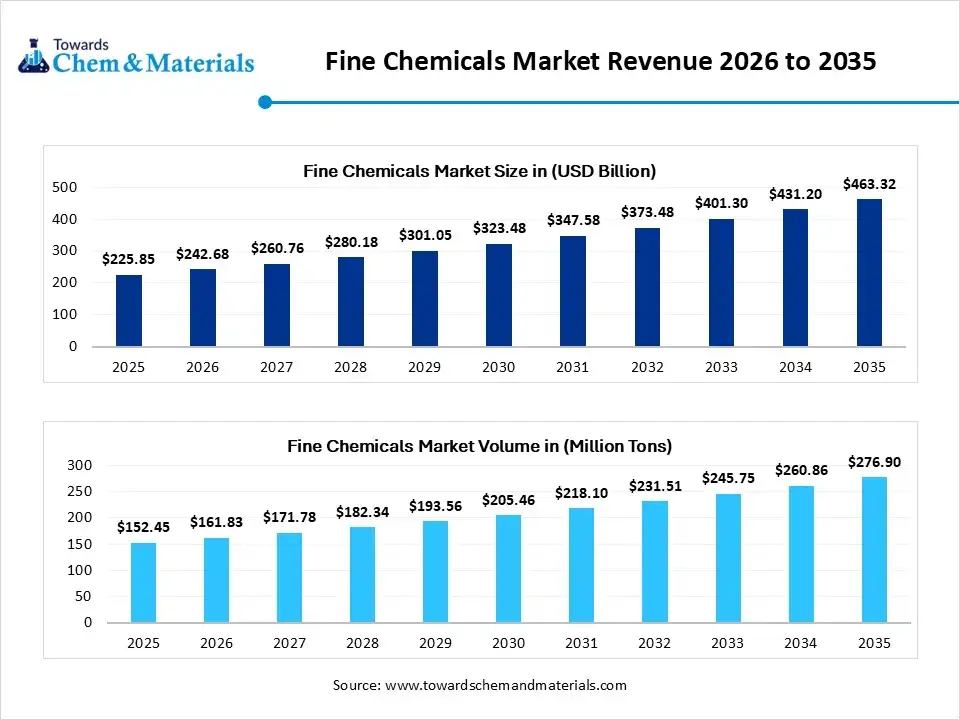
The global fine chemicals market size was valued at USD 225.85 billion in 2025, is estimated to reach USD 242.68 billion in 2026, and is projected to reach USD 463.32 billion by 2035, exhibiting a compound annual growth rate (CAGR) of 7.45% over the forecast period from 2026 to 2035. In terms of volume, the Fine Chemicals market is projected to grow from 152.45 million tons in 2025 to 276.9 million tons by 2035. growing at a CAGR of 6.15% from 2026 to 2035. The growing agrochemical demand and the robustly expanding nutrition sector drive the market growth. The fine chemicals are special chemical substances manufactured in limited quantities. Fine chemicals have characteristics like limited production volume, high added value, high purity, and high flexibility. It offers benefits like high-purity standards, enhanced agricultural productivity, process efficiency, medical advancements, and performance enhancement. They are produced using multi-step synthesis, purification, batch processing, finishing, and biotechnology. Fine chemicals include medicinal agents, advanced intermediates, dyes, catalysts, peptides, antibiotics, and many more.
Market Highlights
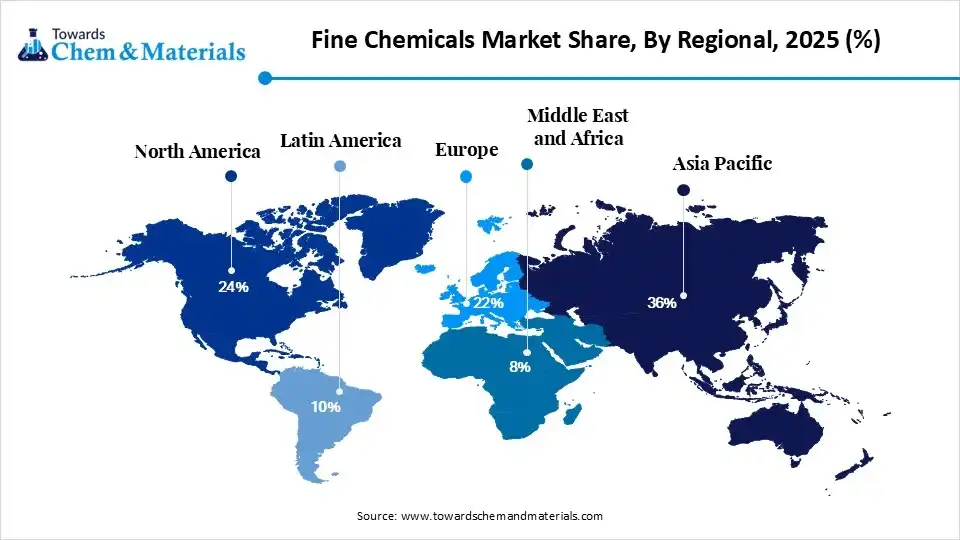
- By region, Asia Pacific dominated the market with a 36% share in 2025 and is expected to grow at the fastest rate in the market with a CAGR of 8.20% during the forecast period.
- By region, North America held a 24% market share in 2025, growing at a CAGR of 6.90% from 2026 to 2035.
- By product type, the pharmaceuticals segment dominated the market with a 46% share in 2025 and is expected to grow at the fastest CAGR of 7.80% during the forecast period.
- By manufacturing process, the batch processing segment dominated the market with a 48% share in 2025, growing at a CAGR of 6.80% from 2026 to 2035.
- By manufacturing process, the continuous processing segment held the 27% market share in 2025 and is expected to grow at the fastest CAGR of 7.60% during the forecast period.
- By application, the healthcare & pharmaceuticals segment dominated the market with a 44% share in 2025 and is expected to grow at the fastest CAGR of 7.90% during the forecast period.
- By distribution channel, the direct sales segment dominated the market with a 55% share in 2025, growing at a CAGR of 7.10% from 2026 to 2035.
- By distribution channel, the distributors & wholesalers segment held the 33% market share in 2025 and is expected to grow at the fastest CAGR of 7.50% during the forecast period.
Market Size and Volume Forecast
- Market Estimated Size (2025): USD 225.85 Billion | CAGR (2026–2035): 7.45%
- Market Projected Size (2035): USD 463.32 Billion
- Market Volume (2025): 152.45 Million Tons | Volume CAGR (2026–2035): 6.15%
- Market Projected Volume (2035): 276.90 Million Tons
- Market Pricing (2025):
- Average Manufacturing Price (2025): USD 1,190 per ton
- Average Selling Price (2025): USD 1,770 per ton
- Pricing CAGR (2025–2035): 4.25%
Recent Market Trends:
- Biotech Rise:- The popularity of precision diagnostics and the increased medicine customization increases demand for fine chemicals. The explosion of biopharmaceuticals and the surge in pharmaceutical CDMOs have increased the use of fine chemicals.
- Growth in Green Chemistry: The surging health hazards and the focus on using fewer raw materials increase the adoption of green chemistry. The emphasis on saving energy and the consumer awareness about the negative impact of chemical products increases the development of sustainable fine chemicals.
- Expansion of HPAPIs: The development of oncology therapies and the focus on smaller dosage formats increase the adoption of HPAPIs. The emphasis on lowering the side effects of medicine and advanced pharmaceutical development increases the use of HPAPIs.
Key Technological Shifts in the Fine Chemicals Market:
The fine chemicals market is undergoing key technological shifts driven by the demand for process optimization, sustainability, and precision. The transformations like machine learning, digital twins, blockchain, IoT, and digitalization help in optimizing formulations and identifying inefficiencies. The incorporation of AI is the prominent shift in the market.
AI develops new fine chemical compounds and optimizes the routes of synthesis. AI detects anomalies in the process and easily predicts market fluctuations. AI lowers the utilization of reagents and lowers physical experimentation requirements. AI lowers the byproduct waste and easily develops custom orders. Overall, companies like Shell, Evonik Industries, BASF, and PPG use AI in fine chemicals production.
Report Scope
| Report Attribute | Details |
| Market Size and Volume in 2026 | USD 242.68 Billion / 161.83 Million Tons |
| Revenue Size and Volume Forecast in 2035 | USD 463.32 Billion / 276.9 Million Tons |
| Growth Rate | CAGR 7.45% |
| Forecast Period | 2026 - 2035 |
| Base Year | 2025 |
| Dominant Region | Asia Pacific |
| Segment Covered | By Product Type, By Manufacturing Process, By Application, By Distribution Channel, By Region |
| Key companies profiled | Lonza Group, Albemarle Corporation, BASF SE, Evonik Industries AG, Sumitomo Chemical Co., Ltd., LANXESS, Vertellus, Solvay S.A., Clariant AG, Arkema, Lotte Fine Chemical, W.R. Grace and Co |
Supply Chain Analysis of the Fine Chemicals Market
Feedstock Procurement
- The stage sources feedstocks like natural gas, sugar, terpenes, lactose, food processing waste, formic acid, petrochemical intermediates, plant oils, glycerol, lignocellulosic biomass, carbon dioxide, and minerals.
- Key Players:- Univar Solutions, HELM AG, Azelis, Catalynt Solutions, Inc., Brenntag, IMCD Group, DKSH, Wego Chemical Group Inc.
Chemical Synthesis and Processing
- The stage involves steps like route scouting, reaction optimization, reaction transformation, isolation, process development, and product formulation.
- Key Players:- Evonik Industries AG, Sumitomo Chemical Co., Ltd, DSM-Firmenich, BASF SE, Albemarle Corporation, Arkema SA, Lonza Group AG
Quality Testing and Certification
- Quality testing performs tests like physical property analysis, stability testing, composition analysis, regulatory compliance, contaminant testing, chemical property analysis, and purity analysis. Certifications like ISO 9001:2015, REACH, CoA, and IEC 17025 are required.
- Key Players:- SGS, FARE Labs, Eurofins Scientific, SIMA Labs, Intertek, McCreath Laboratories, Bureau Veritas, Fine Finish Analytical Laboratory
Regulatory Framework: Fine Chemicals Market
| Region | Key Regulations | Regulatory Focus |
| China |
|
The expansion of chemical industrial parks and VOC control |
| European Union |
|
The reporting of microplastics, chronic hazards, and the PFAS restriction proposal. |
| United States |
|
The industrial safety and workplace hazard management. |
Fine Chemicals Market Dynamics
Driver
Expanding Electronic Applications Drives Market Growth
The expansion of electronic applications is a major driver for the market. The shift to advanced semiconductor nodes and the rise in precision etching increase the use of fine chemicals. The technological modernization and presence of electric vehicles increase the use of electronics-grade fine chemicals. The consumer interest in diverse display technologies like LED and the popularity of transparent electronics increases the use of fine chemicals.
The use of advanced photoresist and the development of chip structure increases the use of fine chemicals. The device miniaturization trend and wafer surface polishing require fine chemicals. The need for high-bandwidth memory and the expansion of stretchable electronics increases the use of fine chemicals. The ongoing electronic advancement drives the market growth.
Restraints
Fluctuating Raw Material Prices Restrain the Market Growth
The robust environmental regulations and imbalances in supply & demand increase the raw material price fluctuation. The prevalence of natural disasters and raw material supply shortages increases raw material costs. The growing freight rates and the issues in production capacity increase the cost of raw materials.
The fluctuating oil prices and energy-intensive methods increase the cost. The growing political instability in regions and import-export restrictions increases raw material prices. The unexpected rise in product demand and the closures of the factory plant increase the costs. The volatility in the cost of energy and shortages of containers increase fluctuations in prices. The fluctuating raw material prices restrict the growth of the market.
Opportunity
Interest in Bio-Based Chemicals Unlocks Market Opportunity
The global transition to sustainability and the focus on lowering dependence on volatile petrochemical fuels the development process of bio-based chemicals. The growing consumer pressure and the shift away from fossil-based petrochemicals increase the use of bio-based chemicals. The development of functional materials requires bio-based chemicals.
The development of products like bio-lubricants, bio-succinic, and bio-surfactants, and many more, helps in the development of sustainable products. The industry's shift to sustainable chemicals increases bio-based chemicals production. The high availability of agricultural waste, vegetable oils, biomass, and others increases the production of bio-based chemicals. The increasing use of bio-based chemicals in high-quality industrial applications creates an opportunity for market growth.
Segmental Insights
Product Type Insights
Fine Chemicals Market Share, By Product Type, 2025 (%)
| By Product Type | Revenue Share, 2025 (%) |
| Pharmaceuticals | 46% |
| Agrochemicals | 21% |
| Specialty Chemicals | 23% |
| Flavors & Fragrances | 10% |
The pharmaceuticals segment dominated the market with a 46% share in 2025 and is expected to grow at the fastest CAGR of 7.80% during the forecast period due to growing global healthcare demand. The rising generic drug use and the need for monoclonal antibodies increase fine chemicals use. The demand for complex molecules and the need for specialized pharmaceuticals increases the adoption of fine chemicals. The surge in API development drives the segment growth.
The specialty chemicals segment held the 23% market share in 2025 due to the increased use of advanced materials. The development of high-performance coatings and the interest in low-VOC products increase the adoption of specialty chemicals. The shift to high-margin products and the need for high-purity compounds increase the adoption of specialty chemicals. The advancements in catalysts support the segment growth.
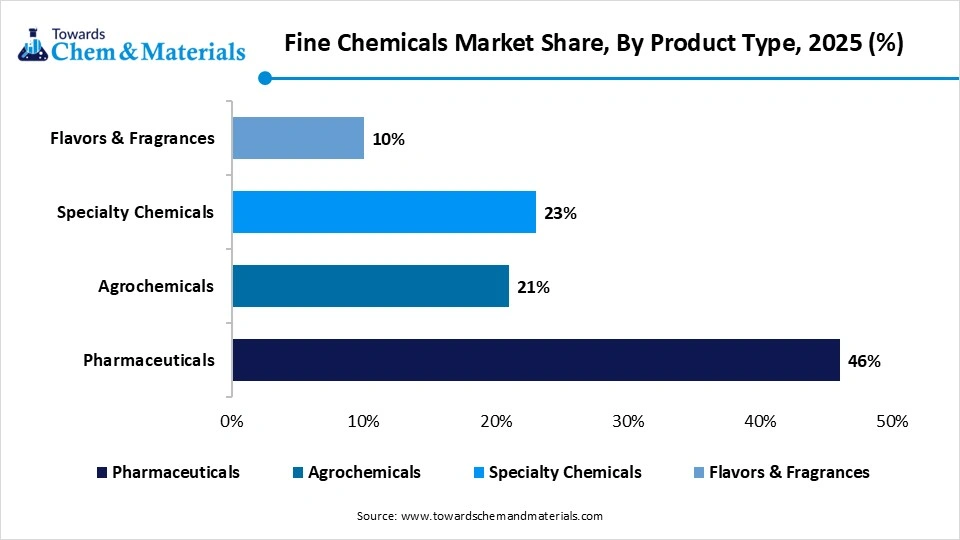
The agrochemicals segment held the 21% market share in 2025 due to the increasing food demand. The rising crop production and the shift to environmentally-friendly fungicides increase agrochemical production. The growing pesticide resistance and crop protection focus increases the use of agrochemicals. The agricultural modernization boosts the segment growth.
The flavors & fragrances segment held the 10% market share in 2025 due to the higher processed food demand. The interest in plant-based products and the increased use of scented personal care increases the adoption of flavors & fragrances. The popularity of fine perfumes and the rise in luxury personal care items increase demand for flavors and fragrances. The expanding household care drives the segment growth.
Manufacturing Process Insights
Fine Chemicals Market Share, By Manufacturing Process, 2025 (%)
| By Manufacturing Process | Revenue Share, 2025 (%) |
| Batch Processing | 48% |
| Continuous Processing | 27% |
| Biotechnological Processing | 25% |
The batch processing segment dominated the market with a 48% share in 2025 due to the growing use in high-value production. The rise in multi-product manufacturing and focus on hazard mitigation increases the use of batch processing. The hazardous reactions and rise in multi-step reactions increase the use of batch processing. The high flexibility, economic viability, and superior precision of batch processing drive the segment growth.
The continuous processing segment held the 27% market share in 2025 and is expected to grow at the fastest CAGR of 7.60% during the forecast period due to the reduced manufacturing cost. The focus on maximizing automation and smaller internal volume increases the use of continuous processing. The development of modern plants and the quality assurance improvements increase the continuous processing use. The excellent consistency of the product supports the segment growth.
The biotechnological processing segment held the 25% market share in 2025 due to the interest in sustainable production methods. The emphasis on waste reduction and the rise in renewable feedstocks increase the adoption of biotechnological processing. The regulatory pressure and the interest in biodegradable sourced ingredients increase the use of biotechnological processing. The sustainability and performance benefits of biotechnological processing boost segment growth.
Application Insights
Fine Chemicals Market Share, By Application, 2025 (%)
| By Application | Revenue Share, 2025 (%) |
| Healthcare & Pharmaceuticals | 44% |
| Agriculture | 20% |
| Food & Beverages | 13% |
| Electronics | 11% |
| Industrial Applications | 12% |
The healthcare & pharmaceuticals segment dominated the market with a 44% share in 2025 and is expected to grow at the fastest CAGR of 7.90% during the forecast period due to the expansion of worldwide healthcare infrastructure. The growth in biopharmaceuticals and the rising use of branded drugs increase demand for fine chemicals. The rise in high-value pharmaceutical synthesis and the need for effective medications increases the use of fine chemicals. The huge antiviral production drives the segment growth.
The agriculture segment held the 20% market share in 2025 due to the higher need for crop protection chemicals. The development of organic pesticides and the emphasis on lowering yield loss increase demand for fine chemicals. The surging global food manufacturing increases the use of fine chemicals. The rise in drone-based spraying supports the overall segment growth.
The food & beverages segment held the 13% market share in 2025 due to the food safety regulations. The burgeoning packaged food base and the emphasis on natural sweeteners increase the use of fine chemicals. The healthier food transition and the prebiotic fiber production increase the adoption of fine chemicals. The strong food quality standards boost the segment growth.
The industrial applications segment held the 12% market share in 2025 due to the manufacturing expansion. The demand for complex intermediates and the expansion of advanced electronics increase the use of fine chemicals. The rising use of battery materials and semiconductor development increases the use of fine chemicals. The wide industrial usage drives the segment growth.
Distribution Channel Insights
Fine Chemicals Market Share, By Distribution Channel, 2025 (%)
| By Distribution Channel | Revenue Share, 2025 (%) |
| Direct Sales | 55% |
| Distributors & Wholesalers | 33% |
| Online Sales | 12% |
The direct sales segment dominated the market with a 55% share in 2025 due to the preference for direct procurement. The focus on direct accountability and the specific needs of clients increases the adoption of direct sales. The long-term contracts and the need for specialized knowledge increase the use of direct sales. The availability of technical support and quality control in direct sales drives the segment growth.
The distributors & wholesalers segment held the 33% market share in 2025 and is expected to grow at the fastest CAGR of 7.50% during the forecast period due to the expansion of trade networks. The higher specialty chemicals demand and safety regulations increase the adoption of distributors & wholesalers. The fragmented base of consumers and the demand for value-added services increase the adoption of distributors & wholesalers. The growing multi-sourcing supports the segment growth.
The online sales segment held the 12% market share in 2025 due to the digital platform expansion. The rise in 24/7 searching and lower transactional costs increases the adoption of online sales. The easy data accessibility, pricing transparency, and improved speed of online sales help with expansion. The rise in small-scale buyers and the interest in an Amazon-like experience boost the segment growth.
Regional Insights
Why Asia Pacific Dominated the Fine Chemicals Market?
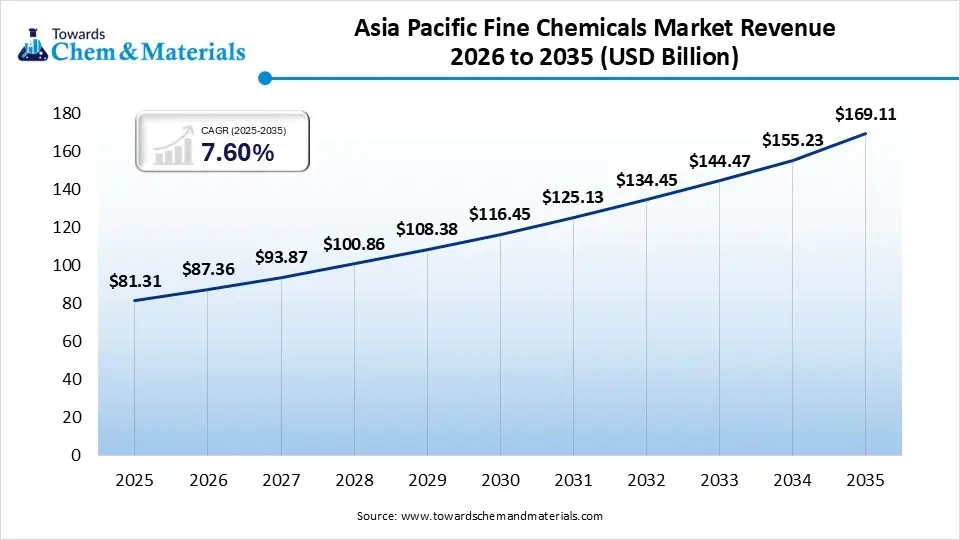
The Asia Pacific Fine Chemicals Market size was estimated at USD 81.31 billion in 2025 and is projected to reach USD 169.11 billion by 2035, growing at a CAGR of 7.60% from 2026 to 2035 Asia Pacific dominated the market with a 36% share and is expected to grow at the fastest CAGR of 8.20% during the forecast period due to the expanded pharmaceutical production. The presence of a lower-cost workforce and the growth in biotech startups increase the fine chemicals production. The surging gene therapies and the strong chemical supply chain increase production of fine chemicals. The rise in utilization of flow chemistry technology and the surging development of chemical intermediates drive the market growth.
China Fine Chemicals Market Trends
China is a prominent player in the market. The well-established consumer goods factory and the growing manufacturing of specialized chemical parks increase the production of fine chemicals. The expansion of industrial parks and the large manufacturing ecosystem increases demand for fine chemicals. The investment in electronic chemicals supports the overall market growth.
North America Fine Chemicals Market Trends
North America held the 24% market share in 2025 due to its advanced R&D capabilities. The transition to green chemistry and the rise in custom synthesis increase the production of fine chemicals. The increased cardiovascular drug production and localizing manufacturing increases demand for fine chemicals. The heavy agrochemical demand and the utilization of biotechnology methods help with expansion. The dominance of the pharmaceutical industry drives the market growth.
Fine Chemicals Market Share, By Regional, 2025 (%)
| Regional | Revenue Share, 2025 (%) |
| North America | 24% |
| Europe | 22% |
| Asia-Pacific | 36% |
| Latin America | 10% |
| Middle East & Africa | 8% |
United States Fine Chemicals Market Trends
The United States is a robust contributor to the market due to the surge in formulations of complex drugs. The geopolitical tensions and the green chemistry expansion increase the production of fine chemicals. The advanced agriculture base and the rising API demand increase fine chemicals adoption. The focus on lowering hazardous waste and the demand for advanced intermediates support the overall market growth.
Recent Developments
- In April 2026, Evonik collaborated with Fuhua to launch a specialty H2O2 plant in Leshan, China. The specialty H2O2 is available to use in industries like semiconductor manufacturing, cosmetics, solar cell production, pharmaceuticals, and food packaging. The yearly manufacturing capabilities of the plant are 20000 tons.
(Source: www.indianchemicalnews.com) - In May 2025, Pharcos Specialty Ltd. introduced India’s first homegrown HPMC excipient, Pharcocel. The excipient is widely used across applications like tablet coating, vegetarian capsule production, frozen food, wet granulation, suspension stabilization, pharmaceutical formulation, and dietary food.(Source: www.pharmabiz.com)
- In March 2026, Cosmo Specialty Chemicals expanded its high-performance masterbatch product portfolio. The portfolio includes new CosmoAdd and CosmoWhite. CosmoAdd is used across applications like blown film, BOPP, and CPP packaging. CosmoWhite is used across blown films, injection moulding, raffia, BOPP films, extrusion coating, pail containers, and non-wovens applications.(Source: www.indianchemicalnews.com)
Top Companies List
- Lonza Group:- The Switzerland-based company manufactures fine chemicals like HPAPIs, small molecule APIs, biopharmaceutical ingredients, specialty ingredients, personal care actives, and pharmaceutical intermediates.
- Albemarle Corporation:- The company’s fine chemicals product portfolio includes bromine & derivatives, cesium compounds, organometallics, performance curatives, and metal hydrides.
- BASF SE:- The company manufactures several products like pharmaceutical excipients, catalysts, pharmaceutical ingredients, specialty intermediates, adsorbents, and chemical intermediates.
Other Companies List
- Evonik Industries AG
- Sumitomo Chemical Co., Ltd.
- LANXESS
- Vertellus
- Solvay S.A.
- Clariant AG
- Arkema
- Lotte Fine Chemical
- W.R. Grace and Co
Segments Covered
By Product Type
- Pharmaceuticals
- Active Pharmaceutical Ingredients (APIs)
- Synthetic APIs
- Biotech APIs
- Intermediates
- Active Pharmaceutical Ingredients (APIs)
- Agrochemicals
- Herbicides
- Insecticides
- Fungicides
- Specialty Chemicals
- Electronic Chemicals
- Polymer Additives
- Surfactants
- Flavors & Fragrances
- Natural Ingredients
- Synthetic Ingredients
By Manufacturing Process
- Batch Processing
- Continuous Processing
- Biotechnological Processing
- Fermentation
- Enzyme-Based Synthesis
By Application
- Healthcare & Pharmaceuticals
- Agriculture
- Food & Beverages
- Electronics
- Industrial Applications
By Distribution Channel
- Direct Sales
- Distributors & Wholesalers
- Online Sales
By Region
- North America
- U.S.
- Canada
- Mexico
- Europe
- Germany
- UK
- France
- Italy
- Spain
- Asia Pacific
- China
- India
- Japan
- South Korea
- Latin America
- Brazil
- Argentina
- Middle East & Africa
- Saudi Arabia
- South Africa
FAQ's
Question 1 : What exactly are fine chemicals?
Answer : Fine chemicals are high-purity chemical substances produced in limited quantities. They are the active ingredients in things like medicines, pesticides, and specialty food additives.
Question 2 : Why is the Asia Pacific region so dominant?
Answer : The region benefits from lower labor costs, a massive manufacturing ecosystem, and a growing number of biotech startups, particularly in China and India.
Question 3 : How is AI helping the chemical industry?
Answer : AI helps scientists discover new chemical compounds faster, reduces the need for physical trial and error in the lab, and detects errors in the manufacturing process before they become expensive mistakes.
Question 4 : What is the difference between batch and continuous processing?
Answer : Batch processing makes chemicals in lots or groups (like baking cookies), while continuous processing is a non-stop flow (like a river), which is more efficient for large-scale, consistent production.
Question 5 : What is Green Chemistry in this market?
Answer : It refers to designing chemical products and processes that reduce or eliminate hazardous substances, use less energy, and rely on sustainable plant-based materials instead of oil.
Question 6 : Are there any risks to market growth?
Answer : The biggest challenges are fluctuating raw material prices (often caused by oil prices or political instability) and the high cost of meeting strict environmental regulations.
Meet the Team

Saurabh Bidwai
Principal Consultant
Saurabh Bidwai, a B.Tech Chemical Engineering graduate with 4+ years of experience, specializes in specialty chemicals, commodity chemicals, and engineered materials, offering valuable insights into market trends and emerging opportunities.

Aditi Shivarkar
Reviewed By
Aditi Shivarkar, with 14+ years in Chemical and Materials market research, specializes in Chemical and Materials. She ensures accurate, actionable insights, driving Towards Chemicals And Materials Analytics and Consulting excellence in industry trends and sustainability.