
Fluorochemicals Market Market Size, Share & Trends Analysis Report by 2026-2035
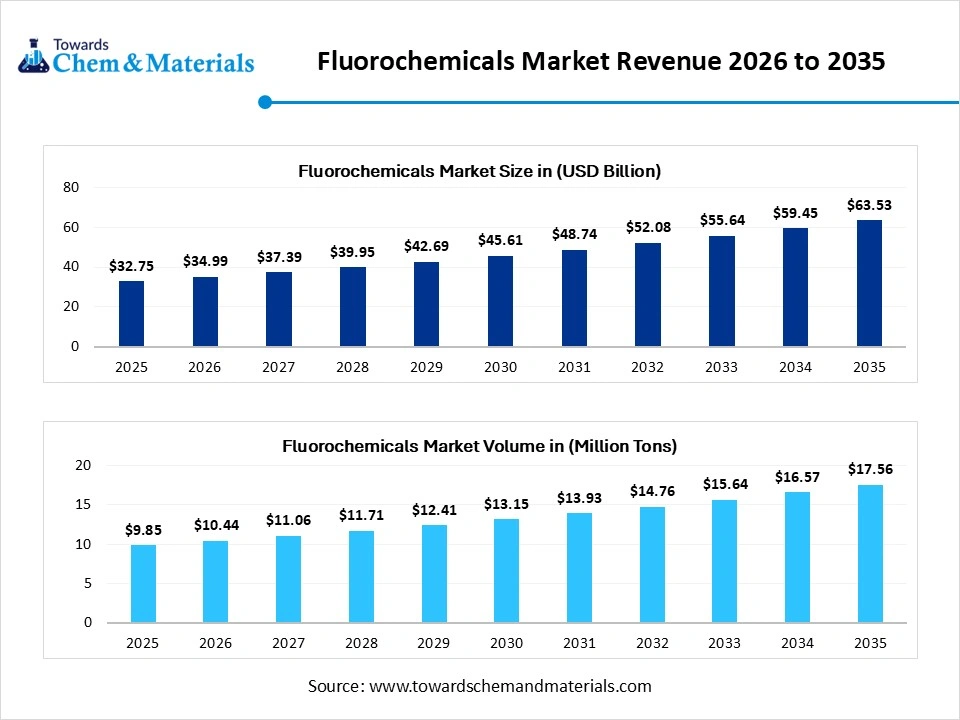
The fluorochemicals market is witnessing steady growth, increasing from USD 32.75 billion in 2025 to USD 63.53 billion by 2035, with a CAGR of 6.85% from 2026 to 2035. Volume consumption is expected to rise from 9.85 million tons to 17.56 million tons, growing at a CAGR of 5.95%. This report delivers detailed segmentation data, regional demand patterns, and insights into key industries driving adoption. It further covers major manufacturers and suppliers, along with a thorough competitive analysis, value chain mapping, and trade flow assessment across global markets.
Content
Fluorochemicals Market Growth, Innovations and Market Size Forecast
The global fluorochemicals market was valued at USD 32.75 billion in 2025, is estimated to reach USD 34.99 billion in 2026, and is projected to reach USD 63.53 billion by 2035, growing at a CAGR of 6.85% from 2026 to 2035. In terms of volume, the fluorochemicals market is projected to grow from 9.85 million tons in 2025 to 17.56 million tons by 2035. growing at a CAGR of 5.95% from 2026 to 2035.
Key Takeaways
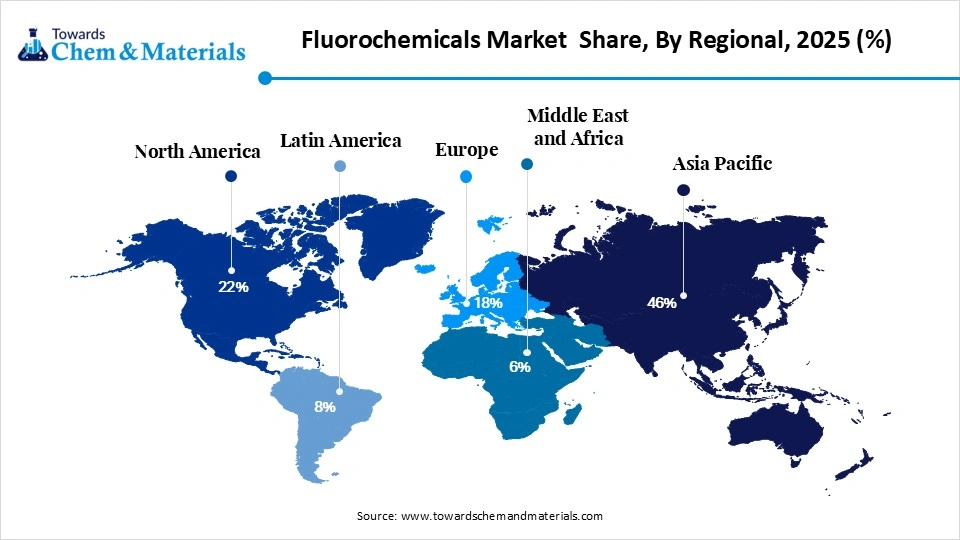
- By region, Asia Pacific dominated the market with a share of 46% in 2025 and is expected to sustain its position while growing with the fastest CAGR of 7.4% in the forecast period.
- By region, North America held the second largest share of 22% in 2025. Supports advanced HVAC and automotive sectors.
- By product type, the fluorocarbons segment dominated the market with 38% share in 2025. Drives demand through HVAC sector expansion.
- By product type, the fluoropolymers segment held the second largest share of 27% in 2025 and is expected to have the fastest growth with a CAGR of 7.6% in the forecast period. Expands with EV battery and semiconductor demand.
- By application, the refrigeration segment dominated the market with 34% share in 2025. Expands due to rising global cooling demand.
- By application, the electrical and electronics segment held the third largest share of 16% in 2025 and is expected to have the fastest growth with a CAGR of 7.8% in the forecast period. Supports semiconductor manufacturing boom.
- By distribution channel, the direct sales segment dominated the market with 52% share in 2025. Enables bulk supply to large industries.
- By distribution channel, the online sales segment held the third largest share of 15% in 2025 and is expected to have the fastest growth with a CAGR of 8.3% in the forecast period. Drives digital procurement adoption.
Fluorochemicals Market Size and Volume Forecast
- Market Estimated Size (2025): USD 32.75 Billion | CAGR (2026–2035): 6.85%
- Market Projected Size (2035): USD 63.53 Billion
- Market Volume (2025): 9.85 Million Tons (MT)| Volume CAGR (2026–2035): 5.95%
- Market Projected Volume (2035): 17.56 Million Tons (MT)
- Market Pricing (2025):
- Average Manufacturing Price: USD 2,470/per ton
- Average Selling Price: USD 3,150/per ton
- Pricing CAGR (2025–2035): 3.45%
Market Overview
What is the Significance of the Fluorochemicals Market?
The fluorochemicals market is vital for industrial, automotive, electronics, and pharmaceutical sectors, valued for their unique stability, durability, and low surface tension. Driven by rising demand for aluminum smelting, refrigeration, high-performance polymers (PTFE), and semiconductor manufacturing, with a key shift toward eco-friendly, low-GWP alternatives. The sector is integral to the production of high-performance components and is seeing increased demand due to electric vehicle battery manufacturing and the need for lightweight materials.
Fluorochemicals Market Growth Trends:
- Shift to Sustainable Refrigerants: Due to strict environmental regulations regarding high-GWP (Global Warming Potential) HFCs, there is a strong transition towards Hydrofluoroolefins in the HVAC and cold-chain sectors.
- Semiconductor and Electronics Boom: The growing semiconductor industry, particularly in East Asia, requires high-purity fluorochemicals for etching and cleaning processes.
- Electric Vehicle Expansion: The automotive industry is driving demand for fluoropolymers for specialized lithium-ion battery components, seals, and gaskets.
Report Scope
| Report Attributes | Details |
| Market Size in 2026 | USD 34.99 Billion / 10.44 Million Tons |
| Projected Market Size in 2035 | USD 63.53 Billion/ 17.56 Million Tons |
| CAGR (2026 - 2035) | 6.85% |
| Leading Region | Asia Pacific |
| Market Segmentation | By Product Type, By Application, By End-Use Industry, By Distribution Channel and By Regions |
| Top Key Players | Chemours Company, Gujarat Fluorochemicals Limited, SRF Limited, Navin Fluorine International Limited, Dongyue Group Limited, 3M, DuPont, Daikin Industries Ltd., Solvay, Honeywell International Inc., Arkema, Air Products and Chemicals, Inc., Mitsui Chemicals India Pvt. Ltd., Pelchem SOC Ltd, Halocarbon, LLC, Koura. |
Key Technological Shifts in the Fluorochemicals Market
The fluorochemicals market is undergoing a major change driven by the demand for sustainable, low-GWP alternatives, high-performance electronics materials, and EV batteries. It is transitioning from traditional fluorocarbons to advanced fluoropolymers and new refrigerants, with an emphasis on circular economy practices. The industry is rapidly replacing Hydrofluorocarbons with Hydrofluoroolefins and their blends to meet regulations like the Kigali Amendment and EU F-gas rules.
Trade Analysis of Fluorochemicals Market: Import & Export Statistics
- According to Global Export Data, the world exported 4,010 Fluoride shipments between July 2024 and June 2025 (TTM) via 1,018 verified exporters and 1,007 buyers, representing a 11% YoY change.
- The United States, India, and Vietnam lead as the top Fluoride importers, while China with 2,761 shipments, the United States with 2,279 shipments, and Germany with 2,071 shipments, rank as the largest global Fluoride exporters.
Top-performing Global Fluoride Exporters by volume
- Merck Life Science KGaA: 265 shipments (28%)
- NRS OCEAN LOGISTICS LTD: 140 shipments (15%)
- Mexichem Fluor Comercial S A de C: 105 shipments (11%)
Supply Chain Analysis of Fluorochemicals Market
Chemical Production & Processing
Fluorochemicals are produced through fluorination processes involving hydrogen fluoride and other intermediates to manufacture products such as fluoropolymers, refrigerants, and specialty fluorinated compounds.
- Key players: Chemours, Daikin Industries, Arkema, Solvay.
Quality Testing and Certification
Fluorochemicals must comply with stringent environmental, safety, and chemical handling regulations due to their potential environmental impact and toxicity concerns.
- Key players: European Chemicals Agency, U.S. Environmental Protection Agency, International Organization for Standardization, Montreal Protocol.
Distribution to Industrial Users
Fluorochemicals are supplied to refrigeration and HVAC industries, electronics manufacturers, automotive companies, construction sectors, and chemical processing industries.
- Key players: Chemours, Daikin Industries, Arkema.
Fluorochemicals Regulatory Landscape: Global Regulations
| Country / Region | Regulatory Body | Key Regulations | Focus Areas | Notable Notes |
| U.S. | Environmental Protection Agency (EPA); Occupational Safety and Health Administration (OSHA) | Toxic Substances Control Act (TSCA); Clean Air Act; PFAS Action Plan | Chemical safety, emissions control, PFAS regulation | The U.S. is increasingly regulating fluorochemicals, particularly PFAS, due to environmental persistence and health concerns, with stricter monitoring and reporting requirements. |
| Europe | European Chemicals Agency (ECHA); European Commission | REACH Regulation; PFAS Restriction Proposal; Industrial Emissions Directive (IED) | Hazardous substance restriction, environmental protection, and chemical registration | The EU is moving toward broad restrictions on PFAS-based fluorochemicals, significantly impacting production and use across industries. |
| China | Ministry of Ecology and Environment (MEE); Ministry of Industry and Information Technology (MIIT) | Environmental Protection Law; Chemical Industry Standards | Emissions control, industrial chemical management | China regulates fluorochemicals through environmental compliance and industrial standards, with increasing focus on pollution control. |
| India | Ministry of Environment, Forest and Climate Change (MoEFCC); Central Pollution Control Board (CPCB) | Environment Protection Act; Hazardous Chemical Rules | Chemical safety, emissions monitoring | India regulates fluorochemicals under hazardous chemical frameworks, focusing on safe handling and environmental protection. |
| Japan | Ministry of Economy, Trade and Industry (METI); Ministry of the Environment | Chemical Substances Control Law (CSCL); Industrial Safety and Health Act | Chemical risk management, environmental safety | Japan enforces strict controls on fluorochemicals, particularly persistent substances, under its chemical management regulations. |
| South Korea | Ministry of Environment (MoE); Ministry of Trade, Industry and Energy (MOTIE) | K-REACH; Chemicals Control Act | Chemical registration, hazardous substance management | South Korea regulates fluorochemicals through comprehensive chemical registration and safety laws, aligning with global standards. |
Segmental Insights
Product Type Insights
The Fluorocarbons Segment Dominated The Market With 38% Market Share In 2025
The fluorocarbons segment dominated the market with 38% share in 2025, due to the rapid adoption of eco-friendly, next-generation refrigerants like hydrofluoroolefins (HFOs) in response to regulations phasing out traditional HCFCs/HFCs. Expanding demand in HVAC systems, automotive insulation, and electric vehicle battery components, alongside increasing use in aerospace and pharmaceutical sectors, drives this growth.
The fluoropolymers segment held the second largest share of 27% in 2025 and is expected to have the fastest growth with a CAGR of 7.6% in the forecast period, driven by high demand in electric vehicles, electronics, and renewable energy. High-performance polymers like PTFE are critical in semiconductor manufacturing for their extreme chemical purity and resistance. Increased adoption in specialized coatings, medical devices, and aerospace for superior corrosion resistance and durability.
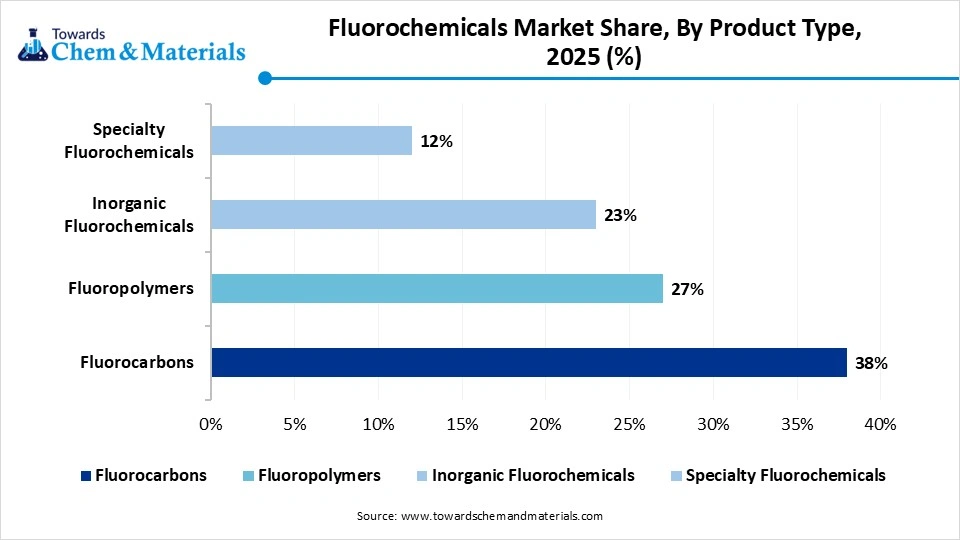
The inorganic fluorochemicals segment held the third largest share of 23% in 2025, driven by rapid expansion in the electric vehicle battery market, rising aluminum demand, and increasing applications in electronics. Specifically, lithium-ion battery production requires high-purity inorganic fluoride compounds, while the aluminum industry depends on these chemicals for smelting.
The specialty fluorochemicals segment held the fourth largest share of 12% in 2025, driven by surging demand for high-performance fluoropolymers in electronics, automotive, and semiconductor manufacturing. Their unique properties, exceptional heat resistance, durability, and chemical inertness make them essential for modern applications. Rapid industrialization, particularly in India, and the shift towards low-GWP refrigerants under sustainability regulations are further fueling this expansion.
Fluorochemicals Market Share, By Product Type, 2025 (%)
| By Product Type | Revenue Share, 2025 (%) |
| Fluorocarbons | 38% |
| Fluoropolymers | 27% |
| Inorganic Fluorochemicals | 23% |
| Specialty Fluorochemicals | 12% |
Application Insights
The Refrigeration Segment Dominated The Market With 34% Market Share In 2025
The refrigeration segment dominated the market with 34% share in 2025, driven by rising demand for HVAC and cooling systems due to urbanization, industrialization, and increased need for cold chain storage. The shift to sustainable, low-GWP (Global Warming Potential) Hydrofluoroolefins and strict environmental regulations like the Kigali Amendment are driving massive replacement demand for new fluorochemicals.
Fluorochemicals Market Share, By Application, 2025 (%)
| By Application | Revenue Share, 2025 (%) |
| Refrigeration | 34% |
| Aluminum Production | 18% |
| Electrical & Electronics | 16% |
| Automotive | 12% |
| Chemical Processing | 10% |
| Pharmaceuticals | 6% |
| Others | 4% |
The aluminum production segment held the second largest share of 18% in 2025. The growth is primarily fueled by increasing demand for high-purity AlF3 in primary aluminum smelting, which is driven by rising lightweighting needs in the automotive and aerospace industries, particularly for electric vehicles. Aluminum is favored in electric vehicles for battery enclosures, wheels, and body components to offset the weight of batteries, driving high-purity aluminum demand, which requires high-grade fluorochemicals.
The electrical & electronics segment held the third largest share of 16% in 2025 and is expected to have the fastest growth with a CAGR of 7.8% in the forecast period, fueled by the accelerating demand for high-performance fluoropolymers in 5G infrastructure, semiconductor manufacturing, and electric vehicle components. Specialty fluorochemicals and gases are in high demand for the production of advanced electronic components and semiconductors, which drives the growth of the market.
The automotive segment held the fourth largest share of 12% in 2025, driven heavily by the rapid transition to electric vehicles, the adoption of lightweight materials, and stricter environmental regulations for air conditioning. The market is shifting toward high-performance materials like fluoropolymers and specialized fluoroelastomers to enhance vehicle efficiency, safety, and battery performance.
Distribution Channel Insights
The Direct Sales Segment Dominated The Market With 52% Market Share In 2025
The direct sales segment dominated the market with 52% share in 2025, driven by the need for high-performance materials in specialized industries and the requirement for close technical collaboration. As manufacturers pivot toward high-value applications, particularly in electric vehicles, semiconductors, and advanced electronics, direct sales channels are preferred to manage complex, customized, and high-volume orders.
Fluorochemicals Market Share, By Distribution Channel, 2025 (%)
| By Distribution Channel | Revenue Share, 2025 (%) |
| Direct Sales | 52% |
| Distributors & Wholesalers | 33% |
| Online Sales | 15% |
The distributors & wholesalers segment held the second largest share of 33% in 2025, driven by the demand for complex supply chain management, compliance with changing environmental regulations, and the rapid expansion of end-use industries like electronics and electric vehicles. This segment acts as a vital bridge between large-scale manufacturers and diverse, often fragmented, end-users, ensuring timely delivery and technical support.
The online sales segment held the third largest share of 15% in 2025 and is expected to have the fastest growth with a CAGR of 8.3% in the forecast period, driven by the rapid digitalization of B2B chemical distribution, the demand for high-purity, specialized products in emerging technologies, and the need for more efficient, transparent supply chains. With the semiconductor and electronics manufacturing sectors expanding, digital channels facilitate the rapid sourcing of specialized materials, which are critical for microelectronics and 5G technology. The need for precision in ordering these materials favors online platforms.
Regional Insights
How did Asia Pacific Dominate the Fluorochemicals Market in 2025?
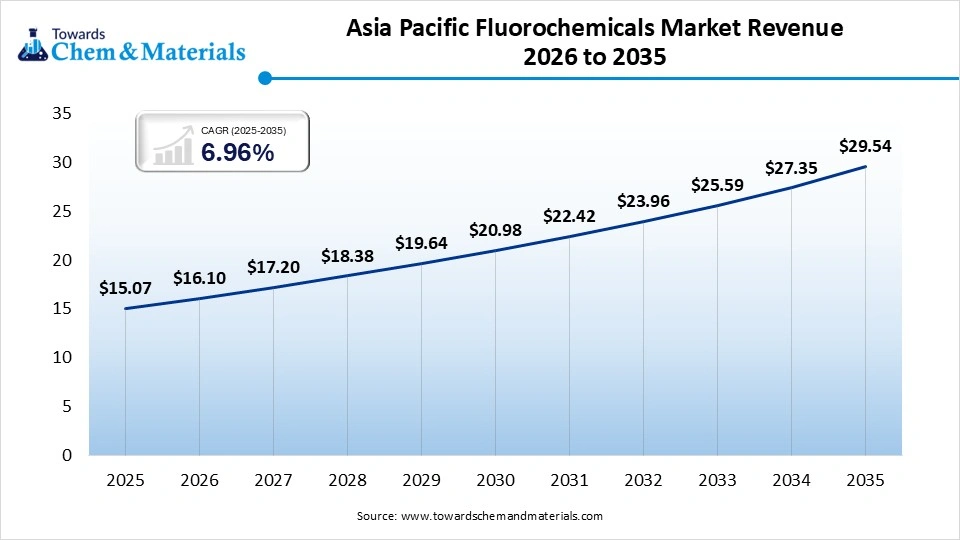
The Asia Pacific fluorochemicals market size was estimated at USD 15.07 billion in 2025 and is projected to reach USD 29.54 billion by 2035, growing at a CAGR of 6.96% from 2026 to 2035 in the forecast period, driven by rapid industrialization, booming electronics/semiconductor sectors, and increasing demand for refrigerants in China and India. The region is experiencing strong growth, with China leading in production and capacity, while India sees rising demand for low-GWP (Global Warming Potential) alternatives. Increasing HVAC installations in infrastructure and rising automotive production are fueling demand for refrigerants, which drives the growth and expansion of the market in the region.
India Fluorochemicals Market Growth Factor
The Indian fluorochemicals market is experiencing robust growth, driven by high demand from the refrigeration, automotive, and electronics sectors. The market is driven by "Make in India" initiatives, rising consumer demand for cooling appliances, and growth in specialty chemicals. The electronics and electrical sector is a primary driver, utilizing fluorochemicals in semiconductor manufacturing, PCBs, and electronics assembly.
North America Fluorochemicals Market Growth Factor
North America held the second largest share of 22% in 2025, driven by strict EPA regulations and high demand in the HVAC, electronics, and automotive sectors. The market is shifting from legacy HFCs to high-performance hydrofluoroolefins and fluoropolymers due to the AIM Act. Stringent environmental regulations, particularly the American Innovation and Manufacturing Act, are forcing a 85% reduction of HFCs by 2036, accelerating the shift toward low-GWP (Global Warming Potential) alternatives.
U.S. Fluorochemicals Market Growth Factor
The U.S. fluorochemicals market is driven by demand in HVAC, electronics, and automotive sectors. Growth is propelled by high-performance plastics and refrigerant needs, despite regulatory pressure on fluorocarbons. Key demand drivers include increased manufacturing of semiconductors, flat display panels, and demand from the automotive industry, along with expanded use in construction. Increasing regulatory challenges and environmental concerns regarding Hydrofluorocarbons are shaping the market, pushing manufacturers towards alternative materials and specialized coatings.
Recent Developments
- In February 2026, Stallion India Fluorochemicals is investing ₹200 crore to establish a manufacturing plant in Bhiwadi, Rajasthan, focused on producing next-generation Hydrofluoroolefins and semiconductor-grade gases. Set to be commissioned by October 2026, the facility aims to enhance local production of high-value gases for the electronics, refrigeration, and aerospace sectors.
- In September 2025, the Directorate General of Trade Remedies (DGTR) initiated anti-dumping investigations into Chinese imports of R-125 (pentafluoroethane) and Polytetrafluoroethylene (PTFE) following applications by domestic manufacturers, including Gujarat Fluorochemicals Limited.
Top players in the Fluorochemicals Market & Their Offerings
- Chemours Company: Chemours is a leading global producer of fluorochemicals, particularly refrigerants (Opteon™), fluoropolymers (Teflon™), and industrial fluoroproducts. The company focuses on sustainable, low-global-warming-potential (GWP) solutions aligned with environmental regulations.
- Gujarat Fluorochemicals Limited: A key Indian player, Gujarat Fluorochemicals, manufactures refrigerants, fluoropolymers, and specialty chemicals. The company is expanding into battery materials and semiconductor-grade fluorochemicals.
- SRF Limited: SRF produces refrigerants, specialty fluorochemicals, and intermediates for agrochemicals and pharmaceuticals. The company has a strong presence across the fluorochemical value chain.
- Navin Fluorine International Limited: Navin Fluorine specializes in high-value fluorochemical intermediates and contract manufacturing for pharma and specialty chemical industries, focusing on innovation and high-margin segments.
- Dongyue Group Limited: Dongyue is a major producer of fluoropolymers and refrigerants, supplying to global electronics, automotive, and industrial markets.
Fluorochemicals Market Top Players
- 3M
- DuPont
- DAIKIN INDUSTRIES, Ltd.
- Solvay
- Asahi India Glass Limited
- Arkema
- Honeywell International Inc.
- Pelchem SOC Ltd
- Air Products and Chemicals, Inc.
- Mitsui Chemicals India Pvt. Ltd.
- Halocarbon, LLC
- Koura
Fluorochemicals Market Segments Covered
By Product Type
- Fluorocarbons
- Hydrofluorocarbons (HFCs)
- Hydrochlorofluorocarbons (HCFCs)
- Hydrofluoroolefins (HFOs)
- Fluoropolymers
- Polytetrafluoroethylene (PTFE)
- Polyvinylidene Fluoride (PVDF)
- Fluorinated Ethylene Propylene (FEP)
- Others
- Inorganic Fluorochemicals
- Aluminum Fluoride
- Hydrogen Fluoride
- Fluorspar
- Others
- Specialty Fluorochemicals
- Fluorosurfactants
- Fluorinated Intermediates
- Electronic-grade Fluorochemicals
By Application
- Refrigeration
- Residential Cooling
- Commercial Refrigeration
- Industrial Refrigeration
- Aluminum Production
- Electrical & Electronics
- Semiconductor Manufacturing
- Wiring & Insulation
- Automotive
- EV Batteries
- Fuel Systems
- Chemical Processing
- Pharmaceuticals
- Others
By End-Use Industry
- HVAC & Refrigeration
- Automotive & Transportation
- Electronics & Semiconductor
- Chemical Industry
- Healthcare & Pharmaceuticals
- Construction
- Others
By Distribution Channel
- Direct Sales
- Distributors & Wholesalers
- Online Sales
By Regions
- North America
- U.S.
- Canada
- Mexico
- U.S.
- Europe
- Germany
- UK
- France
- Italy
- Spain
- Germany
- Asia Pacific
- China
- India
- Japan
- South Korea
- China
- Latin America
- Brazil
- Argentina
- Brazil
- Middle East & Africa
- Saudi Arabia
- South Africa
- Saudi Arabia
FAQ's
Question 1 : What are the key trends shaping the fluorochemicals market?
Answer : Major trends include transition to low-GWP (global warming potential) refrigerants, increased adoption of fluoropolymers in EVs/electronics, and stringent regulations impacting traditional PFAS materials.
Question 2 : Which region holds the largest share of the fluorochemicals market?
Answer : Asia Pacific holds the largest share of the fluorochemicals market.
Question 3 : Who are the key players in the fluorochemicals market?
Answer : The fluorochemicals market is fragmented with multiple players, including Daikin Industries, Chemours, 3M, Solvay, Arkema, and Honeywell International across the world.
Question 4 : Which region dominates the fluorochemicals market?
Answer : Asia Pacific dominates the global market, accounting for 46% share in 2025, driven by strong industrialization, electronics manufacturing, and rising cooling demand in countries like China and India.
Question 5 : Which product segment holds the largest market share?
Answer : The fluorocarbons segment leads the market with a 38% share in 2025, primarily due to its extensive use in refrigeration and air conditioning systems.
Meet the Team

Saurabh Bidwai
Principal Consultant
Saurabh Bidwai, a B.Tech Chemical Engineering graduate with 4+ years of experience, specializes in specialty chemicals, commodity chemicals, and engineered materials, offering valuable insights into market trends and emerging opportunities.

Aditi Shivarkar
Reviewed By
Aditi Shivarkar, with 14+ years in Chemical and Materials market research, specializes in Chemical and Materials. She ensures accurate, actionable insights, driving Towards Chemicals And Materials Analytics and Consulting excellence in industry trends and sustainability.