
Fusion Bonded Epoxy Coatings Market Trends, Cost per Unit, Sales Volume, Recycling Rate, Export & Import Metrics, Adoption Rates, Pricing Strategies, Production Volume, and Logistics Efficiency
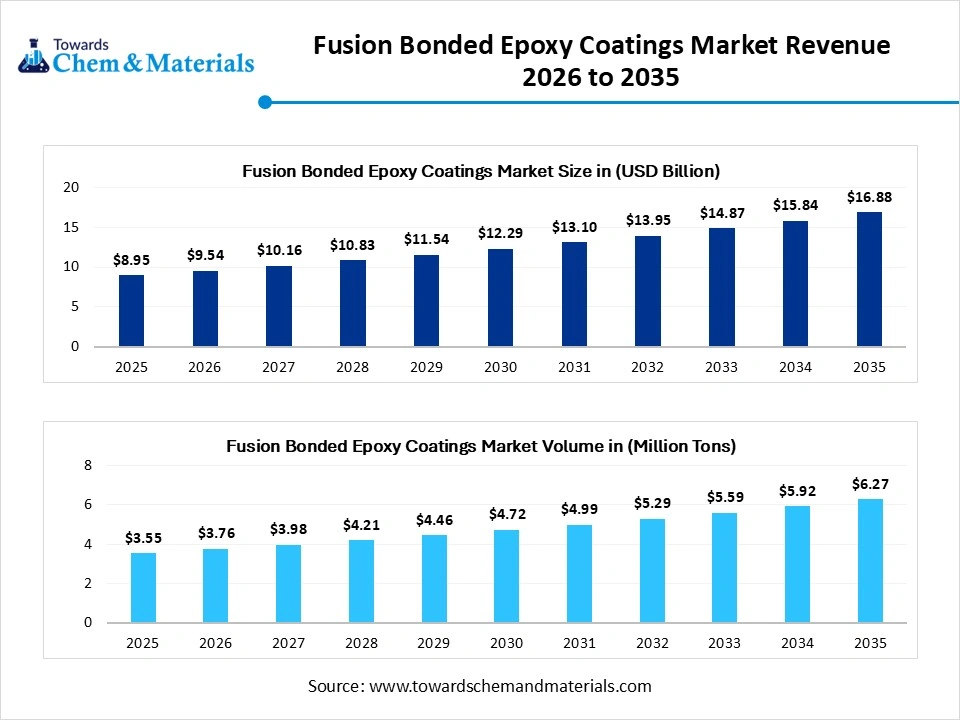
The fusion bonded epoxy coatings market is experiencing steady growth, with its valuation increasing from USD 8.95 billion in 2025 to nearly USD 16.88 billion by 2035 at a CAGR of 6.55%. Volume consumption is forecasted to rise from 3.55 million tons to 6.27 million tons over the same period, growing at 5.85% CAGR. This report delivers detailed segment-wise data, regional performance insights, and profiles of key industry participants. It further includes competitive analysis, value chain mapping, trade flow evaluation, and a comprehensive overview of manufacturers and suppliers shaping the market.
Content
Fusion Bonded Epoxy Coatings Market Analysis, Demand and Growth Rate Forecast
The global fusion bonded epoxy coatings market size was estimated at USD 8.95 billion in 2025 and is expected to be worth around USD 16.88 billion by 2035, growing at a CAGR of 6.55% from 2026 to 2035. In terms of volume, the fusion bonded epoxy coatings market is projected to grow from 3.55 million tons in 2025 to 6.27 million tons by 2035. growing at a CAGR of 5.85% from 2026 to 2035.
Key Takeaways
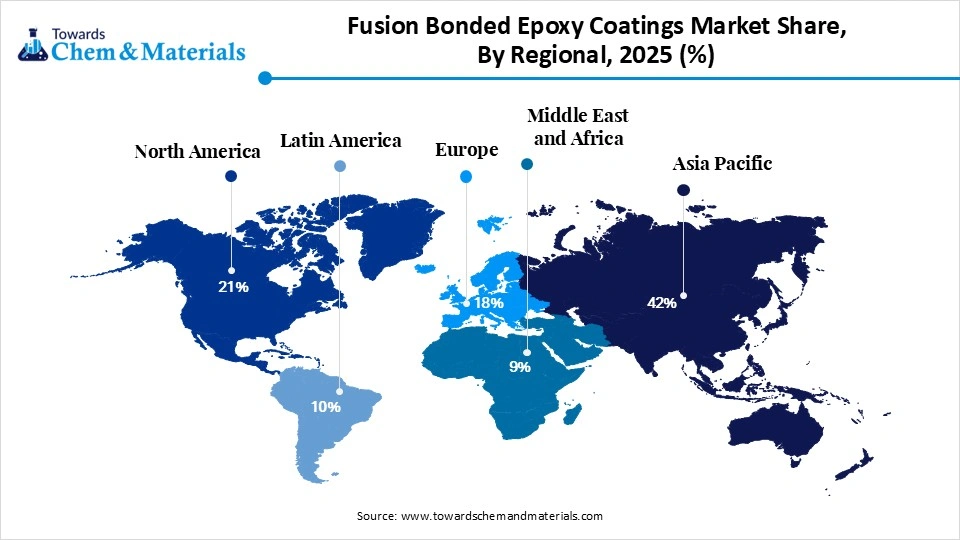
- By region, Asia Pacific dominated the fusion bonded epoxy coatings market by holding 42% share in 2025 and is expected to grow fastest with a CAGR of 7.2% during the forecast period due to infrastructure expansion and demand in pipeline and construction.
- By region, North America held the second largest share of 21% in 2025, and is expected to experience notable growth in the market with 6.00% CAGR during the forecast period, driven by advancements in oil and gas pipeline and regional investment in the energy sector.
- By type, the single layer FBE held the largest 48% share in the market in 2025 due to cost-effectiveness and adoption in standard corrosion protection in pipeline applications.
- By type, the multi-layer FBE segment held the third largest share of 25% in 2025 and is expected the fastest growth in the market with 7.8% CAGR during the forecast period due to superior protection and advanced infrastructure in oil and gas deepwater.
- By application, the pipeline coatings segment dominated the market with 54% share in 2025 due to corrosion resistance and durability that support oil, gas and water transport infrastructure.
- By application, the rebar coatings segment held the second largest share of 16% in 2025 and is expected the fastest growth in the market with 6.8% CAGR during the forecast period due to its demand for concrete durability and long-term structural integrity in the infrastructure and construction sector.
- By end-use industry, the oil & gas segment dominated with 49% share in the market in 2025 due to FBE support for upstream and midstream activity with improved corrosion resistance.
- By end-use industry, the water & wastewater segment held the second largest share of 17% in 2025 and expects the fastest growth in the market with 6.7% CAGR during the forecast period, fueled by investments in urban water infrastructure and regulatory compliance for water systems.
- By substrate, the steel segment dominated the market with 68% share in 2025, due to extensive use in pipelines and demand in high-strength applications.
- By substrate, the concrete segment held the third largest share of 12% in 2025 and is expected to experience the fastest growth in the market with 6.7% CAGR during the forecast period, due to demand for enhanced protection and durability in construction growth.
- By coating method, the electrostatic spray segment dominated the market with 57% share in 2025 and is expected to experience the fastest growth with 6.4% CAGR during the forecast period, due to its operational efficiency in coating application and its ability to achieve uniform coating thickness with automation.
- By coating method, the fluidized bed coating segment held the second largest share of 28% in 2025 demand in thicker coating applications and its durability in heavy-duty industrial use.
Market Size and Volume Forecast
- Market Estimated Size (2025): USD 8.95 Billion | CAGR (2026–2035): 6.55%
- Market Projected Size (2035): USD 16.88 Billion
- Market Volume (2025): 3.55 Million Tons (MT) | Volume CAGR (2026–2035): 5.85%
- Market Projected Volume (2035): 6.27 Million Tons (MT)
- Market Pricing (2025):
- Average Manufacturing Price: USD 2,160/ton
- Average Selling Price: USD 2,790/ton
- Pricing CAGR (2025–2035): 3.25%
Market Overview
- Fusion-bonded epoxy (FBE) is an operationally efficient thermosetting polymer coating that offers higher corrosion protection for critical industrial infrastructure, especially in pipelines and steel systems. The FBE-based coating manufacturing is an electrostatically charged dry powder that bonds chemically upon heating by ensuring key protection against moisture, soil and chemical degradation.
- The market is increasingly implementing FBE for its environmental sustainability in the water and energy sector as a solvent-free, zero-VOC alternative. The substantial investment in the automated system and powder engineering aligns with environmental certification, driving expansion. Additionally, the industry is moving toward specialized epoxy formulations such as high-Tg resins and nanotechnology for a superior cost-to-longevity ratio coating framework.
Fusion Bonded Epoxy Coatings Market Trends
- Focus on Nanotechnology Advancement: The industry is shifting toward the integration of graphene nanofillers and carbon nanotubes to enhance adhesion, abrasion resistance, and mechanical stability.
- Shift Towards Hydrogen-Barrier Pigmentation: The demand for advanced FBE formulation and specialized platelet-shaped pigment that resists hydrogen saturation for blending and the green hydrogen economy.
- Glass Transition and Self-Healing Engineering: FBE is re-engineered with modern high-Tg FBE for exceeding 150°C. While FBE powder contains micro-encapsulated healing agents to prevent sub-film corrosion.
Report Scope
| Report Attributes | Details |
| Market Size and Volume in 2026 | USD 9.53 Billion / 3.76 Million Tons |
| Projected Market Size and Volume in 2035 | USD 16.88 Billion/ 6.27 Million Tons |
| CAGR (2026 - 2035) | 6.55% |
| Leading Region | Asia Pacific |
| Market Segmentation | By Type, By Application, By End-Use Industry, By Substrate, By Coating Method and By Regions |
| Top Key Players | 3M Company, Sherwin-Williams, Jotun, SolEpoxy, PPG Industries, BASF SE, Akzo Nobel N.V., Arkema, Specialty Polymer Coatings, VITRACOAT, Tecosy |
Key Technological Shifts and AI in the Fusion Bonded Epoxy Coatings Market
The development in technology, driven by the integration of AI and molecular engineering, is transforming FBE into a smart coating material. The manufacturer implements machine learning for quality control and computer vision for automated break detection with thermal imaging and sensors to minimize human error.
The technological shift enables innovation, including graphene-infused matrices and microcapsules that allow autonomous repairs and breakthroughs in high-Tg re-engineering, ensuring operational resilience. This digital revolution enhances energy efficiency and the dominance of FBE as a sustainable, technology-driven solution for protecting critical infrastructure and robotic applications
Trade Analysis of the Fusion Bonded Epoxy Coatings Market: Import and Export Statistics
- China exported 17 shipments of fusion bonded epoxy coatings.
- The United States exported 8 shipments of fusion bonded epoxy coatings.
- Canada exported 4 shipments of fusion bonded epoxy coatings.
- From May 2024 to April 2025, the world exported 6 shipments of fusion bonded epoxy coatings.
Supply Chain Analysis of Fusion Bonded Epoxy Coatings Market
Feedstock Procurement and Synthesis:
The key stage involve raw chemical building blocks for liquid epoxy resin manufacturing that form the FBE backbone. The stage focuses on refining and developing curative agents and inorganic pigments, given the prices of bisphenol A and epichlorohydrin.
- Key Players: BASF SE, Huntsman International, Dow Chemical, Arkema, and Kukdo Chemical.
Advanced Formulation and Powder Engineering:
Stage of raw epoxy resin converted into micronized dry powder by utilizing high-shear extrusion and cryogenic grinding to blend resin with flow modifiers, high-Tg catalyst and nanomaterials to achieve NSF/ANSI certification.
- Key Players: 3M Company (Scotchkote), PPG Industries, AkzoNobel (Resicoat), The Sherwin-Williams Company (Pipeclad), Jotun, and Axalta Coating Systems.
Application and Infrastructure Integration:
The final stage in which powder transforms into a monolithic protective barrier that is handled by engineering, procurement and construction. The stage involves the adoption of automated abrasive inspection and robotic applications throughout the logistics of transporting coating assets.
- Key Players: Wasco Energy, Shawcor (MattrTenaris), Jindal Saw, L&T (Larsen & Toubro), and ArcelorMittal.
Regulatory Framework: Fusion Bonded Epoxy Coatings Market
| Region | Key Standards | Regulatory Focus |
| North America | NSF/ANSI 61-certified, CAN and CSA standards | Standard for leachable toxicity and limits for xylene and toluene, which is driving a shift towards ultra-low VOC potable water coating. |
| European Union | REACH regulation and ISO standards | Regulations of bisphenol and chemical safety. Focus on coating performance for hydrogen transport, energy transition, and carbon capture systems. |
| Asia Pacific | BIS IS and GB standards | Mandatory quality control orders and banning non-certified epoxy products in public bridges and highways. |
| Middle East and Africa | Aramco 09-SAMSS and ADNOC V2 | Focus on high-Tg by ensuring coating thermal stability and saline resilience with temperature exceeding 100°C. |
| Global | IMO PSPC and NACE SP0394 | Mandatory standards for protective epoxy coatings in marine, ballast tanks and infrastructure life. |
Segmental Insights
Type Insights
Single Layer FBE Segment Dominated the Fusion Bonded Epoxy Coatings Market with 48% of Market Share in 2025
Single layer FBE segment dominated the market with 48% share in 2025, defined by its anti-corrosion standard and superior interfacial adhesion with cost-effectiveness. The segment growth is driven by its solvent-free composition against cathodic disbondment as a thermosetting powder in industrial infrastructure. The single-layer FBE is key for onshore and potable water systems with excellent field-joint compatibility.
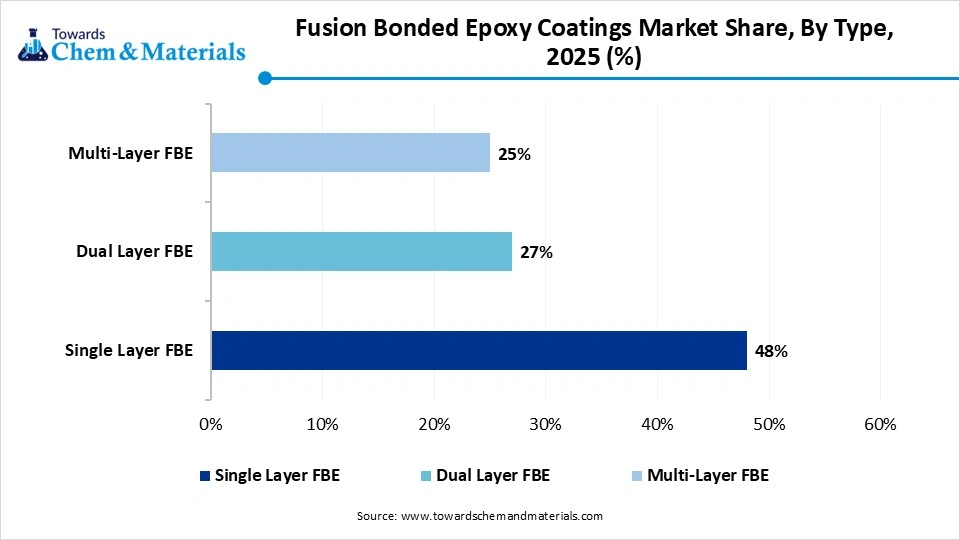
Dual layer FBE segment held the second largest share of 27% in 2025, due to its superior impact resistance, moisture barrier, corrosion resistance, and thermal protection. The dual-layer FBE utilized in trenchless installation and offshore pipelines by maintaining a premium price and longevity in harsh environments. Additionally, this type consists of a base layer with an abrasion-resistant topcoat that offers mechanical resilience for key infrastructure.
Multi-layer FBE segment held the third largest share of 25% in 2025 and expects the fastest growth with 7.8% CAGR during the forecast period, due to its ability to offer ultra-premium solution in standard coatings. The segment integrates a high-adhesion anti-corrosion base with polyolefin topcoats that offer impact resistance and thermal insulation. The segment is key type in subsea pipeline and high-temperature logistics by maintaining mechanical protection and moisture resistance align with lifecycle benefits.
Fusion Bonded Epoxy Coatings Market Share, By Type, 2025 (%)
| By Type | Revenue Share, 2025 (%) |
| Single Layer FBE | 48% |
| Dual Layer FBE | 27% |
| Multi-Layer FBE | 25% |
Application Insights
Pipeline Coatings Segment Dominated the Fusion Bonded Epoxy Coatings Market with 54% of Market Share in 2025
Pipeline coatings segment dominated the market with 54% share in 2025, driven by FBE corrosion-prevention standards in the energy and water sector. The FBE offers interfacial bonding, structural integrity of steel substrates and resistant soil stress. The pipeline coating requires optimized flow efficiency, which is supported by trenchless installation and rehabilitation projects as a long-term high-pressure transport asset.
Fusion Bonded Epoxy Coatings Market Share, By Application, 2025 (%)
| By Application | Revenue Share, 2025 (%) |
| Pipeline Coatings | 54% |
| Rebar Coatings | 16% |
| Structural Steel Coatings | 11% |
| Tanks & Vessels | 10% |
| Valves & Fittings | 9% |
Rebar coatings segment held the second largest share of 16% in 2025 and is expected the fastest growth with 6.8% CAGR during the forecast period, driven by its demand in the marine sector, coastal construction and bridge decks by offering a dielectric barrier to prevent chloride-based corrosion and structural cracking. The expansion in service life of public works FBE-coated rebar is acting as a lifecycle asset by maintaining an electrochemical shield and enabling a shift towards sustainable modernization construction infrastructure.
Structural steel coatings segment held the third largest share of 11% in 2025, serving as a protective barrier for industrial and complex architectural infrastructure. The FBE offer edge coverage in lattice towers and stadium joists. The shift towards sustainable building is driving FBE coatings adoption due to their low-maintenance, impact resistance and net-zero solvent finish in heavy-duty operation and pre-fabricated construction.
Tanks & vessels segment held the fourth largest share of 10% in 2025, acting as a high-integrity internal lining for storage infrastructure. In tanks and vessels infrastructure, FBE coating offers thermal stability and low permeability, non-leaching and solvent-free solution. The growth is driven by industrial processing and water treatment, which make them a key choice for extending the service life of storage tanks and vessels.
End-Use Industry Insights
Oil & Gas Segment Dominated the Fusion Bonded Epoxy Coatings Market with 49% of Market Share in 2025
Oil & gas segment dominated the market with 49% share in 2025, accelerated by the expansion of midstream networks and the transition towards shale gas extraction. The FBE coating enables interfacial bonding, corrosion moderation and resistance to cathodic disbondment. The oil & gas refiners and manufacturers focus on deepwater exploration and shale gas extraction, where FBE offers an external barrier and a lower internal lining that aligns with environmental compliance.
Fusion Bonded Epoxy Coatings Market Share, By End-Use Industry, 2025 (%)
| By End-Use Industry | Revenue Share, 2025 (%) |
| Oil & Gas | 49% |
| Water & Wastewater | 17% |
| Construction & Infrastructure | 13% |
| Power Generation | 9% |
| Marine | 7% |
| Others | 5% |
Water & wastewater segment held the second largest share of 17% in 2025 and is expected the fastest growth with 6.9% CAGR during the forecast period, due to FBE's non-leaching ability for potable water systems. The growth is accelerated by rapid urbanization and the need for a low-maintenance setup to avoid microbial impurity and water contamination. The FBE coatings offer resistance to biogenic sulfuric acid, interfacial adhesion and solvent-free compaction that make key pillars of municipal pipeline infrastructure.
Construction & infrastructure segment held the third largest share of 13% in 2025, driven by FBE's high-performance anti-corrosion layer for emphasizing steel and structural building components. The rising demand for green buildings and sustainable construction aligns with certification, and a solvent-free solution enables market growth. The FBE coating offers a uniform, electrochemical barrier by maintaining the structural integrity of concrete reinforcement and heavy coastal development.
Power generation segment held the fourth largest share of 9% in 2025, fueled by demand in heat exchangers and cooling systems. FBE offers thermal stability and anti-chemical leaching resistance by maintaining stable and efficient fluid transport. The nuclear and renewable power facility requires FBE coating to prevent impingement erosion and galvanic activity as an operational efficient solution that meets the standard, reduces downtime and protects the energy asset.
Substrate Insights
Steel Segment Dominated the Fusion Bonded Epoxy Coatings Market with 68% of Market Share in 2025
Steel segment dominated the market with 68% share in 2025 because this substrate's interfacial abrasion enables metal surface quality, enabling coating longevity through the chemical fusion process. The steel requires precise mechanical resilience, thermal induction where molecular cross-linking occurs. The rising demand focuses on high-yield alloys where FBE formulation fosters steel substrate thermal expansion and surface integrity as a high-integrity corrosion barrier.
Fusion Bonded Epoxy Coatings Market Share, By Substrate, 2025 (%)
| By Substrate | Revenue Share, 2025 (%) |
| Steel | 68% |
| Cast Iron | 14% |
| Concrete | 12% |
| Others | 6% |
Cast iron segment held the second largest share of 14% in 2025, driven by its use in municipal valves, pumps and fittings. The FBE offers a non-leaching barrier that shields porous iron from pitting corrosion and graphitization. The FBE coating growth is continued by rising focus on consumer health and mandates for potable-water-safe lining for iron cast infrastructure with high build capability.
Concrete segment held the third largest share of 12% in 2025 and is expected fastest growth with 6.7% CAGR during the forecast period, due to FBE standard for metal reinforcement in the construction sector. The FBE coating acts as a chemical and physical separator that offers long-term reliability by reducing costly remedial brickwork in aging public infrastructure. The resilient engineering standards and their epoxy alkaline matrix are pillars of concrete longevity in heavy civil projects.
Coating Method Insights
Electrostatic Spray Segment Dominated the Fusion Bonded Epoxy Coatings Market with 57% of Market Share in 2025
Electrostatic spray segment dominated the market with 57% share in 2025 and expected the fastest growth with 6.4% CAGR during the forecast period, due to its precision thickness and wrap-around coverage for complex industrial frameworks. The method utilized charged powder particles that ensure a uniform film in intricate fittings and valves by ensuring high-transfer efficiency and low material waste. The industrial transition towards automated manufacturing lines with fast-curing and net-zero VOC coating processes to meet stringent sustainability goals is boosting market growth.
Fusion Bonded Epoxy Coatings Market Share, By Coating Method, 2025 (%)
| By Coating Method | Revenue Share, 2025 (%) |
| Electrostatic Spray | 57% |
| Fluidized Bed Coating | 28% |
| Other Powder Coating Methods | 15% |
Fluidized bed coating segment held the second largest share of 28% in 2025, driven by its thick, monolithic shield, porosity-free barrier in industrial applications. The method transforms heated parts into suspended powder, ensuring total surface encapsulation and edge coverage with operational speed for heavy-duty infrastructure. Additionally, the segment provides superior abrasion resistance and long-term leak prevention as a robust solution.
Other powder coating methods segment held the third largest share of 15% in 2025, represented by field-applied flame spraying and tribo-charging that utilized in coating complex internal bores and deep recesses by preventing the Faraday cage effect. The method dominates in onsite repair and the field-joint sector by offering flexibility, high-integrity corrosion protection for diversified factory infrastructure.
Regional Insights
How Did The Asia Pacific Dominated The Fusion Bonded Epoxy Coatings Market In 2025?
The Asia Pacific fusion bonded epoxy coatings market size was estimated at USD 3.76 billion in 2025 and is projected to reach USD 7.17 billion by 2035, growing at a CAGR of 6.67% from 2026 to 2035.
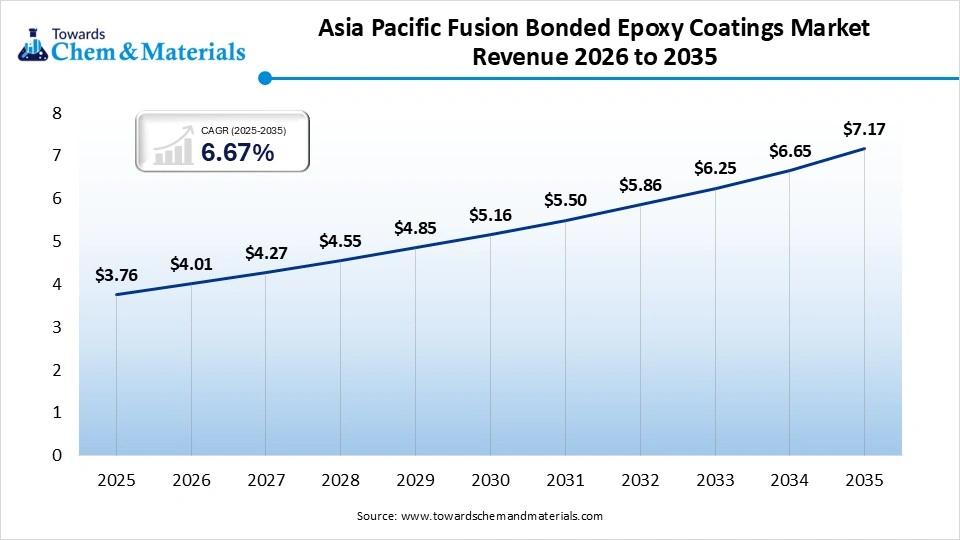
The region's surge in cross-border pipeline projects and expansion of the water delivery framework is driven by the rising population. Additionally, the Asia Pacific focuses on sustainable building practices and manufacturing innovation that make them key region for high-performance anti-corrosion technology advancement.
China Fusion Bonded Epoxy Coatings Market Growth Trends
China market expansion is fueled by its diversified pipeline network and manufacturing hub for infrastructure modernization. The region is expanding shale gas and urban water grids that making China a leading consumer in the adoption of anti-corrosion technology. The regional manufacture focus on FBE low VOC powder algin with stringent green-building mandates that drive domestic growth with high-temperature epoxy formulation.
North America held the second largest share of 21% in 2025, and expects notable growth in the market with 6.00% CAGR during the forecast period, driven by the region's focus on infrastructure, access, and rehabilitation of aging pipeline infrastructure. The region is advancing in a multi-layer FBE system to meet stringent environmental and performance compliance. North America's shift towards hydrogen-based retrofits and shale gas growth, with the adoption of low-VOC FBE as a premium region for impact-resistant coatings.
U.S. Fusion Bonded Epoxy Coatings Market Growth Trends
The United States market is a hub for modernized energy grid. And growth is accelerated by their national infrastructure mandates. The region's demand for NSF-certified coatings in water rehabilitation and dual-layer systems that foster shale-gas expansion. The regional focus on hydrogen-compatible FBE formulation and make the U.S. is leader in innovation and a technological driver by maintaining safety and long-term infrastructure resilience.
Recent Developments
- In May 2025, the Association for Materials Protection and Performance (AMPP) launched a new Fusion Bonded Epoxy (FBE) Coating Application And Inspection Course. The program focuses on strengthening workforce training and industry standards.
- In April 2024, Sherwin-Williams Protective & Marine launched Sher-Bar™ TEC, a damage-tolerant textured epoxy coating, especially for the rebar sector. IT is designed to offer improved bond strength and superior corrosion resistance in concrete infrastructure with safety, longevity and sustainability.
Top Companies in the Fusion Bonded Epoxy Coatings Market
- 3M Company
- Sherwin-Williams Company
- Jotun
- SolEpoxy
- PPG Industries, Inc.
- BASF SE
- Akzo Nobel N.V.
- Arkema
- Specialty Polymer Coatings
- VITRACOAT
- Tecosy
Fusion Bonded Epoxy Coatings Market Segment Covered in the Report
By Type
- Single Layer FBE
- Dual Layer FBE
- Multi-Layer FBE
- FBE+ Adhesive+ Polyethylene (3LPE)
- FBE- Adhesive+ Polypropylene (3LPP)
By Application
- Pipeline Coatings
- Oil Pipelines
- Gas Pipelines
- Water Pipelines
- Rebar Coatings
- Structural Steel Coatings
- Tanks & Vessels
- Vales & Fittings
By End-Use Industry
- Oil & Gas
- Upstream
- Midstream
- Downstream
- Water & Wastewater
- Construction & Infrastructure
- Power Generation
- Marine
- Others
By Substrate
- Steel
- Cast Iron
- Concrete
- Others
By Coating Method
- Electrostatic Spray
- Fluidized Bed Coating
- Other Powder Coating Methods
By Regions
- North America
- U.S.
- Canada
- Mexico
- U.S.
- Europe
- Germany
- UK
- France
- Italy
- Spain
- Germany
- Asia Pacific
- China
- India
- Japan
- South Korea
- China
- Latin America
- Brazil
- Argentina
- Brazil
- Middle East & Africa
- Saudi Arabia
- South Africa
- Saudi Arabia
FAQ's
Question 1 : What are the key trends to shape the fusion bonded epoxy coatings market? 
Answer : Major trends are the Focus on nanotechnology advancement, shift towards hydrogen-barrier pigmentation, glass transition and self-healing engineering
Question 2 : Which region holds the largest share of the fusion bonded epoxy coatings market?
Answer : Asia Pacific holds the largest share of the fusion bonded epoxy coatings market.
Question 3 : Who are the key players in the fusion bonded epoxy coatings market?
Answer : The market is divided with major players including 3M, AkzoNobel, The Sherwin-Williams Company, Axalta Coating Systems, PPG Industries, Jotun, Kansai Paint, KCC Corporation, Hempel, Berger Paints, TIGER Coatings, Shawcor (Mattr), Wasco Energy, Tenaris, and Jindal Saw.
Question 4 : What is driving the growth of the fusion bonded epoxy coatings market?
Answer : Market growth is primarily driven by increasing demand for corrosion-resistant coatings in oil & gas pipelines, water infrastructure, and construction, along with rising investments in infrastructure and energy sectors.
Question 5 : Which region dominates the fusion bonded epoxy coatings market?
Answer : Asia Pacific dominates the market with a 42% share in 2025, supported by rapid infrastructure development, pipeline expansion, and urbanization.
Meet the Team

Saurabh Bidwai
Principal Consultant
Saurabh Bidwai, a B.Tech Chemical Engineering graduate with 4+ years of experience, specializes in specialty chemicals, commodity chemicals, and engineered materials, offering valuable insights into market trends and emerging opportunities.

Aditi Shivarkar
Reviewed By
Aditi Shivarkar, with 14+ years in Chemical and Materials market research, specializes in Chemical and Materials. She ensures accurate, actionable insights, driving Towards Chemicals And Materials Analytics and Consulting excellence in industry trends and sustainability.