
Gas Mixtures Market Size, Share, Growth, Report 2026 to 2035
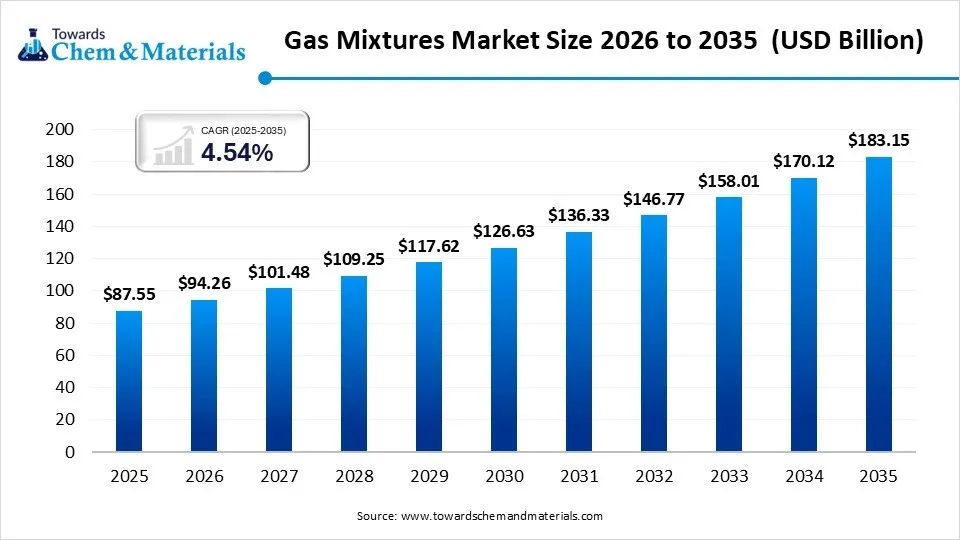
The global gas mixtures market size is expected to grow from USD 29.21 billion in 2026 to USD 43.49 billion in 2035, growing at a CAGR of 4.52% from 2026 to 2035. The top key players in the market are Linde PLC, Air Liquide S.A., Messer SE & Co. KGaA, Air Products and Chemicals, Inc., and Westfalen AG.
Content
What is the Current Size of the Gas Mixtures Market and its Projected Growth?
The global gas mixtures size was estimated at USD 27.95 billion in 2025 and is expected to increase from USD 29.21 billion in 2026 to USD 43.49 billion by 2035, growing at a CAGR of 4.52% from 2026 to 2035. North America dominated the gas mixtures with the largest revenue share of 42.00% in 2025.The growth of the market is driven by growing demand in metal fabrications, electronics, and healthcare, fueling growth.
Market Highlights
- By region, North America dominated the market share 42.00% in 2025. The growth of the market is driven by strict industrial safety standards.
- By region, Asia Pacific is expected to have the fastest growth in the market in the forecast period between 2026 and 2035. Demand for specialty calibration gases and advancements in shielding gases fuel the growth of the market.
- By purity, the ultra-high purity segment dominated the market share 55.00% in 2025. The strong manufacturing base drives the growth of the market.
- By purity, the high-purity segment is projected to grow at the fastest CAGR between 2026 and 2035. The growing demand for high-purity gases for green hydrogen drives the growth.
- By end-user, the manufacturers segment dominated the market share 48.00% in 2025. They maintained dominance through strategic investments in infrastructure
- By end-user, the healthcare providers segment is projected to grow at the fastest CAGR between 2026 and 2035. expanding due to its essential use in diagnostic and therapeutic
- By type, the nitrogen segment dominated the market share 44.00% in 2025. Rapid expansion in semiconductor fabrication and electronics demands high-purity nitrogen.
- By type, the oxygen segment is projected to grow at the fastest CAGR between 2026 and 2035. The market is witnessing robust growth in demand for on-site generation, fueling growth.
- By application, the oil and gas segment dominated the market share 49.00% in 2025. Gas mixtures are crucial for maintaining safety standards
- By application, the medical segment is projected to grow at the fastest CAGR between 2026 and 2035. Rising demand for specific, high-purity gas mixtures used in anesthesia and diagnostic applications is fueling segment growth.
- By distribution channel, the direct sales segment dominated the market share 47.00% in 2025. Direct sales eliminate the need for distributors, allowing for better pricing
- By distribution channel, the online platforms segment is projected to grow at the fastest CAGR between 2026 and 2035. Increased infrastructure development and digital adoption fuel growth.
Market Overview
What Is the Significance of the Gas Mixtures Market?
The gas mixtures market is essential for providing specialized, precise gas blends that drive efficiency, safety, and quality across critical industries, including healthcare, manufacturing, and electronics. This market supports vital operations such as medical breathing, industrial welding, and environmental monitoring, with key growth driven by metal fabrication and healthcare needs. The market is dominated by the metal manufacturing & fabrication sector, which uses gases for welding, cutting, and heat treatment to ensure structural integrity.
Recent Growth Trends:
- Growing Demand for Specialty Gases: High-purity and specialized gas mixtures are increasingly vital for environmental monitoring, safety sensors, and laboratory applications, often commanding significant price premiums.
- Expansion in Healthcare: The gas mixture market is experiencing strong growth, driven by increasing needs for pain management and anesthetic gases.
- Sustainable and Efficient Production: Companies are focusing on lowering the environmental impact of gas production and enhancing supply chain security.
Key Technological Shifts In The Gas Mixtures Market:
Key technological shifts in the gas mixtures market are driven by automation, digital monitoring (IoT), and sustainability, focusing on high-precision blending and real-time, remote analytics to ensure safety and quality. Key trends include AI-optimized formulations, smart cylinders with IoT sensors, and cleaner, green production technologies tailored for diverse, high-tech industry demands. Artificial Intelligence and machine learning are being used to optimize mixture formulations, improve quality control, and streamline supply chains.
Trade Analysis of Gas Mixtures Market: Import & Export Statistics
According to Global Export Data, between June 2024 and May 2025 (TTM), a total of 140 Compressed Gas Mixture shipments were exported worldwide through 32 verified exporters and 34 buyers.
India, Vietnam, and Chile are the leading importers of Compressed Gas Mixtures. Conversely, the United States, India, and Germany are the top global exporters of these mixtures, with 282, 107, and 46 shipments, respectively.
Top-performing Global Compressed Gas Mixture Exporters by volume:
- CHEMTRON SCIENCE LABORATORIES PRIVA: 32 shipments (34%)
- NOVA GAS TECHNOLOGIES INC: 23 shipments (24%)
- Asia Pacific Gas Enterprise Co Ltd: 17 shipments (18%)
Gas Mixtures Market Supply Chain Analysis
Gas Production & Blending
- Gas mixtures are produced by blending industrial gases such as oxygen, nitrogen, argon, carbon dioxide, and specialty gases in precise proportions using controlled filling and calibration systems for industrial, medical, and laboratory applications.
- Key players: Linde plc, Air Liquide, Air Products, Messer Group
Quality Testing and Certification
- Gas mixtures must meet strict purity, composition accuracy, safety, and calibration standards for industrial, medical, and scientific use.
- Key players: International Organization for Standardization, International Organization of Legal Metrology, European Chemicals Agency, U.S. Food and Drug Administration.
Distribution to Industrial Users
- Gas mixtures are supplied to healthcare facilities, laboratories, semiconductor manufacturers, food and beverage companies, chemical industries, and calibration service providers.
- Key players: Linde plc, Air Liquide, Air Products.
Gas Mixtures Regulatory Landscape: Global Regulations
| Country / Region | Regulatory Body | Key Regulations | Focus Areas | Notable Notes |
| U.S. | Occupational Safety and Health Administration (OSHA); Environmental Protection Agency (EPA); Department of Transportation (DOT) | OSHA Hazard Communication Standard; Clean Air Act; Hazardous Materials Regulations (HMR) | Industrial gas safety, transport regulations, and emissions control | Gas mixtures used in industrial, medical, and specialty applications must comply with strict storage, labeling, and transportation regulations. |
| Europe | European Chemicals Agency (ECHA); European Commission | REACH Regulation; CLP Regulation; ADR (Transport of Dangerous Goods) | Chemical classification, labeling, and transport safety | The EU enforces strict classification and labeling rules for gas mixtures along with safe transport and handling requirements. |
| China | Ministry of Emergency Management (MEM); Ministry of Ecology and Environment (MEE) | Work Safety Law; Environmental Protection Law | Industrial safety, hazardous gas management | China regulates gas mixtures for industrial use with strict safety and environmental compliance requirements. |
| India | Petroleum and Explosives Safety Organisation (PESO); Central Pollution Control Board (CPCB) | Gas Cylinder Rules; Environment Protection Act | Storage, transport, and handling of compressed gases | India regulates gas mixtures through cylinder safety rules and environmental compliance for industrial and medical gases. |
| Japan | Ministry of Economy, Trade and Industry (METI) | High-Pressure Gas Safety Act | High-pressure gas safety, storage, and transport | Japan enforces strict controls on the production, storage, and use of compressed and mixed gases. |
| Brazil | National Institute of Metrology, Quality and Technology (INMETRO); Brazilian Institute of Environment and Renewable Natural Resources (IBAMA) | Industrial Gas Regulations; Environmental Safety Laws | Gas cylinder certification, environmental protection | Brazil regulates gas mixtures for safety, quality, and environmental impact across industrial applications. |
Segmental Insights
Purity Insights
The Ultra-High Purity Segment Led The Gas Mixtures Market In 2025 With The Largest Share.The ultra-high purity segment dominated the market in 2025, driven primarily by intense demand in the semiconductor, electronics, and specialty chemical industries. The need for zero-contamination environments during advanced wafer fabrication and microchip production, combined with rapid growth in electronics manufacturing, solidified its market leadership. Growth was bolstered by expansion in AI processing, electric vehicle components, solar cell manufacturing, and data center investments, which fuel the growth of the market.
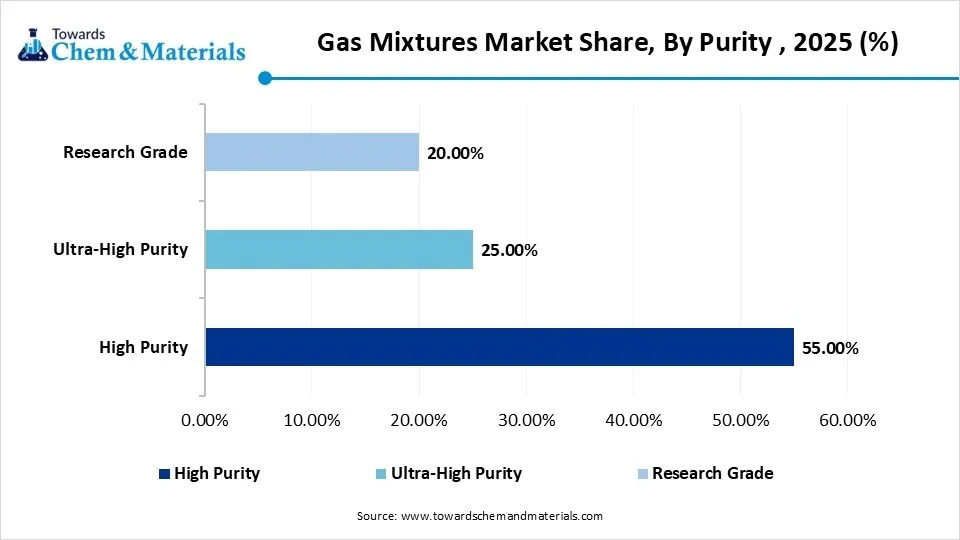
The high-purity segment is projected to grow at the fastest CAGR between 2026 and 2035 in the market, driven by the expanding semiconductor, healthcare, and electronics manufacturing sectors, which fuel the growth of the market. The market is driven by the necessity for high-purity noble gases, e.g., argon and helium, in electronics manufacturing and the rising demand for high-purity gas mixtures in specialized industrial, chemical, and medical applications.
Gas Mixtures Market Share, By Purity , 2025 (%)
| By Purity | Revenue Share, 2025 (%) |
| High Purity | 55.00% |
| Ultra-High Purity | 25.00% |
| Research Grade | 20.00% |
- High Purity segment accounts for 55% of the market share, commonly used in industrial and commercial applications, dominating due to its balanced cost and performance in various sectors.
- Ultra-High Purity segment holds 25% of the market share, used in high-precision applications such as semiconductor manufacturing, gaining momentum as industries require higher purity levels for advanced technologies.
- Research Grade segment represents 20% of the market share, mainly utilized in scientific research and laboratories, but not dominating due to its more specialized use in comparison to high and ultra-high purity gases.
End-use Industry Insights
The Manufacturers Segment Led The Gas Mixtures Market In 2025 With The Largest Share
The manufacturers led the market in 2025, by leveraging advanced air separation technologies, such as cryogenic distillation, to produce high-purity nitrogen, oxygen, and argon at scale. They maintained dominance through strategic investments in infrastructure, such as new on-site plants, and by providing tailored, precise gas blends crucial for manufacturing, healthcare, and semiconductor industries.
The healthcare providers segment is projected to grow at the fastest CAGR between 2026 and 2035 in the market, poised to experience rapid growth due to its critical application in calibration of lung function testing instruments and diagnostic tools, despite pure gases retaining the largest revenue share, supporting the growth of the market. Growth is fueled by increasing demand for specialty gas mixtures, advancements in pulmonary function testing, and the rising prevalence of chronic respiratory diseases.
Gas Mixtures Market Share, By End User, 2025 (%)
| By End User | Revenue Share, 2025 (%) |
| Manufacturers | 48.00% |
| Distributors | 20.00% |
| Research Institutions | 10.00% |
| Healthcare Providers | 8.00% |
| Industrial Consumers | 14.00% |
- Manufacturers segment accounts for 48% of the market share, leading the market due to high demand from various industries that require gas mixtures for production processes.
- Distributors segment holds 20% of the market share, playing a key role in the supply chain, but not dominating due to the competitive nature of the distribution market.
- Research Institutions segment represents 10% of the market share, driven by demand for high-purity gases in experiments, but not dominating due to its more niche application.
- Healthcare Providers segment accounts for 8% of the market share, used in medical gases, but not dominating due to the relatively smaller share compared to industrial applications.
- Industrial Consumers segment holds 14% of the market share, used in various manufacturing processes, but not dominating due to its smaller contribution compared to manufacturers.
Type Insights
The Nitrogen Segment Led The Gas Mixtures Market In 2025 With The Largest Share
The nitrogen segment led the market in 2025, due to its high versatility, cost-effectiveness compared to rare gases, and essential role in creating inert, oxygen-free environments across high-volume industries. The growth is also driven by widespread applications in food packaging, petrochemical processing, and electronics manufacturing. Rapid expansion in semiconductor fabrication and electronics, particularly in the APAC region, demands high-purity nitrogen for producing contamination-free end products, driving the growth of the market.
The oxygen segment is projected to grow at the fastest CAGR between 2026 and 2035 in the market, driven by rapid industrialization and healthcare needs. The market is propelled by surging demand in steelmaking, chemical processing, and on-site generation, specifically expanding rapidly, supporting the growth and expansion of the market. The industrial oxygen market is anticipated to experience strong growth, driven by increasing demand for medical oxygen and technological advancements in industrial applications.
Gas Mixtures Market Share, By Type, 2025 (%)
| By Type | Revenue Share, 2025 (%) |
| Nitrogen | 44.00% |
| Oxygen | 19.00% |
| Hydrogen | 14.00% |
| Helium | 11.00% |
| Argon | 5.00% |
| Carbon Dioxide | 7.00% |
- Nitrogen segment accounts for 44% of the market share, dominating due to its wide application in industrial processes, food packaging, and chemical production.
- Oxygen segment holds 19% of the market share, widely used in medical and industrial applications, gaining momentum as demand for medical-grade oxygen increases.
- Hydrogen segment represents 14% of the market share, utilized in chemical industries and fuel cells, gaining momentum with the rise of clean energy initiatives and hydrogen-based technologies.
- Helium segment accounts for 11% of the market share, used in cooling systems and scientific research, but not dominating due to its limited availability and higher costs.
- Argon segment holds 5% of the market share, primarily used in welding and metal production, not dominating due to its more specialized applications.
- Carbon Dioxide segment represents 7% of the market share, used in beverage carbonation and food preservation, but not dominating due to its more niche industrial applications.
Application Insights
The Oil And Gas Segment Led The Gas Mixtures Market In 2025 With The Largest Share
The oil and gas segment led the market in 2025, due to the industry’s critical need for high-purity, specialized gas mixtures in exploration, refining, and transportation, alongside the rapid expansion of LNG infrastructure. This dominance is driven by the vast consumption of calibration gases to ensure safety and precision in upstream drilling and downstream petrochemical manufacturing, supporting the growth of the market.
The medical segment is projected to grow at the fastest CAGR between 2026 and 2035 in the market, due to rising demand for respiratory therapies, anesthesia, and home healthcare. Key drivers include aging populations, increased chronic respiratory diseases (COPD, asthma), and expanding critical care infrastructure. The growing prevalence of chronic respiratory diseases requiring long-term oxygen therapy, increased surgical procedures, and the adoption of home healthcare devices.
Gas Mixtures Market Share, By Application, 2025 (%)
| By Application | Revenue Share, 2025 (%) |
| Oil and Gas | 49.00% |
| Electronics | 15.00% |
| Medical | 10.00% |
| Industrial | 12.00% |
| Research and Development | 14.00% |
- Oil and Gas application accounts for 49% of the market share, dominating due to the high demand for gas mixtures in exploration, drilling, and refining processes.
- Electronics application holds 15% of the market share, used in semiconductor manufacturing and production, gaining momentum with the increasing demand for electronics and advanced technologies.
- Medical application represents 10% of the market share, driven by the need for medical gases in hospitals and healthcare facilities, but not dominating due to its more specialized use.
- Industrial application accounts for 12% of the market share, used in various manufacturing and production processes, but not dominating compared to the oil and gas sector.
- Research and Development application holds 14% of the market share, primarily for scientific studies and experiments, but not dominating due to its niche role in comparison to oil and gas applications.
Distribution Insights
The Direct Sales Segment Led The Gas Mixtures Market In 2025 With The Largest Share
The direct sales segment led the market in 2025, by establishing a strong, high-volume, and customized relationship with large industrial clients, which often requires a consistent, reliable supply of specialized gas blends. Manufacturers prioritize this channel to build direct relationships with end-users and provide tailored, technical solutions, especially for high-volume customers in the chemical and metal manufacturing industries, fueling the growth and expansion of the market.
The online platforms segment is projected to grow at the fastest CAGR between 2026 and 2035 in the market, driven by the digitalization of industrial gas procurement and increased demand for specialized, high-purity, and custom-blended gases, supporting the growth of the market. The integration of AI-powered systems, IoT, and digital monitoring for gas distribution, tracking, and predictive maintenance is creating new business models that drive rapid adoption of online sales channels.
Gas Mixtures Market Share, By Distribution Channel, 2025 (%)
| By Distribution Channel | Revenue Share, 2025 (%) |
| Direct Sales | 47.00% |
| Distribution Partners | 30.00% |
| Online Platforms | 23.00% |
- Direct Sales channel accounts for 47% of the market share, dominating due to the direct relationships established between manufacturers and large industrial clients, ensuring reliable and bulk supply.
- Distribution Partners channel holds 30% of the market share, playing a significant role in reaching a wider customer base, but not dominating due to the reliance on intermediaries for supply.
- Online Platforms channel represents 23% of the market share, gaining momentum as e-commerce and online sales for industrial and medical gases become increasingly popular, but not dominating due to its smaller reach compared to direct sales.
Regional Insights
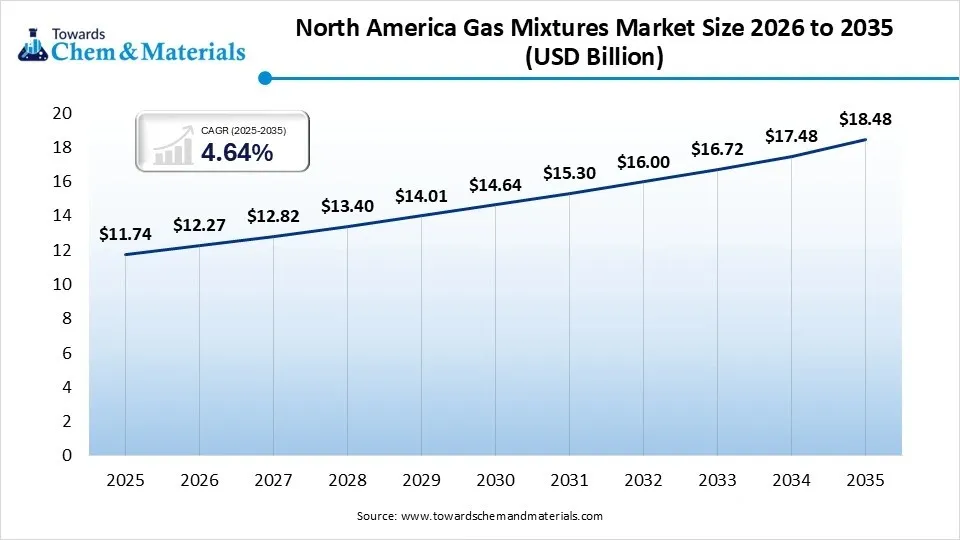
The North America gas mixtures market size was valued at USD 11.74 billion in 2025 and is expected to be worth around USD 18.48 billion by 2035, exhibiting at a compound annual growth rate (CAGR) of 4.64% over the forecast period from 2026 to 2035. North America dominated the market share 42.00% in 2025, by leveraging its strong semiconductor manufacturing, extensive shale gas production, and strict industrial safety standards. The region benefited from high demand for ultra-high purity gases and advanced calibration mixtures, driven by major industrial applications and major players focusing on localizing production. Companies like Air Products and Linde maintain a dominant presence, utilizing strong infrastructure for processing.
U.S. Gas Mixtures Market Growth Factor
The U.S. gas mixtures market is experiencing strong growth, driven by increasing demand in healthcare, metal fabrication, and electronics. Key factors accelerating market growth include rising chronic diseases requiring respiratory therapies, the need for high-purity gases in electronics, and advanced manufacturing processes. The U.S. semiconductor industry, supported by government initiatives, creates a massive demand for specialized, ultra-pure gases (nitrogen, argon, helium) for wafer fabrication and electronics manufacturing.
Asia Pacific Gas Mixtures Market Growth Factor
Asia Pacific is expected to experience the fastest market growth over the forecast period, driven by rapid industrialization, expansion in electronics manufacturing (semiconductors), and rising healthcare needs in China and India. Key growth factors include rising demand for specialty calibration gases, advancements in shielding gases for metal fabrication, and stringent environmental regulations. Growing requirements for emissions monitoring and safety compliance necessitate the use of specialized calibration gas mixtures.
India Gas Mixtures Market Growth Factor
The Indian gas mixtures market is experiencing rapid growth, driven by accelerating industrialization, infrastructure expansion, and government initiatives promoting cleaner energy, with natural gas demand set to rise. Massive investment in the national gas pipeline grid, including a 40% increase in pipeline length since 2019, is boosting accessibility. The number of compressed natural gas (CNG) stations is targeted to reach 17,700 by 2030, significantly increasing the adoption of CNG for transport. These factors combined ensure a strong upward trajectory for industrial, medical, and fuel-based gas mixtures in India.
Europe Gas Mixtures Market Growth Factor
The European gas mixtures market is experiencing steady growth. This market includes high-purity calibration gases, industrial mixtures, and specialty gases essential for environmental monitoring, industrial manufacturing, and healthcare. European companies are increasingly adopting eco-friendly gas solutions, driving demand for specialized mixtures, including those for renewable energy applications and hydrogen infrastructure, as part of the green transformation.
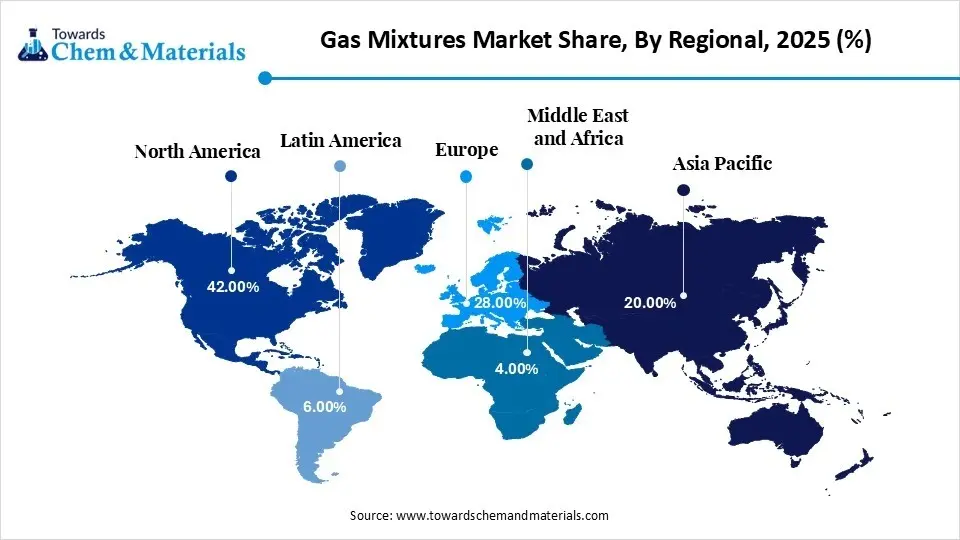
Gas Mixtures Market Share, By Regional, 2025 (%)
| Regional | Revenue Share, 2025 (%) |
| North America | 42.00% |
| Europe | 28.00% |
| Asia Pacific | 20.00% |
| Latin America | 6.00% |
| Middle East & Africa | 4.00% |
- The North America share of 42.00% in 2025 Why it dominates: Strong demand from industrial sectors, advanced technologies, and high investment in research and development in the region."
- The Europe share of 28.00% in 2025 Why it does not dominate: While it holds a significant share, it faces slower growth compared to North America due to relatively stable market conditions."
- The Asia Pacific share of 20.00% in 2025 Why it is gaining momentum: Rapid industrialization, growing manufacturing sectors, and increasing demand for gas mixtures in emerging economies."
- The Latin America share of 6.00% in 2025 Why it does not dominate: Relatively smaller market due to economic challenges and slower industrial growth in comparison to other regions."
- The Middle East & Africa share of 4.00% in 2025 Why it does not dominate: Limited industrial base and lower adoption of gas mixtures technology, holding back market growth."
Germany Gas Mixtures Market Growth Factor
The German gas mixtures market is experiencing growth driven by high industrial demand for specialized manufacturing (metal fabrication), stringent quality/safety standards, and increased medical application needs, with market activity expanding. Key growth factors include automation in manufacturing, electronics production, and the adoption of lower-emission alternatives. Major industry players shaping the German market include Linde PLC, Air Liquide, Messer SE & Co., and Air Products and Chemicals, Inc. The expanding electronics manufacturing sector in Germany requires specialized gas mixtures for production processes.
Recent Developments
- In February 2026, Inhance Technologies announced a new U.S.-based supply of packaged fluorine and custom gas mixtures produced at its expanded Catoosa, Oklahoma, facility. This domestic production aims to simplify supply chains for high-performance industries, including semiconductors, pharmaceuticals, and energy storage.(Source: www.prnewswire.com)
- In November 2025, ABB has introduced the GCPro series GCP100, the first gas chromatograph to feature built-in cybersecurity with integrated Wi-Fi and encryption for natural gas, biogas, and petrochemical applications. This technology helps protect the sensitive data meeting needs.(Source: www.manufacturingtodayindia.com)
Top players in the Gas Mixtures Market & Their Offerings:
- Matheson Tri-Gas, Inc.: Matheson supplies specialty gas mixtures for analytical laboratories, electronics, and industrial applications. The company focuses on high-purity gas solutions and precision gas blending.
- SOL Group: SOL Group produces gas mixtures for medical, industrial, and technical applications. Its portfolio includes oxygen-based mixtures, shielding gases, and specialty blends for healthcare and manufacturing.
- Gulf Cryo: Gulf Cryo supplies industrial and specialty gas mixtures across the Middle East, focusing on healthcare, oil & gas, and construction sectors. The company offers customized gas blending and distribution solutions.
- Ellenbarrie Industrial Gases Ltd.: Ellenbarrie Industrial Gases manufactures and supplies gas mixtures for industrial, medical, and laboratory applications. The company has a strong presence in India with customized gas solutions for diverse end-use industries.
- Advanced Specialty Gases
- Air Liquide SA
- Air Products And Chemicals, Inc.
- Airgas, Inc.
- Linde AG
- Messer Group GmbH
- Praxair, Inc.
- Taiyo Nippon Sanso Corporation
- Welsco Inc.
Segments Covered:
By Purity
- High Purity
- Ultra-High Purity
- Research Grade
By End User
- Manufacturers
- Distributors
- Research Institutions
- Healthcare Providers
- Industrial Consumers
By Type
- Nitrogen
- Oxygen
- Hydrogen
- Helium
- Argon
- Carbon Dioxide
By Application
- Oil and Gas
- Electronics
- Medical
- Industrial
- Research and Development
By Distribution Channel
- Direct Sales
- Distribution Partners
- Online Platforms
By Regions
- North America
- U.S.
- Canada
- Mexico
- Europe
- Germany
- UK
- France
- Italy
- Spain
- Asia Pacific
- China
- India
- Japan
- South Korea
- Latin America
- Brazil
- Argentina
- Middle East & Africa
- Saudi Arabia
- South Africa
FAQ's
Question 1 : How will the Gas Mixtures Market size change across key regions over the next decade?
Answer : The Gas Mixtures Market is expected to grow from USD 29.21 billion in 2026 to USD 43.49 billion by 2035, with the fastest growth projected in the Asia Pacific region, driven by industrialization and healthcare needs.
Question 2 : What are the key growth drivers for the Gas Mixtures Market?
Answer : Demand for high-purity gas mixtures in electronics, healthcare, and manufacturing, along with advancements in shielding gases and industrial safety standards, are key growth drivers.
Question 3 : What is the competitive landscape of the Gas Mixtures Market?
Answer : Top companies like Linde plc, Air Liquide, and Air Products dominate the market, focusing on high-purity, specialized gas solutions for sectors such as healthcare, semiconductor manufacturing, and metal fabrication.
Question 4 : How does the regulatory landscape impact the Gas Mixtures Market?
Answer : Strict regulations on safety, emissions, and purity standards in the U.S., Europe, and Asia are shaping the market, ensuring compliance in industries like healthcare, electronics, and energy.
Meet the Team

Saurabh Bidwai
Principal Consultant
Saurabh Bidwai, a B.Tech Chemical Engineering graduate with 4+ years of experience, specializes in specialty chemicals, commodity chemicals, and engineered materials, offering valuable insights into market trends and emerging opportunities.

Aditi Shivarkar
Reviewed By
Aditi Shivarkar, with 14+ years in Chemical and Materials market research, specializes in Chemical and Materials. She ensures accurate, actionable insights, driving Towards Chemicals And Materials Analytics and Consulting excellence in industry trends and sustainability.