
Global Silicone Elastomer Market Manufacturers & Suppliers Company Analysis 2026-2035
The global silicone elastomer market size is expected to grow from USD 8.82 billion in 2026 to USD 19.00 billion in 2035, growing at a CAGR of 8.9% from 2026 to 2035. The top key players in the market are Dow Inc, Wacker Chemie AG, Shin-Etsu Chemical Co., Ltd, Momentive Inc., Elkem Silicones, KCC Corporation, Nusil (Avantor), Henkel, Evonik Industries, Kaneka Corporation, Kao Corporation, 3M, Trelleborg, Rogers Corporation, Momentive Performance Materials - Global Forecast 2026 To 2035
Content
What is the Current Global Silicone Elastomer Market Size and Volume?
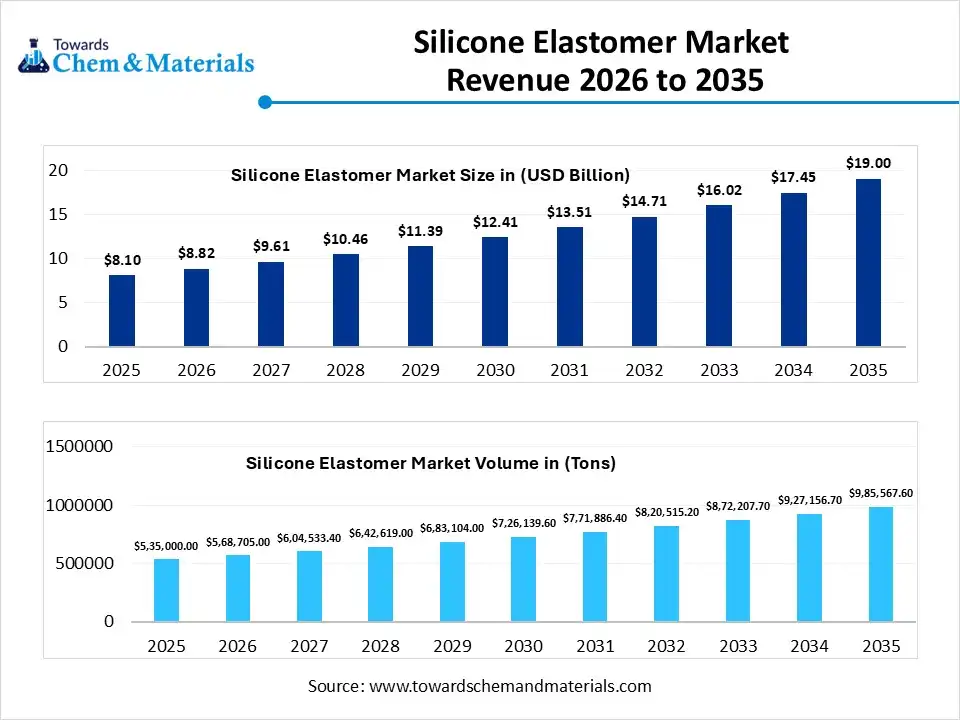
The global silicone elastomer market size was estimated at USD 8.10 billion in 2025 and is expected to increase from USD 8.82 billion in 2026 to USD 19.00 billion by 2035, growing at a CAGR of 8.9% from 2026 to 2035. In terms of volume, the market is projected to grow from 535,000.00 tons in 2025 to 985,567.60 tons by 2035. growing at a CAGR of 6.30% from 2026 to 2035. Asia Pacific dominated the silicone elastomer market with the largest volume share of 42% in 2025.The market is driven by demand for sustainable solutions, technological advancement, miniaturization in electronics and healthcare expansion.
Market Highlights
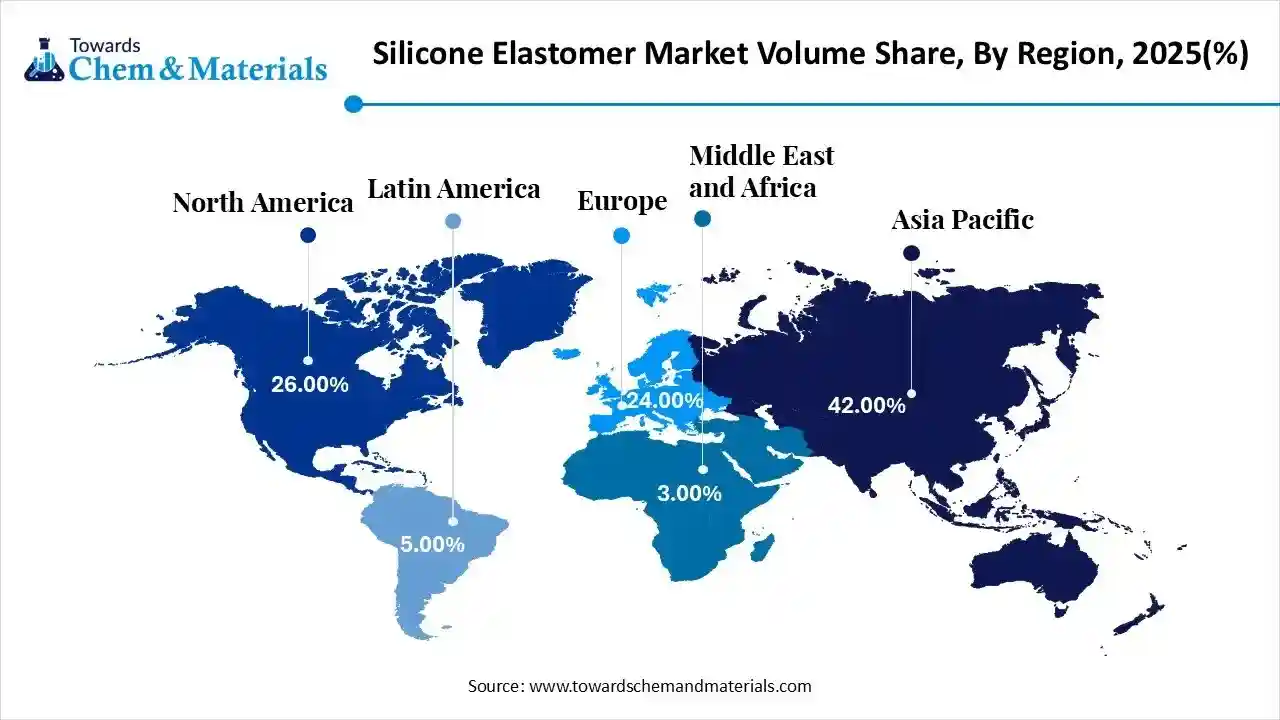
- The Asia Pacific dominated the silicone elastomer market with the largest volume share of 42% in 2025.
- The silicone elastomer market in North America is expected to grow at a substantial CAGR of 7.12% from 2026 to 2035.
- The Europe silicone elastomer market segment accounted for the major volume share of 24.00% in 2025.
- By product, the liquid silicone rubber (LSR) segment dominated the market and accounted for the largest volume share of 34% in 2025.
- By product, the high-temperature vulcanizing (HTV) segment is expected to grow at the fastest CAGR of 7.12% from 2026 to 2035 in terms of volume.
- By form, the platinum-cured LSR segment led the market with the largest revenue volume share of 36% in 2025.
- By sales channel, the direct sales segment dominated the market and accounted for the largest volume share of 65% in 2025.
- By end-use application, the automotive & transportation segment led the market with the largest revenue volume share of 28% in 2025.
Market Overview
What are the Growth Factors for the Silicone Elastomer Market?
The market's expansion is driven by the material's superior heat resistance, flexibility, chemical stability, and biocompatibility, making it preferred for demanding applications. Major players invest heavily in R&D to meet industry demands for performance and sustainability that ultimately drives opportunity for bio-based innovation and advancement in additive manufacturing.
The demand from the automotive and transportation sectors, especially for batteries, thermal management, and sealing in electric vehicles. While healthcare relies on medical-grade silicones for implants and devices. Other significant markets include construction, electrical, and electronics, which need high-performance sealants and insulations, making silicone elastomer dominant in the market.
Silicone Elastomer Market Trends:
- Sustainability and Eco-Friendly Solutions: The increasing focus on reducing environmental impact and strict regulations is driving the adoption of bio-based, low-VOC elastomers. Forcing manufacturers to invest in R&D to improve recycling technologies with safety and environmental standards
- Shift Towards E-mobility: The rapid growth in EV production is a key driver for silicone elastomers used in battery insulation, thermal management systems, and sealing applications due to their heat resistance and electrical insulation properties.
- Increase in Investment in Advanced Manufacturing: The increased investments in advanced manufacturing, such as 3D printing, offering design flexibility and prototyping without expensive molds which shaping this market adoption.
- Miniaturization in Electronics: The trend toward smaller, more powerful electronic devices requires high-performance silicone materials for effective heat degeneration, electrical insulation, and protection of the environment.
- End-Use Application: The rising demand for various applications in automotive & transportation, construction, electrical, industrial machinery and especially in medical devices, fueling demand for biocompatible, medical-grade elastomers and promoting innovation and consumption.
Report Scope
| Report Attribute | Details |
| Market Size and Volume in 2026 | USD 8.82 Billion / 568,705.00 Tons |
| Revenue Forecast in 2035 | USD 19.00 Billion / 985,567.60 Tons |
| Growth Rate | CAGR 8.9% |
| Forecast Period | 2026 - 2035 |
| Base Year | 2025 |
| Units Considered | Value (Billion / Million), Volume (Tons) |
| Dominant Region | Asia Pacific |
| Segment Covered | By Product Type, By Form/Chemistry, By Sales Channel, By End-Use Application, By Region |
| Key companies profiled | Dow Inc, Wacker Chemie AG, Shin-Etsu Chemical Co., Ltd, Momentive Inc., Elkem Silicones, KCC Corporation, Nusil (Avantor), Henkel, Evonik Industries, Kaneka Corporation, Kao Corporation, 3M, Trelleborg, Rogers Corporation, Momentive Performance Materials |
Key Technological Shifts and AI in the Silicone Elastomer Market:
Technological advances are shifting the silicone elastomer market toward digital, automated, and AI-driven processes. AI and machine learning are transforming R&D by self-healing silicones and enabling the design of biocompatible formulations with specific properties, reducing development time.
Manufacturing is becoming smart with Industry 4.0 integration, real-time process optimization, predictive maintenance, and precise quality control via computer vision. Additive manufacturing in silicones provides design and mass customization without the need for costly molds. These innovations improve efficiency, accuracy, and customization for demanding industries.
Trade Analysis of the Silicone Elastomer Market: Import and Export Statistics
- India imported 2,435 shipments of silicon elastomer.
- Indonesia imported 1,549 shipments of silicon elastomer.
- The Philippines imported 1,319 shipments of silicon elastomer.
- From June 2024 to May 2025, the world imported 5,698 shipments of silicon elastomer.
Silicone Elastomer Market: Value Chain Analysis
- Raw Material Sourcing: It is the initial stage of the extraction of silicon metal from the production of methyl chloride, securing high-purity key feedstocks
- Key Player: Hoshine Silicon Industry, Cabot Corporation, Sibelco
- Chemical Synthesis and Formulation: The conversion of raw materials into silanes and vice versa into siloxane by initiating the base properties of the elastomer and mixing the base polymer with the cross-linker and shifting towards formulation.
- Key Players: Dow Inc., Wacker Chemie AG, Elkem ASA, Shin-Etsu Chemical, Reiss Manufacturing, KCC Corporation
- Processing and Fabrication: The final conversion of the finished product through liquid injection molding or extrusion for intricate medical parts and heavy-duty gaskets.
- Key Players: Stocjwell Elastomerics, Mesgo S.p.A., Rogers Corporation
- End-Use Distribution: Finished products are moved by direct sale or specialized distributors by using logistical support to end-users like automotive, healthcare and electronics.
- Key Players: Safic-Alcan, Nordmann, TER Chemicals, Henkel, and Ravago
Regulatory Landscape: Silicone Elastomer Market
| Region | Regulation | Regulatory Focus |
| United States | FDA (food & Drug Administration); USP and Food Contact Safety | This regulation focuses on cured silicone elastomers used in healthcare and rigorous migration testing. |
| Asia Pacific | CFDA, PMDA, CDSCO and local health and industrial authorities | Emphasis on manufacturing quality control, standards for chemical registration and labelling. |
| China | NHC (National Health Commission); Food Contact Silicone | Aimed at standards for silicone rubber and pushing the market towards platinum-cured systems. |
| Global | ISO (International Organization for Standardization) | Focus on biocompatibility and provide adherence for silicone used in medical implants and devices. |
Segmental Insights
Product Insights
How did the Liquid Silicon Rubber (LSR) Segment hold the Largest Share of the Silicone Elastomer Market?
The liquid silicone rubber (LSR) segment volume was valued at 181,900.0 tons in 2025 and is projected to reach 347,215.5 tons by 2035, expanding at a CAGR of 7.45% during the forecast period from 2025 to 2035. The Liquid Silicone Rubber (LSR) segment dominated with approximately 34% share in the market due to its superior material properties that offer robust thermal and chemical resistance, and advanced manufacturing techniques that meet the rigorous demands of modern industries like automotive and electronics. Their prominence is due to their biocompatibility and ease of sterilization, making them the preferred choice for medical & healthcare. Additionally, the adoption of automated liquid injection molding technology solidifies LSR dominance.
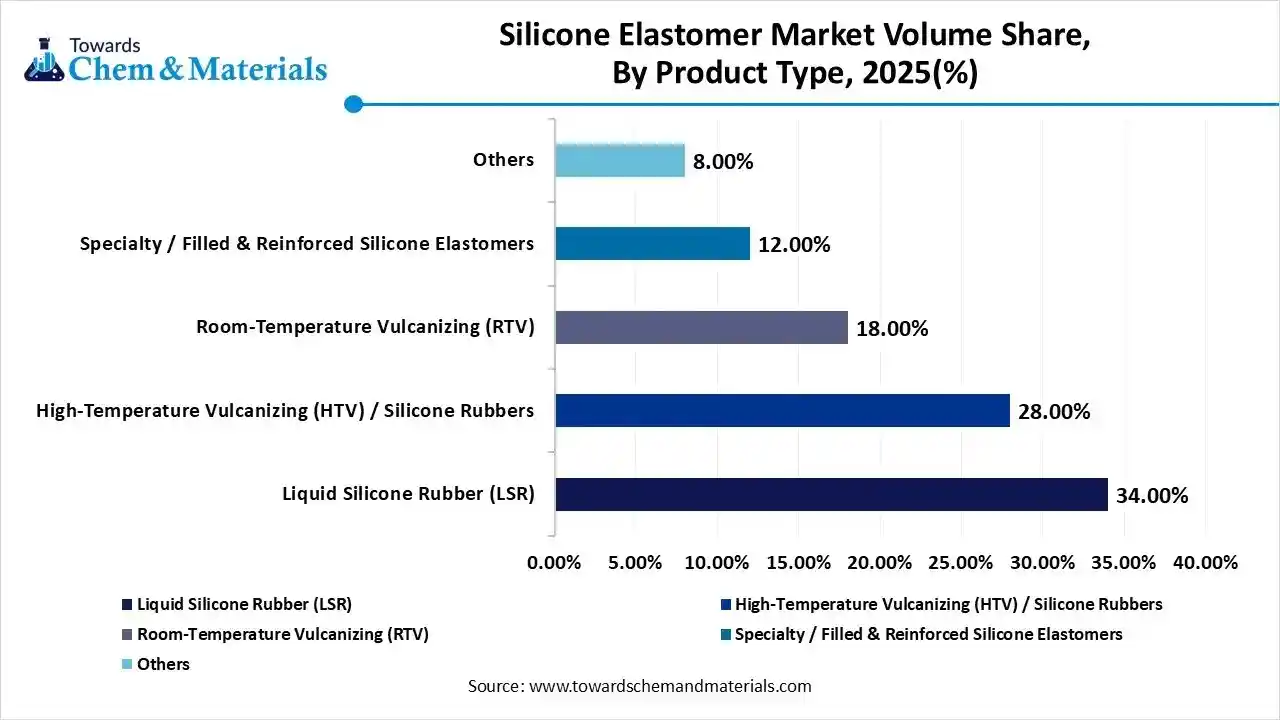
The high-temperature vulcanizing (HTV) segment volume was valued at 149,800.0 tons in 2025 and is projected to reach 278,127.2 tons by 2035, expanding at a CAGR of 7.12% during the forecast period from 2025 to 2035. The high-temperature vulcanizing (HTV) segment is expected to grow fastest in the market during the projected period due to its mechanical strength, thermal stability, and durability, which are crucial in established industries such as aerospace, automotive engine seals, and heavy machinery components. HTV exhibits excellent electrical insulation properties, high tensile strength, and low compression, which boosts the continuous demand for high-resistant solutions, which ensures its substantial growth during the forecast period.
Silicone Elastomer Market Volume and Share, By Foam Type, 2025-2035
| By Product Type | Market Volume Share (%), 2025 | Market Volume (Tons)2025 | Market Volume (Tons)2035 | CAGR(%) 2026-2035 | Market Volume Share (%), 2035 |
| Liquid Silicone Rubber (LSR) | 34.00% | 181,900.0 | 347,215.5 | 7.45% | 35.23% |
| High-Temperature Vulcanizing (HTV) / Silicone Rubbers | 28.00% | 149,800.0 | 278,127.2 | 7.12% | 28.22% |
| Room-Temperature Vulcanizing (RTV) | 18.00% | 96,300.0 | 179,373.3 | 7.16% | 18.20% |
| Specialty / Filled & Reinforced Silicone Elastomers | 12.00% | 64,200.0 | 102,696.1 | 5.36% | 10.42% |
| Others | 8.00% | 42,800.0 | 78,155.5 | 6.92% | 7.93% |
Form/Chemistry Insights
How Did the Platinum-Cured LSR Segment Dominated the Silicone Elastomer Market in 2025?
The platinum-cured LSR segment is leading the market with approximately 36% share in 2025, mainly due to its exceptional purity and superior performance. It produces no volatile organic byproducts, odorless, and has zero residues, resulting in a low extractables outline, making it ideal for healthcare applications like implantation and catheters that require biocompatibility and regulatory compliance. These systems also offer strong mechanical properties and long-term stability, inherent transparency, and high tensile and tear strength, driving their demand in sectors like medical devices, food electronics, automotive and food-contact applications.
The peroxide-cured HTV/RTV segment is expected to grow at the fastest CAGR in the market during the forecast period driven by its cost-effectiveness, superior performance and its consumption in the HTV segment. The compatibility of this segment with established manufacturing techniques like extrusion and compression boosts its demand in the automotive and electronics sectors. Additionally, these systems offer long-term sealing applications at elevated temperatures with proven reliability, fueling their wide applicability across the industrial market.
Sales Channel Insights
How did the Direct Sales/OEM Contracts Segment hold the Largest Share of the Silicone Elastomer Market?
The direct sales channel/OEM contracts segment held approximately 65% share in the market due to the technical complexity of the products, requiring close manufacturer-user interaction. Direct sales teams offer specialized product information, tailored support, and formulation advice that aligns with regulatory compliance and troubleshooting. This approach remains the most trusted for high-volume landscape and high-value contracts in this specialized B2B market landscape.
The distributor & dealers’ segment is set to experience the fastest growth, primarily driven by extensive market reach and strategic domestic partnership. The distributors provide large volume management required by industrial sectors like automotive and construction by maintaining a bridge to fragmented global markets and by maintaining supply chain efficiency.
Application Insights
Which Application Dominated the Silicone Elastomer Market?
The automotive and transportation segment leads in the end-user market with approximately 28% revenue share, due to its materials' performance in high and low temperatures, while their superior durability to UV, ozone, and weathering ensures long-lasting service life and heat resistance in engine seals and gaskets. Its electrical insulating properties are vital for high-voltage systems, especially in electric vehicles. The material's flexibility provides effective sealing and vibration damping, enhancing vehicle reliability, performance, and safety, particularly in EV battery and electronics management.
The medical and healthcare segment is an emerging segment projected to grow at a CAGR between 2026 and 2035, driven by strict purity requirements, safety, and performance standards. Platinum-cured liquid silicone rubber (LSR), providing biocompatibility, non-toxicity, and low extractables, is used in short-term use like respiratory masks, catheters and long-term implantable devices. Silicone elastomer shows high transparency, strength, and sterilization support its critical medical role. The rise in chronic diseases and ageing populations fuels innovation, making silicone elastomers essential for consistent, safe medical devices.
Regional Insights
The Asia Pacific silicone elastomer market size was valued at USD 3.41 billion in 2025 and is expected to be worth around USD 8.01 billion by 2035, exhibiting at a compound annual growth rate (CAGR) of 8.92% over the forecast period from 2026 to 2035.
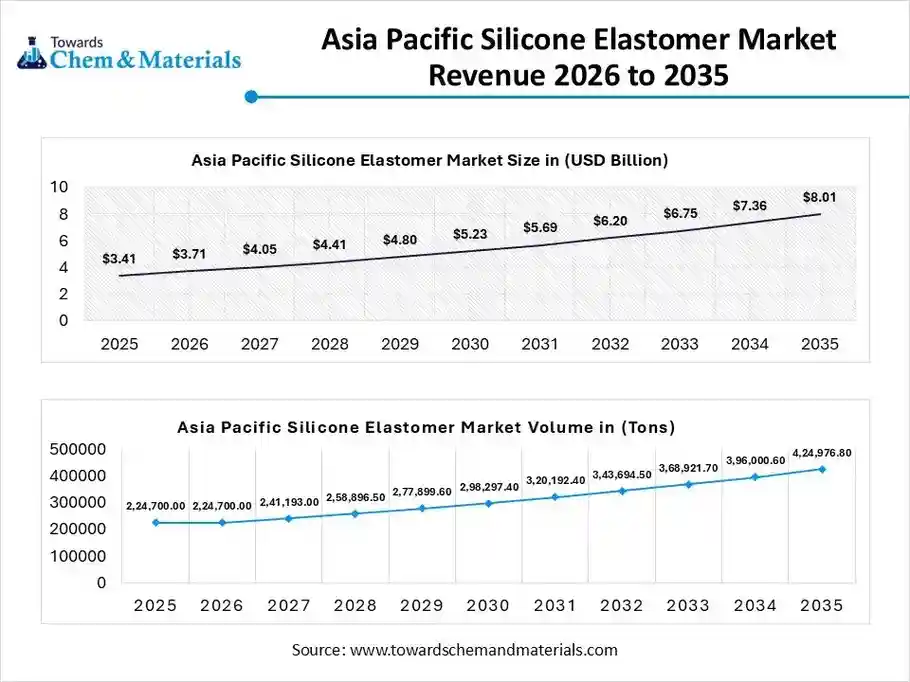
The Asia Pacific silicone elastomer volume was estimated at 224,700.00 tons in 2025 and is projected to reach 424,976.80 tons by 2035, growing at a CAGR of 7.34% from 2026 to 2035.Asia Pacific dominated with approximately 42% share in the market in 2025, driven by its powerful and expanding manufacturing base, rapid industrialization & urbanization, and its substantial infrastructure growth within the medical and automotive industries. The leadership is sustained by its robust electronics production and consumption of these specialized materials, with the availability of raw materials and supportive government across its dynamic economic landscape, fueling regional growth.
China Silicone Elastomer Market Trends
China is the leading market in the Asia Pacific region due to its robust manufacturing ecosystem, its stringent government policies, and its strong focus on innovation. The transition to e-mobility and technological development, such as liquid silicone rubber injection molding & 3D printing sustain its leadership in the region.
What is driving the Rapid Growth of the Silicone Elastomer Market in North America?
The North America silicone elastomer volume was estimated at 139,100.0 tons in 2025 and is projected to reach 258,317.3 tons by 2035, growing at a CAGR of 7.12% from 2026 to 2035. North America is expected to experience the fastest growth in the market during the forecast period due to its robust healthcare demand, with its high-purity and biocompatibility. The rapid shift towards automotive electrification due to its heat resistance and durability, along with emphasis on innovation of low-volatile organic compound silicone formulations to meet sustainability goals driving market expansion.
U.S. Silicone Elastomer Market Trends
The U.S. holding central position in North America, driven by its robust industrial and economic landscape, including healthcare, automotive, construction, and electronics. By leveraging substantial investments in R&D due to its sophisticated manufacturing capabilities, it enables the production of high-precision components that expand its market presence.
Silicone Elastomer Market Volume and Share, By Region, 2025-2035
| By Region | Market Volume Share (%), 2025 | Market Volume (Tons)2025 | Market Volume (Tons)2035 | CAGR(%) 2026-2035 | Market Volume Share (%), 2035 |
| North America | 26.00% | 139,100.0 | 258,317.3 | 7.12% | 26.21% |
| Europe | 24.00% | 128,400.0 | 230,721.4 | 6.73% | 23.41% |
| Asia Pacific | 42.00% | 224,700.0 | 424,976.8 | 7.34% | 43.12% |
| Latin America | 5.00% | 26,750.0 | 47,997.1 | 6.71% | 4.87% |
| Middle East & Africa | 3.00% | 16,050.0 | 23,555.1 | 4.35% | 2.39% |
Recent Developments
- In November 2025, Shin-Etsu Chemical announced the launch of its Recyclable Thermoplastic Silicone and flexible silicone resin lines. These materials offer a sustainable solution for medical device coatings and electronic components.(Source: www.shinetsu.co.jp)
- In April 2025, Wacker Chemie launched a strategic partnership with Nordmann in the field of silicone elastomers for distribution in Europe that focuses on providing high-quality silicone elastomers, including LSR and additives.(Source: www.nordmann.global)
Top Players in the Silicone Elastomer Market and Their Offerings
- Dow Inc: They provide advanced Liquid Silicon Rubber for the automotive industry and self -adhesive LSR for EV battery and high-voltage cable insulation without losing flexibility.
- Wacker Chemie AG: focus on scaling up production from bio-based methanol and offer solid and liquid rubbers as well as cleanroom-manufacturer medical silicones.
- Shin-Etsu Chemical Co., Ltd: They provide specialized thermal interface materials and silicone gels, focusing on low-volatile silicone elastomers.
- Momentive Inc.
- Elkem Silicones
- KCC Corporation
- Nusil (Avantor)
- Henkel
- Evonik Industries
- Kaneka Corporation
- Kao Corporation
- 3M
- Trelleborg
- Rogers Corporation
- Momentive Performance Materials
Segments Covered in the Report:
By Product Type
- Liquid Silicone Rubber (LSR)
- High-Temperature Vulcanizing (HTV)/Silicone Rubbers
- Room-Temperature Vulcanizing (RTV)
- Special/Filled & Reinforced Silicone Elastomers
- Others
By Form/Chemistry
- Platinum-cured LSR
- Peroxide-cured HTV/RTV
- Addition-cured Specialty Grades
- Filled/Reinforced Blends
By Sales Channel
- Direct Sales/OEM Contacts
- Distributors & Dealers
- Online/Specialty Suppliers
By End-Use Application
- Automotive & Transportation
- Medical & Healthcare
- Electrical & Electronics
- Construction & Building
- Consumer Goods & Appliances
- Industrial & Others
By Region
- North America
- U.S.
- Canada
- Mexico
- Europe
- Germany
- UK
- France
- Italy
- Spain
- Asia Pacific
- China
- India
- Japan
- South Korea
- Latin America
- Brazil
- Argentina
- Middle East & Africa
- Saudi Arabia
- South Africa
FAQ's
Question 1 : What is the current global silicone elastomer market size and forecast?
Answer : The global silicone elastomer market was valued at USD 8.10 billion in 2025 and is projected to grow to USD 19.00 billion by 2035, with a CAGR of 8.9% from 2026 to 2035. The market volume is expected to increase from 535,000 tons in 2025 to 985,567.60 tons by 2035, growing at a CAGR of 6.30%.
Question 2 : What are the key growth drivers in the silicone elastomer market?
Answer : The market is driven by the increasing demand for sustainable and eco-friendly materials, technological advancements in manufacturing, the rise in e-mobility, and miniaturization in electronics. The growing need for high-performance materials in automotive, healthcare, and electronics sectors significantly fuels market growth.
Question 3 : Who are the leading companies operating in the silicone elastomer market?
Answer : Key players in the silicone elastomer market include Dow Inc., Wacker Chemie AG, Shin-Etsu Chemical Co. Ltd, Momentive Inc., Elkem Silicones, KCC Corporation, Nusil (Avantor), Henkel, Evonik Industries, and 3M, among others. These companies lead through innovation in product offerings, particularly in LSR, HTV, and medical-grade silicones.
Question 4 : How will technology disruptions impact the silicone elastomer market?
Answer : Technological advances, including the integration of AI, automation, and 3D printing, are transforming the silicone elastomer market. These innovations enable better customization, faster production, and more efficient manufacturing processes, leading to enhanced market adoption in industries like automotive, medical devices, and electronics.
Meet the Team

Saurabh Bidwai
Principal Consultant
Saurabh Bidwai, a B.Tech Chemical Engineering graduate with 4+ years of experience, specializes in specialty chemicals, commodity chemicals, and engineered materials, offering valuable insights into market trends and emerging opportunities.

Aditi Shivarkar
Reviewed By
Aditi Shivarkar, with 14+ years in Chemical and Materials market research, specializes in Chemical and Materials. She ensures accurate, actionable insights, driving Towards Chemicals And Materials Analytics and Consulting excellence in industry trends and sustainability.