
Graphene-Enhanced Plastics Market Size, Share, Growth, Report 2026 to 2035
The global graphene-enhanced plastics market size is expected to grow from USD 43.22 billion in 2026 to USD 232.36 billion in 2035, growing at a CAGR of 20.55% from 2026 to 2035. The top key players in the market are 3M, DuPont, Pentair plc, BWT Holding GmbH, Culligan, Watts, Veolia, Calgon Carbon Corporation, EcoWater Systems LLC, Watch Water, O. Smith, Haier Smart Home (GE Appliances), NanoXplore Inc., G6 Materials Corp. , Talga Group,First Graphene, Thomas Swan & Co. Ltd., Applied Graphene MaterialsAvanzar Innovación Tecnológica, Perpetuus Advanced Materials, Cabot Corporation, Skeleton Technologies, Levidian Nanosystems, Nanoinnova Technologies, Graphene Composites Ltd. , ACS Material LLC, Enerage In., Gerdau Graphene, HydroGraph Clean Power, Graphene Composites Ltd, Black Swan Graphene
Content
What is the Current Size of the Graphene-Enhanced Plastics Market and Its Projected Growth?
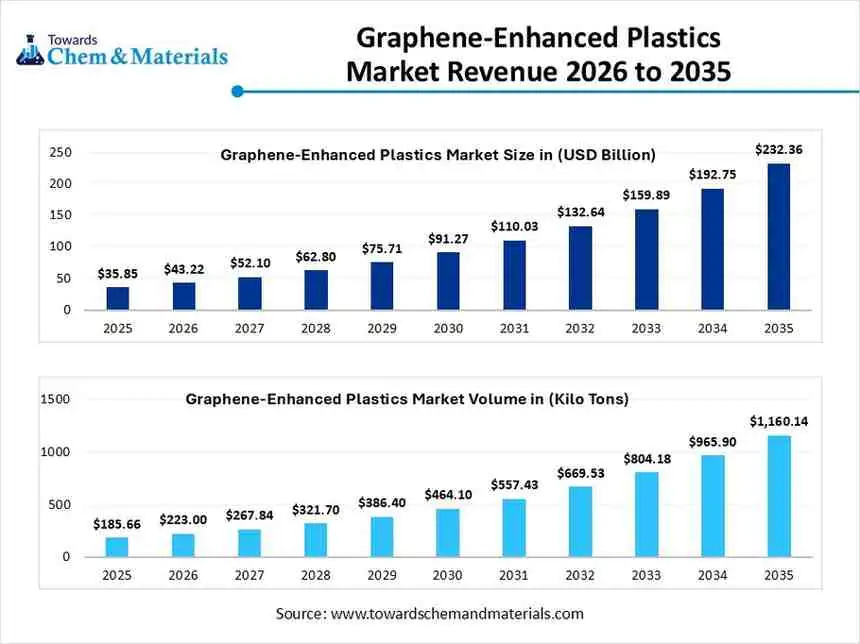
The global graphene-enhanced plastics market size was estimated at USD 35.85 billion in 2025 and is expected to increase from USD 43.22 billion in 2026 to USD 232.36 billion by 2035, growing at a CAGR of 20.55% from 2026 to 2035. In terms of volume, the market is projected to grow from 185.66 kilo tons in 2025 to 1,160.14 kilo tons by 2035. growing at a CAGR of 20.11% from 2026 to 2035. Asia Pacific dominated the graphene-enhanced plastics market with the largest volume share of 41% in 2025.The growth of the market is driven by the demand for lightweight, durable materials in the automotive and electronics sectors to enhance conductivity and structural strength.
Market Highlights
- By region, Asia Pacific dominated the market with a share of 41% in 2025. The growing and advanced research infrastructure drives growth.
- By region, Europe held the second largest share of 24% in 2025. The enhanced and advanced technology and production drives growth.
- By polymer type, the thermoplastics segment dominated the market with 64% share in 2025. The demand for lightweight materials drives growth.
- By polymer type, the thermosetting plastics segment held the second largest share of 36% in 2025. The enhanced mechanical strength drives the demand for the market.
- By graphene type, the graphene nanoplatelets (GNP) segment dominated the market with 42% share in 2025. The high strength and cost-effective scalability drive growth.
- By graphene type, the graphene oxide (GO) segment held the second largest share of 21% in 2025, with the growing demand and adoption in EV drives growth.
- By processing method, the melt blending segment dominated the market with 38% share in 2025. The high profitability of materials fuels the growth
- By processing method, the extrusion compounding segment held the second largest share of 22% in 2025. This method helps in enhancing performance.
- By application, the automotive segment dominated the market with 24% share in 2025. The growing automotive industry and demand for high-performance materials drive growth.
- By application, the electrical & electronics segment held the second largest share of 21% in 2025. The growth is fueled by thermal management.
Market Size and Volume Forecast
- Market Size (2025): USD 35.85 Billion | CAGR (2026–2035): 20.55%
- Market Projected Size (2035): USD 232.36 Billion
- Market Volume (2025): 185.66 Kilotons (KT) | Volume CAGR (2026–2035): 20.11%
- Market Projected Volume (2035):1,160.14 Kilotons (KT)
- Market Pricing (2025):
- Average Manufacturing Price: USD 7.88/kg
- Average Selling Price: USD 12.58/kg
- Pricing CAGR (2025–2035): 4.9%
Market Overview
What Is The Significance Of The Graphene-Enhanced Plastics Market?
The graphene-enhanced plastics market is significant for revolutionizing material science by producing plastics that are substantially stronger, lighter, and more durable, while enhancing thermal and electrical conductivity. Driven by sustainability and performance, this market is transforming the automotive, aerospace, and electronics sectors, with the need for advanced, eco-friendly, and lightweight materials, which fuels the growth of the market.
Recent Market Growth Trends:
- Electronics & Conductivity: The rise of 5G and IoT is fueling demand for graphene-enhanced plastics in EMI shielding, thermal management, and flexible electronics.
- Technological Shift: The market is shifting towards using graphene for multifunctional properties, such as combining structural reinforcement with thermal conductivity and sensor capabilities.
- Sustainability Focus: Graphene composites are increasingly recognized for their ability to maintain performance over multiple recycling cycles.
- Rising Demand for Performance: Graphene-enhanced plastics, particularly in polypropylene, provide improved thermal, mechanical, and electrical conductivity properties.
Report Scope
| Report Attribute | Details |
| Market Size in 2026 | USD 43.22 Billion / 223.00 Kilo Tons |
| Revenue Forecast in 2035 | USD 232.36 Billion / 1,160.14 Kilo Tons |
| Growth Rate | CAGR 20.55% |
| Forecast Period | 2026 - 2035 |
| Base Year | 2025 |
| Dominant Region | North America |
| Segment Covered | By Polymer Type, By Graphene Type, By Processing Method, By Application |
| Key companies profiled | 3M, DuPont, Pentair plc, BWT Holding GmbH, Culligan, Watts, Veolia, Calgon Carbon Corporation, EcoWater Systems LLC, Watch Water, O. Smith, Haier Smart Home (GE Appliances), NanoXplore Inc., G6 Materials Corp. , Talga Group,First Graphene, Thomas Swan & Co. Ltd., Applied Graphene MaterialsAvanzar Innovación Tecnológica, Perpetuus Advanced Materials, Cabot Corporation, Skeleton Technologies, Levidian Nanosystems, Nanoinnova Technologies, Graphene Composites Ltd. , ACS Material LLC, Enerage In., Gerdau Graphene, HydroGraph Clean Power, Graphene Composites Ltd, Black Swan Graphene |
Key Technological Shifts In The Graphene-Enhanced Plastics Market:
Key technological shifts in the graphene-enhanced plastics market focus on boosting material performance, particularly in automotive and electronics, through superior strength-to-weight ratios, enhanced conductivity, and improved thermal management. Key advancements include scalable high-surface-area graphene, advanced dispersion techniques for uniform matrix integration, and enhanced functionality for electric vehicle battery casings and lightweight aerospace components.
Trade Analysis Of Graphene-Enhanced Plastics Market: Import & Export Statistics
According to Global Export Data, the world exported 54 Graphene Oxide, Holmium Oxide shipments between June 2024 and May 2025 (TTM) via 26 exporters and 29 buyers, representing a 32% YoY change.
India, Vietnam, and Russia lead as the top Graphene Oxide, Holmium Oxide importers, while India with 72 shipments, China with 48 shipments, and the United States with 14 shipments rank as the largest global Graphene Oxide, Holmium Oxide exporters.
Top-performing Global Graphene Oxide, Holmium Oxide Exporters by volume:
- SIGMA ALDRICH INTERNATIONAL GMBH: 14 shipments (17%)
- ALDRICH CHEMICAL CO LLC: 11 shipments (13%)
- LOBA CHEMIE PVT LTD: 10 shipments (12%)
Graphene-Enhanced Plastics Market -- Supply Chain Analysis
Material Production & Compounding
- Graphene-enhanced plastics are produced by incorporating graphene or graphene nanoplatelets into polymer matrices through compounding, extrusion, or injection molding to improve mechanical strength, conductivity, and thermal properties.
- Key players: Directa Plus, XG Sciences, Haydale Graphene Industries, Applied Graphene Materials
Quality Testing and Certification
- Graphene-enhanced plastics must meet standards for dispersion quality, mechanical performance, electrical conductivity, and safety compliance for industrial and consumer applications.
- Key players: International Organization for Standardization, ASTM International, European Chemicals Agency, International Electrotechnical Commission.
Distribution to Industrial Users
- Graphene-enhanced plastics are supplied to automotive manufacturers, electronics companies, aerospace firms, construction material producers, and packaging industries.
- Key players: Directa Plus, XG Sciences, Haydale Graphene Industries
Graphene-Enhanced Plastics Regulatory Landscape: Global Regulations
| Country / Region | Regulatory Body | Key Regulations | Focus Areas | Notable Notes |
| U.S. | Environmental Protection Agency (EPA); Occupational Safety and Health Administration (OSHA) | Toxic Substances Control Act (TSCA); OSHA Hazard Communication Standard | Nanomaterial safety, chemical registration, and worker exposure | Graphene used in plastics is regulated as a nanomaterial, requiring safety evaluation, reporting, and proper handling to mitigate inhalation and exposure risks. |
| Europe | European Chemicals Agency (ECHA); European Commission | REACH Regulation; CLP Regulation; Nanomaterial Guidance | Chemical registration, nanomaterial classification, labeling | The EU requires detailed registration and safety data for graphene-based materials, including nano-specific risk assessments and labeling requirements. |
| China | Ministry of Ecology and Environment (MEE); Ministry of Industry and Information Technology (MIIT) | Environmental Protection Law; New Material Industry Policies | Industrial material safety, environmental compliance | China promotes graphene materials under advanced material policies while enforcing environmental and safety regulations. |
| India | Ministry of Environment, Forest and Climate Change (MoEFCC); Department of Science and Technology (DST) | Environment Protection Act; Nanotechnology Research Guidelines | Environmental safety, nanomaterial research oversight | India is developing regulatory frameworks for nanomaterials, including graphene, with a focus on safe industrial use and research development. |
| Japan | Ministry of Economy, Trade and Industry (METI); Ministry of Health, Labour and Welfare (MHLW) | Chemical Substances Control Law (CSCL); Industrial Safety and Health Act | Chemical safety, nanomaterial handling, worker protection | Japan regulates graphene under existing chemical safety laws with strict workplace safety requirements. |
| South Korea | Ministry of Environment (MoE); Ministry of Trade, Industry and Energy (MOTIE) | K-REACH; Industrial Technology Innovation Promotion Act | Nanomaterial registration, industrial innovation, and environmental compliance | South Korea supports graphene innovation while enforcing chemical registration and safety compliance under K-REACH. |
Segmental Insights
Polymer Type Insights
The Thermoplastics Segment Dominated The Market With 64% Market Share In 2025
The thermoplastics segment dominated the market with 64% share in 2025, driven by its versatility and high compatibility with manufacturing techniques like injection molding. Polypropylene (PP) and Polyethylene (PE) are particularly dominant due to their widespread use in automotive, packaging, and consumer goods, allowing for high-volume, cost-effective production. The demand for lightweight, conductive, and mechanically strong materials in the automotive and aerospace industries drives the use of thermoplastic compounds.
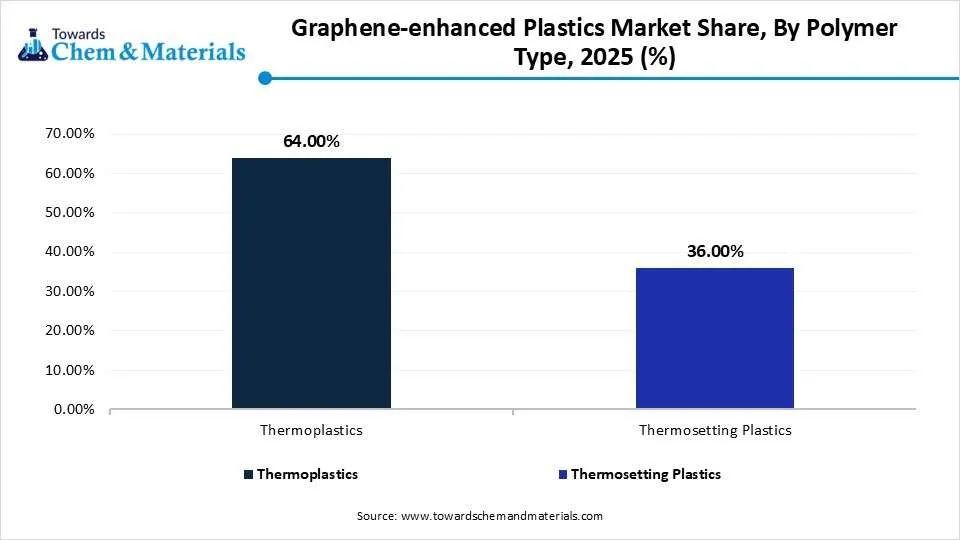
The thermosetting plastics segment held the second-largest share of 36% in 2025, driven by its integration into high-performance applications like automotive, aerospace, and electronics. The demand for superior structural integrity, thermal resistance, and electrical conductivity is accelerating the adoption of graphene-enhanced thermosets, particularly in electric vehicle battery housings and aerospace components. Growth is fueled by demand in the electronics sector for EMI/RFI shielding, conductive inks, and flexible, conductive, and heat-resistant devices.
Graphene-enhanced Plastics Market Share, By Polymer Type, 2025 (%)
| By Polymer Type | Revenue Share, 2025 (%) |
| Thermoplastics | 64.00% |
| Thermosetting Plastics | 36.00% |
- Thermoplastics dominate the graphene-enhanced plastics market with a 64.00% share in 2025, driven by their recyclability, ease of processing, and wide applicability across industries. Their compatibility with graphene improves mechanical strength, conductivity, and flexibility in various end-use applications.
- Thermosetting plastics account for 36.00% of the market share in 2025, supported by their superior thermal stability and structural integrity. These materials are widely used in high-performance applications such as aerospace, automotive, and electronics where durability is critical.
Graphene Type Insights
The Graphene Nanoplatelets (GNP) Segment Dominated The Market With 42% Market Share In 2025
The graphene nanoplatelets (GNP) segment dominated the market with 42% share in 2025, driven by high demand for lightweight, high-strength materials in the automotive, aerospace, and electronics sectors. GNPs offer superior mechanical and thermal conductivity, making them ideal additives for polymer composites, with the Asia Pacific leading in consumption. GNPs are heavily used as reinforcements in polymers to create high-performance, durable composites, particularly within the automotive, aerospace, and construction industries.
The graphene oxide (GO) segment held the second largest share of 21% in 2025, driven by its high dispersibility in polymers, cost-effectiveness, and superior electrical/thermal conductivity. The segment is driven by increasing adoption in EV batteries, lightweight composites, and conductive coatings. Graphene oxide is highly dispersible in water and other solvents, making it easier and cheaper to mix with polymers to enhance tensile strength, electrical conductivity, and elasticity compared to other graphene types.
The reduced graphene oxide (rGO) segment held the third-largest share of 19% in 2025, due to its superior electrical conductivity, mechanical strength, and ease of dispersion within polymers. As a versatile, cost-effective derivative of graphene oxide, rGO is increasingly used to enhance thermoplastics and thermosets for automotive, electronics, and aerospace applications. rGO enhances the structural integrity, tensile strength, and electrical conductivity of polymers, making it ideal for high-performance applications.
The pristine graphene segment held the fourth largest share of 18% in 2025, due to its unmatched mechanical strength and superior electrical conductivity, driven by rising demand in high-performance sectors like aerospace, defense, and specialized electronics. While costlier, its unmatched, high-performance properties make it indispensable for specialized applications. Pristine graphene is utilized where premium performance is required, specifically for enhancing the electrical and mechanical strength of polymers.
Graphene-enhanced Plastics Market Share, By Graphene Type, 2025 (%)
| By Graphene Type | Revenue Share, 2025 (%) |
| Graphene Nanoplatelets (GNP) | 42.00% |
| Graphene Oxide (GO) | 21.00% |
| Reduced Graphene Oxide (rGO) | 19.00% |
| Pristine Graphene | 18.00% |
- Graphene nanoplatelets lead the graphene-enhanced plastics market with a 42.00% share in 2025, driven by their cost-effectiveness and ease of integration into polymer matrices. They offer improved mechanical strength, thermal conductivity, and barrier properties across various applications.
- Graphene oxide accounts for 21.00% of the market share in 2025, supported by its excellent dispersibility and functional groups that enhance compatibility with different polymers. It is widely used in coatings, membranes, and advanced composite materials.
- Reduced graphene oxide holds a 19.00% share of the market in 2025, valued for its balance between performance and cost compared to pristine graphene. It provides enhanced electrical conductivity and mechanical properties for industrial and electronic applications.
- Pristine graphene captures 18.00% of the market share in 2025, driven by its superior electrical, thermal, and mechanical characteristics. Its usage is prominent in high-end and specialized applications despite higher production costs.
Processing Method Insights
The Melt Blending Segment Dominated The Market With 38% Market Share In 2025
The melt blending segment dominated the market with 38% share in 2025, preferred for its scalability, cost-effectiveness, and compatibility with existing industrial extrusion and injection molding equipment. This solvent-free, environmentally friendly method is highly favored for producing thermoplastics, though other techniques exist. Melt mixing is frequently cited as a leading technique for large-scale production, allowing for efficient dispersion of graphene into polymer matrices.
The extrusion compounding segment held the second largest share of 22% in 2025, driven by its superior electrical conductivity, exceptional mechanical strength, and ease of processing compared to other graphene types. The ability of the method helps in enhancing the polymer properties due to its application in various fields like lightweight automotive compounds, energy storage, and electronics, which fuels the demand. Its dispersibility and ability to be produced via chemical reduction make it easier to incorporate into polymers, allowing for cost-effective manufacturing compared to other graphene derivatives.
The solution mixing segment held the third largest share of 21% in 2025, due to its ability to achieve uniform dispersion of graphene within polymer matrices, which is critical for enhancing electrical, thermal, and mechanical properties. This technique is favored for manufacturing high-performance composites in the automotive, electronics, and aerospace sectors. This method is preferred for specialized, high-performance applications such as flexible sensors, conductive films, and advanced coatings for electronics and aerospace, where precise material performance is necessary.
The in-situ polymerization segment held the fourth largest share of 19% in 2025, driven by its superior ability to achieve uniform graphene dispersion at the molecular level, crucial for high-performance applications. It is becoming favored over traditional melt mixing for producing lightweight, high-strength composites in automotive, aerospace, and electronics. This technique is critical for producing specialized polymers used in advanced electronics and aerospace, where consistent, high-performance characteristics are required.
Graphene-enhanced Plastics Market Share, By Processing Method, 2025 (%)
| By Processing Method | Revenue Share, 2025 (%) |
| Melt Blending | 38.00% |
| Solution Mixing | 21.00% |
| In-Situ Polymerization | 19.00% |
| Extrusion Compounding | 22.00% |
- Melt blending leads the graphene-enhanced plastics market with a 38.00% share in 2025, driven by its cost-effectiveness and ease of large-scale production. This method allows uniform dispersion of graphene within thermoplastics, making it widely adopted in industrial applications.
- Solution mixing accounts for 21.00% of the market share in 2025, supported by its ability to achieve better dispersion of graphene at the molecular level. It is commonly used in applications requiring high-performance composites and enhanced material properties.
- In-situ polymerization holds a 19.00% share of the market in 2025, as it enables strong bonding between graphene and the polymer matrix during formation. This method is preferred for advanced applications requiring superior mechanical and thermal performance.
- Extrusion compounding captures 22.00% of the market share in 2025, driven by its efficiency in continuous processing and scalability. It is widely used for manufacturing graphene-enhanced plastic products in packaging, automotive, and industrial sectors.
Application Insights
The automotive segment dominated the market with 24% market share in 2025
The automotive segment dominated the market with 24% share in 2025. driven by the need for lightweight materials in electric vehicle (EV) battery housings, structural components, and improved fuel efficiency. Graphene-enhanced plastics, often used to replace metal, improve thermal management, conductivity, and mechanical strength. The push for lower CO2 emissions, extended EV range, and increased fuel efficiency encourages the adoption of these lightweight materials.
The electrical & electronics segment held the second-largest share of 21% in 2025. leveraging superior electrical conductivity, thermal management, and lightweight properties, rising demand for wearable tech, 5G infrastructure, conductive housings, and energy storage solutions drives the growth of the market. Growth is driven by the urgent need for graphene-based conductive materials that provide faster charging times and higher energy density in, for instance, electric vehicle applications.
The packaging segment held the third-largest share of 14% in 2025, driven by the need for superior barrier properties that improve moisture and oxygen resistance by 98%. The shift toward eco-friendly packaging encourages the adoption of graphene, which allows for thinner materials while maintaining strength. Furthermore, the integration of graphene-enabled sensors is accelerating the adoption of "smart" packaging for improved product tracking and traceability.The aerospace & defense segment held the fourth largest share of 12% in 2025, by adopting these materials to achieve superior strength-to-weight ratios, enhanced durability, and high thermal/electrical conductivity for next-generation aircraft and defense systems. These materials enhance the durability and fatigue resistance of composite structures, making them ideal for structural components. The sector is utilizing graphene for ballistic protection, durable coatings, and specialized defense equipment.
Graphene-enhanced Plastics Market Share, By Application, 2025 (%)
| By Application | Revenue Share, 2025 (%) |
| Automotive | 24.00% |
| Electrical & Electronics | 21.00% |
| Aerospace & Defense | 12.00% |
| Packaging | 15.00% |
| Construction | 10.00% |
| Healthcare | 8.00% |
| Sports & Leisure | 6.00% |
| Others | 4.00% |
- Automotive leads the graphene-enhanced plastics market with a 24.00% share in 2025, driven by the need for lightweight, high-strength materials to improve fuel efficiency and performance. Graphene integration enhances durability, conductivity, and thermal stability in vehicle components.
- Electrical & electronics account for 21.00% of the market share in 2025, supported by the demand for conductive and heat-resistant materials in advanced electronic devices. Graphene-enhanced plastics are widely used in circuits, sensors, and electronic housings.
- Aerospace & defense hold a 12.00% share of the market in 2025, driven by the need for high-performance materials with superior strength-to-weight ratio. These materials are used in aircraft components and defense equipment requiring durability and reliability.
- Packaging captures 15.00% of the market share in 2025, supported by the use of graphene-enhanced plastics for improved barrier properties and longer shelf life of products. The growing demand for advanced packaging solutions is boosting this segment.
- Construction represents 10.00% of the market in 2025, with applications in coatings, insulation, and structural components. Graphene-enhanced plastics offer improved strength, durability, and resistance to environmental conditions.
- Healthcare accounts for 8.00% of the market share in 2025, driven by applications in medical devices, diagnostics, and antimicrobial materials. The integration of graphene enhances performance and safety in healthcare products.
- Sports & leisure hold 6.00% of the market in 2025, supported by the use of advanced materials in equipment such as rackets, helmets, and protective gear. Graphene improves strength while maintaining lightweight characteristics.
- Others capture 4.00% of the market share in 2025, covering niche and emerging applications across various industries. This segment reflects specialized uses with steady but limited demand.
Regional Insights
How did Asia Pacific Dominate the Graphene-Enhanced Plastics Market in 2025?
Asia Pacific Graphene-Enhanced Plastics Market size was valued at USD 14.70 billion in 2025 and is expected to be worth around USD 96.43 billion by 2035, exhibiting at a compound annual growth rate (CAGR) of 20.70% over the forecast period from 2026 to 2035.Asia Pacific dominated the market with a share of 41% in 2025, with rapid growth driven by high demand for lightweight and conductive materials in automotive, electronics, and energy sectors, fueling the growth of the market. The market is dominated by China, Japan, and South Korea, which are expanding their production capacities and research initiatives for high-tech manufacturing applications. The market is transitioning toward sustainable materials and circular economy solutions.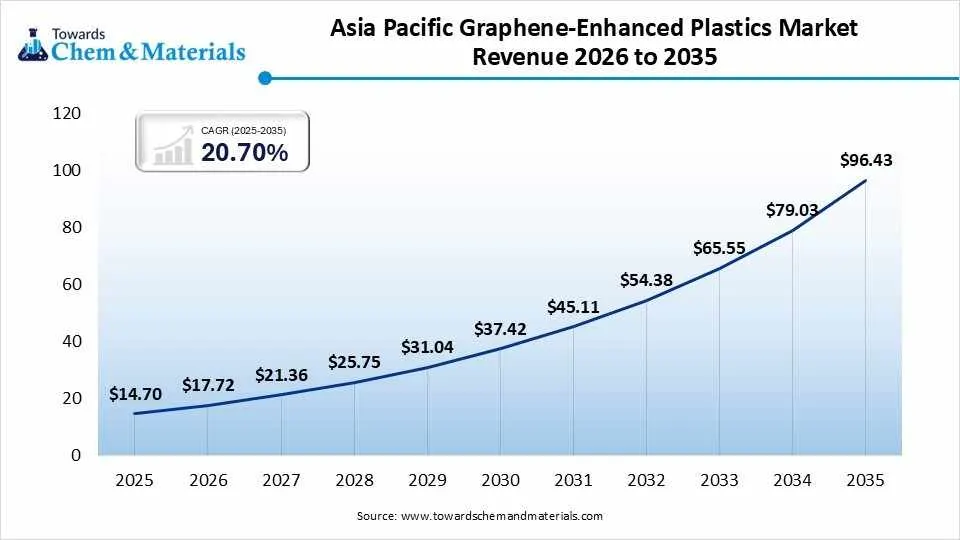
India Graphene-Enhanced Plastics Market Growth Factor
The Indian graphene-enhanced plastics market is experiencing robust growth, driven by rapid industrialization, increasing demand for lightweight materials in automotive and aerospace, and the push for electric vehicle (EV) battery efficiency, which fuels the growth of the market. International and local collaborations, such as the agreement between Imkemex and Applied Graphene Materials, are expanding the availability of graphene for the polymer, resin, and coating industries. The shift from traditional materials to graphene-based polymers increases durability and conductivity in plastics.
Europe Graphene-Enhanced Plastics Market Growth Factor
Europe held the second largest share of 24% in 2025, due to high demand for lightweight, high-performance materials in automotive, aerospace, and electronics. The main growth drivers in the region are the need for conductive composites, enhanced sustainability through reduced material use, and strong R&D funding. Intense research, particularly in Germany, the UK, and Spain, along with EU funding for graphene-related collaborative projects, accelerates commercialization.
Germany Graphene-Enhanced Plastics Market Growth Factor
The German graphene-enhanced plastics market is experiencing robust growth, driven by high demand for lightweight, conductive materials in the automotive and aerospace sectors to meet emission targets. Strict European regulations drive the demand for sustainable, high-strength, and conductive materials. Graphene-enhanced plastics offer superior mechanical, thermal, and electrical properties, replacing traditional heavier metals. Germany’s strong industrial base is supported by significant research into application-specific graphene, enhancing the integration of graphene in various polymer matrices.
Graphene-enhanced Plastics Market Share, By Regional, 2025 (%)
| Regional | Revenue Share, 2025 (%) |
| Asia-Pacific | 41.00% |
| Europe | 24.00% |
| North America | 21.00% |
| Latin America | 8.00% |
| Middle East & Africa | 6.00% |
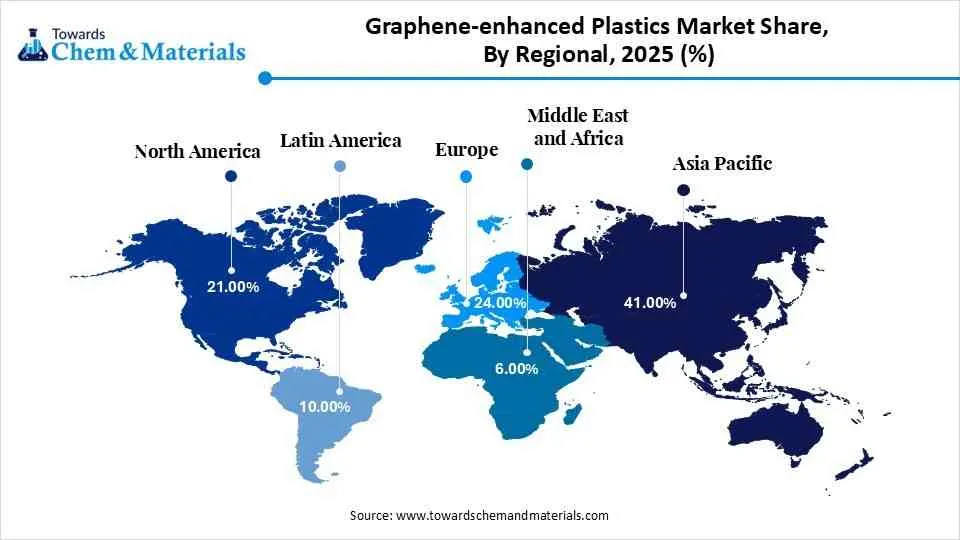
- Asia-Pacific leads the graphene-enhanced plastics market with a 41.00% share in 2025, driven by rapid industrialization and strong demand from automotive, electronics, and construction sectors. Countries like China, Japan, and India play a key role in market growth due to expanding manufacturing capabilities.
- Europe accounts for 24.00% of the market share in 2025, supported by advanced research in nanotechnology and increasing adoption of high-performance materials. The region benefits from strong presence in automotive and aerospace industries.
- North America holds a 21.00% share of the market in 2025, driven by technological advancements and high investment in innovation and product development. Demand is supported by applications in electronics, healthcare, and defense sectors.
- Latin America represents 8.00% of the market share in 2025, with growth fueled by expanding industrial activities and increasing adoption of advanced materials. The region is witnessing gradual development in automotive and construction sectors.
- Middle East & Africa capture 6.00% of the market in 2025, supported by emerging industrial infrastructure and growing interest in advanced material applications. Demand is gradually increasing across construction and energy-related sectors.
Recent Development
- In July 2025, HydroGraph Clean Power launched a compounding partner program to accelerate the adoption of graphene-enhanced thermoplastics, Fractal Graphene, across industries like automotive and packaging. The initiative aims to build a qualified network for consistent, commercial-scale production of these advanced materials.(Source: www.compositesworld.com)
Top players in the Graphene-Enhanced Plastics Market & Their Offerings:
- XG Sciences, Inc.: XG Sciences develops graphene nanoplatelets used to enhance plastics with improved mechanical strength, thermal conductivity, and electrical performance. Its materials are widely applied in automotive components, packaging, and industrial plastics.
- Directa Plus plc: Directa Plus produces graphene-based additives (G+®) for polymer applications. These materials improve durability, barrier properties, and conductivity in plastics used in consumer goods, textiles, and industrial applications.
- Haydale Graphene Industries plc: Haydale specializes in functionalized graphene materials for polymer composites. Its graphene-enhanced plastics are used in aerospace, automotive, and electronics applications, offering improved dispersion and performance.
- Versarien plc: Versarien produces graphene materials for incorporation into plastics and composites. The company focuses on lightweight, high-strength materials for automotive, construction, and 3D printing applications.
- Graphenea S.A.: Graphenea supplies high-quality graphene materials for R&D and industrial applications. Its graphene products are used to enhance polymer performance in electronics, coatings, and advanced composites.
- NanoXplore Inc.
- G6 Materials Corp.
- Talga Group,
- First Graphene,
- Thomas Swan & Co. Ltd.
- Applied Graphene Materials
- Avanzar Innovación Tecnológica
- Perpetuus Advanced Materials
- Cabot Corporation
- Skeleton Technologies
- Levidian Nanosystems
- Nanoinnova Technologies
- Graphene Composites Ltd.
- ACS Material LLC
- Enerage In.
- Gerdau Graphene
- HydroGraph Clean Power
- Graphene Composites Ltd
- Black Swan Graphene
Segments Covered:
By Polymer Type
- Thermoplastics
- Thermosetting Plastics
By Graphene Type
- Graphene Nanoplatelets (GNP)
- Graphene Oxide (GO)
- Reduced Graphene Oxide (rGO)
- Pristine Graphene
By Processing Method
- Melt Blending
- Solution Mixing
- In-Situ Polymerization
- Extrusion Compounding
By Application
- Automotive
- Electrical & Electronics
- Aerospace & Defense
- Packaging
- Construction
- Healthcare
- Sports & Leisure
- Others
By Regions
- North America
- U.S.
- Canada
- Mexico
- Europe
- Germany
- UK
- France
- Italy
- Spain
- Asia Pacific
- China
- India
- Japan
- South Korea
- Latin America
- Brazil
- Argentina
- Middle East & Africa
- Saudi Arabia
- South Africa
FAQ's
Question 1 : What are the key growth drivers, emerging trends, and market dynamics shaping the graphene-enhanced plastics market globally?
Answer : The market is driven by rising demand for lightweight, high-strength materials in automotive and electronics, along with trends like 5G-enabled applications, sustainability focus, and multifunctional graphene integration.
Question 2 : What is the current market size, projected CAGR, and long-term investment potential of the graphene-enhanced plastics market through 2035?
Answer : The market was valued at USD 35.85 billion in 2025 and is projected to reach USD 232.36 billion by 2035, growing at a CAGR of 20.55%, indicating strong long-term investment potential.
Question 3 : How are technological advancements and evolving regulatory frameworks influencing innovation and adoption in the graphene-enhanced plastics market?
Answer : Advancements in scalable graphene production and dispersion techniques, combined with strict global nanomaterial regulations, are accelerating innovation while ensuring safety and compliance across industries.
Question 4 : Who are the leading companies operating in the graphene-enhanced plastics market, and what strategies are they implementing to gain a competitive advantage?
Answer : Key players such as 3M, DuPont, NanoXplore, and Cabot Corporation are focusing on product innovation, strategic partnerships, and large-scale production capabilities to strengthen their market position.
Meet the Team

Saurabh Bidwai
Principal Consultant
Saurabh Bidwai, a B.Tech Chemical Engineering graduate with 4+ years of experience, specializes in specialty chemicals, commodity chemicals, and engineered materials, offering valuable insights into market trends and emerging opportunities.

Aditi Shivarkar
Reviewed By
Aditi Shivarkar, with 14+ years in Chemical and Materials market research, specializes in Chemical and Materials. She ensures accurate, actionable insights, driving Towards Chemicals And Materials Analytics and Consulting excellence in industry trends and sustainability.