
Graphic Film Market Size, Share, Growth, Report 2026 to 2035
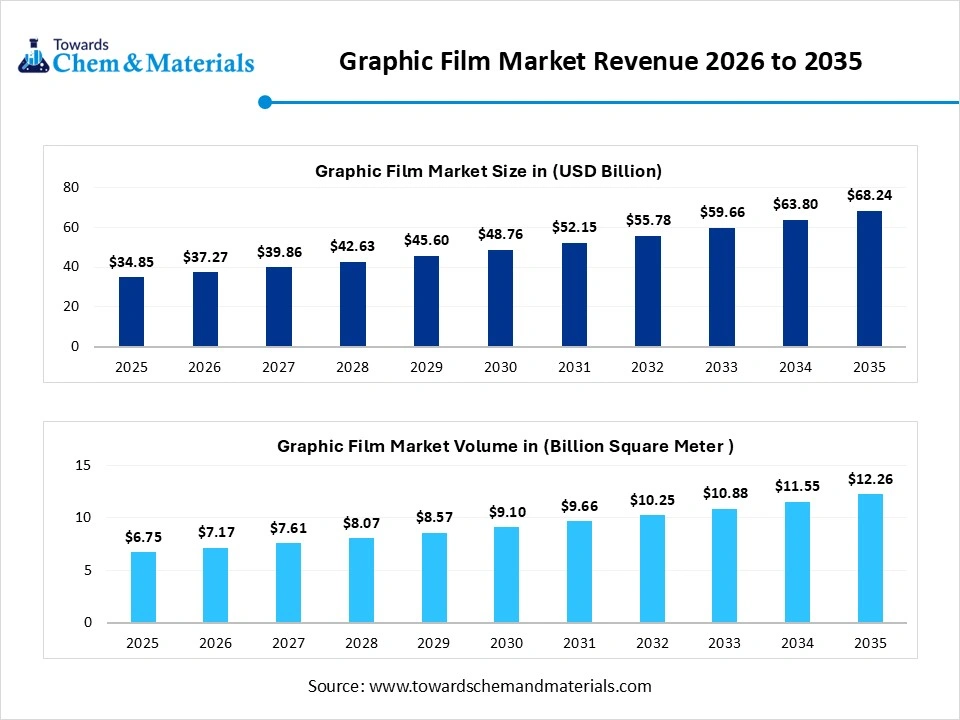
The graphic film market is expected to expand significantly from USD 37.27 billion in 2026 to USD 68.24 billion by 2035, growing at a CAGR of 6.95%. This report includes detailed market size evaluation along with segmentation data by product type, material, and application. It further highlights regional performance across major geographies and provides extensive coverage of leading companies, competitive benchmarking, value chain insights, trade analysis, and a comprehensive overview of key manufacturers and suppliers shaping the industry.
Content
Graphic Film Market Size, Share, Trends and Growth Forecast
The global graphic film market size was estimated at USD 34.85 billion in 2025 and is expected to be worth around USD 68.24 billion by 2035, exhibiting a compound annual growth rate (CAGR) of 6.95% over the forecast period from 2026 to 2035. In terms of volume the graphic film market is projected to grow from 6.75 billion square meters in 2025 to 12.26 billion square meters by 2035. growing at a CAGR of 6.15% from 2026 to 2035.The report provides a comprehensive analysis of market size along with detailed segment-wise data by film type, application, and end-use industries. It also delivers in-depth regional insights across North America, Europe, Asia-Pacific, Latin America, and the Middle East & Africa. Additionally, the study covers key company profiles, competitive landscape, value chain analysis, trade data, and detailed information on manufacturers and suppliers operating in the global market.
Key Takeaways
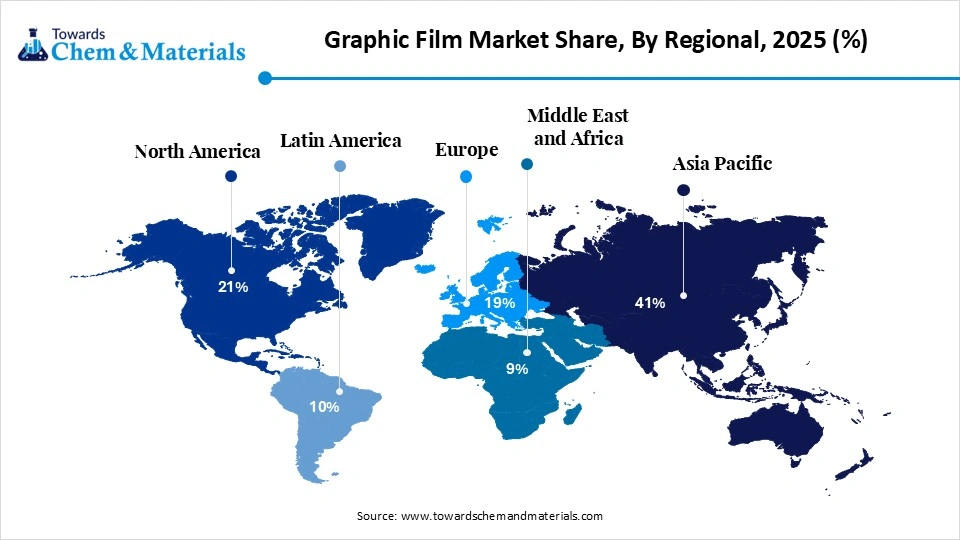
- By region, Asia Pacific dominated the market with the largest share of 41% and is expected to grow at the fastest CAGR of 7.6% over the forecast period. The dominance and growth of the region can be attributed to rapid urbanization.
- By region, North America held the second largest market share of 21% in 2025 and is expected to grow at a notable CAGR of 6.30% over the forecast period. The growth of the region can be credited to the robust need for innovative printing technologies.
- By polymer type, the Polyvinyl Chloride (PVC) segment dominated the market with the largest share of 48% in 2025. The dominance of the segment can be attributed to its high flexibility and printability.
- By polymer type, the polypropylene (PP) segment is expected to grow at the fastest CAGR of 7.1% over the forecast period. The growth of the segment can be credited to the increasing packaging crossover applications.
- By film type, the opaque films segment dominated the market with the largest share of 34% in 2025. The dominance of the segment is owed to its high visibility.
- By film type, the reflective films segment is expected to grow at the fastest CAGR of 7.2% during the projected period. The growth of the segment is due to increasing product demand.
- By application, the advertising & promotion segment dominated the market with 38% share in 2025 and is expected to grow at the fastest CAGR of 7.2% over the forecast period. The dominance and growth of the segment can be linked to the increasing demand for visual marketing.
- By end-use industry, the retail segment dominated the market with 28% share in 2025 and is expected to grow at the fastest CAGR of 7.1% during the study period. The dominance and growth of the segment can be attributed to the increasing focus on visual merchandising.
Market Size and Volume Forecast
- Market Size (2025): USD 34.85 Billion | CAGR (2026–2035): 6.95%
- Market Projected Size (2035): USD 68.24 Billion
- Market Volume (2025): 6.75 Billion Square Meters | Volume CAGR (2026–2035): 6.15%
- Market Projected Volume (2035): 12.26 Billion Square Meters
- Market Pricing (2025):
- Average Manufacturing Price: USD 3.25 per sq. meter
- Average Selling Price (ASP): USD 4.95 per sq. meter
- Pricing CAGR (2025–2035): 3.11%
What are Graphic Film Market?
The market includes polymeric sheets mainly, PP, PVC, and PE, used to print, safeguard, and display visual information on surfaces. These films are extensively used for vehicle wraps, advertising, and architectural decoration, featuring easy-to-install, pressure-sensitive, and removable properties for indoor and outdoor applications.
Graphic Film Market Trends
- The extensive usage of graphic films in vehicle wraps and custom signage is the latest trend in the market, shaping positive market growth. Graphic films are durable, which makes them crucial for storefront displays, vehicle wraps, and custom signs, which are necessary for many businesses.
- The rising demand for marketing and branding is anot her major factor driving market growth, particularly with the growing popularity of digital marketing. The surge in digital advertising underscores the demand for high-grade graphics, further fuelling the adoption of graphic films.
- Increasing investments in the R&D of manufacturing technologies and novel printing are enhancing the application scope of graphic films. Also, developments of innovative polymer films improve flexibility, durability, and adhesion across various surfaces.
How Cutting-Edge Technologies Are Revolutionizing the Graphic Film Market?
Advanced technologies are transforming the market by transitioning it from static, simple decorative coatings to sustainable, high-performance, and innovative materials. Furthermore, developments in adhesive technologies like repositionable adhesives enable bubble-free, rapid, and smooth installation, especially for complex applications such as vehicle wraps.
Trade Analysis of the Graphic Film Market: Import & Export Statistics
- In 2024-25, global printer exports reached a total value of $81.18 billion, reflecting a 2% year-on-year growth according to international trade statistics.
- China is the world's leading printer exporter, shipping $13.94 billion worth of units, a massive 17.2% share of the total industry.
Exports
- In 2025, China's photographic film exports totaled $159 million, ranking it as the country's 806th most exported product out of a total of 1,218 categories.
- In 2025, the major destinations of China's Photographic Film exports were: Chinese Taipei ($38.2M), Vietnam ($25.8M), Thailand ($25.6M), Japan ($20M), and South Korea ($12.3M).
Imports
- In 2025, photographic film ranked as China's 340th most imported product out of 1,196, with total imports valued at $530M million.
- In 2025, the prime origins of China's Photographic Film imports were: the United States ($229M), Japan ($175M), Belgium ($75.5M), South Korea ($26.4M), and Chinese Taipei ($8.76M).
- In 2024, India imported 349,130 kg of Pictures, designs, and photographs totaling $2,807.77K. Key suppliers included the UK ($898.25K, 771 kg), China ($651.46K, 293,005 kg), the United States ($382.84K, 686 kg), and Germany ($169.42K, 1,606 kg).
Graphic Film Market Supply Chain Analysis
Feedstock Procurement
It involves sourcing of essential raw materials, mainly polymer resins, needed to produce films used in signage, advertising, and vehicle wrapping. The market is heavily dependent on petroleum-based products.
- Major Players: 3M Company, Avery Dennison Corporation
Chemical Synthesis and Processing
It includes the foundational chemical engineering and material science utilized to create and refine the raw polyemers and specialized coatings that form graphic films.
- Major Players: DuPont de Nemours, Inc., BASF SE
Packaging and Labelling
It involves the use of printable, specialized, and often adhesive-backed films to wrap, seal, detect, and support products. These films provide high weather resistance and durability.
- Major Players: ORAFOL Europe GmbH, Taghleef Industries LLC
Regulatory Compliance and Safety Monitoring
The market involves adherence to strict health, environmental, and quality standards regarding the manufacturing, usage, and disposal of films, emphasizing minimizing PVC usage.
- Major Players: Hexis S.A.S.,Arlon Graphics LLC
Graphic Film Market's Regulatory Landscape: Global Regulations
| Country/Region | Key Regulations |
| Europe | Europe holds some of the most stringent environmental regulations globally. Regulations focus heavily on the prohibition of certain plastics, reduction of PVC, and strict control over waste disposal, forcing manufacturers toward eco-friendly, biodegradable, and non-toxic materials. |
| USA | EPA VOC Standards: The Environmental Protection Agency (EPA) sets national limits on VOC emissions for consumer and commercial products under 40 CFR Part 59. |
| India | BIS Certification: Manufacturers must comply with standards for specific film types, such as IS 16077 for thin films. BIS also formulates standards for sustainable packaging. |
Segmental Insights
Polymer Type Insights
Polyvinyl Chloride (PVC) Segment Dominated the Market with 48% of Market Share in 2025
The Polyvinyl Chloride (PVC) segment dominated the market with the largest share of 48% in 2025. The dominance of the segment can be attributed to its high flexibility and printability, along with the cost-effectiveness, which promotes large-scale use in advertising. In addition, its strong durability further improves its applications in various sectors.
The polypropylene (PP) segment held 10% market share in 2025 and is expected to grow at the fastest CAGR of 7.1% over the forecast period. The growth of the segment can be credited to the increasing packaging crossover applications and its better moisture resistance. Also, recyclability initiatives align well with sustainability goals.
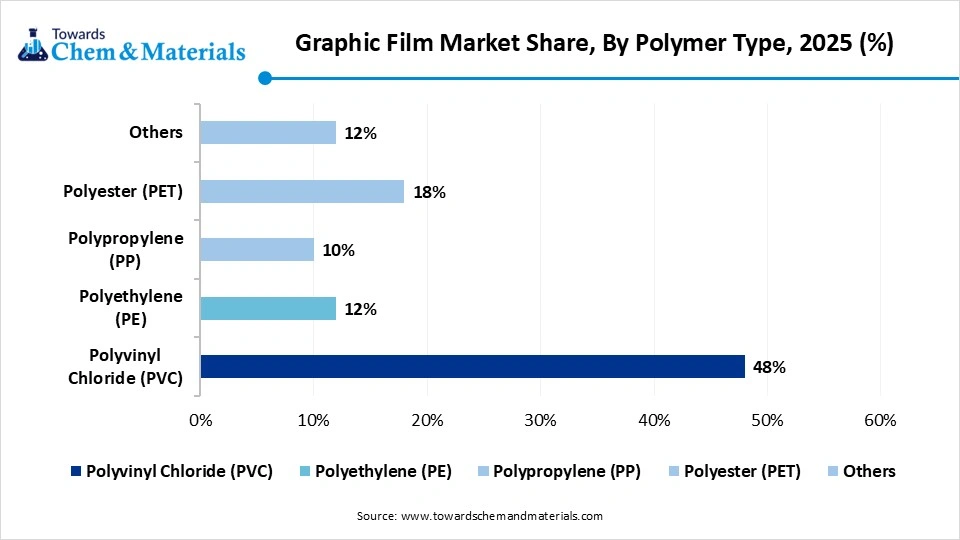
The polyester (PET) segment held the second largest share in the market of 18% in 2025. The growth of the segment can be driven by growing demand in architectural applications and its high strength and clarity, which enhance visual appeal. It is also used in premium graphics and backlit displays.
The polyethylene (PE) segment held the third largest share in the market of 12% in 2025. The growth of the segment can be linked to its growing use in eco-friendly films, and lightweight properties reduce logistics costs. The demand for polyethylene (PE) especially rises in short-term applications.
Film Type Insights
The Opaque Films Segment Dominated the Market with 34% of Market Share in 2025
The opaque films segment dominated the market with the largest share of 34% in 2025. The dominance of the segment is owed to its high visibility and strong color reproduction. It is widely used in advertising and branding. These films are cost-effective for large-scale campaigns.
The reflective films segment held the third largest share of 16% in 2025 and is expected to grow at the fastest CAGR of 7.2% during the projected period. The growth of the segment is due to increasing product demand in safety and transportation signage, coupled with the high visibility of these films. Government regulations also boost adoption.
Graphic Film Market Share, By Film Type, 2025 (%)
| By Film Type | Revenue Share, 2025 (%) |
| Opaque Films | 34% |
| Transparent Films | 22% |
| Translucent Films | 14% |
| Reflective Films | 16% |
| Specialty Films | 14% |
The transparent films segment held the second largest share in the market of 22% in 2025. The growth of the segment can be attributed to the increasing demand for window graphics and a surge in use in retail and commercial spaces. It improves aesthetics without blocking visibility.
The specialty films segment held the fourth largest share in the market of 14% in 2025. The growth of the segment can be credited to the growing demand for aesthetic, customizable and sustainable, eco-friendly films. Growing demand for fleet graphics and vehicle wraps is also a significant segment driver.
Application Insights
The Advertising & Promotion Segment Dominated the Market with 38% of Market Share in 2025
The advertising & promotion segment dominated the market with 38% share in 2025 and is expected to grow at the fastest CAGR of 7.2% over the forecast period. The dominance and growth of the segment can be linked to the increasing demand for visual marketing and the growth of digital and physical advertising campaigns. High ROI encourages brand investments shortly.
The architectural graphics segment held the second largest share in the market of 20% in 2025. The growth of the segment can be driven by rising demand for interior decoration and branding, along with the growth in commercial space. In addition, customization trends drive demand further.
Graphic Film Market Share, By Application, 2025 (%)
| By Application | Revenue Share, 2025 (%) |
| Advertising & Promotion | 38% |
| Vehicle Wraps | 18% |
| Architectural Graphics | 20% |
| Retail Graphics | 14% |
| Industrial Graphics | 10% |
The vehicle wraps segment held the third largest share in the market of 18% in 2025. The growth of the segment is owing to the increasing product utilisation in mobile advertising and rising automotive customization trends. It also offers a cost-effective branding solution for businesses.
The retail graphics wraps segment held the fourth largest share in the market of 14% in 2025. The growth of the segment is due to growth in the retail facilities, coupled with the advent of in-store branding, which improves overall customer engagement. Seasonal promotions also increase usage.
End-Use Industry Insights
The Retail Segment Dominated the Market with 28% of Market Share in 2025
The retail segment dominated the market with 28% share in 2025 and is expected to grow at the fastest CAGR of 7.1% during the study period. The dominance and growth of the segment can be attributed to the increasing focus on visual merchandising and the expansion of organized retail. Furthermore, frequent promotional campaigns increase consumption.
The automotive segment held the second largest share in the market of 17% in 2025. The growth of the segment can be credited to the rising demand for branding in fleet vehicles and increasing car ownership. Vehicle wraps and customization trends will fuel segment expansion shortly.
Graphic Film Market Share, By End-Use Industry, 2025 (%)
| By End-Use Industry | Revenue Share, 2025 (%) |
| Retail | 28% |
| Automotive | 17% |
| Construction | 16% |
| Transportation | 13% |
| Industrial | 14% |
| Media & Entertainment | 12% |
The construction segment held the third largest share in the market of 16% in 2025. The growth of the segment can be linked to the growth in commercial real estate and the ongoing boom in renovation activities. Architectural graphics enhance interior aesthetics.
The industrial segment held the fourth largest share in the market of 14% in 2025. The growth of the segment can be driven by rising demand for labelling and safety films and growth in the manufacturing sector. Durable films improve overall performance.
Regional Insights
How did Asia Pacific Dominate the Graphic Film Market in 2025?
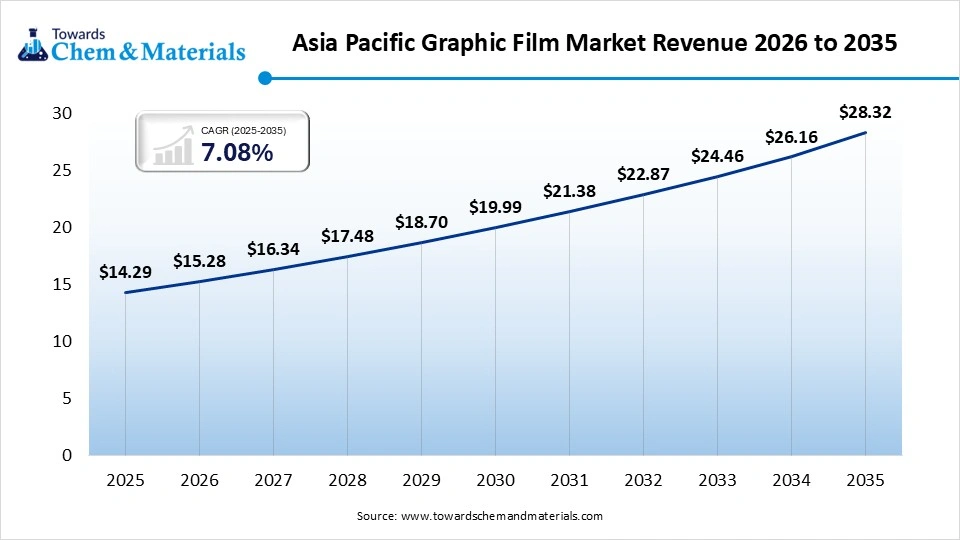
The Asia-Pacific graphic film market size was estimated at USD 14.29 billion in 2025 and is projected to reach USD 28.32 billion by 2035, growing at a CAGR of 7.08% from 2026 to 2035. Asia Pacific dominated the market with the largest share of 41% in 2025 .The dominance and growth of the region can be attributed to the rapid urbanization and retail expansion, along with the rising advertising industry in emerging economies such as China and India. In addition, the ongoing shift towards digital printing technologies is further impacting positive regional growth.
China Graphic Film Market Trends
In the Asia Pacific, China dominated the market owing to the growing consumer income and extensive use of vehicle wraps. Also, innovations in digital printing technologies are further impacting positive market growth. The surge in vehicle population in the country propels the demand for paint protection films (PPF) aimed at safeguarding exterior surfaces.
North America held the second largest market share of 21% in 2025 and is expected to grow at a notable CAGR of 6.30% over the forecast period. The growth of the region can be credited to the robust need for innovative printing technologies coupled with the presence of a strong advertising sector in the U.S. Furthermore, the increasing trend towards personalizing vehicles and utilizing company vehicles for branding is leading to market growth soon.
U.S. Graphic Film Market Trends
The growth of the market in the country is due to ongoing innovation in sustainable and eco-friendly films, along with the increasing demand for vehicle wraps/branding. Moreover, the strong presence of major market players and innovative production facilities keeps the country at the forefront of development.
Recent Developments
- In September 2025, Kodak expanded its 35mm film lineup with the quiet release of Kodacolor 100. This new addition sits alongside classics like Ektar 100, Gold 200, and the Portra series. If you're looking to snag a roll, Unique Photo already has it in stock at their New Jersey and Pennsylvania stores, said the company.
Graphic Film Market Companies
- 3M:3M is a dominant global leader in the graphic film market, renowned for high-performance cast/calendered films, durable vehicle wraps, and innovative, sustainable, non-PVC solutions.
- Avery Dennison Corporation: Avery Dennison Corporation is a global leader in the graphic film market, specializing in high-performance pressure-sensitive materials for vehicle wraps, architectural signage, and branding.
Companies in the Graphic Film Market
- Hexis S.A.S.
- Orafol Group
- Arlon Graphics LLC
- Ritrama S.p.A.
- Mactac, LLC
- Dunmore
- The Griff Network
- Spandex AG
- FDC Graphic Films Inc.
Graphic Film Market Segments Covered in the Report
By Polymer Type
- Polyvinyl Chloride (PVC)
- Monomeric PVC
- Polymeric PVC
- Cast PVC
- Polyethylene (PE)
- Polypropylene (PP)
- Polyester (PET)
- Others
- Polycarbonate (PC)
- Acrylic Films
By Film Type
- Opaque Films
- Transparent Films
- Translucent Films
- Reflective Films
- Specialty Films
- Perforated Films
- Textured Films
- Anti-Graffiti Films
By Technology
- Solvent-Based Printing
- Eco-Solvent Printing
- UV-Cured Printing
- Latex Printing
By Application
- Advertising & Promotion
- Indoor Advertising
- Outdoor Advertising
- Vehicle Wraps
- Full Wraps
- Partial Wraps
- Architectural Graphics
- Wall Graphics
- Floor Graphics
- Window Graphics
- Retail Graphics
- Industrial Graphics
By End-Use Industry
- Retail
- Automotive
- Construction
- Transportation
- Industrial
- Media & Entertainment
By Regions
- North America:
- U.S.
- Canada
- Mexico
- Rest of North America
- Latin America:
- Brazil
- Argentina
- Rest of Latin America
- Europe:
- Western Europe
- Germany
- Italy
- France
- Netherlands
- Spain
- Portugal
- Belgium
- Ireland
- UK
- Iceland
- Switzerland
- Poland
- Rest of Western Europe
- Eastern Europe
- Austria
- Russia & Belarus
- Türkiye
- Albania
- Rest of Eastern Europe
- Asia Pacific:
- China
- Taiwan
- India
- Japan
- Australia and New Zealand,
- ASEAN Countries (Singapore, Malaysia)
- South Korea
- Rest of APAC
- MEA:
-
- GCC Countries
- Saudi Arabia
- United Arab Emirates (UAE)
- Qatar
- Kuwait
- Oman
- Bahrain
- South Africa
- Egypt
- Rest of MEA
- GCC Countries
FAQ's
Question 1 : Which prime factors are stimulating the growth of the graphic film market?
Answer : Rising population, urbanization, and industrialization across the globe are the major factors driving market growth.
Question 2 : Which region dominated the graphic film market?
Answer : Asia Pacific dominated the graphic film market.
Question 3 : What are the applications of the graphic film market?
Answer : The graphic film market, valued at over $32 billion, is driven by applications in promotional advertising, automotive wraps, and interior decoration. Leading applications include high-impact vehicle wraps, storefront branding, signage, and protective, decorative films for indoor surfaces.
Question 4 : What role does the retail sector play in this market?
Answer : The retail sector is the largest end-user, driven by visual merchandising, in-store branding, and promotional campaigns, accounting for 28% of the market share in 2025.
Question 5 : What is the future outlook of the graphic film market?
Answer : The market is expected to witness steady growth, supported by technological innovation, increasing advertising demand, and expansion in emerging economies, particularly in Asia Pacific.
Meet the Team

Saurabh Bidwai
Principal Consultant
Saurabh Bidwai, a B.Tech Chemical Engineering graduate with 4+ years of experience, specializes in specialty chemicals, commodity chemicals, and engineered materials, offering valuable insights into market trends and emerging opportunities.

Aditi Shivarkar
Reviewed By
Aditi Shivarkar, with 14+ years in Chemical and Materials market research, specializes in Chemical and Materials. She ensures accurate, actionable insights, driving Towards Chemicals And Materials Analytics and Consulting excellence in industry trends and sustainability.