
Hexylene Glycol (HG) Market Trends, Sales Volume, Production Cost, Fulfillment Cycle Time, Export & Import Flows, Pricing Metrics, Recycling Rate, Adoption Rates, and Distribution Performance
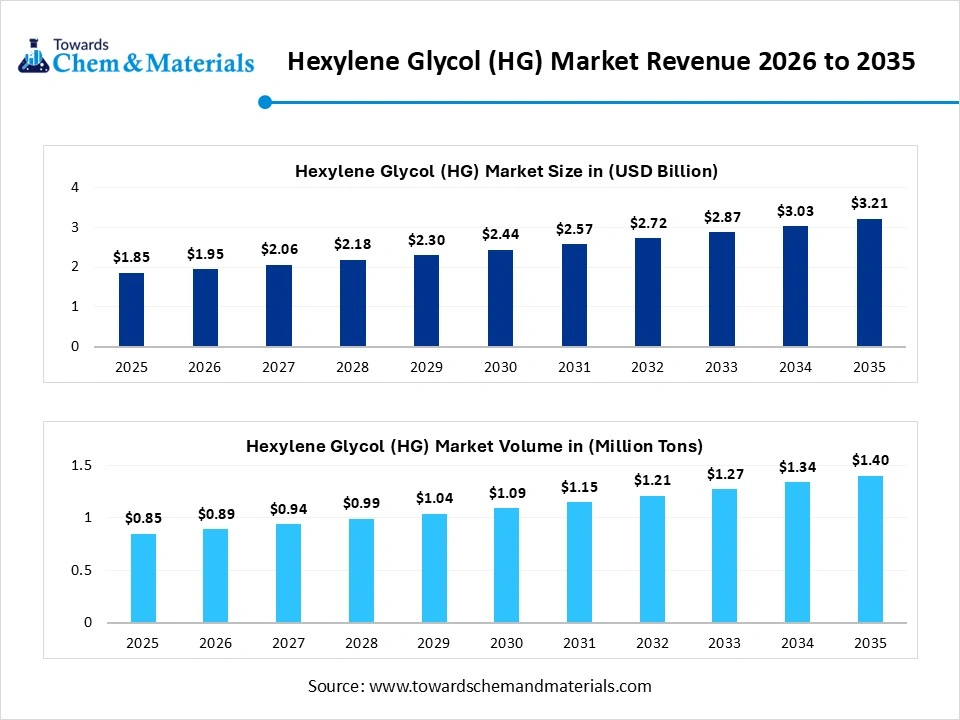
The hexylene glycol (HG) market is witnessing steady growth, increasing from USD 1.85 billion in 2025 to an estimated USD 3.21 billion by 2035, driven by a CAGR of 5.65%. Volume consumption is forecasted to rise from 0.85 million tons to 1.4 million tons at a CAGR of 5.15%. The study covers detailed segmentation, regional performance, company analysis, competitive dynamics, trade statistics, and value chain evaluation along with insights into major producers and suppliers.
Content
Hexylene Glycol (HG) Market Growth, Innovations and Market Size Forecast
The global hexylene glycol (HG) market size was estimated at USD 1.85 billion in 2025 and is expected to be worth around USD 3.21 billion by 2035, growing at a CAGR of 5.65% from 2026 to 2035. In terms of volume, the hexylene glycol (HG) market is projected to grow from 0.85 million tons in 2025 to 1.4 million tons by 2035. growing at a CAGR of 5.15% from 2026 to 2035.
Key Takeaways
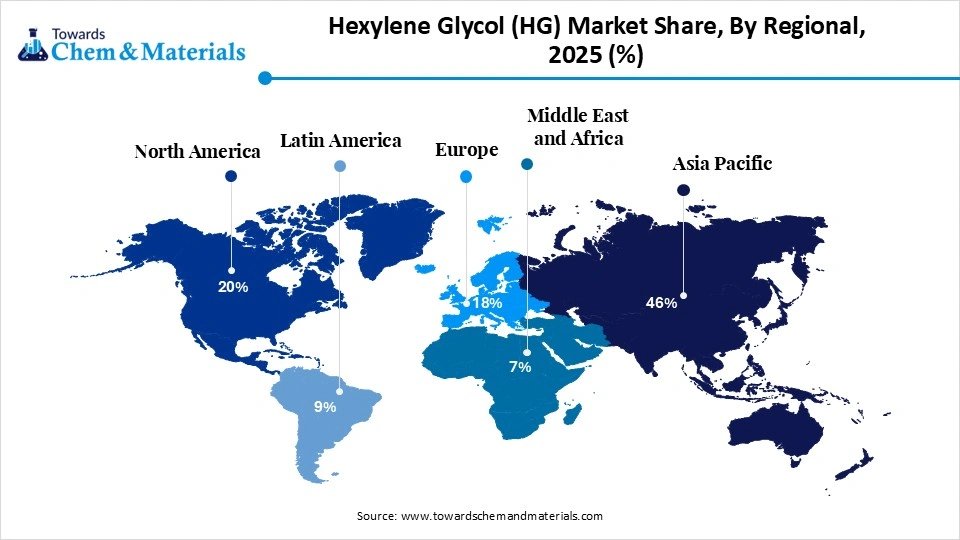
- By region, Asia Pacific dominated the market with the largest share of 46% in 2025 and is expected to grow at the fastest CAGR of 6.40% over the forecast period.
- By region, North America held the market share of 20% in 2025.
- By grade, the industrial grade segment dominated the market with the largest share of 54% in 2025.
- By grade, the cosmetic grade segment is expected to grow at the fastest CAGR of 6.20% over the forecast period.
- By application, the solvent segment dominated the market with the largest share of 36% in 2025.
- By application, the humectant segment is expected to grow at the fastest CAGR of 6.40% over the forecast period.
- By end-use industry, the paints & coatings segment dominated the market with the largest share of 32% in 2025.
- By end-use industry, the personal care & cosmetics segment is expected to grow at the fastest CAGR of 6.50% during the forecast period.
- By distribution channel, the direct sales segment dominated the market with the largest share of 45% in 2025.
- By distribution channel, the online sales segment is expected to grow at the fastest CAGR of 6.60% during the projected period.
Market Size and Volume Forecast
- Market Estimated Size (2026): USD 1.95 Billion | CAGR (2026–2035): 5.65%
- Market Projected Size (2035): USD 3.21 Billion
- Market Volume (2025): 0.85 Million Tons (MT) | Volume CAGR (2026–2035): 5.15%
- Market Projected Volume (2035): 1.40 Million Tons (MT)
- Market Pricing (2025):
- Average Manufacturing Price: USD 1,489/ton
- Average Selling Price: USD 1,955/ton
- Pricing CAGR (2025–2035): 3.10%
What Is Hexylene Glycol (HG) Market?
The market encompasses the manufacturing, distribution, and sale of 2-Methyl-2,4-pentanediol, a diverse colorless solvent mainly used in cosmetics, paints, coatings, and industrial cleaning. It is an oxygenated solvent derived from acetone, known for its capability to dissolve an extensive range of substances and its complete miscibility with water.
Recent Market Trends
- The ongoing transition towards low-VOC and waterborne coatings formulations is the latest trend in the market, shaping positive market growth. HG, with its efficient film formation ability at low addition levels, regulatory acceptance, and biodegradable profile under major standards, has emerged as a favoured solvent in many applications.
- The pharmaceutical industry's increasing manufacturing of semisolid, topical, and transdermal drug delivery systems is creating lucrative demand for high-grade hexylene glycol. HG works as a co-solvent and skin penetration enhancer in topical formulations like creams, gels, patches, and ointments.
- Technological innovations, like developments in process automation and green chemistry, have improved the sustainability and efficiency of HG production. Furthermore, advancements in AI and ML are transforming R&D by boosting the speed of formulation process and ensuring new products comply with changing regulations.
Report Scope
| Report Attribute | Details |
| Market Size and Volume in 2026 | USD 1.95 Billion / 0.85 Million Metric Tons |
| Expected Size and Volume by 2035 | USD 3.21 Billion / 1.4 Million Metric Tons |
| Growth Rate from 2026 to 2035 | CAGR 5.65% |
| Forecast Period | 2026 - 2035 |
| Dominant Region | Asia Pacific |
| Segment Covered | By Grade, By Application, By End-Use Industry, By Distribution Channel and By Region |
| Key companies profiled | BASF SE, Solvay S.A., LyondellBasell Industries, Arkema Group, Huntsman Corporation, Monument Chemical, INEOS Oxide, KH Neochem, Prasol Chemicals |
How Cutting-Edge Technologies Are Revolutionizing the Hexylene Glycol (HG) Market?
Advanced technologies are revolutionizing the market by optimizing bio-based and sustainable production methods, along with improving industrial efficiency. Furthermore, the growing adoption of cutting-edge catalysts enables HG production in low-cost equipment, rather than costly slurry reactors, using much lower hydrogen pressure for cost-effective synthesis.
Supply Chain Analysis of Hexylene Glycol (HG) Market
Feedstock Procurement
It involves acquiring acetone and hydrogen, which are then processed via hydrogenation to produce this specialized diol.
- Major Players: BASF SE, Solvay S.A.
Chemical Synthesis and Processing
It refers to both the industrial manufacturing of the compound itself and its secondary use as a building block for other specialty chemicals.
- Major Players: Arkema S.A, Solvay S.A.
Packaging and Labelling
It is crucial for maintaining product stability, ensuring safety, and compliance during transport with international chemical regulations like the Global Harmonized System (GHS).
- Major Players: Arkema Group, Monument Chemicals, Inc.
Regulatory Compliance and Safety Monitoring
It emphasises adhering to stringent safety, environmental, and health standards enforced by agencies such as the EPA, OSHA, and the FDA.
- Major Players: Solventis Ltd, Monument Chemicals, Inc.
Hexylene Glycol (HG) Market's Regulatory Landscape: Global Regulations
| Country/Region | Key Regulations |
| European Union (EU) | CLP Classification: Under the Classification, Labelling and Packaging (CLP) Regulation, it is classified as an Eye Irritation Category 2 and Skin Irritation Category 2. |
| United States | FDA Status: Authorized for use in specific Food Contact Substances (indirect additives) as outlined in 21 CFR parts 175-178, depending on identity and conditions of use |
| China | Subject to the Regulations on Safe Management of Hazardous Chemicals (China GHS), which mandates precise labeling and SDS updates. Cosmetic applications are strictly governed by the Cosmetic Supervision and Administration Regulation (CSAR), implemented in 2021. |
Market Dynamics
Driver
Increasing Demand from the Specialty Chemicals Industry
Hexylene glycol's structural properties and reactivity make it a crucial building block for the synthesis of a wide range of specialty chemicals, such as HG acetals, HG esters, and HG-based surfactants. The speciality chemical sector is witnessing a structural growth driven by advancements in various sectors.
Restraints
High Costs
The high costs associated with bio-based synthesis routes, which currently lag behind conventional petrochemical processes, are the major factor hindering market growth. Moreover, operational limitations such as the demand for specialized handling and storage because of chemical stability concerns constrain broader applications in various regions.
Opportunity
Growth of Supply Chain Capabilities
The heavy investments in regional manufacturing hubs, particularly in the Middle East and Asia, to minimize reliance on single-source suppliers, are creating lucrative opportunities in the market. Technological innovations in manufacturing facilities, such as real-time monitoring and automation, are enhancing yield, quality, and cost-efficiency.
Segmental Insights
Grade Insights
The Industrial Grade Segment Dominated the Market with 54% of Market Share in 2025
The industrial grade segment dominated the market with the largest share of 54% in 2025. The dominance of the segment can be attributed to its extensive use in coatings, paint, and industrial solvents, along with the growing construction and manufacturing sectors. Cost-effectiveness supports large-scale industry adoption.
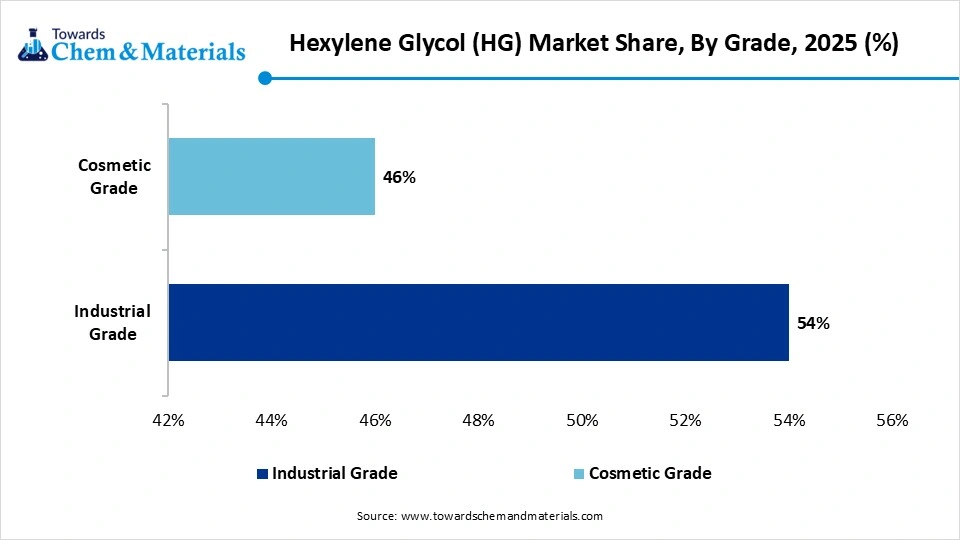
The cosmetic grade segment held the market share of 46% in 2025 and is expected to grow at the fastest CAGR of 6.20% over the forecast period. The growth of the segment can be credited to the increasing product demand in personal care and skin care formulations. Its humectant properties enhance overall product performance. Growing consumer focus on cosmetics drives adoption further.
Application Insights
The Solvent Segment Dominated the Market with 36% of Market Share in 2025
The solvent segment dominated the market with the largest share of 36% in 2025. The dominance of the segment can be linked to its extensive use in paints and coatings, along with its compatibility with various formulations. Industrial expansion further supports solvent consumption.
Hexylene Glycol (HG) Market Share, By Application, 2025 (%)
| By Application | Revenue Share, 2025 (%) |
| Solvent | 36% |
| Chemical Intermediate | 21% |
| Humectant | 19% |
| Cleaning Agent | 14% |
| Others | 10% |
The humectant segment held the market share of 19% in 2025 and is expected to grow at the fastest CAGR of 6.40% over the forecast period. The growth of the segment can be driven by increasing demand in personal care and cosmetics, coupled with the expanding personal care sector. Its moisture retention properties enhance product value.
The chemical intermediate segment held the market share of 21% in 2025. The growth of the segment is owing to its increasing use in resins and platiziers coupled with the growth of the polymer industry. Application in chemical synthesis will boost steady segment growth soon.
End-Use Industry Insights
The Paints & Coatings Segment Dominated the Market with 32% of Market Share in 2025
The paints & coatings segment dominated the market with the largest share of 32% in 2025. The dominance of the segment is due to expansion in the construction and infrastructure sector and industrial growth. Coatings formulations need efficient solvents, leading to segment growth.
Hexylene Glycol (HG) Market Share, By End-Use Industry, 2025 (%)
| By End-Use Industry | Revenue Share, 2025 (%) |
| Paints & Coatings | 32% |
| Personal Care & Cosmetics | 26% |
| Pharmaceuticals | 12% |
| Chemicals | 15% |
| Industrial Cleaning | 9% |
| Others | 6% |
The personal care & cosmetics segment held the market share of 26% in 2025 and is expected to grow at the fastest CAGR of 6.50% during the forecast period. The growth of the segment can be attributed to the increasing consumer spending on grooming products and product innovations. The expanding beauty sector will drive market growth soon.
The chemicals segment held the market share of 15% in 2025. The growth of the segment can be credited to its growing integration in chemical synthesis and versatility. Industrial product growth supports market growth in the foreseeable future.
Distribution Channel Insights
The Direct Sales Segment Dominated the Market with 45% of Market Share in 2025
The direct sales segment dominated the market with the largest share of 45% in 2025. The dominance of the segment can be linked to the stronger supplier relationships and bulk purchasing to ensure supply stability. Large buyers are increasingly preferring direct procurement for cost benefits.
Hexylene Glycol (HG) Market Share, By Distribution Channel, 2025 (%)
| By Distribution Channel | Revenue Share, 2025 (%) |
| Direct Sales | 45% |
| Distributors & Wholesalers | 35% |
| Online Sales | 20% |
The online sales segment held the market share of 20% in 2025 and is expected to grow at the fastest CAGR of 6.60% during the projected period. The growth of the segment can be driven by ongoing expansion in the e-commerce industry and increasing procurement by digital platforms for convenience. Price transparency further attracts many buyers.
The distributors & wholesalers segment held the market share of 35% in 2025. The growth of the segment is owing to the presence of extensive distribution networks across emerging regions and regional expansion. SME's relay more on intermediates to boost segment growth soon.
Regional Insights
How did Asia Pacific Dominate the Hexylene Glycol (HG) Market in 2025?
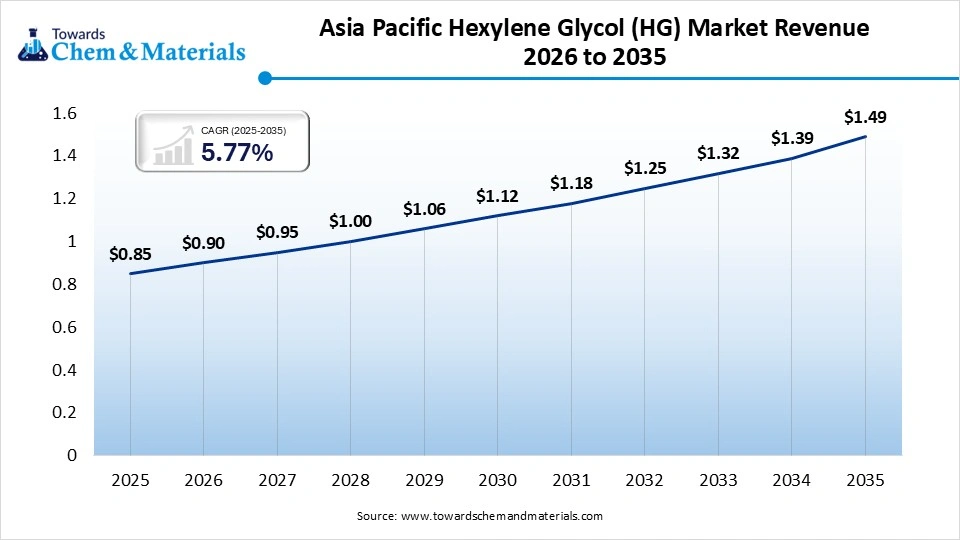
The Asia Pacific hexylene glycol (HG) market size was estimated at USD 0.85 billion in 2025 and is projected to reach USD 1.49 billion by 2035, growing at a CAGR of 5.77% from 2026 to 2035. The dominance and growth of the region can be attributed to the surge in manufacturing activities across emerging economies, along with rapid urbanisation. In addition, increasing consumer awareness about personal grooming and health is fuelling demand for products necessitating hexylene glycol.
China Hexylene Glycol (HG) Market Trends
In the Asia Pacific, China dominated the market owing to the surge in construction projects in the country, along with the rapid technological innovations in the manufacturing process. Also, China serves as a leading production hub for different end-use industries, such as chemicals and cleaning products, which sustains high demand for hexylene glycol.
North America held the market share of 20% in 2025. The growth of the segment can be credited to the increasing product demand from the personal care, cosmetics, and industrial coatings sectors. Furthermore, the region has a robust competitive landscape with leading market players established with manufacturing facilities and cutting-edge distribution networks.
U.S. Hexylene Glycol (HG) Market Trends
The growth of the market in the country is due to increasing demand for high-performance coatings, especially in the construction industry, coupled with ongoing technological and product innovation. Moreover, the country is a hub for state-of-the-art drug manufacturing. HG is used as a high-purity solvent in drug synthesis and topical dermatological formulations.
Recent Development
- In February 2026, BASF officially announced the expansion of its pharmaceutical grade Neopentylglycol (NPG) production at the Ludwigshafen Verbund site. This investment increases capacity for high-purity glycol grades, specifically addressing the rising demand within European and North American pharmaceutical excipient markets.
Hexylene Glycol (HG) Market Company
- BASF SE: BASF SE is a leading global producer in the hexylene glycol (HG) market, dictating pricing trends and innovation roadmaps alongside other major industry players. The company leverages integrated production capabilities to supply HG for various industrial applications, including cosmetics, pharmaceuticals, and paints and coatings.
- Solvay S.A.: Solvay S.A. is a prominent global producer and supplier in the Hexylene Glycol (HGL) market, recognized for its focus on high-purity chemicals and sustainable formulation solutions.
Hexylene Glycol (HG) Market Companies in the Market
- LyondellBasell Industries
- Arkema Group
- Huntsman Corporation
- Monument Chemical
- INEOS Oxide
- KH Neochem
- Prasol Chemicals
Hexylene Glycol (HG) Market Segments Covered in the Report
By Grade
- Industrial Grade
- Cosmetic Grade
- Personal Care Grade
- Pharmaceutical Grade
By Application
- Solvent
- Paints & Coatings
- Printing Inks
- Chemical Intermediate
- Plasticizers
- Resins
- Humectant
- Skincare Products
- Haircare Products
- Cleaning Agent
- Industrial Cleaning
- Surface Cleaning
- Others
By End-Use Industry
- Paints & Coatings
- Personal Care & Cosmetics
- Pharmaceuticals
- Chemicals
- Industrial Cleaning
- Others
By Distribution Channel
- Direct Sales
- Distributors & Wholesalers
- Online Sales
By Region
- North America:
- U.S.
- Canada
- Mexico
- Rest of North America
- Latin America:
- Brazil
- Argentina
- Rest of Latin America
- Europe:
- Western Europe
- Germany
- Italy
- France
- Netherlands
- Spain
- Portugal
- Belgium
- Ireland
- UK
- Iceland
- Switzerland
- Poland
- Rest of Western Europe
- Eastern Europe
- Austria
- Russia & Belarus
- Türkiye
- Albania
- Rest of Eastern Europe
- Asia Pacific:
- China
- Taiwan
- India
- Japan
- Australia and New Zealand,
- ASEAN Countries (Singapore, Malaysia)
- South Korea
- Rest of APAC
- MEA:
- GCC Countries
- Saudi Arabia
- United Arab Emirates (UAE)
- Qatar
- Kuwait
- Oman
- Bahrain
- South Africa
- Egypt
- Rest of MEA
- GCC Countries
FAQ's
Question 1 : What Is the Hexylene Glycol (HG) Market and What Does It Include?
Answer : The Hexylene Glycol (HG) market covers the production, distribution, and commercialization of 2-Methyl-2,4-pentanediol, a versatile solvent used across cosmetics, paints, coatings, pharmaceuticals, and industrial cleaning applications. It includes raw material sourcing, chemical processing, and downstream applications.
Question 2 : What Is the Current and Projected Market Size of the Hexylene Glycol Market?
Answer : The global market was valued at USD 1.85 billion in 2025 and is projected to reach USD 3.21 billion by 2035, growing at a CAGR of 5.65%. In volume terms, it is expected to increase from 0.85 million tons to 1.4 million tons during the same period.
Question 3 : What Are the Key Growth Drivers of the Hexylene Glycol Market?
Answer : Major growth drivers include increasing demand from the specialty chemicals sector, rising use in personal care and cosmetics, expanding paints and coatings industry, and growing pharmaceutical applications such as topical drug formulations.
Question 4 : What Are the Major Trends Shaping the Hexylene Glycol Market?
Answer : Key trends include the shift toward low-VOC and waterborne coatings, rising demand for eco-friendly solvents, increased use in skincare formulations, and adoption of green chemistry and AI-driven process optimization in production.
Question 5 : Which Region Dominates the Hexylene Glycol Market and Why?
Answer : Asia Pacific dominates the market with a 46% share in 2025, driven by rapid industrialization, strong manufacturing base, expanding construction sector, and increasing consumer demand for personal care products.
Meet the Team

Saurabh Bidwai
Principal Consultant
Saurabh Bidwai, a B.Tech Chemical Engineering graduate with 4+ years of experience, specializes in specialty chemicals, commodity chemicals, and engineered materials, offering valuable insights into market trends and emerging opportunities.

Aditi Shivarkar
Reviewed By
Aditi Shivarkar, with 14+ years in Chemical and Materials market research, specializes in Chemical and Materials. She ensures accurate, actionable insights, driving Towards Chemicals And Materials Analytics and Consulting excellence in industry trends and sustainability.