
High-Performance Pigments Market Size, Share, Growth, Report 2026 to 2035
The global high-performance pigments market report is segmented based on Product, Application, and End-Use Industry. By Product, the market is classified into Organic and Inorganic. By Application, it is categorized into Coating, Plastics, Printing Inks, Cosmetics, and Other. By End-Use Industry, the segmentation includes Automotive, Construction, Packaging, Consumer Goods, Electronics, Textile, Cosmetics & Personal Care, and Others-Global Industry Analysis, Size, Trends, Leading Companies, Regional Outlook, and Forecast 2026 to 2035
Content
What is the High-Performance Pigments Market Size and Share?
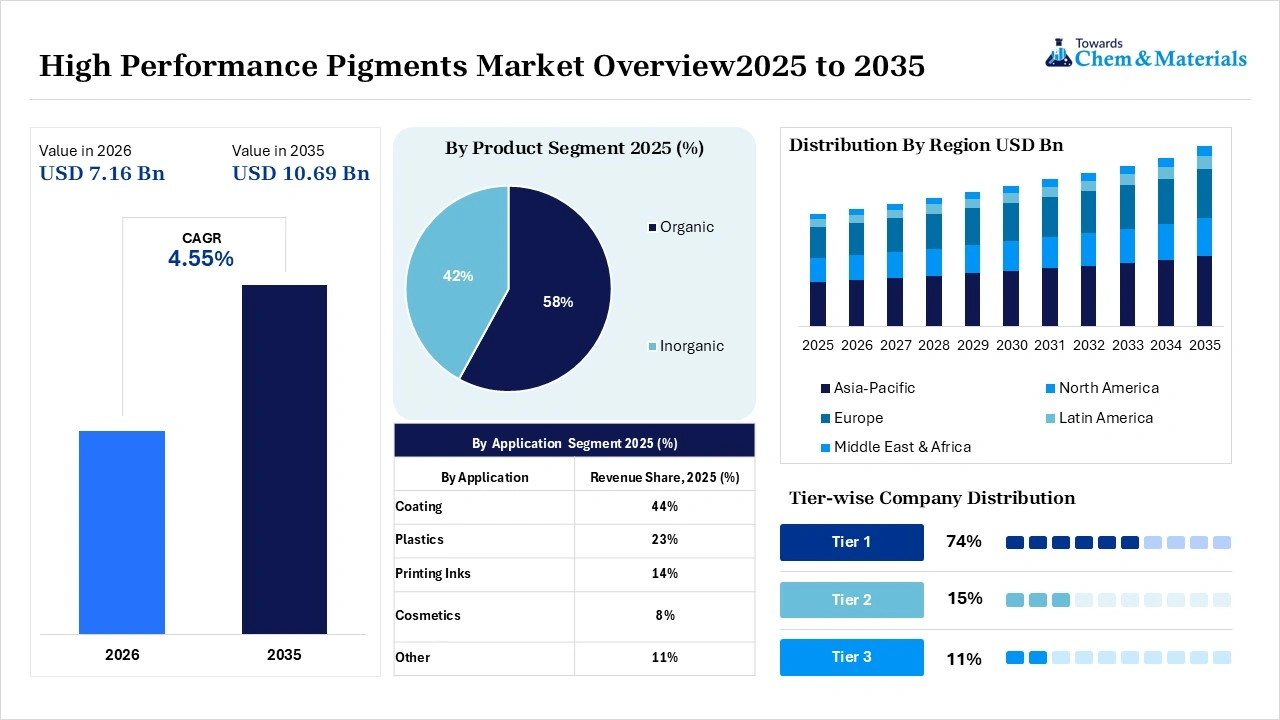
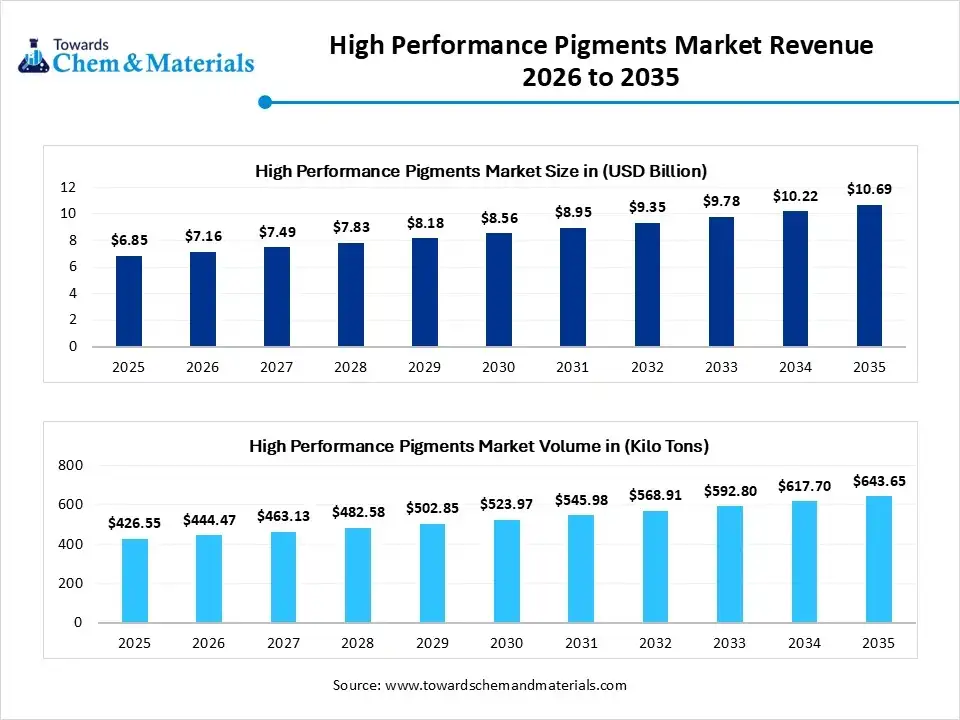
The high-performance pigments market size was valued at USD 6.85 billion in 2025, is estimated to reach USD 7.16 billion in 2026, and is projected to reach USD 10.69 billion by 2035, exhibiting a compound annual growth rate (CAGR) of 4.55% over the forecast period from 2026 to 2035.Asia Pacific dominated the high-performance pigments market with the largest revenue share of 39% in 2025 and is expected to grow at the fastest CAGR of 4.68% during the forecast period. In terms of volume, the high-performance pigments market is projected to grow from 426.55 kilo tons in 2025 to 643.65 kilo tons by 2035. growing at a CAGR of 4.20% from 2026 to 2035.The growth of the market is driven by the superior chemical resistance, thermal stability, and sustainability.
The market for high-performance pigments is vital because it supplies colorants with exceptional durability, heat resistance, chemical resistance, and lightfastness, outperforming standard pigments. These qualities help products maintain their visual appeal, color, and protective functions even under harsh environmental conditions over extended periods. high-performance pigments are crucial for automotive OEM and refinish coatings, providing weatherability and UV resistance to ensure car finishes endure extreme climates and retain a high-gloss appearance.In electronics, such as touch screens and LCDs, high-performance plastics rely on high-performance pigments for color stability, while industrial machinery uses them for heat-resistant coatings. The market is increasingly shifting toward eco-friendly organic high-performance pigments, driven by stringent regulations in Europe and North America, prompting manufacturers to develop bio-based pigments that reduce toxicity while offering superior brightness and gloss.
Market Highlights
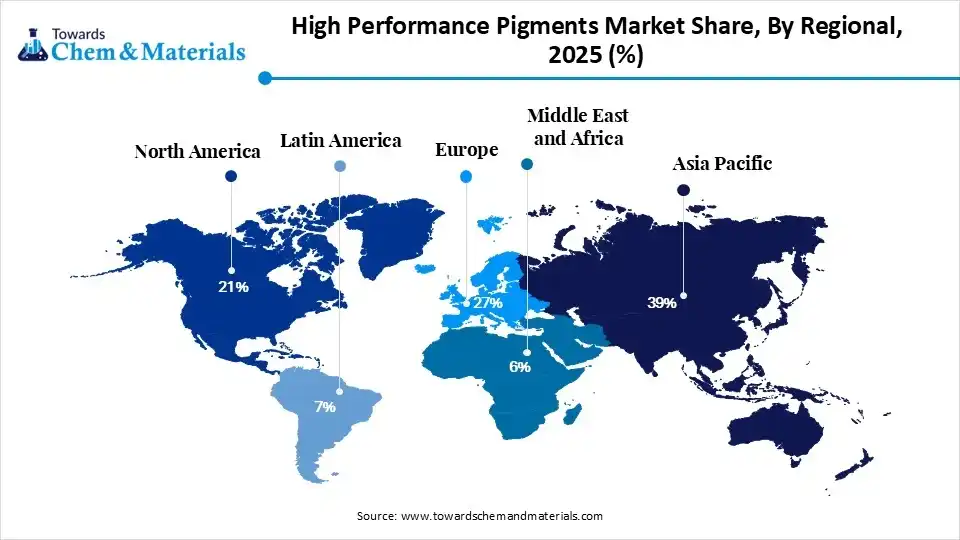
- By region, Asia Pacific dominated the market with a share of 39% in 2025 and is expected to sustain its position while growing with a CAGR of 5.70% in the forecast period. Strong manufacturing base supports demand.
- By region, Europe held 27% market share in 2025. The established coatings industry supports consumption.
- By product, the organic segment dominated the market with 58% share in 2025. Rising demand for bright shades in automotive coatings.
- By product, the inorganic segment held 42% market share in 2025 and is expected to have the fastest growth with a CAGR of 5.20% in the forecast period. Strong demand in construction coatings.
- By application, the coating segment dominated the market with 44% share in 2025. Automotive and industrial coating demand continues to expand.
- By application, the cosmetics segment held 8% market share in 2025 and is expected to have the fastest growth with a CAGR of 5.80% in the forecast period. Premium beauty products require color stability.
- By end-use industry, the automotive segment dominated the market with 28% share in 2025. Vehicle production growth increases pigment demand.
- By end-use industry, the electronics segment held 8% market share in 2025 and is expected to have the fastest growth with a CAGR of 5.90% in the forecast period. Growth of displays and electronic devices.
Quick Stats at a Glance
- Market Estimated Size (2025): USD 6.85 Billion | CAGR (2026–2035): 4.55%
- Market Projected Size (2035): USD 10.69 Billion
- Asia Pacific: largest Market Revenue Share of 39% in 2025|USD 2.67 Billion
- Market Estimated Volume (2025): 426.55 Kilo Tons| Volume CAGR (2026–2035): 4.20%
- Market Projected Volume (2035): 426.55 Kilo Tons
- Market Pricing (2025):
- Average Manufacturing Price (2025):USD 12.86/kg
- Average Selling Price (2025): USD 16.50/kg
- Pricing CAGR (2026–2035): 2.85%
The Coatings represent the largest revenue segment of the high-performance pigments market, largely fueled by recovery in the global construction and automotive industries. The competitive landscape features specialty chemical giants like BASF, DuPont, Solvay, Evonik, and specialty manufacturers such as Trust Chem and Lansco Colors, all focusing heavily on R&D to ensure consistent color quality and innovative chemistries.
Moreover, major brands are seeking product longevity and material resilience; by fulfilling their demands, high-performance pigments gained major market traction over the years. Also, the need for lightweight material in automotive industries is heavily contributing to industry growth as automakers are seen in heavy usage of plastic, which is made up of high-performance plastic in the current period.
The expansion of the construction and infrastructure industry is driving the high-performance pigments market in the current period. The need for aesthetic appeal and durable materials are heavily contributing to the growth of the market. High-performance pigments are used in the architectural coatings for resisting fading in upcoming years, and these properties of HPP have gained market attraction in the construction industry nowadays.Moreover, several developers are suing high-performance pigment for the exterior application owing to its excellent weather.
High-Performance Pigments Market Trends
- Automotive & Transportation: Lightweighting in automotive manufacturing requires robust, heat-resistant plastic components, which drives significant high-performance pigments consumption.
- Industrial Coatings: Rapid urbanization and infrastructure development in emerging economies fuel the need for high-end industrial paints and finishes.
- Electronics & Packaging: Growing demand for consumer electronics and UV-curable printing inks necessitates pigments that can withstand heat and chemical exposure.
High-Performance Pigments Market Report Scope
| Report Attributes | Details |
| Market Size and Volume in 2026 | USD 7.16 Billion / 444.47 Kilo Tons |
| Revenue Forecast in 2035 | USD 10.69 Billion / 643.65 Kilo Tons |
| Growth Rate | CAGR 4.55% |
| Base Year of Estimation | 2025 |
| Forecast Period | 2025 - 2035 |
| High Impact Region | Europe |
| Segment Covered | By Product, By Application, By End-Use Industry, By Region |
| Key Companies Profiled | Sun Chemical Corporation, Clariant AG, Lanxess AG, Heubach GmbH, BASF SE, Trust Chem Co., Ltd., DIC Corporation, Ferro Corporation / Vibrantz Technologies, Sudarshan Chemical Industries Ltd., Merck KGaA, Venator Materials PLC, Cathay Industries, Altana AG, Synthesia a.s., Toyo Ink SC Holdings Co., Ltd., Chromaflo Technologies, Flint Group, Sensient Cosmetic Technologies, Lomon Billions Group, Eckart GmbH / Altana, Vibfast Pigments Pvt. Ltd., Yipin Pigments Co., Ltd., Cabot Corporation, Atul Ltd., Pidilite Industries Limited |
Key Technological Shifts in the High-Performance Pigments Market:
Technological advancements are revolutionizing the High-Performance Pigments market, transitioning it toward ultra-high-performance pigments. Driven by the automotive, aerospace, and construction sectors. Innovations like IR-reflective and thermochromic pigments minimize heat absorption in buildings and vehicles, improving energy efficiency. Growing regulatory compliance, like REACH, and demand for low-VOC products drive the shift toward bio-based, non-toxic pigments to replace hazardous traditional variants like lead chromate.
High-Performance Pigments Market Regulatory Landscape
| Country / Region | Regulatory Body | Key Regulations | Focus Areas | Notable Notes |
| United States | Environmental Protection Agency (EPA); Occupational Safety and Health Administration (OSHA); Food and Drug Administration (FDA) | Toxic Substances Control Act (TSCA); OSHA Hazard Communication Standards | Chemical safety, emissions control, specialty pigments | The U.S. regulates pigment formulations for environmental safety and promotes advanced pigments for automotive, coatings, and plastics applications. |
| European Union | European Chemicals Agency (ECHA); European Commission | REACH Regulation; RoHS Directive; CLP Regulation | Hazardous substance restriction, sustainable chemicals | Europe strongly emphasizes environmentally compliant and heavy metal-free pigment technologies. |
| China | Ministry of Ecology and Environment (MEE); Ministry of Industry and Information Technology (MIIT) | Environmental Protection Law; Green Manufacturing Policies | Low-emission pigment production, industrial sustainability | China is expanding high-performance pigment manufacturing while strengthening environmental compliance standards. |
| India | Central Pollution Control Board (CPCB); Bureau of Indian Standards (BIS) | Chemical Safety Regulations; Industrial Emission Standards | Specialty chemicals, industrial coatings | India is witnessing increasing demand for high-performance pigments in paints, plastics, and printing applications. |
| Germany | Federal Environment Agency (UBA); German Chemical Industry Association (VCI) | REACH Compliance; Sustainable Manufacturing Standards | Eco-friendly pigments, industrial coatings | Germany is a major hub for advanced pigment innovation and sustainable specialty chemical manufacturing. |
Supply Chain Analysis of High-Performance Pigments Market
- Pigment Production & Processing:High-performance pigments are produced through advanced organic and inorganic synthesis processes to provide superior color strength, heat stability, chemical resistance, and weather durability for demanding industrial applications.
- Key players: BASF, Clariant, DIC Corporation, Heubach Group.
- Quality Testing and Certification:High-performance pigments must comply with standards for color consistency, lightfastness, thermal stability, toxicity control, and environmental safety before industrial uses.
- Key players: International Organization for Standardization, ASTM International, European Chemicals Agency, U.S. Environmental Protection Agency
- Distribution to Industrial Users:High-performance pigments are supplied to plastics producers, automotive coatings manufacturers, construction materials industries, printing ink companies, and cosmetics manufacturers.
- Key players: BASF, Clariant, DIC Corporation.
High-Performance Pigments Market Dynamics
| Drivers | Restrains | Opportunities |
| Superior Technical Performance:HPPs outperform traditional pigments by offering exceptional resistance to UV light, high temperatures, chemicals, and natural degradation. | Strict Environmental and Regulatory Compliance:The chemical synthesis of HPPs is often associated with toxic byproducts and hazardous waste. Stringent global regulations, such as REACH in Europe and similar toxic control acts globally, restrict the use of certain heavy-metal-based HPPs. | Sustainability & Eco-Friendly Alternatives:Increasing consumer and regulatory pressure is pushing manufacturers to develop bio-based and non-toxic high-performance pigments. Strict environmental standards are expanding the need for eco-friendly compliant options in premium inks, paints, and packaging. |
| Eco-friendly and Sustainable Solutions:Stricter environmental regulations and shifting consumer preferences are accelerating the shift toward bio-based, sustainable, and low-VOC pigment formulations. | Raw Material Volatility:The production of specialty pigments relies heavily on volatile commodity markets and specialized petrochemicals. Geopolitical disruptions, supply chain bottlenecks, and sudden spikes in raw material and energy prices cause continuous production delays and profit margin compressions. | Electronics & Smart Pigments:Integrating technology into pigments such as heat-reflective coatings and functional smart pigments for consumer electronics and displays offers high-profit margins. |
| Personal Care and Cosmetics:The growth of the global personal care industry directly increases the utilization of safe, high-purity, and FDA-approved specialty pigments for luxury cosmetics and premium packaging inks. | Shortage of Skilled Labor:A lack of specialized professionals in these fields slows down new product innovation and delays speed-to-market for emerging pigment grades. | Automotive & Aerospace Coatings:Rising vehicle production and the demand for premium, weather-resistant, and UV-protected finishes are major drivers. Advanced HPPs provide superior heat and light resistance required to protect metal and plastic parts in extreme environments. |
Segmental Insights
Product Insights
The Organic Segment Dominated the Market With 58% Market Share In 2025
The organic segment dominated the market with 58% share in 2025, driven by a strong global shift toward sustainability, eco-friendly manufacturing, and rising demand for vibrant, non-toxic colorants. Organic high-performance pigments are synthesized from carbon-based molecules and offer an eco-friendlier alternative to inorganic pigments, which often contain heavy metals like lead, cadmium, and chromium.
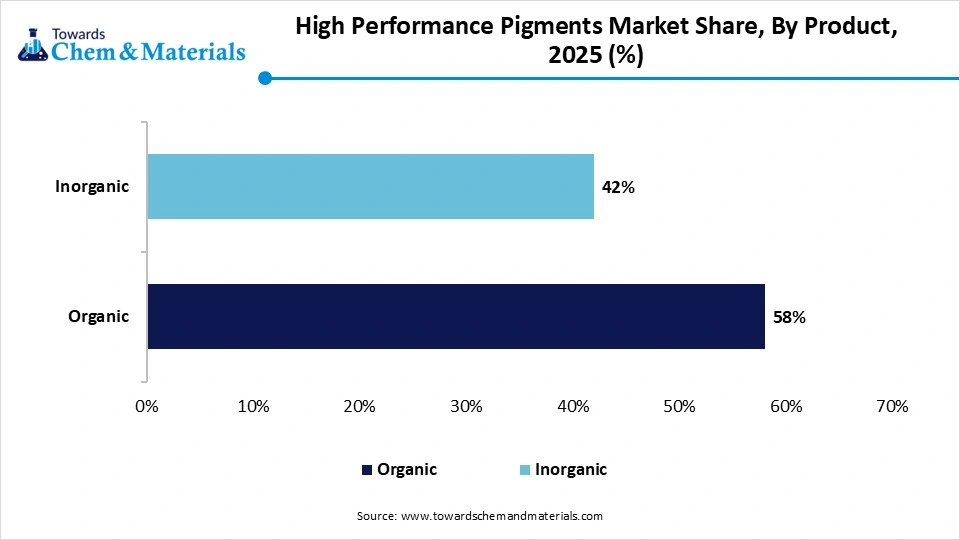
The inorganic segment held 42% market share in 2025 and is expected to have the fastest growth with a CAGR of 5.20% in the forecast period. This growth is driven by rising demand in the automotive, industrial coatings, and construction sectors, where their exceptional durability, heat resistance, and chemical stability are vital. inorganic pigments are celebrated for their low solubility, exceptional chemical stability, and opacity.
High Performance Pigments Market Share, By Product, 2025 (%)
| By Product | Revenue Share, 2025 (%) |
| Organic | 58% |
| Inorganic | 42% |
Application Insights
The Coating Segment Dominated the Market With 44% Market Share In 2025
The coating segment dominated the market with 44% share in 2025. Thriving on booming automotive production and global infrastructure development, high-performance pigments are heavily utilized for their ability to resist weathering, chemicals, and extreme temperatures. Its continued growth is driven by rising demand in automotive finishes, architectural construction, and protective industrial applications that require exceptional durability, heat stability, and weather resistance.
The plastics segment held 23% market share in 2025. Driven by superior heat stability, excellent lightfastness, and chemical resistance, high-performance pigments are increasingly utilized in automotive parts, consumer goods, and packaging. This boom is particularly prominent in Asia's rapidly expanding polymer manufacturing and packaging sectors.
The printing inks segment held 14% market share in 2025, Driven by the expanding e-commerce and packaging sectors, this segment is experiencing rapid growth, often highlighted as the fastest application segment behind paints and coatings. Stricter global regulations are pushing manufacturers to adopt water-based, UV-curable, and bio-based inks that rely on chemically inert and eco-friendly pigments.
The cosmetics segment held 8% market share in 2025 and is expected to have the fastest growth with a CAGR of 5.80% in the forecast period. Driven by consumer demand for "clean beauty," multifunctional makeup, and social media trends, the sector is experiencing rapid expansion. Brands are heavily investing in safe, vibrant, and long-lasting formulations. The increasing regulatory compliance for clean and sustainable ingredients.
High Performance Pigments Market Share, By Application, 2025 (%)
| By Application | Revenue Share, 2025 (%) |
| Coating | 44% |
| Plastics | 23% |
| Printing Inks | 14% |
| Cosmetics | 8% |
| Other | 11% |
End-Use Industry Insights
The Automotive Segment Dominated the High-Performance Pigments Market With 28% Market Share In 2025
The automotive segment dominated the market with 28% share in 2025, the rise in use and demand for EVs and luxury lines for premium passengers increases the demand. they are highly sought after because they provide exceptional heat stability, chemical resistance, and lightfastness, allowing car finishes to withstand extreme environmental conditions and UV exposure without fading or degrading.
The construction segment held 22% market share in 2025. The construction sector's rapid urbanization and infrastructure investments are driving massive demand in the high-performance pigments market. Because these pigments offer superior weather resilience, alkali resistance, and UV stability, they are increasingly utilized in residential and commercial coatings, PVC, and concrete materials.
The packaging segment held 16% market share in 2025. Driven by the surging demand for premium food and beverage, cosmetic, and luxury packaging, the industry relies heavily on HPPs to achieve vibrant aesthetics, product differentiation, and reliable UV and heat resistance. Strict global regulations restricting heavy metals in food-contact applications have sparked a major push toward migration-resistant, non-toxic, and eco-friendly organic pigments.
The electronics segment held 8% market share in 2025 and is expected to have the fastest growth with a CAGR of 5.90% in the forecast period, due to their superior heat stability, chemical resistance, and colorfastness. They are heavily utilized in LCD displays, touch screens, and solar panels to maintain functional integrity and vibrant aesthetics under prolonged exposure to light and heat. Specialty pigments are essential in the formulation of the high-precision printing inks used in PCB manufacturing and electronic labelling.
High Performance Pigments Market Share, By End-Use Industry, 2025 (%)
| By End-Use Industry | Revenue Share, 2025 (%) |
| Automotive | 28% |
| Construction | 22% |
| Packaging | 16% |
| Consumer Goods | 11% |
| Electronics | 8% |
| Textile | 6% |
| Cosmetics & Personal Care | 5% |
| Others | 4% |
Regional Analysis
How Did Asia Pacific Dominate the High-Performance Pigments Market In 2025?
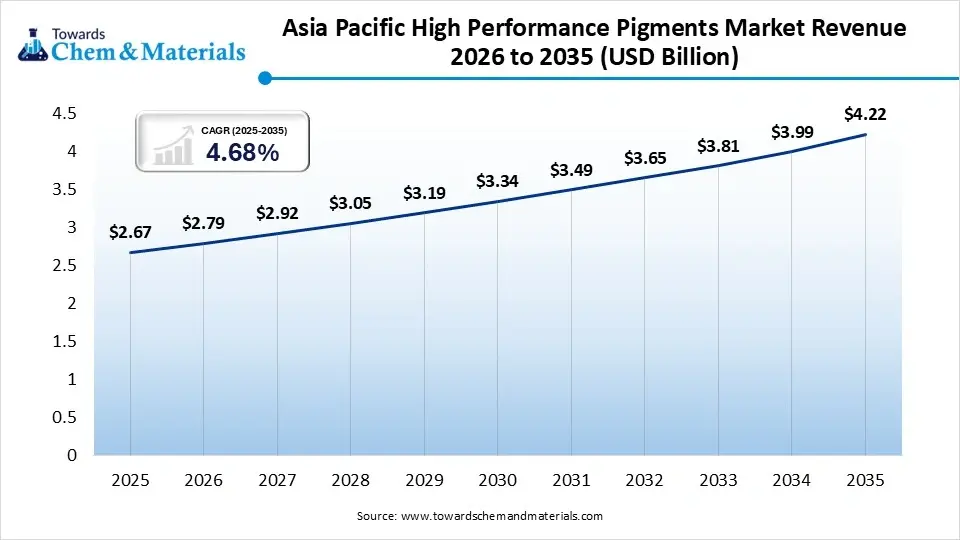
The Asia Pacific high-performance pigments market size was estimated at USD 2.67 billion in 2025 and is projected to reach USD 4.22 billion by 2035, growing at a CAGR of 4.68% from 2026 to 2035.Asia Pacific dominated the market with a share of 39% in 2025 and is expected to sustain its position while growing with a CAGR of 5.70% in the forecast period, booming domestic construction, an escalating shift to regional manufacturing, and surging demand for premium aesthetic coatings in the automotive and packaging industries. High-performance pigments are required for UV stability, heat resistance, and superior durability in OEM automotive finishes and architectural coatings. Rapid urbanization and rising consumer disposable incomes in economic hubs like China and India propelled the paints and coatings sector.
 India
India
- India's high-performance pigments market is expanding rapidly, driven by the booming automotive, paints and coad for colorfast and weather-resistant materials in the domestic market is supported by structural shifts toward premium, durable goods.
China
- China’s high-performance pigments market growth is driven primarily by soaring demand in the automotive industry, booming architectural coatings, stringent environmental regulations, and local manufacturing advancements in specialty colorants.
- China's position as the world's largest coatings producer translates directly into massive demand for premium organic & inorganic pigments that provides excellent color fastness, opacity, and long operational life.
Japan
- Japan houses a massive cosmetics industry that increasingly relies on HPPs especially organic and special effect pigments for vibrant color richness, skin-friendly formulations, and high-quality aesthetic products.
- Japan's strict chemical safety and environmental regulations compel manufacturers to adopt high-performance organic pigments and complex inorganic color pigments (CICPs) that meet sustainability metrics without compromising performance.
Europe High-Performance Pigments Market Growth Factor
The Europe high-performance pigments market size was estimated at USD 1.85 billion in 2025 and is projected to reach USD 2.94 billion by 2035, growing at a CAGR of 4.74% from 2026 to 2035.Europe held the market share of 27% in 2025, driven by robust demand in the automotive, architectural coatings, and premium packaging sectors. Key growth factors include the need for superior heat/light resistance and strict sustainability regulations driving eco-friendly, non-toxic formulations. The European Union’s push for green alternatives restricts the use of toxic heavy metals, encouraging manufacturers to shift toward bio-based and eco-friendly pigment formulations.
Germany
- Germany’s powerhouse automotive industry demands premium aesthetics, weather resistance, and color durability.
- The shift toward electric vehicles is pushing manufacturers to utilize specialized, high-performance pigments that offer UV resistance and thermal stability.
- There is increasing demand for HPPs in architectural coatings and construction materials due to their superior longevity, anti-corrosive properties, and heat resistance.
Italy
- Italy is home to prominent vehicle manufacturing and specialty coating hubs such as PPG’s Quattordio Center of Excellence. HPPs are heavily utilized for their exceptional durability, UV resistance, and weatherability.
- Compliance with EU REACH regulations is forcing a shift from toxic traditional pigments toward eco-friendly, bio-based alternatives, and low-VOC pigment dispersions.
France
- Expanding construction and industrial sectors require pigments that offer extended operational lifespans, anti-corrosion, and color retention.
- Driven by strict EU regulations such as REACH and low-VOC (volatile organic compound) mandates, the market is shifting heavily toward non-toxic, bio-based, and highly sustainable pigment formulations.
North America High-Performance Pigments Market Growth Factor
The North America high-performance pigments market size was estimated at USD 1.44 billion in 2025 and is projected to reach USD 2.30 billion by 2035, growing at a CAGR of 4.79% from 2026 to 2035.North America held the market share of 21% in 2025, is primarily driven by robust automotive production, stringent environmental regulations favoring sustainable alternatives, and rising consumer preference for premium aesthetics. High-performance pigments are favored for providing superior weatherability, heat resistance, and long operational life. In the U.S. and North America, a strong automotive sector and consumer demand for premium, durable vehicle finishes heavily propel growth.
U.S.
- The U.S. High-Performance Pigments market is primarily driven by robust demand in automotive finishes, sustainable regulatory shifts, and advanced packaging.
- The rising demand for highly vibrant, metallic, and specialty effect pigments in premium consumer goods and cosmetic packaging is boosting ink applications.
Canada
- Urbanization and continuous development across Canada fuel the demand for high-performance architectural coatings and specialty plastics that can withstand harsh, freezing Canadian climates without fading.
- The expanding food, beverage, and consumer goods industries are boosting the use of specialized pigments for vibrant, functional, and heat-stable packaging applications.
Latin America High-Performance Pigments Market Growth Factor
The Latin America high-performance pigments market size was estimated at USD 0.48 billion in 2025 and is projected to reach USD 0.80 billion by 2035, growing at a CAGR of 5.24% from 2026 to 2035.Latin America held the market share of 7% in 2025, is primarily driven by the expanding automotive sector, rapidly growing construction activities, and increasing demand for sustainable, durable coatings. The automotive industry in countries like Brazil, and Argentina is a massive consumer of HPPs. Increasing infrastructural developments and residential construction projects across Latin America drive the consumption of architectural coatings, industrial paints, and plastics. Consumers and regulatory bodies across Latin America are pushing for environmentally friendly, low-VOC products.
Brazil
- Rapid urbanization and ongoing residential/commercial development across major Brazilian cities are increasing the consumption of architectural paints. HPPs are vital here to prevent fading, chalking, and degradation from intense UV exposure.
- Brazil’s growing focus on sustainability has resulted in stricter regulations regarding VOCs. This is pushing manufacturers to transition away from traditional heavy-metal-based inorganic pigments and shift toward organic and bio-based high-performance solutions.
Argentina
- The steady recovery and advancement of domestic automotive manufacturing in Argentina demand high-end organic and inorganic pigments. These are used in OEM coatings and refinishes for their aesthetic appeal and ability to withstand extreme environmental conditions.
- The growing FMCG sector in Argentina necessitates high-quality, vibrant, and durable packaging. HPPs are highly sought after by ink manufacturers for UV-curable, screen, and laminating inks to ensure attractive shelf presence.
Middle East and Africa High-Performance Pigments Market Growth Factor
The Middle East and Africa high-performance pigments market size was estimated at USD 0.34 billion in 2025 and is projected to reach USD 0.59 billion by 2035, growing at a CAGR of 5.67% from 2026 to 2035.The Middle East and Africa held the market share of 6% in 2025, is driven by rapid urbanization, infrastructure development, and growing demand for eco-friendly, durable coatings. The region's expanding automotive manufacturing and construction sectors are the primary end-use industries fueling this growth.
High Performance Pigments Market Share, By Regional, 2025 (%)
| Regional | Revenue Share, 2025 (%) |
| Asia-Pacific | 39% |
| Europe | 27% |
| North America | 21% |
| Latin America | 7% |
| Middle East & Africa | 6% |
Saudi Arabia
- Government initiatives under Vision 2030, including large-scale urban development projects and real estate investments, are significantly driving the demand for high-performance architectural coatings and paints.
- Mega-developments like NEOM and the Red Sea Project are aggressively driving the consumption of paints, architectural coatings, and construction materials that utilize HPPs
UAE
- Thriving beauty industry in the UAE creates steady demand for high-performance organic and inorganic pigments used in premium color cosmetics and skincare.
- Rapid infrastructure development, mega real estate projects such as luxury residential and commercial hubs, and a subsequent surge in demand for architectural and industrial coatings.
Recent Developments
- In November 2025, BASF has officially started up its new high-performance dispersant production line at the Jiangbei New Material Technology Park in Nanjing, China. This local facility utilizes Controlled Free Radical Polymerization technology to manufacture advanced dispersants directly for the regional market. Combined with BASF's existing plant in Heerenveen, Netherlands, this expansion increases global production capacity to deliver more reliable and flexible supply chains for customers worldwide.(Source: basf.com)
- In April 2026, Specialty chemical distributor Grolman Group has officially expanded its distribution partnership with Bruchsaler Farbenfabrik, a leading German manufacturer of high-performance pigments. Grolman has extended its sales and distribution coverage for Bruchsaler’s specialized colorant portfolio into Northern Germany and Baden-Württemberg. This strategic expansion builds upon the successful long-term collaboration between the two companies in Bavaria and Eastern Germany, further strengthening Grolman's ability to supply premium industrial coatings and plastics manufacturers across the country.(Source: european-coatings.com)
Top players in the High-Performance Pigments Market & Their Offerings
- BASF SE: A major global chemical leader providing a broad range of high-performance organic and inorganic pigments.
- Sun Chemical Corporation: A member of the DIC Group, and one of the largest producers of pigments and advanced colorants.
- Clariant AG: Known for premium organic pigments, dyes, and specialty chemicals.
- Lanxess AG: Renowned for high-quality synthetic iron oxides and inorganic pigments.
- Heubach GmbH: A premier manufacturer focused entirely on organic, inorganic, and anti-corrosive pigments.
Other Top Players Are
- Trust Chem Co., Ltd.
- DIC Corporation
- Ferro Corporation / Vibrantz Technologies
- Sudarshan Chemical Industries Ltd.
- Merck KGaA
- Venator Materials PLC
- Cathay Industries
- Altana AG
- Synthesia a.s.
- Toyo Ink SC Holdings Co., Ltd.
- Chromaflo Technologies
- Flint Group
- Trust Chem Co., Ltd.
- Sensient Cosmetic Technologies
- Lomon Billions Group
- Eckart GmbH / Altana
- Vibfast Pigments Pvt. Ltd.
- Yipin Pigments Co., Ltd.
- Cabot Corporation
- Atul Ltd.
- Pidilite Industries Limited
Segments Covered in the report
By Product
- Organic
- Quinacridone Pigments
- Phthalocyanine Pigments
- DPP Pigments
- Perylene Pigments
- Inorganic
- Titanium Dioxide-Based
- Iron Oxide-Based
- Mixed Metal Oxides
- Chromium Oxide Pigments
By Application
- Coating
- Automotive Coatings
- Industrial Coatings
- Architectural Coatings
- Plastics
- Engineering Plastics
- Commodity Plastics
- Masterbatches
- Printing Inks
- Packaging Inks
- Publication Inks
- Digital Inks
- Cosmetics
- Color Cosmetics
- Personal Care Products
- Other
- Textile Coloration
- Specialty Applications
By End-Use Industry
- Automotive
- OEM Coatings
- Refinish Coatings
- Plastic Components
- Construction
- Architectural Paints
- Infrastructure Coatings
- Packaging
- Flexible Packaging
- Rigid Packaging
- Consumer Goods
- Household Products
- Toys & Recreation
- Electronics
- Displays
- Electronic Components
- Textile
- Synthetic Fibers
- Technical Textiles
- Cosmetics & Personal Care
- Makeup Products
- Personal Care Formulations
- Others
- Aerospace
- Marine
- Industrial Equipment
By Region
- North America
- U.S.
- Canada
- Mexico
- Europe
- UK
- Germany
- France
- Italy
- Spain
- Sweden
- Denmark
- Norway
- Asia Pacific
- Japan
- China
- India
- Australia
- South Korea
- Thailand
- Latin America
- Brazil
- Argentina
- The Middle East and Africa
- South Africa
- Saudi Arabia
- UAE
- Kuwait
FAQ's
Question 1 : What is the high-performance pigments market size and share?
Answer : The global high-performance pigments market size is estimated at USD 7.16 billion in 2026 and is projected to hit USD 10.69 billion by 2035. Geographically, Asia Pacific dominates the market with a 39% revenue share, followed by Europe at 27%.
Question 2 : Who are the key players in the surface high-performance pigments market?
Answer : The top key players operating in the global market include BASF SE, Sun Chemical Corporation, Clariant AG, Lanxess AG, Heubach GmbH, Trust Chem Co., Ltd., DIC Corporation, Sudarshan Chemical Industries Ltd., Merck KGaA, and Toyo Ink SC Holdings Co., Ltd.
Question 3 : Which product segment holds the majority of the market share?
Answer : The organic high-performance pigments segment dominated the market with a 58% share in 2025. This dominance is driven by the growing manufacturing demand for bright, non-toxic colorants that comply with clean label and eco-friendly standards.
Question 4 : Why is the electronics industry demanding more high-performance pigments?
Answer : The electronics end-use segment is the fastest-growing sector with a 5.90% CAGR. HPPs are increasingly vital for touch screens, LCD displays, and solar panels because they maintain perfect color stability and functional integrity under prolonged heat and UV exposure.
Question 5 : What are the main drivers of the high-performance pigments market?
Answer : The primary market drivers include the rapid expansion of global vehicle production, massive infrastructure investments requiring weather-resistant architectural paints, and strict environmental regulations pushing for the replacement of hazardous heavy-metal pigments.
Meet the Team

Saurabh Bidwai
Principal Consultant
Saurabh Bidwai, a B.Tech Chemical Engineering graduate with 4+ years of experience, specializes in specialty chemicals, commodity chemicals, and engineered materials, offering valuable insights into market trends and emerging opportunities.

Aditi Shivarkar
Reviewed By
Aditi Shivarkar, with 14+ years in Chemical and Materials market research, specializes in Chemical and Materials. She ensures accurate, actionable insights, driving Towards Chemicals And Materials Analytics and Consulting excellence in industry trends and sustainability.