
High Purity Methane Gas Market Size, Share, Growth, Report 2026 to 2035
The global high purity methane gas market size is expected to grow from USD 8.72 billion in 2026 to USD 15.40 billion in 2035, growing at a CAGR of 6.52% from 2026 to 2035. The top key players in the market are Linde PLC, Air Liquide S.A, Taiyo Nippon Sanso Corporation, Advanced Specialty Gases, AGT International, American Welding & Gas, Axcel Gases, Bhuruka Gases Limited., Chemix Gases, Chengdu Taiyu Industrial Gases Co., Ltd., Cryocarb, Electronic Fluorocarbons LLC, Linde plc, Matheson Tri-Gas, Inc., Messer Group GmbH-Global Forecast 2026 To 2035 .
Content
High Purity Methane Gas Market Size and Forecast 2026 - 2035
The global high purity methane gas market size was estimated at USD 8.19 billion in 2025 and is expected to increase from USD 8.72 billion in 2026 to USD 15.40 billion by 2035, growing at a CAGR of 6.52% from 2026 to 2035. Asia Pacific dominated the high purity methane gas with the largest revenue share of 45.00% in 2025.The growth is driven by rising adoption of high-purity precursors, decarbonization commitment, technological integration and industrial applications.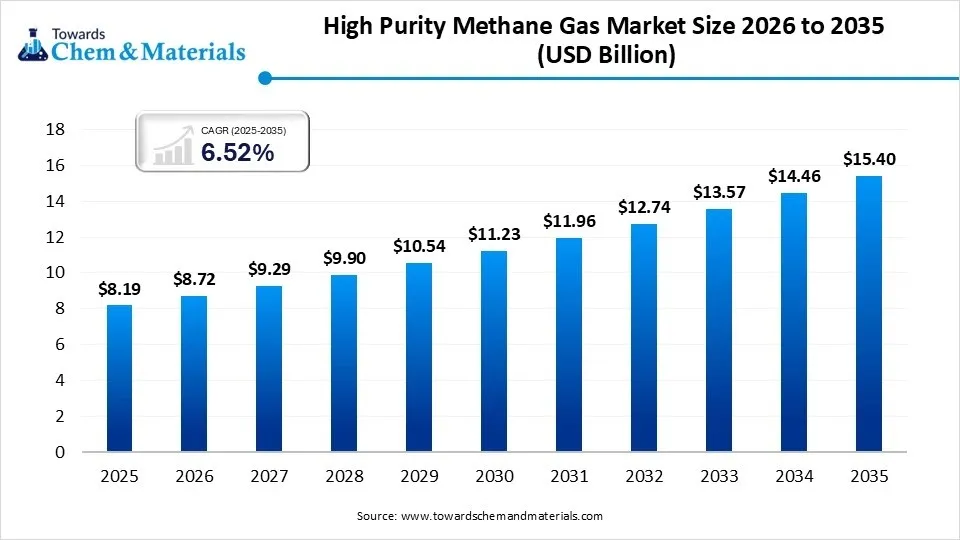
Market Highlights
- By region, Asia Pacific dominated the high purity methane gas market in 2025 due to its vast semiconductor and electronic hub.
- By region, North America is expected to grow at the fastest CAGR from 2026 to 2035 due to innovation in semiconductor and advanced aerospace infrastructure.
- By transportation, the cylinder segment held the largest share 54.00% in the market in 2025 due to its molecular flexibility and logistical containment.
- By transportation, the bottles segment is expected to grow at the fastest CAGR during the forecast period due to its high-precision logistics and demand in sensitive applications.
- By end-use, the electrical and electronics segment dominated the market share 34.00% in 2025, due to demand for modern microchips, high-frequency transistors, and semiconductor fabrication.
- By end-use, the oil and gas segment is anticipated to grow at the fastest CAGR in the market during the forecast period due to its ability to perform leak detection, instrument calibration and decarbonization.
Market Overview
The high purity methane gas market is a crucial part of the specialty chemicals industry, primarily serving technological shifts that require ultra-high-purity (UHP) methane, processed through cryogenic distillation and membrane separation to remove moisture, nitrogen and oxygen. The market growth is fueled by the semiconductor industry, where methane is vital for chemical vapour deposition and epitaxial growth for high-performance microchips.
The emerging applications in nanotechnology for the manufacturing of carbon nanotubes, graphene, and the hydrogen economy are pushing the market towards expansion. The market development is driven by smart manufacturing, AI-based real-time monitoring and sensor technology, which optimize purification and ensure contamination-free supply chains for optoelectronics and photovoltaic sectors.
Recent Market Trends
- Rising Focus on High-Purity Grades: The rising transition towards high purity levels enables miniaturization of semiconductor nodes to check moisture and lattice defects by offering precise gas integrity.
- Raw Material Precursor for Hydrogen Economy: The market represents a low-carbon feedstock for hydrogen production using advanced steam methane reforming and methane pyrolysis by maintaining optimized yield pathway, clean fuel, and decarbonized transportation.
- Shift Towards Sustainable and Renewable Methane: The trend is driven by biogas-to-ultrahigh purity levels, aligning with renewable natural gas to promote circular economy commitments as green alternatives where methane gas acts as the primary feedstock for the revolutionary push.
Report Scope
| Report Attribute | Details |
| Market Size in 2026 | USD 8.72 Billion |
| Revenue Forecast in 2035 | USD 15.40 Billion |
| Growth Rate | CAGR 6.52% |
| Forecast Period | 2026 - 2035 |
| Base Year | 2025 |
| Dominant Region | Asia Pacific |
| Segment Covered | By Transportation, By End Use, By Region |
| Key companies profiled | Linde PLC, Air Liquide S.A, Taiyo Nippon Sanso Corporation, Advanced Specialty Gases, AGT International, American Welding & Gas, Axcel Gases, Bhuruka Gases Limited., Chemix Gases, Chengdu Taiyu Industrial Gases Co., Ltd., Cryocarb, Electronic Fluorocarbons LLC, Linde plc, Matheson Tri-Gas, Inc., Messer Group GmbH |
High Purity Methane Gas Market Dynamics
Market Driver
- Shift Towards Contamination-Free Environment: The market focus is on the exclusion of impurities such as oxygen, moisture and nitrogen to avoid catastrophic atomic-level defects during semiconductor fabrication, and oil and gas recovery.
- Clean Energy Expansion: The transition to expanding steam methane reforming units that offer high-purity hydrogen and protect carbon-neutral economies, driving the market growth.
Market Restraints
Stringent Regulation for Greenhouse Gas Leak Detection and Methane:
The strict regulatory framework, such as environmental, social and governmental, for methane leak detection and carbon intensity is reinforcing manufacturers towards high compliance costs, and those that fail to meet green formulation face restricted access for capital expenditure, which limits the high-purity methane gas expansion.
Market Opportunity
The Rise in Implementation of Responsibility Sourced Gas
The significant opportunity for market players, especially for manufacturers that are increasingly demanding certified gas to prove low methane intensity and maximum operational efficiency, is to meet strict environmental and corporate standards for semiconductor fabrication and transportation. It supports capturing price premiums by certifying its supply to eco-conscious buyers and significant investors.
Key Technological Shifts and AI in the High Purity Methane Gas Market
The combination of AI and high-fidelity sensors is transforming the supply chain into a smart ecosystem in high purity methane gas. The machine learning optimising purification processes in real-time using pressure swing adsorption and distillation, while predictive maintenance integrated with a digital twin prevents methane micro-leaks by achieving purity.
Additionally, the advancement in smart cylinders with IoT regulators ensures supply chain transparency and contamination control, crucial for quantum computing and semiconductor manufacturing by achieving maximum operation yield. While blockchain enables carbon-methane gas trading, and autonomous robots maintain deep-water resources. Overall, the industry is transforming into a high-tech, data-driven ecosystem focused on consistency and decarbonization goals.
High Purity Methane Gas Market: Supply Chain Analysis
- Feedstock Procurement: The initial stage that focuses on methane extraction and raw natural gas collection from natural and synthetic sources by using natural gas drilling, coalbed methane extraction, integrated with a shift towards emerging biogas-to-methane recovery.
- Key Players: BP plc., Reliance Industries, Gazprom, ExxonMobil, and Shell plc
- Purification and Molecular Engineering: The stage of raw methane converts it into ultra-high purity levels by using cryogenic fractional distillation and multi-stage pressure swing adsorption. The stage show passivates specialized cylinders and bottles to maintain chemical integrity and remove impurities.
- Key Players: Linde PLC, Air Products and Chemicals, Messer Group, Air Liquide S.A., and Taiyo Nippon Sanso Corporation
- Logistics and End-Use Integration: The stage focuses on contamination-free delivery and integrates it into industrial sectors by using specialized distribution integrated with on-site gas generation at manufacturing hubs, semiconductor firms, and research laboratories.
- Key Players: TSMC, Intel Corporation, Thermo Fisher Scientific, and Samsung Electronics
Regulatory Framework: High Purity Methane Gas Market
| Region | Key Regulations | Regulatory Focus |
| Global | ISO Standards, SEMI, IATA/IMDG Code | Standards for gas purity levels and high-performance ultra-clean logistics for semiconductor production. Focus on the safe transport of compressed methane. |
| North America | DOT-3AA/ OSHA PSM | Mandates structural integrity of high-pressure cylinders and process safety management for high-purity gases and hazardous chemicals. |
| Europe | REACH/CLP Regulation | Regulations for the restriction and classification of high-purity methane focus on chemical safety and leak-proof packaging standards. |
| Asia Pacific | GB Standards, METI | Standards for hydrogen and methane purity grades for semiconductor and industrial applications. National standards for trace impurities in methane |
| United States | EPA Greenhouse Gas Reporting, CHIPS Act | Focus on methane leak detection and guidelines for domestic production of gases used in high-tech fabrication. |
Segmental Insights
Transportation Insights
How did the Cylinder Segment hold the Largest Share in the High Purity Methane Gas Market?
The cylinder segment held the largest revenue share 54.00% in the market in 2025, driven by its modular flexibility and logistical containment, enabling precision-scale industries. The segment acts as a storage vessel using specialised cylinder system with polished surfaces and leak-proof sealing technologies. The cylinder ensures contamination-free pathways, which are critical for delivering methane safely and precisely for sensitive chemical vapor deposition and nanomaterial synthesis processes utilized in semiconductor end-use and advanced research laboratories.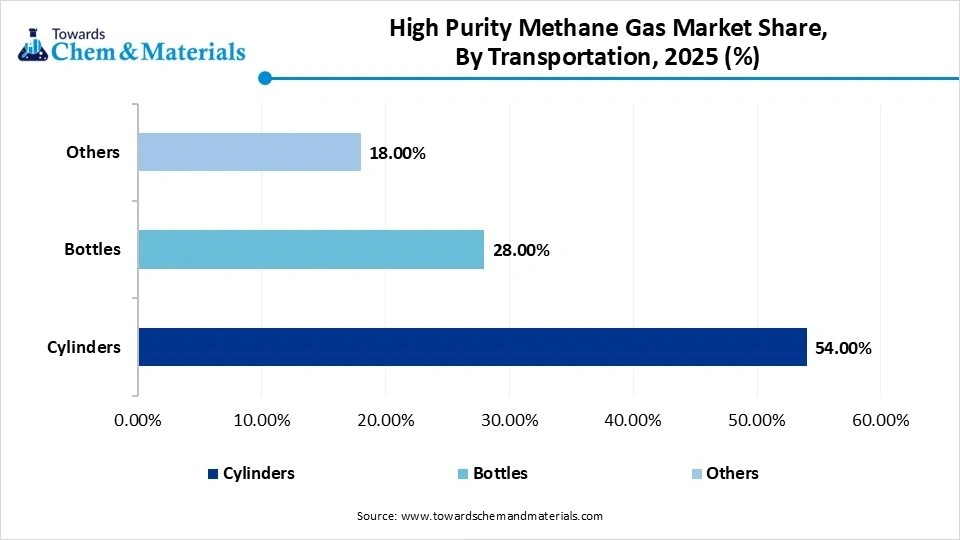
The bottles segment is experiencing the fastest growth in the market during the forecast period. It serves as a high-precision delivery system for manufacturers with electropolished internal walls and advanced passivation treatments. The segment employing inert, sealed bottles with advanced fittings and diaphragm-sealed valves supports sensitive applications specialty gas laboratories and R&D of microelectronics by integrating with CVD and nano-synthesis, maintaining molecular stability and preventing atmospheric ingress during transit and storage.
High Purity Methane Gas Market Share, By Transportation , 2025 (%)
| By Transportation | Revenue Share, 2025 (%) |
| Cylinders | 54.00% |
| Bottles | 28.00% |
| Others | 18.00% |
- Cylinders (54.00%) Why it dominates: "Accounts for 54.00% of the market, driven by widespread use for safe, large-volume storage and transportation of high purity methane across industrial and laboratory applications."
- Bottles (28.00%) Why it is gaining momentum: "Holds 28.00% share, supported by increasing demand for smaller, portable storage solutions in research and specialty applications."
- Others (18.00%) Why it is gaining momentum: "Represents 18.00% of the market, driven by diverse transportation methods catering to specific industrial and logistical requirements."
End-Use Insights
Which End-Use Dominated the High Purity Methane Gas Market?
The electrical and electronics segment dominated the market share 34.00% in 2025. It represents a key carbon precursor in semiconductor fabrication as a technological catalyst. The methane decomposed during chemical vapor deposition and epitaxial growth to bind atom-thin conductive layers for modern microchips, nanomaterials, and next-gen optoelectronics, high-frequency transistors and quantum computing components requiring thermal and electrical stability, ultra-high purity to prevent impurities and lattice defects.
The oil and gas segment is anticipated to grow fastest in the market during the projected period, due to the requirement for calibration reference and monitoring. The ultra-high purity methane acts as a reagent that supports instrument calibration, leak detection, and satellite-based emission monitoring. It utilized in gas chromatography and mass spectroscopy to achieve composition and product purity. It also fueled decarbonization efforts through catalyst research and hydrogen production. Overall, the industry focuses on purity, safety, and technological advancement, and this segment plays a vital role in the modern industry and low-carbon fuel conversion.
High Purity Methane Gas Market Share, End Use, 2025 (%)
| By End Use | Revenue Share, 2025 (%) |
| Automotive & Transportation | 20.00% |
| Oil & Gas | 18.00% |
| Chemical | 12.00% |
| Electrical & Electronics | 34.00% |
| Medical | 7.00% |
| Others | 9.00% |
- Electrical & Electronics (34.00%) Why it dominates: "Accounts for 34.00% of the market, driven by high demand for ultra-pure methane in semiconductor manufacturing and electronics processing applications."
- Automotive & Transportation (20.00%) Why it is gaining momentum: "Holds 20.00% share, supported by increasing use in alternative fuel applications and emission reduction initiatives."
- Oil & Gas (18.00%) Why it is gaining momentum: "Represents 18.00% of the market, driven by its role in processing, calibration, and energy-related operations."
- Chemical (12.00%) Why it is gaining momentum: "Accounts for 12.00% share, supported by its use as a feedstock and process gas in chemical manufacturing."
- Others (9.00%) Why it is gaining momentum: "Captures 9.00% of the market, driven by diverse industrial and specialty applications."
- Medical (7.00%) Why it is gaining momentum: "Holds 7.00% share, supported by increasing use in diagnostic and research-related medical applications."
Regional Insights
The Asia Pacific high purity methane gas market size was valued at USD 3.69 billion in 2025 and is expected to be worth around USD 7.01 billion by 2035, exhibiting at a compound annual growth rate (CAGR) of 6.63% over the forecast period from 2026 to 2035.Asia Pacific dominated the market in 2025, driven by its dense semiconductor and electronics manufacturing hubs. The regional shift towards ultra-pure methane is crucial for process node miniaturization in chip manufacturing, especially in Chemical Vapor Deposition (CVD) and epitaxial growth. 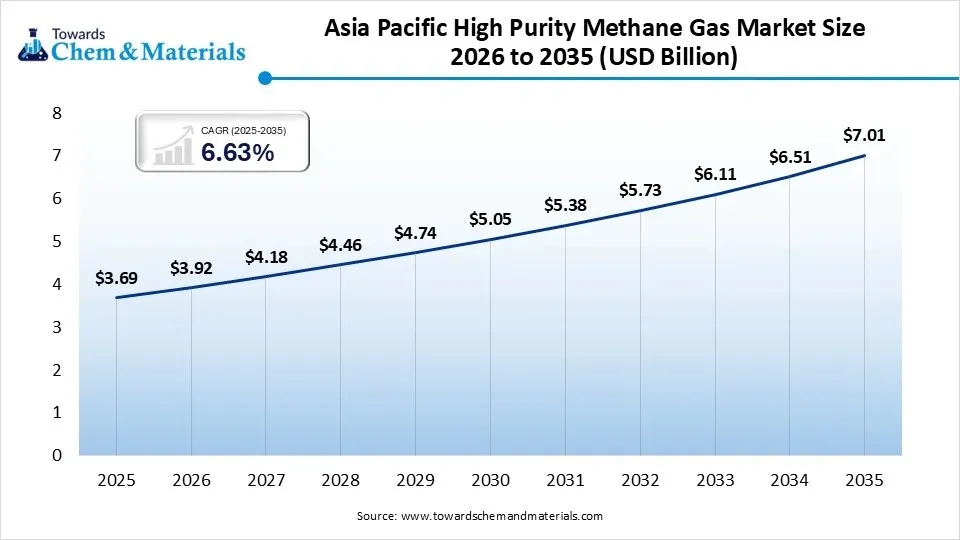
The Asia Pacific dominates modern display technology and photovoltaics, which fuel growth. The region also advances hydrogen and nanomaterial industries, which focus on graphene synthesis and carbon nanotubes. Additionally, integrated supply chains and AI-powered purification logistics ensure contamination-free gas flow to top cleanrooms globally.
China High Purity Methane Gas Market Growth Trends
China maintains its leadership in the market and serves as a key for its booming semiconductor and electronics infrastructure, supported by extensive wafer foundries. The region provides ultra-pure carbon for CVD and plasma fabrication, with domestic purification technology focused on atomic-scale integrity. China also dominates nanomaterial synthesis for next-generation energy storage promoted by strategic self-reliance initiatives, digital supply chains, and automated systems.
North America High Purity Methane Gas Market Growth Trends
North America High Purity Methane Gas Market segment accounted for the major revenue share of 20.00% in 2025. North America is expected to grow at the fastest CAGR in the market during the forecast period. It represents a hub for innovation, with numerous semiconductor R&D and advanced aerospace production bases. The regional growth is fueled by the domestic chip resurgence, where ultra-pure methane is essential for CVD and plasma etching. The rapid expansion of the hydrogen economy advanced reforming technologies for low-carbon hydrogen production, enabling regional growth. North America is using smart distribution and AI monitoring for purity and contamination control.
U.S. High Purity Methane Gas Market Growth Trends
The United States is witnessing the fastest growth in the market, driven by domestic semiconductor manufacturing and aerospace industries, aligning with technological innovation. The region utilises high purity methane gas in clean energy applications like hydrogen production and carbon capture technologies. The U.S. focuses on domestic synthesis of diamond-like carbon coating, and graphene plays a significant role for defence and medical use with AI-enhanced supply chains and gas monitoring.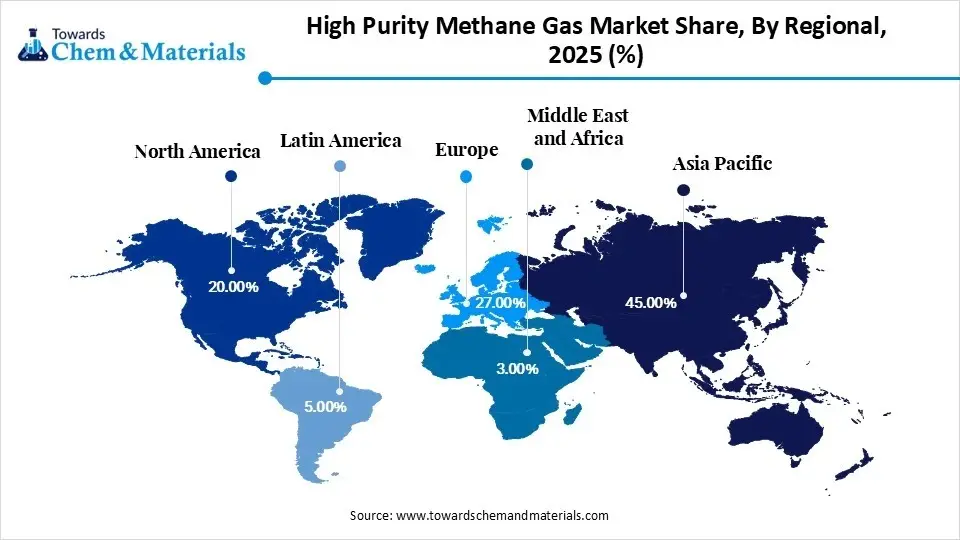
Europe High Purity Methane Gas Market Growth Trends
Europe High Purity Methane Gas Market segment accounted for the major revenue share of 27.00% in 2025. Europe's market is prized for its sustainability in specialty gas, integrated into automotive and green energy manufacturing corridors. The European Chips Act boosts demand for UHP methane for semiconductor manufacturing. The region focuses on a circular carbon economy, using methane gas for low-emission hydrogen and carbon- neutral fuels. The region focuses on methane gas utilization as a strategic asset for medical diagnostics and research, with strict regulatory standards and on- site purification to meet environmental and quality aspects.
High Purity Methane Gas Market Share, By Regional, 2025 (%)
| Regional | Revenue Share, 2025 (%) |
| North America | 20.00% |
| Europe | 27.00% |
| Asia Pacific | 45.00% |
| Latin America | 5.00% |
| Middle East & Africa | 3.00% |
- Asia Pacific (45.00%) Why it dominates: "Accounts for 45.00% of the market, driven by strong growth in semiconductor manufacturing, electronics production, and expanding industrial base."
- Europe (27.00%) Why it is gaining momentum: "Holds 27.00% share, supported by advanced research facilities and increasing demand in electronics and chemical industries."
- North America (20.00%) Why it is gaining momentum: "Represents 20.00% of the market, driven by technological advancements and steady demand from semiconductor and energy sectors."
- Latin America (5.00%) Why it is gaining momentum: "Accounts for 5.00% share, supported by gradual industrial development and growing adoption across emerging applications."
- Middle East & Africa (3.00%) Why it is gaining momentum: "Captures 3.00% of the market, driven by increasing investments in industrial and energy sectors."
Germany High Purity Methane Gas Market Growth Trends
The Germany market is a technology hub, relying on high- purity methane for advanced microchips, sensors, and hydrogen through methane pyrolysis to decarbonize heavy industry. The regional growth strengthens economically in medical technology and analytical chemistry, supporting MRI cooling and calibration. Additionally, Germany focuses on zero-defect manufacturing and Industry 4.0 integration with AI and smart filtration, ensuring contamination-free and pure products.
Recent Developments
- In December 2024, the environmental intelligence firm, Kayrros announced the new launched methane GPT a publicly available AI- enable tool that uses satellite data to report methane leaks globally. The new launched focus on enhancing transparency for high-purity supply chains.(Source: illuminem.com)
- In March 2024, Kayrros announced a strategic R&D partnership with the European Union's leading bank, BNP Paribas, to accelerate methane abatement from the oil and gas industry and develop advanced methane metrics. This collaboration focuses on methane emission quantification.(Source: group.bnpparibas)
Top Companies in the High Purity Methane Gas Market and Their Offerings
- Linde PLC: The global provider of high-purity methane and precise gas mixtures with specialty gas program that focuses on semiconductor manufacturing and integrated gas management systems.
- Air Liquide S.A.: The global leader supplies methane with guaranteed low-impurity methane and high-stability gases for electronics, chemical synthesis, and engine emission testing. They also offer specialized telemetry and smart-cylinder services.
- Taiyo Nippon Sanso Corporation: The global provider in Asia-Pacific offers electronic-grade methane, ultra-clean carrier gases, and specialty blends that focus on the development of an advanced stainless-steel delivery manifold and chip fabrication.
- Advanced Specialty Gases
- AGT International
- American Welding & Gas
- Axcel Gases
- Bhuruka Gases Limited.
- Chemix Gases
- Chengdu Taiyu Industrial Gases Co., Ltd.
- Cryocarb
- Electronic Fluorocarbons LLC
- Linde plc
- Matheson Tri-Gas, Inc.
- Messer Group GmbH
Segment Covered in the Report
By Transportation
- Cylinders
- Bottles
- Others
By End Use
- Automotive & Transportation
- Oil & Gas
- Chemical
- Electrical & Electronics
- Medical
- Others
By Region
- North America
- U.S.
- Canada
- Mexico
- Europe
- Germany
- UK
- France
- Italy
- Spain
- Asia Pacific
- China
- India
- Japan
- South Korea
- Latin America
- Brazil
- Argentina
- Middle East & Africa
- Saudi Arabia
- South Africa
FAQ's
Question 1 : What is the market size and growth forecast for the High Purity Methane Gas Market from 2026 to 2035?
Answer : The global market size is expected to grow from USD 8.72 billion in 2026 to USD 15.40 billion by 2035, growing at a CAGR of 6.52%.
Question 2 : Who are the leading companies in the High Purity Methane Gas Market?
Answer : Key players include Linde PLC, Air Liquide S.A., Taiyo Nippon Sanso Corporation, Advanced Specialty Gases, and AGT International.
Question 3 : Why did the Electrical and Electronics segment dominate the High Purity Methane Gas Market in 2025?
Answer : The Electrical and Electronics segment dominated the market with a 34.00% share in 2025 because methane serves as a key carbon precursor in semiconductor fabrication, essential for producing microchips, nanomaterials, and optoelectronics with ultra-high purity.
Question 4 : Why did the Oil and Gas segment of the High Purity Methane Gas Market share in 2025?
Answer : The Oil and Gas segment held 18.00% of the market share in 2025 because methane is crucial for gas chromatography, mass spectroscopy, and hydrogen production, supporting low-carbon fuel conversion and emission monitoring technologies.
Question 5 : Why did the Automotive & Transportation segment of the High Purity Methane Gas Market share in 2025?
Answer : The Automotive & Transportation segment held 20.00% of the market share in 2025 due to methane\'s growing role in clean energy applications, particularly in fuel cells and hydrogen production for decarbonization initiatives.
Question 6 : Why did the Chemical segment of the High Purity Methane Gas Market share in 2025?
Answer : The chemical segment held 12.00% of the market share in 2025 due to the use of high-purity methane in chemical processes, particularly in materials synthesis and research for industrial applications.
Question 7 : Why did the Medical segment of the High Purity Methane Gas Market share in 2025?
Answer : The Medical segment held 7.00% of the market share in 2025 because methane is used in medical research and diagnostics, particularly in high-precision applications that require contamination-free gas delivery.
Question 8 : Why did Asia Pacific dominate the High Purity Methane Gas Market in 2025?
Answer : Asia Pacific dominated the High Purity Methane Gas Market with a 45.00% share in 2025 due to its dense semiconductor and electronics manufacturing hubs, driving the demand for ultra-pure methane in Chemical Vapor Deposition (CVD) and epitaxial growth processes.
Question 9 : Why did North America High Purity Methane Gas Market share in 2025?
Answer : North America held 20.00% of the market share in 2025 due to its innovation hubs in semiconductor R&D and aerospace production, where ultra-pure methane is essential for clean energy applications and hydrogen production.
Meet the Team

Saurabh Bidwai
Principal Consultant
Saurabh Bidwai, a B.Tech Chemical Engineering graduate with 4+ years of experience, specializes in specialty chemicals, commodity chemicals, and engineered materials, offering valuable insights into market trends and emerging opportunities.

Aditi Shivarkar
Reviewed By
Aditi Shivarkar, with 14+ years in Chemical and Materials market research, specializes in Chemical and Materials. She ensures accurate, actionable insights, driving Towards Chemicals And Materials Analytics and Consulting excellence in industry trends and sustainability.