
Hydrogen Peroxide Market Size, Share, Growth, Report 2026 to 2035
The hydrogen peroxide market report segmented By Product Function (Chemical Synthesis, Bleaching, Disinfectant, Cleaning & Etching, Other Product Functions), By Grade (90% Hydrogen Peroxide, 35% Hydrogen Peroxide, 6-10% Hydrogen Peroxide, <3% Hydrogen Peroxide), By End-Use Industry (Oil & Gas, Chemical & Petrochemicals, Pulp and Paper, Wastewater Treatment, Mining, Food and Beverage, Cosmetics and Healthcare, Textiles, Other End-user Industries)-Global Industry Analysis, Size, Trends, Leading Companies, Regional Outlook, and Forecast 2026 to 2035
Content
What is the Current Hydrogen Peroxide Market Size and Share?
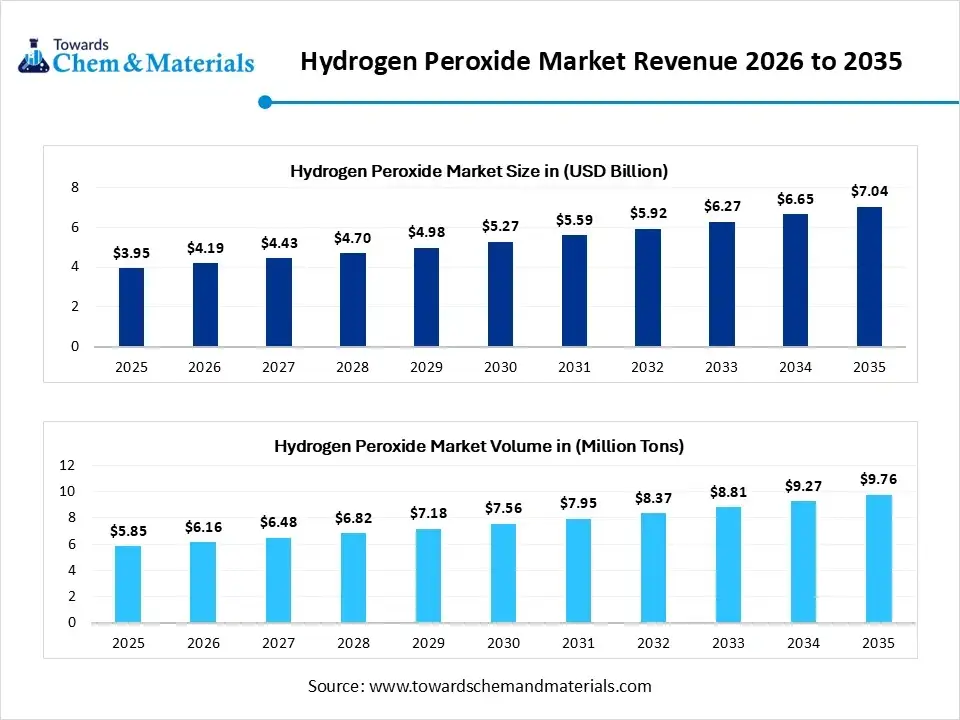
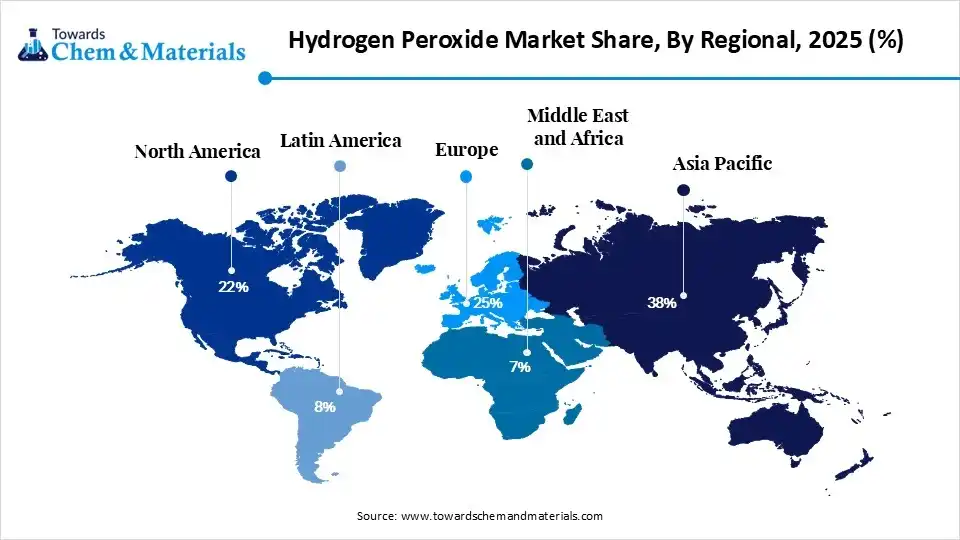
The global hydrogen peroxide market size was valued at USD 3.95 billion in 2025, is estimated to reach USD 4.19 billion in 2026, and is projected to reach USD 7.04 billion by 2035, exhibiting a compound annual growth rate (CAGR) of 5.95% over the forecast period from 2026 to 2035. Asia Pacific dominated the hydrogen peroxide market with the largest revenue share of 38% in 2025 and is expected to grow at the fastest CAGR of 6.09% during the forecast period. In terms of volume, the hydrogen peroxide Industry is projected to grow from 3.95 million tons in 2025 to 7.04 million tons by 2035. growing at a CAGR of 5.95% from 2026 to 2035. The market growth is driven by HPPO technology, technological innovation, carbon-neutral chemical lines, and environmental regulation.
Hydrogen peroxide consists of a combination of pure water and oxygen and is represented as a green oxidizing agent crucial for industrial decarbonization. The hydrogen peroxide market is a high-value alternative for modern infrastructure to meet circular economy commitments. The chemical manufacturers are increasingly expanding in wastewater remediation and chemical recycling to meet net-zero goals. As manufacturers focus on replacing chlorine-based chemicals with eco-friendly alternatives, boosting the utilization of ultra-pure hydrogen peroxide. The global and domestic manufacturers are investing in modular on-site production units to maintain a stable supply chain.
The surge for hydrogen peroxide due to its neutralization of micropollutants, residue, and harmful effluent make them key in advanced oxidation processes and industrial water management. The emerging economies shift towards specialized applications, which is fueling the demand for 35% and 6-10% grade hydrogen peroxide for elemental chlorine-free and total chlorine-free bleaching frameworks. Chemical manufacturing applications focus on innovation in propylene oxide synthesis and development in ultra-pure electronic-grade chemical solutions that make them key for the manufacturing of eco-friendly plastics and consumer electronics.
The stringent regulatory compliance and corporate sustainability mandating are pushing chemical providers to integrate into renewable energy infrastructure and green hydrogen feedstock through strategic partnerships. The major market players are adopting clean energy and low-carbon peroxide product lines through renewable water electrolysis, which is boosting the market expansion. Additionally, the hydrogen peroxide is crucial for precise surface cleaning, automotive and metal surface treatment, medical sterilization, and next-generation sub-5-nanometer microchip fabrication
Market Highlights
- By region, Asia Pacific dominated the market by holding 38% share in 2025 and is expected to grow at the fastest with a CAGR of 7.10% during the forecast period, driven by domestic chemical manufacturing capacity expansion and investment in wastewater treatments.
- By region, Europe held the 25% market share in 2025 and expects notable growth in the market with 4.70% CAGR during the forecast period, accelerated by stringent environmental regulations and green chemistry mandates.
- By product function, the chemical synthesis segment dominated the market with the largest share of 38% in 2025 due to demand for cleaner oxidizing intermediates and expansion of green oxidation processes.
- By product function, the disinfectant segment held 15% market share in 2025 and is expected to grow at the fastest CAGR of 6.7% over the forecast period, driven by demand for peroxide sanitization and rising hygiene awareness.
- By grade, the 35% hydrogen peroxide segment dominated the market with the largest share of 46% in 2025, driven by large-scale industrial consumption and utilization of wastewater treatment plants.
- By grade, the 6-10% hydrogen peroxide segment held 25% market share in 2025 and is expected to grow at the fastest CAGR of 6.3% over the forecast period, driven by demand for cosmetic, cleaning products, and personal care.
- By end-use industry, the chemical & petrochemicals segment dominated the market with the largest share of 27% in 2025 due to HPPO technology expansion and petrochemical investment for sustainable peroxides.
- By end-use industry, the cosmetics and healthcare segment held 9% market share in 2025 and is expected to grow at the fastest CAGR of 6.8% over the forecast period, driven by medical sterilization requirements and premium cosmetic formulation.
Quick Stats at a Glance
- Market Estimated Size (2025): USD 3.95 Billion | CAGR (2026–2035): 5.95%
- Market Projected Size (2035): USD 7.04 Billion
- Asia Pacific: largest Market Revenue Share of 38% in 2025|USD 1.50 Billion
- Market Estimated Volume (2025): 5.85 Million Tons | Volume CAGR (2026–2035): 5.25%
- Market Projected Volume (2035): 9.76 Million Tons
- Market Pricing (2025):
- Average Manufacturing Price (2025): USD 530/Ton
- Average Selling Price (2025): USD 720/Ton
- Pricing CAGR (2025–2035): 3.11%
Market Trends
- Rising Focus Towards Wastewater Treatment:The trend is redefined by integrating process automation and regulatory compliance to minimize disinfection by-products and improve environmental protection.
- Sustainability Commitments: To achieve a net-zero manufacturing future, the industry is increasingly demanding low-carbon energy that promotes investment in hydrogen peroxide infrastructure and technological development.
Report Scope
| Report Attributes | Details |
| Market Size and Volume in 2026 | USD 4.19 Billion/ 6.16 Million Tons |
| Revenue Forecast in 2035 | USD 7.04 Billion/ 9.76 Million Tons |
| Growth Rate | CAGR 5.95% |
| Base Year of Estimation | 2025 |
| Forecast Period | 2025 - 2035 |
| High Impact Region | Asia Pacific |
| Segment Covered | By Product Function, By Grade, By End-Use Industry, By Regions |
| Key Companies Profiled | Evonik Industries AG, Taekwang Industrial, CO., LTD., Arkema, Grupa Azoty, Solvay, Akzo Nobel N.V., Gujarat Alkalies & Chemicals Ltd., National Peroxide Limited, OCI Company Ltd., Airedale Chemical |
Key Technological Shifts and AI in the Hydrogen Peroxide Market
The technological advancement and artificial intelligence in the market are optimizing chemical manufacturing by maintaining precision and volatility in the supply chain. The advanced automation technologies are driving the continuous transformation in the hydrogen peroxide market. The combination of digital twin & an industrial Internet of Things sensor offers the safety management of highly reactive hydrogen peroxide and recognize structural corrosion.
The machine learning model allows manufacturers to perform real-time monitoring during the anthraquinone auto-oxidation loop by offering higher chemical yield and reduced energy use. An AI-driven hybrid filtration network and automated precision dosing solution ensure precision-driven operation of hydrogen peroxide.
Supply Chain Analysis of the Hydrogen Peroxide Market
- Feedstock Procurement: The key stage of sourcing of raw materials, including hydrogen gas and atmospheric oxygen. The large-scale production method requires anthraquinone derivatives, palladium, and heavy organic solvents.
- Key Players: BASF SE, Air Liquide, Clariant AG, Air Products and Chemicals, and Linde plc
- Hydrogen Peroxide Synthesis and Refining: The stage of raw material processing to synthesize hydrogen peroxide. The anthraquinone loop produces raw hydrogen peroxide through advanced distillation and column purification. The stage of formulation of ultra-pure electronic grade and standard industrial grade.
- Key Players: Mitsubishi Gas Chemical Company, Arkema S.A., Solvay S.A., Kemira Oyj, and Evonik Industries AG
- Logistics and End-Use Integration:The stage of specialized logistics of finished and purified hydrogen peroxide through passivated stainless steel and high-density polyethylene containers. End-use industries like oil & gas, Petrochemicals, wastewater treatment, electronics fabrication, pulp, and paper.
- Key Players: Brenntag SE, Univar Solution Inc., BASF SE, Evonik, Chemtrade Logistics, and Barentz.
Regulatory Framework: Hydrogen Peroxide Market
| Region | Key Regulations | Regulatory Focus |
| Asia Pacific | CPCB Standards, METI, NRDL, and MEE Regulations | Restriction for chemical oxygen demand limits for unreacted hydrogen peroxide, transport bands for bulk liquid H2O2 concentration, Standards for ultra-pure electronic-grade, and classification of toxic oxidizers. |
| North America | EPA Standards, OSHA, WHMIS, and CEPA | Monitoring hydrogen peroxide effluent limits and process safety management, Regulations for hydrogen peroxide vapor and liquid concentration levels. |
| Europe | ECHA, EU REACH, and German Water Resource Act | Strict registrations for hydrogen peroxide import and classifying H2O2 storage, mandating hydrogen peroxide to replace chlorine bleaching. |
| Latin America | SMA, National Mining Codes, Maritime Authority, and IBAMA | Environmental permitting for high-capacity anthraquinone loop hydrogen peroxide and regulation for cyanide detoxification. |
Market Dynamics
Driver
Demand in Semiconductor Fabrication and Pulp Bleaching
The hydrogen peroxide market expansion is driven by the industrial infrastructure. The shift towards domestic microchip manufacturing and modern sub-2-nm fabrication is driving the demand for ultra-high-purity electronic-grade hydrogen peroxide, crucial for chemical cleaning operations and silicon wafer etching. The stringent regulatory compliances driving the shift away from chlorine-free chemical formulation for non-polluting pulp and paper bleaching, where hydrogen peroxide acts as an eco-friendly alternative. Additionally, the emerging focus on e-commerce, paper packaging, and hygiene awareness is accelerating the adoption of hydrogen peroxide.
Restraints
Hydrogen Peroxide Degradation Complexity
The hydrogen peroxide is volatile and chemically unstable, which enable their continuous decomposition into water and oxygen, that demand the expensive and highly specialized containers and passivates the stainless-steel storage network to eliminate degradation, limiting the large-scale adoption. Additionally, the hydrogen peroxide manufacturing requires steam methane reforming of natural gas, hydrogen, and oxygen, which restrains the market expansion.
Opportunity
Sustainable HPPO Technology and Green Hydrogen Infrastructure
The market is gaining momentum through commercial scaling of hydrogen peroxide to propylene oxide technology that boosting the key opportunity for production of sustainable feedstock for industrial manufacturing. The key opportunity is demand for specialized photovoltaic-grade etching fluids and biocidal crop sprays through industrial automation. The chemical producers are adopting hydrogen peroxide green hydrogen infrastructure to meet certified carbon-neutral chemical lines and eco-labeled agricultural disease management.
Segmental Insights
Product Function Insights
The chemical synthesis segment dominated the market with the largest share of 38% in 2025. The hydrogen peroxide acts as a reaction intermediate and a cleaner molecular alternative. The industrial transition towards hydrogen peroxide to propylene oxide technology is fueling the utilization of hydrogen peroxide in epoxidation reactions, propylene oxide, and organic peroxide production. The specialty chemical facilities utilize industrial high-purity grade to produce organic peroxide initiators that make them crucial for curing plastics, resins, and synthetic rubber to meet zero-toxic chlorine standards. The segment growth is driven by long-term supply contracts in the major synthesis hub.
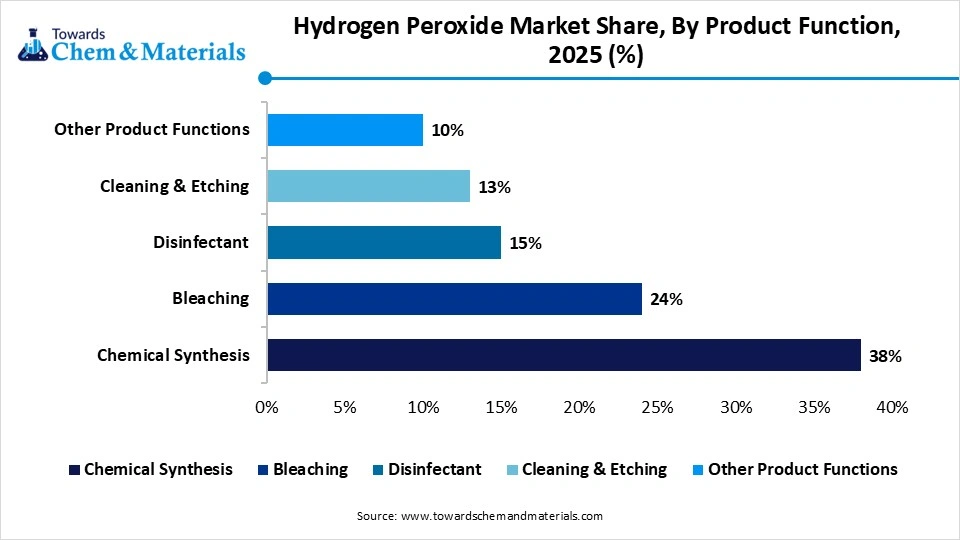
The disinfectant segment held the 15% market share in 2025 and is expected to grow at the fastest CAGR of 6.7% over the forecast period. The hydrogen peroxide offers microbial destruction and maintains zero-residue in the environment to meet stringent sanitization standards. The rising focus on surface disinfection, medical sterilization, and food contact sanitization through automated vaporised hydrogen peroxide technology is fueling the expansion.
Additionally, the innovation focuses on eco-friendly post-sanitization and development in chemical stabilization.
The bleaching segment held the 24% market share in 2025 due to a strict regulatory approach to phase out toxic chlorine and demand for eco-friendly wood fiber whitening. The textile, flour pulp, and paper industry relies on hydrogen peroxide to bleach raw feedstock. The segment utilized a standard 30% to 45% industrial-grade solution in bleaching operations. The domestic players focus on pipelined-based contract to eliminate costly operations and logistics in high-volume manufacturing.
The cleaning & etching segment held 13% market share in 2025. The advancement in semiconductor fabrication and modern electronics is driving the demand for hydrogen peroxide for semiconductor cleaning, electronics etching, and metal surface treatments. The hydrogen peroxide functions as a precision oxidizing etchant and creating wafer cleaning mixture in microchip batches.
Hydrogen Peroxide Market Share, By Product Function, 2025 (%)
| By Product Function | Revenue Share, 2025 (%) |
| Chemical Synthesis | 38% |
| Bleaching | 24% |
| Disinfectant | 15% |
| Cleaning & Etching | 13% |
| Other Product Functions | 10% |
Grade Insights
The 35% hydrogen peroxide segment dominated the market with the largest share of 46% in 2025, supported by its ability to offer an optimal balance of superior oxidizing power and large-scale shipping stability. The chemical manufacturers utilized hydrogen peroxide as a key chemical feedstock for heavy manufacturing and commercial operations. The 35% grade is crucial for industrial effluent remediation systems and aseptic-grade sanitization.
The 6-10% hydrogen peroxide segment held the 25% market share in 2025 and is expected to grow at the fastest CAGR of 6.3% over the forecast period. Defined by their high value demand in consumer personal care and cosmetic sectors, where this grade acts as a chemical activator and high-strength stain remover.
The dental manufacturers utilized 6-10% hydrogen peroxide for the formulation of teeth whitening gels and mold remediation fluids. The strict hazardous chemical shipping regulation is fueling the adoption of this grade by ensuring oxidative reactivity.The <3% hydrogen peroxide segment held the 15% market share in 2025, serving as a low-strength formulation essential in first-aid antiseptics, household safety, and non-toxic personal care fluid. As consumer hygiene awareness and environmental concern are making the use of <3% hydrogen peroxide in oxygenating mouthwashes and eco-friendly sanitizing sprays. Additionally, the grade dominated in pharmacy, grocery, and e-commerce supply chains.
The 90% hydrogen peroxide segment held 14% market share in 2025. This grade functions as a key catalyst for high-energy rocket monopropellant and satellite propulsion systems. 90% hydrogen peroxide needs specialized passivated aluminum storage and a supersonic combustion chamber to meet weapon-grade logistics protocols. It acts as a key green propellant alternative to hydrazine fuels and shifts towards attitude control thrusters, which boosts the aerospace development.
Hydrogen Peroxide Market Share, By Grade, 2025 (%)
| By Grade | Revenue Share, 2025 (%) |
| 90% Hydrogen Peroxide | 14% |
| 35% Hydrogen Peroxide | 46% |
| 6-10% Hydrogen Peroxide | 25% |
| <3% Hydrogen Peroxide | 15% |
End-Use Industry Insights
Chemical & petrochemicals segment dominated the market with the largest share of 27% in 2025. The growth is attributed to the utilization of propylene oxide and specialty hydrogen peroxide in petrochemical-based anthraquinones and reformed hydrogen gas. The major chemical manufacturers implement direct oxidation technology for polyurethane foam, thermoplastic elastomers, and caprolactam polymer intermediates. Hydrogen peroxide is a key chlorine-free alternative for green chemistry and integrative refinery complexes.
The cosmetics and healthcare segment held the 9% market share in 2025 and is expected to grow at the fastest CAGR of 6.8% over the forecast period, represents key sector for consumer personal care and clinical sanitation framework. The hydrogen peroxide enables releasee destructive free radicals and acts as a bleaching agent for cosmetic formulation, medical, and hair care. Additionally, its microbial preservation ability makes them key for anti-acne treatment.
The pulp and paper segment held the 18% market share in 2025. The manufacturing hubs inject liquid hydrogen peroxide into pulp slurries to ensure paper brightness by acting as a lignin-modifying agent and yellowing inhibitor. As paper factories are increasingly adopting flotation de-inking cells by integrating chlorine-free bleaching technology to remove hazardous organochlorine byproducts. The hydrogen peroxide produce net-zero liquid discharge infrastructure which makes it key for the mechanical & chemical pulp and paper industry.
The wastewater treatment segment held 14% market share in 2025, driven by demand for eco-friendly liquid oxidants to purify contaminated industrial, municipal, and agricultural waste. The wastewater treatment sector utilizes lower chemical oxygen demand levels by integrating sludge-free purification technologies for municipal treatment and industrial effluent treatment.
Hydrogen Peroxide Market Share, By End-use Industry, 2025 (%)
| By End-use Industry | Revenue Share, 2025 (%) |
| Oil & Gas | 8% |
| Chemical & Petrochemicals | 27% |
| Pulp and Paper | 18% |
| Wastewater Treatment | 14% |
| Mining | 7% |
| Food and Beverage | 6% |
| Cosmetics and Healthcare | 9% |
| Textiles | 7% |
| Other End-user Industries | 4% |
Regional Analysis
How Did the Asia Pacific Dominated the Hydrogen Peroxide Market in 2025?
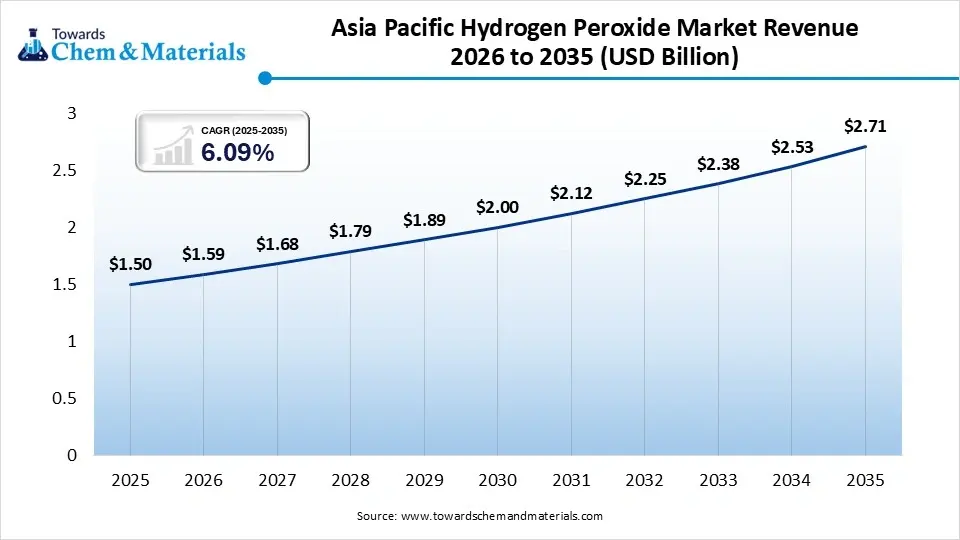
The Asia Pacific hydrogen peroxide market size was estimated at USD 1.50 billion in 2025 and is projected to reach USD 2.71 billion by 2035, growing at a CAGR of 6.09% from 2026 to 2035.Asia Pacific dominated the market by holding 38% share in 2025 and is expected to grow at the fastest with a CAGR of 7.10% during the forecast period. The regional growth is supported by rising chemical consumption and industrial manufacturing. The government support for industrial wastewater detoxification and investment in the municipal purification system to meet environmental standards.
 China
China
- Driven by their stringent chemical oxygen demand, their integration of green hydrogen feedstock for constructing net-zero emission hydrogen peroxide manufacturing.
- China's domestic shift towards photovoltaic cell manufacturing, sub-7nm semiconductor fabrication, and e-commerce paper packaging fuels the demand for hydrogen peroxide.
India
- The region is a manufacturing hub for specialized hydrogen peroxide to propylene oxide infrastructure and a municipal water filtration system for sustainable manufacturing practices.
- India focuses on self-sufficiency for high-volume food & beverage packaging by utilizing hydrogen peroxide sterilant through their manufacturing initiatives.
The Europe hydrogen peroxide market size was estimated at USD 0.99 billion in 2025 and is projected to reach USD 1.80 billion by 2035, growing at a CAGR of 6.16% from 2026 to 2035.Europe held the 25% market share in 2025 and expects notable growth in the market with a 4.70% CAGR during the forecast period. The domestic expansion is propelled by EU environmental compliance and green chemical mandates that enable the integration of recycling infrastructure. The rising demand for hydrogen peroxide in wastewater treatment and the European shift towards green hydrogen feedstock are accelerating their regional expansion. Additionally, Europe focuses on low-emission distribution networks and eco-friendly plastics that strengthen its continuous growth.
Germany
- The region is shifting towards net-zero carbon and green chemistry that driving the innovation in high-value specialized chemical engineering applications.
- Germany is implementing HPPO process lines and a closed-loop paper recycling system to meet stringent regulatory compliance.
The North America hydrogen peroxide market size was estimated at USD 0.87 billion in 2025 and is projected to reach USD 1.58 billion by 2035, growing at a CAGR of 6.15% from 2026 to 2035.North America held 22% market share in 2025, supported by major chemical manufacturers' shift towards domestic supply hubs and semiconductor mega-fabs. The region is represented by its advanced industrial infrastructure to meet carbon-neutral commitments. The strict environmental standards enable the replacement of chlorine with hydrogen peroxide to minimize industrial pollution and foster municipal water purification.
United States
- The U.S. expansion is fueled by domestic supply chain security mandates and EPA clear water compliance.
- The local player is deploying low-carbon foodprint distribution fleets and advanced oxidation processes through strategic alliances.
Canada
- The rising development in large-scale natural resource processing and retrofitting of chlorine-free hydrogen peroxide bleaching loops aligns with advanced detoxification.
- Canada leads in the sustainable agriculture industry and heavy-duty chemical oxidant in processing operations.
The Latin America hydrogen peroxide market size was estimated at USD 0.32 billion in 2025 and is projected to reach USD 0.60 billion by 2035, growing at a CAGR of 6.49% from 2026 to 2035.Latin America held 8% market share in 2025, driven by its mining operations, where hydrogen hydroxide is key in gold and copper extraction. The region is defined by its diversified cellulose and eucalyptus pulp export sector using distribution collaboration. Latin America's urbanization is accelerating the expansion of municipal water infrastructure and supporting domestic growth in textile manufacturing.
Brazil
- The region is represented as cellulose export-driven infrastructure and residue-free crop preservation through substantial investments.
- Brazil mining waste regulations and water quality mandates are boosting the expansion in pulp production and food processing.
The Middle East & Africa hydrogen peroxide market size was estimated at USD 0.28 billion in 2025 and is projected to reach USD 0.53 billion by 2035, growing at a CAGR of 6.59% from 2026 to 2035.The Middle East & Africa held 7% market share in 2025, fueled by substantial investment in seawater desalination and municipal wastewater recycling. The regional chemical players focus on building storage terminals and expanding their textile processing facilities to maintain a stable supply chain. MEA is increasingly growing in the mining and metallurgical sector and oilfield chemical services.
 GCC Countries
- Driven by their non-oil industrial diversification to improve oil recovery and the national green vision framework, boosting domestic growth.
- The GCC nations focus on eco-friendly plastic and specialized oilfield chemical oxidation that driving the demand for hydrogen peroxide.
South Africa
- The region adopting mineral-driven chemical infrastructure and high-volume chemical formulation in textile and apparel bleaching.
- The stringent effluent dumping and water safety standards enable the cyanide tailing treatment and manufacturing expansion.
Recent Developments
- In October 2025, Metrex introduced CaviCide™ HP as a fast-acting hydrogen peroxide-based liquid surface disinfectant. This eco-friendly formulation provides healthcare professionals with a 1-minute universal contact time to destroy 70 labeled pathogens.(Source: www.metrex.com)
- In January 2025, Evonik Industries AG established a 51/49 joint venture with Fuhua Tongda Chemicals Company to produce and market hydrogen peroxide (H2O2) in China for specialty applications. The joint venture focuses on producing specialty-grade hydrogen peroxide for semiconductors, solar panels, and food packaging.(Source: www.marketscreener.com)
Top Companies in the Hydrogen Peroxide Market
- Evonik Industries AG
- Taekwang Industrial, CO., LTD.
- Arkema
- Grupa Azoty
- Solvay
- Akzo Nobel N.V.
- Gujarat Alkalies & Chemicals Ltd.
- National Peroxide Limited
- OCI Company Ltd.
- Airedale Chemical
Segments Covered in the Report
By Product Function
- Chemical Synthesis
- Propylene Oxide Production
- Epoxidation Reactions
- Organic Peroxide Manufacturing
- Bleaching
- Pulp Bleaching
- Textile Bleaching
- Flour Bleaching
- Disinfectant
- Surface Disinfection
- Medical Sterilization
- Food Contact Sanitization
- Cleaning & Etching
- Semiconductor Cleaning
- Metal Surface Treatment
- Electronics Etching
- Other Product Functions
- Environmental Applications
- Laboratory Applications
- Agriculture Applications
By Grade
- 90% Hydrogen Peroxide
- Aerospace Grade
- Industrial High-Purity Grade
- 35%Hydrogen Peroxide
- Industrial Grade
- Wastewater Treatment Grade
- 6-10% Hydrogen Peroxide
- Household Grade
- Cosmetic Grade
- <3% Hydrogen Peroxide
- Pharmaceutical Grade
- Oral Care Grade
By End-Use Industry
- Oil & Gas
- Enhanced Oil Recovery
- Sulfur Removal
- Chemical & Petrochemicals
- Propylene Oxide
- Specialty Chemicals
- Pulp and Paper
- Mechanical Pulp
- Chemical Pulp
- Wastewater Treatment
- Municipal Treatment
- Industrial Effluent Treatment
- Mining
- Gold Mining
- Uranium Mining
- Food and Beverage
- Packaging Sterilization
- Food Processing
- Cosmetics and Healthcare
- Hair Care
- Medical Applications
- Textiles
- Fabric Bleaching
- Dye Removal
- Other End-user Industries
- Electronics
- Agriculture
- Energy Storage
By Region
- North America
- U.S.
- Canada
- Europe
- Germany
- UK
- France
- Italy
- Spain
- Sweden
- Denmark
- Norway
- Asia Pacific
- China
- Japan
- India
- South Korea
- Thailand
- Latin America
- Brazil
- Mexico
- Argentina
- Middle East and Africa (MEA)
- South Africa
- UAE
- Saudi Arabia
- Kuwait
FAQ's
Question 1 : What is the expected hydrogen peroxide market size in 2026?
Answer : The global market size is estimated to reach USD 4.19 billion in 2026, demonstrating steady upward momentum from the previous year.
Question 2 : What is driving the growth of the hydrogen peroxide market?
Answer : The main growth drivers are the expansion of eco-friendly plastic manufacturing, rising demand for clean wastewater treatment, and high-tech semiconductor microchip cleaning.
Question 3 : Why is the 35% grade of hydrogen peroxide so popular?
Answer : The 35% concentration is the industrial workhorse because it is highly effective for large-scale operations while remaining stable and safe to transport in bulk.
Question 4 : Which region is expanding the fastest in this market?
Answer : The Asia-Pacific region is growing the fastest, featuring an expected 7.10% growth rate due to massive domestic chemical production and water infrastructure investments.
Question 5 : How is artificial intelligence used in the hydrogen peroxide industry?
Answer : Manufacturers are using AI sensors and machine learning models to track production loops in real time, which helps prevent structural corrosion, improves chemical yields, and cuts down on energy use.
Meet the Team

Saurabh Bidwai
Principal Consultant
Saurabh Bidwai, a B.Tech Chemical Engineering graduate with 4+ years of experience, specializes in specialty chemicals, commodity chemicals, and engineered materials, offering valuable insights into market trends and emerging opportunities.

Aditi Shivarkar
Reviewed By
Aditi Shivarkar, with 14+ years in Chemical and Materials market research, specializes in Chemical and Materials. She ensures accurate, actionable insights, driving Towards Chemicals And Materials Analytics and Consulting excellence in industry trends and sustainability.