
Hydrophilic Coatings Market Size, Share, Growth, Report 2026 to 2035
The global hydrophilic coatings market size is expected to grow from USD 18.02 billion in 2026 to USD 32.99 billion in 2035, growing at a CAGR of 6.95% from 2026 to 2035. The top key players in the market are Surmodics, Inc., Coatings2Go, LLC, Applied Medical Coatings, LLC, Avery Dennison Corporation, Hydromer Inc. , Biocoat Inc., AST Products Inc., Aculon Inc., Surface Solutions Group LLC, DSM Biomedical (dsm-firmenich), Tokyo Ohka Kogyo Co., Ltd., BioInteractions Ltd., Covalon Technologies Ltd., Harland Medical Systems, Inc.
Content
What is the Current Size of the Hydrophilic Coatings Market and Its Projected Growth?
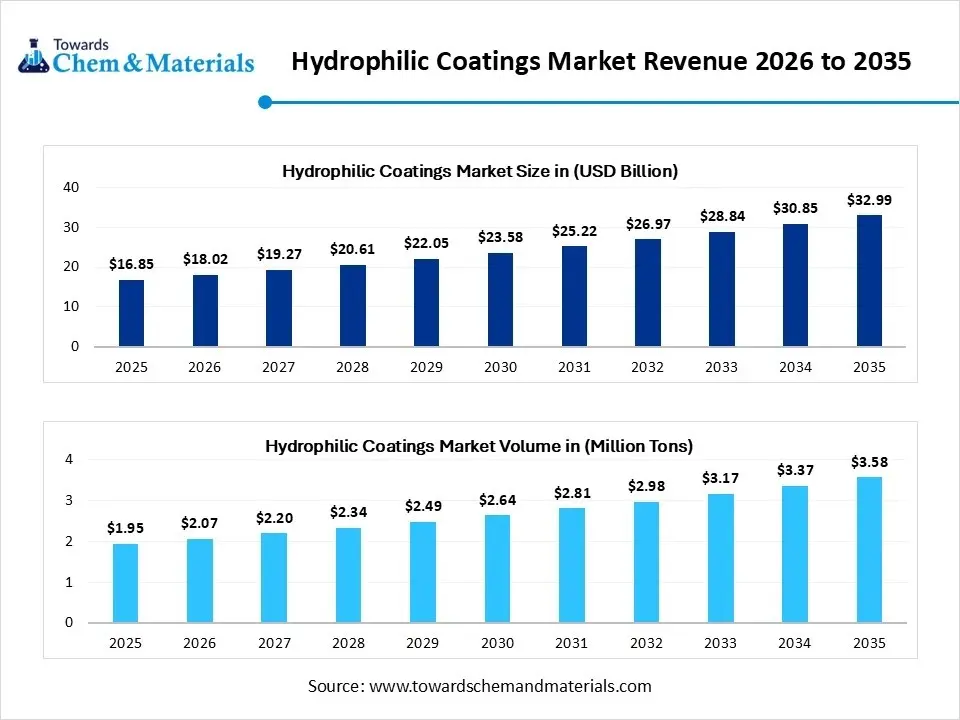
The global hydrophilic coatings market size was estimated at USD 16.85 billion in 2025 and is expected to increase from USD 18.02 billion in 2026 to USD 32.99 billion by 2035, growing at a CAGR of 6.95% from 2026 to 2035 Asia Pacific dominated the hydrophilic coatings market with the largest revenue share of 34% in 2025.In terms of volume, the market is projected to grow from 1.95 million tons in 2025 to 3.58 million tons by 2035. growing at a CAGR of 6.25% from 2026 to 2035.The growth of the market is driven by the growing adoption from various sectors, especially aerospace and consumer goods, which fuel the growth.
Market Highlights
- By region, Asia Pacific dominated the market with a share of 34% in 2025 and is expected to sustain its position while growing with a CAGR of 9.10% in the forecast period. The increase in manufacturing of electronics and automotive components drives growth.
- By region, North America is expected to have the second largest share of 27% in the market and expected to grow notably with CAGR of 7.30% during the forecast period. The increase in the adoption of advanced coating technologies fuels the growth of the market.
- By type, the polymer-based coatings segment dominated the market with 52% share in 2025. The growth is driven by wide adoption in the automotive and medical sectors.
By type, the nanostructured coatings segment held the second largest share of 28% in 2025 and is expected to sustain its position while growing with a CAGR of 9.2% in the forecast period. The growth is driven by its wide applications. - By substrate, the glass segment dominated the market with 38% share in 2025. The increased addition from sectors due to its applications drives growth.
- By substrate, the plastics segment held the second largest share of 28% in 2025 and is expected to have the fastest growth with a CAGR of 8.50% in the forecast period in the market. Its application, like flexible coating and lightweight nature, drives growth.
- By end use industry, the healthcare segment dominated the market with a share of 32% in 2025 and is expected to sustain its position while growing with a CAGR of 8.6% in the forecast period. Its properties, like minimal intervention, drive growth.
- By end use industry, the automotive segment held the second largest share of 24% in 2025. Enhanced visibility and safe coating support growth.
- By technology, the dip coating segment dominated the market with 30% share in 2025. Wide use in medical and industrial applications fuels the growth.
- By technology, the chemical vapor deposition is expected to have the fastest growth with a CAGR of 8.4% in the forecast period. Having performance and durable coating drives the growth of the market.
Market Size and Volume Forecast
- Market Size (2025): USD 16.85 Billion | CAGR (2026–2035): 6.95%
- Market Projected Size (2035): USD 32.99 Billion
- Market Volume (2025): 1.95 Million Tons (MT) | Volume CAGR (2026–2035): 6.25%
- Market Projected Volume (2035): 3.58 Million Tons (MT)
- Market Pricing (2025):
- Average Manufacturing Price: USD 9,075/Ton
- Average Selling Price: USD 11,386/Ton
- Pricing CAGR (2026–2035): 4.14%
Market Overview
What Is The Significance Of The Hydrophilic Coatings Market?
The hydrophilic coatings market is significant for enabling low-friction, biocompatible, and anti-fog surfaces, primarily driving safety and performance in medical devices (catheters, guidewires) and industrial applications. Valued for its role in reducing infection risk and improving device navigation, the market is expanding rapidly, driven by rising demand for minimally invasive surgeries and advances in nanotechnology. Innovations in materials, particularly the integration of nanoparticles and polymers, have improved coating durability and functionality across various substrates.
Market Growth Trends:
- Nanotechnology Integration: The use of nanoparticle-based coatings is accelerating, offering superior lubricity, durability, and better adhesion to stainless steel or nitinol.
- Sustainability and PFAS-Free Solutions: Stricter environmental regulations are driving a shift toward solvent-free and halogen-free primers, with
- Rise of Advanced Deposition Technologies: While dip-coating remains common, plasma and UV-grafting technologies are gaining momentum due to better lumen coverage in catheters and reduced solvent use. For example, new coatings launched in 2025 eliminating the need for PFAS primers.
Report Scope
| Report Attribute | Details |
| Market Size in 2026 | USD 18.02 Billion |
| Revenue Forecast in 2035 | USD 32.99 Billion |
| Growth Rate | CAGR 6.95% |
| Forecast Period | 2026 - 2035 |
| Base Year | 2025 |
| Dominant Region | Asia Pacific |
| Segment Covered | By Type, By Substrate, By Application, By End-Use Industry, By Technology, By Regions |
| Key companies profiled | Surmodics, Inc., Coatings2Go, LLC, Applied Medical Coatings, LLC, Avery Dennison Corporation, Hydromer Inc. , Biocoat Inc., AST Products Inc., Aculon Inc., Surface Solutions Group LLC, DSM Biomedical (dsm-firmenich), Tokyo Ohka Kogyo Co., Ltd., BioInteractions Ltd., Covalon Technologies Ltd., Harland Medical Systems, Inc. |
Key Technological Shifts In The Hydrophilic Coatings Market:
Key technological changes in the hydrophilic coatings sector are driven by the demand for greater durability in medical devices, environmental rules, and the growth of anti-fog and self-cleaning features in automotive and optical products. The industry is moving toward UV-curable, water-based, and PFAS-free formulas to align with strict safety and environmental policies, with nanoparticle innovations boosting performance. Strict regulations, such as the upcoming PFAS restrictions in medical applications, are driving a shift from solvent-based coatings to eco-friendly, VOC-free water-based alternatives.
Trade Analysis Of Hydrophilic Coatings Market: Import & Export Statistics
According to Global Export Data, the world exported 417 Hydrophilic Coating Under HSN Code 59032000 shipments via 28 exporters and 23 buyers.
Top-performing Global Hydrophilic Coating Exporters by volume:
- QUASAR ELECTRONIC TECHNOLOGY DONGG: 4 shipments (29%)
- NIHON PARKERIZING CO. LTD.: 2 shipments (14%)
- HYDROMER INC: 2 shipments (14%)
Hydrophilic Coatings Market -- Supply Chain Analysis
Coating Formulation & Application
- Hydrophilic coatings are produced through the formulation of polymers and surface-active agents, followed by application via spraying, dipping, or plasma coating to enhance wettability, lubrication, and anti-fog properties.
- Key players: DSM, Surmodics, Biocoat, AST Products
Quality Testing and Certification
- Hydrophilic coatings must meet performance standards for wettability, durability, biocompatibility, and safety compliance, especially in medical and industrial applications.
- Key players: ASTM International and UL Solutions
Distribution to Industrial Users
- Hydrophilic coatings are supplied to medical device manufacturers, automotive companies, electronics producers, optical product manufacturers, and industrial equipment suppliers.
- Key players: Surmodics, Biocoat, AST Products.
Hydrophilic Coatings Regulatory Landscape: Global Regulations
| Country / Region | Regulatory Body | Key Regulations | Focus Areas | Notable Notes |
| U.S. | Food and Drug Administration (FDA); Environmental Protection Agency (EPA) | Federal Food, Drug, and Cosmetic Act; Toxic Substances Control Act (TSCA); FDA Medical Device Regulations | Medical device coating safety, chemical compliance, and biocompatibility | Hydrophilic coatings widely used in catheters and guidewires must meet strict FDA biocompatibility and safety standards. |
| Europe | European Medicines Agency (EMA); European Chemicals Agency (ECHA) | Medical Device Regulation (MDR); REACH Regulation | Medical device safety, chemical registration, and patient safety | The EU enforces strict clinical evaluation and chemical safety requirements for hydrophilic-coated medical devices. |
| China | National Medical Products Administration (NMPA); Ministry of Ecology and Environment (MEE) | Medical Device Regulations; Environmental Protection Law | Medical device approval, coating safety, and environmental compliance | China regulates hydrophilic coatings mainly through medical device frameworks, especially for minimally invasive devices. |
| India | Central Drugs Standard Control Organization (CDSCO); Ministry of Environment, Forest and Climate Change (MoEFCC) | Medical Device Rules; Environment Protection Act | Device approval, chemical safety, and environmental monitoring | India is strengthening regulations for coated medical devices and ensuring compliance with safety and quality standards. |
| Japan | Pharmaceuticals and Medical Devices Agency (PMDA); Ministry of Health, Labour and Welfare (MHLW) | Pharmaceutical and Medical Device Act (PMD Act) | Medical device approval, coating performance, safety evaluation | Japan requires stringent testing and approval for coatings used in medical devices, focusing on durability and biocompatibility. |
Segmental Insights
Type Insights
The Polymer-Based Coatings Segment Dominated The Hydrophilic Coatings Market With 52% Market Share In 2025
The polymer-based coatings segment dominated the market with 52% share in 2025, driven by the wide adoption of coatings in medical and automotive applications, supporting the growth of the market. It enables strong adhesion across diverse substrates, increasing the demand from sectors supporting the growth of the market. The key properties, like improved durability and moisture retention performance, are major factors that increase the demand for high-performance materials, driving growth.
The nanostructured coatings segment held the second largest share of 28% in 2025 and is expected to have the fastest growth with a CAGR of 9.2% in the forecast period in the market. Enhanced surface functionality through nanoscale engineering is a major factor that supports the growth of the market. Improved anti-fog and self-cleaning efficiency has gained significant traction in advanced electronics and solar panels, which fuels the growth of the market.
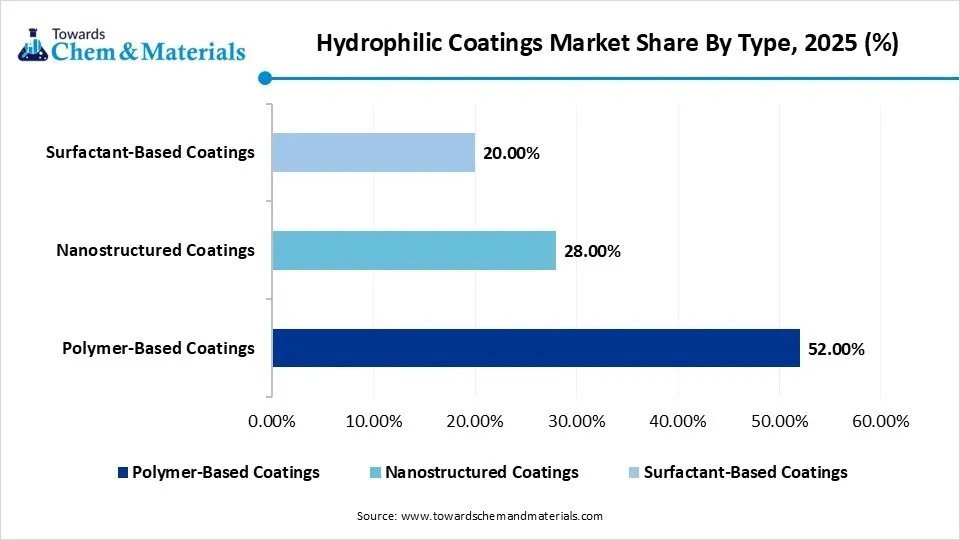
The surfactant-based coatings segment held the third-largest share of 20% in 2025. The reduced surface tension improves wettability and offers cost-effective solutions for large-scale applications, which fuels the growth of the market. These coatings are preferred for their ability to lower the surface tension between water and the substrate. The expanded use in consumer and industrial coatings also further increases the demand for the market, fueling its growth of the market.
Hydrophilic Coatings Market Share By Type, 2025 (%)
| By Type | Revenue Share, 2025 (%) |
| Polymer-Based Coatings | 52.00% |
| Nanostructured Coatings | 28.00% |
| Surfactant-Based Coatings | 20.00% |
- Polymer-Based Coatings lead the market with a share of 52.00%. These coatings are popular due to their durability and effectiveness in various applications, such as medical devices and automotive parts.
- Nanostructured Coatings account for 28.00% of the market. Their advanced properties, including high surface area and enhanced performance, make them ideal for specialized applications in electronics and pharmaceuticals.
- Surfactant-Based Coatings hold 20.00% of the market. These coatings are widely used for their ability to reduce surface tension, improving wettability and adhesion in diverse industries.
Substrate Insights
The Glass Segment Dominated The Hydrophilic Coatings Market With 38% Market Share In 2025
The glass segment dominated the market with 38% share in 2025. The increased adoption of glass in automotive and architectural applications enhances anti-fog and transparency properties, which increases the demand and drives demand in smart windows and solar panels, fueling the growth of the market. The rise in luxury vehicles and electric vehicles (EVs) requires advanced coatings for improved visibility and sensor performance, which fuels the growth of the market.
The plastics segment held the second largest share of 28% in 2025 and is expected to have the fastest growth with a CAGR of 8.50% in the forecast period in the market. The lightweight and flexible coating applications increase the demand for the market. The other application and the extensive increase in use of medical devices and electronics further support the growth of the market. The cost-effective mass production processes also support the growth and expansion of the market.
The metals segment held the third-largest share of 24% in 2025. The increased demand for improved corrosion resistance and lubrication properties increases the demand for the market. It also supports industrial and marine applications, due to increasing demand from the industries, driving the growth of the market. The expanded use of heavy machinery and equipment further supports the growth of the market. The metal substrate segment's strength is driven by the need for hydrophilic coatings that protect metal surfaces, particularly using epoxy-based applications in corrosive environments.
The ceramics segment held the fourth largest share of 10% in 2025. High thermal and chemical resistance properties in the product increase the demand from the industry, fueling the growth of the market. support from niche industrial applications, also increases the demand for the market from the industry, and maintains stable performance under extreme conditions, further supporting the growth and expansion of the market. Ceramics are valued for their high surface energy, which allows for robust adhesion of hydrophilic coating materials, providing long-lasting performance in challenging environments.
Hydrophilic Coatings Market Share By Substrate, 2025 (%)
| By Substrate | Revenue Share, 2025 (%) |
| Glass | 38.00% |
| Metals | 24.00% |
| Plastics | 28.00% |
| Ceramics | 10.00% |
- Glass holds the largest share of the market with 38.00%. Hydrophilic coatings on glass are widely used in applications like optics, medical devices, and architectural glass due to their enhanced surface wettability.
- Metals account for 24.00% of the market. Hydrophilic coatings on metals are used to improve corrosion resistance and surface interactions in industries like automotive and manufacturing.
- Plastics make up 28.00% of the market. These coatings are applied to plastics for enhanced surface properties, including increased adhesion and better moisture resistance in medical and consumer goods.
- Ceramics hold 10.00% of the market. Hydrophilic coatings on ceramics are used primarily in specialized industrial applications, providing improved wettability and durability.
End-Use Industry Insights
The healthcare Segment Dominated the Hydrophilic Coatings Market With 32% Market Share In 2025
The healthcare segment dominated the market with 32% share in 2025 and is expected to have the fastest growth with a CAGR of 8.6% in the forecast period in the market. The increased use of minimally invasive devices in the healthcare sector fuels the demand for the market. Other key factors are improved patient safety and device performance, which fuel the growth of the market. Innovation in catheter and guidewire coatings drives demand for coated, high-performance medical devices.
The automotive segment held the second-largest share of 24% in 2025. The product helps enhance visibility and safety through anti-fog coating, which drives the demand from the automotive sector, supporting the growth of the market. It supports advanced driver-assistance systems, expanding adoption in EV and smart vehicles, further supporting the growth of the market. The growth is driven by increasing adoption in advanced driver-assistance systems (ADAS) and autonomous vehicles (LiDAR).
The construction segment held the third largest share of 18% in 2025. It promotes energy-efficient buildings with self-cleaning glass; its property makes it a preferred choice by industry, which increases the demand for the market. Reducing maintenance costs in infrastructure and increasing demand for smart urban solutions further support the growth of the market. The construction sector's push for "green building" materials and reduced environmental footprints is driving the demand for advanced coating solutions.
The electronics segment held the fourth-largest share of 14% in 2025. The ability to improve display clarity and durability increases the demand for the market due to its applications. enable advanced optical performance, further driving growth. It also drives adoption in consumer electronics and wearables, supporting the growth and expansion of the market. Major manufacturers like Apple, Samsung, and Sony use these coatings to increase durability and screen visibility, particularly in high-touch, water-resistant applications.
Hydrophilic Coatings Market Share By End User, 2025 (%)
| By End-Use | Revenue Share, 2025 (%) |
| Healthcare | 32.00% |
| Automotive | 24.00% |
| Construction | 18.00% |
| Marine | 12.00% |
| Electronics | 14.00% |
- Healthcare leads the market with a share of 32.00%. Hydrophilic coatings are crucial in the medical field for applications like catheters, medical devices, and wound dressings due to their biocompatibility and moisture retention properties.
- Automotive accounts for 24.00% of the market. These coatings are used in automotive components to improve durability, surface interactions, and resistance to environmental factors.
- Construction holds 18.00% of the market. Hydrophilic coatings in the construction industry are applied to surfaces for improved weather resistance and self-cleaning properties in building materials.
- Marine makes up 12.00% of the market. These coatings are used on marine equipment and vessels to reduce friction, improve corrosion resistance, and prevent fouling in harsh marine environments.
- Electronics accounts for 14.00% of the market. Hydrophilic coatings are applied to electronic components to enhance moisture resistance, improving the longevity and performance of devices.
Technology Insights
The Dip Coating Segment Dominated The Hydrophilic Coatings Market With 30% Market Share In 2025
The dip coating segment dominated the market with 30% share in 2025. It provides uniform coating on complex geometries and enables cost-effective large-scale production, as it is widely used in medical and industrial applications, which further expands the growth of the market. Dip coating is uniquely suited to cover complex shapes, such as catheters and intricate, small-diameter medical devices, ensuring a uniform coating thickness across the entire surface.
The spray coating segment held the second-largest share of 22% in 2025. The major growth factors are that it allows flexible and rapid application processes and supports large surface area coverage, which increases the demand for the market. The expanding use in the automotive and construction sectors also further propels the growth of the market. Its flexibility is crucial in the medical, automotive, and consumer goods industries, particularly for coating items unsuitable for immersion.
The chemical vapor deposition segment held the third largest share of 18% in 2025 and is expected to have the fastest growth with a CAGR of 8.4% in the forecast period in the market. It enables high-performance and durable coatings, application with improved adhesion and uniformity at the molecular level, which gains traction in advanced industrial applications, supporting the growth of the market. The technology is considered highly effective for improving durability and surface performance in high-stress environments.
The physical vapor deposition segment held the fourth largest share of 16% in 2025. It provides high-purity and dense coatings, which increases the demand for the market. Enhanced wear resistance and durability are some of the key application and properties which helps the market to grow. Expanded use in precision engineering sectors increases the demand, which significantly drives demand and supports expansion.
Hydrophilic Coatings Market Share By Technology, 2025 (%)
| By Technology | Revenue Share, 2025 (%) |
| Dip Coating | 30.00% |
| Spray Coating | 22.00% |
| Spin Coating | 14.00% |
| Chemical Vapor Deposition (CVD) | 18.00% |
| Physical Vapor Deposition (PVD) | 16.00% |
- Dip Coating leads the market with a share of 30.00%. This technology is widely used due to its simplicity and effectiveness in providing uniform coatings on large surfaces, especially in the medical and automotive industries.
- Spray Coating accounts for 22.00% of the market. It is favored for its flexibility and ability to coat complex and large surfaces, making it ideal for applications in electronics and automotive sectors.
- Spin Coating holds 14.00% of the market. This technology is used for creating thin, uniform coatings, especially in the electronics and semiconductor industries, due to its precision and efficiency.
- Chemical Vapor Deposition (CVD) represents 18.00% of the market. CVD is widely used for high-performance coatings in industries such as aerospace and electronics, providing enhanced material properties and durability.
- Physical Vapor Deposition (PVD) makes up 16.00% of the market. PVD is commonly used to deposit thin, durable films in applications like optics and electronics, where precision and surface quality are critical.
By Application
The market for lithium-ion battery solvents is further segmented by application into Anti-Fog Coatings, Self-Cleaning
Coatings, Anti-Fouling Coatings, and Lubricious Coatings. Among these, Anti-Fog Coatings have emerged as the dominant application due to their widespread use in various industries, including automotive, healthcare, and consumer electronics, where clear visibility is crucial in challenging environments. However, the fastest-growing segment is Self-Cleaning Coatings, driven by an increasing demand for low-maintenance surfaces in sectors like automotive and construction.
These coatings, which offer enhanced durability and ease of maintenance, are gaining traction in markets with harsh environmental conditions. Anti-Fouling Coatings, essential for marine and industrial applications, continue to see steady growth due to their role in preventing biological build-up on surfaces, especially in the maritime industry. Lubricious Coatings, while specialized, cater to the medical and high-tech sectors, offering smooth, friction-reducing properties that are essential for devices requiring precision performance. The market dynamics reflect growing innovation and evolving customer needs across industries.
Hydrophilic Coatings Market Share By Application, 2025 (%)
| By Application | Revenue Share, 2025 (%) |
| Anti-Fog Coatings | 34.00% |
| Self-Cleaning Coatings | 26.00% |
| Anti-Fouling Coatings | 18.00% |
| Lubricious Coatings | 22.00% |
- Anti-Fog Coatings hold the largest share of the market with 34.00%. These coatings are widely used in applications such as eyewear, automotive windows, and medical devices to prevent fogging and enhance visibility.
- Self-Cleaning Coatings account for 26.00% of the market. These coatings are used in a variety of applications, including windows and solar panels, to reduce maintenance and improve cleanliness by utilizing water and environmental factors.
- Anti-Fouling Coatings make up 18.00% of the market. These coatings are commonly applied in marine environments to prevent the growth of marine organisms on surfaces like ships and underwater structures.
- Lubricious Coatings represent 22.00% of the market. These coatings are used in medical devices and industrial applications to reduce friction and wear, enhancing the performance and longevity of components.
Regional Insights
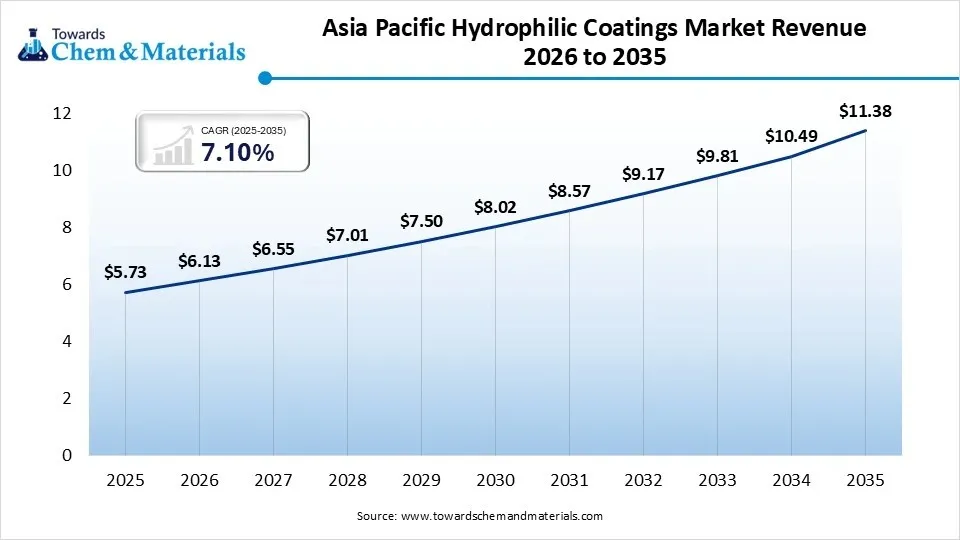
The Asia Pacific hydrophilic coatings market size was valued at USD 5.73 billion in 2025 and is expected to be worth around USD 11.38 billion by 2035, exhibiting at a compound annual growth rate (CAGR) of 7.10% over the forecast period from 2026 to 2035.Asia Pacific dominated the market with a share of 34% in 2025 and is expected to sustain its position while growing with a CAGR of 9.10% in the forecast period, driven primarily by high demand for medical devices (catheters, guidewires), advanced optical components, and automotive applications. The rapid expansion of medical device manufacturing, particularly in China, Japan, India, and Singapore, is a major driver, with increased use of coatings to improve device lubricity and biocompatibility.
India Hydrophilic Coatings Market Growth Factor
The Indian hydrophilic coatings market is driven by rapid growth in the medical device, automotive, and infrastructure sectors. Key growth factors include rising demand for biocompatible, anti-fog coatings, increased adoption of minimally invasive procedures, and enhanced, durable surfaces that improve product longevity and performance. A growing focus on eco-friendly and bio-based, sustainable coatings to meet regulatory standards.
North America Hydrophilic Coatings Market Growth Factor
North America is expected to have the second-largest share of 27% in 2025, and expected to grow notably with the CAGR of 7.30% during the forecast period. Driven primarily by the rising demand for advanced medical devices, catheters, and guidewires, alongside a robust automotive sector. The increasing prevalence of chronic diseases and a growing elderly population requiring medical intervention are driving product innovation and usage in North America.
U.S. Hydrophilic Coatings Market Growth Factor
The U.S. hydrophilic coatings market is driven by high demand for lubricious medical devices (catheters, guidewires), rising minimally invasive surgeries, an aging population, and adoption in automotive/optics for anti-fog, high-durability surfaces. The surge in interventional cardiology and urology procedures requires coatings that reduce friction, improve catheter and stent insertion, driving significant market expansion.
Hydrophilic Coatings Market Share, By Regional, 2025 (%)
| Regional | Revenue Share, 2025 (%) |
| North America | 27.00% |
| Europe | 24.00% |
| Asia-Pacific | 34.00% |
| Latin America | 8.00% |
| Middle East & Africa | 7.00% |
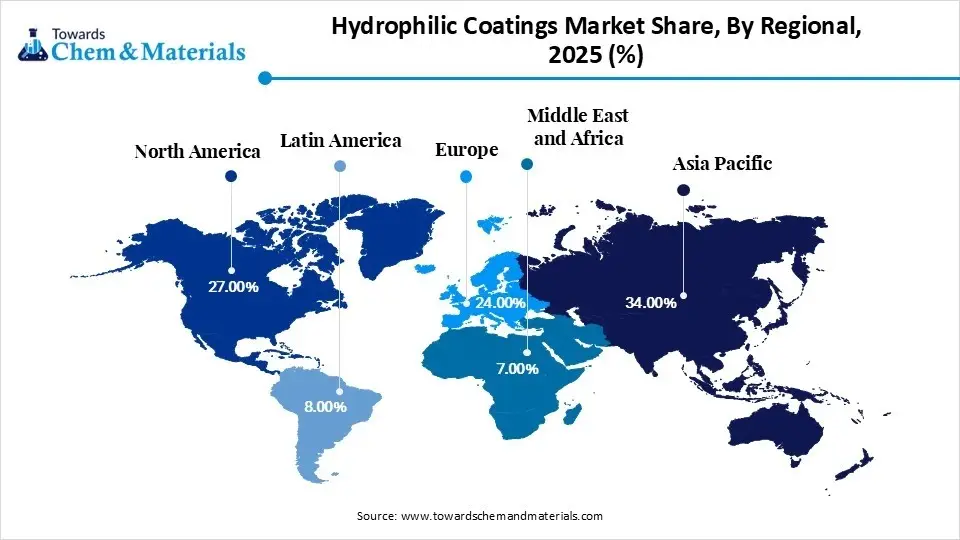
- Asia-Pacific dominates the hydrophilic coatings market with a 34.00% share, driven by the rapid industrialization and increasing demand for advanced coatings in sectors such as automotive, medical devices, and electronics in countries like Japan, China, and South Korea.
- North America holds a significant 27.00% share, supported by strong adoption in healthcare applications, particularly in medical devices, as well as in the automotive and consumer electronics industries.
- Europe accounts for 24.00% of the market, where stringent regulations and a focus on innovation in sectors like healthcare, automotive, and electronics are contributing to the growth of hydrophilic coatings.
- Latin America represents 8.00% of the market, with demand primarily driven by the growing healthcare and industrial sectors, although the market remains smaller compared to other regions.
- Middle East & Africa holds the smallest market share at 7.00%, with the growth driven by increased applications in the healthcare and industrial sectors, though the overall adoption rate is still relatively low.
Recent Developments
- In February 2026, Freudenberg Medical launched LUBRITEQ™, a high-performance, UV-curable hydrophilic coating designed for medical devices that features an "ultra-low particulate" formulation for enhanced safety. The product differentiates itself through a disruptive commercial model that eliminates royalties, annual fees, and regulatory access charges.(Source: manufacturingchemist.com)
Top players in the Hydrophilic Coatings Market & Their Offerings:
- Surmodics, Inc.: Surmodics is a leading provider of hydrophilic coatings primarily for medical devices such as catheters, guidewires, and stents. The company specializes in advanced surface modification technologies that improve lubricity, biocompatibility, and device performance in minimally invasive procedures.
- Coatings2Go, LLC: Coatings2Go supplies hydrophilic coatings and application services for medical and industrial markets. The company focuses on cost-effective solutions for improving surface properties and product performance.
- Applied Medical Coatings, LLC: Applied Medical Coatings provides custom hydrophilic coating services for medical devices, improving lubricity and durability. The company supports OEMs with tailored coating solutions.
- Avery Dennison Corporation: Avery Dennison offers specialty coatings, including hydrophilic coatings used in industrial and healthcare applications. The company leverages its expertise in materials science to develop innovative surface technologies.
- Hydromer Inc.
- Biocoat Inc.
- AST Products Inc.
- Aculon Inc.
- Surface Solutions Group LLC
- DSM Biomedical (dsm-firmenich)
- Tokyo Ohka Kogyo Co., Ltd.
- BioInteractions Ltd.
- Covalon Technologies Ltd.
- Harland Medical Systems, Inc.
Segments Covered:
By Type
- Polymer-Based Coatings
- Polyvinylpyrrolidone (PVP)
- Polyethylene Glycol (PEG)
- Polyurethane
- Nanostructured Coatings
- Silica-Based
- Titanium Dioxide-Based
- Surfactant-Based Coatings
- Non-Ionic Surfactants
- Ionic Surfactants
By Substrate
- Glass
- Architectural Glass
- Automotive Glass
- Metals
- Stainless Steel
- Aluminum
- Plastics
- Polycarbonate
- Polyethylene Terephthalate (PET)
- Ceramics
By Application
- Anti-Fog Coatings
- Automotive
- Optical Devices
- Self-Cleaning Coatings
- Solar Panels
- Building Surfaces
- Anti-Fouling Coatings
- Marine
- Medical Devices
- Lubricious Coatings
- Catheters
- Guidewires
By End-Use Industry
- Healthcare
- Medical Devices
- Surgical Instruments
- Automotive
- Windshields
- Mirrors
- Construction
- Facades
- Windows
- Marine
- Electronics
- Displays
- Optical Components
By Technology
- Dip Coating
- Spray Coating
- Spin Coating
- Chemical Vapor Deposition (CVD)
- Physical Vapor Deposition (PVD)
By Regions
- North America
- U.S.
- Canada
- Mexico
- Europe
- Germany
- UK
- France
- Italy
- Spain
- Asia Pacific
- China
- India
- Japan
- South Korea
- Latin America
- Brazil
- Argentina
- Middle East & Africa
- Saudi Arabia
- South Africa
FAQ's
Question 1 : What is the current size and projected growth of the global hydrophilic coatings market?
Answer : The global hydrophilic coatings market is estimated at USD 16.85 billion in 2025, expected to grow to USD 32.99 billion by 2035, with a CAGR of 6.95% from 2026 to 2035.
Question 2 : Which regions are leading the hydrophilic coatings market and why?
Answer : Asia Pacific dominates with a 34% share in 2025, driven by increased demand in the electronics, automotive, and medical sectors, while North America holds the second-largest share at 27%, driven by medical and automotive growth.
Question 3 : What are the key types and applications driving growth in the hydrophilic coatings market?
Answer : Polymer-based coatings dominate with a 52% share, while nanostructured coatings are the fastest-growing segment at 9.2% CAGR. Major applications include anti-fog coatings in automotive and medical devices, and self-cleaning coatings in construction and solar panels.
Question 4 : How are technological advancements like dip coating and chemical vapor deposition shaping the hydrophilic coatings market?
Answer : Dip coating leads the market with a 30% share due to its cost-effectiveness and uniform coating on complex shapes, while chemical vapor deposition (CVD) is expected to grow at the fastest rate, providing durable and high-performance coatings for industrial applications.
Meet the Team
Towards Chemical & Materials
Saurabh Bidwai, a B.Tech Chemical Engineering graduate with 4+ years of experience, specializes in specialty chemicals, commodity chemicals, and engineered materials, offering valuable insights into market trends and emerging opportunities.

Aditi Shivarkar
Reviewed By
Aditi Shivarkar, with 14+ years in Chemical and Materials market research, specializes in Chemical and Materials. She ensures accurate, actionable insights, driving Towards Chemicals And Materials Analytics and Consulting excellence in industry trends and sustainability.