
Industrial Fasteners Market Size, Production Volume, Sales Performance, Export & Import Dynamics, Adoption Rates, Recycling Rate, Material Efficiency, Market Share Analysis, and Demand Trends
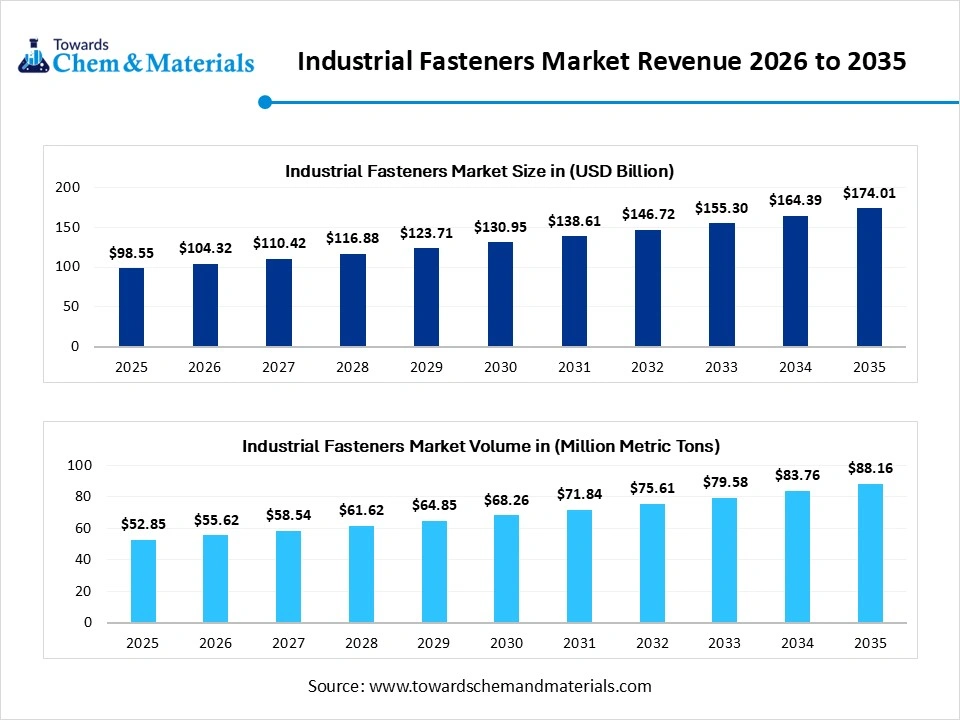
The industrial fasteners market is projected to grow from USD 98.55 billion in 2025 to USD 104.32 billion in 2026 and reach USD 174.01 billion by 2035, at a CAGR of 5.85% during the forecast period. Volume-wise, the market will increase from 52.85 million metric tons in 2025 to 88.16 million metric tons by 2035, with a CAGR of 5.25%. This report includes detailed segmentation data, regional trends, and analysis across major geographies. It further examines key companies, competitive positioning, value chain structure, and trade insights, along with in-depth manufacturers and suppliers data. Market expansion is fueled by strong demand across automotive, aerospace, and construction industries and increasing global infrastructure development.
Content
Industrial Fasteners Market Size, Share, Trends and Forecast Analysis
The global industrial fasteners market was valued at USD 98.55 billion in 2025, is estimated to reach USD 104.32 billion in 2026, and is projected to reach USD 174.01 billion by 2035, growing at a CAGR of 5.85% from 2026 to 2035. In terms of volume, the industrial fasteners market is projected to grow from 52.85 million metric tons in 2025 to 88.16 million metric tons by 2035. growing at a CAGR of 5.25% from 2026 to 2035. The growth of the market is driven by the rising demand from the automotive, construction, and aerospace industries, increasing infrastructure investments, and the adoption of lightweight materials in electric vehicles.
Key Takeaways
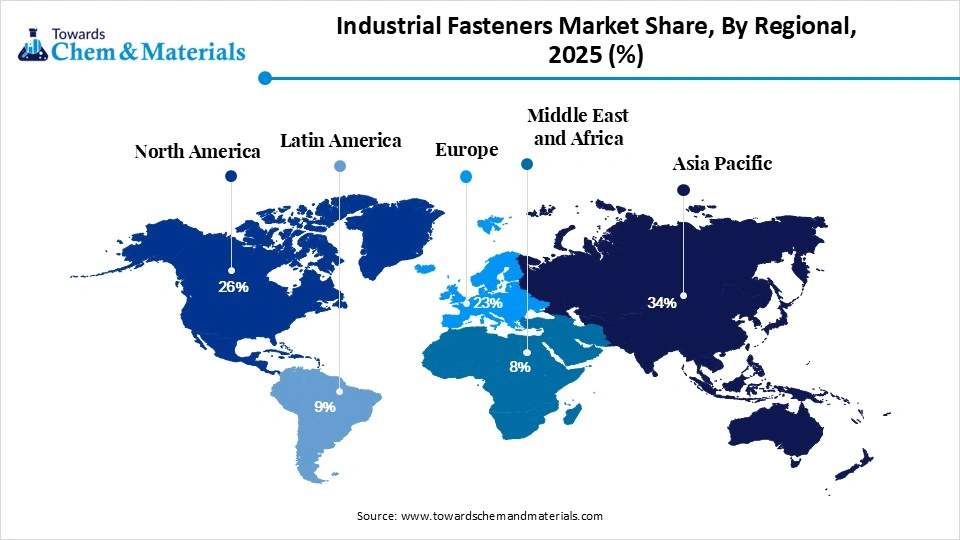
- By region, Asia Pacific dominated the market with a share of 34% in 2025 and is expected to sustain its position while growing with a CAGR of 6.7% in the forecast period.
- By region, North America held the market share of 26% in 2025.
- By product type, the Externally Threaded Fasteners segment dominated the market with 46% share in 2025.
- By product type, the Non-threaded Fasteners segment held 26% market share in 2025 and is expected to have the fastest growth with a CAGR of 6.2% in the forecast period.
- By raw material, the Metal Fasteners segment dominated the market with 72% share in 2025.
- By raw material, the Plastic Fasteners segment held 18% market share in 2025 and is expected to have the fastest growth with a CAGR of 6.6% in the forecast period.
- By coating type, the Zinc Coating segment dominated the market with 41% share in 2025.
- By coating type, the others segment held 15% market share in 2025 and is expected to have the fastest growth with a CAGR of 6.4% in the forecast period.
- By application, the Automotive segment dominated the market with 32% share in 2025.
- By application, the Aerospace segment held 9% market share in 2025 and is expected to have the fastest growth with a CAGR of 6.8% in the forecast period.
- By distribution channel, the direct sales segment dominated the market with 44% share in 2025.
- By distribution channel, the online sales segment held 20% market share in 2025 and is expected to have the fastest growth with a CAGR of 7.2% in the forecast period.
Market Size and Volume Forecast
- Market Estimated Size (2026): USD 104.32 Billion | CAGR (2026–2035): 5.85%
- Market Projected Size (2035): USD 174.01 Billion
- Market Volume (2025): 52.85 Million Metric Tons | Volume CAGR (2026–2035): 5.25%
- Market Projected Volume (2035): 88.16 Million Metric Tons
- Market Pricing (2025):
- Average Manufacturing Price: USD 1.65/kg
- Average Selling Price: USD 2.95/kg
- Pricing CAGR (2025–2035): 3.15%
- Average Manufacturing Price: USD 1.65/kg
Market Overview
What Is The Significance Of The Industrial Fasteners Market?
The industrial fasteners market is highly significant, due to its critical role in assembling components across industries like automotive, construction, and aerospace. These "unsung heroes" are indispensable for structural integrity, safety, and durability in everything from cars to infrastructure, driving innovation through lightweight and high-strength materials. The industry is moving toward smart fasteners with sensors and high-precision, lightweight, and eco-friendly materials to match advancements in manufacturing technology and electric vehicle (EV) demand.
Industrial Fasteners Market Growth Trends:
- Material Innovation: There is an increased focus on high-strength, lightweight materials like titanium and specialized plastics to enhance performance and corrosion resistance.
- Aerospace & Renewables: The aerospace sector is driving demand for specialized, high-temperature fasteners, while the renewable energy sector (wind/solar) is increasing demand for heavy-duty fasteners.
- EV and Automotive Growth: The surge in EV production and traditional vehicle manufacturing is driving demand for advanced fasteners that are lighter and more durable, notes.
Report Scope
| Report Attribute | Details |
| Market Size and Volume in 2026 | USD 104.32 Billion / 55.62 Million Metric Tons |
| Expected Size and Volume by 2035 | USD 174.01 Billion / 88.16 Million Metric Tons |
| Growth Rate from 2026 to 2035 | CAGR 5.85% |
| Forecast Period | 2026 - 2035 |
| Dominant Region | Asia-Pacific |
| Segment Covered | By Product Type, By Raw Material, By Coating Type, By Application, By Distribution Channel and By Region |
| Key companies profiled | Illinois Tool Works, Inc., Arconic Fastening Systems and Rings, Hilti Corporation, LISI Group - Link Solutions for Industry, Nifco Inc, MW Industries, Inc., Birmingham Fastener and Supply, Inc., SESCO Industries, Inc., Elgin Fastener Group LLC, Slidematic, Dokka Fasteners A S, Manufacturing Associates, Inc., Eastwood Manufacturing, ATF, Inc. |
Key Technological Shifts In The Industrial Fasteners Market:
The industrial fasteners market is shifting toward smart, lightweight, and automated solutions to enhance performance and efficiency. Key trends include the integration of sensors for real-time monitoring, the use of advanced materials (titanium, composites) for weight reduction, and the adoption of AI and robotics in assembly, particularly for electric vehicles (EVs) and aerospace. A shift away from standard metal fasteners towards specialized, lightweight materials like titanium and advanced alloys, driven by the demand for fuel-efficient vehicles and lighter aircraft.
Supply Chain Analysis of Industrial Fasteners Market:
Fastener Manufacturing & Processing
Industrial fasteners such as bolts, nuts, screws, rivets, and washers are produced through metal forming processes, including forging, machining, threading, heat treatment, and surface coating, to ensure strength and durability.
- Key players: Stanley Black & Decker, Illinois Tool Works, Bossard Group, Nifco
Quality Testing and Certification
Industrial fasteners must meet standards for tensile strength, corrosion resistance, dimensional accuracy, and load-bearing capacity for safe industrial use.
- Key players: International Organization for Standardization, ASTM International, SAE International, International Fastener Institute
Distribution to Industrial Users
Industrial fasteners are supplied to automotive manufacturers, aerospace companies, construction firms, machinery producers, and electronics industries.
- Key players: Stanley Black & Decker, Illinois Tool Works, Bossard Group.
Industrial Fasteners Regulatory Landscape: Global Regulations
| Country / Region | Regulatory Body | Key Regulations | Focus Areas | Notable Notes |
| United States | American Society for Testing and Materials (ASTM); Occupational Safety and Health Administration (OSHA); American Society of Mechanical Engineers (ASME) | ASTM Standards; ASME Boiler & Pressure Vessel Code; OSHA Safety Standards | Product standardization, mechanical performance, and workplace safety | Industrial fasteners must comply with ASTM and ASME standards for strength, durability, and safety, especially in construction, aerospace, and machinery applications. |
| European Union | European Committee for Standardization (CEN); European Commission | EN Standards; Construction Products Regulation (CPR); CE Marking | Product certification, structural safety, quality compliance | The EU mandates CE marking and EN compliance for fasteners used in construction and industrial applications to ensure structural integrity. |
| China | Standardization Administration of China (SAC); Ministry of Industry and Information Technology (MIIT) | GB Standards (Guobiao); Industrial Product Quality Laws | Product quality, manufacturing standards | China enforces national standards for fastener manufacturing to ensure product consistency and industrial safety. |
| India | Bureau of Indian Standards (BIS); Ministry of Steel | BIS Standards (IS codes); Quality Control Orders (QCOs) | Quality certification, industrial compliance | India mandates BIS certification for certain fastener categories to ensure quality and reliability in infrastructure and industrial usage. |
| Japan | Japanese Industrial Standards Committee (JISC) | Japanese Industrial Standards (JIS) | Product standardization, quality assurance | Japan enforces strict JIS standards for fasteners, especially for the automotive and electronics industries, requiring high precision. |
| Germany | Deutsches Institut für Normung (DIN) | DIN Standards; ISO Standards | Precision engineering, industrial quality | Germany is known for high-precision fasteners, with DIN standards widely adopted globally for engineering and manufacturing applications. |
Market Dynamics
Drivers
What are the Key Growth Drivers of the Industrial Fasteners Market?
The industrial fasteners market is primarily driven by rising demand in the automotive, especially electric vehicles, construction, and aerospace industries, alongside rapid industrial automation and infrastructure development. The market is also fueled by the need for lightweight materials, high-strength, and specialized, customized fasteners. The adoption of 3D printing (SLA) for complex components and the development of "smart" fasteners with sensors to monitor structural integrity are spurring innovation and growth.
Restrains
What are the Key Growth Restraints of the Industrial Fasteners Market?
Key growth constraints for the industrial fasteners market include fluctuating raw material prices (steel, aluminum, titanium), the rise of alternative joining technologies (adhesives, tapes, welding), and high manufacturing costs driven by strict quality standards. These factors create cost pressure and competition, particularly from lightweight and, at times, more efficient fastening alternatives. Fasteners are highly dependent on steel, aluminum, and titanium. Unstable prices for these materials, driven by global trade issues and energy costs, disrupt production costs and profit margins.
Opportunities
What are the Key Growth Opportunities of the Industrial Fasteners Market?
The industrial fasteners market is driven by rapid expansion in electric vehicles (EVs), aerospace, and renewable energy infrastructure. Key growth opportunities include the development of lightweight, high-strength materials, advanced anti-corrosion coatings, and tailored, high-precision, or smart fastening solutions for specialized industrial applications. The rapid installation of solar panels and wind turbines requires massive amounts of durable, corrosion-resistant, and high-strength fasteners. The renewable energy sector is a major growth driver with high-margin, long-term contracts.
Segmental Insights
Product Type Insights
The Externally Threaded Fasteners Segment Dominated the Market With 46% Market Share in 2025
The externally threaded fasteners segment dominated the market with 46% share in 2025, driven by high demand for superior clamping force and reliability in automotive production, heavy machinery, and infrastructure projects. Their dominance is further fueled by ease of installation, reusability, and advancements in vibration-resistant designs. Modern fasteners feature improved surface treatments for corrosion resistance and self-locking capabilities to withstand high vibration in industrial environments.
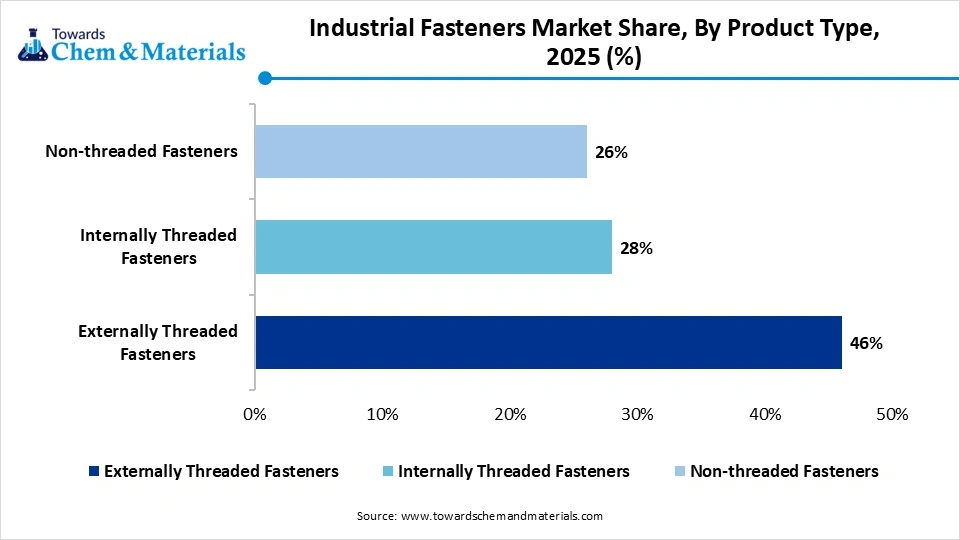
The Internally Threaded Fasteners segment held 28% market share in 2025, driven by high demand from the automotive, aerospace, and construction sectors, along with advancements in specialized, vibration-resistant designs. Enhanced designs provide superior performance in high-vibration environments, crucial for modern machinery. The adoption of automated assembly, such as robotics, favors high-precision internally threaded products.
The Non-threaded Fasteners segment held 26% market share in 2025 and is expected to have the fastest growth with a CAGR of 6.2% in the forecast period, driven by the demand for rapid assembly, reduced weight, and lower costs. Key growth drivers include the shift toward lightweight materials in the automotive industry, widespread use in construction, and adoption of automated, high-precision assembly lines.
Raw Material Insights
The Metal Fasteners Segment Dominated The Market With 72% Market Share In 2025
The Metal Fasteners segment dominated the market with 72% share in 2025, due to unparalleled strength, reliability, and high-load bearing capacity. Metal fasteners offer essential durability, fatigue resistance, and high tensile strength needed for heavy machinery and critical structural applications. Growing construction projects, including smart cities and infrastructure development, necessitate vast quantities of metal fastening solutions.
The Plastic Fasteners segment held 18% market share in 2025 and is expected to have the fastest growth with a CAGR of 6.6% in the forecast period, driven by the urgent need for lightweight, cost-effective, and corrosion-resistant alternatives to metal in automotive, electronics, and construction industries. Plastic fasteners offer, in many cases, superior chemical resistance, non-conductivity (insulation), rustproof properties, and vibration damping compared to metal.
Coating Type Insights
The Zinc Coating segment dominated the market with 41% market share in 2025
The Zinc Coating segment dominated the market with 41% share in 2025, driven primarily by demand for high-performance corrosion protection in automotive and construction sectors. Zinc flake coatings provide exceptional resistance to salt spray and harsh environments without causing hydrogen embrittlement in high-strength bolts. The shift toward electric vehicles (EVs) and lightweighting requires advanced, durable, and thin protective layers, accelerating the adoption of specialized zinc coatings.
Industrial Fasteners Market Share, By Coating Type, 2025 (%)
| By Coating Type | Revenue Share, 2025 (%) |
| Zinc Coating | 41% |
| Black Oxide | 14% |
| Chrome Coating | 12% |
| Phosphate Coating | 18% |
| Others | 15% |
The Phosphate Coating segment held 18% market share in 2025, due to rising demand for superior corrosion resistance, enhanced paint adhesion, and increased wear resistance in the automotive and construction sectors. Driven by electric vehicle (EV) production and high-strength steel usage, this cost-effective, durable coating is becoming essential for high-performance applications. The industry is moving away from hazardous treatments toward eco-friendly alternatives.
The other segment held 15% market share in 2025 and is expected to have the fastest growth with a CAGR of 6.4% in the forecast period. The other segment includes Nickel Coating and Ceramic Coating. The nickel coating segment is growing significantly in the market, driven by urgent demand for superior corrosion resistance and durability in automotive and aerospace applications. The ceramic coating segment in the industrial fasteners market is growing rapidly, driven by the need for superior protection against extreme temperatures, high corrosion, and abrasion, particularly in automotive, aerospace, and energy sectors.
The black oxide segment held 14% market share in 2025, growing rapidly due to its cost-effective corrosion resistance, minimal dimensional change, and aesthetic appeal in the automotive and machinery sectors. This coating, which prevents hydrogen embrittlement, is highly valued for precision components and is increasingly used in robotics and renewable energy applications.
Application Insights
The Automotive Segment Dominated The Market With 32% Market Share In 2025
The automotive segment dominated the market with 32% share in 2025, through rising global vehicle production, the rapid adoption of electric vehicles (EVs), and a push for lightweight, high-performance fastening solutions. Increased complexity in vehicle assembly and higher demand for specialized fasteners in EV battery packs and structural components is accelerating this growth.
The Construction segment held 24% market share in 2025, due to rapid urbanization, rising infrastructure investments, and increased residential/commercial projects globally. This surge is driven by demand for durable fasteners in projects like smart highways, smart cities, and renovations, particularly in the Asia-Pacific and emerging economies.
Industrial Fasteners Market Share, By Application, 2025 (%)
| By Application | Revenue Share, 2025 (%) |
| Automotive | 32% |
| Construction | 24% |
| Machinery & Equipment | 16% |
| Aerospace | 9% |
| Electronics | 11% |
| Others | 8% |
The Machinery & Equipment segment held 16% market share in 2025, due to rapid industrialization, the need for increased efficiency in manufacturing, and technological upgrades, with heavy machinery and industrial equipment accounting for about 10–12% of total fastener consumption. This growth is propelled by demand for high-performance components in automation, robotics, and the modernization of aging factory infrastructure.
The Electronics segment held 10% market share in 2025, with rapid demand for specialized, miniature, and high-precision fasteners used in smart devices, consumer electronics, and electric vehicle (EV) components. The adoption of Industry 4.0, which drives the need for sensors and IoT devices, further accelerates this growth by requiring fasteners that support smart manufacturing systems.
The Aerospace segment held 9% market share in 2025 and is expected to have the fastest growth with a CAGR of 6.8% in the forecast period, driven by rising aircraft production, defense modernization, and high demand for lightweight materials. Key growth factors include fleet expansion by low-cost carriers, increased maintenance (MRO) activity, and the adoption of advanced titanium/composite-compatible fasteners.
Distribution Channel Insights
The Direct Sales Segment Dominated The Market With 44% Market Share In 2025
The Direct Sales segment dominated the market with 44% share in 2025, driven by OEM demands for customization, quality assurance, and supply chain efficiency, with direct channels growing at the highest rate. Manufacturers are bypassing distributors to offer tailored solutions, vendor-managed inventory (VMI), and just-in-time delivery to sectors like automotive and aerospace.
Industrial Fasteners Market Share, By Distribution Channel, 2025 (%)
| By Distribution Channel | Revenue Share, 2025 (%) |
| Direct Sales | 44% |
| Distributors | 36% |
| Online Sales | 20% |
The Distributors segment held 36% market share in 2025, growing rapidly by providing essential, localized access to a vast variety of components for small-to-medium-sized buyers, filling the gap left by direct manufacturer-to-client sales. They drive growth through JIT (Just-In-Time) delivery, inventory management, and tailored technical support across sectors like construction and automotive. Distributors provide smaller, regional industrial players with immediate access to products, overcoming the limitations of large, centralized manufacturers.
The online sales segment held 20% market share in 2025 and is expected to have the fastest growth with a CAGR of 7.2% in the forecast period, driven by the convenience of 24/7 procurement, easier inventory management, and wider access to specialized products. This shift is fueled by the need for faster, more efficient sourcing in construction and manufacturing, and the ability to easily purchase in bulk from digital platforms.
Regional Insights
How did Asia Pacific Dominate the Industrial Fasteners Market in 2025?
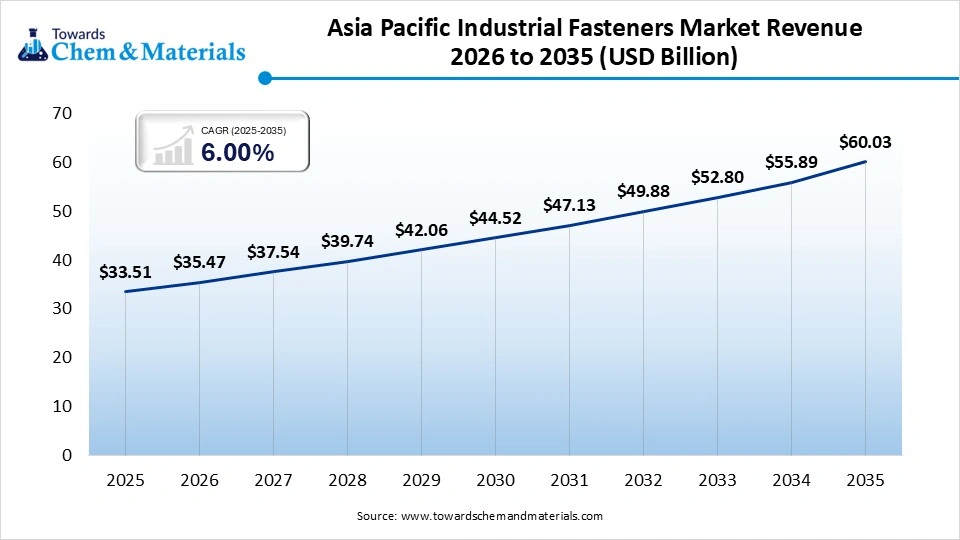
The Asia Pacific global industrial fasteners market size was estimated at USD 33.51 billion in 2025 and is projected to reach USD 60.03 billion by 2035, growing at a CAGR of 6% from 2026 to 2035, driven by rapid industrialization, booming automotive and construction sectors, and massive manufacturing, particularly in China, India, and Japan. The shift towards EVs in the region spurred massive demand for lightweight, specialized threaded fasteners and high-strength fasteners for battery enclosures. The market in this region continues to see high investment in automated production facilities to meet the stringent precision requirements of modern machinery, electronics, and transportation industries.
India Industrial Fasteners Market Growth Factor
The Indian industrial fasteners market is experiencing strong growth, surging demand from the automotive, including EV sector, rapid infrastructure development, "Make in India" manufacturing initiatives, and expansion in aerospace and renewable energy. Increased government and private investment in roads, railways, and industrial construction is driving demand for high-strength fasteners. Rising disposable incomes, growing urban populations, and industrial development create consistent demand for assembly components.
North America Industrial Fasteners Market Growth Factor
North America held the market share of 26% in 2025, with rising automotive production specifically EVs, robust construction activity, aerospace demand, and adoption of lightweight/high-strength materials, with the U.S. holding the largest share. The growing automotive sector, particularly the rapid increase in electric vehicle (EV) production, is a primary driver. EVs require specialized, lightweight fasteners, boosting demand for high-strength, corrosion-resistant, and non-metal materials.
U.S. Industrial Fasteners Market Growth Factor
The U.S. industrial fasteners market is projected to grow, driven by a booming automotive production, especially electric vehicles, infrastructure investment, aerospace recovery, and the adoption of lightweight plastic fasteners. The rise of automation in manufacturing necessitates precision fasteners suitable for robotic assembly. Federal investments in infrastructure, including repairs to bridges, roads, and new construction, significantly drive demand for structural fasteners.
Recent Developments
- In March 2026, Messe Stuttgart India launched the FASTNEX 2027 Signature Edition, a premier trade fair scheduled for February 8-10, 2027, at the Bombay Exhibition Centre to support India’s growing fastener market. Projected to reach USD 17 billion by 2034, the market growth is driven by increasing demand in the automotive, construction, and EV sectors.
- In March 2026, Hebei Chudu Metal Products Co., Ltd. launched a high-performance self-tapping screw series designed for the global construction and automotive sectors, featuring ISO9001-certified precision manufacturing and specialized heat treatment. The new fasteners are engineered for high-speed automated assembly, offering options in stainless and carbon steel to support OEM/ODM requirements.
Top players in the Industrial Fasteners Market & Their Offerings:
- Stanley Black & Decker, Inc.: Stanley Black & Decker provides industrial fastening systems through its industrial segment. The company offers fasteners for construction, automotive, and heavy machinery, supported by a global manufacturing and distribution network.
- SFS Group AG: SFS Group specializes in precision components and fastening systems used in construction, automotive, and electronics. The company operates globally with a strong focus on engineered fastening solutions and innovation.
- Acument Global Technologies: Acument provides engineered fastening solutions, including externally and internally threaded fasteners. The company serves automotive, industrial, and heavy equipment sectors globally.
- Würth Group: Würth Group is a major distributor of fasteners and assembly materials. The company supplies a wide range of screws, bolts, and fastening solutions to the industrial and construction sectors.
- Bossard Group: Bossard provides fastening technology and logistics solutions, offering high-quality fasteners along with supply chain optimization services for industrial clients
Industrial Fasteners Market Top Players
- Illinois Tool Works, Inc.
- Arconic Fastening Systems and Rings
- Hilti Corporation
- LISI Group - Link Solutions for Industry
- Nifco Inc
- MW Industries, Inc.
- Birmingham Fastener and Supply, Inc.
- SESCO Industries, Inc.,
- Elgin Fastener Group LLC
- Slidematic
- Dokka Fasteners A S
- Manufacturing Associates, Inc.
- Eastwood Manufacturing
- ATF, Inc.
Industrial Fasteners Market Segments Covered:
By Product Type
- Externally Threaded Fasteners
- Bolts
- Hex Bolts
- Carriage Bolts
- Structural Bolts
- Screws
- Machine Screws
- Self-tapping Screws
- Wood Screws
- Studs
- Bolts
- Internally Threaded Fasteners
- Nuts
- Hex Nuts
- Lock Nuts
- Wing Nuts
- Threaded Inserts
- Nuts
- Non-threaded Fasteners
- Rivets
- Blind Rivets
- Solid Rivets
- Pins
- Dowel Pins
- Cotter Pins
- Washers
- Flat Washers
- Spring Washers
- Rivets
By Raw Material
- Metal Fasteners
- Steel
- Carbon Steel
- Alloy Steel
- Stainless Steel
- Aluminum
- Brass
- Titanium
- Steel
- Plastic Fasteners
- Nylon
- Polycarbonate
- PTFE
- Others
-
- Composite Fasteners
- Ceramic Fasteners
-
By Coating Type
- Zinc Coating
- Electroplated Zinc
- Hot-dip Galvanized
- Black Oxide
- Chrome Coating
- Phosphate Coating
- Others
- Nickel Coating
- Ceramic Coating
By Application
- Automotive
- Passenger Vehicles
- Commercial Vehicles
- Electric Vehicles
- Construction
- Residential
- Commercial
- Infrastructure
- Machinery & Equipment
- Industrial Machinery
- Agricultural Equipment
- Aerospace
- Electronics
- Others
- Marine
- Energy
By Distribution Channel
- Direct Sales
- OEM Contracts
- Bulk Industrial Supply
- Distributors
- Authorized Distributors
- Independent Dealers
- Online Sales
- E-commerce Platforms
- Company Websites
By Region
- North America:
- U.S.
- Canada
- Mexico
- Rest of North America
- Latin America:
- Brazil
- Argentina
- Rest of Latin America
- Europe:
- Western Europe
- Germany
- Italy
- France
- Netherlands
- Spain
- Portugal
- Belgium
- Ireland
- UK
- Iceland
- Switzerland
- Poland
- Rest of Western Europe
- Eastern Europe
- Austria
- Russia & Belarus
- Türkiye
- Albania
- Rest of Eastern Europe
- Asia Pacific:
- China
- Taiwan
- India
- Japan
- Australia and New Zealand,
- ASEAN Countries (Singapore, Malaysia)
- South Korea
- Rest of APAC
- MEA:
- GCC Countries
- Saudi Arabia
- United Arab Emirates (UAE)
- Qatar
- Kuwait
- Oman
- Bahrain
- South Africa
- Egypt
- Rest of MEA
- GCC Countries
FAQ's
Question 1 : What is the expected growth rate of the industrial fasteners market?
Answer : The market is expected to grow at a CAGR of 5.85% from 2026 to 2035 in terms of value, while volume is projected to grow at a CAGR of 5.25% during the same period.
Question 2 : What are industrial fasteners and why are they important?
Answer : Industrial fasteners are mechanical components such as bolts, nuts, screws, rivets, and washers used to join or secure materials. They are essential for ensuring structural integrity, safety, and durability across industries like automotive, construction, and aerospace.
Question 3 : Which region dominates the industrial fasteners market?
Answer : Asia Pacific dominates the market with a 34% share in 2025 and is expected to maintain its lead due to rapid industrialization, infrastructure development, and strong manufacturing growth.
Question 4 : Which product type leads the market?
Answer : Externally threaded fasteners (such as bolts and screws) lead the market with a 46% share in 2025, due to their reliability and widespread industrial usage.
Question 5 : Which material type is most commonly used?
Answer : Metal fasteners dominate with a 72% market share, owing to their high strength, durability, and load-bearing capacity. However, plastic fasteners are the fastest-growing segment due to their lightweight and corrosion-resistant properties.
Meet the Team

Saurabh Bidwai
Principal Consultant
Saurabh Bidwai, a B.Tech Chemical Engineering graduate with 4+ years of experience, specializes in specialty chemicals, commodity chemicals, and engineered materials, offering valuable insights into market trends and emerging opportunities.

Aditi Shivarkar
Reviewed By
Aditi Shivarkar, with 14+ years in Chemical and Materials market research, specializes in Chemical and Materials. She ensures accurate, actionable insights, driving Towards Chemicals And Materials Analytics and Consulting excellence in industry trends and sustainability.