
Ion Exchange Resins Market Manufacturers & Suppliers Company Analysis 2026-2035
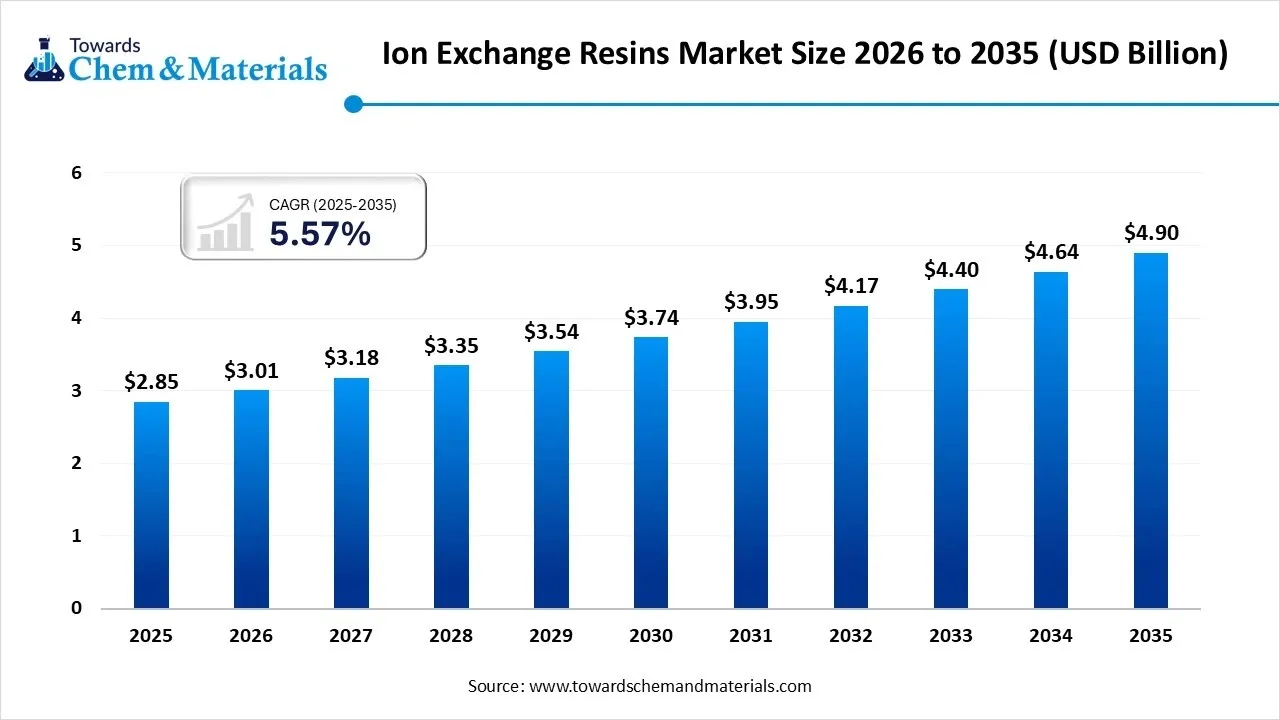
The global ion exchange resins market size is expected to grow from USD 3.01 billion in 2026 to USD 4.90 billion in 2035, growing at a CAGR of 5.57% from 2026 to 2035. The top key players in the market are DuPont de Nemours, Inc., LANXESS AG, Mitsubishi Chemical Group Corporation, Ecolab Inc. (Purolite), Samyang Corporation, Ion Exchange (India) Ltd., Thermax Limited, Sunresin New Materials Co. Ltd., ResinTech, Inc., Jacobi Carbons Group (Osaka Gas), Bio-Rad Laboratories, Inc., Jiangsu Suqing Water Treatment Engineering Group, Tosoh Corporation, Novasep (Applexion), Fineex India Ltd. -Global Forecast 2026 To 2035
Content
What is the Current Ion Exchange Resins Market Size and Share?
The global ion exchange resins market size was estimated at USD 2.85 billion in 2025 and is expected to increase from USD 4.90 billion in 2026 to USD 4.90 billion by 2035, growing at a CAGR of 5.57% from 2026 to 2035. Asia Pacific dominated the ion exchange resins market with the largest revenue share of 49.00% in 2025. The increasing need for water safety and purification has accelerated the industry's potential in recent years.
The specialised solid material, which is primarily used to remove unwanted ions from liquids, mainly from water, is known as ion exchange resins. Also, by replacing harmful ions with the safe ions that are attached to the resin surface, the ion exchange resins have gained major industry attention earlier. Moreover, the major sectors such as the food processing, power plants, and wastewater purification have been seen in demanding the ion exchange resin heavily.
Market Highlights
- The Asia Pacific dominated ion exchange resins market with the largest revenue share of 48.8% in 2025, due to rapid industrial growth and a large population.
- By type, the carbon exchange resin segment dominated the market and accounted for the largest revenue share of 46.4% in 2025, owing to it is widely used for basic water softening and purification.
- By application, the water treatment segment led the market with the largest revenue share of 58.9% in 2025, akin to clean water is essential for all industries and households.
- By end-use, the power generation segment dominated the market and accounted for the largest revenue share of 40.9% in 2025,owing to power plants needing very pure water.
High Selectivity Resins Power Future Growth
The industry has seen a move toward high-selectivity and longer-life resins, which is likely to enable high-return ventures for manufacturers in recent years. Moreover, the new resin designs target specific ions more accurately. This reduces waste and improves efficiency. Manufacturers are developing resins that require less regeneration and use fewer chemicals. Smart monitoring systems now track resin performance in real time. Bio-based and eco-friendly resins are also emerging.
Trade Analysis of the Ion Exchange Resins Market:
Import, Export, Consumption, and Production Statistics
- The world has observed heavy ion exchange resin export between Jul 2024 and June 2025 with 7,862 shipments.
China has emerged as the major exporter of ion exchange resin with the number of shipments has crossed 15,273 as per the published report. - After China, India has exported a heavy amount of the ion exchange resin with 4,026 shipments and the United States with 2,924 shipments as per the published report.
Market Trends:
- The demand for clean water across the globe has increased the commercial viability of the industry in recent years. Moreover, the main factors like urbanisation and population growth has playing major role in the current period.
- The emergence of ion exchange resins in the treatment of industrial wastewater has actively contributed to favourable market economies for the industry in recent years. Also, several regional governments are heavily supporting this initiative.
- The increased expansion in the sectors such as the beverage, food, and pharmaceutical applications is anticipated to create profitable pathways for the sector participants during the forecast period. The ion exchange resins have seen in improving the product safety and quality by purifying water.
Report Scope
| Report Attribute | Details |
| Market Size in 2026 | USD 3.01 Billion |
| Revenue Forecast in 2035 | USD 4.90 Billion |
| Growth Rate | CAGR 5.57% |
| Forecast Period | 2026 - 2035 |
| Base Year | 2025 |
| Dominant Region | Asia Pacific |
| Segment Covered | By Type, By Application, By End Use, By Region |
| Key companies profiled | DuPont de Nemours, Inc., LANXESS AG, Mitsubishi Chemical Group Corporation, Ecolab Inc. (Purolite), Samyang Corporation, Ion Exchange (India) Ltd., Thermax Limited, Sunresin New Materials Co. Ltd., ResinTech, Inc., Jacobi Carbons Group (Osaka Gas), Bio-Rad Laboratories, Inc., Jiangsu Suqing Water Treatment Engineering Group, Tosoh Corporation, Novasep (Applexion), Fineex India Ltd. |
Value Chain Analysis of the Ion Exchange Resins Market:
Distribution to Industrial Users
- Industrial users obtain ion exchange resins through a global network of specialist distributors and direct sales from manufacturers. These resins are distributed primarily to the power generation, semiconductor, and pharmaceutical sectors for water demineralization and purification. Regional distributors often provide technical support and regeneration services alongside bulk product supply.
- Key Players: DuPont (AmberLite) and Lanxess (Lewatit)
Chemical Synthesis and Processing
- The synthesis of ion exchange resins involves the suspension polymerization of hydrocarbon monomers, typically Styrene or Acrylic acid, cross-linked with Divinylbenzene (DVB) to form a porous matrix. This bead is then chemically functionalized: Sulfonation creates strong acid cation resins, while Amination produces anion resins.
- Key Player: Purolite (Ecolab) and Mitsubishi Chemical
Regulatory Compliance and Safety Monitoring
- Ion exchange resins must comply with FDA (Title 21) and NSF/ANSI 61 standards for food and potable water safety. Regulatory bodies like REACH and RoHS monitor chemical composition and leaching risks. Safety monitoring focuses on bead integrity, microbial growth, and osmotic shock.
Ion Exchange Resins Market Regulatory Landscape: Global Regulations
| Country Region | Regulatory Body | Key Regulations | Focus Areas |
| United States | FDA (Food & Drug Administration) | 21 CFR § 173.25 |
Recent EPA mandates (April 2024) have established a maximum contaminant level of 4 ppt for PFOA/PFOS, driving demand for specialized anion resins. |
| European Union | ECHA | Regulation (EC) No 1935/2004 | Good Manufacturing Practice (GMP): Mandated under Regulation (EC) No 2023/2006 to ensure consistent safety standards. |
| China |
State Administration for Market Regulation (SAMR) |
State Administration for Market Regulation (SAMR) GB 9685-2016 | Mandatory GB Testing: Any resin introduced to the market must pass strict "Guobiao" (GB) safety and performance testing. |
Segmental Insights
Type Insights
How did the Carbon Exchange Resin Segment Dominate the Ion Exchange Resins Market in 2025?
The carbon exchange resin segment dominated the market with approximately 46.4% share in 2025, due to it is widely used for basic water softening and purification. Moreover, it effectively removes calcium and magnesium from water. Power plants, industries, and households use it regularly. It is reliable, affordable, and easy to regenerate. Many water treatment systems were designed first around carbon exchange resins. Operators are familiar with its working and maintenance.
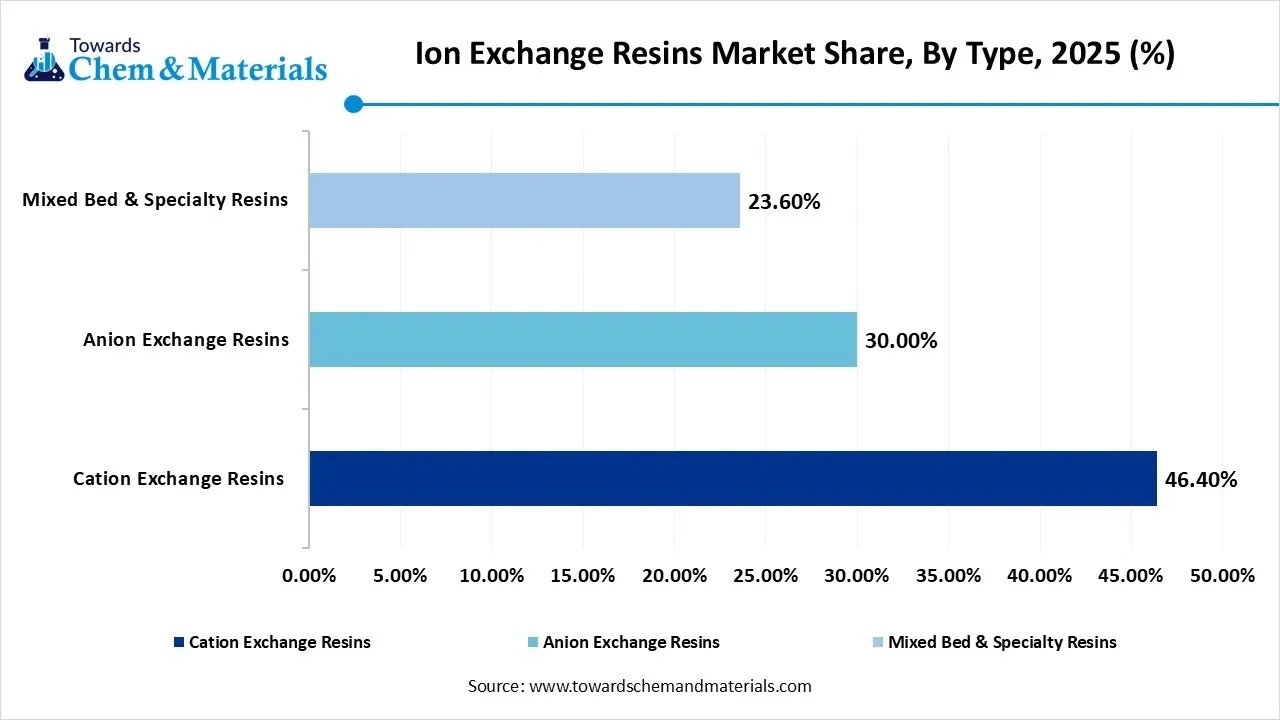
The anion exchange resin segment is expected to grow with a rapid CAGR, owing to the industry's need for advanced water and chemical purification. Also, it removes nitrates, fluorides, arsenic, and organic contaminants. These issues are increasing due to pollution and strict regulations. Anion resins are also used in wastewater reuse and a zero liquid discharge system.
Ion Exchange Resins Market Share, By Type , 2025 (%)
| By Type | Revenue Share, 2025 (%) |
| Cation Exchange Resins | 46.40% |
| Anion Exchange Resins | 30.00% |
| Mixed Bed & Specialty Resins | 23.60% |
Application Insights
How did the Water Treatment Segment Dominate the Ion Exchange Resins Market in 2025?
The water treatment segment dominated the market with 58.9% share in 2025, due to clean water is essential for all industries and households. Furthermore, ion exchange resins are widely used in municipal water plants. industrial water systems, and residential filters. They remove hardness, metals, and harmful ions efficiently. Population growth increased water demand. Industries need treated water to protect equipment.
The non-water treatment segment is expected to grow, akin to sudden growth in specialty industries. Also, ion exchange resins are increasingly used in pharmaceuticals, food processing, chemicals, and electronics. These industries need high-purity separation and recovery processes. Battery materials, bio-processing, and fine chemicals use resins for selective ion removal.
Ion Exchange Resins Market Share, By Application , 2025 (%)
| By Application | Revenue Share, 2025 (%) |
| Water Treatment | 58.90% |
| Non-Water Treatment (Separation/Catalysis) | 41.10% |
End Use Insights
How did the Power Generation Segment Dominate the Ion Exchange Resins Market in 2025?
The power generation segment dominated the market with approximately 40.9% share in 2025, due to power plants needing very pure water. Also, the ion exchange resins are used to treat boiler feed water and cooling systems. Poor water quality damages turbines and boilers. Power plants operate continuously, consuming large resin volumes. Thermal and nuclear plants rely heavily on water treatment. Early adoption in power plants created long-term demand.
The pharmaceutical plants segment is expected to grow with a rapid CAGR, owing to they are seen in requiring extreme purity and precision. Moreover, ion exchange resins are used in drug purification, separation, and water treatment. Medicine safety standards are very strict. Demand for medicines is increasing globally. Biopharmaceutical production uses advanced resin technologies, and resin demand per unit value is high in pharma plants, as per recent observation.
Ion Exchange Resins Market Share, By End Use , 2025 (%)
| By End Use | Revenue Share, 2025 (%) |
| Power Generation | 40.90% |
| Water & Wastewater Treatment Plants | 25.00% |
| Food & Beverages | 15.00% |
| Pharmaceuticals | 10.00% |
| Chemical Processing & Others | 9.10% |
Regional Insights
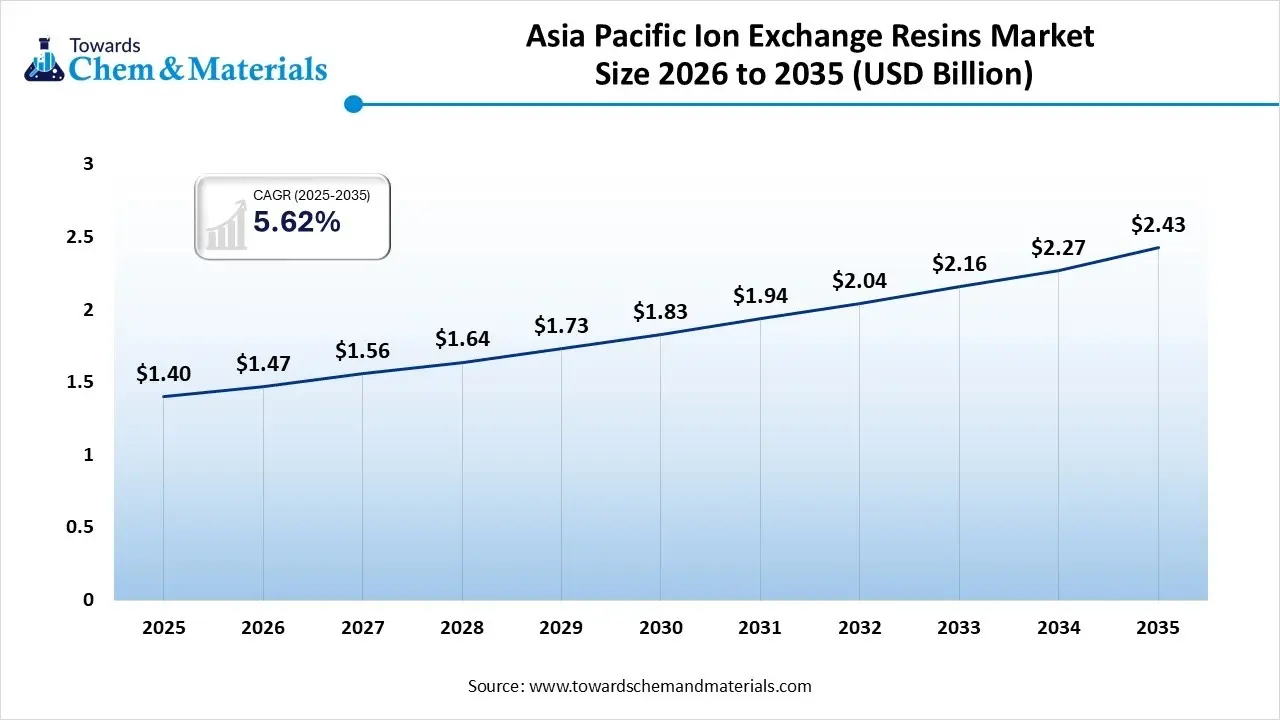
The Asia Pacific Ion Exchange Resins market size was valued at USD 1.40 billion in 2025 and is expected to be worth around USD 2.43 billion by 2035, exhibiting at a compound annual growth rate (CAGR) of 5.62% over the forecast period from 2026 to 2035. Asia Pacific dominated the ion exchange resins market with approximately 48.8% share in 2025, due to rapid industrial growth and a large population. Moreover, the region has a strong demand for water treatment, power generation, and manufacturing. Countries invested heavily in infrastructure and water purification. Low production costs support resin manufacturing. Industrial wastewater treatment demand is high. Asia Pacific also has many power plants and chemical industries.
China Leads High Volume Production
China maintained its dominance in the market, owing to its massive industrial and power generation capacity. Also, the water pollution challenges increase resin demand. China invests heavily in wastewater treatment and reuse. Chemical, electronics, and pharmaceutical industries use ion exchange resins extensively. Local manufacturers produce resins on all scales. Government policies support water treatment and environmental protection.
Ion Exchange Resins Market Evaluation in North America
North America ion exchange resins market segment accounted for the major revenue share of 22.00% in 2025. North America is expected to capture a major share of the ion exchange resins market with a rapid CAGR, owing to advanced technology and strict regulations. Industries in the region focus on high-purity and specialty applications. Chemical recycling, pharmaceuticals, and electronics drive demand. Water reuse projects are expanding. Investment in smart and efficient resins is strong. Environmental laws push advanced treatment solutions.
Advanced Water Systems Boost Resin Use in the United States
The United States is expected to emerge as a prominent country for the ion exchange resins market in the coming years, with strong industrial and pharmaceutical sectors. Also, advanced water treatment systems use high-performance resins. Drug manufacturing and biotech industries are expanding. Power plants upgrade water systems. R&D investment drives resin innovation. Regulations ensure long-term demand. Domestic production and technology leadership strengthen supply.
Europe Ion Exchange Resins Market Examination
Europe ion exchange resins market segment accounted for the major revenue share of 25.00% in 2025.Europe is notably growing in market, owing to strong environmental and water quality regulations. Industries in the region have been seen adopting advanced treatment technologies. Focus on sustainability and the circular economy increases resin use. The pharmaceutical and food industries are strong. Water reuse projects are expanding. This creates steady and value-driven growth in the ion exchange resins market.
Ion Exchange Resins Market Share, By Regional, 2025 (%)
| Regional | Revenue Share, 2025 (%) |
| North America | 18.00% |
| Europe | 20.00% |
| Asia Pacific | 49.00% |
| Latin America | 6.00% |
| Middle East & Africa | 7.00% |
Germany Driving Europe’s Resin Leadership
Germany is expected to gain a significant industry share owing to the country has advanced chemical, pharmaceutical, and manufacturing industries. Moreover, high-quality water treatment standards increase resin demand. Research and innovation support advanced resin use. Environmental laws are strict. Industrial efficiency is a priority. Germany's focus on technology, quality, and sustainability makes it a key market for ion exchange resins in Europe.
Recent Developments
- In October 2024, Mitsubishi Chemical is likely to expand the production of ion exchange resins in the coming years. With the increased demand for semiconductors, the ion exchange resins are expected need more, which are primarily used to produce ultra-pure water, which plays a major role in semiconductor manufacturing, as per the company's thinking. (Source: www.indianchemicalnews.com)
- In April 2024, LANXESS introduced its latest sustainable ion exchange resins, which are specifically designed for water softening. Moreover, the newly launched resin called the Lewatit S 1567 Scope blue, as per published report.(Source: www.echemi.com)
Top Vendors in the Ion Exchange Resins Market & Their Offerings:
- DuPont de Nemours, Inc.: A global leader in specialty chemicals, DuPont’s Water Solutions division produces the renowned AmberLite™ and TapTec™ brands. Their resins are the industry standard for high-purity applications, including nuclear power, semiconductor fabrication, and pharmaceutical processing. DuPont focuses on monodisperse (uniform particle size) technology, which optimizes regeneration efficiency and water conservation. They maintain a dominant market share through continuous innovation in selective ion removal and sustainable water treatment.
- LANXESS AG: Based in Germany, LANXESS operates its Liquid Purification Technologies business unit, famous for the Lewatit® brand. They are a premier provider of resins for industrial water treatment, power generation, and the food and beverage industry (specifically sugar refining). LANXESS is a pioneer in developing resins for lithium extraction and battery-grade chemical purification, positioning itself as a critical supplier for the global electric vehicle and renewable energy supply chains.
- Mitsubishi Chemical Group Corporation: A Japanese powerhouse, Mitsubishi Chemical manufactures the DIAION™ and Sepabeads™ resin lines. They are globally recognized for producing exceptionally durable resins with high physical and osmotic stability, making them preferred for "condensate polishing" in thermal power plants. Their portfolio includes highly specialized adsorbent resins used in the pharmaceutical industry for the purification of antibiotics, peptides, and various synthetic organic compounds.
- Ecolab Inc. (Purolite): Acquired by Ecolab in 2021, Purolite is a dedicated specialist in ion exchange technology. Their Purofine® and Praesto® brands are leaders in the life sciences sector, particularly in agarose-based chromatography for monoclonal antibody purification. Purolite is known for having the widest range of "specialty" resins, addressing niche needs like PFAS removal, metals scavenging, and catalysis, backed by Ecolab’s extensive global service and water management network.
- Samyang Corporation
- Ion Exchange (India) Ltd.
- Thermax Limited
- Sunresin New Materials Co. Ltd.
- ResinTech, Inc.
- Jacobi Carbons Group (Osaka Gas)
- Bio-Rad Laboratories, Inc.
- Jiangsu Suqing Water Treatment Engineering Group
- Tosoh Corporation
- Novasep (Applexion)
- Fineex India Ltd.
Segments Covered in the Report
By Type
- Cation Exchange Resins
- Anion Exchange Resins
- Mixed Bed & Specialty Resins
By Application
- Water Treatment
- Non-Water Treatment (Separation/Catalysis)
By End Use
- Power Generation
- Water & Wastewater Treatment Plants
- Food & Beverages
- Pharmaceuticals
- Chemical Processing & Others
By Region
- North America
- U.S.
- Canada
- Mexico
- Europe
- Germany
- UK
- France
- Italy
- Spain
- Asia Pacific
- China
- India
- Japan
- South Korea
- Latin America
- Brazil
- Argentina
- Middle East & Africa
- Saudi Arabia
- South Africa
FAQ's
Question 1 : What is the current ion exchange resins market size and forecast growth rate through 2035?
Answer : The global ion exchange resins market was valued at USD 2.85 billion in 2025 and is projected to reach USD 4.90 billion by 2035, growing at a CAGR of 5.57% from 2026 to 2035.
Question 2 : What are the key growth drivers, market trends, and investment opportunities shaping the global ion exchange resins market?
Answer : Rising demand for clean water, expanding industrial wastewater treatment, growth in power generation and pharmaceuticals, and the development of high-selectivity, eco-friendly resins are driving strong investment potential in the ion exchange resins market.
Question 3 : How are technological innovations and regulatory changes impacting the competitive landscape of the ion exchange resins industry?
Answer : Advancements in high-performance and specialty resins, smart monitoring systems, and stricter regulations such as EPA PFAS limits, FDA standards, REACH, and NSF certifications are accelerating innovation and increasing demand for compliant, high-purity solutions.
Question 4 : Who are the leading companies operating in the ion exchange resins market and what strategies are they adopting for future growth?
Answer : Key players including DuPont, LANXESS, Mitsubishi Chemical Group, Ecolab (Purolite), and Sunresin are focusing on capacity expansion, sustainable product development, specialty resin innovation, and strategic partnerships to strengthen their global market position.
Meet the Team

Saurabh Bidwai
Principal Consultant
Saurabh Bidwai, a B.Tech Chemical Engineering graduate with 4+ years of experience, specializes in specialty chemicals, commodity chemicals, and engineered materials, offering valuable insights into market trends and emerging opportunities.

Aditi Shivarkar
Reviewed By
Aditi Shivarkar, with 14+ years in Chemical and Materials market research, specializes in Chemical and Materials. She ensures accurate, actionable insights, driving Towards Chemicals And Materials Analytics and Consulting excellence in industry trends and sustainability.