
Isopropyl Alcohol Market Size, Production Volume, Sales Performance, Export & Import Dynamics, Adoption Rates, Recycling Rate, Material Efficiency, Market Share Analysis, and Demand Trends
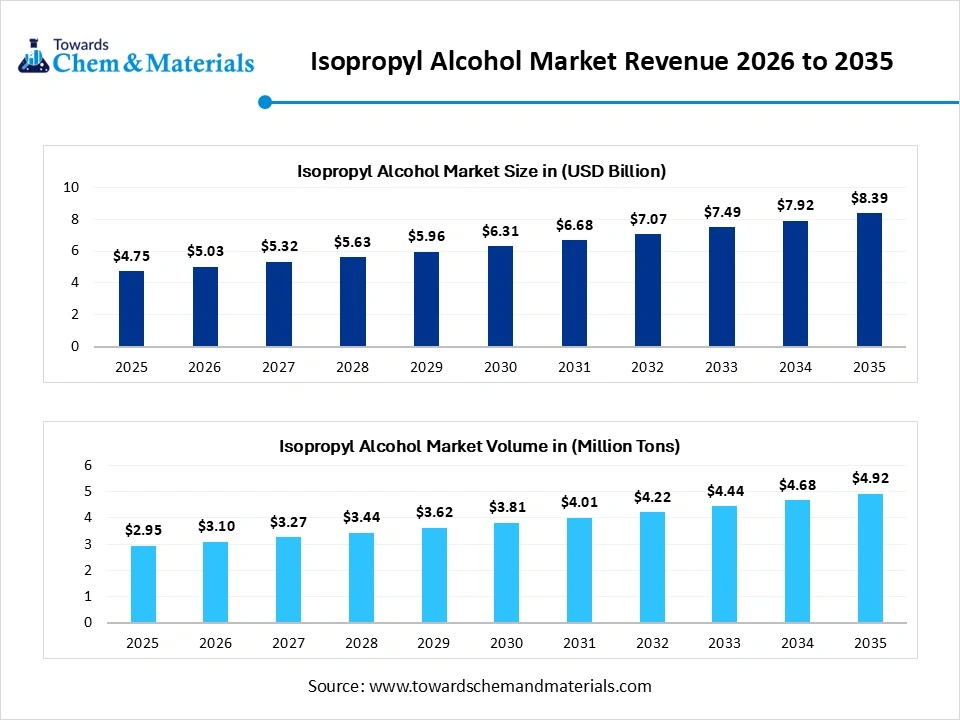
The isopropyl alcohol market was valued at USD 4.75 billion in 2025 and is estimated to reach USD 5.03 billion in 2026, further projected to grow to USD 8.39 billion by 2035, registering a CAGR of 5.85% from 2026 to 2035. In terms of volume, the market is expected to expand from 2.95 million tons in 2025 to 4.92 million tons by 2035, growing at a CAGR of 5.25%. This report provides comprehensive coverage of market size, detailed segment data, regional analysis, company profiling, competitive landscape, value chain analysis, trade data, and in-depth insights into manufacturers and suppliers.
Content
Isopropyl Alcohol Market Size, Share, Trends and Forecast Analysis
The global isopropyl alcohol market was valued at USD 4.75 billion in 2025, is estimated to reach USD 5.03 billion in 2026, and is projected to reach USD 8.39 billion by 2035, growing at a CAGR of 5.85% from 2026 to 2035. In terms of volume, the isopropyl alcohol market is projected to grow from 2.95 million tons in 2025 to 4.92 million tons by 2035. growing at a CAGR of 5.25% from 2026 to 2035.
Key Takeaways
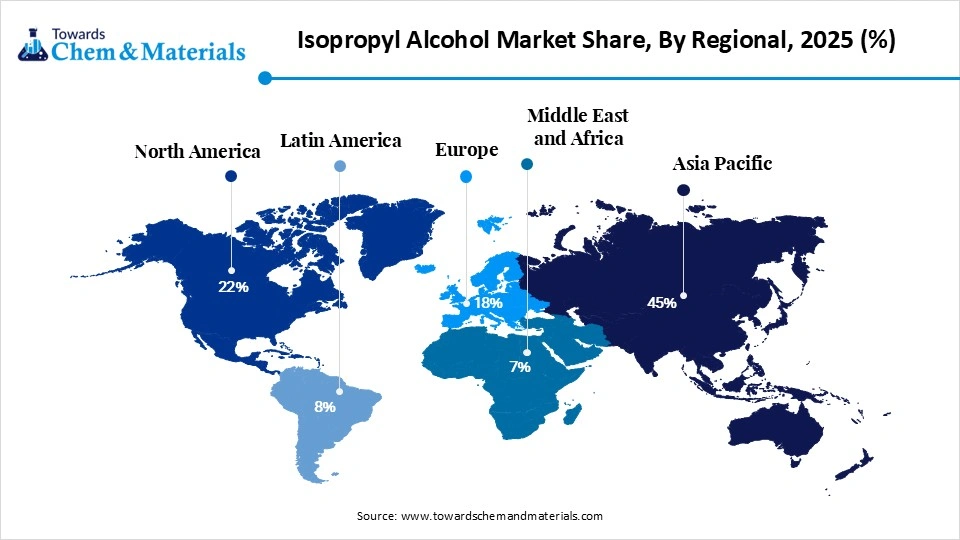
- By region, Asia Pacific dominated the market with a share of 45% in 2025 and is expected to sustain its position while growing with a CAGR of 6.70% in the forecast period.
- By region, North America held the 22% market share in 2025.
- By grade, the pharmaceutical grade segment dominated the market with 42% share in 2025.
- By grade, the electronic grade segment held 20% market share in 2025 and is expected to have the fastest growth with a CAGR of 7.30% in the forecast period.
- By application, the solvents segment dominated the market with 34% share in 2025.
- By application, the disinfectants and sanitizer segment held 28% market share in 2025 and is expected to have the fastest growth with a CAGR of 6.80% in the forecast period.
- By end-use industry, the pharmaceuticals segment dominated the market with 28% share in 2025.
- By end-use industry, the electronics and semiconductors segment held 16% market share in 2025 and is expected to have the fastest growth with a CAGR of 7.50% in the forecast period.
- By distribution channel, the direct sales segment dominated the market with 48% share in 2025.
- By distribution channel, the online sales segment held 15% market share in 2025 and is expected to have the fastest growth with a CAGR of 7.10% in the forecast period.
Market Size and Volume Forecast
- Market Estimated Size (2026): USD 5.03 Billion | CAGR (2026–2035): 5.85%
- Market Projected Size (2035): USD 8.39 Billion
- Market Volume (2025): 2.95 Million Tons (MT) | Volume CAGR (2026–2035): 5.25%
- Market Projected Volume (2035): 4.92 Million Tons (MT)
- Market Pricing (2025):
- Average Manufacturing Price: USD 855/ton
- Average Selling Price: USD 1,125/ton
- Pricing CAGR (2025–2035): 3.11%
Market Overview
What Is The Significance Of The Isopropyl Alcohol Market?
The isopropyl alcohol (IPA) market is highly significant due to its critical role as a versatile solvent, disinfectant, and chemical intermediate across pharmaceutical, personal care, and electronics sectors. Driven by heightened post-pandemic hygiene standards and pharmaceutical expansion, the market is essential for producing antiseptics, drug formulations, and high-purity cleaning agents for the electronics and semiconductor industries.
Isopropyl Alcohol Market Growth Trends
- High-Purity Demand in Electronics: The electronics and semiconductor industry’s need for high-purity IPA for cleaning and degreasing is a major growth factor, particularly in the Asia-Pacific region.
- Shift Toward Sustainable Production: Industry players are increasingly focusing on bio-based IPA production to meet growing demand for sustainable and eco-friendly chemical alternatives.
- Pharmaceutical and Industrial Use: The pharmaceutical sector remains the largest consumer. Additionally, IPA is heavily used as an intermediate in producing acetone, isopropyl acetate, and other chemicals.
Report Scope
| Report Attribute | Details |
| Market Size and Volume in 2026 | USD 5.03 Billion / 3.1 Million Metric Tons |
| Expected Size and Volume by 2035 | USD 8.39 Billion / 4.92 Million Metric Tons |
| Growth Rate from 2026 to 2035 | CAGR 5.85% |
| Forecast Period | 2026 - 2035 |
| Dominant Region | Asia Pacific |
| Segment Covered | By Grade, By Application, By End-Use Industry, By Distribution Channel and By Regions |
| Key companies profiled | LG Chem Ltd., Mitsubishi Chemical Group Corporation, Mitsui Chemicals, Inc., SABIC, Deepak Fertilisers and Petrochemicals Corporation Ltd., Dow Chemical, Mistral Industrial Chemicals, INEOS Corporation, ReAgent Chemicals Ltd., LyondellBasell Industries, Linde Gas, Ecolab, Royal Dutch Shell, ExxonMobil Corporation |
Key Technological Shifts In The Isopropyl Alcohol Market
- Key technological shifts in the isopropyl alcohol (IPA) market focus on sustainability and performance, driven by a surge in demand for high-purity grades, bio-based production methods, and AI-optimized manufacturing. The market is rapidly pivoting toward green chemistry to reduce reliance on petroleum-based propylene, while 5G and semiconductor demands mandate ultra-high purity (>99.9%) standards.
Trade Analysis of Isopropyl Alcohol Market: Import & Export Statistics
- According to Global Export Data, the world exported 1,458 Isopropyl Alcohol shipments between July 2024 and June 2025 (TTM) via 321 verified exporters and 152 buyers, representing a 70% YoY change.
- The United States, Japan, and Vietnam lead as the top Isopropyl Alcohol importers, while the United States with 2,612 shipments, China with 384 shipments, and Japan with 298 shipments, rank as the largest global Isopropyl Alcohol exporters.
Top-performing Global Isopropyl Alcohol Exporters by volume
- NRS OCEAN LOGISTICS LTD: 346 shipments (26%)
- CHEM STAR GLOBAL LOGISTICS LLC: 236 shipments (18%)
- LCY CHEMICAL CORP: 214 shipments (16%)
Supply Chain Analysis of Isopropyl Alcohol Market
Chemical Production & Processing
Isopropyl alcohol (IPA) is produced through hydration of propylene via indirect or direct processes, followed by purification and distillation for use in pharmaceuticals, disinfectants, and industrial solvents.
- Key players: Dow, ExxonMobil, Shell, LyondellBasell
Quality Testing and Certification
Isopropyl alcohol must meet pharmaceutical, industrial, and safety standards, including purity levels, toxicity limits, and regulatory compliance for disinfectant and solvent use.
- Key players:U.S. Food and Drug Administration, International Organization for Standardization, European Chemicals Agency, ASTM International
Distribution to Industrial Users
Isopropyl alcohol is supplied to pharmaceutical companies, healthcare facilities, cosmetics manufacturers, electronics industries, and chemical processing sectors.
- Key players: Dow, ExxonMobil, LyondellBasell.
Isopropyl Alcohol Regulatory Landscape: Global Regulations
| Country / Region | Regulatory Body | Key Regulations | Focus Areas | Notable Notes |
| U.S. | Environmental Protection Agency (EPA); Food and Drug Administration (FDA); Occupational Safety and Health Administration (OSHA) | Toxic Substances Control Act (TSCA); FDA OTC Monograph (for antiseptics); OSHA Hazard Communication Standard | Chemical safety, pharmaceutical use, workplace exposure | Isopropyl alcohol is widely used in disinfectants and pharmaceuticals and must comply with strict purity, labeling, and worker safety standards. |
| Europe | European Chemicals Agency (ECHA); European Commission | REACH Regulation; Biocidal Products Regulation (BPR); CLP Regulation | Chemical registration, disinfectant approval, and hazard classification | In the EU, isopropyl alcohol used as a disinfectant must comply with biocidal product regulations and safety classification standards. |
| China | National Medical Products Administration (NMPA); Ministry of Ecology and Environment (MEE) | Disinfectant Regulations; Environmental Protection Law | Disinfectant approval, industrial chemical safety | China regulates isopropyl alcohol for both industrial and disinfectant uses, requiring product registration and environmental compliance. |
| India | Central Drugs Standard Control Organization (CDSCO); Ministry of Environment, Forest and Climate Change (MoEFCC) | Drugs and Cosmetics Act; Environment Protection Act | Pharmaceutical applications, chemical safety | In India, isopropyl alcohol used in sanitizers and pharmaceuticals must comply with drug regulations and environmental safety standards. |
| Japan | Ministry of Health, Labour and Welfare (MHLW); Ministry of Economy, Trade and Industry (METI) | Pharmaceutical and Medical Device Act (PMD Act); Chemical Substances Control Law (CSCL) | Disinfectant safety, chemical management | Japan regulates isopropyl alcohol under pharmaceutical and chemical safety frameworks, particularly for antiseptic uses. |
| Brazil | National Health Surveillance Agency (ANVISA); Brazilian Institute of Environment and Renewable Natural Resources (IBAMA) | Health Product Regulations; Environmental Safety Laws | Disinfectant regulation, environmental protection | Brazil regulates isopropyl alcohol in healthcare and consumer products with strict safety and labeling requirements. |
Market Dynamics
Drivers
What are the Key Growth Drivers of the Isopropyl Alcohol Market?
The key growth drivers of the isopropyl alcohol (IPA) market include high demand for disinfectants, sanitizers, and pharmaceutical applications. Rising hygiene standards, extensive use in cosmetic formulations, and demand from the electronics/semiconductor industry for cleaning also fuel expansion. The market is also driven by its role as a solvent in paints, coatings, and chemical production, alongside a notable surge in demand from the healthcare sector for sterilization.
Restrains
What are the Key Growth Restraints of the Isopropyl Alcohol Market?
Key growth restraints for the isopropyl alcohol (IPA) market include volatile raw material prices (propylene), stringent environmental regulations on VOC emissions, and health hazards associated with high exposure. Additionally, high production costs, competition from alternative solvents, and supply chain disruptions hinder market expansion. Strict regulations regarding Volatile Organic Compounds (VOCs) and pollution issues associated with chemical manufacturing processes act as a significant barrier.
Opportunities
What are the Key Growth Opportunities of the Isopropyl Alcohol Market?
The global isopropyl alcohol (IPA) market is driven by surging demand for disinfectants, pharmaceutical applications, and electronics cleaning. Key growth opportunities include the expansion of high-purity IPA in semiconductor manufacturing, the rising demand for personal care products, and sustainable bio-based production. IPA remains critical for antiseptics, sanitizers, and medical device sterilization, with steady growth expected in hospital infection control.
Segmental Insights
Grade Insights
The Pharmaceutical Grade Segment Dominated The Market With 42% Market Share In 2025
The pharmaceutical grade segment dominated the market with 42% share in 2025, driven by high demand for sterilization and drug formulation. Valued significantly, it serves as a crucial solvent and disinfectant, meeting strict USP/EP standards for hospitals, labs, and drug manufacturing. The segment is fueled by escalating global hygiene standards, increased need for sanitizers, and its indispensable role in aseptic manufacturing.
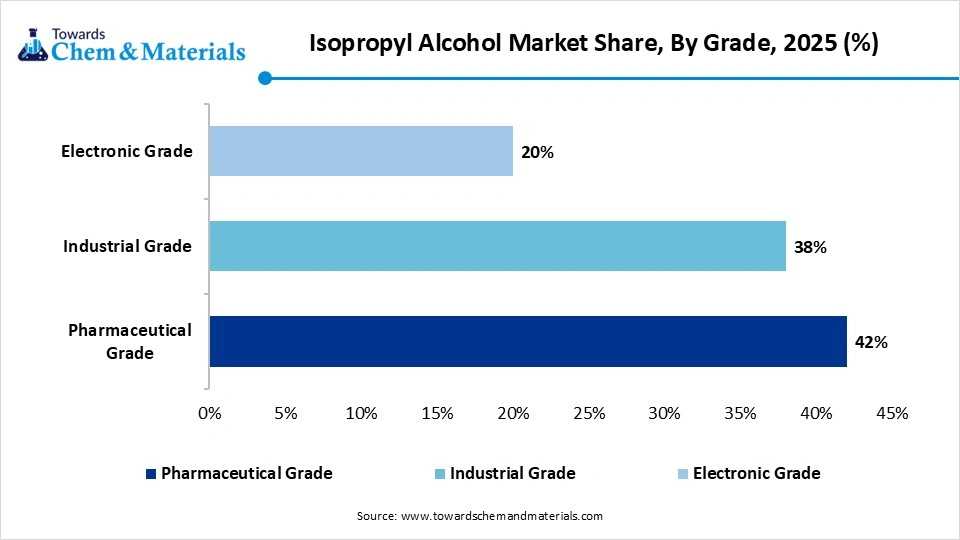
The industrial grade segment held 38% market share in 2025, due to its versatility as a cost-effective solvent in pharmaceuticals, electronics, and manufacturing. Rising demand for high-purity IPA in semiconductor and electronics manufacturing is driving significant investment, such as the LG Chem and LCY Chemical projects. Continued demand for disinfectants, hand sanitizers, and medical applications boosts the industrial-grade market.
The electronic grade segment held 20% market share in 2025 and is expected to have the fastest growth with a CAGR of 7.30% in the forecast period, driven by surging demand for semiconductor, circuit board, and display cleaning in the electronics manufacturing sector. ed for critical cleaning, wafer drying, and surface preparation to prevent defects, electronic grade IPA is essential for cleaning sensitive electronic components.
Application Insights
The Solvents Segment Dominated The Market With 34% Market Share In 2025
The solvents segment dominated the market with 34% share in 2025, largely driven by its versatility as a cleaning agent, antiseptic, and intermediate in industries like pharmaceuticals, cosmetics, and electronics. Due to high demand in paints, coatings, adhesives, and electronics manufacturing, IPA is heavily used for cleaning and sanitizing, especially for electronics and semiconductor fabrication.
The disinfectants and sanitizer segment held 28% market share in 2025 and is expected to have the fastest growth with a CAGR of 6.80% in the forecast period, fueled by heightened hygiene awareness, infection control, and demand in the pharmaceutical/consumer sectors. Increased awareness of infection control in medical and public spaces has propelled the antiseptic segment to over 40.8% of the IPA market share.
Isopropyl Alcohol Market Share, By Application, 2025 (%)
| By Application | Revenue Share, 2025 (%) |
| Solvents | 34% |
| Cleaning Agent | 21% |
| Disinfectant & Sanitizer | 28% |
| Chemical Intermediate | 17% |
The cleaning agent segment held 21% market share in 2025, experiencing high demand due to increased hygiene awareness, industrial cleaning needs, and sanitization protocols following the COVID-19 pandemic. This segment, which includes disinfectants and solvents, is seeing rapid expansion, with IPA being used extensively in pharmaceuticals, electronics, and automotive industries. Rising focus on health, personal hygiene, and surface disinfection has boosted demand for alcohol-based disinfectants and hand sanitizers.
The chemical intermediate segment held 17% market share in 2025, driven by its versatile role in synthesizing other chemicals, particularly in pharmaceutical, agrochemical, and specialty chemical applications. The synthesis of titanium and aluminum isopropoxides, which act as catalysts, is increasing as industrial demand for advanced materials grows. The rising demand for pharmaceuticals, specifically for manufacturing Active Pharmaceutical Ingredients (APIs) and intermediaries, is a major driver for this segment.
End-Use Industry Insights
The Pharmaceutical Segment Dominated The Market With 28% Market Share In 2025
The pharmaceutical segment dominated the market with 28% share in 2025, due to high demand for sanitizers, disinfectants, and its role as a solvent in drug manufacturing. The surge in consciousness regarding personal care and healthcare sanitation has sustained elevated demand for sanitizers and antiseptic products. Rising global standards for sanitization in hospitals, clinics, and laboratories require increased consumption of high-quality pharmaceutical-grade IPA.
The chemicals and petrochemicals segment held 20% market share in 2025, driven by high-volume consumption in industrial processes. The need for 90%+ IPA in precision cleaning for electronics and as a solvent in advanced petrochemicals. To align with sustainability goals, manufacturers are shifting toward producing bio-based IPA from renewable sources like sugarcane and biomass. The market is entering a phase of normalization post-pandemic, but remains robust due to industrial applications, particularly in the chemical intermediate industry.
Isopropyl Alcohol Market Share, By End-Use Industry, 2025 (%)
| By End-Use Industry | Revenue Share, 2025 (%) |
| Pharmaceuticals | 28% |
| Personal Care & Cosmetics | 18% |
| Electronics & Semiconductors | 16% |
| Chemicals & Petrochemicals | 20% |
| Automotive | 10% |
| Others | 8% |
The personal care and cosmetics segment held 18% market share in 2025. This expansion is fueled by high demand for IPA in skincare, haircare, and antiseptic products. IPA is heavily used in personal care as an antiseptic agent in products like hand sanitizers, disinfectants, astringents, and as a solvent for various skin care formulations. The sustained demand for sanitizers and antiseptic products, which saw immense growth, keeps driving.
The electronics and semiconductors segment held 16% market share in 2025 and is expected to have the fastest growth with a CAGR of 7.50% in the forecast period, driven by high-purity cleaning needs in semiconductor, wafer, and display manufacturing. This growth is spurred by demand for advanced electronics, 5G, and IoT devices, with >610,000 metric tons of IPA.
Distribution Channel Insights
The Direct Sales Segment Dominated The Market With 48% Market Share In 2025
The direct sales segment dominated the market with 48% share in 2025, driven by the need for supply chain transparency, reliable delivery of high-purity grades, and specialized servicing of key end-user industries. Stringent hygiene protocols in hospitals and the manufacturing of active pharmaceutical ingredients (APIs) require consistent, direct supplies of pharmaceutical-grade IPA. The pharmaceutical sector is a key driver of direct sales, as demand for sterile environments and sanitizer components continues to rise post-pandemic.
Isopropyl Alcohol Market Share, By Distribution Channel, 2025 (%)
| By Distribution Channel | Revenue Share, 2025 (%) |
| Direct Sales | 48% |
| Distributors & Wholesalers | 37% |
| Online Sales | 15% |
The distributors and wholesalers segment held 37% market share in 2025, driven by the need for a consistent supply chain in the pharmaceutical, electronics, and personal care sectors. The surge in demand for hygiene, sanitization, and sterilization products, particularly in the post-pandemic era, has amplified the need for efficient, large-scale distribution networks.
The online sales segment held 15% market share in 2025 and is expected to have the fastest growth with a CAGR of 7.10% in the forecast period, driven by increasing e-commerce adoption, rising consumer awareness regarding hygiene, and the proliferation of IPA-based personal care products. This digital shift allows for easier access to cleaning, sanitizing, and cosmetic products, transforming the distribution landscape. The expansion of e-commerce has enhanced access to IPA-based disinfectants and personal care items for consumers.
Regional Insights
How did Asia Pacific dominate the Isopropyl Alcohol Market in 2025?
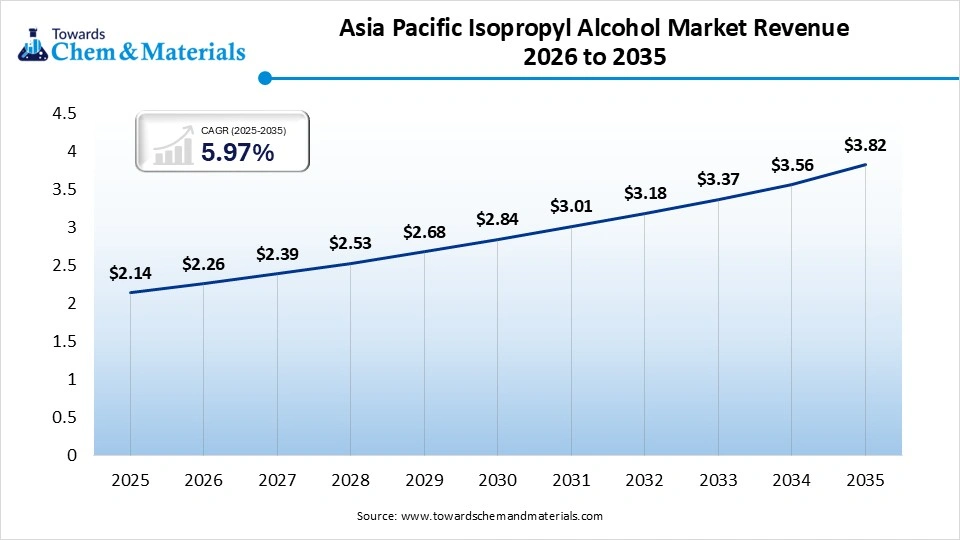
The Asia Pacific isopropyl alcohol market size was estimated at USD 2.14 billion in 2025 and is projected to reach USD 3.82 billion by 2035, growing at a CAGR of 5.97% from 2026 to 2035, driven by booming pharmaceutical manufacturing, high demand for electronics precision cleaning, and increased hygiene awareness. The growing pharmaceutical sector in the region, particularly in India and China, heavily utilizes IPA as a solvent for manufacturing medicines, tablets, and topical formulations. It is also essential as a disinfectant in hospitals and laboratories, a need that intensified post-COVID-19.
India Isopropyl Alcohol Market Growth Factor
The Indian Isopropyl Alcohol (IPA) market is projected to grow significantly, driven by the high demand for disinfectants in the pharmaceutical/healthcare sectors, booming cosmetic and personal care manufacturing, widespread industrial use for cleaning/degreasing, and rising automotive sector demand. Government initiatives like Plastic Parks and PCPIRs, along with FDI inflows in the chemical sector, are enhancing production capacity. Increased focus on hygiene following the pandemic has created a sustained demand for IPA-based sanitizers, wipes, and surface cleaners.
North America Isopropyl Alcohol Market Growth Factor
North America held the 22% market share in 2025, which is primarily driven by high demand for disinfectants and antiseptics in healthcare, robust pharmaceutical manufacturing, and its critical use in electronics cleaning. The market is also heavily supported by expanding personal care industries and the growing adoption of bio-based IPA to meet sustainability standards. Increasing investment in medical and pharmaceutical infrastructure across the US and Canada drives consumption.
U.S. Isopropyl Alcohol Market Growth Factor
The U.S. isopropyl alcohol (IPA) market growth is driven by surging demand for disinfectants, pharmaceutical applications, and high-purity electronics manufacturing. The growing demand for beauty products and personal care items, which use IPA as a solvent, boosts market volume. Increased focus on high-purity IPA for specialized applications like electronics and advanced healthcare, rather than just industrial-grade products.
Recent Development
- In December 2025, United Microelectronics Corp. (UMC) inaugurated its NT$1.8 billion Circular Economy & Recycling Innovation Center in Tainan, Taiwan, designed to process 15,000 metric tons of semiconductor waste annually. The facility utilizes advanced purification and thermal cracking to convert hazardous waste into industrial-grade materials, aiming to reduce UMC's total Taiwanese waste by one-third.
Top players in the Isopropyl Alcohol Market & Their Offerings
- LG Chem Ltd.: LG Chem manufactures isopropyl alcohol for use in electronics, pharmaceuticals, and personal care products. The company focuses on high-quality and specialty chemical production.
- Mitsubishi Chemical Group Corporation: Mitsubishi Chemical produces IPA for industrial and pharmaceutical applications, emphasizing high-purity chemical intermediates and advanced materials.
- Mitsui Chemicals, Inc.: Mitsui Chemicals supplies isopropyl alcohol for coatings, solvents, and specialty applications, supported by strong R&D and production capabilities.
- SABIC: SABIC produces isopropyl alcohol and related petrochemical intermediates used in industrial manufacturing, pharmaceuticals, and consumer goods.
- Deepak Fertilisers and Petrochemicals Corporation Ltd.: Deepak Fertilisers is a key Indian producer of isopropyl alcohol, supplying IPA for pharmaceuticals, disinfectants, and industrial applications, with strong domestic demand.
Isopropyl Alcohol Market Top Players
- Dow Chemical
- Mistral Industrial Chemicals
- INEOS Corporation
- ReAgent Chemicals Ltd.
- LyondellBasell Industries
- Linde Gas
- Ecolab
- Royal Dutch Shell
- ExxonMobil Corporation
Isopropyl Alcohol Market Segments Covered
By Grade
- Pharmaceutical Grade
- USP Grade
- BP/EP Grade
- Industrial Grade
- Electronic Grade
- Semiconductor Grade
- Precision Cleaning Grade
By Application
- Solvents
- Paints & Coatings
- Printing Inks
- Adhesives
- Cleaning Agent
- Surface Cleaning
- Electronic Cleaning
- Disinfectant & Sanitizer
- Hand Sanitizers
- Medical Disinfectants
- Chemical Intermediate
- Acetone Production
- IPA Derivatives
By End-Use Industry
- Pharmaceuticals
- Personal Care & Cosmetics
- Electronics & Semiconductors
- Chemicals & Petrochemicals
- Automotive
- Others
By Distribution Channel
- Direct Sales
- Distributors & Wholesalers
- Online Sales
By Regions
- North America
- U.S.
- Canada
- Mexico
- U.S.
- Europe
- Germany
- UK
- France
- Italy
- Spain
- Germany
- Asia Pacific
- China
- India
- Japan
- South Korea
- China
- Latin America
- Brazil
- Argentina
- Brazil
- Middle East & Africa
- Saudi Arabia
- South Africa
- Saudi Arabia
FAQ's
Question 1 : What is the current size of the isopropyl alcohol market?
Answer : The global isopropyl alcohol (IPA) market was valued at USD 4.75 billion in 2025 and is estimated to reach USD 5.03 billion in 2026. It is projected to grow significantly and reach USD 8.39 billion by 2035, driven by increasing demand across pharmaceuticals, electronics, and personal care industries.
Question 2 : What is the expected growth rate of the isopropyl alcohol market?
Answer : The market is expected to grow at a compound annual growth rate (CAGR) of 5.85% from 2026 to 2035. In terms of volume, it is forecast to expand at a CAGR of 5.25% during the same period.
Question 3 : Which region dominates the isopropyl alcohol market?
Answer : Asia Pacific dominates the market, accounting for 45% of the global share in 2025. This dominance is supported by strong pharmaceutical manufacturing, rapid industrialization, and growing electronics production in countries like China and India.
Question 4 : What are the key applications of isopropyl alcohol?
Answer : Isopropyl alcohol is widely used as a solvent, disinfectant, cleaning agent, and chemical intermediate. Major applications include paints and coatings, electronics cleaning, hand sanitizers, and pharmaceutical formulations.
Question 5 : Which grade segment holds the largest market share?
Answer : The pharmaceutical grade segment leads the market with a 42% share in 2025, owing to its extensive use in disinfectants, sanitizers, and drug manufacturing processes.
Meet the Team

Saurabh Bidwai
Principal Consultant
Saurabh Bidwai, a B.Tech Chemical Engineering graduate with 4+ years of experience, specializes in specialty chemicals, commodity chemicals, and engineered materials, offering valuable insights into market trends and emerging opportunities.

Aditi Shivarkar
Reviewed By
Aditi Shivarkar, with 14+ years in Chemical and Materials market research, specializes in Chemical and Materials. She ensures accurate, actionable insights, driving Towards Chemicals And Materials Analytics and Consulting excellence in industry trends and sustainability.