
Liquefied Natural Gas Market Size, Share, Trends and Forecast 2035
The Liquefied Natural Gas Market Market report is Segmented By Infrastructure Type (Liquefaction Terminals, Regasification Terminals, LNG Carriers, LNG Storage Facilities, LNG Bunkering Infrastructure) By Source (Conventional Natural Gas, Shale Gas, Coal Bed Methane, Biogas-derived LNG) By Application (Power Generation, Industrial Fuel, Residential & Commercial, Transportation Fuel, Feedstock. Others) By End User Industry (Utilities & Power, Oil & Gas Industry, Transportation Industry, Industrial Manufacturing, Chemicals & Fertilizers, Residential & Commercial Sector, Marine Industry) By Contract Type (Long-term Contracts, Spot Trading, Short-term Contracts) By Region (North America, Latin America, Europe, Asia Pacific, Middle East, and Africa) - Global Industry Analysis, Size, Share, Growth, Trends, Regional Analysis And Forecast 2026 To 2035
Content
What is the Current Liquefied Natural Gas (LNG) Market Size and Share?
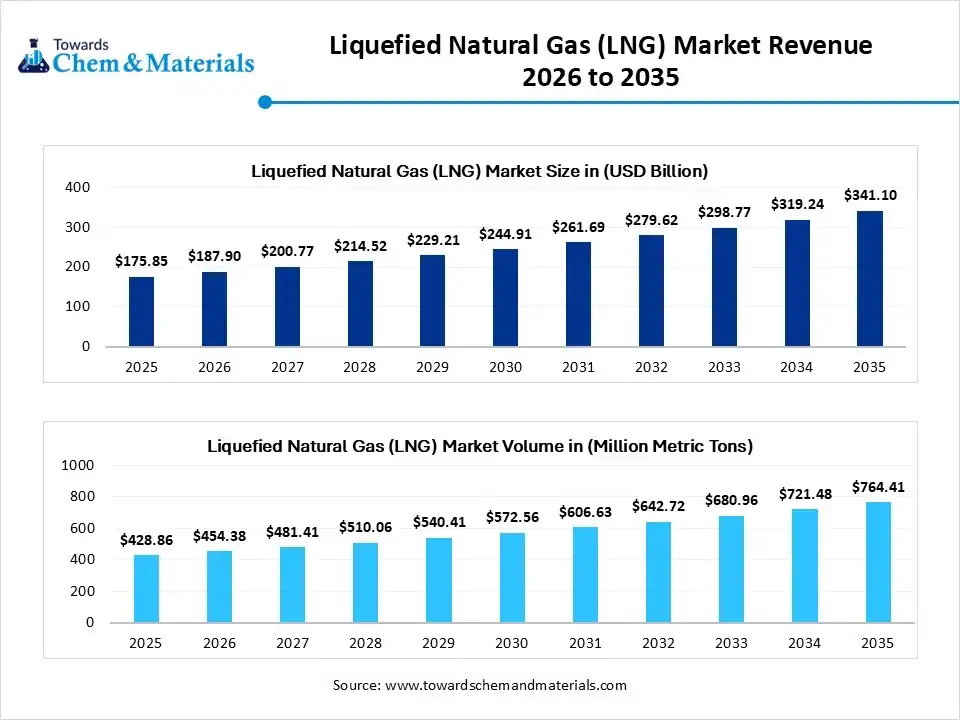
The global liquefied natural gas (LNG) market was valued at USD 175.85 billion in 2025, is estimated to reach USD 187.9 billion in 2026, and is projected to reach USD 341.1 billion by 2035, growing at a CAGR of 6.85% from 2026 to 2035. In terms of volume, the liquefied natural gas (LNG) market is projected to grow from 428.86 million tons in 2025 to 764.41 million tons by 2035. growing at a CAGR of 5.95% from 2026 to 2035.
Key Takeaways
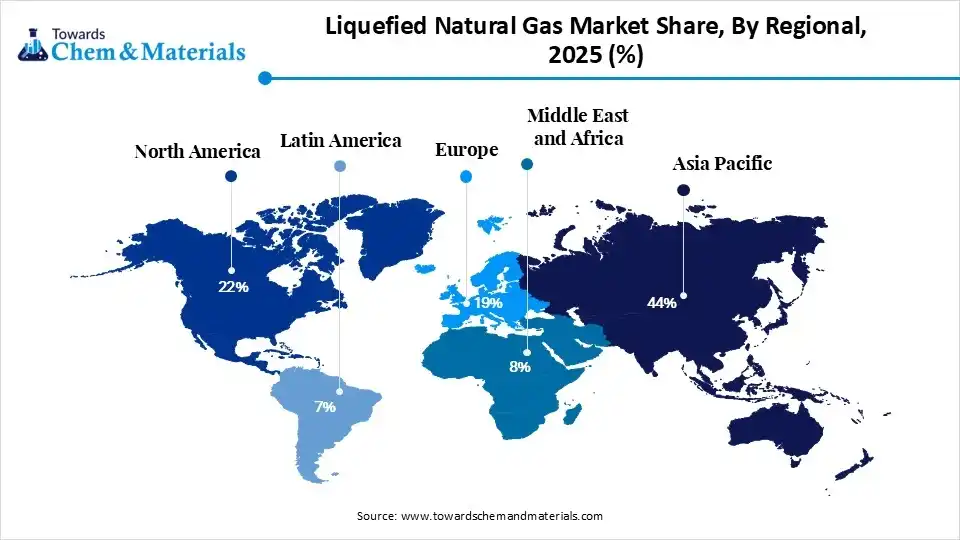
- By region, Asia Pacific dominated the market with a share of 44% in 2025 and is expected to be the fastest-growing region in the market, with a CAGR of 7.8% in the forecast period, due to countries in this region have very high energy demand due to rapid industrial growth, urbanization, and increasing population.
- By region, North America is notably growing with 22% market share in 2025, owing to its large natural gas reserves, advanced technology, and increasing LNG export capacity.
- By infrastructure type, the liquefaction terminals segment dominated the market with 34% share in 2025, as liquefaction is the most important step in LNG production.
- By infrastructure type, the regasification terminals segment held the 26% market share in 2025 and is expected to be the fastest-growing in the market, with a CAGR of 7.5% in the forecast period, owing to more countries importing LNG to meet growing energy demand.
- By source, the conventional natural gas segment dominated the market with 63% share in 2025, as it has been the main source of natural gas production for many years.
- By source, the shale gas segment held the 21% market share in 2025 and is expected to be the fastest-growing segment in the market, with a CAGR of 7.6% in the forecast period, due to increasing technological advancements in gas extraction methods such as hydraulic fracturing and horizontal drilling.
- By application, the power generation segment dominated the market with 38% share in 2025, as LNG is widely used for electricity production.
- By application, the transportation fuel segment held the 15% market share in 2025 and is expected to be the fastest-growing in the market, with a CAGR of 8.1% in the forecast period, owing to LNG is becoming a cleaner alternative for trucks, ships, and heavy vehicles.
- By end use industry, the utilities and power segment dominated the market with 36% share in 2025, owing to the power companies require large amounts of natural gas for electricity generation and energy supply.
- By end-use industry, the transportation industry segment held the 14% market share in 2025 and is expected to be the fastest-growing in the market, with a CAGR of 8.2% in the forecast period in 2025, owing to companies are searching for cleaner and more cost-effective fuel options.
- By contract type, the long-term contracts segment dominated the market with 61% share in 2025, owing to LNG projects require huge investments and stable financial planning.
- By contract type, the spot trading segment held the 24% market share in 2025 and is expected to be the fastest-growing in the market, with a CAGR of 8.4% in the forecast period, as buyers now want more flexibility in LNG purchasing.
- By technology, the APCI liquefaction technology segment dominated the market with 43% share in 2025, owing to it has been widely used for many years and offers reliable performance.
- By technology, the mixed refrigerant technology segment held the 31% market share in 2025 and is expected to be the fastest-growing in the market, with a CAGR of 7.3% in the forecast period, as it improves energy efficiency and reduces operating costs.
- By distribution channel, the direct supply agreements segment dominated the market with 48% share in 2025, owing to energy companies and buyers preferring stable business relationships and secure LNG supply.
- By distribution channel, the energy exchanges segment held the 13% market share in 2025 and is expected to be the fastest-growing in the market, with a CAGR of 8.0% in the forecast period, as the LNG market is becoming more flexible and digitally connected.
At a Glance
- Market Estimated Size (2025): USD 175.85 Billion | CAGR (2026–2035): 6.85%
- Market Projected Size (2035): USD 341.10 Billion
- Asia Pacific: largest Market Revenue Share of 44% in 2025.
- Market Estimated Volume (2025): 428.86 Million Metric Tons | Volume CAGR (2026–2035): 5.95%
- Market Projected Volume (2035): 764.41 Million Metric Tons
- Market Pricing (2025):
- Average Manufacturing Price (2025): USD 8.45/MMBtu
- Average Selling Price (2025): USD 11.25/MMBtu
- Pricing CAGR (2025–2035): 3.15%
LNG Rising as Energy Game Changer
The LNG gas has been cooled to an extremely low temperature until it changes into liquid form. Also, due to factors like easy storage and transportation and being lighter in size, liquefied natural gas has emerged as an ideal alternative to the traditional fuel options nowadays. Furthermore, the major countries are seen transporting this gas into large ships without using heavy and costly pipelines, which provides advantages and affordability in recent years.
Several countries want cleaner and more reliable energy sources nowadays. Compared to coal and oil, LNG produces lower pollution and fewer harmful emissions, making it a better option for the environment. Today, LNG is widely used for electricity generation, industrial production, cooking fuel, and transportation. Countries like Qatar, the United States, and Australia are major LNG exporters, while India, China, Japan, and South Korea are among the biggest buyers.
Also, the LNG industry works through several stages, including gas exploration, liquefaction, transportation, storage, regasification, and distribution to customers. Huge investments are made in LNG plants, storage terminals, and shipping systems because global energy demand is increasing every year as per the recent industry observation.
Liquefied Natural Gas (LNG) Market Trends:
- The greater demand for cleaner fuel options has driven the strategic transformation and sectoral scalability in recent years. Also, various regions are seen in heavy reduction of coal and other heavy fuels, akin to their high pollution problems, where LNG has created more industry opportunities.
- The heavy development and expansion of local LNG infrastructure have strengthened the foundation of future sector growth in the current period. Also, the major global suppliers are observed in the heavy investment in the regeneration and updation of their LNG plants nowadays.
- The shift towards flexible LNG trading is anticipated to position the industry for long-term expansion during the projected period. Also, in the past, LNG was supplied through long-term contracts, but nowadays buyers are seeking more flexibility in supply quantity and pricing, as per the recent survey.
Move Towards Safer Technology
The LNG industry is actively shifting towards new technologies that improve safety, efficiency, and environmental performance. Modern LNG plants now use advanced automation systems, artificial intelligence, and digital monitoring tools to control operations more accurately. These technologies help reduce energy waste, lower operating costs, and improve production speed. New liquefaction systems are also making LNG processing faster and more energy-efficient.
Primary Global Suppliers' Situations for 2026
- North America: North America is increasing LNG production to meet growing global energy demand. New export terminals and strong natural gas reserves are helping the region supply LNG to many countries while maintaining stable local energy supply.
- Middle East: The Middle East remains a major LNG supplier despite regional tensions and security concerns around the Strait of Hormuz, an important global energy shipping route. Countries in the region are continuing investments in LNG production and export projects to maintain their strong position in the global market and meet future energy demand.
- Russia: Russia is facing export challenges due to sanctions and trade restrictions. The country is now focusing on finding new markets, especially in Asia, while trying to maintain stable LNG production and economic growth.
Supply Chain Analysis of the Liquefied Natural Gas (LNG) Market:
Distribution to Industrial Users
- The distribution of liquefied natural gas to industrial users relies on highly specialized cryogenic infrastructure to transport methane chilled to -162°C. Bulk fuel travels via specialized maritime carriers and insulated road tankers to reach manufacturing plants.
- Shell plc: As a global leader supplying roughly 16% of worldwide LNG demand, the company manages one of the largest integrated shipping fleets to deliver high-volume cryogenic fuel directly to industrial hubs and manufacturing end-users.
- Other Key Players: TotalEnergies SE, Cheniere Energy, Inc., QatarEnergy, and ExxonMobil Corporation.
Chemical Synthesis and Processing
- Liquefied natural gas processing focuses on cryogenic physical transformation rather than complex chemical synthesis. Raw natural gas undergoes rigorous purification to strip water, carbon dioxide, hydrogen sulfide, and heavy hydrocarbons.
- QatarEnergy: The state-backed enterprise is driving the massive North Field expansion project to dramatically scale up its advanced liquefaction processing capacity and secure global supply dominance.
- Other Key Players: Sinopec (China Petroleum & Chemical Corporation), ExxonMobil Corporation, and Cheniere Energy, Inc.
Regulatory Compliance and Safety Monitoring
- LNG operations mandate stringent compliance with global cryogenic standards to prevent thermal hazards. Safety infrastructure integrates automatic hazard containment loops, low-temperature optical sensors, and vacuum insulation monitoring.
- Key Agencies: PHMSA (Pipeline and Hazardous Materials Safety Administration) and FERC (Federal Energy Regulatory Commission)
Liquefied Natural Gas (LNG) Market Regulatory Landscape: Regulations
| Country Region | Regulatory Body | Key Regulations | Focus Areas |
| United States | FERC (Federal Energy Regulatory Commission) | 18 CFR Part 153: FERC regulations governing the authorization, environmental reviews, siting, construction, and operation of onshore LNG export or import terminals. | Terminal facility siting safety, thermal radiation boundary zones, strict environmental impact statements (EIS), interstate pipeline integration, and public safety risk modeling for marine transfer channels. |
| Europe | European Commission | Directive 2012/18/EU (Seveso III Directive): Industrial safety legislation controlling major-accident hazards. Upper-tier compliance obligations apply automatically to facilities storing or processing large volumes of liquefied flammable gases like LNG. | Open-access rules for third-party terminal utilization, cross-border energy security. |
| China | NEA (National Energy Administration) | GB/T 38753-2020: The primary national technical standard defining product quality parameters, composition limits (methane fractions), and general safety testing metrics for liquefied natural gas | Rapid scaling of coastal import terminals, mandatory open-access mandates for pipeline networks, tracking and routing security for virtual pipelines. |
Market Dynamics
Driver
Enhancement of the Global Energy Stability Through LNG
The need for cleaner and more reliable energy sources has created a profitable pathway for the industry participants in the current period. LNG produces lower pollution than coal and oil, which helps governments reduce carbon emissions and improve air quality. Rising electricity demand, industrial growth, and increasing energy consumption are also driving the market. Many countries are building LNG terminals and pipelines to improve energy security and reduce dependence on a single fuel source.
Restraint
LNG Sector Under Cost Pressure
Very high investment and long construction time are likely to hinder the industry's growth during the forecast period. Also, the LNG prices can change quickly because of political tensions, supply shortages, and global market conditions. Transportation and storage of LNG also require special safety systems because LNG is stored at extremely low temperatures. Environmental concerns about fossil fuels and carbon emissions are putting increasing pressure on energy companies.
Opportunity
Stronger Business Opportunities Through Better and Cleaner Fuel Supply
Global energy demand is continuously increasing and is projected to create lucrative opportunities for manufacturers in the coming years. Also, developing countries are investing in LNG infrastructure to improve electricity supply and industrial growth. The use of LNG as a cleaner fuel for ships, trucks, and heavy vehicles is also creating new business opportunities. Technological advancements are helping companies reduce operating costs and improve efficiency.
Segmental Insights
Infrastructure Type Insights
The Liquefaction Terminals Segment Dominated the Liquefied Natural Gas (LNG) Market with 34% Market Share in 2025
The liquefaction terminals segment dominated the market with 34% share in 2025, as liquefaction is the most important step in LNG production. Natural gas must be converted into liquid form before it can be stored and transported to international markets. Large investments have been made in liquefaction plants because the global LNG trade is increasing rapidly.
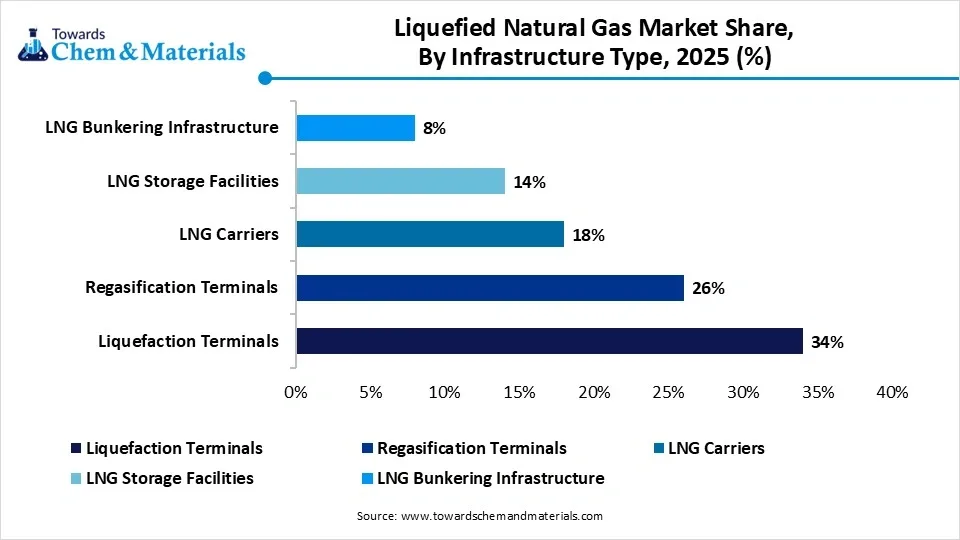
The regasification terminals segment held the 26% market share in 2025 and is expected to be the fastest-growing in the market, with a CAGR of 7.5% in the forecast period, owing to more countries importing LNG to meet growing energy demand. Regasification terminals convert LNG back into gas form before distribution to industries, power plants, and households.
Source Insights
The Conventional Natural Gas Segment Dominated the Market with 63% Market Share in 2025
The conventional natural gas segment dominated the market with 63% share in 2025, as it has been the main source of natural gas production for many years. Conventional gas reserves are easier to explore, extract, and process compared to other gas sources. Many countries already have existing infrastructure and production systems for conventional gas fields, which reduces production costs and improves supply stability.
Liquefied Natural Gas Market Share, By Source, 2025 (%)
| By Source | Revenue Share, 2025 (%) |
| Conventional Natural Gas | 63% |
| Shale Gas | 21% |
| Coal Bed Methane | 7% |
| Biogas-derived LNG | 9% |
The shale gas segment held the 21% market share in 2025 and is expected to be the fastest-growing segment in the market, with a CAGR of 7.6% in the forecast period, due to increasing technological advancements in gas extraction methods such as hydraulic fracturing and horizontal drilling. Countries like the United States are rapidly increasing shale gas production because shale reserves are large and widely available.
Application Insights
The Power Generation Segment Dominated the Liquefied Natural Gas (LNG) Market with 38% Market Share in 2025
The power generation segment dominated the market with a 38% share in 2025, as LNG is widely used for electricity production. Many countries are replacing coal-fired power plants with natural gas power plants because LNG produces lower emissions and cleaner energy. Also, rapid urbanization, industrial growth, and increasing electricity demand have also increased LNG consumption in the power sector.
Liquefied Natural Gas Market Share, By Application, 2025 (%)
| By Application | Revenue Share, 2025 (%) |
| Power Generation | 38% |
| Industrial Fuel | 21% |
| Residential & Commercial | 12% |
| Transportation Fuel | 15% |
| Feedstock | 10% |
| Others | 4% |
The transportation fuel segment held the 15% market share in 2025 and is expected to be the fastest-growing in the market, with a CAGR of 8.1% in the forecast period, owing to LNG is becoming a cleaner alternative for trucks, ships, and heavy vehicles. Many transportation companies are shifting toward LNG to reduce fuel costs and lower carbon emissions. Governments are also introducing strict environmental regulations for the transportation sector, encouraging the use of cleaner fuels.
End User Industry Insights
The Utilities & Power Segment Dominated the Market with 36% Market Share in 2025
The utilities and power segment dominated the market with 36% share in 2025, owing to the power companies require large amounts of natural gas for electricity generation and energy supply. LNG provides a stable and reliable fuel source for power plants, especially in countries with limited domestic gas reserves. Many governments are promoting cleaner energy systems and reducing coal usage, which has increased LNG demand in the utility sector.
Liquefied Natural Gas Market Share, By End User Industry, 2025 (%)
| By End User Industry | Revenue Share, 2025 (%) |
| Utilities & Power | 36% |
| Oil & Gas Industry | 16% |
| Transportation Industry | 14% |
| Industrial Manufacturing | 13% |
| Chemicals & Fertilizers | 11% |
| Residential & Commercial Sector | 7% |
| Marine Industry | 3% |
The transportation industry segment held the 14% market share in 2025 and is expected to be the fastest-growing in the market, with a CAGR of 8.2% in the forecast period in 2025, owing to companies are searching for cleaner and more cost-effective fuel options. LNG is gaining popularity in heavy trucks, marine transport, and long-distance transportation because it produces lower emissions than diesel and fuel oil. Governments are also supporting cleaner transportation systems through environmental policies and fuel regulations.
Contract Type Insights
The Long-term Contracts Segment Dominated the Market with 61% Market Share in 2025
The long-term contracts segment dominated the market with 61% share in 2025, owing to LNG projects require huge investments and stable financial planning. Long-term agreements help suppliers and buyers secure stable prices, guaranteed supply, and reduced market risks over many years. Energy companies prefer long-term contracts because they support investment recovery for LNG terminals, pipelines, and shipping infrastructure.
Liquefied Natural Gas Market Share, By Contract Type, 2025 (%)
| By Contract Type | Revenue Share, 2025 (%) |
| Long-term Contracts | 61% |
| Spot Trading | 24% |
| Short-term Contracts | 15% |
The spot trading segment held the 24% market share in 2025 and is expected to be the fastest-growing in the market, with a CAGR of 8.4% in the forecast period, as buyers now want more flexibility in LNG purchasing. Spot trading allows companies to buy LNG based on current market prices and short-term demand instead of fixed long-term agreements. This system helps businesses respond quickly to changing energy needs and market conditions.
Technology Insights
The APCI Liquefaction Technology Segment Dominated the Market with 43% Market Share in 2025
The APCI liquefaction technology segment dominated the market with 43% share in 2025, owing to it has been widely used for many years and offers reliable performance. This technology is known for high efficiency, stable operations, and strong production capacity in large LNG plants.
Liquefied Natural Gas Market Share, By Technology, 2025 (%)
| By Technology | Revenue Share, 2025 (%) |
| APCI Liquefaction Technology | 43% |
| Cascade Liquefaction Technology | 16% |
| Mixed Refrigerant Technology | 31% |
| Expander-based Technology | 10% |
The mixed refrigerant technology segment held the 31% market share in 2025 and is expected to be the fastest-growing in the market, with a CAGR of 7.3% in the forecast period, as it improves energy efficiency and reduces operating costs. This technology uses a combination of refrigerants to cool natural gas more effectively during the liquefaction process. It is becoming popular because it can handle different operating conditions and improve overall plant performance.
Distribution Channel Insights
The Direct Supply Agreements Segment Dominated the Market with 48% Market Share in 2025
The direct supply agreements segment dominated the market with 48% share in 2025, owing to energy companies and buyers preferring stable business relationships and secure LNG supply. Direct agreements help reduce market uncertainty, improve pricing stability, and ensure continuous energy delivery.
Liquefied Natural Gas Market Share, By Distribution Channel, 2025 (%)
| By Distribution Channel | Revenue Share, 2025 (%) |
| Direct Supply Agreements | 48% |
| LNG Trading Companies | 27% |
| Energy Exchanges | 13% |
| LNG Retail Distribution | 12% |
The energy exchanges segment held the 13% market share in 2025 and is expected to be the fastest-growing in the market, with a CAGR of 8.0% in the forecast period, as the LNG market is becoming more flexible and digitally connected. Energy exchanges allow buyers and sellers to trade LNG quickly based on current market prices and demand conditions. These platforms improve price transparency, market competition, and trading efficiency.
Regional Insights
Why did Asia Pacific Dominated the Liquefied Natural Gas (LNG) Market in 2025?
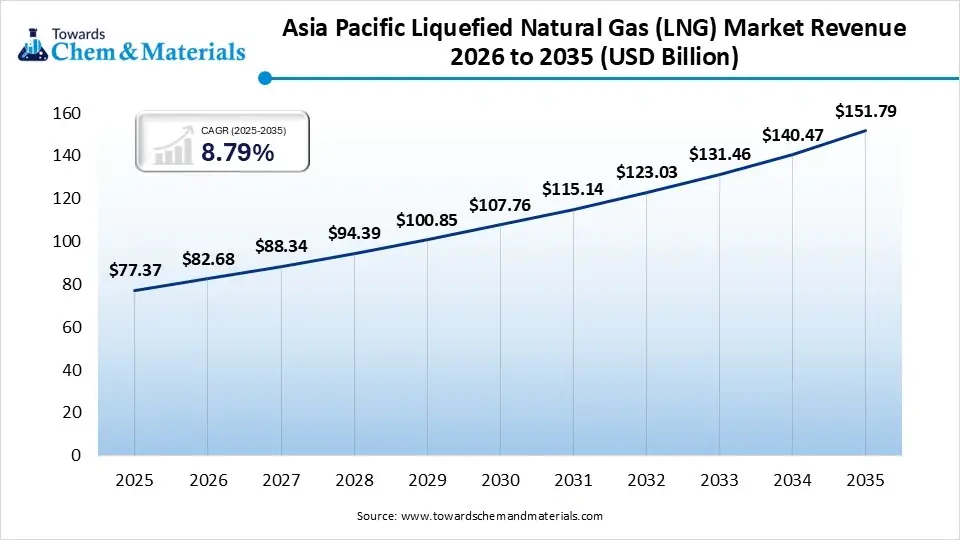
The Asia Pacific liquefied natural gas (LNG) market size was estimated at USD 77.37 billion in 2025 and is projected to reach USD 151.79 billion by 2035, growing at a CAGR of 8.79% from 2026 to 2035, due to countries in this region have very high energy demand due to rapid industrial growth, urbanization, and increasing population. Many countries in Asia do not produce enough natural gas domestically, so they depend heavily on LNG imports for electricity generation and industrial use.
China is Shifting Towards the Low-Carbon LNG Transition
China maintained its dominance in the market, owing to its growing industries, large population, and rising electricity demand. The country is increasing LNG imports to reduce dependence on coal and improve environmental conditions. The Chinese government is promoting cleaner fuels to reduce air pollution in major cities. China is also investing heavily in LNG terminals, pipelines, and storage infrastructure to ensure stable energy supply.
Liquefied Natural Gas (LNG) Market Evaluation in North America
North America is notably growing, with a 22% market share in 2025, owing to its large natural gas reserves, advanced technology, and increasing LNG export capacity. The region is expanding liquefaction terminals and export infrastructure to supply LNG to Europe, Asia, and other global markets. Technological advancements in shale gas production are helping increase natural gas availability at lower costs.
United States Rising LNG Export Leader
The United States is expected to emerge as a leading country for the liquefied natural gas (LNG) market in the coming years, due to its huge shale gas production and advanced energy infrastructure. The country is increasing LNG exports to meet rising global demand, especially in Europe and Asia. The United States has many large liquefaction terminals and export facilities that support international LNG trade.
Europe Liquefied Natural Gas Industry Conditions
Europe held the 19% market share in 2025 owing to many countries are trying to reduce dependence on pipeline gas and improve energy security. Rising geopolitical tensions and supply uncertainties have encouraged European countries to increase LNG imports from different global suppliers. Governments are also replacing coal with cleaner fuels like LNG to achieve environmental and climate goals.
Germany Supporting Sustainable LNG Market Expansion
Germany is notably observing a significant growth across the region owing to country is investing in LNG import terminals and regasification infrastructure to secure a stable energy supply for industries and households. Germany is also promoting cleaner energy systems to reduce carbon emissions and support environmental goals. Industrial production, manufacturing activities, and electricity demand are increasing LNG consumption in the country.
Liquefied Natural Gas Industry Survey in Latin America
Latin America held the 7% market share in 2025 due to countries are increasing investments in cleaner energy infrastructure and electricity generation. Growing industrial activities, urban development, and rising energy demand are increasing LNG consumption across the region. Several countries are using LNG to improve energy reliability and reduce dependence on oil and coal.
Brazil Expanding LNG Infrastructure and Power
Brazil emerges as a leading country in the Latin American market, owing to rising electricity demand and growing industrial development. The country uses LNG to support power generation, especially during periods of low hydroelectric power production. Brazil is investing in LNG terminals, floating storage systems, and gas infrastructure to improve energy security and supply stability.
Middle East & Africa’s Liquefied Natural Gas Industry Observation
The Middle East and Africa held the 8% market share in 2025, akin to large natural gas reserves and increasing investments in energy infrastructure. Countries in this region are expanding LNG production and export facilities to meet rising global energy demand. Governments are also focusing on economic diversification and increasing revenue from energy exports. Rising industrial development and growing electricity demand are increasing LNG consumption within the region.
Saudi Arabia Building a Strong LNG Future
Saudi Arabia is expected to receive a better comeback in the coming years by increasing its focus on LNG as part of its long-term energy and economic development plans. The country is investing in natural gas production and LNG infrastructure to support industrial growth and reduce dependence on oil for domestic energy use. Saudi Arabia is also expanding energy projects to meet rising electricity demand and support economic diversification goals.
Recent Development
- In May 2026, Venture Global created an LNG purchase Agreement with Vitol and TotalEnergies. Also, these deals are associated with the U.S. liquified natural gas from Venture Global, where the total energy is likely to receive approximately 0.85 MTPA of LNG from the Venture Global for the next five years as per the published report.
Top Vendors in the Liquefied Natural Gas (LNG) Market & Their Offerings:
- QatarEnergy: This state-run company from Qatar is the ultimate powerhouse in the global LNG industry. They manage the world's largest natural gas fields and are currently working on massive expansion projects. Their main focus is processing and shipping huge volumes of super-chilled gas to fuel countries all over the world.
- Sinopec: This massive Chinese company is a major player in importing, processing, and distributing LNG across Asia. They operate giant coastal receiving terminals and a large network of pipelines. The company makes sure that heavy industries and big cities across China get a steady, reliable supply of clean energy.
- PetroChina: As the main public branch of China's national oil company, this enterprise handles massive natural gas production and exploration. They run an extensive network of LNG storage tanks and supply lines. The company focuses heavily on securing energy imports and managing the complex distribution systems that power local businesses.
Liquefied Natural Gas Market Key Players
- PETRONAS
- ADNOC (Abu Dhabi National Oil Company)
- Sonatrach
- NNPC (Nigerian National Petroleum Company)
- GAIL (India) Limited
Liquefied Natural Gas Market Segments Covered in the Report
By Infrastructure Type
- Liquefaction Terminals
- Onshore Liquefaction
- Floating LNG (FLNG)
- Regasification Terminals
- Land-based Regasification
- Floating Storage and Regasification Units (FSRU)
- LNG Carriers
- Moss-type Carriers
- Membrane-type Carriers
- LNG Storage Facilities
- Above-ground Tanks
- Underground Storage
- LNG Bunkering Infrastructure
- Truck-to-Ship
- Ship-to-Ship
- Terminal-to-Ship
By Source
- Conventional Natural Gas
- Associated Gas
- Non-associated Gas
- Shale Gas
- Coal Bed Methane
- Biogas-derived LNG
- Bio-LNG
- Synthetic LNG
By Application
- Power Generation
- Combined Cycle Power Plants
- Peaking Power Plants
- Industrial Fuel
- Manufacturing Industries
- Petrochemical Industries
- Residential & Commercial
- City Gas Distribution
- Commercial Heating
- Transportation Fuel
- Heavy-duty Trucks
- Marine Fuel
- Rail Transport
- Feedstock
- Fertilizer Production
- Chemical Manufacturing
- Others
- Mining Operations
- Remote Power Systems
By End User Industry
- Utilities & Power
- Oil & Gas Industry
- Transportation Industry
- Industrial Manufacturing
- Chemicals & Fertilizers
- Residential & Commercial Sector
- Marine Industry
By Contract Type
- Long-term Contracts
- Spot Trading
- Short-term Contracts
By Technology
- APCI Liquefaction Technology
- Cascade Liquefaction Technology
- Mixed Refrigerant Technology
- Expander-based Technology
By Distribution Channel
- Direct Supply Agreements
- LNG Trading Companies
- Energy Exchanges
- LNG Retail Distribution
By Regions
- North America
- U.S.
- Canada
- Mexico
- Europe
- Germany
- UK
- France
- Italy
- Spain
- Asia Pacific
- China
- India
- Japan
- South Korea
- Latin America
- Brazil
- Argentina
- Middle East & Africa
- Saudi Arabia
- South Africa
FAQ's
Question 1 : What is Liquefied Natural Gas (LNG)?
Answer : Liquefied Natural Gas (LNG) is natural gas that has been cooled to around 162°C, converting it into liquid form for easier storage and transportation.
Question 2 : Which region dominates the LNG market?
Answer : Asia Pacific dominates the market with a 44% share in 2025, driven by high energy demand, industrialization, and population growth.
Meet the Team

Saurabh Bidwai
Principal Consultant
Saurabh Bidwai, a B.Tech Chemical Engineering graduate with 4+ years of experience, specializes in specialty chemicals, commodity chemicals, and engineered materials, offering valuable insights into market trends and emerging opportunities.

Aditi Shivarkar
Reviewed By
Aditi Shivarkar, with 14+ years in Chemical and Materials market research, specializes in Chemical and Materials. She ensures accurate, actionable insights, driving Towards Chemicals And Materials Analytics and Consulting excellence in industry trends and sustainability.