
Liquefied Waste Plastic Market Size, Share & Trends Analysis Report by 2026-2035
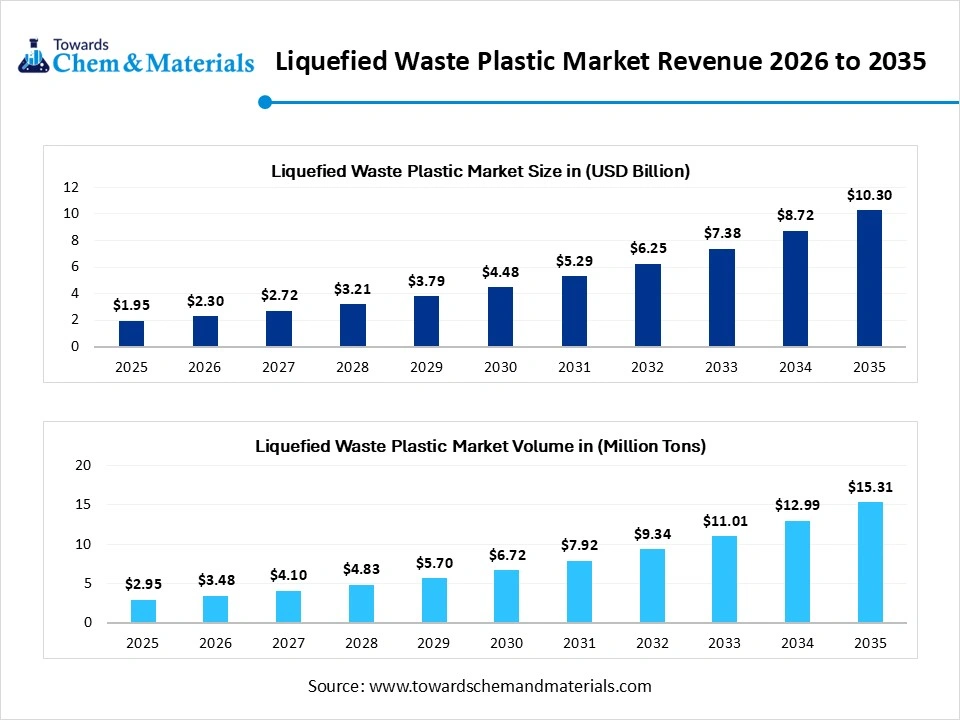
The liquefied waste plastic market is experiencing rapid growth, increasing from USD 1.95 billion in 2025 to an estimated USD 2.3 billion in 2026 and projected to reach USD 10.3 billion by 2035, reflecting a CAGR of 18.11%. The market volume is forecast to rise from 2.95 million tons to 15.31 million tons over the same period, growing at 17.9% CAGR. The study covers detailed segmentation insights, regional performance analysis, and evaluates key growth drivers and challenges. It further presents competitive benchmarking, company profiles, value chain analysis, trade flow data, and a comprehensive overview of major manufacturers and suppliers.
Content
Liquefied Waste Plastic Market Demand, Size and Growth Rate Forecast
The global liquefied waste plastic market was valued at USD 1.95 billion in 2025, is estimated to reach USD 2.3 billion in 2026, and is projected to reach USD 10.3 billion by 2035, growing at a CAGR of 18.11% from 2026 to 2035. In terms of volume, the liquefied waste plastic market is projected to grow from 2.95 million tons in 2025 to 15.31 million tons by 2035. growing at a CAGR of 17.9% from 2026 to 2035.
Key Takeaways
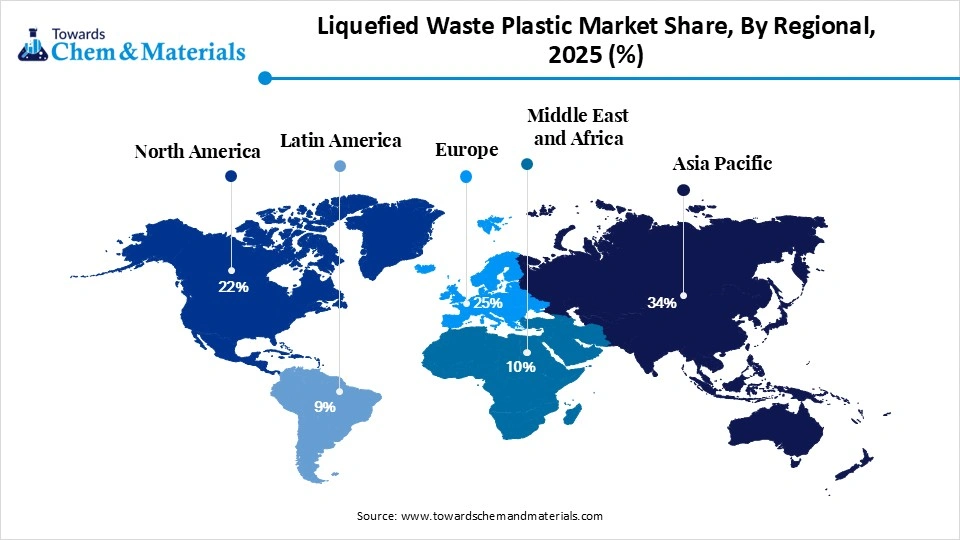
- By region, Asia Pacific dominated the market with a share of 34% in 2025 and is expected to sustain its position while growing with the fastest CAGR of 20.40% in the forecast period.
- By region, Europe held 25% market share in 2025.
- By technology, the pyrolysis segment dominated the market with 68% share in 2025.
- By technology, the hydrothermal liquefaction segment is expected to have the fastest growth with a CAGR of 19.4% in the forecast period.
- By feedstock type, the polyethylene segment dominated the market with 34% share in 2025.
- By feedstock type, the mixed plastic waste segment is expected to have the fastest growth with a CAGR of 19.6% in the forecast period.
- By product type, the fuel oil segment dominated the market with 57% share in 2025.
- By product type, the chemical feedstock segment is expected to have the fastest growth with a CAGR of 19.8% in the forecast period.
- By end-use industry, the energy and power segment dominated the market with 36% share in 2025.
- By end-use industry, the chemical and petrochemical segment is expected to have the fastest growth with a CAGR of 20.2% in the forecast period.
Market Size and Volume Forecast
- Market Estimated Size (2025): USD 1.95 Billion | CAGR (2026–2035):18.11%
- Market Projected Size (2035): USD 10.30 Billion
- Market Volume (2025): 2.95 Million Tons (MT) | Volume CAGR (2026–2035): 17.9%
- Market Projected Volume (2035):15.31 Million Tons (MT)
- Market Pricing (2025):
- Average Manufacturing Price: USD 489/ton
- Average Selling Price: USD 727/ton
- Pricing CAGR (2025–2035): 4.11%
Market Overview
What Is The Significance Of The Liquefied Waste Plastic Market?
The liquefied waste plastic market is significant because it provides a crucial chemical recycling pathway for hard-to-recycle plastic waste, such as mixed, contaminated, or multi-layer packaging, that is typically destined for incineration or landfill. By converting this waste into valuable, high-quality circular oil feedstock (pyrolysis oil), the market enables the production of virgin-quality polymers, replacing fossil resources and reducing greenhouse gas emissions.
Liquefied Waste Plastic Market Growth Trends
- Sustainability and Regulations: Stringent environmental regulations and government mandates for sustainable waste disposal are driving the industry. Corporations are increasingly investing in chemical recycling to meet ESG goals and produce sustainable, high-quality recycled material.
- Focus on Polyolefins: Research and commercial focus are shifting towards polyolefins (PE, PP), which make up a significant portion of packaging waste.
- Rising Waste-to-Energy: There is a continued trend of converting unrecyclable plastic waste into fuel.
Report Scope
| Report Attribute | Details |
| Market Size and Volume in 2026 | USD 2.3 Billion / 3.48 Million Metric Tons |
| Expected Size and Volume by 2035 | USD 10.3 Billion / 15.31 Million Metric Tons |
| Growth Rate from 2026 to 2035 | CAGR 18.11% |
| Forecast Period | 2026 - 2035 |
| Dominant Region | Asia Pacific |
| Segment Covered | By Feedstock, By Fuel and By Regions |
| Key companies profiled | Licella Holdings Pty Ltd, Mura Technology Limited, Anellotech Inc., Alterra Energy, SABIC, Plastic Energy Limited, Brightmark Energy, Biofabrik Green Refinery GmbH, Resynergi Inc., ReNew ELP, Neste Oyj, OMV AG, Quantafuel ASA, Agilyx Corporation, GreenMantra Technologies, Cynar Plc, Enval Limited, APK AG, Recycling Technologies Ltd, BlueAlp Innovations BV, Clariant AG |
Key Technological Shifts In The Liquefied Waste Plastic Market
The liquefied waste plastic market is experiencing a rapid shift from traditional mechanical recycling toward advanced chemical recycling (feedstock recycling), driven by the need to process mixed, contaminated, and multi-layer plastics that were previously considered unrecyclable. These technological shifts aim to create a circular economy by breaking down plastics into monomers or oils that can produce virgin-quality plastics.
Trade Analysis of Liquefied Waste Plastic Market: Import & Export Statistics
- According to Global Export Data, the world exported 65,666 Plastic Waste shipments between July 2024 and June 2025 (TTM) via 2,926 verified exporters and 1,984 buyers, representing a 14% YoY change.
- Vietnam, Mexico, and India lead as the top Plastic Waste importers, while Vietnam with 127,258 shipments, Mexico with 27,165, and the United States with 19,952, rank as the largest global Plastic Waste exporters.
Top-performing Global Plastic Waste Exporters by volume:
- CONG TY TNHH TM-SX NONG SAN THUC PHAM QUOC TE QUAN: 26,631 shipments (58%)
- SAMSUNG ELECTRONICS HCMC CE COMPLEX CO LTD: 9,084 shipments (20%)
- CHANG SHIN VIETNAM CO LTD: 5,546 shipments (12%)
Supply Chain Analysis of Liquefied Waste Plastic Market:
Waste Plastic Conversion & Processing
Liquified waste plastic is produced through advanced recycling technologies such as pyrolysis, depolymerization, and catalytic cracking, converting plastic waste into liquid fuels, oils, and chemical feedstocks.
- Key players: Plastic Energy, Agilyx, Brightmark, Shell
Quality Testing and Certification
Liquified plastic products must meet fuel quality standards, environmental regulations, and chemical safety guidelines before use or commercialization.
- Key players: U.S. Environmental Protection Agency, International Organization for Standardization, ASTM International, European Chemicals Agency
Distribution to Industrial Users
Liquified waste plastic is supplied to petrochemical companies, refineries, fuel producers, and chemical manufacturers as an alternative feedstock and energy source.
- Key players: Plastic Energy, Agilyx, Brightmark.
Liquefied Waste Plastic Regulatory Landscape: Global Regulations
| Country / Region | Regulatory Body | Key Regulations | Focus Areas | Notable Notes |
| U.S. | Environmental Protection Agency (EPA); Department of Energy (DOE) | Resource Conservation and Recovery Act (RCRA); Clean Air Act | Waste-to-fuel conversion, emissions control, chemical recycling | Liquified waste plastic (via pyrolysis or depolymerization) is regulated under waste management and fuel production laws, with increasing support for advanced recycling technologies. |
| Europe | European Commission; European Chemicals Agency (ECHA) | Waste Framework Directive; REACH Regulation; Circular Economy Action Plan | Chemical recycling, waste classification, and sustainability | The EU promotes chemical recycling technologies, including plastic liquefaction, under circular economy policies while ensuring compliance with chemical safety standards. |
| China | Ministry of Ecology and Environment (MEE); National Development and Reform Commission (NDRC) | Circular Economy Promotion Law; Plastic Pollution Control Policies | Plastic waste reduction, recycling technologies, and environmental compliance | China encourages advanced recycling and waste-to-energy technologies, including plastic liquefaction, to reduce environmental pollution. |
| India | Ministry of Environment, Forest and Climate Change (MoEFCC); Central Pollution Control Board (CPCB) | Plastic Waste Management Rules; Environment Protection Act | Waste conversion, extended producer responsibility (EPR), emissions control | India supports waste-to-fuel technologies under its waste management policies while enforcing strict environmental and emissions standards. |
| Japan | Ministry of Economy, Trade and Industry (METI); Ministry of the Environment | Plastic Resource Circulation Act; Recycling Laws | Chemical recycling, resource efficiency | Japan promotes plastic-to-fuel and chemical recycling technologies as part of its circular economy strategy. |
| South Korea | Ministry of Environment (MoE); Ministry of Trade, Industry and Energy (MOTIE) | Waste Control Act; K-Circular Economy Policies | Waste recycling, chemical recycling, and environmental safety | South Korea is advancing chemical recycling technologies, including plastic liquefaction, with strong regulatory support for sustainability. |
Market Dynamics
Drivers
What are the Key Growth Drivers of the Liquefied Waste Plastic Market?
The liquefied waste plastic market is rapidly expanding, mainly due to chemical recycling methods such as pyrolysis and hydrothermal liquefaction. It converts waste into valuable products like pyrolysis oil, diesel, and naphtha, fostering a circular economy. This growth is driven by the necessity to manage non-recyclable mixed plastics, increasing demand for superior recycled materials, and strict environmental regulations.
Restrains
What are the Key Growth Restraints of the Liquefied Waste Plastic Market?
The key growth restraints of the liquefied waste plastic market, primarily driven by chemical recycling techniques like pyrolysis, revolve around high operational costs, technical limitations, and infrastructure challenges. While the industry is growing due to demand for recycled materials, these factors significantly hinder large-scale commercialization.
Opportunities
What are the Key Growth Opportunities of the Liquefied Waste Plastic Market?
The liquefied waste plastic market, heavily driven by chemical recycling (pyrolysis), is experiencing rapid expansion as a critical solution for managing hard-to-recycle, contaminated, and mixed plastic waste. Key growth opportunities are focused on converting this waste into valuable pyrolysis oil, naphtha, and diesel. Mandatory EPR and recycled-content targets in regions like the EU and India are accelerating market growth.
Segmental Insights
Technology Insights
The pyrolysis segment dominated the market with 68% market share in 2025
The pyrolysis segment dominated the market with 68% share in 2025, driven by its ability to convert non-recyclable, mixed, and contaminated plastics into high-value pyrolysis oil, often referred to as "plastic-to-fuel" or chemical recycling. Chemical companies and brands are investing in pyrolysis to meet recycled-content mandates, as pyrolysis oil can be refined into new plastic, supporting a circular economy.
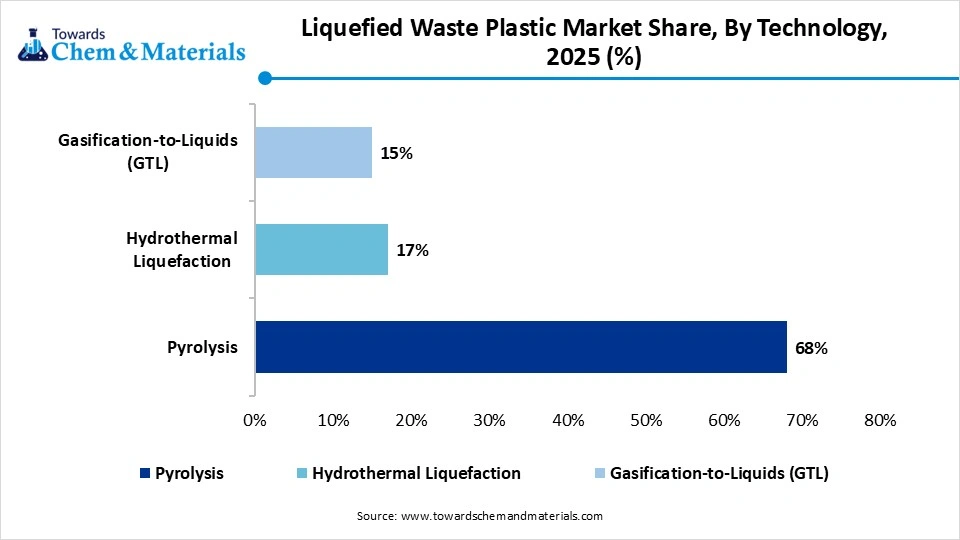
The hydrothermal liquefaction segment held 17% market share in 2025 and is expected to have the fastest growth, with a CAGR of 19.4% in the forecast period, driven by its unique ability to process wet, mixed, and contaminated plastics, a major bottleneck for traditional chemical recycling methods like pyrolysis. HTL operates at moderate temperatures (250–550 °C) and high pressures (4–30 MPa), using water as a solvent to break down polymers into high-quality, oil-like hydrocarbons, often yielding over 90% liquid oil for specific polymers.
The gasification-to-liquids (GTL) segment held 15% market share in 2025, driven by its ability to convert diverse, contaminated, and unsorted plastics into high-value chemical feedstocks (methanol, hydrogen) rather than just lower-grade fuels. This trend is propelled by the need for advanced chemical recycling in a circular economy, as conventional mechanical recycling struggles with mixed plastic waste streams.
Feedstock Type Insights
The Polyethylene (PE) Segment Dominated The Market With 34% Market Share In 2025
The polyethylene (PE) segment dominated the market with 34% share in 2025, driven by its status as the most produced and consumed plastic worldwide, which provides a massive, consistent feedstock for chemical recycling technologies like pyrolysis. As industries and governments push for a circular economy, PE waste, particularly High-Density Polyethylene (HDPE) and Low-Density Polyethylene (LDPE), is increasingly liquefied into raw materials for new plastic production.
The mixed plastic waste segment held 23% market share in 2025 and is expected to have the fastest growth with a CAGR of 19.6% in the forecast period, often referred to as chemical recycling or plastic-to-fuel, due to the inability of traditional mechanical recycling to process contaminated, multi-layer, or varied polymer mixtures. This segment, which converts mixed waste into pyrolysis oil, is projected to grow significantly, with post-consumer mixed plastics leading the market.
Liquefied Waste Plastic Market Share, By Feedstock Type, 2025 (%)
| By Feedstock Type | Revenue Share, 2025 (%) |
| Polyethylene (PE) | 34% |
| Polypropylene (PP) | 21% |
| Polystyrene (PS) | 14% |
| Mixed Plastic Waste | 23% |
| Others (PET, PVC) | 8% |
The polypropylene (PP) segment held 21% market share in 2025, driven by the urgent need for circular economy solutions, advancements in chemical recycling technologies, and high demand from the packaging and automotive sectors. Brand commitments to sustainability and Environmental, Social, and Governance (ESG) goals are pushing for higher recycled content in packaging and consumer products.
The polystyrene (PS) segment held 14% market share in 2025, driven by advanced chemical recycling technologies that allow it to be broken down into high-purity styrene monomers, which can then be reused to create "new" virgin-quality plastic. This shift is fueled by the need to overcome environmental, non-biodegradable issues associated with traditional disposal methods, resulting in a market transformation from waste to a valuable feedstock.
Product Type Insights
The Fuel Oil Segment Dominated The Market With 57% Market Share In 2025
The fuel oil segment dominated the market with 57% share in 2025, driven by the increasing demand for sustainable alternatives to traditional fossil fuels and the need for efficient, non-recyclable plastic management. Increasing regulations against plastic landfilling and corporate commitments to circular economy initiatives are boosting demand, with over 53% of plastic waste now targeted for recycling or conversion into oil.
The chemical feedstock segment held 29% market share in 2025 and is expected to have the fastest growth with a CAGR of 19.8% in the forecast period, driven by the need to convert plastic waste into high-value petrochemical intermediates (like monomers and pyrolysis oil) rather than just fuel. This segment is transforming post-consumer, mixed, or contaminated plastic waste into virgin-quality feedstocks suitable for food-grade packaging, textiles, and automotive components.
The waxes & lubricants segment held 14% market share in 2025, driven by the need for high-value applications of pyrolysis oil, increasing sustainability regulations, and technological advancements that allow waste plastics to be converted into high-performance industrial products. Strict environmental regulations and corporate commitments to circular economy targets are driving the demand for recycled-content waxes.
End-Use Industry Insights
The Energy & Power Segment Dominated The Market With 36% Market Share In 2025
The energy & power segment dominated the market with 36% share in 2025, driven by the conversion of plastic waste into plastic pyrolysis oil (PPO) and its use as a sustainable alternative to conventional fossil fuels. This sector is expanding due to rising demand for clean energy, high calorific value of waste-derived fuels, and the need to reduce landfill reliance. Power plants adopt waste-derived fuels to reduce emissions, which fuels the growth. Rising energy demand increases alternative fuel usage, along with the Government incentives supporting adoption, which supports growth.
Liquefied Waste Plastic Market Share, By End-Use Industry, 2025 (%)
| By End-Use Industry | Revenue Share, 2025 (%) |
| Energy & Power | 36% |
| Chemical & Petrochemical | 27% |
| Automotive | 14% |
| Industrial Manufacturing | 15% |
| Others | 8% |
The chemical and petrochemical segment held 27% market share in 2025 and is expected to have the fastest growth with a CAGR of 20.2% in the forecast period by shifting from a linear "take-make-dispose" model to a circular economy, where pyrolysis oil is used as a sustainable alternative feedstock to virgin naphtha. Petrochemical companies are investing heavily in this sector to meet sustainability goals, reduce carbon emissions, and comply with regulatory mandates requiring increased recycled content in plastics.
The industrial manufacturing segment held 15% market share in 2025, fueled by rapid industrialization, stringent regulatory compliance, and the need to achieve circular economy goals. Stringent environmental policies, such as the EU's Circular Economy Action Plan and Extended Producer Responsibility (EPR) mandates, are forcing industries to adopt circular systems and achieve sustainable waste reduction.
The automotive segment held 14% market share in 2025. This rapid expansion is fueled by the need for high-quality sustainable materials for lightweighting vehicles, enhancing electric vehicle (EV) efficiency, and meeting stringent regulatory mandates on the circular economy and carbon emissions. The chemically recycled plastic market within the automotive sector is accelerating, with companies like BASF, Sabic, and Covestro investing heavily in developing automotive-grade resins from pyrolysis oil.
Regional Insights
How did Asia Pacific Dominate the Liquefied Waste Plastic Market in 2025?
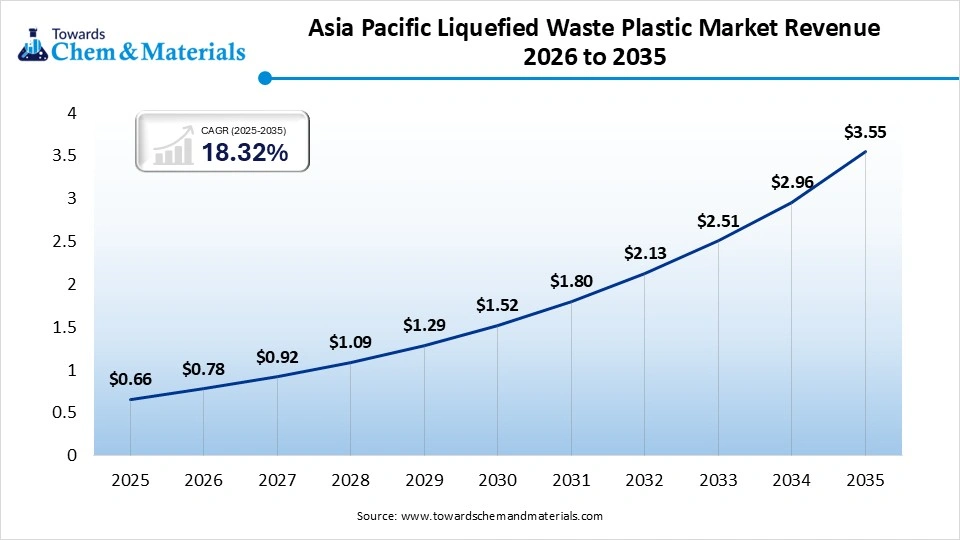
The Asia Pacific liquefied waste plastic market size was estimated at USD 0.66 billion in 2025 and is projected to reach USD 3.55 billion by 2035, growing at a CAGR of 18.32% from 2026 to 2035. High plastic waste generation drives market growth, along with Rapid industrialization, which increases fuel demand. Government initiatives promote recycling infrastructure, fueling the growth and expansion of the market in the region.
China Liquefied Waste Plastic Market Growth Factor
China's liquefied waste plastic market is expanding rapidly, driven by strict "plastic control" policies and a ban on plastic imports. China dominates the sector due to massive plastic waste generation and strict regulations, while India is seeing significant growth due to government-mandated Extended Producer Responsibility. The 2020 Law on Prevention and Control of Solid Waste and "Beautiful China" initiatives are accelerating investments in waste-to-resource projects.
Europe Liquefied Waste Plastic Market Growth Factor
Europe held 25% market share in 2025, expanding rapidly, driven by chemical recycling, with Germany leading in market share. Strict environmental policies drive the adoption of waste-to-fuel technologies. Key developments include the commissioning of the world's largest upgrading facility for liquefied plastic waste by Neste in 2026, targeting 150,000 tons per year to convert waste into feedstock. Circular economy initiatives boost demand. Government funding supports projects, which support growth.
Germany Liquefied Waste Plastic Market Growth Factor
The liquefied waste plastic market in Germany is experiencing rapid growth, driven by advanced chemical recycling, regulatory pressure, and high demand for recycled-content feedstock in the chemical industry. Germany is a major player in the international waste market, with both imports and exports of waste plastics increasing. Germany incinerates a large portion of its plastic waste, highlighting the potential for increased chemical recycling capacities, which increases the growth and expansion of the market.
Recent Development
- In March 2026, Neste commissioned the world’s largest upgrading facility for liquefied waste plastic at its Porvoo refinery in Finland, marking a shift to industrial-scale chemical recycling with a 150,000-ton annual capacity. This €111 million investment supports the production of Neste RE™ feedstock to replace fossil resources and reduce greenhouse gas emissions by over 35%.
Top players in the Liquefied Waste Plastic Market & Their Offerings
- Shell plc: Shell is actively investing in chemical recycling technologies, including pyrolysis-based conversion of plastic waste into liquid feedstock. The company integrates liquefied plastic waste into its refining and petrochemical value chain to produce circular polymers.
- TotalEnergies SE: TotalEnergies develops advanced recycling solutions for plastic waste, converting it into liquid hydrocarbons used as feedstock for new plastics production. The company focuses on circular economy initiatives and low-carbon fuel integration.
- ExxonMobil Corporation: ExxonMobil is expanding its advanced recycling portfolio, including plastic waste liquefaction technologies. The company processes plastic waste into feedstock for petrochemical manufacturing, supporting large-scale circular plastic production.
- Chevron Phillips Chemical Company: Chevron Phillips is involved in converting plastic waste into liquid hydrocarbons through advanced recycling processes. The company collaborates with recycling technology firms to scale liquefied waste plastic solutions.
- LyondellBasell Industries N.V.: LyondellBasell is a key player in advanced recycling, developing facilities that convert plastic waste into liquid feedstock for polymer production. The company aims to produce large volumes of recycled and renewable-based polymers through chemical recycling.
Liquefied Waste Plastic Market Top Players
- Licella Holdings Pty Ltd
- Mura Technology Limited
- Anellotech Inc.
- Alterra Energy
- SABIC
- Plastic Energy Limited
- Brightmark Energy
- Biofabrik Green Refinery GmbH
- Resynergi Inc.
- ReNew ELP
- Neste Oyj
- OMV AG
- Quantafuel ASA
- Agilyx Corporation
- GreenMantra Technologies
- Cynar Plc
- Enval Limited
- APK AG
- Recycling Technologies Ltd
- BlueAlp Innovations BV
- Clariant AG
Liquefied Waste Plastic Market Segments Covered
By Technology
- Pyrolysis
- Thermal Pyrolysis
- Catalytic Pyrolysis
- Zeolite-based Catalysts
- Metal Oxide Catalysts
- Hydrothermal Liquefaction
- Gasification-to-Liquids (GTL)
By Feedstock Type
- Polyethylene (PE)
- HDPE
- LDPE
- Polypropylene (PP)
- Polystyrene (PS)
- Mixed Plastic Waste
- Others (PET, PVC)
By Product Type
- Fuel Oil
- Diesel
- Naphtha
- Heavy Fuel Oil
- Chemical Feedstock
- Waxes & Lubricants
By End-Use Industry
- Energy & Power
- Chemical & Petrochemical
- Automotive
- Industrial Manufacturing
- Others (Construction, Marine)
By Plant Capacity
- Small Scale (<50 TPD)
- Medium Scale (50–200 TPD)
- Large Scale (>200 TPD)
By Regions
By Feedstock
- Coal
- Natural Gas
- Biomass
- COâ‚‚ + Hydrogen
By Fuel
- Synthetic Diesel
- Synthetic Gasoline
- Synthetic Jet Fuel (SAF)
- Others
By Regions
- North America
- U.S.
- Canada
- Mexico
- U.S.
- Europe
- Germany
- UK
- France
- Italy
- Spain
- Germany
- Asia Pacific
- China
- India
- Japan
- South Korea
- China
- Latin America
- Brazil
- Argentina
- Brazil
- Middle East & Africa
- Saudi Arabia
- South Africa
- Saudi Arabia
FAQ's
Question 1 : What are the key trends shaping the liquefied waste plastic market?
Answer : Major trends include rising demand for circular economy solutions, with Asia Pacific leading in market share and technology adoption.
Question 2 : Which region holds the largest share of the liquefied waste plastic market?
Answer : Asia Pacific holds the largest share of the liquefied waste plastic market.
Question 3 : Who are the key players in the liquefied waste plastic market?
Answer : The liquefied waste plastic market is fragmented with multiple players, including Veolia Environnement S.A., SUEZ Group (now part of Veolia), and Remondis AG & Co. KG across the world.
Question 4 : What is driving the growth of the liquefied waste plastic market?
Answer : Key growth drivers include increasing plastic waste generation, stringent environmental regulations, rising demand for sustainable fuels, and growing adoption of circular economy practices across industries.
Question 5 : Which region dominates the liquefied waste plastic market?
Answer : Asia Pacific leads the market with a 34% share in 2025 and is expected to witness the fastest growth due to high plastic waste generation, rapid industrialization, and supportive government policies.
Meet the Team

Saurabh Bidwai
Principal Consultant
Saurabh Bidwai, a B.Tech Chemical Engineering graduate with 4+ years of experience, specializes in specialty chemicals, commodity chemicals, and engineered materials, offering valuable insights into market trends and emerging opportunities.

Aditi Shivarkar
Reviewed By
Aditi Shivarkar, with 14+ years in Chemical and Materials market research, specializes in Chemical and Materials. She ensures accurate, actionable insights, driving Towards Chemicals And Materials Analytics and Consulting excellence in industry trends and sustainability.