
Liquid Alloys Market Size, Share, Growth, Report 2026 to 2035
The Liquid Alloys Market is Segmented by Alloy Type (Mercury-Based, Gallium-Based, Sodium-Potassium (NaK), and Others), By Application (Electronics & Semiconductors, Healthcare, Energy & Power, Industrial Machinery, and Aerospace & Defense), By End-Use Industry (Electronics, Healthcare, Energy, Industrial Manufacturing, and Aerospace & Defense), By Form (Bulk Liquid, Encapsulated Liquid Metal, and Paste/Composite), and By Distribution Channel (Direct Sales, Distributors & Wholesalers, and Online Sales)-Global Industry Analysis, Size, Trends, Leading Companies, Regional Outlook, and Forecast 2026 to 2035.
Content
What is the Current Liquid Alloys Market Size and Share?
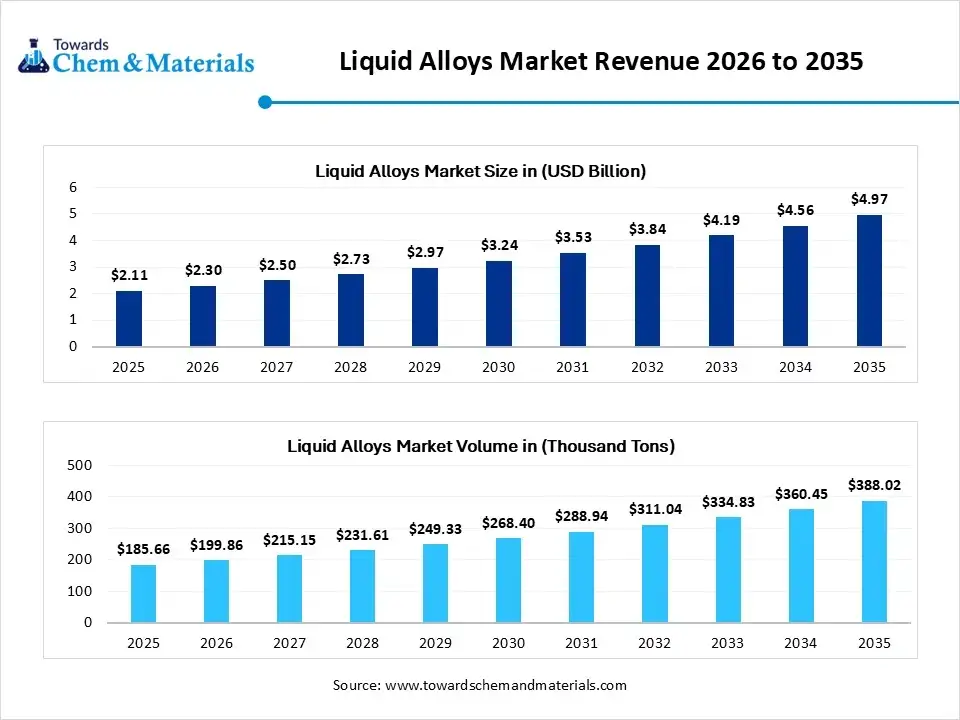
The global liquid alloys market size was estimated at USD 2.11 billion in 2025 and is expected to increase from USD 2.30 billion in 2026 to USD 4.97 billion by 2035, growing at a CAGR of 8.95% from 2026 to 2035. In terms of volume, the liquid alloys industry is projected to grow from 185.66 thousand tons in 2025 to 388.02 thousand tons by 2035, exhibiting a compound annual growth rate (CAGR) of 8.95% over the forecast period from 2026 to 2035. The global shift towards heavy industrialization has accelerated the market growth in recent years.
The liquid alloys are a major part of the advanced material industry, which is constantly focused on metal designs to remain liquid or partially liquid at a lower temperature. Moreover, these alloys are seen in development with mixed metals such as indium, tin, gallium, and bismuth, according to recent industry observation. Moreover, the greater demand for high-performance materials, compact designs, and lightweight materials has enabled high returns for manufacturers in the current period. Also, the regions such as the Asia Pacific and North America have seen stable growth of the industry in recent years.
The industries are searching for smarter and more efficient materials nowadays. Also, the companies in electronics, healthcare, aerospace, automotive, robotics, and energy sectors are increasingly using liquid alloys in their products. In electronic devices, liquid alloys help control heat and improve performance. In healthcare, they are used in wearable sensors and flexible medical tools because they are lightweight and adaptable. The automotive and aerospace industries also use these materials in advanced systems that require durability and high thermal efficiency. Furthermore, the rising demand for compact and high-performance technologies is contributing to the industry's growth. Also, modern devices are becoming smaller and more powerful, which creates heat and performance challenges.
Market Highlights
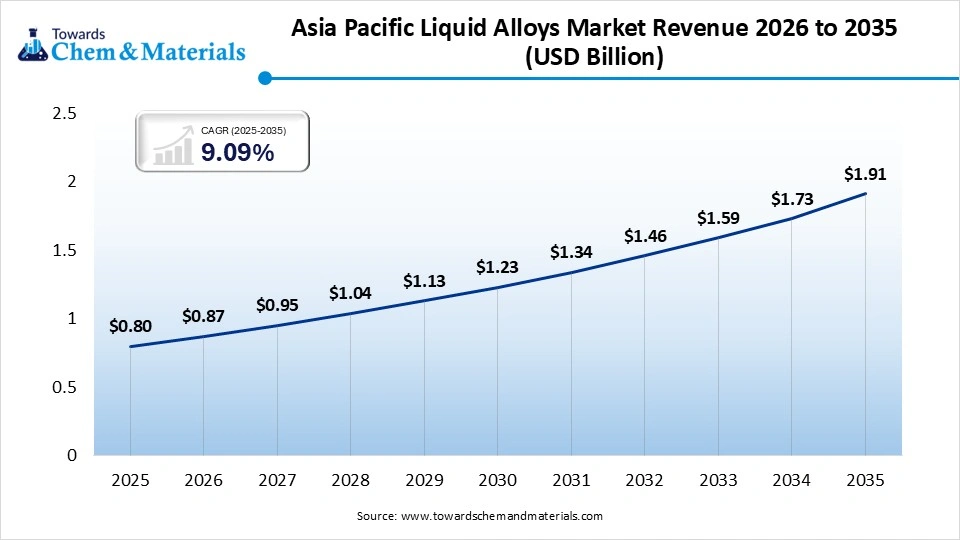
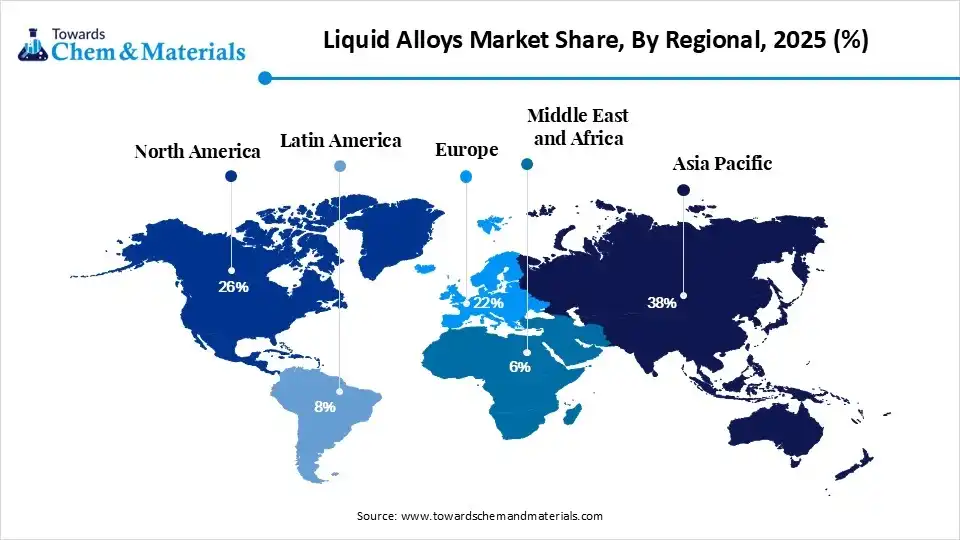
- By region, Asia Pacific dominated the market with a share of 38% in 2025 and is expected to be the fastest-growing region in the market, with a CAGR of 10.9% in the forecast period, due to the region having strong electronics manufacturing, rapid industrial growth, and large investments in advanced technologies.
- By region, North America is notably growing with 26% market share in 2025, owing to the region focuses heavily on technological innovation and advanced industrial development.
- By alloy type, the gallium-based alloys segment dominated the market with a 48% share in 2025 and is expected to be the fastest-growing in the market, with a CAGR of 10.8% in the forecast period, as they offer excellent thermal and electrical conductivity while remaining safer than mercury-based materials.
- By application, the electronics and semiconductors segment held the 42% market share in 2025 and is expected to be the fastest-growing in the market, with a CAGR of 11.2% in the forecast period, owing to as modern electronic devices require advanced heat control and efficient electrical performance.
- By end-use industry, the electronics industry segment dominated the market with 44% share in 2025 and is expected to be the fastest-growing in the market, with a CAGR of 11.5% in the forecast period, as electronic products require materials that can handle heat, conductivity, and miniaturization efficiently.
- By form, bulk liquid segment dominated the market with 51% share in 2025, owing to the many industrial and manufacturing applications that require liquid alloys in larger quantities for processing and production activities.
- By form, encapsulated liquid metal segment held the 29% market share in 2025 and is expected to be the fastest-growing in the market, with a CAGR of 10.6% in the forecast period in 2025, owing to it offers better safety, stability, and easier handling compared to open liquid alloys.
- By distribution channel, the direct sales segment dominated the market with 55% share in 2025, owing to industrial buyers often preferring to purchase materials directly from manufacturers.
- By distribution channel, the online sales segment held the 15% market share in 2025 and is expected to be the fastest-growing in the market, with a CAGR of 11.8% in the forecast period, as digital purchasing platforms are becoming more popular across industrial and commercial sectors.
Market Size and Volume Forecast
- Market Estimated Size (2025): USD 2.11 Billion | CAGR (2026–2035): 8.95%
- Market Projected Size (2035): USD 4.97 Billion
- Market Volume (2025): 185.66 Thousand Tons | Volume CAGR (2026–2035): 7.65%
- Market Projected Volume (2035): 388.02 Thousand Tons
- Market Pricing (2025):
- Average Manufacturing Price: USD 8,210 per ton
- Average Selling Price: USD 10,460 per ton
- Pricing CAGR (2025–2035): 3.11%
Recent Market Trends:
- The sudden demand for flexible electronics has generated value-added opportunities for the industry participants in recent years. Also, consumers have been seen preferring portable, lightweight, and foldable devices over the past few years.
- The increased need for advanced cooling solutions has enhanced market participation for producers in the current period. Also, by helping heat transfer quickly from the modern machines while improving overall system performance, the liquid alloys have gained heavy industry attention.
- The active expansion in soft robotics and healthcare applications, the liquid alloys are likely to support the long-term expansion of manufacturing operations in the coming years. Also, these robotics and healthcare applications have been seen as requiring adaptability and smooth movements, where liquid alloys can emerge as an ideal option during the forecast period.
Report Scope
| Report Attribute | Details |
| Market Size and Volume in 2026 | USD 2.30 Billion/ 199.86 Thousand Tons |
| Revenue Forecast in 2035 | USD 4.97 Billion/ 388.02 Thousand Tons |
| Growth Rate | CAGR 8.95% |
| Forecast Period | 2026 - 2035 |
| Base Year | 2025 |
| Dominant Region | Asia Pacific |
| Segment Covered | Alloy Type, By Application, By End-Use Industry, By Form, By Distribution Channel |
| Key companies profiled | Indium Corporation, Liquidmetal Technologies, Inc., Texa Metals & Alloys Pvt. Ltd., Ekadanta Metal Alloys Pvt. Ltd., Liquid Metals Group Co., Ltd., RotoMetals, Dongguan EONTEC Co., Ltd., Materion Corporation, Hitachi Metals, Ltd.,Sino Santech Materials Technology Co., Ltd. |
Transition to Safer Alloy Technologies
The industry is actively experiencing a major technology shift from traditional heavy metal materials toward safer, smarter, and high-performance liquid metal technologies in the current period. Also, earlier industries mainly depended on mercury-based materials, but now companies are rapidly adopting gallium-based and flexible liquid alloys because they are safer, more efficient, and environmentally friendly. Moreover, the movement from rigid electronic systems to flexible and wearable technologies has been observed.
Supply Chain Analysis of the Liquid Alloys Market:
Distribution to Industrial Users
- Liquid alloys are transported to industrial users via specialized, temperature-controlled containers to maintain their fluid state. These materials serve as vital components in high-performance cooling systems, precision casting, and advanced electronics.
- By delivering alloys in liquid form, manufacturers bypass energy-intensive melting stages, enhancing production cycles and improving efficiency.
- Key players: Liquidmetal Technologies and Heraeus.
Chemical Synthesis and Processing
- Synthesizing liquid alloys involves precise vacuum induction melting and mechanical alloying to ensure chemical homogeneity. Key players utilize high-purity gallium or tin bases, integrating reactive elements under inert atmospheres.
- This meticulous processing prevents oxidation, ensuring superior thermal conductivity for semiconductor and aerospace applications.
- Key Players: Indium Corporation and Materion
Regulatory Compliance and Safety Monitoring
- Ensuring safety in liquid alloy handling involves strict adherence to REACH and RoHS standards.
- These players collaborate with regulatory bodies to maintain environmental compliance, ensuring secure containment during transport and industrial use.
- Key Agencies: REACH and RoHS
Liquid Alloys Market Regulatory Landscape: Regulations
| Country Region | Regulatory Body | Key Regulations | Focus Areas |
| United States | Environmental Protection Agency (EPA) | Toxic Substances Control Act (TSCA): Specifically, the Mercury Inventory Reporting Rule (TSCA Section 8(b)(10)), which mandates triennial reporting on the supply, use, and trade of mercury-added products. | Toxic release reporting (TRI Program), waste management standards, and the reduction of mercury in consumer products |
| Europe | European Commission (EC) |
REACH Regulation (EC) No 1935/2004: Annex XVII contains restrictions on the manufacturing, placing on the market, and use of certain dangerous substances, including specific mercury compounds and heavy metals found in alloys. | "Zero Pollution" objectives, mandatory chemical registration for imports over one tonne, and phasing out mercury from medical and industrial devices. |
| China | Ministry of Ecology and Environment (MEE) | China RoHS (Administrative Measure on the Control of Pollution Caused by EEP): Aligned with EU standards via GB 26572-2025, restricting 10 hazardous substances (including mercury and lead) to (leq 0.1%). | Mandatory labeling for market access, environmental protection during manufacturing, and aligning domestic chemical lists with global standards |
Market Dynamics
Driver
Future Electronics Increasing Alloy Applications
The rapid growth of advanced electronics and smart technologies is driving substantial financial gains in the manufacturing sector. Also, the modern devices are becoming smaller, faster, and more powerful, which increases the need for better heat management and flexible materials. Liquid alloys help solve these problems because they transfer heat efficiently and maintain strong electrical performance. Furthermore, the rising demand for wearable devices, electric vehicles, renewable energy systems, and medical technologies.
Restraint
Supply Limitations Slowing Industry Expansion
The high cost of raw materials such as gallium and indium is likely to hinder the industry's growth during the forecast period. Also, these metals are expensive and sometimes limited in supply, which increases manufacturing costs for companies. Another challenge is the technical difficulty of handling liquid alloys safely during production and transportation. Some liquid metals can react with air or other materials if not managed properly.
Opportunity
Electric Vehicles Increasing Alloy Applications
The increasing use of artificial intelligence, robotics, and wearable electronics, where liquid alloys can improve flexibility and performance, is expected to create lucrative opportunities for consumers in the coming years. Moreover, the growth of electric vehicles and renewable energy systems is also creating demand for advanced cooling materials and conductive components. Also, in healthcare, liquid alloys can support future medical devices, smart implants, and flexible monitoring systems. Emerging economies are investing heavily in industrial development and electronics manufacturing, which creates additional market opportunities.
Segmental Insights
Alloy Type Insights
Liquid Alloys Market Share, By Alloy Type, 2025 (%)
| By Alloy Type | Revenue Share, 2025 (%) |
| Mercury-Based Alloys | 22% |
| Gallium-Based Alloys | 48% |
| Sodium-Potassium Alloys | 18% |
| Other Liquid Alloys | 12% |
The Gallium-Based Alloys Segment Dominated the Liquid Alloys Market with 48% Market Share in 2025
The gallium-based alloys segment dominated the market with 48% share in 2025 and is expected to be the fastest-growing in the market, with a CAGR of 10.8% in the forecast period, as they offer excellent thermal and electrical conductivity while remaining safer than mercury-based materials. These alloys are widely used in electronics, semiconductors, cooling systems, and advanced industrial applications.
The mercury-based alloys segment held the 22% market share in 2025, owing to some industries still using mercury materials in specialized scientific, industrial, and measurement applications. Mercury alloys offer stable conductivity and unique liquid properties that are useful in certain high-precision systems.
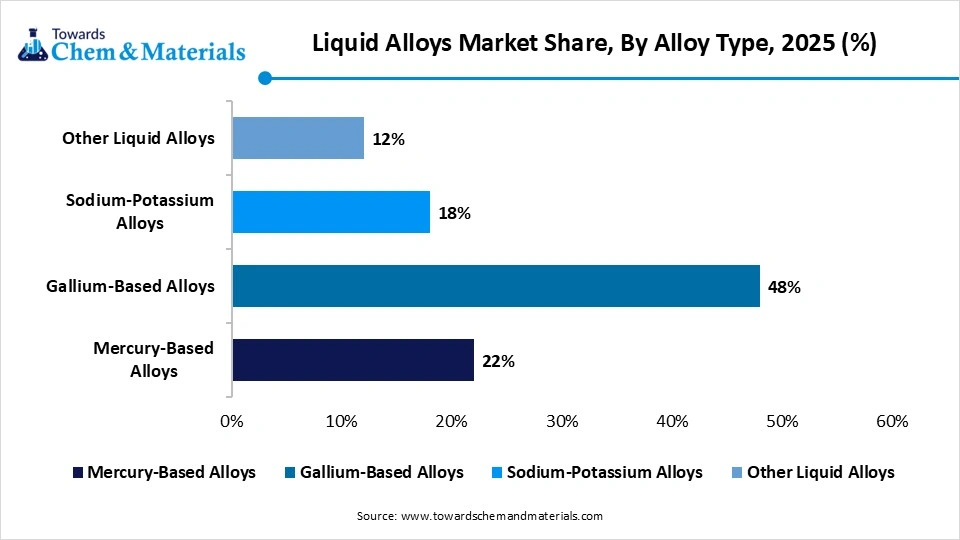
The sodium potassium alloys segment held the 18% market share in 2025, owing to they provide excellent heat transfer performance in high-temperature systems. These alloys are mainly used in energy systems, nuclear technologies, advanced batteries, and industrial cooling applications. Their ability to remain liquid across a wide temperature range makes them highly useful in specialized industries.
Application Insights
Liquid Alloys Market Share, By Application, 2025 (%)
| By Application | Revenue Share, 2025 (%) |
| Healthcare & Medical | 16% |
| Energy & Power | 20% |
| Industrial Machinery | 13% |
| Aerospace & Defense | 9% |
The Electronics and Semiconductors Segment Dominated the Market with 42% Market Share in 2025
The electronics and semiconductors segment dominated the market with 42% share in 2025 and is expected to be the fastest-growing segment in the market, with a CAGR of 11.2% in the forecast period, as modern electronic devices require advanced heat control and efficient electrical performance. Liquid alloys help cool processors, chips, and compact electronic systems more effectively than many traditional materials. Smartphones, laptops, gaming systems, servers, and semiconductor devices all generate large amounts of heat during operation.
The energy and power segment held the 20% market share in 2025, due to industries investing heavily in renewable energy systems, advanced batteries, and energy-efficient infrastructure. Liquid alloys are useful in power generation and energy storage technologies because they provide strong thermal conductivity and efficient heat transfer.
The healthcare and medical segment held the 16% market share in 2025, owing to liquid alloys are highly suitable for flexible and wearable medical technologies. These materials are used in sensors, monitoring devices, smart implants, and soft medical equipment that require flexibility and comfort. Hospitals and healthcare companies are increasingly adopting advanced medical devices for patient monitoring and personalized treatment systems.
End-Use Industry Insights
Liquid Alloys Market Share, By End-Use Industry, 2025 (%)
| By End-Use Industry | Revenue Share, 2025 (%) |
| Electronics Industry | 44% |
| Healthcare Industry | 15% |
| Energy Industry | 19% |
| Industrial Manufacturing | 14% |
| Aerospace & Defense | 8% |
The Electronics Industry Segment Dominated the Liquid Alloys Market with 44% Market Share in 2025
The electronics industry segment dominated the market with 44% share in 2025 and is expected to be the fastest-growing in the market, with a CAGR of 11.5% in the forecast period, as electronic products require materials that can handle heat, conductivity, and miniaturization efficiently. Liquid alloys improve cooling performance and support compact designs in smartphones, computers, servers, and semiconductor systems.
The energy industry segment held the 19% market share in 2025, owing to companies focusing more on clean energy, energy storage, and efficient power systems. Liquid alloys help improve cooling and thermal management in energy infrastructure and advanced industrial systems.
The healthcare industry segment held the 15% market share in 2025, as medical technologies are becoming smarter, smaller, and more flexible. Liquid alloys are highly useful in wearable medical devices, body sensors, flexible electronics, and advanced monitoring systems. These materials improve patient comfort while maintaining strong performance and durability.
Form Insights
Liquid Alloys Market Share, By Form, 2025 (%)
| By Form | Revenue Share, 2025 (%) |
| Bulk Liquid | 51% |
| Encapsulated Liquid Metal | 29% |
| Paste / Composite Form | 20% |
The Bulk Liquid Segment Dominated the Market with 51% Market Share in 2025
The bulk liquid segment dominated the market with 51% share in 2025, owing to the many industrial and manufacturing applications that require liquid alloys in larger quantities for processing and production activities. Bulk liquid alloys are widely used in electronics cooling systems, industrial heat transfer equipment, and metal processing operations.
The encapsulated liquid metal segment held the 29% market share in 2025 and is expected to be the fastest-growing in the market, with a CAGR of 10.6% in the forecast period in 2025, owing to it offers better safety, stability, and easier handling compared to open liquid alloys. Encapsulation technology protects liquid metals from external contamination and prevents leakage during use. This makes the materials more ideal for healthcare devices, wearable electronics, flexible circuits, and consumer products.
The paste/composite form segment held the 20% market share in 2025, owing to these materials being easy to apply in electronic manufacturing and thermal management systems. Liquid alloy pastes are commonly used in processors, chips, and cooling applications where smooth heat transfer is important. Composite forms also combine liquid metals with other materials to improve strength, flexibility, and durability.
Distribution Channel Insights
Liquid Alloys Market Share, By Distribution Channel, 2025 (%)
| By Distribution Channel | Revenue Share, 2025 (%) |
| Direct Sales | 55% |
| Distributors & Wholesalers | 30% |
| Online Sales | 15% |
The Direct Sales Segment Dominated the Market with 55% Market Share in 2025
The direct sales segment dominated the market with 55% share in 2025, owing to industrial buyers often preferring to purchase materials directly from manufacturers. Direct sales help companies receive customized products, technical support, and better pricing for large-volume orders. Industries such as electronics, semiconductors, aerospace, and healthcare require specialized liquid alloy materials with strict quality standards.
The distribution and wholesalers segment held the 30% market share in 2025, akin to many small and medium-sized businesses prefer purchasing liquid alloys through local supply networks. Distributors help manufacturers reach wider markets and provide faster delivery services in different regions. They also support industries that require smaller quantities or a regular supply of materials.
The online sales segment held the 15% market share in 2025 and is expected to be the fastest-growing in the market, with a CAGR of 11.8% in the forecast period, as digital purchasing platforms are becoming more popular across industrial and commercial sectors. Online sales allow buyers to compare products, check specifications, and place orders quickly from different locations.
Regional Analysis:
How will Asia Pacific Dominate the Liquid Alloys Market in 2025?
Asia Pacific dominated the market with a share of 38% in 2025 and is expected to be the fastest-growing region in the market, with a CAGR of 10.9% in the forecast period, due to the region having strong electronics manufacturing, rapid industrial growth, and large investments in advanced technologies. Countries such as China, Japan, South Korea, and India produce large volumes of electronic devices, semiconductors, and industrial equipment that require liquid alloys.
China Expanding Semiconductor Manufacturing Leadership
China maintained its dominance in the market, owing to its massive electronics and semiconductor manufacturing industry. The country produces smartphones, computers, batteries, and industrial equipment on a large scale, creating strong demand for advanced thermal and conductive materials. China is also investing heavily in renewable energy, electric vehicles, and advanced manufacturing technologies.
Liquid Alloys Market Evaluation in North America
North America is notably growing with 26% market share in 2025, owing to the region focuses heavily on technological innovation and advanced industrial development. Companies in the United States and Canada are investing in semiconductors, artificial intelligence, healthcare technologies, and aerospace systems that require high-performance materials.
United States Leading Advanced Alloy Growth
The United States is expected to emerge as a prominent country for the liquid alloys market in the coming years, due to its strong technology, healthcare, aerospace, and semiconductor industries. American companies are continuously developing advanced electronics, artificial intelligence systems, and medical technologies that require efficient thermal and conductive materials.
Liquid Alloys Market Share, By Regional, 2025 (%)
| Regional | Revenue Share, 2025 (%) |
| North America | 26% |
| Europe | 22% |
| Asia-Pacific | 38% |
| Latin America | 8% |
| Middle East & Africa | 6% |
Recent Development
- In February 2026, Johnson Controls acquired Alloy Enterprises. Also, in this deal, Johnson Controls has signed an acquisition agreement, and the main motive of this acquisition is to make better data center thermal management leadership, as per the company's claim.(Source: www.johnsoncontrols.com )
Top Vendors in the Liquid Alloys Market & Their Offerings:
- Indium Corporation: This global materials supplier specializes in refining and manufacturing advanced electronics assembly infrastructure. The enterprise produces high-quality liquid alloys, fusible materials, and specialty thermal interface products primarily utilizing gallium and indium chemistries.
- Liquidmetal Technologies, Inc.: This technology developer leads the commercialization of amorphous metallic alloys, leveraging unique non-crystalline structures. The company licenses and manufactures specialized zirconium-based bulk metallic glasses that exhibit exceptional strength, corrosion resistance, and elasticity.
- Texa Metals & Alloys Pvt. Ltd.: Headquartered in India, this industrial supplier focuses on processing, distributing, and trading diverse non-ferrous products and metallic solutions. The organization serves regional manufacturing operations by providing specific low-melting-point formulations, custom alloys, and pure metal variations.
Other Key Players
- Ekadanta Metal Alloys Pvt. Ltd.
- Liquid Metals Group Co., Ltd.
- RotoMetals
- Dongguan EONTEC Co., Ltd.
- Materion Corporation
- Hitachi Metals, Ltd.
- Sino Santech Materials Technology Co., Ltd.
Segments Covered in the Report
By Alloy Type
- Mercury-Based Alloys
- Dental Amalgams
- Electrical Switch Alloys
- Gallium-Based Alloys
- Gallium-Indium Alloys
- Gallium-Tin Alloys
- Gallium-Indium-Tin (Galinstan)
- Sodium-Potassium (NaK) Alloys
- Reactor Coolant Alloys
- Heat Transfer Fluids
- Other Liquid Alloys
- Bismuth-Based Alloys
- Lead-Based Alloys
By Application
- Electronics & Semiconductors
- Flexible Electronics
- Thermal Interface Materials
- Printed Circuits
- Healthcare & Medical
- Dental Fillings
- Biomedical Devices
- Energy & Power
- Nuclear Reactors
- Solar Thermal Systems
- Industrial Machinery
- Cooling Systems
- Lubrication Systems
- Aerospace & Defense
- Heat Dissipation Systems
- Advanced Sensors
By End-Use Industry
- Electronics Industry
- Healthcare Industry
- Energy Industry
- Industrial Manufacturing
- Aerospace & Defense
By Form
- Bulk Liquid
- Encapsulated Liquid Metal
- Paste / Composite Form
By Distribution Channel
- Direct Sales
- Distributors & Wholesalers
- Online Sales
By Region
- North America
- U.S.
- Canada
- Mexico
- Europe
- Germany
- UK
- France
- Italy
- Spain
- Asia Pacific
- China
- India
- Japan
- South Korea
- Latin America
- Brazil
- Argentina
- Middle East & Africa
- Saudi Arabia
- South Africa
FAQ's
Question 1 : What exactly is a liquid alloy?
Answer : A liquid alloy is a blend of metals (like gallium, indium, and tin) that remains in a liquid state at or near room temperature. They combine the high conductivity of metals with the flexibility of liquids.
Question 2 : Are liquid alloys safe to use?
Answer : Modern liquid alloys, especially gallium-based ones, are considered much safer and more environmentally friendly than traditional mercury-based alloys. However, they still require specialized handling to prevent oxidation.
Question 3 : Why are they used in foldable phones?
Answer : Traditional wires can snap if you fold them too many times. Liquid alloys can be used to create self-healing or flexible circuits that maintain a perfect electrical connection even when bent or stretched.
Question 4 : Can liquid alloys be used in medicine?
Answer : Yes! They are increasingly used in wearable health monitors and flexible medical tools. Because they can move with the body while conducting signals, they are much more comfortable for patients than rigid sensors.
Question 5 : What is the biggest challenge for the market?
Answer : The main hurdle is the cost. Raw materials like gallium and indium are expensive and can have supply chain limitations, which makes the final product more costly for manufacturers compared to traditional materials.
Meet the Team

Saurabh Bidwai
Principal Consultant
Saurabh Bidwai, a B.Tech Chemical Engineering graduate with 4+ years of experience, specializes in specialty chemicals, commodity chemicals, and engineered materials, offering valuable insights into market trends and emerging opportunities.

Aditi Shivarkar
Reviewed By
Aditi Shivarkar, with 14+ years in Chemical and Materials market research, specializes in Chemical and Materials. She ensures accurate, actionable insights, driving Towards Chemicals And Materials Analytics and Consulting excellence in industry trends and sustainability.