
Liquid Ammonia Market Size, Production & Manufacturing Efficiency, Sales Volume, Export & Import Dependency, Adoption Rates, Cost Structure, Recycling Rate, and Supply Chain Metrics
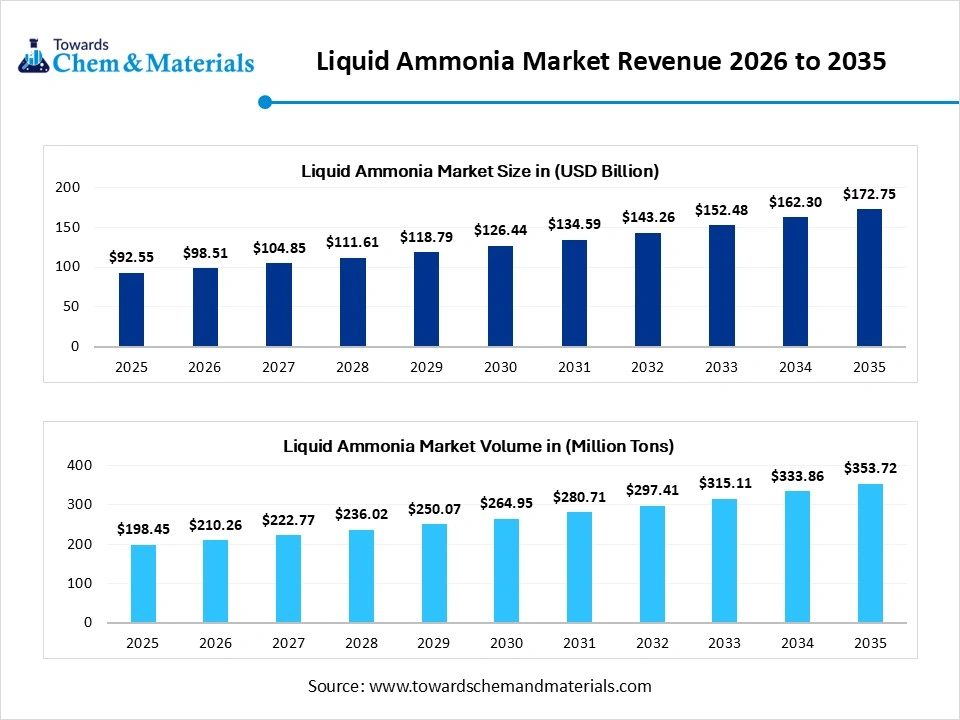
The liquid ammonia market was valued at USD 92.55 billion in 2025 and is expected to reach USD 98.51 billion in 2026, further projected to grow to USD 172.75 billion by 2035, registering a CAGR of 6.44% during the forecast period. In volume terms, the market is anticipated to expand from 198.45 million tons in 2025 to 353.72 million tons by 2035, growing at a CAGR of 5.95%. This report provides comprehensive coverage of market size, segment-wise data, and regional insights, along with detailed competitive analysis, company profiling, value chain evaluation, trade data, and in-depth analysis of manufacturers and suppliers shaping the global market.
Content
Liquid Ammonia Market Trends, Share and Growth Analysis
The global liquid ammonia market was valued at USD 92.55 billion in 2025, is estimated to reach USD 98.51 billion in 2026, and is projected to reach USD 172.75 billion by 2035, growing at a CAGR of 6.44% from 2026 to 2035. In terms of volume, the liquid ammonia market is projected to grow from 198.45 million tons in 2025 to 353.72 million tons by 2035. growing at a CAGR of 5.95% from 2026 to 2035.
Key Takeaways
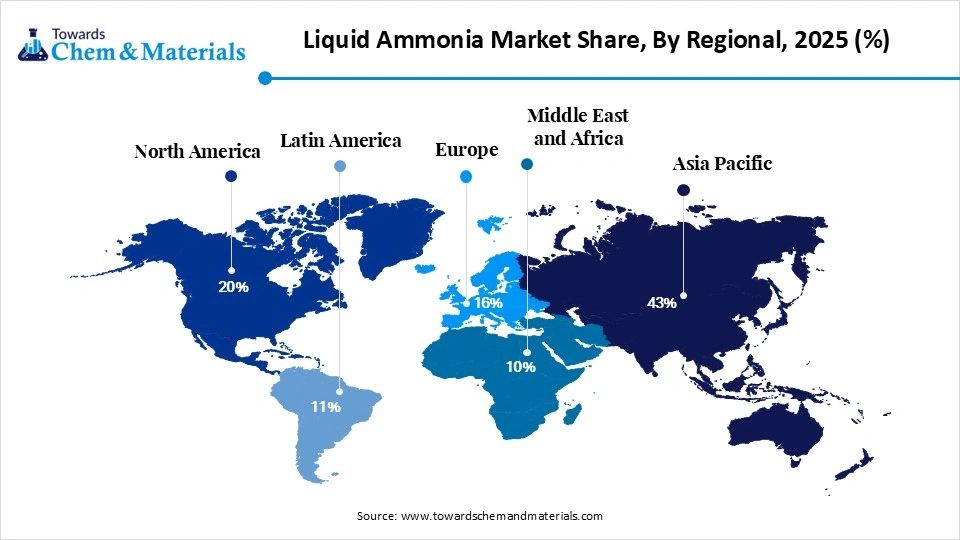
- By region, Asia Pacific dominated the liquid ammonia market in 2025, with 43% share, and is expected to be the fastest-growing in the market, with a CAGR of 7.1% in the forecast period.
- By region, North America is notably growing with 20% market share in 2025.
- By production method, the steam methane reforming (SMR) segment dominated the market with 62% share in 2025.
- By production method, the electrolysis-based (green ammonia) segment held the 20% market share in 2025 and is expected to be the fastest-growing in the market, with a CAGR of 9.8% in the forecast period.
- By application, the fertilizers segment dominated the market with 72% share in 2025.
- By application, the energy carrier segment held the 6% market share in 2025 and is expected to be the fastest-growing in the market with the CAGR of 10.1% during the forecast period.
- By end-use industry, the agriculture segment dominated the market with 66% share in 2025.
- By end-use industry, the energy and power segment held the 5% market share in 2025 and is expected to be the fastest-growing in the market, with a CAGR of 9.6% in the forecast period.
- By distribution channel, the direct sales segment dominated the market with 58% share in 2025.
- By distribution channel, pipeline distribution segment held the 15% market share in 2025 and is expected to be the fastest-growing in the market, with a CAGR of 6.5% in the forecast period.
- By storage and transportation, the refrigerated storage segment dominated the market with 38% share in 2025.
- By storage and transportation, the ISO Tank Containers segment held the 18% market share in 2025 and is expected to be the fastest-growing in the market with the CAGR of 6.4% during the forecast period.
- By purity level, the industrial grade segment dominated the market with 64% share in 2025.
- By purity level, the electronic grade segment held the 14% market share in 2025 and is expected to be the fastest-growing in the market, with a CAGR of 7.2% in the forecast period.
Market Size and Volume Forecast
- Market Estimated Size (2026): USD 98.51 Billion | CAGR (2026–2035): 6.44%
- Market Projected Size (2035): USD 172.75 Billion
- Market Volume (2025): 198.45 Million Tons (MT) | Volume CAGR (2026–2035): 5.95%
- Market Projected Volume (2035): 353.72 Million Tons (MT)
- Market Pricing (2025):
- Average Manufacturing Price: USD 289/ton
- Average Selling Price: USD 429/ton
- Pricing CAGR (2025–2035): 4.8%
Investment Rising in the Liquid Ammonia Sector
The specific form of the ammonia gas, which has been pressurized or cooled and turns into a liquid, is called liquid ammonia. Also, the greater demand from the agriculture and major manufacturing industries has attracted increased capital and investment in manufacturing in recent years. Moreover, this liquid form of ammonia has been seen in very easy to transport and store, which has led to its growth.
Liquid Ammonia Market Trends:
- The greater shift toward green ammonia has driven the sectoral scalability and strategic transformation of the industry in recent years. Moreover, the global shift towards the reduction of carbon emissions and sustainability has seen green ammonia emerge as the ideal option for industries.
- Having the ability to store and transport easily for the long term, liquid ammonia has gained major industry attention in recent years. Also, renewable energies like solar and others cannot be stored or transported easily, while liquid ammonia has enabled the sector to explore untapped potential.
- The increased need for liquid ammonia from the agricultural sector has allowed stakeholders to capitalize on growth opportunities in the coming years. Also, farmers are actively using them as fertilizers in the current period.
Report Scope
| Report Attribute | Details |
| Market Size and Volume in 2026 | USD 98.51 Billion / 210.26 Million Metric Tons |
| Expected Size and Volume by 2035 | USD 172.75 Billion / 353.72 Million Metric Tons |
| Growth Rate from 2026 to 2035 | CAGR 6.44% |
| Forecast Period | 2026 - 2035 |
| Dominant Region | Asia Pacific |
| Segment Covered | By Production Method, By Technology, By End-Use Industry, By Distribution Channel, By Storage and Transportation, By Purity Level and By Region |
| Key companies profiled | OCP Group, EuroChem Group, SABIC, OCI Global, Koch Fertilizer, LLC, Mitsubishi Chemical Corporation |
Green Electrolysis Transforming Ammonia Industry Future
Supply Chain Analysis of the Liquid Ammonia Market
Distribution to Industrial Users
- Industrial distribution of liquid ammonia is dominated by the fertilizer industry for direct soil application or downstream production of ammonium nitrate.
- Other major users include the refrigeration sector, where it serves as a sustainable coolant, and the chemical industry, which utilizes it for manufacturing plastics, explosives, and textiles
Chemical Synthesis and Processing
- Liquid ammonia is synthesized primarily via the Haber-Bosch process, reacting nitrogen and hydrogen under high pressure and temperature with iron catalysts.
- In industrial processing, it serves as a versatile solvent and building block for synthesizing nitrogen-based compounds, including urea, nitric acid, and various high-performance polymers and pharmaceuticals.
Regulatory Compliance and Safety Monitoring
- Regulatory compliance for liquid ammonia is governed by strict mandates, such as OSHA’s PSM and EPA’s RMP, due to its toxicity and pressure.
- Safety monitoring relies on continuous gas detectors, automated shut-off valves, and emergency relief systems to prevent leaks, ensuring worker protection and environmental safety during storage and transport.
Liquid Ammonia Market Regulatory Landscape: Regulations
| Country Region | Regulatory Body | Key Regulations | Focus Areas |
| United States | Environmental Protection Agency (EPA), | 29 CFR 1910.111: Dedicated specifically to the "Storage and Handling of Anhydrous Ammonia". Section (b)(10) mandates stationary storage must have two full-face respirators and a 50-gallon drum of water for emergencies | Preventing accidental releases, mandatory operator training, mechanical integrity of pressure vessels, and immediate 15-minute reporting for releases over 100 lbs. |
| Europe | European Commission - Environment | Seveso III Directive (2012/18/EU): The primary law for major-accident hazards. Annex I, Part 2 specifically lists anhydrous ammonia with a lower-tier threshold of 50 tonnes and an upper-tier of 200 tonnes | Public information and participation, transboundary effects of accidents, and the "Safety Report" requirement for upper-tier facilities to demonstrate risk mitigation. |
| China | Ministry of Ecology and Environment (MEE) | Decree 591: The "Regulations on the Control over Safety of Hazardous Chemicals". Chapter 2 (Articles 12-27) details safety management for manufacture and storage. | Strengthening safety controls across the entire supply chain, mandatory safety assessments every three years (Article 22 of Decree 591), and strict licensing for production and operation |
Market Dynamics
Driver
Ammonia Demand Surges Across Key Industries
The increased need for more clean energy and industrial chemicals is driving the industry growth nowadays. Also, farmers use ammonia to make fertilizers that increase crop production. At the same time, countries are searching for cleaner fuels, and ammonia is being tested as an energy carrier and fuel.
Restraint
Costly Green Ammonia Slows Market Expansion
Producing ammonia in the traditional way releases a lot of carbon emissions, which is likely to hinder the industry's growth in the coming years. Also, the green ammonia is cleaner, but it is still expensive to produce.
Opportunity
Ammonia Emerging as Future Clean Fuel
Segmental Insights
Production Method Insights
The Steam Methane Reforming (SMR) Segment Dominated the Liquid Ammonia Market With 62% Market Share in 2025
The steam methane reforming (SMR) segment dominated the market with 62% share in 2025, owing to its being the most established and widely used method. It uses natural gas, which is easily available in many countries, making production cheaper and more reliable. Industries have been using this process for decades, so the technology is well understood and efficient.
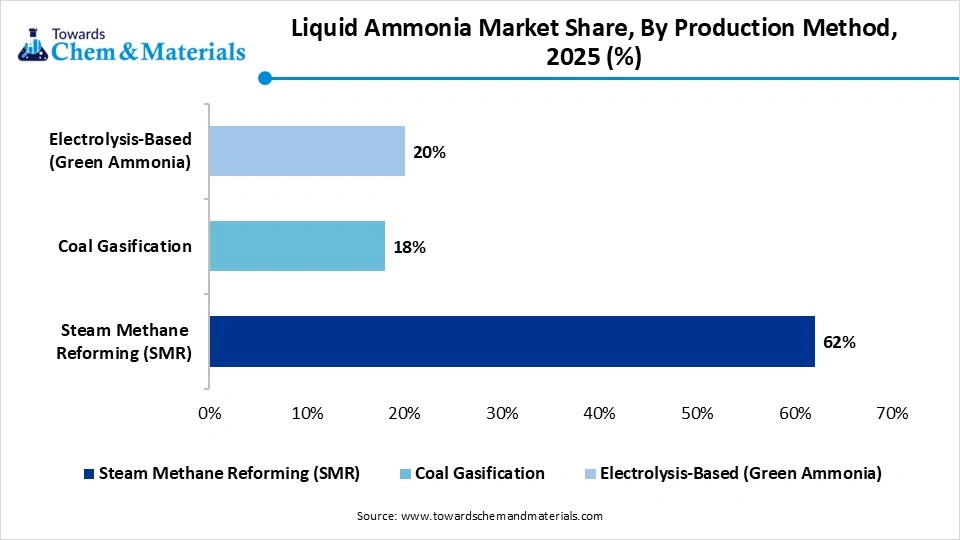
The coal gasification segment held 18% market share in 2025, as it is growing mainly in countries that have large coal reserves but limited natural gas. It allows these countries to produce ammonia using their own resources, reducing dependence on imports. This method is especially popular in developing regions where energy security is important.
The electrolysis-based (green ammonia) segment held the 20% market share in 2025 and is expected to be the fastest-growing in the market, with a CAGR of 9.8% in the forecast period due to its clean and sustainable. It uses renewable electricity to produce hydrogen, which is then converted into ammonia. This method produces almost zero carbon emissions, which makes it very attractive as countries try to fight climate change.
Application Insights
The Fertilizers Segment Dominated the Market with 72% Market Share in 2025
The fertilizers segment dominated the market with 72% share in 2025, owing to ammonia is a key ingredient in nitrogen-based fertilizers, which are essential for farming. As the global population grows, food demand increases, and farmers need better fertilizers to improve crop yield.
Liquid Ammonia Market Share, By Application, 2025 (%)
| By Application | Revenue Share, 2025 (%) |
| Fertilizers | 72% |
| Industrial Chemicals | 15% |
| Refrigeration | 3% |
| Energy Carrier | 6% |
| Others | 4% |
The industrial chemicals segment held the 15% market share in 2025, owing to ammonia is used to make many important products like plastics, textiles, cleaning agents, and explosives. As industries expand, especially in developing countries, the demand for these chemicals increases.
The energy carrier segment held the 6% market share in 2025 and is expected to be the fastest-growing in the market, with a CAGR of 10.1% in the forecast period due to ammonia can store and transport hydrogen safely. Hydrogen is hard to store, but ammonia makes it easier and cheaper to move across long distances. As countries shift to clean energy, ammonia is being tested as a fuel for ships, power plants, and heavy industries.
End-Use Industry Insights
The Agriculture Segment Dominated the Liquid Ammonia Market with 66% Market Share in 2025
The agriculture segment dominated the market with 66% share in 2025, owing to ammonia is essential for producing fertilizers that improve crop yield. Farmers rely on ammonia-based fertilizers to grow enough food for a growing population. It is widely used across both developed and developing countries.
Liquid Ammonia Market Share, By End-Use Industry, 2025 (%)
| By End-Use Industry | Revenue Share, 2025 (%) |
| Agriculture | 66% |
| Chemical Manufacturing | 17% |
| Mining | 6% |
| Energy & Power | 5% |
| Food & Beverage | 2% |
| Pharmaceuticals | 4% |
The chemical manufacturing segment held 17% industry share in 2025, as ammonia is used to produce many everyday products such as plastics, fibers, and cleaning chemicals. As urbanization increases, demand for these products rises, which increases ammonia usage.
The energy and power segment held the 5% market share in 2025 and is expected to be the fastest-growing in the market, with a CAGR of 9.6% in the forecast period, as ammonia is being explored as a clean fuel. It can be burned in power plants or used in engines without producing carbon emissions if made from green sources. This makes it attractive for countries trying to reduce pollution.
Distribution Channel Insights
The Direct Sales Segment Dominated the Market with 58% Market Share in 2025
The direct sales segment dominated the market with 58% share in 2025 because large buyers like fertilizer companies and industrial plants prefer to purchase ammonia directly from producers. This reduces cost and ensures a stable supply. Long-term contracts are common in this market, which builds strong relationships between producers and buyers.
Liquid Ammonia Market Share, By Distribution Channel, 2025 (%)
| By Distribution Channel | Revenue Share, 2025 (%) |
| Direct Sales (Bulk Supply) | 58% |
| Distributors & Traders | 27% |
| Pipeline Distribution | 15% |
The distributors and traders segment held the 27% market share in 2025, owing to they help smaller buyers who cannot purchase directly from large producers. They break bulk quantities into smaller amounts and supply to different regions. This makes ammonia accessible to more customers.
The pipeline distribution segment held the 15% market share in 2025 and is expected to be the fastest-growing in the market, with a CAGR of 6.5% in the forecast period, as it offers a safe, cost-effective, and continuous supply of ammonia. Pipelines reduce the need for trucks or ships, lowering transportation risks and costs. They are especially useful for connecting large production plants with industrial zones.
Storage and Transportation Insights
The Refrigerated Storage Segment Dominated the Market with 38% Market Share in 2025
The refrigerated storage segment dominated the market with 38% share in 2025 because it is the most reliable way to store large volumes of liquid ammonia. By keeping ammonia at low temperatures, it remains stable and safe for long periods. This method is widely used in ports and large industrial facilities.
Liquid Ammonia Market Share, By Storage & Transportation, 2025 (%)
| By Storage & Transportation | Revenue Share, 2025 (%) |
| Refrigerated Storage | 38% |
| Pressurized Storage | 28% |
| ISO Tank Containers | 18% |
| Pipeline Transport | 15% |
The pressurised storage segment held the 28% market share in 2025, owing to it allows ammonia to be stored at higher temperatures but under pressure. This makes it suitable for smaller storage facilities and local distribution. It is often used in industries that need moderate quantities of ammonia.
The ISO Tank Containers segment held the 18% market share in 2025 and is expected to be the fastest-growing in the market, with a CAGR of 6.4% in the forecast period, as they offer safe and flexible transportation. These containers can be used across ships, trucks, and trains without transferring the ammonia, reducing risk and cost. They are ideal for global trade and long-distance transport.
Purity Level Insights
The Industrial Grade Segment Dominated the Market with 64% Market Share in 2025
The industrial grade segment dominated the market with 64% share in 2025 because it is widely used in fertilizers and large-scale chemical production, where ultra-high purity is not required. It is cheaper to produce and meets the needs of most industries.
Liquid Ammonia Market Share, By Purity Level, 2025 (%)
| By Purity Level | Revenue Share, 2025 (%) |
| Industrial Grade | 64% |
| Refrigeration Grade | 22% |
| Electronic Grade | 14% |
The refrigeration grade segment held the 22% market share in 2025, owing to it is used in cooling systems for food storage, cold chains, and industrial refrigeration. As the demand for frozen and processed food increases, the need for efficient refrigeration systems also grows.
The electronic grade segment held the 14% market share in 2025 and is expected to be the fastest-growing in the market, with a CAGR of 7.2% in the forecast period, as it is used in high-tech industries like semiconductors and electronics. These industries require extremely pure chemicals. As technology advances, demand for chips, displays, and electronic devices is rising rapidly.
Regional Insights
How will Asia Pacific Dominate the Liquid Ammonia Market in 2025?
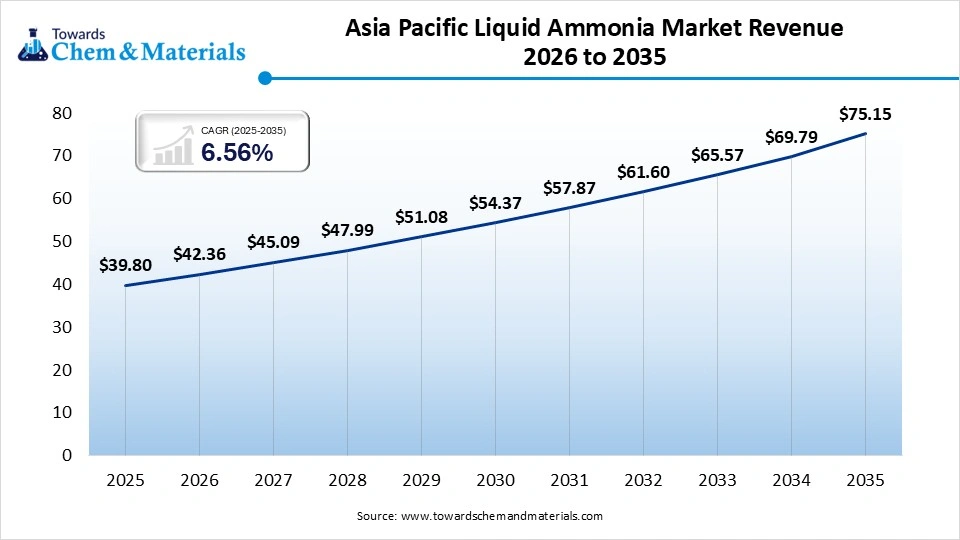
The Asia Pacific liquid ammonia market size was estimated at USD 39.80 billion in 2025 and is projected to reach USD 75.15 billion by 2035, growing at a CAGR of 6.56% from 2026 to 2035 Countries in this region have high demand for fertilizers to support food production. Rapid industrialization also increases the need for ammonia in chemicals and manufacturing.
China at the Centre of Ammonia Demand
China maintained its dominance in the market, owing to its large population, strong agriculture sector, and growing industries. Countries in this region have high demand for fertilizers to support food production. Rapid industrialization also increases the need for ammonia in chemicals and manufacturing.
Liquid Ammonia Market Evaluation in North America
North America is notably growing with 20% market share in 2025, owing to its focus on clean energy and advanced technology. The region has strong investments in green ammonia and hydrogen projects. Availability of natural gas also supports current production. Governments are encouraging low-carbon solutions, which boosts innovation.
United States Leading Future Ammonia Growth
The United States is expected to emerge as a prominent country for the liquid ammonia market in the coming years, due to its advanced production facilities and strong energy sector. It has abundant natural gas, which supports ammonia production. The country is also investing heavily in green ammonia and hydrogen technologies.
Recent Development
- In November 2025, Air Liquide successfully started the plant, which has the capacity to convert ammonia to hydrogen at an industrial scale. Also, the newly launched plant has the capacity to convert 30 tons per day with the latest technology, as per the published report.
Top Vendors in the Liquid Ammonia Market & Their Offerings:
- Yara International ASA: Yara is a Norwegian global leader in nitrogen-based fertilizers and industrial applications. The company operates one of the world's largest ammonia networks, focusing on sustainable food production and environmental solutions. Yara is currently a pioneer in "green ammonia" technology, investing heavily in carbon-free production to decarbonize shipping and agriculture.
- CF Industries Holdings, Inc.: Based in the United States, CF Industries is a premier global manufacturer of hydrogen and nitrogen products. As one of the world's largest ammonia producers, they operate massive integrated manufacturing complexes. The company is aggressively pivoting toward clean energy, leveraging its infrastructure to produce blue and green ammonia.
- Nutrien Ltd.: Nutrien is a Canadian integrated agriculture company and the world's largest provider of crop inputs and services. It maintains a significant liquid ammonia production footprint to support its vast retail distribution network. Nutrien focuses on enhancing global food security while implementing low-carbon ammonia production technologies across its nitrogen operations.
Liquid Ammonia Market Key Players
- OCP Group
- EuroChem Group
- SABIC (Saudi Basic Industries Corporation)
- OCI Global
- Koch Fertilizer, LLC
- Mitsubishi Chemical Corporation
Liquid Ammonia Market Segments Covered in the Report
By Production Method
- Steam Methane Reforming (SMR)
- Conventional SMR
- Advanced SMR with Carbon Capture (Blue Ammonia)
- Coal Gasification
- Electrolysis-Based (Green Ammonia)
- Alkaline Electrolysis
- PEM Electrolysis
- Solid Oxide Electrolysis
By Technology
- Fertilizers
- Urea
- Ammonium Nitrate
- Ammonium Sulfate
- Industrial Chemicals
- Nitric Acid
- Explosives
- Caprolactam
- Refrigeration
- Industrial Refrigeration Systems
- Energy Carrier
- Hydrogen Storage
- Power Generation Fuel
- Others
- Water Treatment
- Pharmaceuticals
By End-Use Industry
- Agriculture
- Chemical Manufacturing
- Mining
- Energy & Power
- Food & Beverage
- Pharmaceuticals
By Distribution Channel
- Direct Sales (Bulk Supply)
- Distributors & Traders
- Pipeline Distribution
By Storage and Transportation
- Refrigerated Storage
- Pressurized Storage
- ISTank Containers
- Pipeline Transport
By Purity Level
- Industrial Grade
- Refrigeration Grade
- Electronic Grade
By Region
- North America:
- U.S.
- Canada
- Mexico
- Rest of North America
- Latin America:
- Brazil
- Argentina
- Rest of Latin America
- Europe:
- Western Europe
- Germany
- Italy
- France
- Netherlands
- Spain
- Portugal
- Belgium
- Ireland
- UK
- Iceland
- Switzerland
- Poland
- Rest of Western Europe
- Eastern Europe
- Austria
- Russia & Belarus
- Türkiye
- Albania
- Rest of Eastern Europe
- Asia Pacific:
- China
- Taiwan
- India
- Japan
- Australia and New Zealand,
- ASEAN Countries (Singapore, Malaysia)
- South Korea
- Rest of APAC
- MEA:
- GCC Countries
- Saudi Arabia
- United Arab Emirates (UAE)
- Qatar
- Kuwait
- Oman
- Bahrain
- South Africa
- Egypt
- Rest of MEA
- GCC Countries
FAQ's
Question 1 : What is the current size of the global liquid ammonia market?
Answer : The global liquid ammonia market was valued at USD 92.55 billion in 2025 and is estimated to reach USD 98.51 billion in 2026.
Question 2 : What is the projected growth of the liquid ammonia market by 2035?
Answer : The market is projected to reach USD 172.75 billion by 2035, growing at a CAGR of 6.44% from 2026 to 2035.
Question 3 : How is the liquid ammonia market expected to grow in terms of volume?
Answer : The market volume is expected to grow from 198.45 million tons in 2025 to 353.72 million tons by 2035, at a CAGR of 5.95%.
Question 4 : Which region dominates the liquid ammonia market?
Answer : Asia Pacific dominates the market with a 43% share in 2025 and is also the fastest-growing region.
Question 5 : Which region is showing notable growth in the liquid ammonia market?
Answer : North America is significantly growing, holding around 20% market share in 2025, driven by clean energy investments.
Question 6 : What is the current size of the global liquid ammonia market?
Answer : The global liquid ammonia market was valued at USD 92.55 billion in 2025 and is estimated to reach USD 98.51 billion in 2026.
Question 7 : What is the projected growth of the liquid ammonia market by 2035?
Answer : The market is projected to reach USD 172.75 billion by 2035, growing at a CAGR of 6.44% from 2026 to 2035.
Question 8 : How is the liquid ammonia market expected to grow in terms of volume?
Answer : The market volume is expected to grow from 198.45 million tons in 2025 to 353.72 million tons by 2035, at a CAGR of 5.95%.
Question 9 : Which region dominates the liquid ammonia market?
Answer : Asia Pacific dominates the market with a 43% share in 2025 and is also the fastest-growing region.
Question 10 : Which region is showing notable growth in the liquid ammonia market?
Answer : North America is significantly growing, holding around 20% market share in 2025, driven by clean energy investments.
Question 11 : What is the current size of the global liquid ammonia market?
Answer : The global liquid ammonia market was valued at USD 92.55 billion in 2025 and is estimated to reach USD 98.51 billion in 2026.
Question 12 : What is the projected growth of the liquid ammonia market by 2035?
Answer : The market is projected to reach USD 172.75 billion by 2035, growing at a CAGR of 6.44% from 2026 to 2035.
Question 13 : How is the liquid ammonia market expected to grow in terms of volume?
Answer : The market volume is expected to grow from 198.45 million tons in 2025 to 353.72 million tons by 2035, at a CAGR of 5.95%.
Question 14 : Which region dominates the liquid ammonia market?
Answer : Asia Pacific dominates the market with a 43% share in 2025 and is also the fastest-growing region.
Question 15 : Which region is showing notable growth in the liquid ammonia market?
Answer : North America is significantly growing, holding around 20% market share in 2025, driven by clean energy investments.
Meet the Team

Saurabh Bidwai
Principal Consultant
Saurabh Bidwai, a B.Tech Chemical Engineering graduate with 4+ years of experience, specializes in specialty chemicals, commodity chemicals, and engineered materials, offering valuable insights into market trends and emerging opportunities.

Aditi Shivarkar
Reviewed By
Aditi Shivarkar, with 14+ years in Chemical and Materials market research, specializes in Chemical and Materials. She ensures accurate, actionable insights, driving Towards Chemicals And Materials Analytics and Consulting excellence in industry trends and sustainability.