
Liquid Organic Hydrogen Carrier (LOHC) Market Size, Share, Growth, Report 2026 to 2035
The Liquid Organic Hydrogen Carrier (LOHC) Market Report is Segmented by Material Type (Toluene-Based, N-Ethylcarbazole-Based, Dibenzyl Toluene-Based, and Other LOHC Materials), By Hydrogenation/Dehydrogenation Process (Hydrogenation Process and Dehydrogenation Process), By Application (Hydrogen Storage, Hydrogen Transport, and Hydrogen Supply Systems), By End-Use Industry (Energy & Power, Transportation, Chemical Industry, Oil & Gas, and Industrial Manufacturing), By Form (Pure LOHC Compounds, Blended LOHC Formulations, and Catalyst-Integrated Systems), and By Distribution Channel (Direct Supply Contracts, Chemical Distributors, and Strategic Partnerships).-Global Industry Analysis, Size, Trends, Leading Companies, Regional Outlook, and Forecast 2026 to 2035
Content
What is the Current Liquid Organic Hydrogen Carrier (LOHC) Market Size and Share?
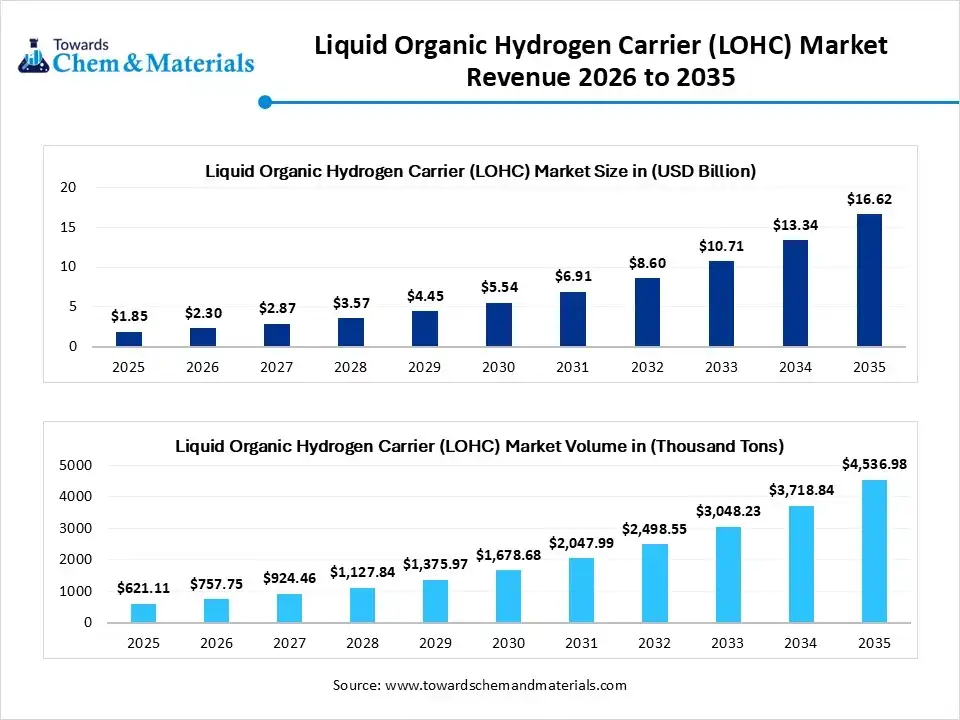
The global liquid organic hydrogen carrier (LOHC) market size was estimated at USD 1.85 billion in 2025 and is expected to increase from USD 2.30 billion in 2026 to USD 16.62 billion by 2035, growing at a CAGR of 24.55% from 2026 to 2035. In terms of volume, the liquid organic hydrogen carrier (LOHC) industry is projected to grow from 621.11 thousand tons in 2025 to 4,536.98 thousand tons by 2035, exhibiting a compound annual growth rate (CAGR) of 22.00% over the forecast period from 2026 to 2035.The growth of the market is driven by the demand for safe, efficient, and long-term hydrogen transport. This technology uses liquid media compatible with existing infrastructure to store hydrogen at ambient conditions.
The liquid organic hydrogen carrier (LOHC) market is significant for enabling the safe, scalable, and economical long-distance transport and storage of hydrogen by leveraging existing oil and gas infrastructure, addressing key challenges in the transition to a sustainable hydrogen economy. By enabling hydrogen to be stored at ambient conditions as a stable liquid, LOHCs overcome the high costs and risks associated with high-pressure or cryogenic storage, offering a key solution for large-scale energy transport. LOHC technology, such as the benzyl-toluene system used by Hydrogenious LOHC Technologies GmbH, allows hydrogen to be transported at ambient pressures and temperatures, reducing safety risks compared to liquid hydrogen.
LOHCs can utilize existing fuel pipelines, tankers, and storage tanks, significantly lowering infrastructure investment costs. It enables the importation of large volumes of renewable hydrogen, supporting international supply chains for industries and countries with limited local production capabilities. LOHCs offer high volumetric storage density, making them an efficient choice for storing large amounts of energy over long periods. The ability to hydrogenate and dehydrogenate (store and release) the carrier liquid repeatedly allows for a sustainable circular energy cycle.
Market Highlights
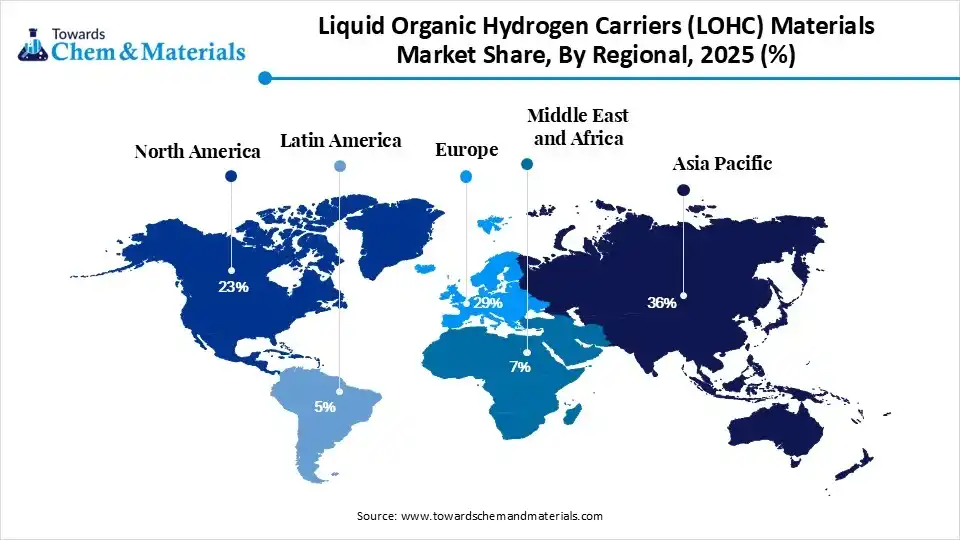
- By region, Asia Pacific dominated the market with a share of 36% in 2025 and is expected to sustain its position while growing with a CAGR of 26.8% in the forecast period. China, Japan, and South Korea lead hydrogen deployment.
- By region, Europe held the market share of 29% in 2025. Strict decarbonization targets boost hydrogen adoption.
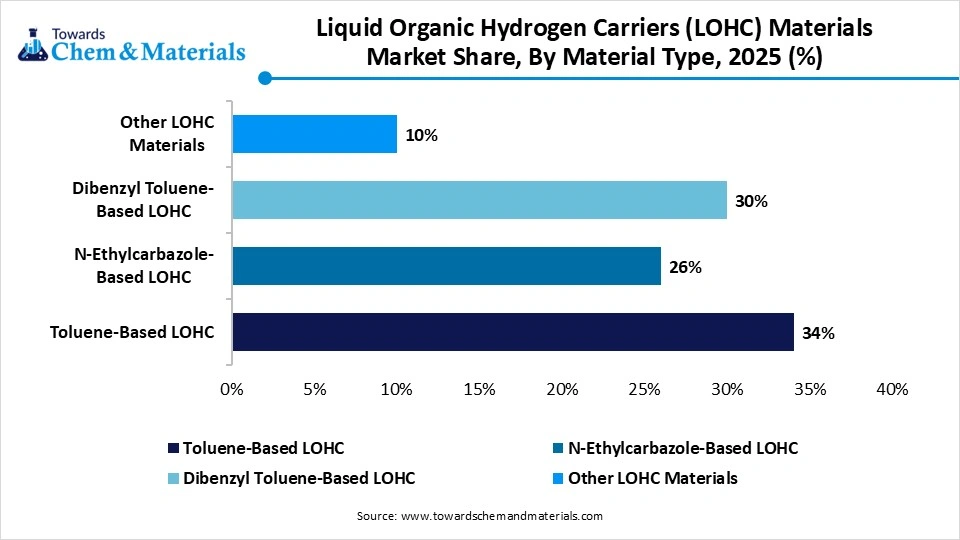
- By material type, the toluene-based LOHC segment dominated the market with 34% share in 2025. Established infrastructure supports large-scale hydrogen transport.
- By material type, the dibenzyl toluene-based LOHC segment held 30% market share in 2025 and is expected to have the fastest growth with a CAGR of 25.6% in the forecast period. High thermal stability supports long-distance transport.
- By hydrogenation/dehydrogenation process, the dehydrogenation process segment dominated the market with 54% share in 2025 and is expected to have the fastest growth with a CAGR of 25.80% in the forecast period. Hydrogen release demand increases with end-use applications
- By application, the hydrogen transport segment dominated the market with 42% share in 2025 and is expected to have the fastest growth with a CAGR of 25.2% in the forecast period. Cross-border hydrogen trade drives LOHC usage.
- By end-use industry, the energy and power segment dominated the market with 33% share in 2025 and is expected to have the fastest growth with a CAGR of 25.4% in the forecast period. Renewable energy storage drives LOHC demand.
- By form, the pure LOHC compounds segment dominated the market with 49% share in 2025. Widely used in established systems for simplicity.
- By form, the blended LOHC Formulations segment held 28% market share in 2025 and is expected to have the fastest growth with a CAGR of 24.9% in the forecast period. Custom blends optimize performance characteristics.
- By distribution channel, the direct supply contracts segment dominated the market with 52% share in 2025. Large-scale hydrogen projects prefer long-term agreements.
- By distribution channel, the strategic partnerships segment held 21% market share in 2025 and is expected to have the fastest growth with a CAGR of 26.1% in the forecast period. Collaborations accelerate technology commercialization.
Market Size and Volume Forecast
- Market Estimated Size (2025): USD 1.85 Billion | CAGR (2026–2035): 24.55%
- Market Projected Size (2035): USD 16.62 Billion
- Market Volume (2025): 621.11 Thousand Tons | Volume CAGR (2026–2035):22%
- Market Projected Volume (2035): 4,536.98 Thousand Tons
- Market Pricing (2025):
- Average Manufacturing Price: USD 2,960 per ton
- Average Selling Price: USD 3,790 per ton
- Pricing CAGR (2025–2035): 2.85%
Recent Market Growth Trends:
- Infrastructure Compatibility: A major trend is leveraging existing oil and gas pipelines, tankers, and storage infrastructure for LOHC, offering a significant cost advantage over high-pressure tanks or cryogenic liquid hydrogen.
- High-Volume Transport Solution: LOHC technology is emerging as a preferred solution for long-distance maritime transport of hydrogen, bridging the gap between renewable energy production sites and industrial demand centers.
- Safety and Compatibility: LOHC uses conventional liquid handling technology, making it ideal for large-scale storage and integration with existing pipelines and tanker infrastructure.
Key Technological Shifts In The Liquid Organic Hydrogen Carrier (LOHC) Market:
The Liquid Organic Hydrogen Carrier (LOHC) market is shifting toward early commercialization, driven by the need for safe, long-distance hydrogen transport using existing infrastructure. Key shifts include optimizing catalysts to lower hydrogenation/dehydrogenation temperatures, scaling up, and exploring sustainable bio-derived carriers to improve sustainability. Companies are focusing on specific pairings like benzyl toluene for commercial shipping.
Report Scope
| Report Attribute | Details |
| Market Size and Volume in 2026 | USD 2.30 Billion/ 757.75 Thousand Tons |
| Revenue Forecast in 2035 | USD 16.62 Billion/ 4,536.98 Thousand Tons |
| Growth Rate | CAGR 24.55% |
| Forecast Period | 2026 - 2035 |
| Base Year | 2025 |
| Dominant Region | Asia Pacific |
| Segment Covered | By Material Type, By Hydrogenation/Dehydrogenation Process, By Application, By End-Use Industry, By Form, By Distribution Channel, By Regions |
| Key companies profiled | Shell plc, Covestro AG., Mitsubishi Heavy Industries, Ltd., Clariant AG, Hydrogenious LOHC Technologies, Chiyoda Corporation, Evonik Industries AG, Honeywell International Inc., Hynertech Co Ltd, Nippon Chemical Texas Incorporated (NCTI), Mitsubishi Corporation, Air Liquide, ENEOS, and Johnson Matthey Plc. |
Supply Chain Analysis of Liquid Organic Hydrogen Carrier (LOHC) Market:
Chemical Production & Hydrogen Storage Processing
- Liquid organic hydrogen carriers (LOHCs) are produced through the synthesis of organic compounds capable of reversibly storing and releasing hydrogen via hydrogenation and dehydrogenation processes for energy transport and storage applications.
- The process involves exothermic hydrogen loading and endothermic dehydrogenation (release) at ~300°C, providing a high-density, reusable "liquid battery" system
- Key players: Hydrogenious LOHC Technologies, Chiyoda Corporation, Shell, Air Liquide.
Quality Testing and Certification
- LOHC systems must comply with hydrogen purity standards, chemical safety regulations, transportation guidelines, and environmental compliance requirements.
- Quality testing and certification are crucial to verify storage capacity, thermal stability, and purity of the released hydrogen, often requiring it to meet ISO 14687:2012 standards
- Key players: International Organization for Standardization, International Electrotechnical Commission, U.S. Department of Energy, European Chemicals Agency
Distribution to Industrial Users
- LOHC technologies are supplied to hydrogen infrastructure developers, renewable energy projects, transportation fuel providers, chemical industries, and industrial energy storage applications.
- The technology involves binding hydrogen chemically to a liquid carrier (such as dibenzyltoluene) which can be transported at ambient pressure and temperature, reducing transportation costs.
- Key players: Hydrogenious LOHC Technologies, Chiyoda Corporation, Air Liquide.
Liquid Organic Hydrogen Carrier (LOHC) Regulatory Landscape: Global Regulations
| Country / Region | Regulatory Body | Key Regulations | Focus Areas | Notable Notes |
| United States | Department of Energy (DOE); Environmental Protection Agency (EPA); Occupational Safety and Health Administration (OSHA) | Hydrogen Energy Earthshot Initiative; Clean Air Act; Hazardous Materials Regulations | Hydrogen storage safety, emissions control, transport safety | The U.S. promotes LOHC technologies under hydrogen economy initiatives, focusing on safe hydrogen transport and large-scale storage infrastructure. |
| European Union | European Commission; European Chemicals Agency (ECHA) | EU Hydrogen Strategy; REACH Regulation; Alternative Fuels Infrastructure Regulation (AFIR) | Hydrogen infrastructure, chemical safety, decarbonization | The EU strongly supports LOHC deployment as part of its hydrogen strategy to enable long-distance hydrogen transport and renewable energy storage. |
| Japan | Ministry of Economy, Trade and Industry (METI); New Energy and Industrial Technology Development Organization (NEDO) | Basic Hydrogen Strategy; Hydrogen Supply Chain Programs | Hydrogen import infrastructure, energy security | Japan is a global leader in LOHC adoption, particularly through methylcyclohexane (MCH)-based hydrogen transport systems. |
| China | National Development and Reform Commission (NDRC); Ministry of Ecology and Environment (MEE) | Hydrogen Industry Development Plan; Environmental Protection Law | Clean energy transition, hydrogen logistics | China is investing heavily in hydrogen infrastructure and exploring LOHC systems for industrial and transportation applications. |
| South Korea | Ministry of Trade, Industry and Energy (MOTIE) | Hydrogen Economy Roadmap; Hydrogen Safety Management Act | Hydrogen commercialization, transport safety | South Korea supports LOHC technologies for hydrogen mobility and energy storage under its hydrogen economy roadmap. |
| Germany | Federal Ministry for Economic Affairs and Climate Action (BMWK); Federal Environment Agency (UBA) | National Hydrogen Strategy; Renewable Energy Policies | Green hydrogen transport, industrial decarbonization | Germany is advancing LOHC technologies through partnerships and pilot projects to support renewable hydrogen imports and storage. |
Market Dynamics
Drivers
What are the key growth drivers of the Liquid Organic Hydrogen Carrier (LOHC) market?
The Liquid Organic Hydrogen Carrier (LOHC) market is driven by the urgent need for safe, large-scale, long-distance hydrogen transport and storage, leveraging existing fuel infrastructure. Key growth drivers include accelerating global decarbonization policies, surging demand for renewable hydrogen, and advances in catalysis for improved efficiency. Increased governmental commitments to carbon neutrality in Europe, Asia, and North America are driving investments in hydrogen infrastructure, accelerating LOHC adoption. Continuous research and development in hydrogenation and dehydrogenation catalysts are improving the efficiency and reducing the costs of LOHC systems, enhancing their commercial viability.
Restrains
What are the key growth restraints of the Liquid Organic Hydrogen Carrier (LOHC) market?
Key growth restraints for the Liquid Organic Hydrogen Carrier (LOHC) market include high capital costs for infrastructure, significant energy requirements for dehydrogenation (250–300°C), and low operational efficiency. Other major barriers involve catalyst degradation, limited large-scale production, and competition from existing, cheaper hydrogen storage technologies. Although LOHCs can use existing oil infrastructure, specialized handling facilities need to be scaled up to compete with conventional, established delivery methods. The LOHC materials themselves can experience degradation after multiple hydrogen storage and release cycles.
Opportunities
What are the key growth opportunities of the liquid organic hydrogen carrier (LOHC) market?
The Liquid Organic Hydrogen Carrier (LOHC) market is poised for significant growth, driven by the need for safe, long-distance hydrogen transport and compatibility with existing infrastructure. Key growth opportunities include adoption in maritime and heavy-duty shipping, large-scale international energy storage, and the utilization of existing petrochemical infrastructure. LOHCs are emerging as a leading solution for shipping and long-haul trucking, allowing hydrogen to be transported in liquid form using existing refueling setups. The ability to transport hydrogen safely at ambient pressure and temperature makes LOHC ideal for importing hydrogen from regions with high renewable energy potential to demand hubs, bypassing the need for expensive cryogenic infrastructure.
Segmental Insights
Material Type Insights
Liquid Organic Hydrogen Carriers (LOHC) Materials Market Share, By Material Type, 2025 (%)
| By Material Type | Revenue Share, 2025 (%) |
| Toluene-Based LOHC | 34% |
| N-Ethylcarbazole-Based LOHC | 26% |
| Dibenzyl Toluene-Based LOHC | 30% |
| Other LOHC Materials | 10% |
The Toluene-Based LOHC Segment Dominated The Market With 34% Market Share In 2025
The toluene-based LOHC segment dominated the market with a 34% share in 2025, driven by its role in storing hydrogen as liquid methylcyclohexane (MCH) under ambient conditions, utilizing existing infrastructure and maturing technologies like the SPERA Hydrogen system. The system offers a high-capacity, safe storage option that is non-toxic and compatible with traditional, existing shipping and storage infrastructure.
The dibenzyl toluene-based LOHC segment held 30% market share in 2025 and is expected to have the fastest growth with a CAGR of 25.6% in the forecast period, driven by its high thermal stability, low toxicity, and compatibility with existing petroleum infrastructure. DBT is highly valued because it can utilize existing pipelines, ports, and shipping infrastructure, offering a cheaper and safer alternative to high-pressure hydrogen storage.
Hydrogenation/Dehydrogenation Process Insights
Liquid Organic Hydrogen Carriers (LOHC) Materials Market Share, By Hydrogenation/Dehydrogenation Process, 2025 (%)
| By Hydrogenation/Dehydrogenation Process | Revenue Share, 2025 (%) |
| Hydrogenation Process | 46% |
| Dehydrogenation Process | 54% |
The Dehydrogenation Process Segment Dominated The Market With 54% Market Share In 2025.
The dehydrogenation process segment dominated the market with a 54% share in 2025 and is expected to have the fastest growth with a CAGR of 25.80% in the forecast period, driven by increased hydrogen pilot projects, advanced catalytic reactor designs, and growing demand for hydrogen transport solutions. The market is accelerating, spurred by governmental commitments to carbon neutrality and a surge in hydrogen demonstration projects.
The hydrogenation process segment held 46% market share in 2025, driven by the need for safe, long-distance hydrogen storage and transport. This growth is propelled by the ability of LOHCs to utilize existing infrastructure (ships, pipelines) and the rising demand for efficient, reversible hydrogen storage solutions.
Application Insights
Liquid Organic Hydrogen Carriers (LOHC) Materials Market Share, By Application, 2025 (%)
| By Application | Revenue Share, 2025 (%) |
| Hydrogen Storage | 38% |
| Hydrogen Transport | 42% |
| Hydrogen Supply Systems | 20% |
The Hydrogen Transport Segment Dominated The Market With 42% Market Share In 2025.
The hydrogen transport segment dominated the market with a 42% share in 2025 and is expected to have the fastest growth with a CAGR of 25.2% in the forecast period, driven by its application as a safe, efficient, and high-energy-density solution for long-distance hydrogen transport, often leveraging existing, conventional oil infrastructure. LOHCs can be transported using existing oil tanker & pipeline infrastructure, lowering the need for new, costly specialized facilities.
The hydrogen storage segment held 38% market share in 2025, driven by the need for safe, long-term, and large-scale hydrogen storage. By chemically binding hydrogen to a non-volatile, non-flammable liquid, LOHCs offer safer long-term storage and transportation compared to pressurized gas.
End-Use Industry Insights
Liquid Organic Hydrogen Carriers (LOHC) Materials Market Share, By End-Use Industry, 2025 (%)
| By End-Use Industry | Revenue Share, 2025 (%) |
| Energy & Power | 33% |
| Transportation | 26% |
| Chemical Industry | 17% |
| Oil & Gas | 13% |
| Industrial Manufacturing | 11% |
The Energy & Power Segment Dominated The Market With 33% Market Share In 2025.
The energy & power segment dominated the market with a 33% share in 2025 and is expected to have the fastest growth with a CAGR of 25.4% in the forecast period, driven by the energy & power sector's need for safe, long-distance hydrogen storage. LOHCs offer a viable, cost-effective alternative to conventional high-pressure storage by utilizing existing infrastructure.
The transportation segment held 26% market share in 2025, driven largely by the transportation sector's need for safe, efficient, and high-density hydrogen storage for long-haul, heavy-duty applications. Also, the growth is propelled due to the need to move large volumes of hydrogen from renewable-rich production sites to demand centers, with a growing number of international projects and applications.
Form Insights
Liquid Organic Hydrogen Carriers (LOHC) Materials Market Share, By Form, 2025 (%)
| By Form | Revenue Share, 2025 (%) |
| Pure LOHC Compounds | 49% |
| Blended LOHC Formulations | 28% |
| Catalyst-Integrated Systems | 23% |
The Pure LOHC Compounds Segment Dominated The Market With 49% Market Share In 2025.
The pure LOHC compounds segment dominated the market with a 49% share in 2025, driven by the need for safe, high-density hydrogen storage and transport, especially within the pure LOHC segment. Pure LOHCs such as dibenzyltoluene are highly sought after for their ability to transport hydrogen using existing fossil fuel infrastructure.
The blended LOHC formulations segment held 28% market share in 2025 and is expected to have the fastest growth with a CAGR of 24.9% in the forecast period due to their ability to optimize performance, specifically freezing points below -30°C and improved hydrogen storage density. These tailored blends improve transport efficiency and safety, addressing crucial challenges in cold climates.
Distribution Channel Insights
Liquid Organic Hydrogen Carriers (LOHC) Materials Market Share, By Distribution Channel, 2025 (%)
| By Distribution Channel | Revenue Share, 2025 (%) |
| Direct Supply Contracts | 52% |
| Chemical Distributors | 27% |
| Strategic Partnerships | 21% |
The Direct Supply Contracts Segment Dominated The Market With 52% Market Share In 2025.
The direct supply contracts segment dominated the market with a 52% share in 2025, driven by the urgent need to establish secure, large-scale hydrogen import routes and the maturation of LOHC technology for industrial applications. The industry is moving from pilot projects to full-scale deployment, creating a demand for consistent, long-term supply contracts to assure off-take and investment return, especially for international transport.
The strategic partnerships segment held 21% market share in 2025 and is expected to have the fastest growth with a CAGR of 26.1% in the forecast period. These partnerships are crucial for integrating LOHC technology with existing oil and gas infrastructure, enabling long-distance hydrogen transport at ambient conditions. The Honeywell & ENEOS organizations are partnering on the world's first commercial-scale LOHC project.
Regional Insights
How did the Asia-Pacific dominate the Liquid Organic Hydrogen Carrier (LOHC) market in 2025?
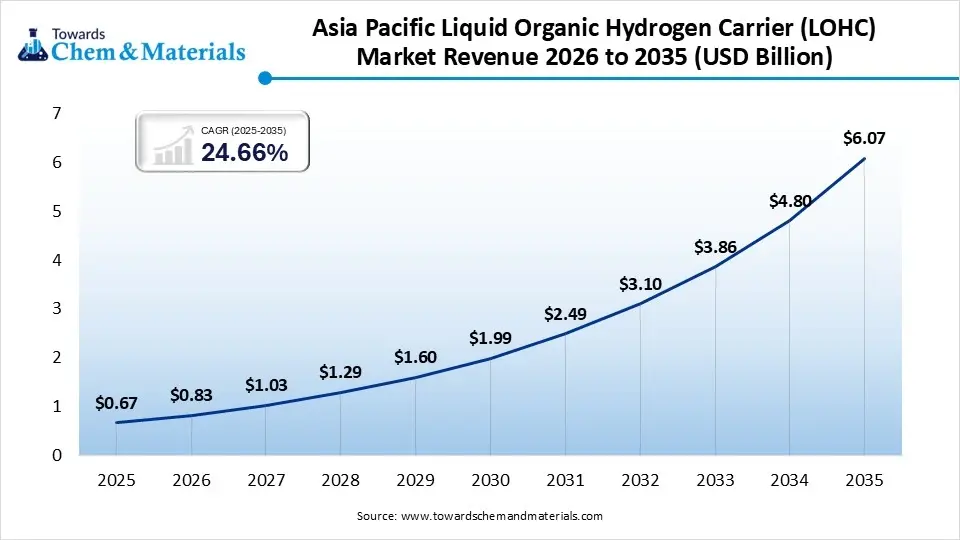
The Asia Pacific liquid organic hydrogen carrier (LOHC) market size was estimated at USD 0.67 billion in 2025 and is projected to reach USD 6.07 billion by 2035, growing at a CAGR of 24.66% from 2026 to 2035. Asia Pacific dominated the market with a share of 36% in 2025 and is expected to sustain its position while growing with a CAGR of 26.8% in the forecast period, driven by massive investment in hydrogen infrastructure in Japan, South Korea, and China; intense public-private partnerships; and rapid development of large-scale, international hydrogen supply chains. Countries like Japan and South Korea heavily funded large-scale hydrogen import-export projects and pilot facilities, placing them at the forefront of LOHC deployment.
India Liquid Organic Hydrogen Carrier (LOHC) Market Growth Factor
The Indian liquid organic hydrogen carrier (LOHC) market is growing, driven by the need for safe, long-distance hydrogen transport, utilization of existing fuel infrastructure, and high-density storage. Key drivers include India’s National Green Hydrogen Mission and the need to move large-scale hydrogen from production to consumption hubs efficiently. India's aggressive push for a net-zero energy sector necessitates efficient hydrogen logistics, accelerating demand for reliable storage methods like LOHC.
Europe Liquid Organic Hydrogen Carrier (LOHC) Market Growth Factor
Europe held the market share of 29% in 2025, driven by the need to safely store and transport large-scale hydrogen using existing oil infrastructure. Key factors include aggressive EU decarbonization targets, superior safety compared to pressurized gas, and the capability for long-distance transport, with key players like Hydrogenious LOHC Technologies driving market innovation. The EU's Hydrogen Strategy aims to install 40 GW of renewable hydrogen electrolyzers by 2030, necessitating efficient transport solutions like LOHC.
Liquid Organic Hydrogen Carriers (LOHC) Materials Market Share, By Regional, 2025 (%)
| Regional | Revenue Share, 2025 (%) |
| North America | 23% |
| Europe | 29% |
| Asia-Pacific | 36% |
| Latin America | 5% |
| Middle East & Africa | 7% |
Germany Liquid Organic Hydrogen Carrier (LOHC) Market Growth Factor
The German liquid organic hydrogen carrier (LOHC) market is growing rapidly, driven by the need for safe, long-distance hydrogen transport, utilization of existing fuel infrastructure, and ambitious national decarbonization targets. Key factors include investments in storage technology and high demand from industrial sectors. Germany's strong focus on renewable energy and hydrogen economy initiatives drives the adoption of LOHC for storing energy from wind and solar power, enabling a reliable, green energy supply.
Recent Developments
- In September 2025, India's Ministry of New and Renewable Energy (MNRE) launched a ₹100 crore scheme in September 2025 to fund start-ups piloting green hydrogen projects, including Liquid Organic Hydrogen Carrier (LOHC) solutions. Eligible Indian start-ups can receive up to ₹5 crore each to demonstrate technologies that move from proof-of-concept toward commercial scalability.(Source: www.energetica-india.net)
- In July 2025, India's Ministry of New and Renewable Energy (MNRE) opened a second round of R&D proposals to advance the National Green Hydrogen Mission. The initiative seeks innovative projects from industry and academia to improve the efficiency and cost-effectiveness of green hydrogen production and storage.(Source: fuelcellsworks.com)
- In January 2026, Chongqing, China's largest city, announced over $1 billion in investments in January 2026 to develop a new "hydrogen corridor" focused on transport and infrastructure. The plan includes 37 distinct projects designed to bolster the city's hydrogen ecosystem, though it does not explicitly specify a focus on green hydrogen.(Source: www.upstreamonline.com)
Top players in the Liquid Organic Hydrogen Carrier (LOHC) Market & Their Offerings:
- Shell plc: Shell is actively involved in hydrogen transportation and storage projects, including research into LOHC systems for large-scale clean energy distribution.
- Covestro AG: Covestro collaborates on LOHC technologies and hydrogen supply chain development, focusing on sustainable industrial energy systems.
- Mitsubishi Heavy Industries, Ltd.: Mitsubishi Heavy Industries supports hydrogen infrastructure projects, including hydrogen storage and transportation technologies such as LOHC systems.
- Clariant AG: Clariant supplies specialty catalysts and materials used in hydrogen carrier technologies and hydrogen value chains.
Other Top Players Are
- Hydrogenious LOHC Technologies
- Chiyoda Corporation
- Evonik Industries AG
- Honeywell International Inc.
- Hynertech Co Ltd
- Nippon Chemical Texas Incorporated (NCTI)
- Mitsubishi Corporation
- Air Liquide
- ENEOS
- Johnson Matthey Plc
Segments Covered:
By Material Type
- Toluene-Based LOHC
- Methylcyclohexane (MCH)
- Toluene (Dehydrogenated Form)
- N-Ethylcarbazole-Based LOHC
- Hydrogenated NEC
- Dehydrogenated NEC
- Dibenzyl Toluene-Based LOHC
- Hydrogenated DBT
- Dehydrogenated DBT
- Other LOHC Materials
- Formic Acid-Based Carriers
- Ammonia-Borane Derivatives
By Hydrogenation/Dehydrogenation Process
- Hydrogenation Process
- Catalytic Hydrogenation
- High-Pressure Hydrogenation
- Dehydrogenation Process
- Catalytic Dehydrogenation
- Low-Temperature Dehydrogenation
By Application
- Hydrogen Storage
- Bulk Storage
- Distributed Storage
- Hydrogen Transport
- Marine Transport
- Pipeline Blending
- Road Transport
- Hydrogen Supply Systems
- Refueling Stations
- Industrial Hydrogen Supply
By End-Use Industry
- Energy & Power
- Transportation
- Chemical Industry
- Oil & Gas
- Industrial Manufacturing
By Form
- Pure LOHC Compounds
- Blended LOHC Formulations
- Catalyst-Integrated Systems
By Distribution Channel
- Direct Supply Contracts
- Chemical Distributors
- Strategic Partnerships
By Regions
- North America
- U.S.
- Canada
- Mexico
- Europe
- Germany
- UK
- France
- Italy
- Spain
- Asia Pacific
- China
- India
- Japan
- South Korea
- Latin America
- Brazil
- Argentina
- Middle East & Africa
- Saudi Arabia
- South Africa
FAQ's
Question 1 : Is LOHC safer than compressed hydrogen gas?
Answer : Yes, significantly. LOHC is a non-explosive, non-flammable liquid at ambient conditions. It can be handled with the same safety protocols as diesel or oil, whereas compressed gas requires high-pressure tanks that carry much higher risks.
Question 2 : Can we use regular oil tankers to move LOHC?
Answer : Absolutely. One of the biggest selling points of LOHC is its compatibility with existing infrastructure. We can use the same ships, rail cars, and pipelines that currently move petroleum products.
Question 3 : Does the carrier liquid get used up?
Answer : No, it\'s a circular process. Once the hydrogen is released, the \"empty\" carrier liquid can be sent back to the production site to be refilled with hydrogen and used all over again.
Question 4 : What temperature is required to release the hydrogen?
Answer : Current systems typically require heating the liquid to about 250–300°C to trigger the release (dehydrogenation) process. Improving the catalysts to lower this temperature is a major focus for researchers right now.
Question 5 : How much hydrogen can LOHC hold?
Answer : While it varies by material, LOHC offers high volumetric storage density. It is much more efficient than hauling large tanks of compressed gas, making it the preferred choice for massive, industrial-scale energy moves.
Meet the Team

Saurabh Bidwai
Principal Consultant
Saurabh Bidwai, a B.Tech Chemical Engineering graduate with 4+ years of experience, specializes in specialty chemicals, commodity chemicals, and engineered materials, offering valuable insights into market trends and emerging opportunities.

Aditi Shivarkar
Reviewed By
Aditi Shivarkar, with 14+ years in Chemical and Materials market research, specializes in Chemical and Materials. She ensures accurate, actionable insights, driving Towards Chemicals And Materials Analytics and Consulting excellence in industry trends and sustainability.