
Lithium-ion Battery Market Size, Share, Growth, Report 2026 to 2035
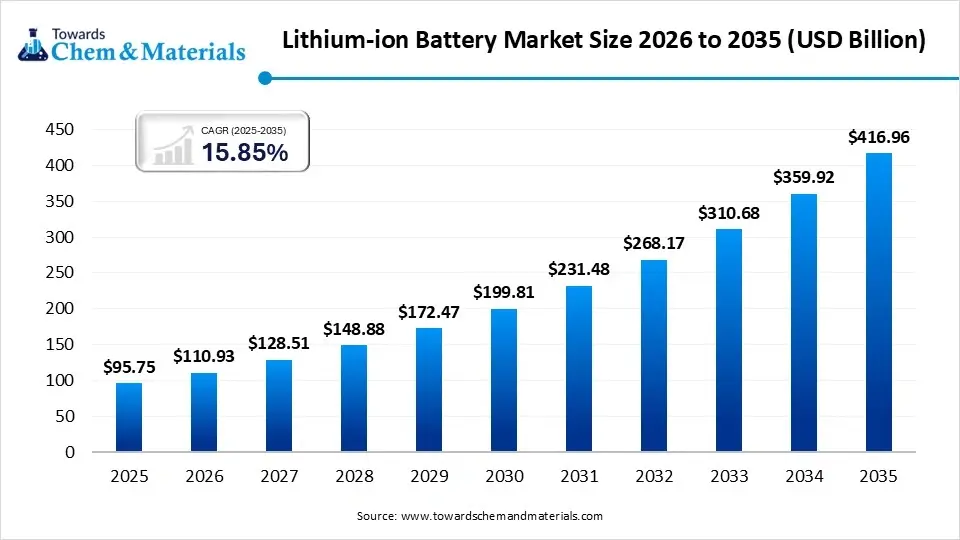
The global lithium-ion battery market size is expected to grow from USD 110.93 billion in 2026 to USD 416.96 billion in 2035, growing at a CAGR of 15.85% from 2026 to 2035. The top key players in the market are Contemporary Amperex Technology Co., Limited (CATL), LG Energy Solution Ltd., Panasonic Corporation, Northvolt AB, AESC Group, BYD Co., Ltd., CALB (China Aviation Lithium Battery Co., Ltd.), EVE Energy Co., Ltd., Samsung SDI Co., Ltd., SK On Co., Ltd., Tesla, Inc., Toshiba Corporation -Global Forecast 2026 To 2035
Content
What is the Current Size of the Lithium-ion Battery Market and Its Projected Growth?
The global lithium-ion battery size was estimated at USD 95.75 billion in 2025 and is expected to increase from USD 110.93 billion in 2026 to USD 416.96 billion by 2035, growing at a CAGR of 15.85% from 2026 to 2035. Asia Pacific dominated the lithium ion battery with the largest revenue share of 52% in 2025. The growth of the market is driven by the growing and rapid adoption of electric vehicles and the need for renewable energy storage, which fuels the growth of the market.
Market Highlights
- Asia Pacific dominated the market share 52% in 2025. The presence of raw materials in the regions supports growth.
- By region, North America is expected to have the fastest growth in the market in the forecast period between 2026 and 2035. The growing demand from the automotive sector helps the growth.
- By battery type, the NMC segment dominated the market share 38.00% in 2025. The growing consumer demand for electronics fuels the growth.
- By battery type, the Lithium Iron Phosphate (LFP) segment is projected to grow at the fastest CAGR between 2026 and 2035. growth is supported by LFP's superior safety, long life cycle, and low cost, fueling the growth of the market.
- By application, the consumer electronics segment dominated the market share 48.00% in 2025. Growing demand for EVs, government incentives for battery manufacturing, fuel the growth of the market.
- By application, the energy storage segment is projected to grow at the fastest CAGR between 2026 and 2035. The need to manage intermittent renewable energy and enhanced grid reliability fuels the growth.
Market Overview
What Is The Significance Of The Lithium-ion Battery Market?
The lithium-ion battery market is a crucial and critical backbone of decarbonization, driven by the growth in the automotive sector, especially the extensive use of electric vehicles and renewable energy, which fuels the growth of the market. This market enables cleaner transportation, grid stability, and powers modern electronics, making it essential to modern economies and future energy security, further boosting the growth. Their high energy density further boosts the growth and expansion of the market.
Recent Growth Trends:
- Dominance of EVs & Energy Storage: The surge in EV production is the primary driver, alongside increasing demand for utility-scale renewable energy storage.
- Sustainability and Recycling: Increased emphasis on circular economy efforts, such as battery recycling and "closed-loop" manufacturing, encouraged by regulations like the EU's Battery Regulation.
- Technological Advancements: The advancement in battery manufacturing and investment in batteries to increase safety and energy density is a growing trend.
Report Scope
| Report Attribute | Details |
| Market Size in 2026 | USD 110.93 Billion |
| Revenue Forecast in 2035 | USD 416.96 Billion |
| Growth Rate | CAGR 15.85% |
| Forecast Period | 2026 - 2035 |
| Base Year | 2025 |
| Dominant Region | Asia Pacific |
| Segment Covered | By Product, By Application, By Component, By Capacity, By Voltage, By End-User, By Regions |
| Key companies profiled | Contemporary Amperex Technology Co., Limited (CATL), LG Energy Solution Ltd., Panasonic Corporation, Northvolt AB, AESC Group, BYD Co., Ltd., CALB (China Aviation Lithium Battery Co., Ltd.), EVE Energy Co., Ltd., Samsung SDI Co., Ltd., SK On Co., Ltd., Tesla, Inc., Toshiba Corporation |
Key Technological Shifts In The Lithium-ion Battery Market:
Key technological shifts in the lithium-ion battery (LIB) market are driven by the need for higher energy density, faster charging, improved safety, and lower costs, fueling the growth of the market. Manufacturers are moving towards nickel-rich cathodes like NMC 811 and high-voltage LNMO to improve energy density. Simultaneously, to address cost and ethical concerns, there is a push to reduce or eliminate cobalt, driving the popularity of Lithium Iron Phosphate (LFP) batteries for cost-effective applications.
Trade Analysis Of Lithium-ion Battery Market: Import & Export Statistics
- According to Global Export Data, the world exported 51,910 Li Ion Batteries shipments between June 2024 and May 2025 (TTM) via 3,341 exporters and 3,766 buyers, representing a 59% YoY change.
- Vietnam, India, and the United States are the top Li Ion Batteries importers, while China, with 76,344 shipments, Vietnam with 16,987 shipments, and South Korea with 6,852 shipments, rank as the largest global Li Ion Batteries exporters.
Top-performing Global Li Ion Batteries Exporters by volume:
- Green Planet Distribution Centre Joint Stock Company: 5,108 shipments (21%)
- TTI PARTNERS SPC ACTING FOR THE ACCOUNT OF MPV SP: 3,233 shipments (13%)
- XIAOMI H K LIMITED: 3,062 shipments (12%)
Lithium-ion Battery Market -- Supply Chain Analysis
Battery Material Production & Cell Manufacturing
- Lithium-ion batteries are produced through the processing of cathode and anode materials, electrolyte formulation, and assembly of cells, modules, and battery packs for energy storage applications.
- Key players: CATL, LG Energy Solution, Panasonic, Samsung SDI
Quality Testing and Certification
- Lithium-ion batteries must meet stringent safety, performance, transportation, and environmental standards before commercialization.
- Key players: International Electrotechnical Commission, Underwriters Laboratories, International Organization for Standardization, U.S. Department of Transportation.
Distribution to Industrial Users
- Lithium-ion batteries are supplied to electric vehicle manufacturers, consumer electronics companies, energy storage system providers, industrial equipment manufacturers, and renewable energy projects.
- Key players: CATL, LG Energy Solution, Panasonic.
Lithium-ion Battery Regulatory Landscape: Global Regulations
| Country / Region | Regulatory Body | Key Regulations | Focus Areas | Notable Notes |
| U.S. | Environmental Protection Agency (EPA); Department of Transportation (DOT); Department of Energy (DOE) | Resource Conservation and Recovery Act (RCRA); Hazardous Materials Regulations (HMR); Inflation Reduction Act (IRA) | Battery recycling, transportation safety, and domestic manufacturing incentives | The U.S. promotes local battery production and recycling through IRA incentives, while enforcing strict transport and disposal regulations for lithium-ion batteries. |
| Europe | European Commission; European Chemicals Agency (ECHA) | EU Battery Regulation (2023); REACH Regulation | Battery lifecycle management, recycling targets, and carbon footprint reporting | The EU Battery Regulation mandates sustainability, recycling efficiency, and traceability across the battery value chain. |
| China | Ministry of Industry and Information Technology (MIIT); Ministry of Ecology and Environment (MEE) | New Energy Vehicle (NEV) Policies; Battery Recycling Regulations | EV battery production, recycling, and environmental compliance | China enforces strict recycling obligations and supports EV battery manufacturing through strong industrial policies. |
| India | Ministry of Environment, Forest and Climate Change (MoEFCC); NITI Aayog | Battery Waste Management Rules; National Electric Mobility Mission Plan | Battery recycling, extended producer responsibility (EPR), and EV adoption | India mandates EPR compliance for battery producers and promotes EV battery manufacturing and recycling ecosystems. |
| Japan | Ministry of Economy, Trade and Industry (METI); Ministry of the Environment | Act on the Promotion of Effective Utilization of Resources; Recycling Laws | Resource efficiency, battery recycling, and environmental protection | Japan emphasizes circular economy practices and efficient recycling systems for lithium-ion batteries. |
| South Korea | Ministry of Environment (MoE); Ministry of Trade, Industry and Energy (MOTIE) | K-Battery Strategy; Waste Management Act | Battery recycling, industrial policy, and environmental safety | South Korea supports battery industry growth while enforcing strict recycling and environmental compliance standards. |
Segmental Insights
By Battery Type Insights
Lithium Cobalt Oxide (LCO) Segment Led the Lithium-ion Battery Market in 2025 with the Largest Share
The lithium cobalt oxide (LCO) segment dominated the market in 2025, driven by its high energy density in consumer electronics like smartphones and laptops, which fuels the growth of the market. LCO's high energy density and lightweight characteristics make it the preferred choice for portable, compact electronics, increasing the demand for the market. The growing consumer demand for electronics, a large installed base, and its usage in high-end, compact electronics further fuel the growth.
The lithium iron phosphate (LFP) segment is projected to have the fastest CAGR in the market between 2026 and 2035, driven by rising adoption in electric vehicles (EVs) and energy storage systems (ESS). This growth is supported by LFP's superior safety, long life cycle, and low cost, fueling the growth of the market. The surge in demand is largely due to the rapid adoption of LFP technology in cost-sensitive EVs and grid-scale energy storage systems, as LFP provides higher energy density, better thermal stability, and enhanced safety compared to other chemistries.
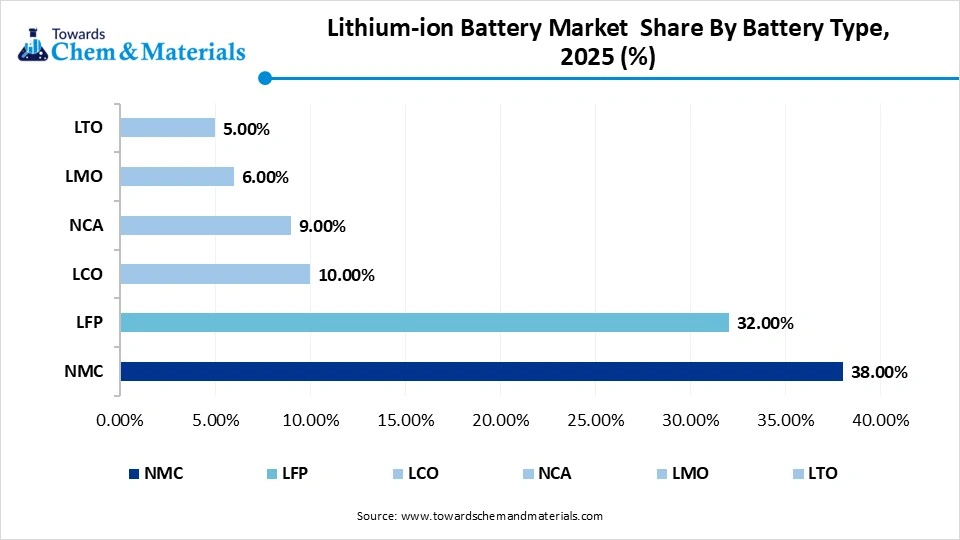
Lithium-ion Battery Market Share By Battery Type, 2025 (%)
| By Battery Type | Revenue Share, 2025 (%) |
| NMC | 38.00% |
| LFP | 32.00% |
| LCO | 10.00% |
| NCA | 9.00% |
| LMO | 6.00% |
| LTO | 5.00% |
- NMC (Nickel Manganese Cobalt) batteries account for 38.00% of the lithium-ion battery market in 2025, making them the dominant type, widely used in electric vehicles (EVs), energy storage systems, and consumer electronics due to their high energy density and long lifespan.
- LFP (Lithium Iron Phosphate) holds a 32.00% share, driven by its growing use in EVs and renewable energy storage, owing to its safety, lower cost, and long cycle life.
- LCO (Lithium Cobalt Oxide) represents 10.00% of the market, primarily used in mobile phones, laptops, and other portable devices due to its high energy density and compact form.
- NCA (Nickel Cobalt Aluminum) accounts for 9.00%, being popular in high-performance applications like electric vehicles and power tools, offering excellent energy density and longevity.
- LMO (Lithium Manganese Oxide) captures 6.00% of the market, used in power tools, medical devices, and some EV applications, known for its thermal stability and safety.
- LTO (Lithium Titanate Oxide) holds 5.00% of the market, favored for high-power applications and fast charging capabilities, making it suitable for specific EV and grid storage uses.
By Component Insights
The lithium-ion battery market by component is characterized by key parts that work together to deliver efficient energy storage and power delivery. The cathode is one of the most crucial components, typically made from lithium metal oxides, which store and release lithium ions during charge and discharge cycles, significantly impacting the battery's energy density and lifespan. The anode, often made from graphite or silicon, plays a vital role in lithium-ion movement and overall capacity. The electrolyte facilitates the flow of lithium ions between the cathode and anode, typically in liquid or solid form, and is a critical factor in determining battery efficiency and safety. The separator ensures that the cathode and anode do not come into direct contact, preventing short circuits while allowing ions to pass through. Current collectors are responsible for transmitting electrical energy between the electrodes and the external circuit, ensuring optimal performance. These components are central to improving battery performance, driving advancements in various industries such as automotive, electronics, and energy storage.
Lithium-ion Battery Market Share By Component, 2025 (%)
| By Component | Revenue Share, 2025 (%) |
| Cathode | 40.00% |
| Anode | 20.00% |
| Electrolyte | 15.00% |
| Separator | 15.00% |
| Current Collectors | 10.00% |
- The cathode accounts for 40.00% of the lithium-ion battery market in 2025, making it the dominant component, as it plays a crucial role in determining the battery's energy capacity and overall performance, particularly in electric vehicles and energy storage systems.
- The anode holds a 20.00% share, driven by its significance in charging and discharging cycles, with materials like graphite being widely used for high energy capacity and stability.
- Electrolyte represents 15.00% of the market, essential for enabling the flow of ions between the cathode and anode, contributing to battery efficiency and stability in various applications, from consumer electronics to EVs.
- The separator also captures 15.00% of the market, crucial for maintaining the physical separation between the anode and cathode while ensuring safety and performance, especially in high-energy density batteries.
- Current collectors account for 10.00% of the market, playing an important role in facilitating electron flow and improving the overall conductivity and efficiency of lithium-ion batteries
By Capacity Insights
The segment by capacity is segmented based on the energy requirements of various applications, with different capacity ranges tailored to specific needs. Batteries with a capacity below 3,000 mAh are commonly found in smaller devices like smartphones, wearables, and portable electronics, offering a balance of compact size and sufficient power for daily usage. The 3,000–10,000 mAh range is popular in mid-sized devices such as tablets, laptops, and power banks, where higher energy demands are met without compromising portability. Batteries in the 10,000–60,000 mAh range cater to larger applications like electric vehicles (EVs), energy storage systems, and high-performance industrial tools, offering substantial power for longer durations and more demanding energy needs. Finally, batteries above 60,000 mAh are designed for heavy-duty uses, including commercial electric vehicles, grid-scale energy storage, and other industrial applications that require substantial, sustained energy output. This segmentation enables lithium-ion batteries to meet diverse power needs across industries.
Lithium-ion Battery Market Share By Capacity, 2025 (%)
| By Capacity | Revenue Share, 2025 (%) |
| Below 3,000 mAh | 18.00% |
| 3,000–10,000 mAh | 26.00% |
| 10,000–60,000 mAh | 34.00% |
| Above 60,000 mAh | 22.00% |
- The 10,000–60,000 mAh capacity range accounts for 34.00% of the lithium-ion battery market in 2025, making it the dominant segment, driven by its extensive use in electric vehicles (EVs), energy storage systems, and high-capacity consumer electronics.
- The 3,000–10,000 mAh range holds a 26.00% share, primarily used in portable devices such as smartphones, tablets, and power banks, offering a balanced energy output for everyday consumer needs.
- Batteries below 3,000 mAh represent 18.00% of the market, widely used in smaller electronics like wearable devices, hearing aids, and other compact gadgets due to their lightweight design and efficiency.
- The above 60,000 mAh capacity segment captures 22.00% of the market, favored for large-scale applications such as grid energy storage and commercial EVs, requiring high energy storage capacity and long-lasting performance.
By Voltage Insights
The segment by voltage is categorized based on the power requirements of various applications, with each voltage range designed to meet specific energy needs. Low voltage batteries (below 12V) are typically used in smaller devices such as portable electronics, power tools, and some consumer gadgets, where compactness and ease of use are essential. These batteries offer adequate power for everyday tasks without the need for high energy output. Medium voltage batteries (12V–36V) are commonly found in applications like electric bikes, solar energy storage systems, and certain automotive uses, providing a good balance between size, weight, and energy efficiency for medium-range power needs. High voltage batteries (above 36V) are used in more demanding applications such as electric vehicles (EVs), large-scale energy storage solutions, and heavy machinery, where high power output and efficiency are critical. These batteries are integral to industries requiring long-lasting performance and enhanced energy delivery.
Lithium-ion Battery Market Share By Voltage, 2025 (%)
| By Voltage | Revenue Share, 2025 (%) |
| Low (Below 12V) | 20.00% |
| Medium (12V–36V) | 30.00% |
| High (Above 36V) | 50.00% |
- High voltage batteries (above 36V) dominate the lithium-ion battery market with 50.00% of the share in 2025, driven by their widespread use in electric vehicles (EVs), energy storage systems, and industrial applications that require high power output and efficiency.
- Medium voltage batteries (12V–36V) hold a 30.00% share, commonly used in applications like electric bikes, power tools, and hybrid vehicles, offering a balance of performance and energy capacity.
- Low voltage batteries (below 12V) represent 20.00% of the market, primarily used in smaller, portable consumer electronics such as smartphones, wearables, and remote control devices, where compact size and ease of integration are key factors.
Application Insights
The Automotive Segment Led the Lithium-ion Battery Market in 2025 with the Largest Share
The automotive segment dominated the market in 2025, driven by rapid electric vehicle (EV) adoption and strict emission regulations, fueling the growth of the market. The other key growth factors are high energy density requirements and government incentives for clean transportation, with BEVs serving as a primary driver, supporting the growth of the market. Growing demand for EVs, government incentives for battery manufacturing, and the need for higher energy density in transportation fuels this dominance and also help in the expansion of the market.
The energy storage segment is projected to have the fastest CAGR in the market between 2026 and 2035, driven by renewable energy integration and grid stability, which are fueling the growth of the market. rising utility-scale installations, declining battery costs, and strong policy support further support the growth. The need to manage intermittent renewable energy (solar/wind) and enhanced grid reliability is accelerating the adoption of stationary lithium-ion, particularly with Lithium Iron Phosphate (LFP) technologies gaining favor for safety and cost.
Lithium-ion Battery Market Share By Application, 2025 (%)
| By Application | Revenue Share, 2025 (%) |
| Automotive | 48.00% |
| Consumer Electronics | 22.00% |
| Energy Storage Systems | 18.00% |
| Industrial | 8.00% |
| Others | 4.00% |
- The automotive sector accounts for 48.00% of the lithium-ion battery market in 2025, making it the dominant segment, driven by the rapid adoption of electric vehicles (EVs) and the increasing demand for energy-efficient, high-performance batteries.
- Consumer electronics holds a 22.00% share, supported by the growing demand for lithium-ion batteries in smartphones, laptops, wearables, and other portable devices that require compact, reliable power sources.
- Energy storage systems represent 18.00% of the market, fueled by the rising need for efficient, sustainable energy solutions, particularly in residential, commercial, and utility-scale applications for renewable energy integration.
- The industrial sector captures 8.00% of the market, driven by the use of lithium-ion batteries in equipment like power tools, robotics, and material handling systems.
- Other applications account for 4.00% of the market, covering niche and specialized uses of lithium-ion technology across various industries.
By End-User
by end-user is divided into two key segments: OEMs (Original Equipment Manufacturers) and the aftermarket. The OEM segment includes manufacturers that integrate lithium-ion batteries directly into products during the initial production process. This includes sectors such as automotive, electronics, and energy storage, where OEMs rely on lithium-ion batteries to power electric vehicles, smartphones, laptops, and other high-demand applications. OEMs require batteries that meet specific performance standards and are crucial in driving technological advancements and innovations.
On the other hand, the aftermarket segment refers to the sale and distribution of lithium-ion batteries as replacement parts or upgrades for existing devices or systems. This segment plays a critical role in industries like automotive (for EV battery replacements), consumer electronics, and industrial machinery, where customers seek to extend the lifespan of their devices or enhance performance. Both segments are essential for maintaining the growth and expansion of the lithium-ion battery market.
Lithium-ion Battery Market Share By End-User, 2025 (%)
| By End-User | Revenue Share, 2025 (%) |
| OEMs | 72.00% |
| Aftermarket | 28.00% |
- OEMs (Original Equipment Manufacturers) dominate the lithium-ion battery market with 72.00% of the share in 2025, driven by the high demand for batteries used in electric vehicles, consumer electronics, and energy storage systems, where manufacturers source batteries for new products.
- The aftermarket segment holds a 28.00% share, supported by the growing demand for replacement batteries in EVs, consumer electronics, and industrial equipment, as well as the increasing focus on battery recycling and refurbishment.
Regional Insights
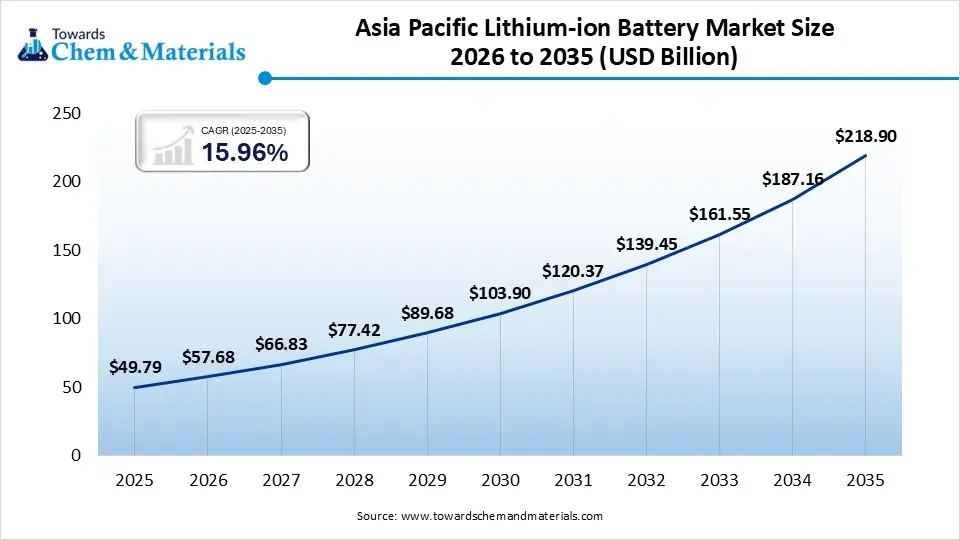
The Asia Pacific lithium ion battery market size was valued at USD 49.79 billion in 2025 and is expected to be worth around USD 218.90 billion by 2035, exhibiting at a compound annual growth rate (CAGR) of 15.96% over the forecast period from 2026 to 2035.Asia Pacific dominated the lithium-ion battery market in 2025, controlling over 77% of production by combining massive manufacturing capacity with secure supply chains, particularly in China, Japan, and South Korea. This dominance is fueled by aggressive government incentives, high electric vehicle (EV) adoption, and deep integration of raw material processing. Strong policy-level support for EVs, such as China’s National New Energy Vehicle (NEV) program, and rising demand for consumer electronics, have accelerated industry expansion. The region benefits from a complete ecosystem, from raw material suppliers to battery management system innovators.
China Lithium-ion Battery Market Growth Factor
The Chinese lithium-ion battery market is experiencing rapid growth, driven by surging demand for Electric Vehicles, massive investment in energy storage systems, dominant production of cost-effective LFP (Lithium Iron Phosphate) batteries, and a robust, vertically integrated supply chain. China dominates production with major companies like CATL, BYD, and CALB Group leading the market. Favorable policy support for electrification and infrastructure development, along with competitive commercial electricity prices, sustains the manufacturing boom.
North America Lithium-ion Battery Market Growth Factor
North America is expected to have the fastest growth in the market in the forecast period between 2026 and 2035, driven primarily by surging electric vehicle adoption, heavy federal incentives, and massive investments in domestic manufacturing. Federal legislation, such as tax credits for EV purchases and incentives for manufacturing, drives market growth. Significant investments in gigafactories by major players like Panasonic, Tesla, and others are boosting local supply chains.
U.S. Lithium-ion Battery Market Growth Factor
The U.S. lithium-ion battery market is primarily driven by accelerating electric vehicle adoption, massive investments in domestic manufacturing, and expanding utility-scale energy storage for renewable energy grid integration, which supports the growth of the market. Rising penetration of electric vehicles and hybrid vehicles is the biggest driver, requiring massive battery production, supported by major automakers such as Tesla, General Motors, and Ford. The Inflation Reduction Act and other federal incentives provide critical support for domestic manufacturing of batteries and sourcing of raw materials, encouraging onshoring to reduce reliance on imports.
Europe Lithium-ion Battery Market Growth Factor
The European lithium-ion battery market is experiencing strong growth, driven by accelerating electric vehicle (EV) adoption and the urgent need for large-scale energy storage systems (ESS) to support renewable energy transitions under the EU Green Deal. Increased investment in wind and solar power requires substantial storage solutions to stabilize grids, boosting demand for lithium-ion technology. Stringent emission targets and incentives for green technology accelerate investment, especially in Germany and Sweden, which support the growth of the market.
Germany Lithium-ion Battery Market Growth Factor
Germany’s lithium-ion battery market is projected to grow significantly, driven by rapid electric vehicle (EV) adoption, ambitious renewable energy expansion, and strong government support, fueling the growth of the market. The expansion of solar and wind power requires massive energy storage solutions (ESS) to stabilize the grid, boosting the adoption of stationary lithium-ion batteries, which further supports the growth of the market. Germany is boosting local battery innovation and production to reduce reliance on external suppliers, supported by European Union sustainability regulations and local subsidies.
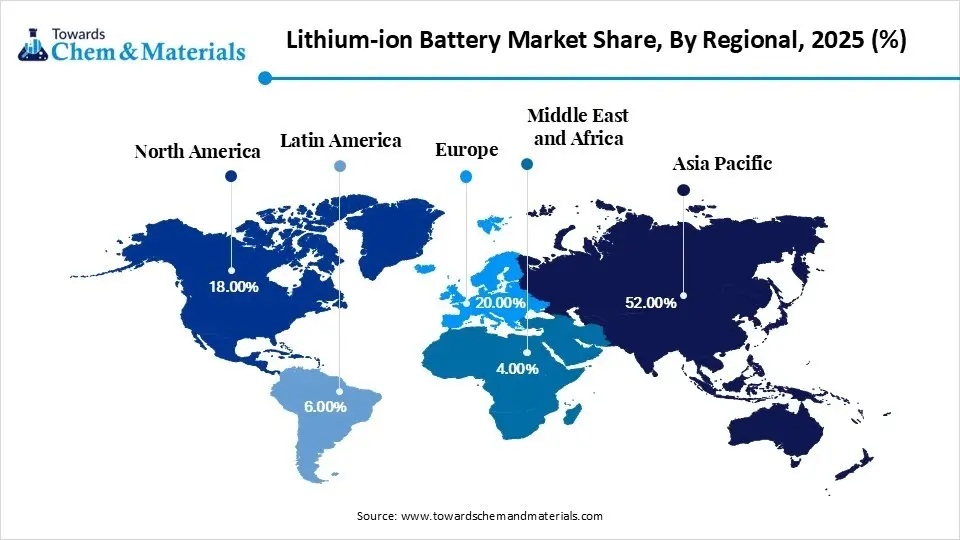
Lithium-ion Battery Market Share, By Regional, 2025 (%)
| Regional | Revenue Share, 2025 (%) |
| Asia-Pacific | 52.00% |
| Europe | 20.00% |
| North America | 18.00% |
| Latin America | 6.00% |
| Middle East & Africa | 4.00% |
- Asia-Pacific dominates the lithium-ion battery market with 52.00% of the share in 2025, driven by the rapid growth of the electric vehicle (EV) market, consumer electronics, and energy storage systems, particularly in countries like China, Japan, and South Korea.
- Europe holds a 20.00% share, fueled by strong demand for EVs, renewable energy solutions, and the region's push for sustainability and green energy policies.
- North America captures 18.00% of the market, supported by increasing investments in EV infrastructure, energy storage, and the growing adoption of lithium-ion batteries in consumer electronics and industrial applications.
- Latin America accounts for 6.00% of the market, driven by the expansion of renewable energy projects and the growing interest in electric vehicles.
- The Middle East & Africa represents 4.00% of the market, with increasing interest in energy storage solutions and a gradual shift toward electric mobility and renewable energy technologies.
Recent Developments
- In March 2026, CEVA Logistics, in partnership with CMA CGM, introduced a specialized maritime transport service for the secure, large-scale movement of used lithium-ion batteries from remote regions to Continental Europe for recycling. The service utilizes a secure double-container system to ensure maximum safety during maritime transport.(Source: batteriesnews.com )
- In October 2025, Kolkata-based NavPrakriti launched Eastern India’s first large-scale lithium-ion battery recycling facility. The plant will play a crucial role in processing battery waste generated, designed to process 1,000 to 2,000 tonnes per month. Utilizing indigenous technology developed by C-MET, the plant focuses on recovering essential materials like lithium, cobalt, and nickel(Source: www.entrepreneurindia.com )
Top players in the Lithium-ion Battery Market & Their Offerings:
- Contemporary Amperex Technology Co., Limited (CATL): CATL is the world’s largest lithium-ion battery manufacturer, supplying batteries for electric vehicles (EVs), energy storage systems, and consumer electronics. The company focuses on advanced battery chemistries such as LFP and NMC, along with innovations in fast charging and battery recycling technologies.
- LG Energy Solution Ltd.: LG Energy Solution produces lithium-ion batteries for EVs, grid storage, and consumer electronics. The company is known for its high-performance pouch and cylindrical batteries and maintains strong partnerships with global automakers.
- Panasonic Corporation: Panasonic is a key supplier of lithium-ion batteries, particularly for electric vehicles, through its partnership with Tesla. The company focuses on high-energy-density cylindrical cells and next-generation battery technologies.
- Northvolt AB: Northvolt focuses on sustainable lithium-ion battery production using renewable energy. The company supplies batteries for EVs and grid storage while emphasizing recycling and low-carbon manufacturing processes.
- AESC Group: AESC produces lithium-ion batteries for automotive and energy storage applications. The company has strong partnerships with global automakers and focuses on high-performance and reliable battery solutions.
- BYD Co., Ltd.
- CALB (China Aviation Lithium Battery Co., Ltd.)
- EVE Energy Co., Ltd.
- Samsung SDI Co., Ltd.
- SK On Co., Ltd.
- Tesla, Inc.
- Toshiba Corporation
Segments Covered:
By Product
- Lithium cobalt oxide (LCO)
- Lithium iron phosphate (LFP)
- Lithium Nickel Cobalt Aluminum Oxide (NCA)
- Lithium Manganese Oxide (LMO)
- Lithium Titanate
- Lithium Nickel Manganese Cobalt (LMC)
By Application
- Automotive
- Consumer Electronics
- Industrial
- Energy Storage Systems
- Medical Devices
By Battery Type
- Lithium Nickel Manganese Cobalt Oxide (NMC)
- High Nickel NMC (NMC 811, NMC 9½½)
- Mid Nickel NMC (NMC 622)
- Low Nickel NMC (NMC 111)
- Lithium Iron Phosphate (LFP)
- Standard LFP
- Blade LFP
- Lithium Cobalt Oxide (LCO)
- Lithium Nickel Cobalt Aluminum Oxide (NCA)
- Lithium Manganese Oxide (LMO)
- Lithium Titanate (LTO)
By Component
- Cathode
- NMC Cathode
- LFP Cathode
- LCO Cathode
- NCA Cathode
- Anode
- Graphite Anode
- Silicon-based Anode
- Lithium Titanate Anode
- Electrolyte
- Liquid Electrolyte
- Solid-State Electrolyte
- Separator
- Polyethylene Separator
- Polypropylene Separator
- Ceramic-coated Separator
- Current Collectors
- Aluminum
- Copper
By Capacity
- Below 3,000 mAh
- 3,000–10,000 mAh
- 10,000–60,000 mAh
- Above 60,000 mAh
By Voltage
- Low (Below 12V)
- Medium (12V–36V)
- High (Above 36V)
By Application
- Automotive
- Passenger Electric Vehicles
- Commercial Electric Vehicles
- Two & Three Wheelers
- Consumer Electronics
- Smartphones
- Laptops
- Tablets
- Wearables
- Energy Storage Systems
- Residential Storage
- Commercial & Industrial Storage
- Utility-scale Storage
- Industrial
- Forklifts
- Robotics
- Power Tools
- Others
- Aerospace
- Marine
By End-User
- OEMs
- Aftermarket
By Regions
- North America
- U.S.
- Canada
- Mexico
- Europe
- Germany
- UK
- France
- Italy
- Spain
- Asia Pacific
- China
- India
- Japan
- South Korea
- Latin America
- Brazil
- Argentina
- Middle East & Africa
- Saudi Arabia
- South Africa
FAQ's
Question 1 : What are the key growth drivers for the lithium-ion battery market?
Answer : The growing adoption of electric vehicles, increasing demand for renewable energy storage, and advancements in battery technology are driving the growth of the lithium-ion battery market.
Question 2 : How is the lithium-ion battery market expected to evolve by 2035?
Answer : The lithium-ion battery market is projected to grow at a CAGR of 15.85%, reaching USD 416.96 billion by 2035, fueled by technological advancements and rising demand from the automotive and energy storage sectors.
Question 3 : What are the key technological advancements shaping the lithium-ion battery market?
Answer : Advancements in energy density, fast charging, improved safety, and cost reduction, particularly through the use of Nickel Manganese Cobalt (NMC) and Lithium Iron Phosphate (LFP) technologies, are transforming the lithium-ion battery market.
Question 4 : Who are the leading companies operating in the lithium-ion battery market?
Answer : Leading companies in the lithium-ion battery market include CATL, LG Energy Solution, Panasonic, Tesla, BYD, and Northvolt, all of which play crucial roles in EV, energy storage, and consumer electronics sectors.
Meet the Team

Saurabh Bidwai
Principal Consultant
Saurabh Bidwai, a B.Tech Chemical Engineering graduate with 4+ years of experience, specializes in specialty chemicals, commodity chemicals, and engineered materials, offering valuable insights into market trends and emerging opportunities.

Aditi Shivarkar
Reviewed By
Aditi Shivarkar, with 14+ years in Chemical and Materials market research, specializes in Chemical and Materials. She ensures accurate, actionable insights, driving Towards Chemicals And Materials Analytics and Consulting excellence in industry trends and sustainability.