
Musk Aroma Chemicals Market Size, Share, Growth, Report 2026 to 2035
The Musk Aroma Chemicals Market report is Segmented By Product Type (Nitro Musk, Polycyclic Musk, Macrocyclic Musk, Alicyclic Musk), By Source (Synthetic Musk, Natural Musk), By Application (Personal Care & Cosmetics, Household Products, Fine Fragrances, Industrial Fragrances), By Form (Liquid Musk Chemicals, Solid Musk Chemicals), By Distribution Channel (Direct Sales, Distributors & Traders, Online Channels) - Global Industry Analysis, Size, Trends, Leading Companies, Regional Outlook, and Forecast 2026 to 2035.
Content
What is the Current Musk Aroma Chemicals Market Size and Share?
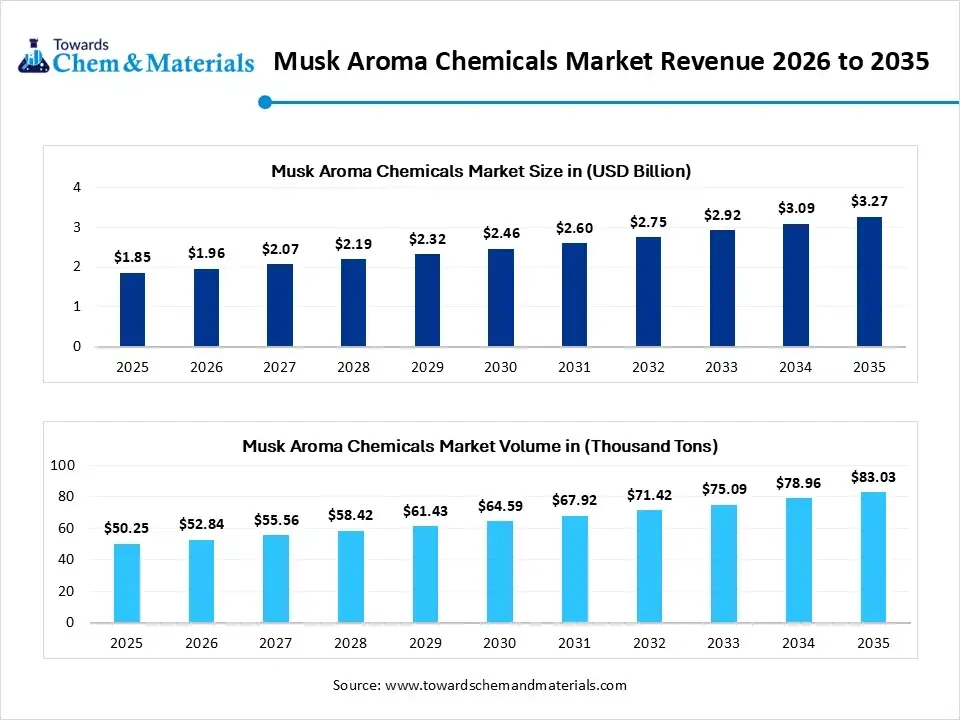
The global musk aroma chemicals market size was valued at USD 1.85 billion in 2025, is estimated to reach USD 1.96 billion in 2026, and is projected to reach USD 3.27 billion by 2035, exhibiting a compound annual growth rate (CAGR) of 5.85% over the forecast period from 2026 to 2035. In terms of volume, the musk aroma chemicals market is projected to grow from 50.25 million tons in 2025 to 83.03 million tons by 2035. growing at a CAGR of 5.15% from 2026 to 2035.Increasing demand for personal care products is the key factor driving market growth. Also, the ongoing transition towards synthetic alternatives, coupled with the surge in disposable incomes in emerging economies, can fuel market growth further.
Market Highlights
- By region, Asia Pacific dominated the market with the largest share of 33% in 2025 and is expected to grow at the fastest CAGR of 6.7% over the forecast period. The dominance and growth of the region can be attributed to the rapid urbanisation.
- By region, Europe held the market share of 28% in 2025. The growth of the region can be credited to the stringent regulations favouring high-quality muskies.
- By product type, the polycyclic musk segment dominated the market with the largest share of 44% in 2025. The dominance of the segment can be attributed to its cost efficiency.
- By product type, the macrocyclic musk segment is expected to grow at the fastest CAGR of 7.4% over the forecast period. The growth of the segment can be credited to its increasing demand for premium fragrance.
- By source, the synthetic musk segment dominated the market with the largest share of 93% in 2025. The dominance of the segment can be driven by its consistent quality supporting industrial usage.
- By source, the natural musk segment is expected to grow at the fastest CAGR of 8.2% over the forecast period. The growth of the segment is owing to the increasing demand for natural fragrances.
- By application, the personal care & cosmetics segment dominated the market with the largest share of 39% in 2025. The dominance of the segment is due to increasing consumer spending on cosmetics.
- By application, the fine fragrances segment is expected to grow at the fastest CAGR of 6.9% during the forecast period. The growth of the segment can be attributed to the increasing disposable income.
- By form, the liquid musk chemicals segment dominated the market with the largest share of 69% in 2025 and is expected to grow at the fastest CAGR of 6.0% during the study period. The dominance and growth of the segment can be linked to its high compatibility.
- By distribution channel, the direct sales segment dominated the market with the largest share of 47% in 2025. The dominance of the segment is owing to the large manufacturers preferring direct procurement.
- By distribution channel, the online channels segment is expected to grow at the fastest CAGR of 6.8% over the forecast period. The growth of the segment is due to increasing reliance on online sourcing by SME'S.
Market Size and Volume Forecast
- Market Estimated Size (2025): USD 1.85 Billion | CAGR (2026–2035): 5.85%
- Market Projected Size (2035): USD 3.27 Billion
- Asia Pacific: largest Market Revenue Share of 33% in 2025.
- Market Estimated Volume (2025): 50.25 Thousand Tons | Volume CAGR (2026–2035): 5.15%
- Market Projected Volume (2035): 83.03 Thousand Tons
- Market Pricing (2025):
- Average Manufacturing Price: USD 18,910 per ton
- Average Selling Price: USD 24,810 per ton
- Pricing CAGR (2025–2035): 2.25%
Market Overview
The market encompasses the manufacturing, sale, and distribution of synthetic and natural aromatic compounds, mainly used as fixatives to improve the longevity, warmth, and complexity of fragrances in households, cosmetics, and personal care products. These chemicals are crucial in perfumery, replacing rare natural musk with cost-effective and safe synthetic alternatives.
The extensive application of musk aroma chemicals across diverse sectors, ranging from household formulations to air fresheners, highlights their significant functional versatility. As the market expands, it remains positioned for sustained growth, particularly within emerging economies where increasing discretionary income is driving demand for luxury goods. Hence, the market is experiencing a transformative phase, driven by a complex interplay of evolving consumer preferences, stringent regulatory frameworks, and rapid technological advancements.
Recent Market Trends
- The ongoing expansion of the personal care sector is the latest trend in the market, shaping positive market growth. Products such as shampoos, lotions, and deodorants heavily use these chemicals to offer appealing scents and improve overall user experience.
- Consumers across the globe are rapidly seeking long-lasting and unique scents, and musk aroma chemicals are increasingly becoming integral to different products, such as personal care and perfume items. This trend is generally evident in luxury brands that focus on the use of high-grade musk aroma chemicals.
- Innovations in chemical synthesis and increasing investments in bio-based musk are another major trend in the market, driving market growth. Natural musk is generally rare, and its sourcing is very challenging as it is derived from glandular secretion from the male musk deer. Therefore, many users are opting for synthetic musk aroma chemicals.
Report Scope
| Report Attribute | Details |
| Market Size and Volume in 2026 | USD 1.96 Million/ 52.84 Thousand Tons |
| Revenue Forecast in 2035 | USD 3.27 Million/ 83.03 Thousand Tons |
| Growth Rate | CAGR 5.85% |
| Forecast Period | 2026 - 2035 |
| Base Year | 2025 |
| Dominant Region | Asia Pacific |
| Segment Covered | By Product Type, By Source, By Application, By Form, By Distribution Channel, By Regions |
| Key companies profiled | Symrise (Germany), International Flavors & Fragrances (IFF) (USA), MANE SA (France), Takasago International Corporation (Japan), PFW Aroma Chemicals B.V. (Netherlands), LANXESS (Germany), Givaudan, dsm-Firmenich, Alfa Chemistry (USA), SODA AROMATIC Co., Ltd. (Japan), The Good Scents Company (USA), Sigma-Aldrich Co. LLC (USA), Bell Flavors & Fragrances (USA) Robertet (France). |
How Cutting-Edge Technologies Are Revolutionizing the Musk Aroma Chemicals Market?
Advanced technologies are transforming the market by transitioning manufacturing towards bio-based, sustainable methods, improving scent longevity via molecular engineering, and utilizing AI to create new molecules. Furthermore, market players are increasingly adopting cleaner extraction technologies, by using methods like Crude Sulphate Turpentine (CST) to manufacture high-value aroma chemicals while minimizing emissions and waste.
Supply Chain Analysis of the Musk Aroma Chemicals Market
- Feedstock Procurement:It involves sourcing of essential raw materials, ranging from petrochemical derivatives to plant-derived and bio-based ingredients used to manufacture synthetic, macrocyclic, or natural-identical musk compounds.
- Major Players: Givaudan, DSM-Firmenich
- Chemical Synthesis and Processing: It refers to the industrial, laboratory-based manufacturing methods used to create synthetic musk compounds that copy the scent of natural animal musk.
- Major Players: Symrise AG, MANE SA
- Packaging and Labelling:It emphasises ensuring stability, safety, and regulatory compliance for various fragrance ingredients, with a robust trend towards sustainable materials.
- Major Players: BASF SE, PFW Aroma Chemicals B.V.
- Regulatory Compliance and Safety Monitoring:It involves adhering to strict international standards regarding the environmental impact, safety assessments, and consumer health to ensure products are safe from skin sensitization, toxicological hazards, and bioaccumulation.
- Major Players: MANE, Takasago International Corporation
Musk Aroma Chemicals Market's Regulatory Landscape: Global Regulations
| Country/Region | Key Regulations |
| European Union (EU) | Allergen Labeling: Strict limits apply to Polycyclic musks like Galaxolide (HHCB) and Tonalide (AHTN) due to environmental aquatic toxicity. Explicit packaging disclosure is required if concentrations exceed thresholds (0.001% for leave-on, 0.01% for rinse-off products). |
| United States | MoCRA (Modernization of Cosmetics Regulation Act): Enforces mandatory facility registration, adverse event reporting, and rigorous safety substantiation. It requires detailed fragrance allergen declarations on labels. |
| Japan | CSCL (Chemical Substances Control Law): Classifies chemical substances based on persistence and bioaccumulation. Polycyclic musks undergo rigorous evaluation regarding biological degradation and environmental accumulation in aquatic life. |
Market Dynamics
Driver
Availability of Bio-based Musk Alternatives
Musk aroma chemical manufacturers are intensifying research and development into sustainable, bio-based alternatives, moving away from petrochemicals and conventional animal sourcing. By leveraging fermentation, plant-derived precursors, and engineered microbes, the industry is transitioning toward eco-friendly, sustainable solutions to meet rising consumer demand for ethical ingredients. This strategic shift within the market is poised to become imperative as global demand for sustainable practices rises.
Restraints
Scarcity of Natural Musk Sources
Rigorous wildlife protection regulations and ethical considerations are the major factors constraining the supply of natural musk. Furthermore, the combination of complex extraction processes, low yield rates, and highly unpredictable supply chains has resulted in exceptionally high market prices. The increasing consumer preference for hypoallergenic, fragrance-free, or minimally scented products poses a potential risk to the demand for traditional musk aroma chemicals.
Opportunity
Increasing Demand in the Fragrance Sector
The market is experiencing substantial growth driven by heightened demand within the fragrance industry. As consumer preferences increasingly prioritize unique, long-lasting, and premium scents, musk compounds have become indispensable components in diverse applications, including high-end perfumes and personal care items. This trend is particularly important within the premium segment, where luxury brands increasingly use high-quality musk aroma chemicals to elevate their product offerings.
Segmental Insights
Product Type Insights
The Polycyclic Musk Segment Dominated the Market with 44% of Market Share in 2025
The polycyclic musk segment dominated the market with the largest share of 44% in 2025. The dominance of the segment can be attributed to its cost efficiency, driving large-scale usage in detergents and personal care, along with strong segment stability supporting mass market application. Also, established manufacturing capacity ensures a steady supply.
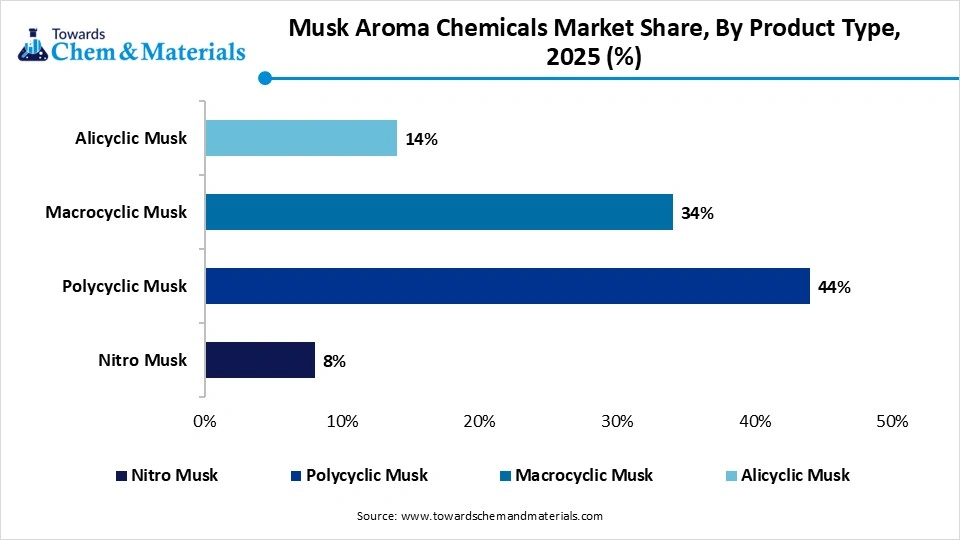
The macrocyclic musk segment held the market share of 34% in 2025 and is expected to grow at the fastest CAGR of 7.4% over the forecast period. The growth of the segment can be credited to its increasing demand for premium fragrance in fine perfumery and biodegradability, aligning with regulatory requirements. Expansion of the luxury segment boosts consumption further.
The alicyclic musk segment held the market share of 14% in 2025. The growth of the segment can be linked to the increasing demand for niche and specialty fragrances, along with the enhanced olfactory performance that supports modern formulations. Technological innovations improve product versatility.
Musk Aroma Chemicals Market Share, By Product Type, 2025 (%)
| By Product Type | Revenue Share, 2025 (%) |
| Nitro Musk | 8% |
| Polycyclic Musk | 44% |
| Macrocyclic Musk | 34% |
| Alicyclic Musk | 14% |
Source Insights
The Synthetic Musk Segment Dominated the Musk Aroma Chemicals Market with 93% of Market Share in 2025
The synthetic musk segment dominated the market with the largest share of 93% in 2025. The dominance of the segment can be driven by its consistent quality, supporting industrial usage and regulatory compliance, which improves adoption. Its scalable production further ensures cost benefits, impacting positive market growth soon.
The natural musk segment held the market share of 7% in 2025 and is expected to grow at the fastest CAGR of 8.2% over the forecast period. The growth of the segment is owing to the increasing demand for natural fragrances and the growing adoption of natural ingredients from premium and niche perfumery segments. Ethical sourcing alternatives support growth shortly.
Musk Aroma Chemicals Market Share, By Source, 2025 (%)
| By Source | Revenue Share, 2025 (%) |
| Synthetic Musk | 93% |
| Natural Musk | 7% |
Application Insights
The Personal Care & Cosmetics Segment Dominated the Market with 39% of Market Share in 2025
The personal care & cosmetics segment dominated the market with the largest share of 39% in 2025. The dominance of the segment is due to increasing consumer spending on cosmetics and the expanding beauty and grooming industry. Product differentiation through fragrance enhances its value.
The fine fragrances segment held the market share of 19% in 2025 and is expected to grow at the fastest CAGR of 6.9% during the forecast period. The growth of the segment can be attributed to the increasing disposable income in emerging economies and the ongoing premiumization trend to fuel luxury perfume demand. High-quality musk compounds improve overall scent profiles.
The household products segment held the market share of 33% in 2025. The growth of the segment can be credited to the increase in consumption of detergents and cleaners and their growing usage in the mass market. Long-lasting fragrance properties improve overall product appeal.
Musk Aroma Chemicals Market Share, By Application, 2025 (%)
| By Application | Revenue Share, 2025 (%) |
| Personal Care & Cosmetics | 39% |
| Household Products | 33% |
| Fine Fragrances | 19% |
| Industrial Fragrances | 9% |
Form Insights
The Liquid Musk Chemicals Segment Dominated the Market with 69% of Market Share in 2025
The liquid musk chemicals segment dominated the market with the largest share of 69% in 2025 and is expected to grow at the fastest CAGR of 6.0% during the study period. The dominance and growth of the segment can be linked to its high compatibility with perfumes and detergents, coupled with the easy blending with liquid formulations. Its efficient processing supports large-scale adoption.
The solid musk chemicals segment held the market share of 31% in 2025. The growth is attributed due to the increasing demand from specific industries and a rise in use in solid and powder formulations. Its stability benefits support niche applications.
Musk Aroma Chemicals Market Share, By Form, 2025 (%)
| By Form | Revenue Share, 2025 (%) |
| Liquid Musk Chemicals | 69% |
| Solid Musk Chemicals | 31% |
Distribution Channel Insights
The Direct Sales Segment Dominated the Market with 47% of Market Share in 2025
The direct sales segment dominated the market with the largest share of 47% in 2025. The dominance of the segment is owed to the large manufacturing preferring direct procurement and bulk procurement to ensure cost efficiency. Long-term contracts stabilize supply chain applications further.
The online channels segment held the market share of 18% in 2025 and is expected to grow at the fastest CAGR of 6.8% over the forecast period. The growth of the segment is due to increasing reliance on online sourcing by SME'S and its convenience and transparency. Digital procurement platforms are increasingly gaining traction across various sectors.
The distributors & traders segment held the market share of 35% in 2025. The growth of the segment can be attributed to the increasing reach across global markets and efficient logistics to enhnace availability. It supports small and medium buyers.
Musk Aroma Chemicals Market Share, By Distribution Channel, 2025 (%)
| By Distribution Channel | Revenue Share, 2025 (%) |
| Direct Sales | 47% |
| Distributors & Traders | 35% |
| Online Channels | 18% |
Regional Insights
How did Asia Pacific Dominate the Musk Aroma Chemicals Market in 2025?
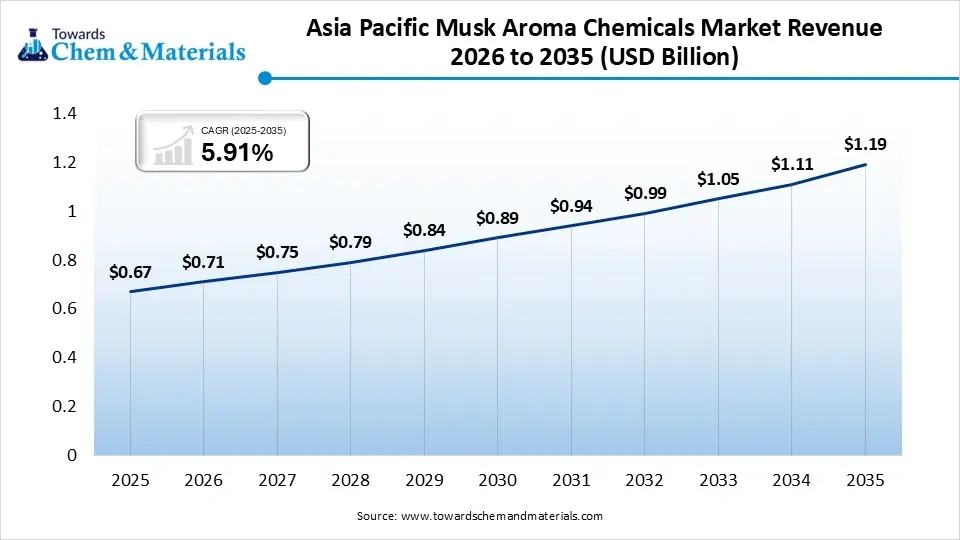
The Asia Pacific musk aroma chemicals market size was estimated at USD 0.67 billion in 2025 and is projected to reach USD 1.19 billion by 2035, growing at a CAGR of 5.91% from 2026 to 2035 .Asia Pacific dominated the market with the largest share of 33% in 2025 and is expected to grow at the fastest CAGR of 6.7% over the forecast period. The dominance and growth of the region can be attributed to the rapid urbanisation and surge in disposable incomes in emerging economies such as China and India. In addition, the rapid development of safe and synthetic musks allows consistent quality and supply for large-scale production, offsetting the limitations of natural solutions.
China Musk Aroma Chemicals Market Trends
In the Asia Pacific, China dominated the market owing to the increasing demand for long-lasting and premium fragrances along with the expanding personal care sector. Also, advancements in synthetic manufacturing offer a stable and cost-effective alternative to natural sources, ensuring a continuous supply.
Europe Musk Aroma Chemicals Market Trends
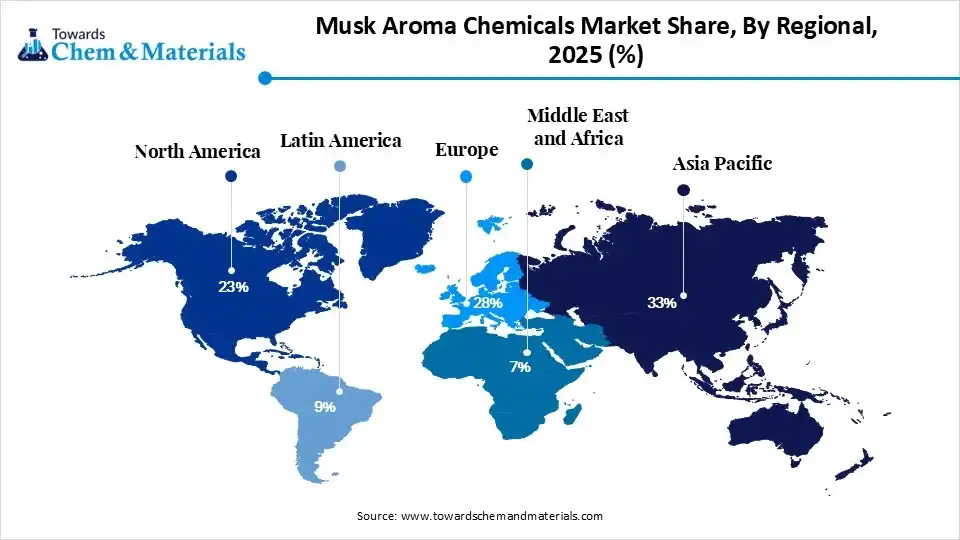
Europe held the market share of 28% in 2025. The growth of the region can be credited to the stringent regulations favouring high-quality musks, the established perfumery industry, and increasing demand for premium products. Furthermore, a surge in consumer emphasis on wellness and hygiene has increased demand for detergents, scented soaps, and household cleaners.
Germany Musk Aroma Chemicals Market Trends
The growth of the market in the country is due to a surge in consumer spending on premium, deodorants, perfumes, and cosmetic products, coupled with the increasing demand for bio-based and biodegradable musk compounds. Moreover, Germany is a hub for chemical advancements, optimizing the development of sustainable and high-performance synthetic musk.
Musk Aroma Chemicals Market Share, By Regional, 2025 (%)
| Regional | Revenue Share, 2025 (%) |
| North America | 23% |
| Europe | 28% |
| Asia-Pacific | 33% |
| Latin America | 9% |
| Middle East & Africa | 7% |
Recent Development
- In February 2026, Balmain Beauty entered a new era with the debut of Destin de Balmain, its inaugural prestige fragrance. The fashion house characterizes this scent as a youthful interpretation of its traditional Parisian heritage. Furthermore, the launch marks a strategic transition toward sustainable product design, incorporating refined formulations and refillable packaging.(Source: the-ethos.co)
Musk Aroma Chemicals Market Companies
- Givaudan: Givaudan is the global leader in the fragrance and beauty industry, holding a significant market share in the overall industry and acting as a dominant player in the musk aroma chemicals market. They offer a wide portfolio of synthetic and sustainable musks.
- dsm-Firmenich:dsm-firmenich is a global leader in the musk aroma chemicals market, often recognized as the "House of Musk" due to its extensive portfolio, including iconic macrocyclic musks like Habanolide®. They focus on sustainable, high-performance ingredients.
Other Companies in the Market
- Symrise (Germany)
- International Flavors & Fragrances (IFF) (USA)
- MANE SA (France)
- Takasago International Corporation (Japan)
- PFW Aroma Chemicals B.V. (Netherlands)
- LANXESS (Germany)
- Alfa Chemistry (USA)
- SODA AROMATIC Co., Ltd. (Japan)
- The Good Scents Company (USA)
- Sigma-Aldrich Co. LLC (USA)
- Bell Flavors & Fragrances (USA)
- Robertet (France)
Segments Covered in the Report
By Product Type
- Nitro Musk
- Musk Xylene
- Musk Ketone
- Polycyclic Musk
- Galaxolide (HHCB)
- Tonalide (AHTN)
- Celestolide
- Traseolide
- Macrocyclic Musk
- Muscone
- Exaltolide
- Ambrettolide
- Civetone (Synthetic)
- Alicyclic Musk
- Helvetolide
- Romandolide
- Sylkolide
By Source
- Synthetic Musk
- Natural Musk
- Animal-Derived Musk
- Plant-Based Musk
By Application
- Personal Care & Cosmetics
- Perfumes
- Deodorants
- Skin Care Products
- Hair Care Products
- Household Products
- Laundry Detergents
- Fabric Softeners
- Air Fresheners
- Surface Cleaners
- Fine Fragrances
- Luxury Perfumes
- Niche Fragrances
- Industrial Fragrances
- Institutional Cleaning
- Odor Masking Agents
By Form
- Liquid Musk Chemicals
- Solid Musk Chemicals
- Powder Form
- Granular Form
By Distribution Channel
- Direct Sales
- Distributors & Traders
- Online Channels
By Regions
- North America
- U.S.
- Canada
- Mexico
- Europe
- Germany
- UK
- France
- Italy
- Spain
- Asia Pacific
- China
- India
- Japan
- South Korea
- Latin America
- Brazil
- Argentina
- Middle East & Africa
- Saudi Arabia
- South Africa
FAQ's
Question 1 : What is the projected market size for musk aroma chemicals by 2035?
Answer : The market is expected to reach approximately USD 3.27 billion by 2035. This growth is supported by a 5.85% annual growth rate starting from 2026.
Question 2 : Why is synthetic musk more popular than natural musk?
Answer : Synthetic musk is the industry standard because it is affordable, consistent in quality, and ethically sound. Natural musk is rare and restricted by wildlife protection laws, as it was traditionally sourced from animals.
Question 3 : Which industry uses the most musk aroma chemicals?
Answer : The Personal Care & Cosmetics sector is the largest user, holding a 39% market share. It’s followed by household products like laundry detergents and fine fragrances (luxury perfumes).
Question 4 : Is the musk market moving toward sustainable options?
Answer : Yes, there is a major shift toward bio-based musk alternatives. Manufacturers are investing heavily in R&D to create scents from plant-derived precursors and eco-friendly chemical processes.
Question 5 : Which country is the biggest player in the Asia Pacific market?
Answer : China is the dominant force in the region. Its massive personal care sector and advancements in synthetic manufacturing make it a global hub for musk production and consumption.
Meet the Team

Saurabh Bidwai
Principal Consultant
Saurabh Bidwai, a B.Tech Chemical Engineering graduate with 4+ years of experience, specializes in specialty chemicals, commodity chemicals, and engineered materials, offering valuable insights into market trends and emerging opportunities.

Aditi Shivarkar
Reviewed By
Aditi Shivarkar, with 14+ years in Chemical and Materials market research, specializes in Chemical and Materials. She ensures accurate, actionable insights, driving Towards Chemicals And Materials Analytics and Consulting excellence in industry trends and sustainability.